Author: azeeadmin

01 Mar 2019

Verified Expert Lawyer: Sam Angus

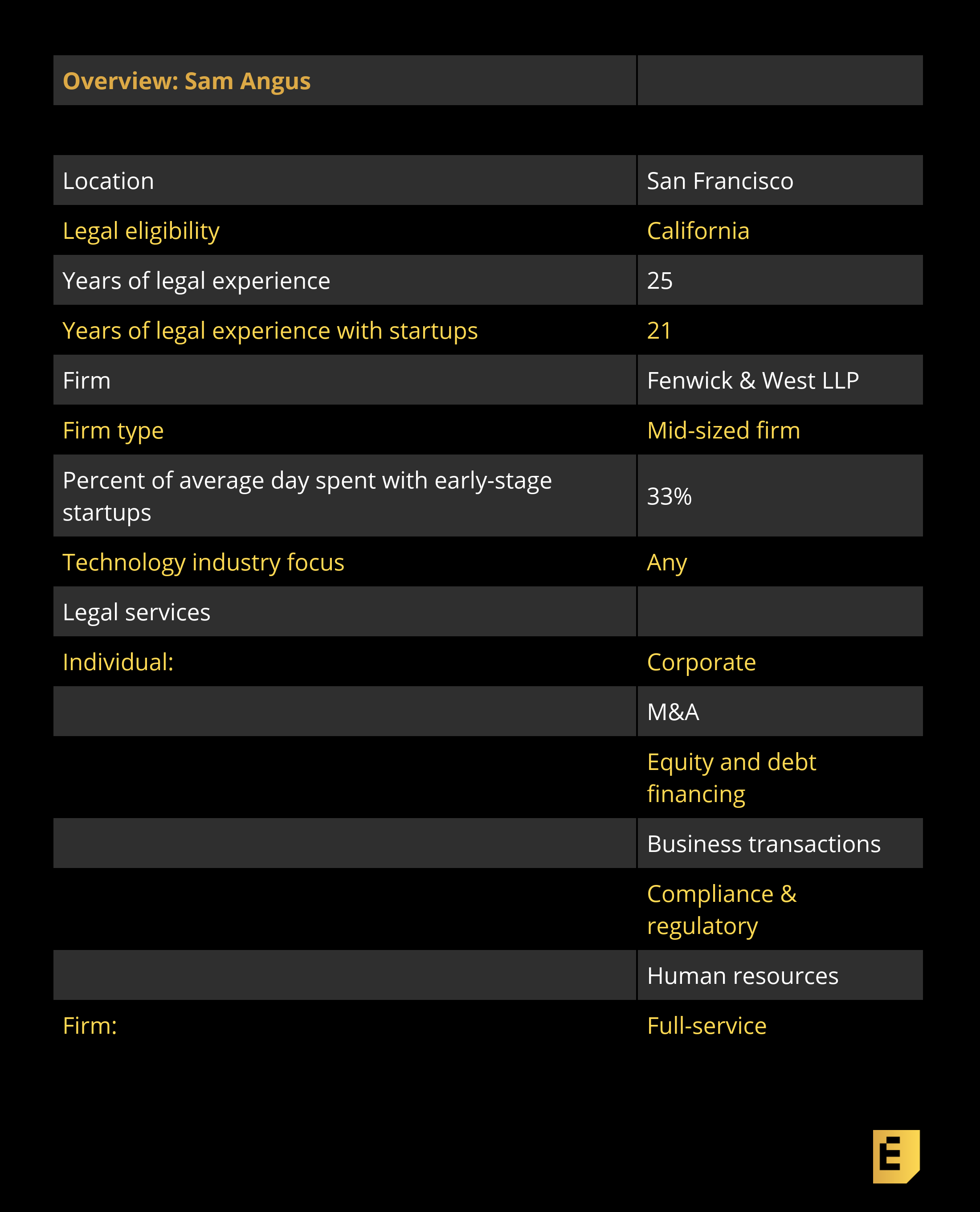
Sam Angus has been a lawyer in Silicon Valley since the 1990s. Today, he represents some of the biggest names in the startup world, from their earliest days through acquisitions and IPOs, and including four acquisitions last year: TSheets, GitHub, Glint and HelloSign.

But his startup experience actually goes back to the 1980s, when he and some friends built a booming calendar publishing business out of their dorm room during college. In the interview below, he tells us about the ups and downs of the tech industry over the decades, how he helps clients through the good times and bad, and how he works within Fenwick & West, one of the leading tech law firms in tech. We also discuss long-term trends, like the shift towards founder-friendly terms in this era versus past decades in the Valley.


On early-stage problems:

“I’ve represented hundreds of early-stage companies. It is not uncommon for companies to have some existing legal issue that needs to be addressed, such as capitalization, documentation and/or employee/IP issues. It is unfortunate, but these issues will frequently — especially with early stage companies — lie dormant and be discovered when the company is contemplating its first financing or a significant transaction, and can take investors or buyers by surprise.

“A common mistake is for a company to think that a given issue will not be a concern to an investor or buyers. In my experience, issues that arise on the eve of a financing or other transaction can create risk in the transaction and can be expensive to address quickly. For example, one client I worked with had been operating for years with virtually no documentation and not surprisingly had significant deficiencies in terms of corporate approvals. Very few things are fatal, but the result for this client was a bumpy and more expensive financing process — which required several rounds of explanation to the investors and their counsel.”

On being a startup lawyer:

“What I’ve learned is that the best lawyers for startups bring more than competent legal advice to the relationship – they act like business owners themselves, thinking strategically about the business. The best lawyers have significant experience and a knack for pattern recognition, the combination of which helps identify issues and opportunities in advance of when they become apparent.”

On risk-taking:

“There are some legal risks that early-stage companies will need to take. In my view, my role with earlier stage clients is to position them for success by being practical and focusing them on the issues that are material for a company at their stage of development. Overall, I want to empower clients to push the bounds of what they think is possible, while making wise business and legal decisions that won’t handicap them in the future.

“I would also point out that being able to scale with clients is extremely important. As clients grow, my role evolves to fit their needs – what works for a startup company is different from what a unicorn/growth company will need from their lawyer. With early-stage companies I tend to be more closely involved with the founders and the company’s business, while with later stage companies the relationship becomes more strategic and we tend to support internal legal teams and boards of directors.
Below, you’ll find the rest of the founder reviews, the full interview, and more details like their pricing and fee structures.

This article is part of our ongoing series covering the early-stage startup lawyers who founders love to work with, based on this survey (which we’re keeping open for more recommendations) and our own research. If you’re a founder trying to navigate the early-stage legal landmines, be sure to check out our growing set of in-depth articles, like this checklist of what you need to get done on the corporate side in your first years as a company.


The Interview

Eric Eldon: To begin with, tell me about Fenwick & West. It’s one of the original law firms that started in Silicon Valley and focused on tech companies, and you’ve been there for years through the various cycles.

Sam Angus: Launching my career in Silicon Valley has provided me with a unique skillset and perspective that now enables me to thoughtfully advise clients who want to scale quickly, no matter where they are located. Working with fast-growing innovators, like those I’ve served since the tech boom of the 1990s, is in my view different from traditional approaches to practicing law. Providing clients with excellent legal advice is table stakes for any advisor to startups. What I’ve learned is that the best lawyers for startups bring more than competent legal advice to the relationship — they act like business owners themselves, thinking strategically about the business. The best lawyers have significant experience and a knack for pattern recognition, the combination of which helps identify issues and opportunities in advance of when they become apparent. Great startup lawyers also have extensive networks of investors, founders and partners and can leverage these networks to help their clients, address material operational issues, fundraise or complete a strategic transaction. They are efficient/cost-effective and move as quickly as their clients, and, most importantly, provide judgment. This entire skill-set is rare for lawyers, but when it comes in one package it is incredibly valuable to emerging companies. That’s one of the reasons why I love working at Fenwick: this approach to advising startups is simply how we practice.

Eldon: The legal industry is seeing real competition from online services and automation — how are you competing?

Angus: It is true that automation is impacting the practice of law, like other sectors of the economy. Because Fenwick works closely with innovative companies across the globe and sees how technology is changing things, we are among the firms leading the way to embrace this change.

For example, Fenwick has an in-house data and technology innovation team. Our innovation team has developed various automation tools and software products to augment and enhance the services we provide our clients. These include automated forms, client portals where clients can access all the data about their companies (i.e. key corporate documents, cap table, contact information for their Fenwick team, etc.), and use of tools such as Kira, an AI platform that automates aspects of document review in M&A deals, allowing us to close deals at a rapid pace while helping control costs.

Another innovation is our budgeting capability. Fenwick’s budgeting team provides our clients with timely and accurate cost estimates for projects and transactions, such as M&A or IPOs. Leveraging our proprietary deal data about hundreds of similar transactions, we are able to more accurately predict legal costs for our clients.

Eldon: Let’s go back to how you got into working with technology companies and startups.

Angus: In the early 1980s, after a short stint playing professional tennis, I was recruited to play tennis at UC Santa Barbara on a tennis scholarship. While at UCSB, I entered the entrepreneur world, starting UCSB’s first entrepreneur club with two friends in 1984. We also launched our own business, a publishing company that produced and distributed wall calendars.

Our growth was rapid: In our first year we did one calendar title, the next year we expanded to five calendar titles, the year after that 25 calendar titles, the year after that 75 titles, as well as a number of posters and other printed products. As our business grew, we started licensing popular culture content, which was something the calendar industry hadn’t really seen before. We were the first to produce the Michael Jackson calendar and the first Madonna calendar.

Eldon: You did all of this while you were in college?

Angus: Yes, though I ended up taking a break from college in 1987, one quarter shy of completing my degree, to pursue the business full time. By 1989, the company had grown to about 150 US salespeople, ten international distributors, and was doing roughly $50 million annually in gross revenue.

In the end, I ended up selling my interest in the company to the lead investor following resolution of various claims with the investor. Through that experience, I learned firsthand what it’s like to be a founder who had bootstrapped and had scaled the company with complex supply chain … and navigated investor issues.

01 Mar 2019

SpaceX’s Crew Dragon makes its first orbital launch tonight

After years of development and delays, SpaceX’s Crew Dragon is ready to launch into orbit. It’s the first commercially built and operated crewed spacecraft ever to do so, and represents in many ways the public-private partnership that could define the future of spaceflight.

Launch is set for just before midnight Pacific time — 2:49 Eastern time in Cape Canaveral, where the Falcon 9 carrying the Crew Dragon capsule will take off from. It’s using Launchpad 39A at Kennedy Space Center, which previously hosted Apollo missions and more recently SpaceX’s momentous Falcon Heavy launch. Feel free to relive that moment with us, while you’re here:

The capsule has been the work of many years and billions of dollars: an adaptation of the company’s Dragon capsule, but with much of its cargo space converted to a spacious crew compartment. It can seat seven if necessary but given the actual needs of the International Space Station, it is more likely to carry 2 or 3 people and a load of supplies.

Of course it had to meet extremely stringent safety requirements, with an emergency escape system, redundant thrusters and parachutes, newly designed spacesuits, more intuitive and modern control methods, and so on.

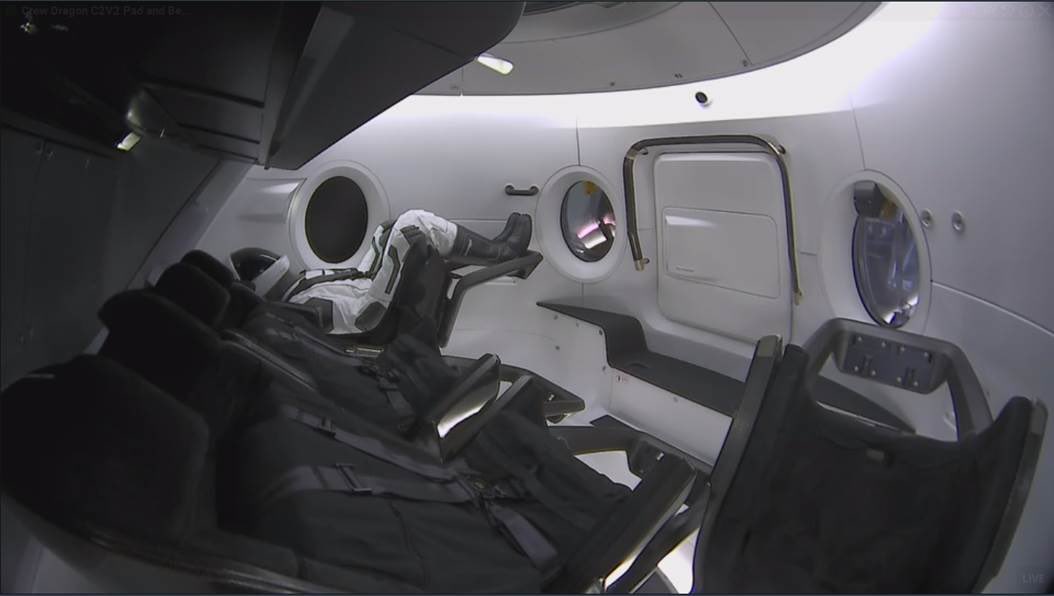
Crew Dragon interior, with “Ripley.”

It’s a huge technological jump over the Russian Soyuz capsule that has been the only method to get humans to space for the last 8 years, since the Shuttle program was grounded for good. But one thing Dragon doesn’t have is the Soyuz’s exemplary flight record. The latter may look like an aircraft cockpit shrunk down to induce claustrophobia, but it has proven itself over and over for decades. The shock produced by a recent aborted launch and the quickness with which the Soyuz resumed service are testament to the confidence it has engendered in its users.

But for a number of reasons the U.S. can’t stay beholden to Russia for access to space, and at any rate the commercial spaceflight companies were going to send people up there anyway. So NASA dedicated a major portion of its budget to funding a new crew capsule, pitting SpaceX and Boeing against one another.

SpaceX has had the best of Boeing for the most part, progressing through numerous tests and milestones, not exactly quickly but with fewer delays than its competitor. Test flights originally scheduled for 2016 are only just now beginning to take place. Boeing’s Starliner doesn’t have a launch date yet but it’s expected to be this summer.

Tonight’s test (“Demo-1”) is the first time the Crew Dragon will fly to space; suborbital flights and landing tests have already taken place, but this is a dry run of the real thing. Well, not completely dry: the capsule is carrying 400 pounds of supplies to the station and will return with some science experiments on board.

After launch, it should take about 11 minutes for the capsule to detach from the first and second stages of the Falcon 9 rocket. It docks about 27 hours later, early Sunday morning, and the crew will be able to get at the goodies just in time for brunch, if for some reason they’re operating on East Coast time.

SpaceX will be live streaming the launch as usual starting shortly before takeoff; you can watch it right here:

01 Mar 2019

Lyft lays out financial risks associated with reclassifying drivers

In Lyft’s S-1 this morning, the company laid out the potential consequences for converting its drivers from independent contractors to W-2 employees. This, of course, has been an ongoing conversation within the gig economy.

Those who work as 1099 contractors can set their own schedules, and decide when, where and how much they want to work. For employers, bringing on 1099 contractors means they can avoid paying taxes, overtime pay, benefits and workers’ compensation.

As Lyft notes in the S-1, this conversation has resulted in a number of lawsuits, arbitration proceedings, government investigations and more.

“The tests governing whether a driver is an independent contractor or an employee vary by governing law and are typically highly fact sensitive,” Lyft states in its S-1. “Laws and regulations that govern the status and misclassification of independent contractors are subject to changes and divergent interpretations by various authorities which can create uncertainty and unpredictability for us. We continue to maintain that drivers on our platform are independent contractors in such legal and administrative proceedings, but our arguments may ultimately be unsuccessful.”

In the event Lyft is forced to reclassify its drivers, that could result in a number of new financial burdens for the company. That includes:

  • Expense reimbursement
  • A potential injunction prohibiting Lyft from continuing its current business practices
  • Claims for employee benefits, social security, workers’ compensation and unemployment
  • Monetary exposure relating to failure to withhold and remit taxes, unpaid wages, and wage and hour law requirements

Lyft goes on to note that reclassifying its drivers as W-2 workers “may require us to significantly alter our existing business models and operations.” And this is one of those risks that could very easily happen.

As Lyft points out, it’s actively involved in six class-action lawsuits pertaining to driver classification. And the company has already settled a couple of lawsuits to the sum of $27 million in 2013, and $1.95 million in 2018. Meanwhile, California is actively examining this issue in Assembly Bill 5, which would improve protections and rights for gig economy workers. That bill was introduced in light of a groundbreaking state Supreme Court decision in April.

01 Mar 2019

Tristan O’Tierney, who helped develop Square’s original payment app, has passed away

Tristan O’Tierney, a cofounder of the payments company Stripe has passed away at age 35. According to the San Francisco Chronicle, O’Tierney died last weekend in Florida or addiction-related causes after a hospital was unable to revive him.

In the Chron’s piece, it reports that Square cofounders Jack Dorsey and Jim McKelvey hired O’Tierney to develop Square’s original mobile payment app in early 2009, and that O’Tierney is generally credited as a co-founder.

He left the company in 2013, either years after coming to the Bay Area, where he also worked as a software engineer at Yahoo for nearly two years and worked briefly at Apple, VMware, and Tapulous.

In recent years, O’Tierney had been working as a freelance photographer in Los Angeles, according to his LinkedIn profile. (You can check out some of his work here.)

He was also the director of mobile at a short-lived San Francisco-based company that Voteraide that aimed to empower voters by enabling them to interact with candidates and elected officials as verified voters.

O’Tierney was reportedly in Florida as part of a months-long rehabilitation program.

Dom Sagolla, a former colleague and roommate of O’Tierney, tells the Chron it was he who introduced O’Tierney to Dorsey 11 years ago. He says O’Tierney had helped to develop the official iPhone app for Barack Obama’s 2008 presidential campaign and that O’Tierney and Dorsey met at an iPhone-app development event that he organized. “I will really miss him and want his memory and legacy to last,” said Sagolla.

O’Tierney clearly had varied interests. Though he studied computer science at the Rochester Institute of Technology, he also later obtained a Master of Fine Arts degree from the San Francisco Art Institute. On Instagram, his descriptor reads: “Square co-founder turned traveling photographer. Searching for the meaning of life and got lost along the way.”

Pictured above: a landscape photo of Death Valley by O’Tierney.

01 Mar 2019

Daily Crunch: Tesla is closing retail stores

The Daily Crunch is TechCrunch’s roundup of our biggest and most important stories. If you’d like to get this delivered to your inbox every day at around 9am Pacific, you can subscribe here.

1. Tesla closing retail stores in shift to online-only sales strategy

Tesla is moving all its sales online, a dramatic shift in its sales strategy that will result in the closure of stores and some layoffs as the automaker looks for ways to reduce costs in order to bring a cheaper Model 3 to market.

CEO Elon Musk noted that some stores would remain and turn into information centers and showrooms. The company didn’t say how many stores or employees would be affected.

2. Twitter confirms it’s working on a ‘Hide Tweet’ feature

Like it sounds, “Hide Tweet” functions as an alternative to muting or blocking a user, while still offering some control over a conversation. At the same time, an option to “View Hidden Tweets” was also found to be in the works.

3. Revolut CFO resigns following money laundering controversy

The startup and CFO Peter O’Higgins have been under pressure after a Daily Telegraph report revealed that Revolut switched off an anti-money laundering system that flags suspect transactions because it was prone to throwing out false positives.

4. Samsung Galaxy S10+ review

The 10th anniversary Galaxy arrives at a transitional time for Samsung — and the industry at large.

5. Amazon stops selling stick-on Dash buttons

Amazon has confirmed it has retired physical stick-on Dash buttons from sale, in favor of virtual alternatives that let Prime Members tap a digital button to reorder a staple product.

6. TiVo prepares to split its business into two as it pursues sale

DVR maker TiVo is preparing to split its company into two businesses: one focused on its products like its Bolt family of DVRs, and the other on its licensing and intellectual property businesses.

7. It’s a new era for fertility tech

Although the investment numbers are still relatively small (compared to, say, scooters), the trend is up. Kate Clark rounds up the latest from founders and investors in the space. (Extra Crunch subscription required.)

01 Mar 2019

Lyft will give drivers a one-time cash bonus up to $10K

Hardworking drivers, rejoice! As part of Lyft’s initial public offering, the transportation company is deciding to reward the drivers who form the backbone of the company’s core service. The program will give a maximum cash bonus of $10,000 to drivers “in good standing” who have completed at least 20,000 rides as of Feb. 25, 2019.

On the lower end, Lyft will give drivers who have completed at least 10,000 rides as of Feb. 25, 2019 a $1,000 one-time cash bonus. Additionally, Lyft will reward a $1,000 cash bonus to drivers who are currently serving or previously served on the company’s Driver Advisory Council. All of these drivers must be in good standing.

Eligible drivers can expect to be paid on or about March 19, 2019. They can then purchase shares in Lyft’s directed share program or just pocket the cash. It’s up to them.

Uber is also reportedly expected to offer drivers a similar bonus, but the company declined to comment.

01 Mar 2019

‘Momo’ videos on YouTube cannot be monetized…but that’s not a new policy

Be warned, YouTube creators: making videos about the latest viral hoax, the “Momo challenge,” will not make you money. Over the past couple of days, the Momo challenge has gone viral once again, leading to a sharp increase news coverage and the number of YouTube videos discussing the topic of the creepy character and the supposed “challenge” that encourages kids to commit acts of self-harm.

The Momo challenge itself isn’t real, to be clear.

As meticulously documented by Taylor Lorenz at The Atlantic, it’s just the latest resurgence of an urban myth that has reared its head repeatedly over the years.  In reality, “Momo” was a sculpture created by the artist Keisuke Aisawa. Photographs of its frightening form made their way to Instagram and Reddit after being exhibited in Tokyo a couple of years ago. Thus, an urban legend was born, Lorenz explained.

According to one version of the myth, Momo sends kids instructions to harm themselves on WhatsApp. But urban legends take on many variations over time.

For example, my child’s entire 3rd grade class currently believes that Momo will randomly appear in YouTube videos and then come out of your sink drain. (This, also, is not true!)

Over the past few days, a social media post from Kim Kardashian and a lot of irresponsible reporting by local news outlets amplified the hoax, warning parents and schools of the dangerous “self harm” challenge. That, in turn, led to more “Momo” videos on YouTube, and a flood of posts across all other social media sites.

The Verge reported this morning that YouTube had begun demonetizing Momo videos on YouTube.

However, a spokesperson at YouTube clarified to TechCrunch that it wasn’t taking action against Momo videos as some sort of new policy or decision on the company’s part. It was simply enforcing its current policies.

The company’s existing advertiser-friendly guidelines, which govern the kinds of videos it shows ads on, do not allow any videos that discuss a harmful or dangerous act to be monetized. That includes any videos from news outlets referencing the Momo challenge, or those from other YouTube creators. This is the same policy that prevented prior YouTube videos about other dangerous challenges and hoaxes from showing advertising, they also noted. For example, any video about the Tide Pods challenge or the choking challenge could not show ads.

Demonetizing videos, to be clear, is not the same thing as disallowing the videos from showing on YouTube. The site today permits news stories and videos that are intended to raise awareness of and educate against the challenge, the spokesperson explained – like those from news outlets.

However, content that promotes the Momo challenge that is not news, educational, or documentary footage is prohibited on the site.

YouTube additionally reaffirmed that the company hadn’t seen any evidence of Momo videos on its platform until widespread media coverage began. And it had not received any links flagged or otherwise shared with the company about videos that either showed or promoted the Momo challenge directly.

“Contrary to press reports, we’ve not received any recent evidence of videos showing or promoting the Momo challenge on YouTube. Content of this kind would be in violation of our policies and removed immediately,” YouTube said, in a statement.

In addition, no Momo videos should be discoverable on YouTube’s kid-friendly app, YouTube Kids, the spokesperson said. And no such content has ever been found in the YouTube Kids app, to date.

Though YouTube hasn’t implemented a new policy here, simply having its name in the press around unsafe, scary content targeting children comes at a bad time for the company, which only yesterday turned off comments on videos of children after reports of a pedophile ring operating within the comments sections of videos. And it’s the latest in a longer string of controversies around advertiser-unfriendly content and false information which has led to other changes around its policies, including, most recently, the demonetization of anti-vaccination videos.

But in the case of Momo, YouTube isn’t the only platform afflicted by the hoax – the topic is being discussed across social media sites, including Facebook, Instagram, and Twitter.

01 Mar 2019

Lyft unveils its S-1 and nearly $1B in 2018 losses

The day has finally come. U.S. ridehailing giant Lyft has unveiled its S-1, the official document required by the Securities and Exchange Commission to go public.

The San Francisco-headquartered business will debut on the Nasdaq stock exchange under the ticker symbol “LYFT.”  JPMorgan Chase & Co., Credit Suisse Group AG and Jefferies Financial Group Inc. will lead the initial public offering expected to value Lyft at upwards of $20 billion, a significant leap from its most recent private valuation of $15.1 billion.

The company hasn’t determined how many shares it will sell or a price range. The filing currently lists an offering size of $100M, though that is typically a placeholder amount.

According to the filing, Lyft recorded $2.2 billion in revenue in 2018, more than double the $1 billion recorded in 2017. Meanwhile losses have been growing considerably. The company posted a net loss of $911 million on $2.2 billion in revenue and a $688 million loss on 2017 revenue.

Lyft’s key stakeholders include Rakuten, a Japenese ecommerce giant, which boasts a 13 percent pre-IPO stake, General Motors (7.76 percent), Fidelity (7.1 percent), Andreessen Horowitz (6.25 percent) and Alphabet (5.3 percent).

Founded in 2007, Lyft has raised $5.1 billion in venture capital funding to date.

This is an updating story.
01 Mar 2019

The best of MWC 2019

After years of promises, 5G finally arrived at MWC 2019 — kind of, sort of. Barcelona served as the launching pad for several 5G handsets, set to arrive later this year. Though your actual 5G mileage may vary.

Foldable displays, another long-promised smartphone tech, also had its moment in the sun. Several companies debuted foldable — some were actual handsets with actual price tags, while others fell firmly within the concept camp. And pretty much all of them were behind glass.

Other notable trends for the event included cameras, AR/VR and security of all sorts. Here are the highlights and lowlights from the world’s biggest mobile show. All in all, we’re here for the weirdness.


5G Comes of Age

It’s been an MWC talking point for years now, but at this week’s show, the first 5G handsets finally arrived.

Huawei Mate X
LG V50 ThinQ 5G
Samsung Galaxy Fold
Samsung Galaxy S10
Xiaomi Mi Mix 3
ZTE Axon 10 Pro 5G

OnePlus, which promised last year that it would be among the first to hop on the 5G train didn’t have a handset to announce, but it did demo a prototype and announce an initiative for 5G app devs.

Unfolding the future 

Time to unfold the checkbook. The first foldables are here, carrying an average price of ~$2,000. That’s like two phones for the price of, well, two phones. Whether or not the phones will be worth it, however, is another question entirely.

Huawei Mate X
Samsung Galaxy Fold

TCL showed off a prototype at the show, promising to deliver a more affordable take on the space at some point next year. Oppo, too, is still very much in the prototype phase.

AR/VR/MR

The biggest hit of the world’s biggest phone show may not have been a phone at all. Microsoft used the event to launch the second generation of its HoloLens, a headset firmly focused on business.

Microsoft HoloLens 2
Microsoft Azure Kinect
Vive Focus Plus
Qualcomm XR chips

Security

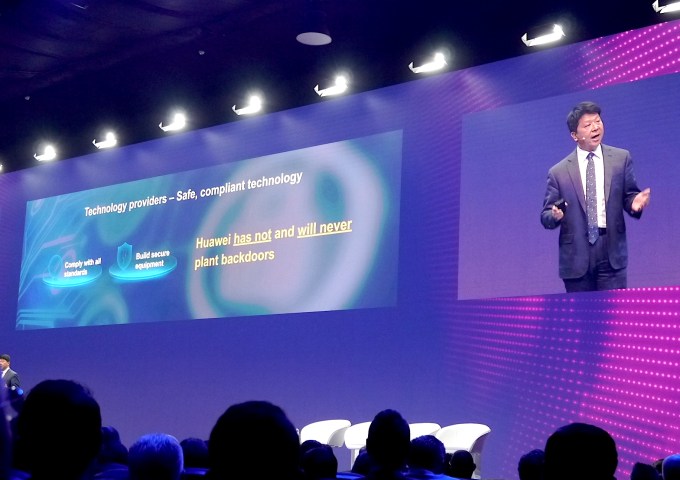
Huawei had a lot to say about accusations of security threats around its 5G equipment. Ditto for the European Commission’s digital commissioner. Android, meanwhile, will be getting more password-less logins.

Misc

Energizer’s 18,000 mAh phone
Light is expanding from smartphone cameras to self-driving cars
HTC’s blockchain phone can now be purchased with fiat currency
Sprint to launch 5G service in 4 cities in May
Facebook expands its internet infrastructure projects
New microSD format promises insane transfer speeds, better battery life
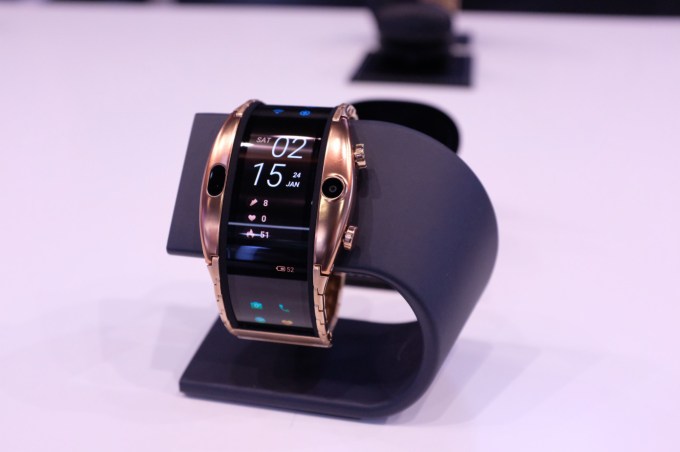
Nubia’s ‘wearable smartphone’ might be the next step for flexible displays

01 Mar 2019

Help TechCrunch find the best startup brand designers

A strong brand is a key part of building a successful company, and that doesn’t just mean coming up with a logo or corporate slogan. It can include brand identity and narrative, and various strategies that help your company come alive in the eyes of your customers, including product user interfaces and experiences (and yes, logos and slogans).

It’s “the set of expectations, memories, stories and relationships that, taken together, account for a consumer’s decision to choose one product or service over another,” in the words of marketing guru Seth Godin.

But naturally, if you’re an early-stage company, you are doing a million other things and you may have trouble focusing on branding and thinking through all of the options — and also finding the people who can make the concept come to life.

So today, TechCrunch is beginning a new survey to help us identify and feature the best brand designers who work with startups.

If you’ve worked with a great person or agency, tell us more in this two-minute survey about how they helped design your company’s brand identity and/or narrative.

We’ll showcase the top brand designers in profile articles and within a new database product we’ll be offering (including your recommendations).

This is the next category of our Verified Experts product, which we kicked off last month as part of our new Extra Crunch membership service. The first service provider category we launched, on great early-stage startup lawyers, has already brought in more than 1,750 recommendations — so we’re excited to see what TechCrunch readers have to share on branding.

Here’s a bit more about why we’re focused on brand design now.

First, it’s basically a black box for many founders, especially if your background is in technology or non-consumer businesses. And similar to attorneys, finding a brand designer as an early-stage entrepreneur can be a convoluted and time-consuming process, with most founders relying on word-of-mouth recommendations.

On the other side, not every designer thrives in chaotic, fast-paced startup environments (especially ones with tight budgets). While there are millions of people who call themselves designers out there, the pool of brand designers that has experienced working with startups is small and difficult to find.

There are also few resources that speak to a startup’s design needs. Should founders hire a design agency or an independent designer? Should you hire a contract or an in-house designer? What are the market rates for brand design services? How does pricing work? There aren’t obvious or standardized answers to these questions. So in addition to coverage of great brand designers, we’ll be producing a series of guides about branding, along with guest posts from top professionals to help provide a new level of answers for startup founders.

Do you know a brilliant designer or agency that helped your company communicate its brand identity and/or brand narrative to customers? Tell us more by filling out this two-minute survey.

Any thoughts or questions? Email us at ec_editors@techcrunch.com.