Author: azeeadmin

25 Feb 2019

SME lender Validus Capital raises $15M for expansion in Southeast Asia

SME lending was a hot topic in Southeast Asia last year, and companies continue to attract investor dollars in 2019. The latest to pull in capital of its own is Singapore-based Validus Capital, which today announced a SG$20.5 million (US$15.2 million) Series B that’ll go towards regional expansion.

Founded in 2015, Validus is focused on growth capital among SMEs with an average loan of SG$70,000 (US$52,000) in Singapore. Its P2P lending platform pairs SMEs with individual and institutional lenders and it has paid out SG$180 million (US$134 million) in loans since acquiring its license in December 2017. Validus works with an insurance firm to underwrite its loans.

The company goes after “brick and mortar SMEs, such as guard supply or service companies that do not have collateral… or companies in the construction sector where cashflow becomes a problem as they grow,” Validus co-founder and executive chairman Vikas Nahata told TechCrunch.

That approach is in contrast to others, which go over micro-loan type enterprises, such as small businesses or sole merchants using e-commerce platforms.

Nahata said Validus uses a cluster model, which includes partnerships with procurement platforms, to tap SMEs at the point that they need capital, for example, when they have landed a big contract or major order.

This new round of funding is led by Dutch development bank FMO — which is making its first direct investment in Asia through this deal — with participation from Taiwan’s Cathay Financial Holdings, Vietnam’s VinaCapital Ventures, AddVentures from Siam Cement Group in Thailand and Singapore-based VCs Openspace Ventures and (returning backer) Vertex, which is backed by sovereign fund Temasek. The company previously raised a $3 million Series A in 2017.
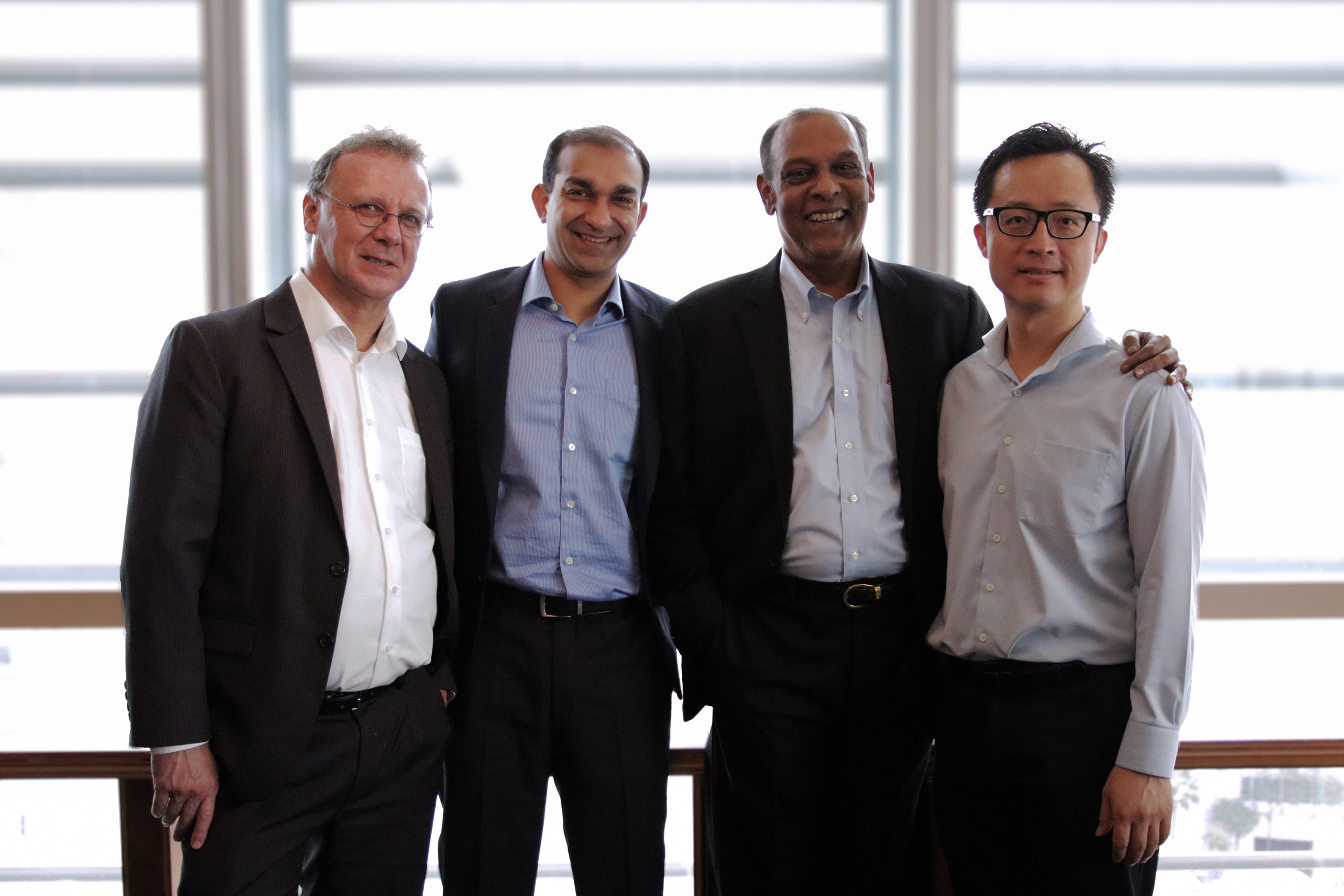
Left to right: FMO senior investment officer Arno de Vette, Validus co-founder and executive chairman Vikas Nahata, Validus co-founder and CEO Ajit Raikar, and Liu Genping, partner at Vertex Ventures

Nahata, who operates the business alongside fellow co-founder and CEO Ajit Raikar, said the goal is to expand to Indonesia by Q2 and Vietnam later this year. Already, the company has a team of nearly 20 in Indonesia’s capital Jakarta, that’s likely to double as the business kicks off once it is awarded the requisite license it is waiting on.

The capital will also go towards developing technology. That includes the Valdius credit risk algorithm, as well as APIs to help work more closely with third-party services, particularly around aggregating data.

Nahata said that, typically, Validus asks for as much data and signs of growth that applicants can provide. So that’s information such as invoices, contracts and cash flow signals. It’ll also map how companies work with large corporates as an endorsement.

In Southeast Asia, however, and particularly outside of Singapore, the reality is that credit is not a digital-only business. A retail presence, including partners with banks, offline touch points sales, are wholly necessary for growth. While he said that word of mouth is a major driver — while a 90 percent return rate is impressive — Nahata said a mixture of on- and offline is crucial.

“The last mile requires touch points but our objective is that origination should be tech-orientated,” he said.

Other SME lenders in Southeast Asia include Funding Societies, Aspire Capital, First Circle and Finaxar.

25 Feb 2019

Facebook expands its internet infrastructure projects

Like every year, Facebook is using MWC Barcelona to focus on its infrastructure projects. While you may mostly think of Facebook as a social network, the company started launching infrastructure projects for connecting bringing more people online (and onto its network) many years ago.

These projects include things like the (now-cancelled) solar-powered Aquila drone and plenty of open-source software and hardware initiatives for carriers. Indeed, there’s so many project’s that range from physical devices and networks to software that it’s sometimes hard to keep up. That wide range is by design, though.

“The one thing that has been consistent since the very beginning is that there’s no silver bullet,” Facebook director of engineering Yael Maguire told me during an interview at MWC. “We try to contribute to different parts of the ecosystem. The ecosystem could be in dense urban markets where we’re doing things like Terragraph, or rural markets where we are doing Express Wi-Fi.”

At MWC, the company announced a number of new partnerships and projects that expand on its existing projects.

Maybe the most interesting of these projects is called Internet para Todos (IpT) Peru. What Facebook is trying to show here is that it’s possible to create an economically viable provider of rural mobile infrastructure. Facebook is building this together with Telefonica, IDB Invest and CAF (Development Bank of Latin America). It’s an open access network that will be open to all carriers. “It is very economically challenging to think about connecting small communities in rural parts of Peru, let alone other parts of the world,” Maguire said. “The idea is that we can create common infrastructure that is open access, let others innovate on business models and create competition etc. The hope is that a business case can close for IpT.” Over time, Facebook hopes to bring this model to other places, too — assuming it works, which Maguire admits is not a given since this is very much an experiment at this point. If the model works, though, then the hope is that commercial vendors will see that there’s money to be made by connecting these small rural communities.

As the company also announced today, Facebook is investing in a new 750km open-access fiber project in Nigeria, for example, which will provide fiber access to more than one million people. Facebook is co-investing in this project with a number of local state authorities. The company previously worked on a similar project in Uganda and as Maguire noted, it learned quite a bit from this experience, including how to make laying fiber through large bodies of water more economically viable. But it’s not just the logistics, it’s also working with the local bureaucracy — which Maguire says is harder than the technical challenges. “There’s not a lot of new technology that we are inventing for this right now,” he said and also acknowledged that these are relatively small projects. But as the company learns, it plans to scale up these efforts and launch more projects in Africa, Latin America and Asia-Pacific.

The company is also announcing new partners for its Express Wi-Fi service, including Cell C in South Africa, Vodafone in Ghana and Globe in the Philippines. That’s on top of other partnerships in India, Nigeria, Kenya, Tanzania and Indonesia. The idea of Express Wi-Fi is to work with internet providers and mobile operators to help them build their Wi-Fi businesses and to give local entrepreneurs the tools to provide internet access to their neighbors.

As far as open source projects go, Facebook also today announced the launch of Magma, a new open-source platform that makes mobile network deployments easier for carriers. The launch partner for Magma is Telefonica, which is using it in Latin America, and BRCK, which is using it to pilot a new LTE network in Kenya.

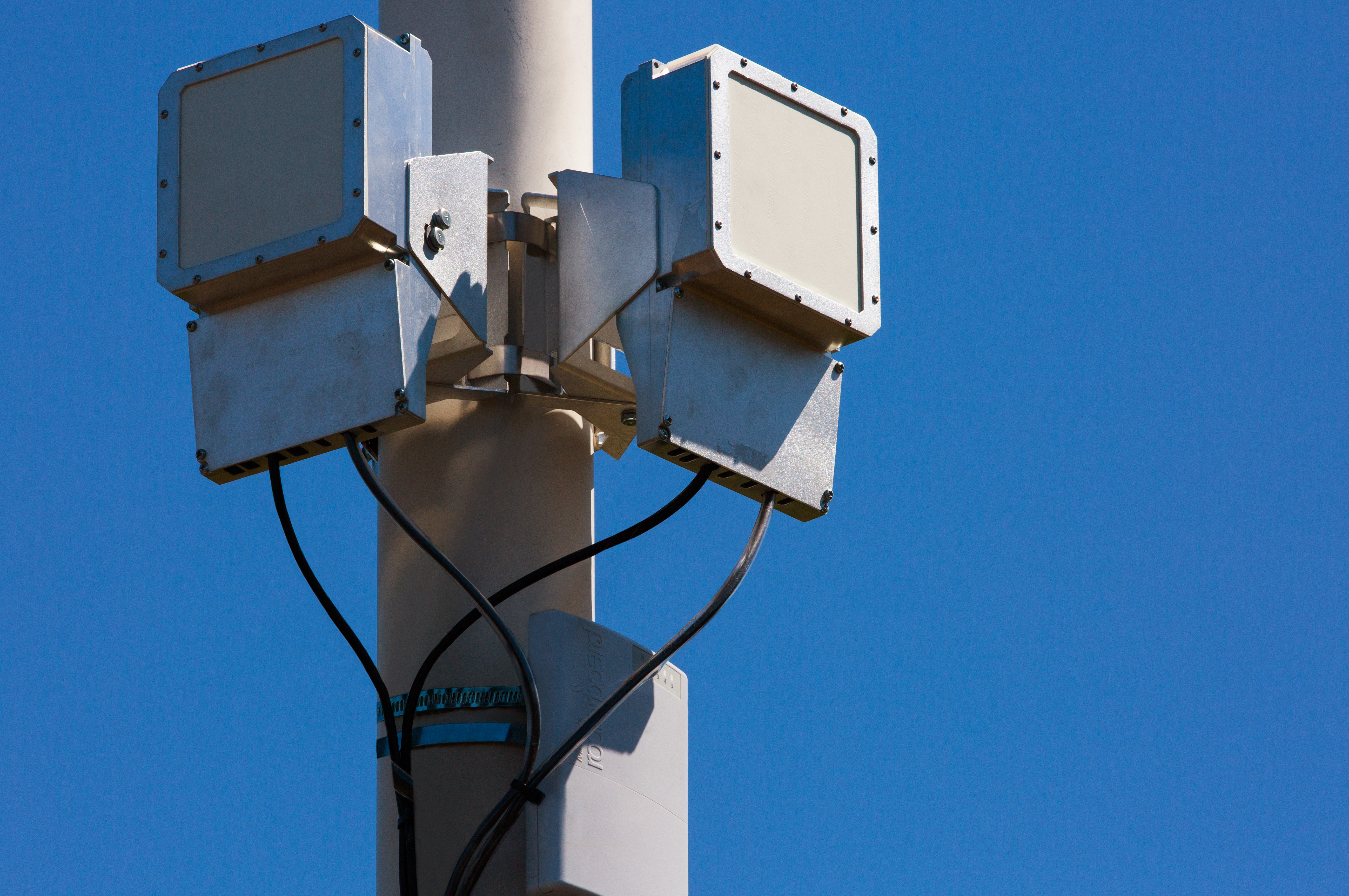
Terragraph, one of the company’s most successful open source infrastructure projects that helps bring high-speed connectivity to urban and suburban communities, is now seeing new trials in Athens, Greece and Curitiba, Brazil and it’s already in production usage in Canon, Ohio and Penang, Malaysia, as well as Alameda, California.

Those are still small-scale projects, though, even if the local impact is huge. What’s maybe more important, though, is that it’s seeing increased support from hardware vendors, which now include MikroTik and Cambium Networks, in addition to Nokia and Radwin, which previously came on board.

One thing Maguire also noted is that Facebook remains as committed to these infrastructure projects as it has ever been. “We are trying to make sure we are learning and reflecting on everything that is happening and it’s important that we understand the role we play in all of this, but it’s super important and tied to the mission of what we do,” he said.

25 Feb 2019

New microSD format promises insane transfer speeds, better battery life

Today MWC Barcelona the SD Association unveiled microSD Express that will allow future mobile devices to consume and create content at even faster speeds. This new microSD card platform boosts incredible transfer speeds while consuming less energy used by previous formats.

The new format will be available in the flavors of microSDHC Express, microSDXC Express and microSDUC Express.

Like SD Express, microSD Express taps the PCIe interface to hit a maximum data transfer rate of 985 megabytes per second (MB/s). This is possible through the PCIe 3.1 and NVMe v1.3 specifications that live on a second row of pins. The SD Association expects the faster cards to consume less energy than traditional memory cards while still being backwards compatible.

The fast data speeds could lead mobile device makers to rethink how they equip devices. Read and write speeds have long been a limiting factor for expandable memory, but with this new format, that’s backwards compatible, the data transfer happens nearly as quick as built-in memory. With 5G data and cameras pumping out huge files, expandable memory could make a comeback.

25 Feb 2019

Don’t worry, ZTE has a 5G phone, too

Another name to add to the ever-lengthening list of 5G phones hitting Barcelona this week. ZTE just announced the Axon 10 Pro 5G, which is due out in the first half of 2019 — in China and Europe, at least. The States are a different question altogether, of course. ZTE hasn’t been quite the same political flashpoint as Huawei in recent years, but the company’s been subject to its own scrutiny from U.S. authorities.

Also like Huawei, ZTE’s got the marked benefit of building its own 5G networking equipment, which puts the Chinese smartphone maker ahead of much of the competition in terms of testing. At present, it’s working with carriers ready its phone for the imminent arrival of the next gen wireless tech.

In fact, the company used the kickoff of MWC today to showcase some of its own 5G tech, including a live presentation executed alongside Qualcomm. From this morning’s release,

The demonstration over 5G NR radio utilizes a real-world end-to-end 5G NR network built with ZTE’s commercial core network and radio base station equipment, as well as a ZTE 5G smartphone powered by the world’s first commercial 5G mobile platform—the Qualcomm Snapdragon 855Mobile Platform paired with the Snapdragon X50 5G modem, as well as Qualcomm Technologies’ RF transceiver and RF front-end solutions.

The forthcoming device also sports three rear-facing cameras, a U-shaped hole punch bezel and what appears to be an in-display fingerprint reader. ZTE also launched the Blade V10 today. That handset features a 32-megapixel front-facing camera, because you can never have high enough resolution selfies.

25 Feb 2019

BMW makes interacting with you car’s AI systems more natural

Even after years of using systems like the Google Assistant or Siri, talking to inanimate objects can still feel weird. In cars, the early voice recognition systems were typically close to unusable, with a user experience that was often eclipsed by the worst of customer service phone trees. Nowadays, though, AI has made for a far better experience and now BMW now wants to take this one step further for its drivers by combining data from its voice recognition systems with better AI tools, gesture control and even gaze recognition.

This new system, dubbed BMW Natural Interaction, will launched in the 2021 BMW iNEXT electric SUV.

The company promises that this technology will allow for more intuitive interactions with the car’s systems. If you’re in a conversation, for example, you may want to use a gesture and gaze control to turn down the volume, open the sunroof or adjust air vents. But if you are driving down the autobahn at 220kmh, you may want to use your voice instead.

“People shouldn’t have to think about which operating strategy to use to get what they want,” said Christoph Grote, Senior Vice President,
BMW Group Electronics. “They should always be able to decide freely– and the car should still understand them. BMW Natural Interaction is also an important step for the future of autonomous vehicles, when interior concepts will no longer be geared solely towards the driver’s position and occupants will have more freedom.”

In many ways, this new system builds upon the work that the company introduced with the BMW OS 7.0 and the launch of the BMW Intelligent Personal Assistant in 2018. Gesture control, too, has been available in BMW cars since 2015. Combining all of these into a single system is a logical next step.

For this new system, the gaze recognition camera is now built directly into the dashboard and the overall system then uses machine learning models to evaluate what the driver is trying to do.

Some of the niftier features that BMW Natural Interaction enables are actually about what’s happening outside of the car. BMW says that you will be able to point at something outside, for example, and ask for opening hours and customer ratings. The company also promises that you’ll be able to point at a restaurant to make a reservation (though hopefully you thought about that before you drove all the way there).

The canned demo the company showed at MWC Barcelona was impressive, of course. It remains to be seen what the experience will look like in reality, though. Since a production launch isn’t imminent, it’ll be a while before we’ll be able to actually give it a try.

25 Feb 2019

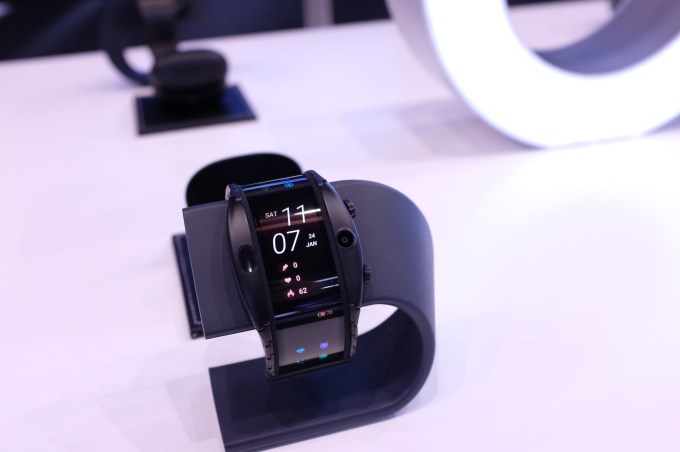
Nubia’s ‘wearable smartphone’ might be the next step for flexible displays

The version of Nubia’s “wearable smartphone” that was on display last year at IFA was an unwieldy thing. This year’s model of the Alpha, however, is certainly a step in the right direction.

It’s still bulky, so far as smartwatches go, but at very least, you could probably walk down the street in the thing, without stopping traffic.

Details are pretty scant at the moment. The Shenzhen-based smartphone maker promised more information at a press event later tonight (Barcelona time), so we’ll be dropping them in here as they arrive.

Meantime, this does feel like a logical next step for this technology, beyond the simple sandwich clamshells we’ve been at the show so far. The human body is a funny, weirdly shaped thing, so why not just wrap it up in OLEDs and be done with it?

TCL clearly had similar ideas when it was working through early concepts of its own demos, which included a phone that wraps around the wrist. Of course, that form factor is not doubt significantly more difficult to pull off than the inclosed version here. And unlike TCL’s mockups. This thing is likely actually coming to market some point soon — in China, at least.

Between this, a mini 5G phone and the recent dual screen handset, Nubia will be an interesting company to watch in the coming years.

25 Feb 2019

Behold the Samsung Galaxy Fold under glass

Samsung decided to forgo the Mobile World Congress pomp and circumstance, instead opting to through its own part last week in San Francisco. I’ve been carrying around Galaxy S10 for a few days now, so more on that soon. In this meantime, here’s the device everyone is really interested.

As promised, the Galaxy Fold was on display at the company’s booth this morning, but it was protected by security rope and thick panes of glass, like so many carbonited Han Solos. Not folding and unfolding — just static, playing videos while throngs of reporters elbowed one another, joking for a bit of space.

It’s not a production device just yet. And honestly, it’s not the kind of display that engenders a lot of faith that the product will be coming to market in just under two months. At least it’s a step ahead of where we saw it late last year.

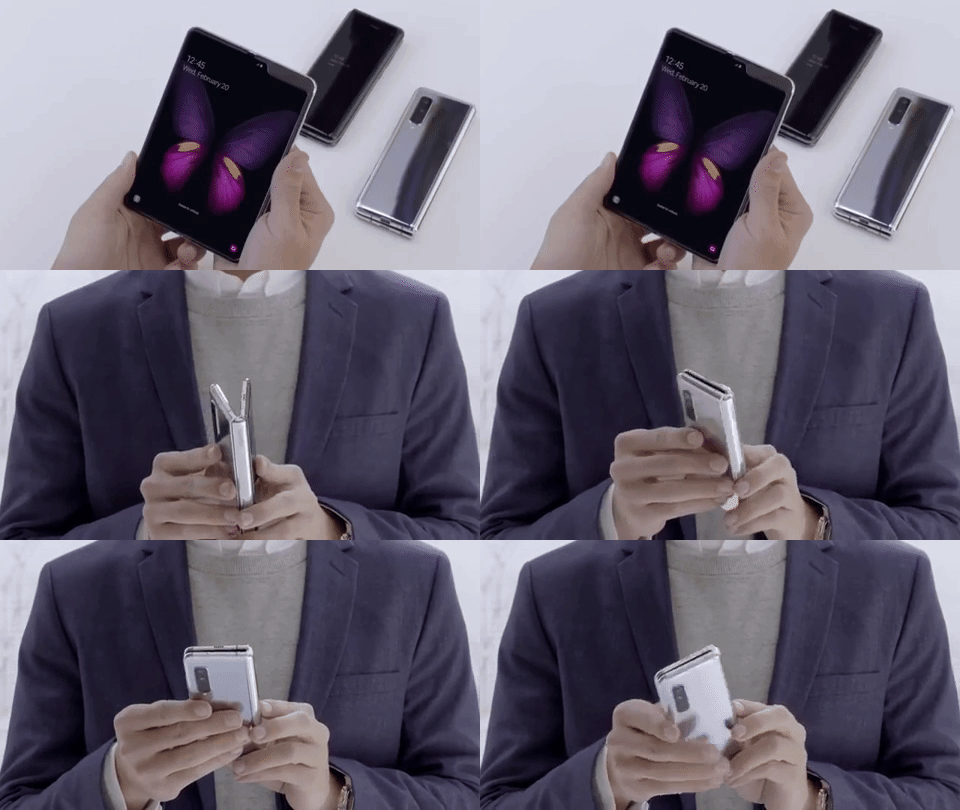
In the meantime, there’s this new video from Samsung. It’s a highly controlled “demo” of the voice, devoid of soundtrack (with some ASMRy sound effects). It shows more of the Fold than we’ve seen so far — which, granted, isn’t a particularly high bar, as far as these things go. You can, however, see folding and unfolding, the same Wireless Power Share feature you’ll find on the S10 and DeX functionality for bringing contact to an event larger screen via USB-C.

You can also catch glimpses of the App Continuity feature, which picks up your workflow where you left off, event as you switch between screens. But again, how that sort of thing plays out in person vs a video shot and edited by Samsung is a different question altogether. The positioning of the product at MWC leave one wondering whether the company has worked through all of the software kinks.

At least we we can the hardware exists in the world. We know there four of the things in the world, each of which was on display behind glass (two with the screen facing out and two with the rear). We also know that, like Huawei’s device, the fold crease is highly visible when the light catches it. How much of an impact that will ultimately have on, say, the movie viewing experience is another one of those open questions.

[gallery ids="1788265,1788270,1788277,1788286"]

But Samsung is a big company with a lot of resources, and it’s got roughly two months to make sure everything is in working order on the device. Given the $1,899 starting price, it no doubt wants to get everything right. The clock is ticking. 

25 Feb 2019

Qualcomm announces a new robotics development platform

Robotics have long been a bit of a white whale for Qualcomm. The burgeoning field is a pretty logical next step for the chipmaker, which seems to have its foot in every other aspect of electronics, these days.

We’ve seen a few robotics here and there that support the company’s chips — Anki, Sony and iRobot have all utilizes them in products to date. . Today at MWC, however, Qualcomm announced a more aggressive push into the field with the Robotics RB3 Platform.

The SDA/SDM845-based platform builds on past learnings in the fields of robotics and drones to develop a set of hardware and software tools designed specifically to develop future robots. Among the things the system-on-chip offering brings to the table are LTE connectivity (5G robots will have to wait, apparently), Qualcomm’s AI engine and sensor processing for things like mapping and navigation.

“With the Qualcomm Robotics RB3 Platform, we aim to bring our cutting-edge AI,” Qualcomm’s Dev Singh said in a release tied to the news, “edge compute and connectivity technologies into the hands of many more robotics innovators to help spur the fast development and commercialization of a new generation of useful and intelligent robots in agriculture, consumer, delivery, inspection, service, smart manufacturing/Industry 4.0, warehousing and logistics, and other applications.”

Along with Qualcomm’s own software offerings, the system is set to work with Amazon’s recently announced AWS RoboMaker and Ubuntu.

Anki, Misty and JD are among the already-announced early adopters of the platform, which is currently available as a dev kit. Commercial applications are set to arrive later this year.

25 Feb 2019

Qualcomm’s new 4G, 5G platforms to bring improved telecommunication to vehicles

Qualcomm today announced new 4g and 5g chipsets for connected vehicles. The chip maker sees the advanced communication platforms powering the next wave of in-vehicle experiences and telematics features including advanced automotive safety features and self-driving cars. Qualcomm says vehicles equipped with these chipsets are planned for production in 2021.

The Qualcomm Snapdragon Automotive 4G and Qualcomm Snapdragon Automotive 5G Platform feature C-V2X direct communications, high-precision multi-frequency global navigation satellite system (HP-GNSS) and RF Front-End (RFFE) functionalities — basically, the chipsets will give vehicles next level positioning capabilities.
Along with improved positioning, vehicles equipped with these Snapdragon platforms gain vehicle-to-vehicle and vehicle-to-infrastructure communications.

The Snapdragon Automotive 5G chipset is the first in the industry announced with support for dual SIM dual active — or DSDA, for short.

Qualcomm says it intends to give automakers the ability to test the platforms with a reference design kit in the second half of 2019.

It’s through chipsets like these that vehicles will gain autonomous driving capabilities. Without advanced, reliable connectivity, vehicles will not have access to the data needed to navigate across the ever-evolving urban landscape. While current systems are being used to some level of success, improved connectivity is ultimately needed to make good on the promise of self-driving cars.

25 Feb 2019

Qualcomm wants your phone to drive your next VR and AR headsets

Qualcomm wants to create a new device category, XR viewer headsets, that combine the compute power of its current Snapdragon 855 platform with the speed of 5G on a smartphone to provide you with mobile VR and AR experiences — or ‘Extended Reality,’ as Qualcomm likes to call it — with six degrees of freedom tracking. The company announced this new initiative at MWC in Barcelona and noted that it expects OEMs like Pico to launch devices later this year.

The idea here is that the headsets will be tethered to a smartphone via a USB-C connection that drives high-res displays, with a lot of the content being streamed over — ideally – a 5G connection.

The headsets are an extension of the company’s previous XR work which mostly focused on using a phone’s camera’s and displays to power AR experiences. The company did start an accelerator program for head mounted displays (HMD), the aptly named HMD accelerator program, back in 2017. In many ways, today’s announcement is an extension of this work.

“Our HMD Accelerator Program has been a critical catalyst for ecosystem partners ranging from component suppliers and ODMs, to bring quality standalone XR headsets to consumers,” said Hugo Swart, senior director, Product Management, Qualcomm. “Building upon the momentum of this program, we will extend this to XR viewers and compatible smartphones, starting with smartphones enabled by the Snapdragon 855 Mobile Platform.”

Qualcomm has signed up a number of platform and software partners like Arvizio, NetEase-AR, Iconic Engine, NextVR, SenseTime and Wikitude, as well as manufacturers like Acer and Asus.