Author: azeeadmin

25 Feb 2019

Oppo executive questions how foldable phones improve the user experience

Oppo VP Brian Shen took to Weibo today to unveil the company’s foldable phone concept. It looks like the same kit used by Huawei and it’s unclear if Oppo will release the device. Shen notes the company doesn’t think a foldable phone improves the user experience, which is why the company is hesitant to move the device into production.

This is a smart move from the Chinese phone company.

Oppo VP Brian Shen says the company is observing the response from consumers before releasing its foldable phone to consumers.

Samsung and Huawei touted their foldable phones as the next great thing while the general response has been tepid at best. Foldable phones, at their core, offer the same features as standard phones and rely on the imagination of the user to create a killer use case. And without a killer use case, foldable phones will never take off.

25 Feb 2019

KaiOS, now with 85M feature phones shipped, doubles down with Google, carrier deals and more

As the rate of smartphone sales continues to slow down and decline, a software startup called KaiOS — which launched in 2017 from the ashes of Mozilla’s failed Firefox OS mobile project as a provider of an internet-based feature phone OS, feature phone apps, and corresponding HTML5 app store that all work mobile data networks — is betting that there is still a big, lucrative market for cheaper, lower-end feature phones, and it’s announcing a slew of news this week on the road to leading it.

With 85 million phones now shipped in more than 100 markets with handset brands like Nokia and India’s Jio, KaiOS now has an expanded partnership to put more Google services natively into KaiOS phones, specifically deeper integration with Google Assistant and Google Maps, and the debut of a YouTube app — one of the most popular apps of all on smartphones — for KaiOS. For context, KaiOS raised $22 million from Google last year and had already worked to put basic Assistant and Maps functionality on its phones. (We also understand KaiOS is on the cusp of another big round.)

Alongside this, KaiOS is launching several new handsets with feature phone handset makers; deals for KaiOS-powered phones with developing market carriers Ooredoo and Orange; and the launch of several new services: its first advertising SDK, KaiAds; and Life, a suite of services for first-time mobile service users to help them fiure out how to use their phones and provide content and functionality around things like mobile banking and access to health, education and other services.

While the main mobile story in the last 10 years has been about the ineluctable rise of smartphones boosted by Apple’s iOS, Google’s Android, and a huge range of handset makers using the latter to push the boundaries ever more on what it means to have a portable computer in your pocket, KaiOS Sebastien Codeville says that this does not tell the whole story.

In developing markets, it’s about offering something less expensive than smartphones but loading them with all the features that a smartphone affords, a crucial way of bridging the digital divide in places where a phone will be a person’s only way to access the internet.

“Yes, smartphones are quite affordable as the least expensive models are now priced at around $35, but KaiOS is $15-20. It’s still half the price of a smartphone,” he said in an interview. “There are 2G feature phones priced at $7-8 dollars, but they don’t have access to most mobile services. KaiOS is something in between.” It also helps that KaiOS is easy on battery life, with a handset typically able to last five days on one charge.

In more mature markets, it’s about picking off specific categories of users who have not been well addressed by smartphone makers. “Seniors are looking for phones with keyboards because of dexterity issues. The use of a touch panel is not easy for them,” he said. “And manual workers might be looking for more rugged products, and others may just want companion phones that can help them mostly disconnect on the weekend, or can be used for sports. Smartphones are not good solutions for these, either.”

This, in fact, is why a company like Google, whose Android operating system has helped to usher in the existence of the sub-$50 smartphone, is working with KaiOS. “We are a distribution platform to customers that they cannot access,” said Codeville. Nevertheless, he admits that Android is also KaiOS’s biggest competitor, too.

Android may be a rival, but it’s also guiding force for KaiOS. Up to now, the feature phone startup has made small revenues from licensing, said Codeville, but the business model for KaiOS is mostly focused around revenues from its app store, and soon from what it hopes will be a lot of advertising around content and apps that people use through the KaiOS browser, in the form of KaiAds.

Available to developers in the form of an SDK, this is a supply-side platform that will tailor ads to work specifically on KaiOS and other feature phones, a segment that hasn’t really been addressed that well up to now because so many feature phones have smaller screens compared to smartphones, and have not really been designed to work with internet-based services. One of the key features of KaiAds, the company says, is that it renders ads in 200 milliseconds or less.

If advertising is KaiOS’s stick, then its suite of ‘how-to’ content and services, Life, will be the carrot, so to speak. Codeville would not go so far as to say that this is the company’s effort at corporate social responsibility — “We’re just a startup,” he protested — but he did confirm that the service does serve a dual purpose. It’s not just an effort to get people more acquainted with using the services, but in doing so, it will help grease the wheels of KaiOS’s business model.

“If we want to be sustainable and have a long term life of our own, we have to develop the monetization,” he said. Life, he added, will be very localised and will roll out country by country, likely starting with regions in Africa.


25 Feb 2019

Google will bring its Assistant to Android Messages

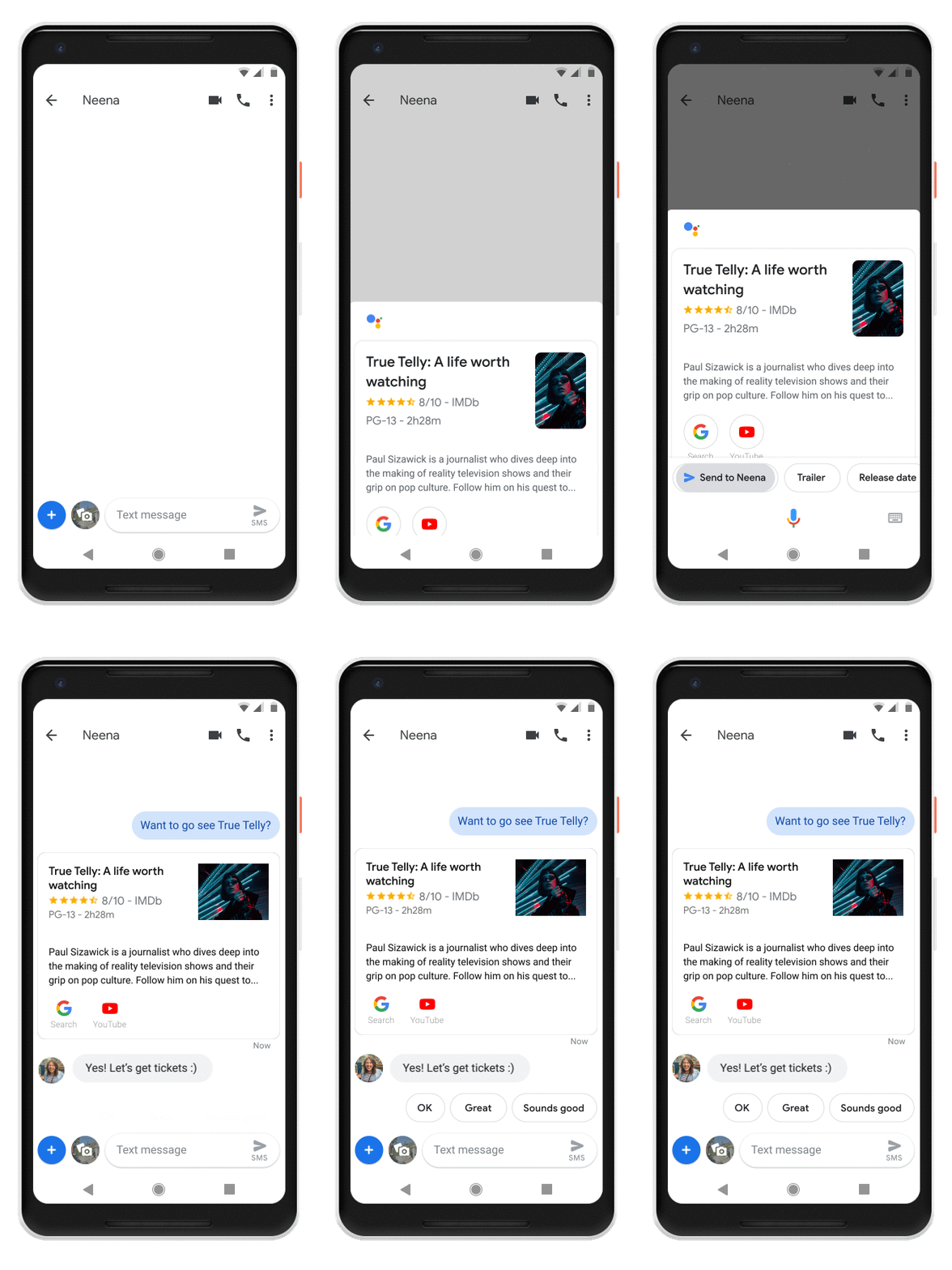
It’s only been a few weeks since Google brought the Assistant to Google Maps to help you reply to messages, play music and more. This feature first launched in English and will soon start rolling out to all Assistant phone languages. In addition, Google also today announced that the Assistant will come to Android Messages, the standard text messaging app on Google’s mobile operating system, in the coming months.

If you remember Allo, Google’s last failed messaging app, then a lot of this will sound familiar. For Allo, after all, Assistant support was one of the marquee features. The different, though, is that for the time being, Google is mostly using the Assistant as an additional layer of smarts in Messages while in Allo, you could have full conversations with a special Assistant bot.

In Messages, the Assistant will automatically pop up suggestion chips when you are having conversations with somebody about movies, restaurants and the weather. That’s a pretty limited feature set for now, though Google tells us that it plans to expand it over time.

What’s important here is that the suggestions are generated on your phone (and that may be why the machine learning model is limited, too, since it has to run locally). Google is clearly aware that people don’t want the company to get any information about their private text chats. Once you tap on one of the Assistant suggestions, though, Google obviously knows that you were talking about a specific topic, even though the content of the conversation itself is never sent to Google’s servers. The person you are chatting with will only see the additional information when you push it to them.

25 Feb 2019

Google Assistant gets expanded language and device support

At MWC Barcelona, Google today made a few announcements around its Assistant. A lot of these center around support for KaiOS, the operating system for low-end feature phones that Google invested in last year, and additional language support.

While KaiOS, which was born out of Mozilla’s failed FirefoxOS project, may be for the very low end of low-end phones, Google argues that it’s exactly these devices that can profit from have access to a voice-driven assistant, given that they often have smaller screens, too, that make typing a hassle. Google is now bringing the Assistant to these KaiOS devices for users in India, Indonesia, Mexico and Brazil. In addition, it’s also bringing Voice Typing to KaiOS to help user enter text using their voice. With this, KaiOS users can simply speak their queries and use the Assistant as a way to input all kinds of information.

“If you look at the emerging markets, we’ve seen that the number of Assistant users has multiplied by seven,” Google’s Behshad Behzadi said. “The main reason for this is that for the new users which are coming to this technology for the first time, voice is really the easiest and most natural way for them to use their phones. It’s removing a technology barrier for these users.”

With today’s launch, Google is also bringing support for its bilingual Assistant to more languages. This allows you to seamlessly switch between two languages. Until now, this only worked for English, Spanish, German, French, Japanese and Italian. Today, the company is adding Korean, Hindi, Swedish, Norwegian, Danish and Dutch to this lineup.

In addition, the Assistant now speaks eight new Indic languages: Marathi, Bengali, Tamil, Telugu, Gujarati, Kannada, Malayalam and Urdu.

Besides the new languages, Google is also bringing Actions — Google’s version of what Amazon calls skills in the Alex ecosystem — to Android Go and KaiOS. Developers can build these actions in 19 languages across 29 locales now.

Google also quietly launched a few other new Assistant features today. You can now check in to your Lufthansa, Swiss or Austrian Air flights within Europe using your voice, for example. The Assistant on your phone can now also control the Digital Wellbeing settings like your wind-down time and ‘do not disturb’ mode (in English, German and French). And if you speak German or French, then multiple actions — which allow you to tell the Assistant to perform more than one action at a time (“What’s the weather like in Munich and Bordeaux?”) — are now available to you, too. Until now, this feature was only available in English.

25 Feb 2019

Sony goes ultra-wide for its new handsets

Two years ago, aspect ratios were all the rage. These days, it’s 5G and foldable all the way down, making the Xperia 1 a bit of a throwback. These days, the company’s getting even longer, with a 21:9 display on Sony’s new flagship.

The idea is to make things as cinematic as is possible for a 6.5 inch smartphone, keeping the dimensions closer to the way filmmakers shoot. The screen is a 4K HDR OLED that leverages the Master Monitor color reproduction Sony developed for films.

It’s a marked change for Sony, which largely relies on camera innovations to help stand out from the pack. Of course, there’s a bit of that in here too. The handset is capable of shooting video in 4K HDR at 24FPS in the 21:9 formate. Given that it’s not currently a particularly popular aspect ratio for handsets at this point, you can alway switch to something a bit more common.

As for content, Sony says it’s working with a number of providers to customize things, including Netflix, Amazon Prime and YouTube on the video side and Gameloft, 10 Cent and Fortnite developer Epic for games.

The handset will be available in late-Spring. Pricing is still TBD.

Sony also took the opportunity to launch a pair of mid-range phones, the Xperia 10 and Xperia 10 Plus. Both handset sport the 21:9 aspect ratio on 6.0 and 6.5 inch handsets, respectively. Those devices run $359 and $430. They’ll be arriving in the U.S. March 18.

25 Feb 2019

Netflix’s ‘Roma’ wins Best Director and two more Oscars (but not Best Picture)

“Roma” took home three Academy Awards tonight — though not Best Picture, which went to “Green Book.”

Alfonso Cuarón did win an Oscar for directing the film — his second victory in the category, following his previous award for “Gravity.” And it marks the fifth time in six years that Best Director has gone to one of the “Three Amigos,” a trio of acclaimed Mexican directors that also includes Guillermo del Toro and Alejandro Iñárritu.

“Roma” is based on Cuarón’s childhood in Mexico City, as told through the eyes of the family’s maid Cleo. It went went into the night with 10 nominations, tying “The Favourite” for the most nods. Ultimately, it won the awards for Best Cinematography, Best Foreign Film and Best Director.

“Being up here doesn’t get old,” Cuarón said as he went up to accept Best Director. He went on to thank the Academy for recognizing “a film centered around an indigenous woman — one of the 70 million domestic workers in the world without work rights, a character that had been historically relegated to the background in cinema.”

Netflix spent an estimated $25 to $30 million to campaign for “Roma” — a particularly impressive sum since the film cost $15 million to make. The company also dropped its previous insistence on simultaneously releasing films on streaming and in theaters. (The exclusive theatrical window of just a few weeks still wasn’t enough to win over the major theater chains.)

While “Roma” was the big streaming success story for the night, Netflix’s “Period. End of Sentence.” won for Best Documentary (Short Subject). The streamer’s “Ballad of Buster Scruggs” also received three nominations, though it didn’t win in any category.

Meanwhile, Hulu’s “Minding the Gap” was nominated for Best Documentary Feature, but lost to “Free Solo.”

Beyond the streaming news, “Black Panther” was the first superhero movie to be nominated for Best Picture. Ultimately, it took home the awards for Best Costume Design, Best Production Design and Best Original Score. Also on the superhero front: “Spider-Man: Into the Spiderverse” won for Best Animated Feature.

And since I’ve written about “First Man” — hey, it won for Best Visual Effects!

The awards were given out at a ceremony without a host — for only the second time in Oscar history. Instead of a monologue, there was a montage highlighting all kinds of movies from the past year, and then Tina Fey, Amy Poehler and Maya Rudolph came out to make a few host-style jokes before presenting the award for Best Supporting Actress.

25 Feb 2019

How Netflix is eating the Academy

It’s Oscar night! Do you care? If you’re me, and/or the statistically average watcher, the answer is: a whole lot less than you used to. Last year’s viewership hit an all-time low. Whither Hollywood, which just does not dominate the cultural conversation the way it used to?

Oh, at first glance it’s doing just fine — last year the total US box office hit almost $12 billion, the highest ever. But look a little deeper and the numbers are more troubling. Most of that gain is from higher ticket prices. The total number of movie tickets sold in the USA has fallen by more than 10% over the last 20 years, despite population growth.

“Netflix!” you say, and yes indeed, and even more than you think. “Hollywood is now irrelevant,” says no less an authority than onetime Hollywood mogul Barry Diller, now chairman of IAC. “Netflix has won this game.” Streaming is the future, despite the studios’ attempt to promote “cloud lockers” for movie ownership, one of which (UltraViolet) closed down last year, while others, such as Disney’s Movies Anywhere (disclaimer/disclosure: I did some ancillary work for MA at my dayjob a couple of years ago) have not exactly conquered the landscape.

In fact, perhaps the keenest-eyed industry analyst alive, Matthew Ball, former head of strategy at Amazon Studios, argues that Netflix has so transcended Hollywood that its real competition is another, and surprising, entity entirely:

He unpacks that in a fascinating piece which is then surpassed by his fourpartsandcounting deep dive into “Netflix Misunderstandings,” composed last summer and since then required reading for every armchair media analyst worldwide. Some highlights:

This cash loss only exists because Netflix is funding next year’s content against this year’s revenue. Netflix could have chosen to stabilize its 2018 content offering at 2017 levels … and had the company done this, it would have generated $700MM in cash, not lost $2B.
[…]
At a time in which most tech companies need to be bullied into admitting they’re also media companies, Netflix’s tech identity is often glossed over. It is as much a technology and product company as Google, Apple or Amazon.
[…]
Hastings knows that if Netflix falls short of, say, 250MM subscribers, his business will buckle. His spend is predicated upon achieving this degree of scale … Even at the low end, Netflix would have achieved greater dominance than the media business has ever seen.
[…]
The company boasts that it will launch 700 total original series in 2018 (or 14 per week) and offer more than 1,000 by the end of the year. This raises the question of what, exactly, is an “Original” … Understanding this difference is critical for any attempt to benchmark SVOD services

We can conclude that Netflix’s (and, to a lesser extent, Amazon Prime’s) reshaping of the visual media industry has only just begun; the repercussions of the first few tremors are still rippling through Hollywood, but we can expect ever bigger quakes in the years to come.

The saving grace is that the rest of the world is getting wealthier, and spending more on Hollywood … although the studios only pull in roughly 25% of what their releases in China gross, compared to 50% back home. Still, 25% of a huge number is still very large, and China is huge. Two of last year’s top 15 worldwide movies made essentially all of their money in China. It seems likely that The Wandering Earth, which has pulled in $557 million in only two weeks, will make more money in China this year than presumed 2019 #1 Avengers:Endgame will in the USA. (Infinity War earned $679 million domestically.)

So where does that leave Hollywood? Being slowly disrupted back home by technical superiors in the form of Netflix and Amazon Prime, and racing to make up their losses overseas. But it’s not like Netflix doesn’t have a robust international strategy. Hollywood’s studios aren’t going anywhere anytime soon, but, with the exception of Disney, they’ll soon have to get used to being mid-level players rather than the kings of the world they once were.

24 Feb 2019

The Google Assistant gets a button

Traditionally, the Google Assistant always lived under the home button on Android phones, but as the company announced at MWC today, LG, Nokia, Xiaomi, TCL and Vivo are about to launch phones with dedicated assistant buttons, similar to what Samsung has long done with its Bixby assistant.

The new phones with the button that are launching this week are the LG G8 ThinQ and K40 and the Nokia 3.2 and 4.2. The upcoming Xiaomi Mi Mix 3 5G and Mi 9, as well as new phones from Vivo (including the Vivo V15 Pro) and TCL will also feature a dedicated Assistant button. With this, Google expects that over 100 million devices will soon offer this feature.

With a dedicated button, Google can also build a few new features into the Android OS, too, that’ll make it easier to bring up some Assistant features that were traditionally always a few taps away.

As expected, a single tap on the button will bring up the Assistant, just like a long tap on your phone does today. A double tap will bring up the Assistant’s visual snapshot feature that provides you with contextual information about your day and location (similar to the sorely missed Google Now of days gone by). A long press activates what Google calls a “walkie talkie feature.” This ensures that the Assistant listens to longer queries, which Google says is “perfect for emails or long text message.”

It’s interesting to see that the Android ecosystem is now building these buttons into phones (and we can probably assume that Google’s own next-gen Pixel devices or the fabled low-end Pixel 3 will have one, too). They will make it easier to discover the Assistant, of course, and maybe get people to use it more often, too — and that’s surely what Google is hoping for.

24 Feb 2019

LG’s latest flagship uses your hand veins to unlock

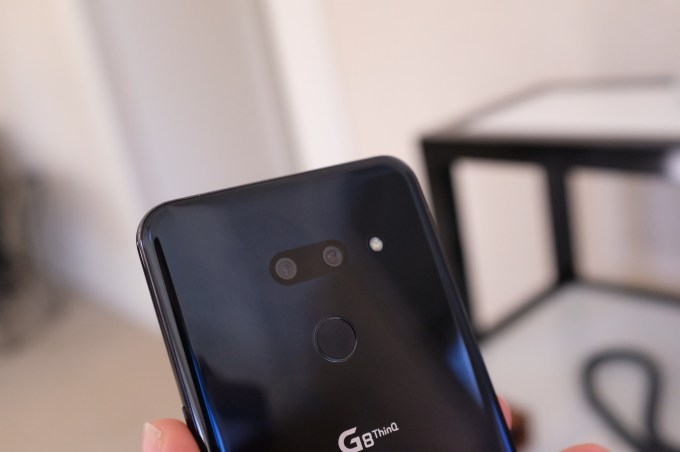
We’ve already known about the G8 ThinQ for some months now. And a few weeks back, LG made the whole camera rig official, announcing that the handset would be getting a ToF image sensor on its front-facing camera, bring, among other things, advanced face unlock technology.

The company did manage to save a few tricks for the product announcement, including a strange little biometric addition. LG says the phone’s Hand ID tech is the first to use “advanced palm vein authentication” — which could well be accurate. Certainly it’s not a mainstream feature yet.

And I’ll give it to LG, Hand ID is a much catchier name than “palm vein unlock,” which is one of the creepier sounding smartphone features in recent memories. Still, the underlying technology is actually pretty cool here, once you’re down shuddering from how weird the whole thing is on the face of it.

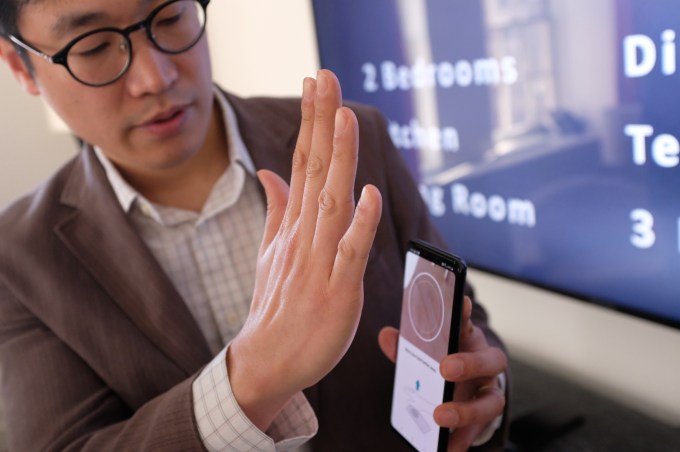
From the company’s press materials, “LG’s Hand ID identifies owners by recognizing the shape, thickness and other individual characteristics of the veins in the palms of their hands.” It turns out, like faces and fingerprints, everyone’s got a unique set of hand veins, so once registered, you can just however your hot blue blood tubes over the handset to quickly unlock in a few seconds.

The Z camera also does depth-sensing face unlock that’s a lot harder to spoof than the kind found on other Android handsets. LG’s also put the tech to use for a set of Air Motion gestures, which allow for hands-free interaction with various apps like the camera (selfies) and music (volume control).

I played around with the feature, and if I’m being totally honest, it takes some getting used to. You’ve got to train yourself to get things just right, which could well dissuade most users from any sort of long-term adoption of features that can pretty quickly with accomplished with a tap.

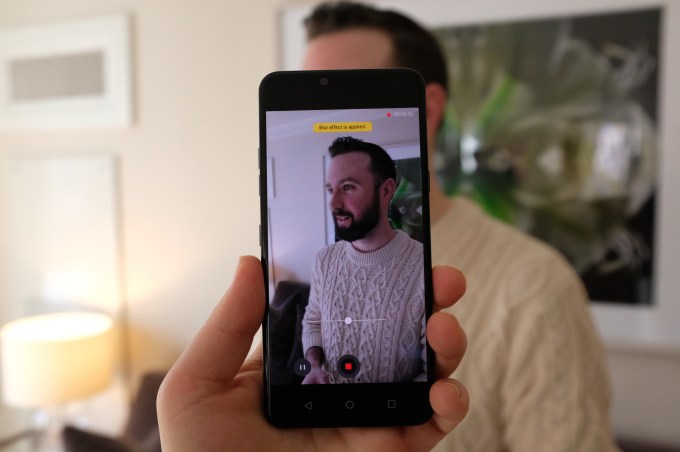
Other notable features for the new flagship include a 6.1 QHD+ OLED display and a new video portrait mode, which lets users adjust bokeh on the fly.

The handset will hit the States “in the coming weeks.” Pricing is still TBD, but I anticipate that it will cost around the same a previous LG flagships.

24 Feb 2019

LG’s latest flagship uses your hand veins to unlock

We’ve already known about the G8 ThinQ for some months now. And a few weeks back, LG made the whole camera rig official, announcing that the handset would be getting a ToF image sensor on its front-facing camera, bring, among other things, advanced face unlock technology.

The company did manage to save a few tricks for the product announcement, including a strange little biometric addition. LG says the phone’s Hand ID tech is the first to use “advanced palm vein authentication” — which could well be accurate. Certainly it’s not a mainstream feature yet.

And I’ll give it to LG, Hand ID is a much catchier name than “palm vein unlock,” which is one of the creepier sounding smartphone features in recent memories. Still, the underlying technology is actually pretty cool here, once you’re down shuddering from how weird the whole thing is on the face of it.

From the company’s press materials, “LG’s Hand ID identifies owners by recognizing the shape, thickness and other individual characteristics of the veins in the palms of their hands.” It turns out, like faces and fingerprints, everyone’s got a unique set of hand veins, so once registered, you can just however your hot blue blood tubes over the handset to quickly unlock in a few seconds.

The Z camera also does depth-sensing face unlock that’s a lot harder to spoof than the kind found on other Android handsets. LG’s also put the tech to use for a set of Air Motion gestures, which allow for hands-free interaction with various apps like the camera (selfies) and music (volume control).

I played around with the feature, and if I’m being totally honest, it takes some getting used to. You’ve got to train yourself to get things just right, which could well dissuade most users from any sort of long-term adoption of features that can pretty quickly with accomplished with a tap.

Other notable features for the new flagship include a 6.1 QHD+ OLED display and a new video portrait mode, which lets users adjust bokeh on the fly.

The handset will hit the States “in the coming weeks.” Pricing is still TBD, but I anticipate that it will cost around the same a previous LG flagships.