Author: azeeadmin

22 Feb 2019

Daimler and BMW invest $1.1 billion in urban mobility services

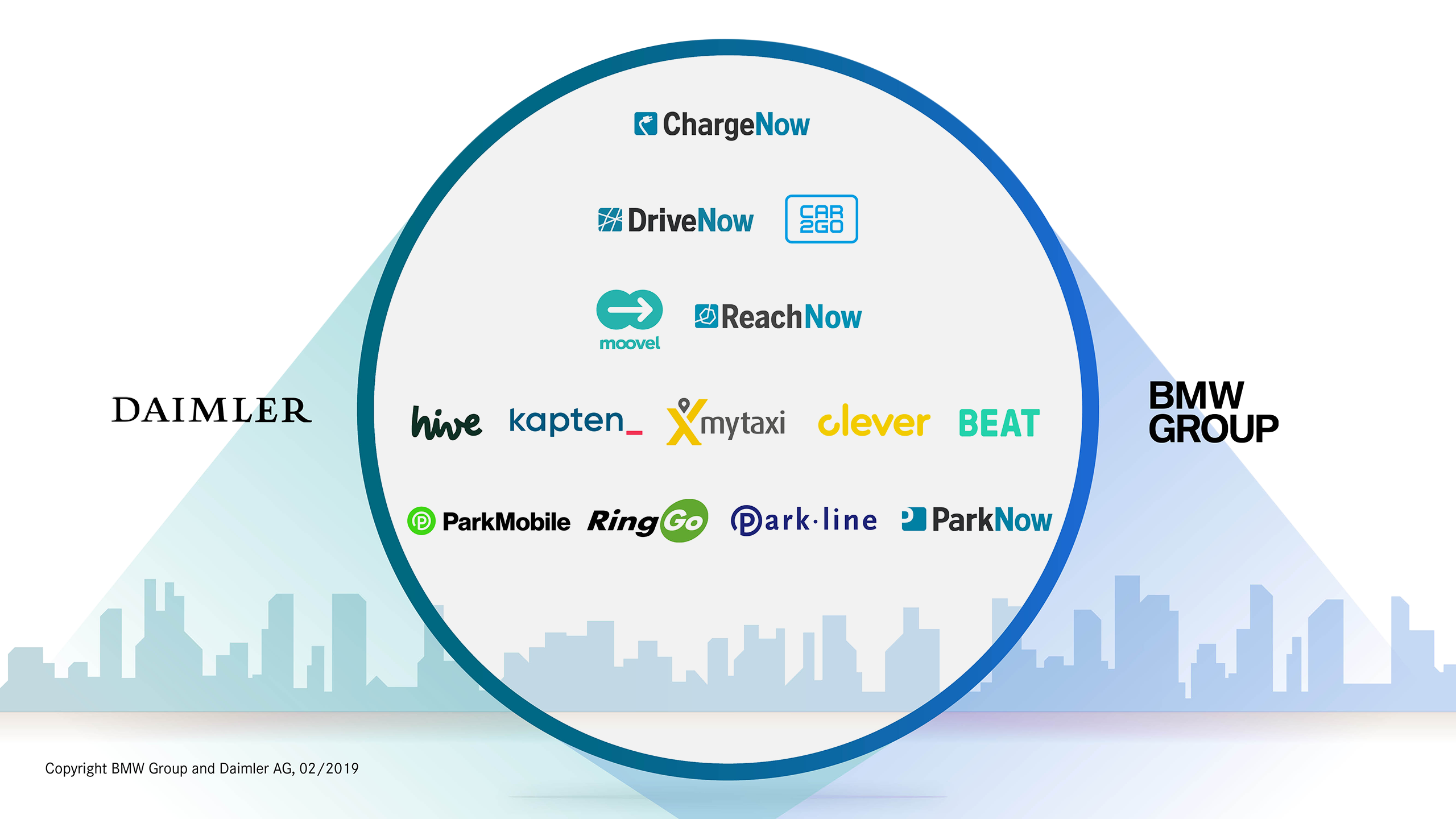
Daimler AG and BMW Group officially agreed to merge their urban mobility services into a single holding company back in March 2018 with a 50 percent stake each. And now, they want to unify their services under 5 categories by creating 5 joint ventures — Reach Now, Charge Now, Park Now, Free Now and Share Now.

Both automakers plan to invest $1.1 billion (€1 billion) to foster those urban mobility services over the coming years. There are already 60 million people using one of the 14 services currently available.

Let’s go through the details. Free Now is the name of the ride-hailing company, which includes mytaxi, Kapten, Clever Taxi and Beat. Those services combined operate in 130 cities in 17 countries. Hive, a new e-scooter company, is also part of Free Now.

mytaxi, a popular app that lets you hail a taxi from your phone, already sent an email to its customers saying that the company will rebrand its service to Free Now later this year. It’s unclear what’s going to happen to the other brands. Chauffeur-Privé recently rebranded to Kapten, so it sounds like apps and services won’t merge overnight.

Charge Now already exists and is a network of public charge points for electric cars. It provides a white label service for car manufacturers as well. So nothing is changing there.

Park Now combines an existing service called ParkNow (I know it’s confusing), ParkMobile, RingGo and Park-line. As the names suggest, they all operate parking services.

Share Now is all about free-floating services. Daimler and BMW each had its own service, DriveNow and Car2Go, they’re now under the same roof.

The new Reach Now combines moovel with an existing service called ReachNow. This one is a bit weird as moovel lets you access various transportation methods from a single app. You can find your itinerary, book and pay for various services through the app. The old ReachNow is different as it’s a ride-hailing service in Seattle and Portland.

That wasn’t easy to unpack. It’s clear that things are still moving and plans aren’t set in stone when it comes to integrations and brand simplification. Eventually, BMW CEO Harald Krüger hopes that all of those services will converge and form an end-to-end service.

“We have a clear vision: these five services will merge ever more closely to form a single mobility service portfolio with an all-electric, self-driving fleet of vehicles that charge and park autonomously and interconnect with the other modes of transport,” he said in the release.

While it sounds like a wild dream, it’s interesting to see that Daimler and BMW are both very serious about mobility services. They know that they can’t just be car manufacturers and have to expand beyond their traditional role.

It’s a competitive industry with well-funded giants, such as Uber and Didi. And if Daimler and BMW want to remain relevant, they need to invest and develop those services.

22 Feb 2019

Can we ever evaluate technical debt?

Every couple of months, I talk to an entrepreneur who is interested in building a marketplace for buying and selling app businesses (i.e. the actual IP and ownership of an app or other piece of software). These markets always seem to suffer from a lack of liquidity, and one reason why is that it’s really hard to know how much technical debt is latent in a codebase.

First, the developer behind the codebase may not even be aware of the technical debt they have piled on. Second, until a software engineer really understands a codebase, they are almost certainly not in a position to answer a question on technical debt authoritatively. That makes it hard to get third-party opinions on anything but the most simple codebases.

This opaqueness isn’t unique to software though. We lack tools for understanding the maintenance quality of assets — physical or digital — across our economy. Even when we do perform maintenance or hire someone to do it for us, it can be hard to verify that the work was performed well. How long does it take for an auto mechanic to truly evaluate the maintenance of a used car?

I was thinking about this challenge of evaluating maintenance when I read this deep dive into the economics of old housing by Akron’s head of planning Jason Segedy:

It has been suggested to me, on more than one occasion, that indebted, college-educated Millennials could be lured back to the city by selling them these old, poorly-maintained houses for $1.00, and having them “fix up the house.”

People who say this do not have a realistic idea of what “fixing up” an old house entails—neither in terms of the scope of the rehabilitation work that would be required, nor in terms of the level of skill, time, and/or money needed to do the work.

Even in a low cost-of-living market like ours, $40,000 houses are generally not a “good deal.” They are almost always a liability. They are a ticking time bomb of deferred maintenance. They are an albatross.

In his own case:

All told, I have spent $93,400 on improvements to this house over the past 15 years. This works out to an additional $502 per month, above what I was paying in mortgage, taxes, and insurance. When you add all of that together, the total monthly cost works out to $1,439.

[…]

The total monthly cost for the brand-new house? $1,444. Which comes out to exactly $5.00 per month more than my 72-year-old house.

Maintenance is the secret challenge of any asset, physical or digital. We have been talking about the Tappan Zee bridge here a bit this week, and maintenance played an outsized role in forcing New York to spend even more money on a new bridge. From Phil Plotch’s book Politics across the Hudson:

However, he also recognized that the Authority probably put less money into the bridge after it decided to replace it. “When maintenance folks know that a capital project is under design and will soon deal with the problems they have been battling for years,” he said. “They often back down a bit and turn their attention and resources to other areas.”

That didn’t work out so well:

One of the reasons the Thruway Authority wanted to build a new bridge in the late 1990s was to avoid replacing the bridge’s deck. However, the environmental review process took so long that the authority had to spend $300 million dollars to do exactly that anyway — after five-foot-wide holes started opening up along the length of the bridge.

Back in the software world, we have gotten much better about quantifying test coverage over the years, but we still seem to lack any means by which to evaluate technical debt. And yet, technical debt from my limited experience is hugely determinative on how fast product features can be launched.

It would be hugely helpful to have some sort of reasonably accurate grading system that said “this codebase is really up-to-date and clean” versus “this codebase is radioactive and run away from it.” Right now, so much of product engineering seems to be making decisions in the dark and discovering software quagmires. There has to be a better way?

Why we can’t build anything? (Part 5?)

Image from Honolulu Authority for Rapid Transit

Written by Arman Tabatabai

We’ve been obsessed with the infrastructure crisis in the U.S. lately and the question of “Why can’t we build anything?”. In case you thought the California HSR shitshow was an isolated incident, think again.

Construction Dive provided some more details around the DOJ’s subpoena of the Honolulu High-Speed Rail Project (Honolulu Rail Transit) last week, which ordered the project leads to open up their books. Just like in California, after decades of debate, Hawaii’s project has been plagued by delays and cost overruns. Today, the project holds an estimated cost of around $9-10 billion, compared to initial estimates of $3-4 billion, and some academics and industry specialists are even saying that number is more like $13 billion-plus. The court order came just after a state-led audit found that much of the cost overruns could be tied to poor contracting, planning, and management practices — just as in California.

Given the similarities here, it’s possible we could see the federal government try and pull back the $1.6 billion it had earmarked for the project if it doesn’t like what it sees. Despite calls for infrastructure improvement, the feds seem to be taking a tougher stance on the use of fed funds for these projects.

Construction Dive also highlighted that the $650 million renovation of Denver International Airport’s Jeppesen Terminal was delayed indefinitely after operators found structural deficiencies in the concrete. Sound familiar? Maybe it’s because in just the last year we’ve seen “structural deficiencies” mar SF’s Transbay Terminal project and DC’s Metrorail extension. Denver’s reclamation project is expected to cost $1.8 billion in its entirety and is a year behind schedule after breaking ground less than nine months ago.

India’s general election might also determine Facebook’s future in the region

Westend61 via Getty Images

Written by Arman Tabatabai

India’s Parliamentary Committee on Information Technology announced it would be meeting with Facebook in early-March to discuss “safeguarding citizens’ rights on social or online news media platforms.” The government has approached social media with a cautious eye ahead of the country’s huge upcoming elections, as concern over the use and misuse of social and messaging platforms in global elections becomes a hot-button issue.

The topic came up in our recent conversation with The Billionaire Raj author James Crabtree. He believes the election will be a hugely important period for social platforms in India. Having experienced a number of major historical scandals, India’s citizenry has a fairly harsh — albeit somewhat selective — view on corruption, and Crabtree believes that if Facebook or others were to face blame for any alleged misconduct, the potential fallout from a political, regulatory, and public opinion standpoint could be devastating.

The prospect of such an outcome becomes even more alarming for foreign social companies as India has ticked up focus on data localization and movements towards a “national champion” policy that will increasingly favor domestic firms over external players.

I love triangulation negotiation

The trade kerfuffle between China and the U.S. is sort of just continuing at a glacial pace. Literally glaciers, because Greenland got involved over the past few months. Greenland power politics is very far afield of TC, but I wanted to point out one little nuance that offers a worthwhile lesson.

Greenland has wanted to upgrade its airports for some time (there are no roads between major cities in the sparsely-populated but huge country). But Denmark, which Greenland is a constituent country, has rebuffed those requests, that is, until the Chinese got involved. From a WSJ article:

After Kalaallit Airports short-listed a Chinese construction firm to build the new airports, Denmark conveyed its alarm to the Pentagon. After Mr. Mattis got involved, Denmark’s government asked a consortium led by Danske Bank to help assemble an alternative financing package.

Officials in Greenland were pleasantly surprised by the terms. “Even Chinese funding is not as cheap as this,” Mr. Hansen said.

Plus this quote:

“He was not into it at all—until the Chinese showed interest,” said Aleqa Hammon, Greenland’s former prime minister, speaking of [Danish Prime Minister] Rasmussen.

This is how you negotiate! Get two larger adversaries lined up on either side of the line, and just start going back and forth between them. This works with Google and Facebook, Sequoia and Benchmark, or any other competitors. At some point, the game isn’t just a deal, it’s also the face-saving that comes from not losing to the competition.

Japan joining the trend of looser fundraising rules for growing companies

Written by Arman Tabatabai

Earlier this week, we talked about how security exchanges around the world were looking to loosen fundraising rules for young companies. The softening of these rules might be indicative of a wider trend, with Japan now proposing revised rules to make it easier for startups to fundraise through traditional brokerages and trade shares of listed companies. While the motivation here may not be to attract IPO deals like it seems to be in the U.S. and China, with the creation of more funding alternatives and with companies opting to stay out of the public markets for longer, national securities industries seem to be trying to brand themselves as the best venue for young companies to grow.

Obsessions

  • More discussion of megaprojects, infrastructure, and “why can’t we build things”
  • We are going to be talking India here, focused around the book “Billonnaire Raj” by James Crabtree, who we just interviewed and will share more soon
  • We have a lot to catch up on in the China world when the EC launch craziness dies down. Plus, we are covering The Next Factory of the World by Irene Yuan Sun.
  • Societal resilience and geoengineering are still top-of-mind
  • Some more on metrics design and quantification

Thanks

To every member of Extra Crunch: thank you. You allow us to get off the ad-laden media churn conveyor belt and spend quality time on amazing ideas, people, and companies. If I can ever be of assistance, hit reply, or send an email to danny@techcrunch.com.

This newsletter is written with the assistance of Arman Tabatabai from New York

22 Feb 2019

Roku on track for $1 billion in revenue in 2019

Roku plans to be a billion-dollar company in 2019, the company said on Thursday as part of its announcement of strong earnings. The company beat analyst estimates and reported strong growth in active users and streaming hours with earnings of $0.05 per share, compared with the $0.03 analysts had estimated, and revenues of $276 million, compared with the expected $262 million.

Roku also reported 40 percent year-over-year active user growth, with 27.1 million active users by year-end, and a 69 percent year-over-year increase in streaming hours, which reached 7.3 billion.

The company said it plans this year to invest in international expansion, its ad-supported service The Roku Channel, advertising, and its Roku TV platform.

While cord cutting is driving some of Roku’s growth, only around half of Roku’s customers fit this description, CEO Anthony Wood pointed out. The other half are more like “cord shavers” – those who are still pay TV subscribers, but are shifting more of their TV viewing to streaming services.

Roku’s ability to also attract pay TV customers combined with the fact that 1 in four smart TVs sold in the U.S. now runs its software, is helping the company’s market share grow.

Roku estimates that 1 in 5 U.S. TV households now uses the Roku platform for at least a portion of their TV viewing. In the year ahead, Roku aims to better capitalize on its traction by increasing the monetization per user and scaling the number of households using Roku.

In addition, the company sees a big opportunity in international.

“International is one of the top four areas we’re investing in,” Wood noted.

“Roku has more than 27 million active accounts globally today. Most of those are in the United States. But we believe many of the assets we built for the U.S. market will help us expand into other markets. And clearly streaming is a global opportunity with one billion households worldwide,” he said.

The company begin investing more substantially in international in 2018, and has now reached 20 countries. It has added more local content and is expanding its relationships with international resellers, said Wood. “We think you’ll start to see the results of this increased investment bearing fruit in 2020,” he added.

Roku also has high hopes for The Roku Channel.

The channel is now one of the top five most popular on the platform and grew from around 1,000 free movies and TV episodes in 2017 to now around 10,000. Last year, it added more streaming partners like ABC, Cheddar and People TV and even expanded into subscriptions, with add-ons like Showtime, Starz, and Epix.

The company believes the channel will continue to become a main destination on its platform, which helps Roku to monetize through advertising and its cut of subscription revenue, when customer opt to add on extra packages. But today the channel is still lacking many of the major subscription services, compared with the more robust lineup offered by Amazon Channels. For example, HBO is not offered through The Roku Channel today, nor is CBS All Access.

However, the company believes its financial performance will improve this year – reaching the billion in revenue mark, with platform revenues accounting for two-thirds of that. This, in part, will be due to growing its installed base and extracting more revenue from each customer, including through The Roku Channel.

It’s worth noting that Roku recently made it possible to stream from The Roku Channel directly on mobile devices, which will likely play a role here.

Roku has been growing at a rapid pace alongside the larger cord cutting and streaming TV trend.

In the past three years, it increased active accounts by 4 million, 6 million and then nearly 8 million, respectively, it said. And it quadrupled the size of its platform revenue from just over $100 million in 2016 to over $400 million in 2018. In the U.S., its active account base of 27+ million would make it equivalent to the No. 2 traditional pay TV provider.

In addition to international expansions in 2019 and investments in The Roku Channel, Roku aims to increase its Roku TV market share, and roll out new ad products in areas like marketplace, programmatic, and self-serve.

Roku’s investments in its platform led to 77 percent year-over-year growth to reach 151.4 million in revenue in Q4. But the player business is still growing too – 21 percent year-over-year to reach 124.3 million in revenue, Roku said.

However, a lot will changing in the streaming landscape this year, as new offerings from AT&T (WarnerMedia streaming service), Apple, Disney, Viacom (which just bought Pluto TV), and NBC hit the market.

But Roku believes it will weather these changes, too.

“I founded this company on the belief that all television was going to be streamed,” Wood told investors. “And it wasn’t that many years ago when there was no streaming, and then the only streaming was Netflix. It took a long time for the incumbents to embrace streaming. But they have. And that’s very gratifying to see every major media company in the world developing streaming strategies, which is great — it’s great for us, because we’re the leading streaming platform,” he said.


22 Feb 2019

TechStyle hits 5 million members for its retail empire

TechStyle Fashion Group, the company behind Kate Hudson’s Fabletics; the children’s brand FabKids; Rihanna’s lingerie brand, Savage X Fenty; and the shoe retailer Shoedazzle, has amassed 5 million members for its discount retail program.

Those members were a large driver behind the $750 million in transactions the company saw for 2018, according to co-chief executive Adam Goldenberg. “We were profitable in 2018,” Goldenberg says. “We can grow now, profitably [and] we can grow both topline and bottom line.”

Numbers like those should give the company a powerful position to head out to public markets, but Goldenberg says the company is taking a wait-and-see approach. “At some point we do need to think about public markets to bring liquidity to our investors and employees,” he says. “We don’t have a set timeline in mind there.”

Designed to make the company’s wares even more attractive for style- and cost-conscious consumers, the VIP Membership is a free offering that gives customers 50% off of all of the company’s products and additional perks like free returns and early access to new product launches.

To be a member, customers need to visit a brand website at least once a month and see shop new collections or skip a month. Members can skip as many months as they want and they have no requirement to buy anything. 

If a member forgets to skip a month they’re charged a membership credit that can be used at any time. The membership offering has provided results for the company, which says it sees 85% of its revenue come from repeat buyers across brands and one quarter of its new members coming from referrals.

22 Feb 2019

Inside Tesla’s solar energy astroturfing

Tesla has been masking its lobbying efforts on solar panels and battery storage through the Energy Freedom Coalition of America, a trade association that is little more than a front for the automaker and alternative energy company, public documents suggest.

SolarCity, which Tesla bought in 2016, began the practice of using the EFCA to promote its products and services without acknowledging it was the only significant member of the organization. EFCA was initially portrayed as a solar advocacy group with grassroots support.

When rule changes threatened payments to Arizonans with domestic solar panels in 2016, EFCA knew just what to do. It launched the Arizona Solar Pledge for citizens “to demonstrate their support for energy choice and add their names to the growing coalition determined to protect Arizona rooftop solar customers.”

Anyone signing the petition would “demonstrate to … the broader political community that the people of Arizona stand with rooftop solar and energy choice,” wrote an EFCA spokesperson at the time.

EFCA noted that its list of members included Silevo, SolarCity Corporation, ZEP Solar, Go Solar, 1 Sun Solar Electric, and Ecological Energy Systems.

However, far from being a grassroots environmental advocacy organization or a broad trade body, the EFCA seems to represent little more than the lobbying arm of Tesla’s energy division.

Three of its named “member” businesses  — Silevo, SolarCity and Zep Solar – are actually subsidiaries of Tesla. Two of the remaining companies are small regional solar installers. TechCrunch could not immediately identify Go Solar LLC.

Tesla would not answer questions about EFCA’s membership, funding or control. However, a spokesperson wrote, “Since the [SolarCity] acquisition, Tesla has been winding down its involvement with the coalition, and to the extent we have worked with them, it’s largely been limited to legacy dockets that have already been in progress for multiple years.”

The EFCA is a non-profit corporation formed in Delaware that describes itself blandly as a “national advocacy organization that seeks to promote public awareness of the benefits of solar and alternative energy.”

It was slightly more forthcoming in a filing with the Minnesota Public Utilities Commission early in 2017, discussing proposed community solar gardens. EFCA wrote that it “represents a broad range of businesses that are fully integrated providers of distributed energy resources (DERs) products and services.” These, it wrote, could include rooftop solar, distributed generation, thermal and battery energy storage, and smart energy services, for residential, commercial, industrial and government customers.

Although EFCA’s legal representative for filings in New Hampshire has an EFCA email address, her LinkedIn profile shows that her job title is Campaign Projects Coordinator at Tesla. Recent filings on behalf of EFCA have been made by a senior policy advisor at Tesla. In fact, EFCA itself is listed as a Tesla subsidiary in filings with the SEC.

EFCA’s roots

Tesla lobbies under its own name in many parts of the country, so how did it come to be working under the guise of the EFCA, and why is it continuing to do so?

The story goes back to 2006, and the formation of SolarCity by two of Musk’s cousins, Lyndon Rive and Peter Rive. SolarCity took the novel approach of installing photovoltaic systems for no money down, instead leasing them to homeowners in exchange for decades of payments for cheaper, greener electricity. Musk invested in SolarCity and took the role of chairman.

SolarCity grew quickly, becoming the largest solar installer in the United States by 2013, despite a business model that required taking on mountains of debt. The company regularly sparred with traditional utility companies, often as part of a rooftop solar trade association called the Alliance for Solar Choice, or TASC.

In late 2015, rooftop solar was facing a tough situation in Nevada. NV Energy, the state’s monopoly electricity provider, wanted to slash domestic solar incentives, and the solar industry was fighting for its life. While SolarCity took a collaborative approach, its main rival, SunRun, suggested suspicious ties between the utility and Nevada’s governor.

SolarCity ultimately withdrew from TASC, saying that its focus was moving beyond residential solar. The new EFCA would “capture more of our interests,” a spokesperson told Utility Dive at the time. SolarCity persuaded a small Las Vegas company called 1 Sun Solar Electric, among others, to join EFCA. 1 Sun, which installs five to 10 residential solar systems in the city each month, was keen to protect its local business.

“There’s no way that a small company like ours would be able to go toe-to-toe with NV Energy,” Louise Helton, the company’s vice-president, told TechCrunch. “EFCA gave us standing with the public utility commission, and their attorneys are just stellar.”

Despite the resources EFCA could bring to bear, Nevada did reduce solar incentives at the end of 2015. Many national solar companies, including SolarCity and SunRun, subsequently left the state.

Towards the end of 2016, Tesla bought SolarCity for $2.6 billion, and EFCA along with it. State records and filings indicate that EFCA has now been active in over 30 proceedings in 16 states, and has retained lobbyists in at least Arizona, Utah, Montana, Florida, New Hampshire, Massachusetts and Washington. It does not appear to have initiated any filings that would not benefit Tesla or its subsidiaries.

EFCA had no fewer than 23 lobbyists working for it in Arizona in 2016, while the organization spent $110,000 on lobbyists in Florida the next year, both according to Follow the Money. It has also hired multiple law firms to help it draft and submit filings across the nation.

None of the money for these activities came from 1 Sun, Helton told TechCrunch, nor has EFCA asked 1 Sun to work on the coalition’s behalf. “I would be available to do whatever, but they have not needed anything else from us,” Helton said. “It’s good to be part of something that is fighting the good fight, and giving that entity a flavor of not just being one giant organization, even though Tesla is definitely doing the heavy lifting. We’re very happy to help make it a little bit more diverse.”

EFCA’s recent activity

EFCA’s website is no longer active, and the coalition has not tweeted since early 2017. However, one exception to the organization’s low profile is in Hawaii, where EFCA initiated new filings in 2018 because, Tesla says, the coalition is a known entity there. Even those recent filings, however, are vague about who is actually lobbying in the state.

An EFCA filing in August 2018 stated, “EFCA Members provide solar and storage facilities and services in the State of Hawaii and/or are interested in expanding their provision of those services in the State.”

The only identifiable non-Tesla companies, 1 Sun Solar Electric and Ecological Energy Systems, are based in Nevada and Tennessee, and show no signs of expanding to the Pacific. Tesla, by contrast, has a massive solar plus storage facility on the island of Kauai.

Some of EFCA’s newer filings do reference Tesla, generally to note that the company owns SolarCity.

Tim LaPira, Associate Professor of Political Science at James Madison University, notes that it is virtually unknown for a trade association to be owned and controlled by a single company.

“It’s probably not illegal, but from a transparency perspective, it’s far, far from being ethical,” LaPira said. “When corporations lobby directly, there’s an understanding that they’re asking the government to do something to increase their profits. It’s a very different story when a credible trade association asks the government to do something because they’re not going to benefit directly — they’re asking for some common good. Tesla is trying to get the best of both worlds.”

EFCA continues to lobby state utility commissions, for example proposing changes to net metering and energy storage rules in California last month. That document did not mention Tesla at all.


22 Feb 2019

Venmo launches a ‘limited edition’ rainbow debit card for its payment app users

Hoping to entice more users to attach the Venmo MasterCard to their account, Venmo this morning announced it’s launching a “special edition” rainbow-colored version of its debit card that will only be available in limited quantities. Clearly, the idea here is to generate a sense of urgency around ordering the Venmo MasterCard as well as a desire to cater to Venmo users’ interest in more card varieties.

The new rainbow card will be offered until supplies last, says Venmo. And existing card holders can choose to request the rainbow card as a replacement for their current card, if they choose.

The card will be first offered to top cardholders o Friday, and will then be available to all Venmo users starting on March 4th, the company says.

“We launched the LImited Edition rainbow card based on the positive response we received from our customers when we launched the initial set of six colorful cards,” a spokesperson for Venmo explained to TechCrunch. “We know our users love to pick a card color that best suits their own personality and style, so the card design is inspired by many of our existing card colors and gives our users an even more vibrant option for their wallets and at checkout,” they added.

Venmo had first beta tested its debit card in 2017, with an ugly card that featured a photo of a lump of dough on it. (Get it? Dough.)

But the company soon realized that young people care about how a card looks – and a photo of dough wasn’t cutting it. When Venmo launched the public version of the card last July, it instead opted for an array of colorful choices. Users could choose a solid white, black, yellow, pink, blue or green shade for their Venmo debit card.

The rainbow version takes all those same colors and splashes them all over the card face.

It’s…well…unique. But it’s not really all that pretty – especially since the card still has to feature the clashing red-and-orange MasterCard logo.

The new card works the same as the old ones – allowing you to pay for things in the real world using your Venmo balance, as well as to easily split costs of purchases and tips, like you can do in the Venmo app.

It’s not surprising that Venmo is trying out different card designs.

Unique card styles have been proven to attract millennial customers. For example, part of the demand for Chase Sapphire Reserve Card is due to the fact that the card is made using a metallic alloy, instead of plastic. The company even ran out of the alloy for a time, because of the high demand.

Today, there are a number of metal cards on the market, including the one from fintech startup Revolut, hoping to gain similar attention.

In addition, newcomers are testing out colorful styles – SoFi, for instance, launched an aqua and green card last year. And savings app Acorns hired Ammunition, a design firm co-led longtime industrial designer for Apple, Robert Brunner, to design its card.

But millennials often seem to prefer “fancy” to splashy, which is why Venmo rival Square went with a more formal design where it allows you to have your signature laser-printed on the card’s front.

Venmo declined to say how many cards it has shipped to date, or how many limited edition cards are now available.

The company claims demand is growing, however.

“The Venmo card has seen strong interest from our customers,” a spokesperson noted. “We saw 300% month-over-month growth in monthly active card users from August to September 2018, and the top two purchase categories are supermarkets and restaurants as Venmo becomes a part of our user’s everyday spend,” they said.


22 Feb 2019

Showfields raises $9M for a more flexible approach to brick-and-mortar retail

Showfields, which helps online brands move into offline, brick-and-mortar retail, is announcing that it’s raised $9 million in seed funding.

“Our thesis was simple: Make the process of becoming physical as easy as becoming digital,” co-founder and CEO Tal Zvi Nathanel told me.

I’ve written about other companies, like Bulletin, promising a more flexible approach to real-world retail. But one of the things that’s impressive about Showfields is the sheer size of its flagship space — Nathanel said the company has signed a lease for 14,000 square feet in New York City’s NoHo neighborhood.

When I visited the Showfields store last week, only the first floor was open, but it’s already home to a number of brands, ranging from mattress company Boll & Branch, to fitness company Cityrow, to toothbrush company Quip.

Each brand gets their own separate, dedicated space. For example, in the Cityrow space, I got to sit down and try out the rowing machine, while the Quip area had a mock-up bathroom sink to display the toothbrushes.

“This space is about [the brand], not about Showfields,” Nathanel said. “We really look at ourselves as a stage.”

Quip in Showfields

He added that brands can sign-up online to create a pop-up store, providing input while Showfields designs and builds the space. The brand also decides which goods to sell in the store, and which ones to highlight via a touchscreen display. And they can choose whether to have a dedicated staff member, or to share staff with neighboring brands.

Nathanel said the spaces can be designed around different goals — one brand might focus on driving sales, while another might simply want to grow consumer awareness. In each case, Showfields will also provide data sow they can see how the space is performing.

The brands pay Showfields a monthly fee, with a minimum four-month commitment. Nathanel emphasized that Showfields doesn’t make any money on the product sales, which he said allows the company to offer a more “curated” and “customer-centric experience.”

Ultimately, Nathanel said the Showfields approach can also result in a more varied and dynamic retail environment (after all, Showfields bills itself as “the most interesting store in the world.”) And naturally, he’s hoping to bring this to additional cities, though he declined to offer specifics, beyond saying, “Before the end of the year, we’re hoping to have more Showfields.”

Showfields

The seed funding was led by Hanaco Ventures, with participation from SWaN & Legend Venture Partners, Rainfall Ventures, Communitas Capital and IMAX CEO Richard Gelfond.

In a statement, Hanaco General Partner Lior Prosor predicted the rise of “experiential retail,” which will be “focused on doing everything that e-commerce cannot do well – enabling discovery, trial, and the use of all five senses to come to a purchasing decision.”

“We truly believe that by being consumer-centric at their core, [Showfields’] founding team and product will make them a category leader in this space,” Prosor said.

22 Feb 2019

Circle raises $20m Series B to help even more parents limit screen time

Circle makes a fantastic screen time management tool and today the company announced a round of funding to help fuel its growth. The $20 million series B included participation from Netgear and T-Mobile, along with Third Kind Venture Capital and follow-on investments from Relay Ventures and other Series A participants.

With this round of funding, Circle has raised over $30 million to date including a Series A from 2017.

According to the company, Circle intends to use the funds to expand its product offering and form new partnerships with hardware makers and mobile carriers.

The timing is perfect. Parents are increasingly looking at ways to make sure children and teenagers do not become addicted to screens.

Circle works different from other solutions attempting to limit screen time. It’s hardware based and sits plugged into a home’s network. It allows an administrator, like a parent, to easily restrict the amount of time a device, such as an iPhone owned by a child, is able to access the local network. It’s easy and that’s the point.

Circle sits in a small, but growing field of services attempting to give parents the ability to limit their child’s screen time. Some of these solutions, like Apple’s, sits in the cloud and thought works well, is limited to iOS and Mac OS devices. Others, like those on Netgear’s Orbi products, offer a similar network-wide net, but is much harder to use than Circle.

In my household we use tools like Circle. The lure of the screen is just too great and these solutions, when used in combination with traditional parenting, ensure my children stare into the real world — at least for a few minutes a day.

22 Feb 2019

Pinterest and Lyft move closer to IPO, and LPs question the Vision Fund’s investment strategy

Hello and welcome back to Equity, TechCrunch’s venture capital-focused podcast, where we unpack the numbers behind the headlines.

What a week. It had looked a bit quiet with just a few big rounds to cover. I was looking forward to a relaxed episode, frankly. But no, as Kate and I were prepping the show notes, the News Gods opened the heavens and dropped a fifty-weight of mana right on our heads.

It was a lot of news.

In quick order, here’s what we tried to run through while keeping it brief:

  • Pinterest has filed to go public, albeit privately. At long last, Pinterest’s IPO is underway. The social company is gunning for liquidity this year, could go public in June and is not targeting a down IPO. It’s looking like $12 billion and up for Big Pint.
  • Lyft’s IPO is racing alongLyft filed to go public back in December, dropping private filings neck-and-neck with Uber. The two ride-hailing companies are both slated to get out this year, but it seems that Lyft is going to lead the way. Even more, it’s tipped to get out at a $20 billion to $25 billion valuation. As grounding, here’s the best math I could come up with concerning those numbers.
  • DoorDash gets $400 million more. The rumored DoorDash round has landed, though it’s shaped a bit differently than we expected. DoorDash did not raise $500 million at a $6 billion valuation, it instead picked up $100 million less, but at a stronger $7.1 billion valuation. And, of course, the Vision Fund was involved.
  • More Vision Fund largesse lands on Clutter and Flexport. What’s a week with just one Vision Fund round? A waste, of course. So, here are two more. Clutter picked up $200 million while Flexport raised a much more impressive $1 billion. Clutter has now raised around $300 million while Flexport’s capital sheet is flush now to the tune of $1.3 billion. As we touched on during the show, the two companies are now going to have more money than they have ever had before to use; let’s hope that that goes well.
  • Speaking of which, what about those valuations? Two quick things to wrap up here. First, discontent among Vision Fund investors. The Vision Fund’s LPs (the sources of its capital) aren’t perfectly happy with some of its choices. That, and what happened to people not taking blood money? We asked that again, probably shouting into the wind while we do so.

As it turns out Silicon Valley capitalism isn’t a New Man; it’s just the same old capitalism in a sweater vest.

All that and it was good to be back. Chat you all in a week’s time!

Equity drops every Friday at 6:00 am PT, so subscribe to us on Apple PodcastsOvercast, Pocket Casts, Downcast and all the casts.

22 Feb 2019

Japanese internet giant Recruit has a new $25M blockchain fund

Crypto market prices may be down significantly, but new investors continue to enter the blockchain space. The latest is Recruit Holdings, the $45 billion Japanese internet giant that owns Glassdoor among other things, which quietly launched a $25 million fund.

The fund is based out of Singapore and it closed in November 2018, but its existence was only made public this week following the announcement of its maiden deal, an undisclosed investment in Beam. Recruit has been very vocal about its intention to offer a crypto fund — I interviewed SVP Youngrok Kim at a Coindesk event in Singapore last year — while it has made equity investments in blockchain companies through its central corporate fund, Recruit Strategic Partners (RSP).

Now, with the crypto fund, Kim — who operates within both RSP and the new fund — said that Recruit is free to do deals in both tokens and equity and generally dive deeper into blockchain.

“When we had an equity fund we weren’t as flexible as we wanted to be,” Kim told TechCrunch in a phone interview this week. “We weren’t in a position to buy tokens and assets. We will continue to have two vehicles, we will use the crypto fund and the RSP fund in tandem as needed.”

That’s all well and good but, with the bubble popped, the number of ICOs is down but not quite out. The dynamics have certainly changed, with token sales now almost universally conducted privately rather than publicly, and for full-time investors and professionals rather than anyone. Still, Kim still sees ample reasons to operate a token-based fund.

“We still see a lot of ICOs, the relative number is smaller but we still see a good amount of deal flow for token and equity raising. We are positive with the outlook,” he explained. “We’re a strong believer in blockchain and decentralized technology.”

Beyond direct investments, the fund will also invest in other funds as an LP to help spread its reach.

“Our investment area is broad, covering deep tech to the application layer too,” Kim explained. “We’re still conducting research to understand core technology and its potential.

“We’re going to very cautious spending the fund, we seek to discover companies that will have a real impact and society and where we can contribute as Recruit,” he added, claiming that there are a number of upcoming deals in the pipeline.

Recruit came on the radar for many in the U.S. through its acquisition of Glassdoor for $1.2 billion last year, but it is already a major name in digital space in Japan, as a recent Bloomberg profile story explained in some detail.

Founded in 1960, it is listed on the Toyko Stock Exchange and valued at over $45 billion. It isn’t just big in Japan, though, and Recruit has some 45,000 employees across 60 countries worldwide.

Its core services are recruitment and HR, but it also operates in the real estate, travel, dining and other segments. It has a history of acquisitions, some of which have included U.S-based Indeed.com (2012) and  Simply Hired (2016) as well as European services restaurant site Quandoo (2015)hair and beauty service Wahanda (2015) and education technology company Quipper (2015).

Despite that, Kim said that he doesn’t anticipate that Recruit will acquire blockchain companies that the fund invests in because it is still early days for the technology in terms of development, adoption and monetization. But, with the fund, Recruit is determined to keep an eye on developments to ensure it doesn’t miss out on potentially significant innovation.

Recruit isn’t the only corporate to start a crypto token fund. Line, another Japanese company that’s best known for its messaging app, launched a $10 million crypto fund last year while Korean rival Kakao has a blockchain consultancy and it is actively doing deals. Kakao made its first blockchain investment in December when it backed Israeli-based Orbs in an undisclosed deal.

Note: The author owns a small amount of cryptocurrency. Enough to gain an understanding, not enough to change a life.