Author: azeeadmin

20 Feb 2019

Mixmax brings LinkedIn integration and better task automation to its Gmail tool

Mixmax today introduced version 2.0 of its Gmail-based tool and plugin for Chrome that promises to make your daily communications chores a bit easier to handle.

With version 2.0, Mixmax gets an updated editor that better integrates with the current Gmail interface and that gets out of the way of popular extensions like Grammarly. That’s table stakes, of course, but I’ve tested it for a bit and the new version does indeed do a better job of integrating itself into the current Gmail interface and feels a bit faster, too.

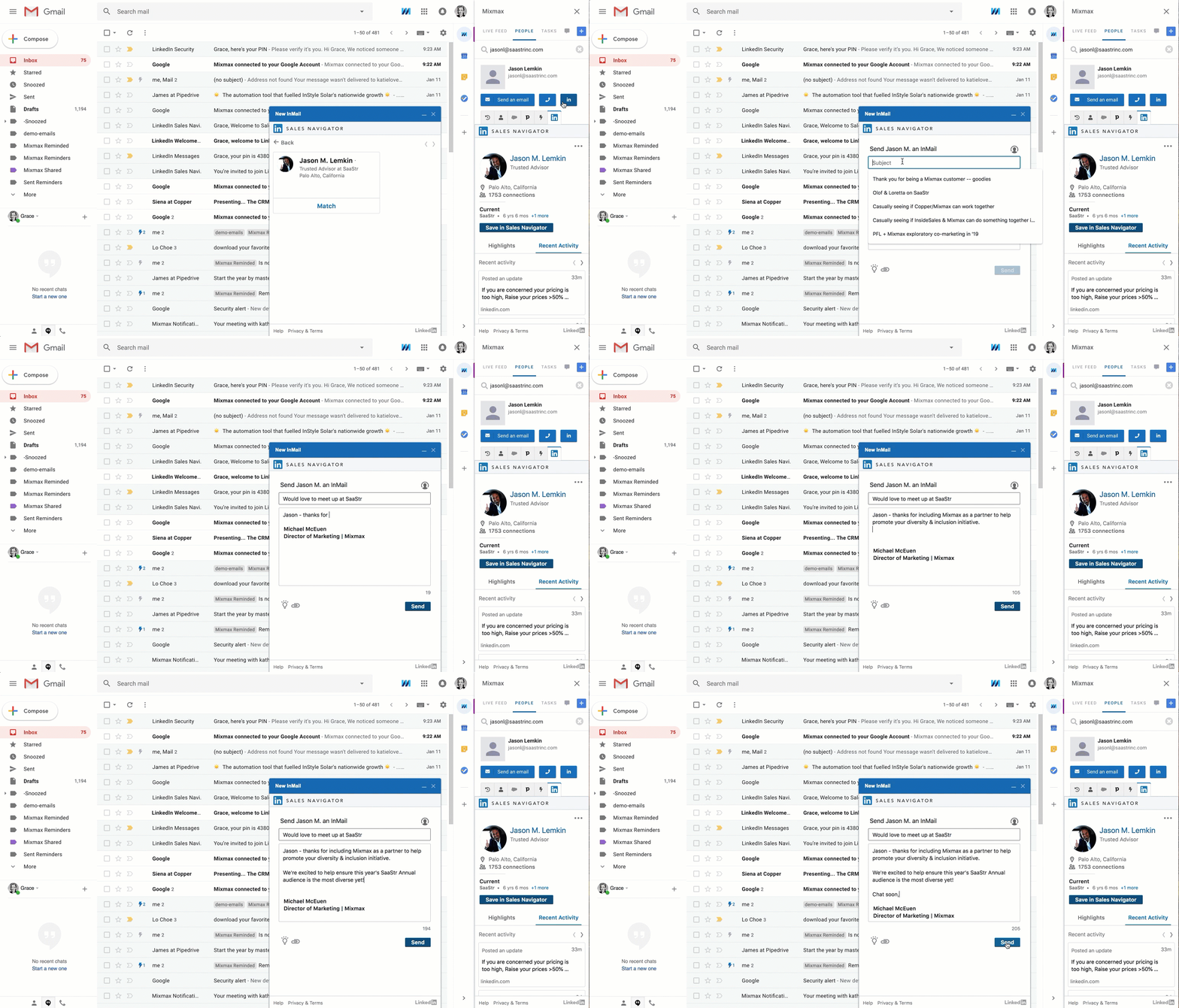
What’s more interesting in that the service now features a better integration with LinkedIn . There’s both an integration with the LinkedIn Sales Navigator, LinkedIn’s tool for generating sales leads and contacting them, and LinkedIn’s messaging tools for sending InMail and connection requests — and see info about a recipient’s LinkedIn profile, including the LinkedIn Icebreakers section — right from the Mixmax interface.

Together with its existing Salesforce integration, this should make the service even more interesting to sales people. And the Salesforce integration, too, is getting a bit of a new feature that can now automatically create a new contact in the CRM tool when a prospect’s email address — maybe from LinkedIn — isn’t in your database yet.

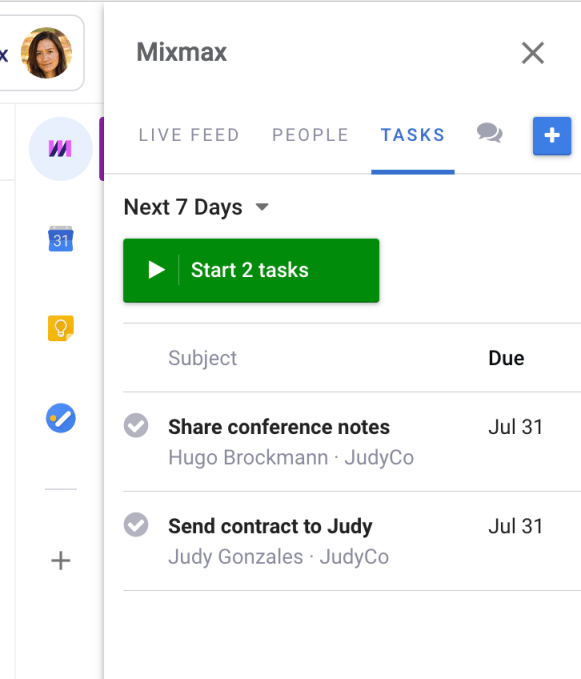
Also new in Mixmax 2.0 is something the company calls “Beast Mode.” Not my favorite name, I have to admit, but it’s an interesting task automation tool that focusing on helping customer-facing users prioritize and complete batches of tasks quickly and that extends the service’s current automation tools.

Finally, Mixmax now also features a Salesforce-linked dialer widget for making calls right from the Chrome extension.

“We’ve always been focused on helping business people communicate better, and everything we’re rolling out for Mixmax 2.0 only underscores that focus,” said Mixmax CEO and Co-Founder Olof Mathé. “Many of our users live in Gmail and our integration with LinkedIn’s Sales Navigator ensures users can conveniently make richer connections and seamlessly expand their networks as part of their email workflow.”

Whether you get these new features depends on how much you pay, though. Everybody, including free users, get access to the refreshed interface. Beast Mode and the dialer are available with the enterprise plan, the company’s highest-level plan which doesn’t have a published price. ThedDialer is also available for an extra $20/user/month on the $49/month/user Growth plan. LinkedIn Sales Navigator support is available with the growth and enterprise plans.

Sadly, that means that if you are on the cheaper Starter and Small Business plans ($9/user/month and $24/user/month respectively), you won’t see any of these new features anytime soon.

20 Feb 2019

Google’s managed hybrid cloud platform is now in beta

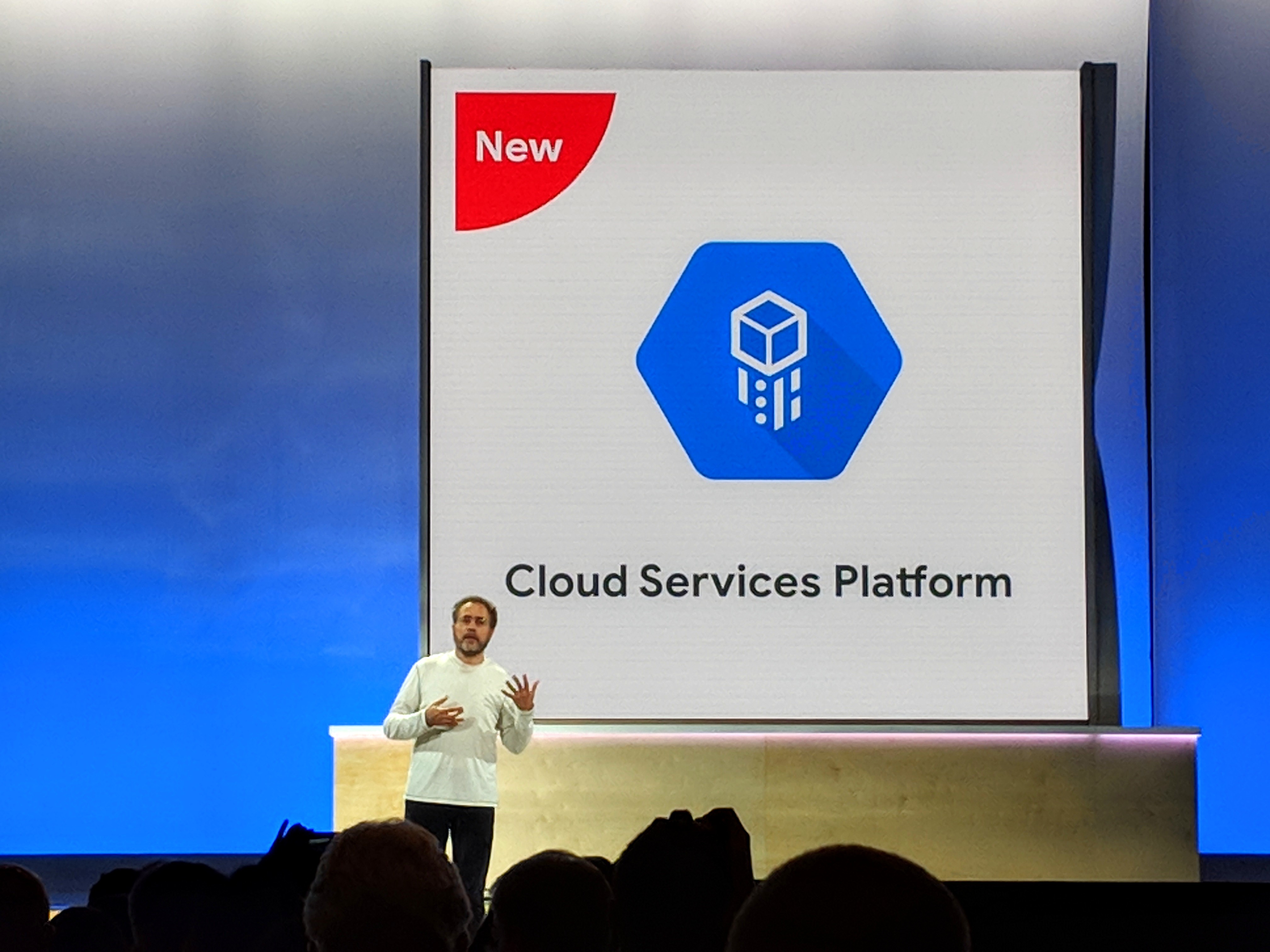
Last July, at its Cloud Next conference, Google announced the Cloud Services Platform, its first real foray into bringing its own cloud services into the enterprise data center as a managed service. Today, the Cloud Services Platform (CSP) is launching into beta.

It’s important to note that the CSP isn’t — at least for the time being — Google’s way of bringing all of its cloud-based developer services to the on-premises data center. In other words, this is a very different project from something like Microsoft’s Azure Stack. Instead, the focus is on the Google Kubernetes Engine, which allows enterprises to then run their applications in both their own data centers and on virtually any cloud platform that supports containers.As Google Cloud engineering director Chen Goldberg told me, the idea here it to help enterprises innovate and modernize. “Clearly, everybody is very excited about cloud computing, on-demand compute and managed services, but customers have recognized that the move is not that easy,” she said and noted that the vast majority of enterprises are adopting a hybrid approach. And while containers are obviously still a very new technology, she feels good about this bet on the technology because most enterprises are already adopting containers and Kubernetes — and they are doing so at exactly the same time as they are adopting cloud and especially hybrid clouds.

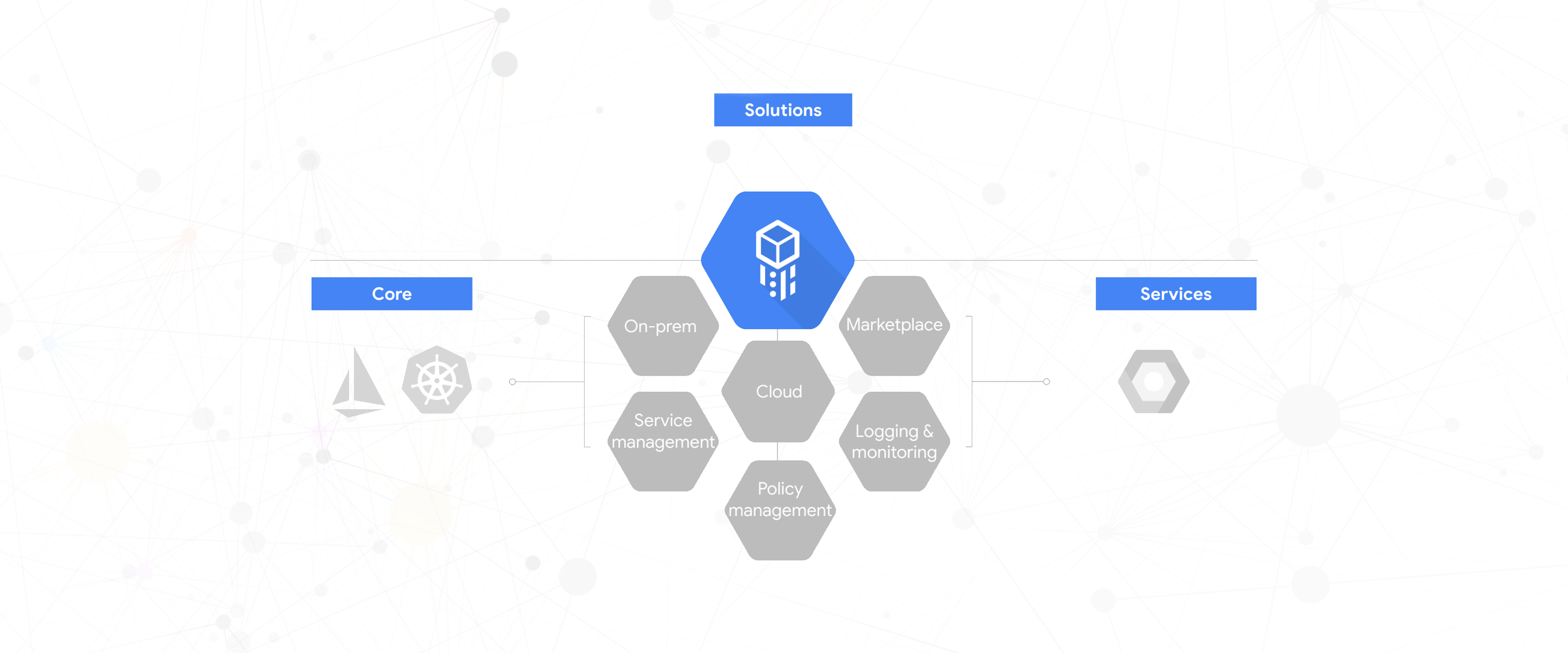
It’s important to note that CSP is a managed platform. Google handles all of the heavy lifting like upgrades and security patches. And for enterprises that need an easy way to install some of the most popular applications, the platform also supports Kubernetes applications from the GCP Marketplace.

As for the tech itself, Goldberg stressed that this isn’t just about Kubernetes. The service also uses Istio, for example, the increasingly popular service mesh that makes it easier for enterprises to secure and control the flow of traffic and API calls between its applications.

With today’s release, Google is also launching its new CSP Config Management tool to help users create multi-cluster policies and set up and enforce access controls, resource quotas and more. CSP also integrates with Google’s Stackdriver Monitoring service and continuous delivery platforms.

“On-prem is not easy,” Goldberg said, and given that this is the first time the company is really supporting software in a data center that is not its own, that’s probably an understatement. But Google also decided that it didn’t want to force users into a specific set of hardware specifications like Azure Stack does, for example. Instead, CSP sits on top of VMware’s vSphere server virtualization platform, which most enterprises already use in their data centers anyway. That surely simplifies things, given that this is a very well-understood platform.

20 Feb 2019

Timing and why we’re all VCs

Timing is the single most valuable skill of the modern economy, but I would argue its’s the least understood and also the least practiced.

Capitalism is fundamentally about timing, since market competition is about finding opportunities before others. When should you start a company? What company should you start? When should a VC invest? When should you join a company? When should you switch industries? When should you back a candidate for public office?

Every single one of our professional decisions is about timing, and yet, we do so little to practice and perfect it. Most employees only make 3-4 major career decisions in their lifetimes — hardly enough feedback for this skill to mature. Anyone who has worked in a large company further knows that timing a product launch or a new marketing strategy has more to do with internal politics than reading market forces.

Most of us want to make more money and accelerate our careers, but the truth is that these opportunities are few and far between. Most jobs have limited growth potential. Most startups die. Most VCs don’t make money. Most political candidates fail to get elected. The difference between success and failure sometimes has to do with hard work and tenacity, but far more often with the strategy of timing.

It’s obvious that we can be too late to these decisions of course. We can miss the round of financing, we can start a company a year or two behind someone else and lose the first-mover advantage. But we can also be way too early, ahead of the market and losing out on alternative opportunities that might have been more valuable.

Now, some perceive that “timing” is synonymous with “luck.” There is some truth there, in the sense that life is random and sometimes — completely unintentionally — people stumble upon a treasure chest of gold.

Don’t be distracted by that, because there are also people who just seem to have timing nailed. There are engineers (I know because I have seen their recruiter profiles) who have joined three unicorns in a row in the first handful of employees. There are VCs who get a string of wins that is far from chance. There are CEOs that always seem to guide their companies to the right place at the right time and drive their stock valuations up.

We talked a lot about why we can’t build infrastructure in America yesterday. One of the challenges is simply timing: so many things have to happen at once for these projects to get off the ground, and most governors and mayors lack the timing skills required to get them over the finish line.

How can you practice timing? Start writing down predictions about people, companies, and markets. Check in with the companies you talked with a few years ago — how are they doing? Ditto people you met a while back. Start evaluating your predictions: were they correct? Were they too early or too late?

More importantly, start cultivating networks of friends who have a sense of pulse on the frontiers of the economy. That could mean someone at the edge of a new science (quantum computing or AI) or someone who gets marketing to new demographics, or someone who tracks new regulatory and legal changes. Find a peer group of people who get timing and practice it as a craft.

Between TechCrunch today and my former roles in venture capital, I’ve had the opportunity to practice timing a lot. I have a list of companies that I would have backed, and some have turned into unicorns while others have ended up on the ash heap of history. I’ve predicted some trends well, while flubbed others. I’ve been way too early (a huge bias for me), and sometimes stupidly late.

But all along, I am practicing that timing muscle. It’s the only way forward in capitalism, and it’s worth every investment you can make.

Mithril Capital, management fees, and VC strategic drift

Peter Kim via Getty Images

Theodore Schleifer at Recode reported a rare deep dive into the internal intrigue at a prominent VC firm, in this case Mithril Capital. From the article:

Mithril had its best moment yet last week when a portfolio company, Auris Health, sold to Johnson & Johnson for more than $3 billion — returning at least $500 million to the fund.

All appears well. But behind the scenes, a far different story has been unfolding.

The late-stage investment firm has been a slow-burning mess for the past several months, angering current and former employees, limited partners, and, crucially, [Peter] Thiel himself, sources say.

Among the issues is the firm’s huge management fee … and I guess lack of expenses?

The firm is likely collecting as much as $20 million a year in management fees, sources familiar with the figures say.

We don’t know exactly how much the firm spends, but people close to Mithril say they can’t imagine that the firm, given its staff size, is spending more than half of that on operational expenses. [Mithril Capital founder Ajay] Royan’s salary, like that of other venture capitalists, is not publicly disclosed.

One limited partner called the fees, given the size of Mithril’s staff, “outrageous.”

What? I don’t understand this line of reasoning at all. The firm negotiates a fairly standard agreement with its limited partners, and then the LPs are pissed because the firm isn’t spending the money on massive staff and large, expensive offices? The whole point of delegating investment decisions to a GP is to empower them to organize their firm to win deals and get stuff done. If — and it’s a big if of course — they can do that on the cheap, then why should an LP care at all? Burn the management fee in a fireplace if it makes the deals happen.

Ajay Royan told Bloomberg in 2017 that Mithril does not “charge excessive fees.” But he was not exactly known for being thrifty with management money. Former employees describe Friday catered lunches where costs could run over $100 per person, and Royan was known internally for a “book ordering problem” — a former employee said that “unbelievable amounts of books” would be delivered each week to the office by Amazon to maintain the firm’s extensive library.

Pro tip: take on the mantle of book editor for a major tech publication, and the publishers will mail you books for free. We get at least a dozen at the TC offices every week, which is why we write about books so often around here these days. Alas, no $100 catered lunches.

The wider story here though appears to be one of a firm completely strategically adrift. Mithril is struggling to compete against ferocious competition in the growth-stage equity market. The best deals are obvious to dozens of firms, and the ones that are less obvious have huge risks attached to them that make it hard to write the big checks required.

“[Royan] literally did not want to compete. If there was a process or bidding war or something resembling a competition, he would just walk,” the employee said. “And he would just say, ‘I don’t want to outbid.’”

Mithril is hardly the only VC firm that is strategically adrift. Every time I go back to SF, this seems to be the norm these days among venture capitalists. There is a huge amount of money sloshing around, and very few deals that are in that sweet spot between obvious and highly risky. Startups either get three dozen term sheets or none at all, since every firm is walking around with the same frameworks and metrics in their head.

It’s so rare to actually hear a VC strategy that isn’t generic capital, that has some differentiation on sourcing, and picking, and growing businesses beyond the “we invest in great companies.” VCs don’t like strategy because it means making choices, and making choices means saying no to certain things, and those things might be the next Facebook. So they do everything, all the time, which really means they do nothing. And so we get book ordering problems and expensive lunches and weirdly angry LPs. What a boring mess.

Quality tech news from around the web

Written by Arman Tabatabai

Carl Larson Photography via Getty Images

South California is also seeing declining seed investment

Today, the Los Angeles Economic Development Corporation (LAEDC) published its updated economic forecast for LA and the Southern California region. One interesting note in the report is an observed slow down in early-stage venture investing. The report highlighted that while growth-stage investments in CA were hitting record highs, total deal count and seed investing — both in terms of total seed dollars and seed deal count — were at their lowest points since 2012.

The data points in LA, Southern CA, and the rest of the state seem to follow the trend of declining seed rounds seen in the rest of the country. While the topic is one we’ve previously discussed and one which has heated up in recent weeks with commentary from Marc Suster, Fred Wilson, and others, it’s interesting to see the trend occurring even in more nascent startup markets.

Will “Diet CA-HSR” even get done as feds look to pull back California funding

The federal government announced that it would be pulling back $1 billion in funding that was slated for the California high-speed rail project through 2022, while also pursuing legal action to help recoup the $2.5 billion it has already coughed up. The Federal Railroad Administration is arguing that the state’s updated plan — completing only a route from Bakersfield to Merced — is starkly different from the plan for which the funds were originally allocated. Ouch.

As stock exchanges compete to attract IPOs, unicorns and investors win?

It might be getting easier for companies to go public around the world. With ample late-stage capital keeping more companies staying private for longer, looser rules from the SEC and the Hong Kong Stock Exchange may be on the way to help entice more IPOs.

In the US, the SEC proposed allowing all companies to market themselves to investors before announcing IPOs versus just those that fall under the agency’s “emerging growth” definition. Across the Pacific, Bloomberg reported that Chinese tech companies have been lobbying the HK Exchange for a number of more favorable rules, including allowing companies to maintain extra voting rights and letting major shareholders buy extra stock in the process. With a serious number of Chinese companies opting to list on foreign exchanges last year, the HK Exchange might be feeling pressure to cough up concessions that could help them win local listings — especially if the US moves forward with friendlier rules.

How Japan lost half its citizens with poor data

The Japanese government failed to pay out billions of yen in government benefits for years due to faulty data. If that wasn’t bad enough, Nikkei Asian Review reported yesterday that the government is struggling to even locate roughly half of those who are owed since they don’t have their current addresses on file.

As simple as it may seem, tracking the indebted is actually a tall task since citizens have changed residences, changed names, and since the Japanese government has historically destroyed benefit applications (containing address info) after the period required to maintain them. At this point, it’s unclear whether everyone who is owed will even end up getting paid, with the Japanese government now offering a prime example of how poor data maintenance and not just poor data collection can make a situation go from bad to a whole lot worse.

Can the race to build roads in Southeast Asia avoid development gridlock?

As we harp on our “Why can’t we build anything?” obsession, infrastructure development in Southeast Asia is continuing to heat up and everyone seems to want a piece of the pie. Japan announced plans to further accelerate investment into infrastructure and urban development in the region — where China is also actively engaged — with initial expansion talks focused on Cambodia and the Philippines. At the same time, a newly unveiled government budget in Singapore and the ongoing election in Indonesia have brought infrastructure development strategies into the spotlight, with open debate on how these projects have been and should be funded.

Obsessions

  • More discussion of megaprojects, infrastructure, and “why can’t we build things”
  • We are going to be talking India here, focused around the book “Billonnaire Raj” by James Crabtree
  • We have a lot to catch up on in the China world when the EC launch craziness dies down. Plus, we are covering The Next Factory of the World by Irene Yuan Sun.
  • Societal resilience and geoengineering are still top-of-mind
  • Some more on metrics design and quantification

Thanks

To every member of Extra Crunch: thank you. You allow us to get off the ad-laden media churn conveyor belt and spend quality time on amazing ideas, people, and companies. If I can ever be of assistance, hit reply, or send an email to danny@techcrunch.com.

This newsletter is written with the assistance of Arman Tabatabai from New York

20 Feb 2019

Menlo Ventures just raised a new $500 million fund to invest in Series B and C rounds

Menlo Ventures, the 43-year-old venture firm with offices in Menlo Park and San Francisco, is currently investing a $450 million fund to invest primarily in early-stage consumer, enterprise and frontier technologies that it closed in 2017.

Now, it has a $500 million later-stage fund, too, the firm is announcing this morning.

Dubbed by its “inflection” fund, the fund looks like the second “opportunities” type fund for the firm, which had closed its first later-stage effort with $250 million in 2016. That said, its mandate appears broader than to simply back Menlo’s own breakout portfolio companies. Instead the fund will be investing between $20 million and $40 million in any promising companies that are seeing at least $5 million in annual recurring revenue, growth of 100 percent year over year, early signs of retention, and are operating in areas like cloud infrastructure, fintech, marketplaces, mobility, and SaaS (and targeting both consumers and enterprises).

The new fund is being led by partners Mark Siegel, Matt Murphy, Shawn Carolan, Tyler Sosin, Venky Ganesan and joined by Steve Sloane, whose recent promotion makes him the youngest partner in Menlo’s history.

Of course, in 2019, it’s hard not to notice that the partners really put the “men” in Menlo, though there is some, small movement toward greater gender parity at the firm. Specifically, last year, the firm brought aboard Naomi Pilosof Ionita as an investing partner focused on early-stage consumer deals. She’d previously been the VP of Growth at the invoicing and expenses app Invoice2go, and prior to that, a product lead at Evernote.

In the meantime, it’s probably safe to assume that Menlo had little problem raising the vehicle, given it has returned a bunch of money to its limited partners in the last 15 months: $2.4 billion says the firm.

According to our sources, that money that came via Uber’s secondary sale to SoftBank (Menlo had led Uber’s Series B round), the IPOs of both the streaming device company Roku and laser manufacturer nLight, and the $1 billionish acquisition by Amazon of the online pharmacy PillPack.

Another Menlo-backed company, Eero, a home mesh router startup, was acquired by Amazon last week. Terms were not disclosed.

Pictured above: Menlo Ventures’s investment team, across both its early and later-stage funds.

20 Feb 2019

How to watch Samsung unveil the Galaxy S10

Today’s the day we finally see the Galaxy S10 — well, officially, at least. As is the tradition with Samsung product launches, the news has already been leaking out at a furious pace. Here’s a decent breakdown of what we expect from the new flagship — though to be fair, plenty more leaks have surfaced since then, including an ad for the S10 and Galaxy Buds.

We also just got a name for the foldable phone we expect to debut alongside numerous new S10 models. That’s the Galaxy Fold, to you.

Of course, Samsung always announces a lot — so there are bound to be some surprises. Heck, the company didn’t splinter off from Mobile World Congress this year for nothing.

All will be revealed at this link, today, starting at 11AM PT (2PM ET). Meantime, here’s the official teaser to whet your collective appetites.

20 Feb 2019

New conflict evidence surfaces in JEDI cloud contract procurement process

For months, the drama has been steady in the Pentagon’s decade long, $10 billion JEDI cloud contract procurement process. This week the plot thickened when the DOD reported that it has found new evidence of a possible conflict of interest, and has reopened its internal investigation into the matter.

“DOD can confirm that new information not previously provided to DOD has emerged related to potential conflicts of interest. As a result of this new information, DOD is continuing to investigate these potential conflicts,” Elissa Smith, Department of Defense spokesperson told TechCrunch.

It’s not clear what this new information is about, but the Wall Street Journal reported this week that senior federal judge Eric Bruggink of the U.S. Court of Federal Claims ordered that the lawsuit filed by Oracle in December would be put on hold to allow the DOD to investigate further.

From the start of the DOD RFP process, there have been complaints that the process itself was designed to favor Amazon, and that were possible conflicts of interest on the part of DOD personnel. The DOD’s position throughout has been that it is an open process and that an investigation found no bearing for the conflict charges. Something forced the department to rethink that position this week.

Oracle in particular has been a vocal critic of the process. Even before the RFP was officially opened, it was claiming that the process unfairly favored Amazon. In the court case, it made the conflict part clearer, claiming that an ex-Amazon employee named Deap Ubhi had influence over the process, a charge that Amazon denied when it joined the case to defend itself. Four weeks ago something changed when a single line in a court filing suggested that Ubhi’s involvement may have been more problematic than the DOD previously believed.

At the time, I wrote:

In the document, filed with the court on Wednesday, the government’s legal representatives sought to outline its legal arguments in the case. The line that attracted so much attention stated, “Now that Amazon has submitted a proposal, the contracting officer is considering whether Amazon’s re-hiring Mr. Ubhi creates an OCI that cannot be avoided, mitigated, or neutralized.” OCI stands for Organizational Conflict of Interest in DoD lingo.

And Pentagon spokesperson Heather Babb told TechCrunch:

“During his employment with DDS, Mr. Deap Ubhi recused himself from work related to the JEDI contract. DOD has investigated this issue, and we have determined that Mr. Ubhi complied with all necessary laws and regulations,” Babb told TechCrunch.

Whether the new evidence that DOD has found is referring to Ubhi’s rehiring by Amazon or not, is not clear at the moment, but it has clearly found new evidence it wants to explore in this case, and that has been enough to put the Oracle lawsuit on hold.

Oracle’s court case is the latest in a series of actions designed to protest the entire JEDI procurement process. The Washington Post reported last spring that co-CEO Safra Catz complained directly to the president. The company later filed a formal complaint with the Government Accountability Office (GAO), which it lost in November when the department’s investigation found no evidence of conflict. It finally made a federal case out of it when it filed suit in federal court in December, accusing the government of an unfair procurement process and a conflict on the part of Ubhi.

The cloud deal itself is what is at the root of this spectacle. It’s a 10-year contract worth up to $10 billion to handle the DOD’s cloud business — and it’s a winner-take-all proposition. There are three out clauses, which means it might never reach that number of years or dollars, but it is lucrative enough, and could possibly provide inroads for other government contracts, that every cloud company wants to win this.

The RFP process closed in October and the final decision on vendor selection is supposed to happen in April. It is unclear whether this latest development will delay that decision.

20 Feb 2019

Google says Nest’s secret microphone was ‘never intended to be a secret’

Google said there’s absolutely, positively, nothing to worry about the secret microphone in your Nest Secure smart home hub that it didn’t tell you about. Nope, not at all. Just an oversight, said Google. No need to be alarmed. Everything is just fine.

When Google announced earlier this month that its Nest Secure would double-up as a Google Assistant, it sparked anger. Google hadn’t told anyone that the security hub had a microphone inside to begin with. There was no mention of the microphone on the initial list of tech specifications, nor was it mentioned after the company announced Google Assistant integration. (It’s there now.)

After Google, which owns Nest, realized its customers didn’t like being deceived or having their privacy violated, the company swallowed its pride and admitted fault

“The on-device microphone was never intended to be a secret and should have been listed in the tech specs,” said Google spokesperson Nicol Addison in an email to TechCrunch. “That was an error on our part. The microphone has never been on and is only activated when users specifically enable the option.”

Business Insider first reported the news.

Google said that security systems “often use microphones to provide features that rely on sound sensing and included the microphone so it could “potentially offer additional features to our users in the future, such as the ability to detect broken glass.”

No doubt it’s a smart, if not terribly executed idea.

You can forgive a company for not wanting to drop the ball on its own future product line-up announcements, but not disclosing the inclusion of a microphone in a device that sits in your home just looks bad. And it couldn’t come at a worst time for tech giants, as they try to clamber back any ounce of respect they have from privacy-conscious consumers.

It makes you wonder how many other devices you have in your home — and out in the world — that could be used to spy on you.

Just this week, Singapore Airlines landed itself in hot water after passengers discovered cameras embedded in the in-flight entertainment systems. The airline said in a tweet that the cameras were included as standard by the original manufacturer and that it has “no plans to enable or develop any features using the cameras.”

No plans doesn’t mean “never.” And, just like the Nest device, the customer would have no way of knowing if it was in use anyway.

20 Feb 2019

Sports streaming service fuboTV expands its lineup with Viacom’s entertainment channels

Sports streaming service fuboTV and Viacom this morning announced a new carriage deal that will see fuboTV carry Viacom’s entertainment networks as a part of its TV packages. The deal includes channels like MTV, Nickelodeon, Nick Jr., BET, CMT, Comedy Central, VH1, Paramount Network, TeenNick and many others. A selection of these will be added to fuboTV’s base package, while an expanded group of channels will be made available to fuboTV’s premier package, “fubo Extra.”

FuboTV originally began as a soccer-focused streaming service, but the company has been steadily expanding its lineup beyond sports channels in recent months. Today, it’s carrying networks like CBS, AMC, NBC and FX, for example, and now describes itself as a “sports-first streaming service.”

That is to say, fuboTV is positioning itself to cord cutters as the service to choose if you’re ditching traditional pay TV, but mostly care about access to sports — with a little entertainment mixed in for variety.

As of last fall, fuboTV had grown to nearly 250,000 subscribers.

The new deal with Viacom will make fuboTV even more of a competitor to rival live TV streaming services like Sling TV, DirecTV Now and Philo — all of which also carry Viacom’s channels.

Viacom says it’s making its nine core media networks — BET, CMT, Comedy Central, MTV, Nickelodeon, Nick Jr., Paramount Network, TV Land and VH1 — available to fuboTV’s base package, “fubo.” Those included in the “fubo Extra” package will include BET Her, BET Jams, BET Soul, Logo, MTV2, MTV Classic, MTV Live, mtvU, Nick Music, Nicktoons and TeenNick.

Meanwhile, fuboTV’s Spanish-language package, “fubo Latino,” will receive Viacom’s Telefe and MTV Tr3s networks.

The deal will bring some of Viacom’s top shows to the sports streaming service, like Comedy Central’s “The Daily Show,” MTV’s “Jersey Shore: Family Vacation,” Nickelodeon’s “Rise of the Teenage Mutant Ninja Turtles” and others.

“FuboTV is quickly evolving as a major force in the streaming television space, and the addition of Viacom’s media networks as a cornerstone of fuboTV’s entertainment offering demonstrates the power and popularity of our global brands and programming,” said Tom Gorke, EVP, head of Distribution and Business Development, for Viacom, in a statement. “This is a great opportunity to continue to grow our reach and audiences across the OTT landscape and connect with our fans wherever they consume content,” he added.

The move to offer further entertainment comes at a time when fuboTV’s rivals — like Dish’s Sling TV and AT&T’s DirecTV Now — are seeing declining growth, as the streaming TV space becomes more competitive. Customers now have several choices in this market — and with the rising prices of over-the-top live TV, they expect to get a well-designed, stable and expansive selection of channels on whichever service to which they choose to subscribe.

FuboTV has been able to capitalize on this demand by targeting cord cutters with a service that has had to work well from day one in order to keep up with the demands of streaming live sports, while also rolling out more advanced features like recommendations and support for 4K HDR, for example.

With this significant expansion into entertainment programming through the Viacom deal, fuboTV may be able to pick up more subscribers who are frustrated with the more basic streaming services offered by Dish and AT&T. These customers may not have previously considered fuboTV because it didn’t have as many entertainment options as others.

The Viacom channels have not yet gone live on fuboTV, but will be available “soon,” the companies said, without providing an exact launch date.

20 Feb 2019

QuizUp founder launches Teatime, a mobile gaming platform with built-in video chat

At the end of 2016, Plain Vanilla founder Thor Fridriksson left the company he founded with the intent to take at least a year off of work.

His product QuizUp, a social trivia game that raised more than $40 million and said it had more than 100 million users, never truly found a way to monetize. After a few missteps, including a proposed TV deal that eventually got cancelled, Plain Vanilla was acquired by Glu Mobile for a deal reportedly valued at $7.5 million.

Fridriksson was only a few weeks into his planned yearlong vacation when he became restless and asked a few members of his core team at QuizUp — Gunnar Holmsteinn, Johann Thorvaldur Bergthorsson, and Ymir Finnbogason — to start brainstorming with him about the future of mobile gaming.

That’s where the seed was planted for what would eventually become Teatime.

“The main thing we kept focusing on, and it seems straightforward and common sense but these things often do in retrospect, is why people play games,” said Fridriksson. “One of the main value propositions of playing a game is not about the game itself but about the human interaction you have while playing with someone – talking to the people you’re playing with and seeing their reactions.”

Teatime Live is a mobile gaming platform that allows users to interact with one another, face to face, while playing games on their phone through a built-in video chat. On top of the video chat, Teatime Live offers users Snapchat-style face filters called Game Faces, that are unique to each individual game on the platform. Players can take their earned game faces from one game to other games, and eventually, Fridriksson sees the opportunity for these items to be collectibles.

Most forms of games or sports have a social element built in. Whether it’s board games or physical sports or even video games, players have been able to communicate with one another in some way shape or form. That simply hasn’t been the case on mobile, which means that it’s still unclear what the best possible game for this platform looks like.

Teatime is debuting the platform with Hyperspeed, a simple racer game that the company developed in house. Teatime will continue to operate as a studio and build out other titles on top of the Teatime Live platform, but it also plans to work alongside other game developers as a publishing partner.

There are obvious concerns around enabling live video chat among strangers across the internet, and Teatime has tried to take steps toward preventing abuse.

To start, users are not allowed to play Teatime games as a guest. All players must sign up with Facebook, Gmail, or a phone number, which means bad actors will have a more taxing time getting back on the platform with a new username.

More importantly, Teatime’s game-face filters require facial recognition technology, which means that the system knows when there is no face visible in the camera. Unless a user is playing with someone that they’ve friended, Teatime will blur the picture whenever a face isn’t visible in the camera.

As per usual, Teatime also has a team of moderators going through profile pictures, etc. and a user reporting system.

Teatime hopes to build games around relatively proven models in mobile gaming to earn revenue on its own games, while sharing revenue with other game developers who build on the platform.

Teatime has raised $9 million in Series A funding from Atomico and Index Ventures.

20 Feb 2019

MLG cofounder Mike Sepso joins 100 Thieves board of directors

Mike Sepso has joined the board of directors for 100 Thieves, an esports and content creation brand.

Sepso cofounded Major League Gaming in 2002, bringing the first true semblance of infrastructure to competitive gaming. MLG became the biggest independent esports league in the world, and played a big part in the evolution of esports as we know it today. In fact, MLG secured the first televised esports series ever with NBC sports, and eventually launched its own esports streaming platform.

MLG was acquired for $46 million by Activision Blizzard in 2016, but still lives as an esports content hub for Activision Blizzard titles like Call of Duty and Overwatch.

Sepso joins the 100 Thieves board alongside 100 Thieves founder and CEO Matthew “Nadeshot” Haag, President and COO John Robinson, Jake Cohen from Detroit Venture Partners, and Scooter Braun (entertainment industry mogul who represents Justin Bieber and Ariana Grande) on the 100 Thieves board of directors.

“Mike is the godfather of esports,” said Haag. “The most influential thing that happened in my career was seeing Halo 2 competitions on Major League Gaming on TBS on the weekends. It was just mind-blowing that kids like me could play games competitively.”

Currently, Sepso serves as chariman and cofounder of the Electronic Sports Group, which is an advisory firm for executives across the finance, media, advertising and sports industries as they navigate esports deals.

“[Haag] been able to move quickly and build something that transcends esports and esports teams and has became an increasingly significant mainstream brand, and that opens up a lot of business opportunities,” said Sepso. “The strategy that 100 Thieves has put in place, using esports and gaming personalities as a way to bring this brand to market, I think it could eventually be much more than that.”

Before founding 100 Thieves, Haag was a decorated pro player in his own right and continues to be a popular Twitch streamer and YouTuber. Many esports orgs are founded by former pros, but Haag has taken a Silicon Valley approach to building out 100 Thieves, at least with regards to pace.

100 Thieves built out professional teams for a variety of titles very quickly. The company also secured capital from the likes of Sequoia, Marc Benioff, Drew Houston, Dan Gilbert, Tao Capital and Advancit Capital. Alongside traditional VCs and tech angels, 100 Thieves has also gotten investment from Scooter Braun and Drake.

Total funding for the org is $25 million.

Beyond titles and professional teams, 100 Thieves is diversifying its product early as well, with a content creator house and a line of apparel coming this spring.

The company recently signed a deal with Totinos (yes, the pizza rolls) that includes an upcoming docuseries that offers a look behind the scenes at the 100 Thieves Call of Duty team.