Author: azeeadmin

20 Feb 2019

Arm expands its push into the cloud and edge with the Neoverse N1 and E1

For the longest time, Arm was basically synonymous with chip designs for smartphones and very low-end devices. But more recently, the company launched solutions for laptops, cars, high-powered IoT devices and even servers. Today, ahead of MWC 2019, the company is officially launching two new products for cloud and edge applications, the Neoverse N1 and E1. Arm unveiled the Neoverse brand a few months ago, but it’s only now that it is taking concrete form with the launch of these new products.

“We’ve always been anticipating that this market is going to shift as we move more towards this world of lots of really smart devices out at the endpoint — moving beyond even just what smartphones are capable of doing,” Drew Henry, Arms’ SVP and GM for Infrastructure, told me in an interview ahead of today’s announcement. “And when you start anticipating that, you realize that those devices out of those endpoints are going to start creating an awful lot of data and need an awful lot of compute to support that.”

To address these two problems, Arm decided to launch two products: one that focuses on compute speed and one that is all about throughput, especially in the context of 5G.
ARM NEOVERSE N1

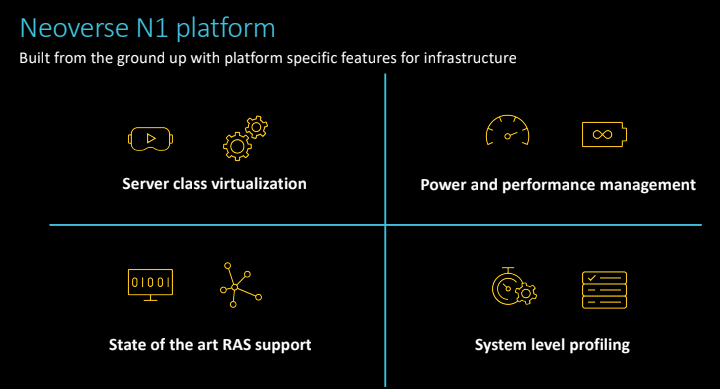
The Neoverse N1 platform is meant for infrastructure-class solutions that focus on raw compute speed. The chips should perform significantly better than previous Arm CPU generations meant for the data center and the company says that it saw speedups of 2.5x for Nginx and MemcacheD, for example. Chip manufacturers can optimize the 7nm platform for their needs, with core counts that can reach up to 128 cores (or as few as 4).

“This technology platform is designed for a lot of compute power that you could either put in the data center or stick out at the edge,” said Henry. “It’s very configurable for our customers so they can design how big or small they want those devices to be.”

The E1 is also a 7nm platform, but with a stronger focus on edge computing use cases where you also need some compute power to maybe filter out data as it is generated, but where the focus is on moving that data quickly and efficiently. “The E1 is very highly efficient in terms of its ability to be able to move data through it while doing the right amount of compute as you move that data through,” explained Henry, who also stressed that the company made the decision to launch these two different platforms based on customer feedback.

There’s no point in launching these platforms without software support, though. A few years ago, that would have been a challenge because few commercial vendors supported their data center products on the Arm architecture. Today, many of the biggest open-source and proprietary projects and distributions run on Arm chips, including Red Hat Enterprise Linux, Ubuntu, Suse, VMware, MySQL, OpenStack, Docker, Microsoft .Net, DOK and OPNFV. “We have lots of support across the space,” said Henry. “And then as you go down to that tier of languages and libraries and compilers, that’s a very large investment area for us at Arm. One of our largest investments in engineering is in software and working with the software communities.”

And as Henry noted, AWS also recently launched its Arm-based servers — and that surely gave the industry a lot more confidence in the platform, given that the biggest cloud supplier is now backing it, too.


20 Feb 2019

Xage brings role-based single sign-on to industrial devices

Traditional industries like oil and gas and manufacturing often use equipment that was created in a time when remote access wasn’t a gleam in an engineer’s eye, and hackers had no way of connecting to them. Today, these devices require remote access and some don’t have even rudimentary authentication. Xage, the startup that wants to make industrial infrastructure more secure, announced a new solution today to bring single sign-on and role-based control to even the oldest industrial devices.

Company CEO Duncan Greatwood says that some companies have adopted firewall technology, but if a hacker breaches the firewall, there often isn’t even a password to defend these kinds of devices. He adds that hackers have been increasingly targeting industrial infrastructure.

Xage has come up with a way to help these companies with its latest product called Xage Enforcement Point (XEP). This tool gives IT a way to control these devices with a single password, a kind of industrial password manager. Greatwood says that some companies have hundreds of passwords for various industrial tools. Sometimes, whether because of distance across a factory floor, or remoteness of location, workers would rather adjust these machines remotely when possible.

While operations wants to simplify this for workers with remote access, IT worries about security and the tension can hold companies back, force them to make big firewall investments or in some cases implement these kinds of solutions without adequate protection.

XEP helps bring a level of protection to these pieces of equipment. “XEP is a relatively small piece of software that can run on a tiny credit-card size computer, and you simply insert it in front of the piece of equipment you want to protect,” Greatwood explained.

The rest of the Xage platform adds additional security. The company introduced fingerprinting last year, which gives unique identifiers to these pieces of equipment. If a hacker tries to spoof a piece of equipment, and the device lacks a known fingerprint, they can’t get on the system.

Xage also makes use of the blockchain and a rules engine to secure industrial systems. The customer can define rules and use the blockchain as an enforcement mechanism where each node in the chain carries the rules, and a certain number of nodes as defined by the customer, must agree that the person, machine or application trying to gain access is a legitimate actor.

The platform taken as a whole provides several levels of protection in an effort to discourage hackers who are trying to breach these systems. Greatwood says that while companies don’t usually get rid of tools they already have like firewalls, they may scale back their investment after buying the Xage solution.

Xage was founded at the end of 2017. It has raised $16 million to this point and has 30 employees. Greatwood didn’t want to discuss a specific number of customers, but did say they were making headway in oil and gas, renewable energy, utilities and manufacturing.

20 Feb 2019

UK’s extended 5km airport drone ‘no-fly’ zones in force next month

The UK’s Department for Transport has said today that an expansion of drone ‘no-fly’ zones to 5km around airport runways will come into force on March 13.

Anyone caught and convicted of flying a drone inside the restricted zones could face a fine and years in prison.

Last month the government said it would tighten restrictions on drones flights around airports, after the existing 1km limit was criticized for being inadequate — saying it believes expanded no-fly zones will help protect airports from drone misuse.

The 1km drone exclusion zone around airports, and a 400ft drone flight height restriction rule, only came into force last July. But ministers came in for sharp criticism following the Gatwick Airport drone fiasco when a spate of drone sightings near the UK’s second busiest airport caused a temporary shutdown of the runway and travel disruption for thousands of people right before Christmas.

Heathrow, the UK’s busiest airport, also briefly halted departures after further sightings of drones last month.

“The law is clear that flying a drone near an airport is a serious criminal act. We’re now going even further and extending the no-fly zone to help keep our airports secure and our skies safe,” said transport secretary, Chris Grayling, in a statement today.

“We are also working to raise awareness of the rules in place. Anyone flying their drone within the vicinity of an airport should know they are not only acting irresponsibly, but criminally, and could face imprisonment.”

The government and the Civil Aviation Authority have announced a partnership with online retailer Jessops to help raise public awareness about the new drone rules — and encourage what they dub “responsible drone use” — as part of a national awareness campaign.

The government also said work is continuing on a new Drones Bill. Although the planned legislation is already almost a year behind schedule — and is still only slated for introduction “in due course”.

The bill will give police officers powers to stop and search people suspected of using drones maliciously above 400ft or within 5km of an airport, the government said.

It added that the planned legislation will give additional new powers to the police to clamp down on those misusing drones and other small unmanned aircraft, including the power to access electronic data stored on a drone with a warrant.

Additional powers for police were trailed back in 2017 when the drone bill was first floated by the government. It re-announced its intention to beef up police powers to tackle drone misuse last month following the Gatwick fiasco.

The government added today that the Home Office is still reviewing the UK’s approach to countering the malicious use of drones, writing that it will “consider how best to protect the full range of the UK’s critical national infrastructure — including testing and evaluating technology to counter drones”.

In related news this month, drone maker DJI announced upgrades to its geofencing systems across Europe — applying stricter and more detailed restrictions around airports and other sensitive sites after switching its mapping data provider from US based AirMap to UK based Altitude Angel.

20 Feb 2019

Xiaomi’s Mi 9 includes a triple lens rear camera and wireless charging

Mobile World Congress, the mobile industry’s annual shindig, is next week but Xiaomi can’t wait reveal its newest top-end phone. The Chinese company instead picked today to unveil the Mi 9.

Once again Xiaomi’s design ethic closely resembles Apple’s iPhone with a minimal bezel and notch-like front-facing camera but Xiaomi has gone hard on photography with a triple lens camera.

There are two models available with the regular Mi 9 priced from RMB 2999, or $445, and the Mi 9SE priced from RMB 1999, or $300. A premium model, the Transparent Edition, includes beefed-up specs for RMB 3999, $595.

The phone runs on Qualcomm’s Snapdragon 855 chipset and the headline feature, or at least the part that Xiaomi is shouting about most, is the triple lens camera array on the back of the device. That trio combines a 48-megapixel main camera with a 16-megapixel ultra-wide-angle camera and a 12-megapixel telephoto camera, Xiaomi said. The benefits of that lineup is improved wide-angle shots, better quality close-up photography and performance in low-light conditions, according to the company.

The premium Mi 9 model, the Transparent Edition, sports 12GB of RAM and 256GB internal storage and features a transparent back cover

There’s also a ‘supermoon’ mode for taking shots of the moon and presumably other night sky images, while Xiaomi touts an improved night mode and, on the video side, 960fps capture and advanced motion tracking. We haven’t had the chance to test these out, which is worth noting at this point.

Xiaomi also talked up the battery features of the Mi 9, which ships with an impressive 3300mAh battery that features wireless charging support and Qi EPP certification meaning it will work with third-party charging mats. Xiaomi claims that the Mi 9 can charge to 70 percent in 30 minutes, and reach 100 percent in an hour using 27W wired charging.

Alongside the Mi 9, it unveiled its third three wireless charging products — a charging pad (RMB 99, $15), a car charger (RMB 169, $25) and a 10,000mAh wireless power bank (RMB 149, $22.)

Xiaomi, as ever, offers a range of different options for customers as follows:

  • Mi 9 with 6GB and 128GB for RMB 2999, $445
  • Mi 9 with 8GB and 128GB for RMB 3299, $490
  • Mi 9 with 12GB and 256GB for RMB 3999, $595 (Transparent Edition)
  • Mi 9SE with 6GB and 128GB for RMB 1999, $300
  • Mi 9SE with 6GB and 128GB for RMB 2299, $342

Notably, the Mi 9 goes on sale February 26 — pre-orders open this evening — with the SE version arriving on March 1. As expected, the launch market is China but you can imagine that India — where Xiaomi is among the top players — and other global launches will follow.

Xiaomi said it plans to announce more products on Sunday, the eve of Mobile World Congress. It recently teased a foldable phone so it’ll be interesting to see if it will follow suit and join Samsung, which had its first foldable phone outed by a leak.

Note: The original version of this article was updated to correct the Transparent Edition price and specs.

20 Feb 2019

Selfie app maker Meitu eyes overseas gaming market with $340 million deal

China’s largest selfie app maker Meitu has been busy working to diversify itself beyond the beauty arena in China. On Wednesday, the Hong Kong-listed company announced in a filing that it has agreed to pay about HK$2.7 billion ($340 million) for a 31 percent stake in game publishing company Dreamscape Horizon.

Dreamscape Horizon, a subsidiary of Hong Kong-listed games group Leyou, specializes in making video games for personal computers and consoles and owns 97 percent of Canada-based studio Digital Extremes. This global connection will potentially hasten Meitu’s overseas expansion and the foray into games, on the other hand, will help the Xiamen-based firm capture more male users. (Operating out of Xiamen might have also been convenient for Meitu to meet the coastal city’s booming hub of game developers.) Out of Meitu’s 110 million monthly active users overseas, only 30 million are male.

“The collaboration with Leyou is not only focused on mainland China but also the global market,” says a Meitu spokesperson in a statement. “Mainland China currently accounts for the majority of Meitu’s earnings. The acquisition will broaden our business scope and diversify the geographic streams of our income.”

The overseas move appears to be a tactful one as the domestic gaming market is crowded with established players like Tencent, NetEase and hundreds of smaller contenders. The local environment has also turned hostile to gaming companies as Beijing steps up scrutiny amid concerns of titles being violent and harmful to young players. The result was a months-long halt in game approvals that dragged down Tencent’s stock prices and prompted a major reshuffle in the giant. And before long Tencent announced it would deepen its ties with Garena to distribute games in Southeast Asia. The hiatus ended in December, but companies are still feeling the chill as China is reportedly mulling a further pause this week.

Meitu is most famous for its suite of photo-editing and beautifying apps, but hardware has been its major income source for years. For the first half of 2018, the company generated 72 percent of its revenues from selling smartphones optimized for taking selfies, a category proven popular in a country where touched-up photos have become the norm. But Meitu’s hardware business is shrinking as smartphone shipment slows in China and phones from mainstream brands like Xiaomi and Huawei now come equipped with filters. It has, however, found a new home for its barely mainstream smartphone brand after Xiaomi gobbled it up in November to lure more female users.

20 Feb 2019

Why Daimler moved its big data platform to the cloud

Like virtually every big enterprise company, a few years ago, the German auto giant Daimler decided to invest in its own on-premises data centers. And while those aren’t going away anytime soon, the company today announced that it has successfully moved its on-premises big data platform to Microsoft’s Azure cloud. This new platform, which the company calls eXtollo, is Daimler’s first major service to run outside of its own data centers, though it’ll probably not be the last.

As Daimler’s head of its corporate center of excellence for advanced analytics and big data Guido Vetter told me, that the company started getting interested in big data about five years ago. “We invested in technology — the classical way, on-premise — and got a couple of people on it. And we were investigating what we could do with data because data is transforming our whole business as well,” he said.

By 2016, the size of the organization had grown to the point where a more formal structure was needed to enable the company to handle its data at a global scale. At the time, the buzzword was ‘data lakes’ and the company started building its own in order to build out its analytics capacities.

Electric Line-Up, Daimler AG

“Sooner or later, we hit the limits as it’s not our core business to run these big environments,” Vetter said. “Flexibility and scalability are what you need for AI and advanced analytics and our whole operations are not set up for that. Our backend operations are set up for keeping a plant running and keeping everything safe and secure.” But in this new world of enterprise IT, companies need to be able to be flexible and experiment — and, if necessary, throw out failed experiments quickly.

So about a year and a half ago, Vetter’s team started the eXtollo project to bring all the company’s activities around advanced analytics, big data and artificial intelligence into the Azure Cloud and just over two weeks ago, the team shut down its last on-premises servers after slowly turning on its solutions in Microsoft’s data centers in Europe, the U.S. and Asia. All in all, the actual transition between the on-premises data centers and the Azure cloud took about nine months. That may not seem fast, but for an enterprise project like this, that’s about as fast as it gets (and for a while, it fed all new data into both its on-premises data lake and Azure).

If you work for a startup, then all of this probably doesn’t seem like a big deal, but for a more traditional enterprise like Daimler, even just giving up control over the physical hardware where your data resides was a major culture change and something that took quite a bit of convincing. In the end, the solution came down to encryption.

“We needed the means to secure the data in the Microsoft data center with our own means that ensure that only we have access to the raw data and work with the data,” explained Vetter. In the end, the company decided to use thethAzure Key Vault to manage and rotate its encryption keys. Indeed, Vetter noted that knowing that the company had full control over its own data was what allowed this project to move forward.

Vetter tells me that the company obviously looked at Microsoft’s competitors as well, but he noted that his team didn’t find a compelling offer from other vendors in terms of functionality and the security features that it needed.

Today, Daimler’s big data unit uses tools like HD Insights and Azure Databricks, which covers more than 90 percents of the company’s current use cases. In the future, Vetter also wants to make it easier for less experienced users to use self-service tools to launch AI and analytics services.

While cost is often a factor that counts against the cloud since renting server capacity isn’t cheap, Vetter argues that this move will actually save the company money and that storage cost, especially, are going to be cheaper in the cloud than in its on-premises data center (and chances are that Daimler, given its size and prestige as a customer, isn’t exactly paying the same rack rate that others are paying for the Azure services).

As with so many big data AI projects, predictions are the focus of much of what Daimler is doing. That may mean looking at a car’s data and error code and helping the technician diagnose an issue or doing predictive maintenance on a commercial vehicle. Interestingly, the company isn’t currently bringing any of its own IoT data from its plants to the cloud. That’s all managed in the company’s on-premises data centers because it wants to avoid the risk of having to shut down a plant because its tools lost the connection to a data center, for example.

20 Feb 2019

eMarketer predicts digital ads will overtake traditional spending in 2019

This is the year when the money spent on digital advertising will finally overtake spending on traditional ads — at least according to the latest forecast from eMarketer.

The research firm is predicting that U.S. digital ad spend will increase 19.1 percent this year, to $129.3 billion, while traditional advertising will fall 19 percent, to $109.5 billion. That means digital will account for 54.2 percent of the total, while traditional will only represent 45.8 percent.

Not surprisingly, most of the digital ad money is going to Google and Facebook . However, eMarketer says Google’s share of the market will actually decline, from 38.2 percent last year to 37.2 percent this year, and Facebook’s share will only grow slightly, from 21.8 percent to 22.1 percent.

emarketer forecast

Apparently, Amazon is the main beneficiary here, with its U.S. ad business set to expand by more than 50 percent, accounting for 8.8 percent of total spend.

“The [Amazon] platform is rich with shoppers’ behavioral data for targeting and provides access to purchase data in real-time,” said eMarketer forecasting director Monica Peart in a statement. “This type of access was once only available through the retail partner, to share at their discretion. But with Amazon’s suite of sponsored ads, marketers have unprecedented access to the ‘shelves’ where consumers are shopping.”

The firm also forecasts that by 2023, digital will account for more than two-thirds of total ad spending.

20 Feb 2019

Resooma launches Resooma Bills to help ‘generation rent’ manage household expenditure

Resooma, the U.K. accommodation booking platform, is entering the fintech and utilities space with the launch of Resooma Bills, a new product to help “gen rent” manage household expenditure. The Cardiff, Wales-based company’s core offering is an accommodation marketplace primarily targeting students and other renters aged 18-30.

Previously trading under the brand name of University Cribs, Resooma was founded in 2014 by Jack Jenkins, Dan Jefferys and Christian Samuel as a solution aimed specifically at the student lettings market. The company has since broadened its remit to “fix the outdated methods” of renting a home and living together in shared accommodation.

“The existing processes, much of which [are] sitting offline, was a total mess and the numbers of people who have to experience it is climbing rapidly,” says co-founder Jenkins. “With more people living in shared accommodation post University life, we aim to appeal to a time constrained user base that want instant gratification from the products and services they use. We’re building a solution for generation rent”.

As a first step, Resooma set out to eradicate the viewing process, or at least make it digital, and help facilitate bookings online. This includes rolling out “VR tours” for homes, in a bid to gain the trust of renters booking online. “Student and young professionals are time sensitive, often nomadic in choosing where they work and live and as such our platform needs to cater for this,” says Jenkins. The startup also has plans to introduce rental guarantees and “Resooma Verified” stamps for rentals.

“Interestingly, we brand ourselves as a booking platform, a relatively unused term in the market we are in. People are used to booking directly on platforms for short-term accommodation, with the rise of Airbnb and Booking.com but our goal is to make this the norm for people renting medium or longer term homes,” adds the Resooma co-founder.

Jenkins says the next problem the company wants to solve is around utilities and the splitting of household bills. “We’ve all sat there in our new home, admiring the wall paper for the first 2 weeks while we wait for the internet or Sky TV to be set up. It’s brainless really, and we’re fixing it,” he says.

“Our product journey will put utilities as part of the rental transaction, allowing users to set up their household bills directly through the platform at the time of booking. What’s more, we’ll allow you to split these bills evenly between all tenants. No more arguments because Tom didn’t pay for his share of the internet bill. Our solution will track utility payments, aim to source the cheapest deals for our customers and then automatically issue each of the housemates one single bill each month for their share of the total house bills.

“While part of the full product vision of Resooma, Resooma Bills will sit as a standalone product as well to allow users the flexibility to use the service for homes found away from the Resooma platform”.

Asked to name Resooma’s competitors, Jenkins says the likes of Spotahome or Uniplaces are probably its most direct competition from a product perspective. “We differentiate ourselves through our adaptation of the utilities, as well as our focus on working with letting agents rather than directly with Landlords,” he says.

With regards to utilities and bill splitting, London-based Acasa could also been considered a very direct competitor.

20 Feb 2019

German insurance giant Allianz increases its VC fund to $1.1 billion

Allianz X, the venture capital arm attached to German insurance giant Allianz, has increased the size of its fund to €1 billion, around $1.1 billion, according to an announcement made today. The fund was initially €430 million, or around $490 million, when it launched in 2016.

This new injection comes directly from parent Allianz SE, the 124-year-old insurer which did €130 billion ($150 billion) in revenue last year, and it makes Allianz X one of the largest active startup investment vehicles in Europe. While it is anchored in Europe, the fund’s investment thesis and focus is very much a global one.

It has made 15 deals to date with a focus on growth-stage investments in startups such as emerging market-focused microinsurance company BIMA, Southeast Asian ride-hailing unicorn Go-Jek, U.S-based capital marketplace C2FO and European challenger bank N26.

Allianz X, which initially began as an in-house incubation venture, is now looking to go after more of the same with its enlargened kitty but it also plans to get to work with its existing portfolio of companies.

“Since shifting our strategy, we have built a great portfolio in which many companies have already developed successful partnerships with Allianz’s business units. We are very excited about raising our investment budget to €1 billion and will use the funds entrusted to us to both strengthen our portfolio and build strong, global platforms that create new businesses for Allianz,” Dr. Nazim Cetin, CEO of Allianz X, said in a statement.

Beyond potentially supplying more capital to its existing investors — it isn’t clear whether Allianz X is a part of the new financing round that Go-Jek is raising, for example — the fund is keen to identify areas where its business units can add value both for the portfolio startups and the Allianz business itself. And, with a network of offices that spans more than 70 countries, there’s plenty of scope for collaboration.

In Indonesia, for example, Allianz has worked with Go-Jek to offer insurance to the ride-hailing company’s drivers that is payable at an affordable daily rate. That, both of them claim, has helped give many families health insurance for the first time whilst of course growing the Allianz Indonesia business by tapping into Go-Jek’s driver base which, the company says, covers “millions” of Indonesians. That’s one part of Go-Jek’s fintech strategy, which includes relationships with some 28 financial institutions to provide access to financial services and other products.

Indeed, Allianz X said it has developed dedicated operational capabilities to replicate that type of collaboration across its portfolio.

“Our work with portfolio companies is focused on developing mutually beneficial strategic partnerships between the portfolio company and one or more Allianz operating entities and global business lines. Each investment has a dedicated team at Allianz X that assists the company with joint corporate development initiatives and implements them alongside the Allianz business unit,” a spokesperson told TechCrunch.

20 Feb 2019

StarOfService switches business model for its independent contractor marketplace

French startup StarOfService has recently switched its business model and has been profitable for the month of January 2019. The company operates a marketplace for independent contractors, a sort of Thumbtack for the rest of the world.

If you’re looking for a plumber, a music teacher or a DJ for a wedding, StarOfService can help you find one. The service is now available in 80 countries in Europe and has worked with 500,000 professionals over the years. It’s unclear how many of them are active right now.

There are 6 million requests posted every year, and StarOfService currently generates $73.7 million (€65 million) in transactions per month.

Originally, you first created a request and sent in to the platform. Professionals had 24 hours to bid on your request, and clients could pick a service providers based on reviews and quotes.

StarOfService would charge contractors every time they’d see a request. It was a sort of lead generation platform for independent contractors. Depending on the conversion rate, StarOfService could have been more attractive for some platforms compared to others.

The company has shifted to a more traditional yellow pages model — even though you don’t pay to get listed. Based on your request, you get a list of potential contractors and you can then contact them through the platform. If you say that you’re interested by sending a message or clicking on the phone number button, StarOfService charges the contractor.

It’s also interesting to see that the startup is communicating about its profits & losses. It sounds like StarOfService is optimizing its bottom line for an acquisition or a fundraising round.