Author: azeeadmin

20 Feb 2019

Binance releases a first version of its decentralized crypto exchange

Binance, the world’s largest crypto exchange, has launched an initial version of its highly-anticipated decentralized trading service (dex) today which is available now at testnet.binance.org.

The launch — which is initially a testnet as the URL suggests — has been a long time coming and it is designed to complement the main Binance exchange, which does around $1 billion in daily trading volumes according to data from CoinMarketCap.com.

That core service is centralized, like most others, meaning that the exchange manages its customers’ fiat or cryptocurrency balance for them. Centralized exchanges also set the price, pick the selection of assets on offer and make money from transaction fees. Some see that as necessary but others disagree. Ethereum creator Vitalik Buterin went so far as to say that centralized exchanges should “burn in hell” for their controlling position.

That, as seasoned crypto traders will tell you, leaves customers open to loses from hacks, shutdowns or other kinds of unexpected issues. Common advice is for users to take control of their own cryptocurrency and manage it via a wallet. That’s where a dex comes into play because it allows users to trade directly from their wallet, as opposed to the cumbersome exercise of transferring tokens into an exchange to trade and then withdrawing them afterward. So the Binance dex is a direct complement to its centralized exchange and it gives customers more options.

Binace also claims that it offers speed.

“Binance Chain has near-instant transaction finality, with one-second block times. This is faster than other blockchains today,” said Binance CEO Changpeng “CZ” Zhao in a statement. “With the core Binance Chain technology, Binance DEX can handle the same trading volume as Binance.com is handling today. This solves the issues many other decentralized exchanges face with speed and power.”
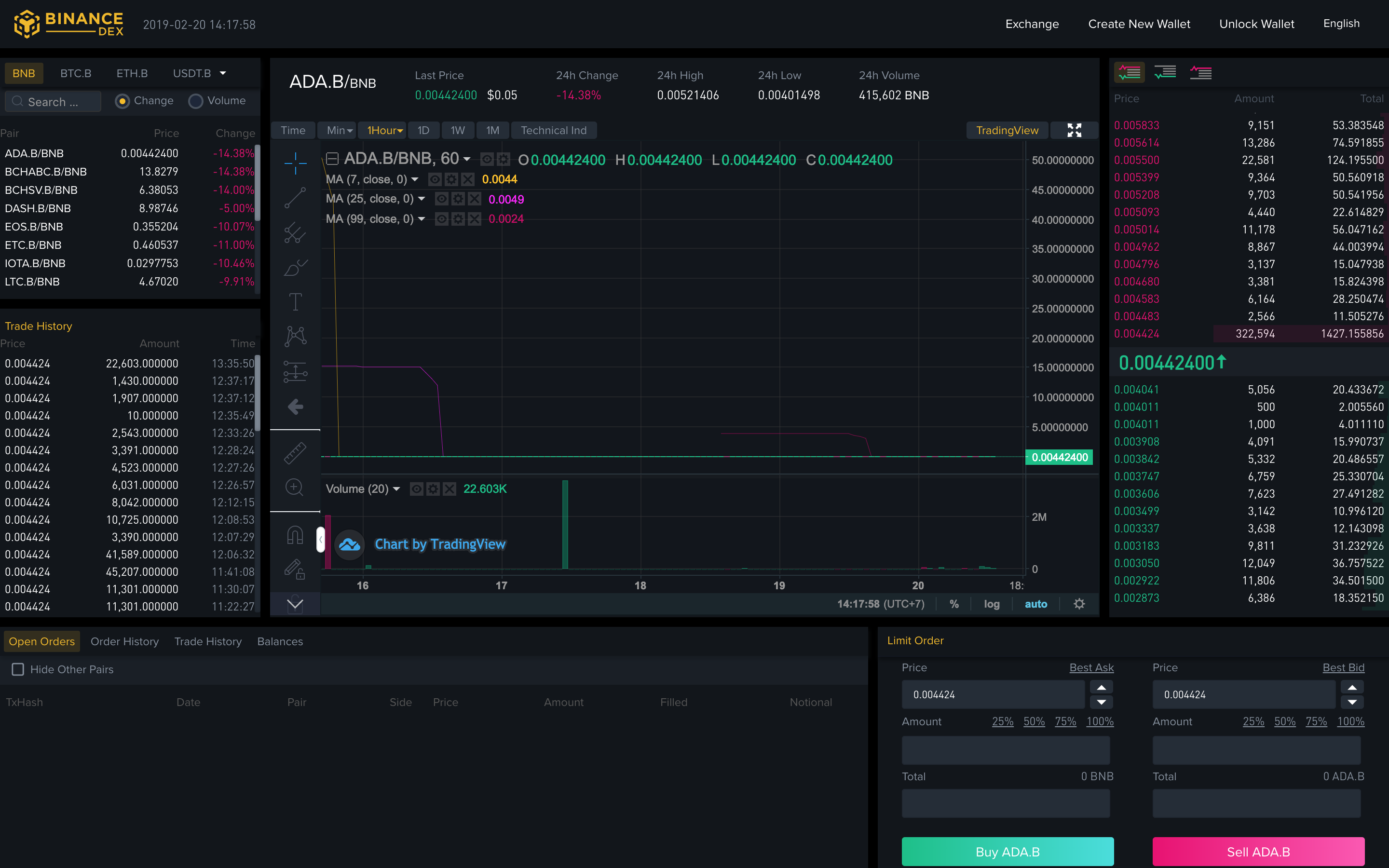
The Binance decentralize exchange

Zhao has also touted the dex as a new revenue driver for the company since it sits on Binance’s own blockchain with the company operating a number of nodes itself. Zhao previously told TechCrunch that when its nodes are used in transactions, the company will gain some of the network fee. Not that Binance needs help making money; a recent report from The Block suggested it made a profit of $446 million in 2018, a year that was most definitely a downer for the crypto industry across the board.

We do have one concern about the Binance Dex, however, and that is that it includes an option to unlock a wallet using a private key.

Pasting a private key into a browser is a major no-no in crypto circles. Users are encouraged to avoid this option for unlocking a wallet since there are a plethora of alternative options that include Metamask — a popular browser extension with over a million users — hardware devices such as Ledger, Trezor or Yubikey and — more recently — authentication apps from the likes of MyEtherWallet or Parity Signer.

Of those secure options, the Binance Dex currently supports Ledger (the hardware and app), but the other options are KeyStore file upload or the less-secure private key or mnemonic phrase.

While you can argue that the onus is on the user when it comes to private keys, service providers do have a responsibility.

Many, including Zhao, commonly claim that crypto adoption is in its early days while terms like ‘education’ and ‘democratization’ are repeated often by many in the space. Removing the private key, and thus limiting potential phishing attacks, would seem to be a part of educating new users and helping make crypto safe for others who join.

It may seem far fetched, but the phishing threat is very real. Leading wallet MyCrypto.com said it had been hit by attacks regularly, including a hijack on its Amazon DNS servers, while MyEtherWallet was hit at least twice last year as attackers went after its DNS and phished other users by compromising a free VPN service.

As a result, MyCrypto dropped the private key option from its primary web-based service.

“We’re removing support for private keys on the web version of MyCrypto because it’s not safe — and we encourage others to follow suit,” the company wrote in a Medium post.

But others haven’t followed, perhaps aware that removing the private key entry mechanism would mean many that users opt for alternatives were unlocking their wallet is easier.

MyEtherWallet, which competes directly with MyCrypto, has a strong warning around its private key entry option while Binance, to its credit, is warning dex users that using a private key or mnemonic phrase to unlock their wallet means there’s “a much higher chance [of losing them] due to phishing websites or applications.”

There is a positive. Binance said it plans to add the option to unlock a wallet on the dex using Trust Wallet, the mobile app it acquired last year.

“We’re working toward decentralized accessibility to cryptocurrency. We want users to have full control over their private keys, and easy access to decentralized applications, to maximize the potential and mainstream adoption of cryptocurrency. Binance DEX is one step further to realizing our vision for greater freedom of money,” Viktor Radchenko, the founder of Trust Wallet, said in a statement.

That would certainly be a major step forward for tightening security. Still, it is somewhat disappointing that Binance hasn’t taken a stand here. It certainly has the clout to send a major message out to the industry and cut down on potential phishing attacks.


20 Feb 2019

Image recognition startup ViSenze raises $20M Series C

ViSenze, a startup that provides visual search tools for online retailers like Rakuten and ASOS, announced today that it has raised a $20 million Series C. The round was co-led by Gobi Ventures and Sonae IM, with participation from other backers including returning investors Rakuten and WI Harper.

Founded in 2012, ViSenze has now raised a total of $34.5 million (its last round was a Series B announced in September 2016). The Singapore-based company, whose clients also include Urban Outfitters, Zalora, and Uniqlo, bills its software portfolio as a “personal shopping concierge” that allows shoppers to find or discover new products based on visual search, automatic photo tagging, and recommendations based on their browsing history. ViSenze’s verticals include fashion, jewelry, furniture, and intellectual property.

ViSenze’s latest funding will be used to develop its software through partnerships with smartphone makers including Samsung, LG, and Huawei. The company has offices in Asia, Europe, and the United States, and claims an annual revenue growth rate of more than 200 percent. Other startups in the same space include Syte.ai, Slyce, Clarifai, and Imagga.

In a statement, Rakuten Ventures partner Adit Swarup said “When we first invested in ViSenze in 2014, retailers had just started seeing the benefits of powering product recommendations with image data. Today, ViSenze not only powers recommendations for the largest brands in the world, but has helped pioneer a paradigm shift in e-commerce; helping consumers find products inside their favorite social media videos and images, as well as initiate a search directly from their camera app.”

Other participants in the round included returning investors Singapore Press Holdings (SPH) Ventures, Raffles Venture Partners, Enspire Capital, and UOB Venture Management, as well as new investors Tembusu ICT Fund, 31Ventures Global Innovation Fund, and Jonathan Coon’s Impossible Ventures.

20 Feb 2019

Netflix says new episodes of “Arrested Development” will debut on March 15

It’s time for another hit off the juice box. Netflix announced today that it will release the remaining eight episodes of “Arrested Development’s” fifth season on March 5, ten months after the first half premiered. In the intervening time, however, the show has dealt with several controversies revolving around accusations of abusive behavior from star Jeffrey Tambor, who plays family patriarch George Bluth.

The Netflix installments of the show, which began in 2013 with season 4 and marked the show’s return after running from 2003 to 2006 on Fox, have received mixed reviews and failed to achieve the iconic status of the original episodes. The controversies surrounding the show’s cast has also dampened some fans’ enthusiasm, at least for the new seasons.

Tambor will appear in the upcoming episodes despite being fired from Amazon Studios’ “Transparent” last year after he was accused of sexual harassment by two of his colleagues on the series. Then Tambor’s “Arrested Development” co-star Jessica Walter said he had verbally abused her during filming. In a New York Times cast interview to promote the first half of season five, Walter said she was “over it now,” but tone-deaf responses from male castmates, including Jason Bateman, underscored how warped gender dynamics and Tambor’s misbehavior might have been enabled on set (Bateman later apologized).

Tambor has denied the sexual harassment accusations, but a year and a half after the MeToo Movement began taking off, it is likely to continue casting a pall over the latest installment of “Arrested Development.” The new season picks up story lines involving the Bluth company’s involvement in building the border wall and Buster’s murder trial.

20 Feb 2019

These hyper-efficient solar panels could actually live on your roof soon

The clean energy boffins in their labs are always upping the theoretical limit on how much power you can get out of sunshine, but us plebes actually installing solar cells are stuck with years-old tech that’s not half as good as what they’re seeing. This new design from Insolight could be the one that changes all that.

Insolight is a spinoff from the École Polytechnique Fédérale de Lausanne, where they’ve been working on this new approach for a few years — and it’s almost ready to hit your roof.

Usually solar cells collect sunlight on their entire surface, converting it to electricity at perhaps 15-19 percent efficiency — meaning about 85 percent of the energy is lost in the process. There are more efficient cells out there, but they’re generally expensive and special-purpose, or use some exotic material.

One place people tend to spare no expense, however, is in space. Solar cells on many satellites are more efficient but, predictably, not cheap. But that’s not a problem if you only use just a tiny amount of them and concentrate the sunlight on those; that’s the Insolight insight.

Small but very high-efficiency cells are laid down on a grid, and above that is placed a honeycomb-like lens array that takes light and bends it into a narrow beam concentrated only on the tiny cells. As the sun moves, the cell layer moves ever so slightly, keeping the beams on target. They’ve achieved as high as 37 percent efficiency in tests, and 30 percent in consumer-oriented designs. That means half again or twice the power from the same area as ordinary panels.

Certainly this adds a layer or two of complexity to the current mass-manufactured arrays that are “good enough” but far from state of the art. But the resulting panels aren’t much different in size or shape, and don’t require special placement or hardware, such as a concentrator or special platform. And a recently completed pilot test on an EPFL roof was passed with flying colors.

“Our panels were hooked up to the grid and monitored continually. They kept working without a hitch through heat waves, storms and winter weather,” said Mathiu Ackermann, the company’s CTO, in an EPFL news release. “This hybrid approach is particularly effective when it’s cloudy and the sunlight is less concentrated, since it can keep generating power even under diffuse light rays.”

The company is now in talks with solar panel manufacturers, whom they are no doubt trying to convince that it’s not that hard to integrate this tech with their existing manufacturing lines — “a few additional steps during the assembly stage,” said Ackermann. Expect Insolight panels to hit the market in 2022 — yeah, it’s still a ways off, but maybe by then we’ll all have electric cars too and this will seem like an even better deal.

19 Feb 2019

Porsche Taycan production forecast may be ‘conservative’

Porsche’s production forecast for its first all-electric vehicle may be too conservative, the company’s head of production said this week.

Porsche has targeted 20,000 Taycan electric vehicles for the first year of production. But interest in the vehicle could push those estimates higher, Albrecht Reimold, Porsche’s board member in charge of production, said in an internally produced Q&A.

Reimold didn’t provide a specific figure. In the interview, Reimold was asked about the company’s new factory for the Taycan that is being constructed in Zuffenhausen, Germany as well as production of the new 911. Reimold explained that there would be some production overlap with the two vehicles, such as using the same new paint shop, despite their marked differences.

“We have built lots of flexibility into production so that the 911 can also be produced in the Taycan assembly plant – though not vice versa,” he said.

And while the company has the technical capacity to use the designated Taycan line to build the 911, Reimold said that would be unlikely. His complete comments:

Yes, we have the technical capacity to do that; but we are absolutely certain that it won’t be required. Based on feedback from the market, the calculation of 20,000 Porsche Taycan models in the first year may be a rather conservative estimate. I’ve had the pleasure of driving the car myself, and I can only say it’s absolutely fantastic! Which is the response we’ve been hearing from all sides.

Reimold’s comments are in line with other Porsche executives who have done everything but shout from the rooftops that demand for the Taycan is high.

Porsche North America president and CEO Klaus Zellmer said in a December interview with CNET that if everyone who placed a deposit to pre-order the car actually buys it, the Taycan will be sold out in its first year of production. According to Zellmer, more than half have not owned or do not own a Porsche. More specifically, Zellmer said these potential customers are coming from Tesla.

Porsche CEO Oliver Blume told WirtschaftsWoche in November that demand for the Taycan prompted the automaker to increase production capacity without indicating by how much.

Demand could push higher as Porsche reveals more details and benefits about the vehicle in the run up to its release date late this year. For instance, last month Porsche said Taycan owners will get three years of free charging at hundreds of Electrify America public stations that are currently being installed in the U.S.

19 Feb 2019

The SEC is looking to make it easier for any company to test the IPO waters

Under the leadership of its newest chairman, Jay Clayton, the SEC has for the last two years made it clear that it wants more companies to go public already.

A new proposal, revealed today, may get it closer to that objective. Specifically, the agency has proposed giving any company that’s exploring a potential IPO a chance to explore its plans privately with potential investors — both institutional and accredited — before making any public pronouncements.

It would essentially widen the net to allow every company to “test the waters” before deciding whether or not to move forward with an offering, compared with the companies that are able to test the waters today, which are “emerging growth companies.”

Per the SEC’s definition, an emerging growth company is an issuer with total annual gross revenue of less than $1 billion during its most recently completed fiscal year.

The public now has 60 days to comment on the proposal, after which the SEC will decide whether or not to move forward.

You can pretty much expect that it will. The move follows a series of steps the SEC has taken to shift over to the public market some of the liquidity sloshing around the private market. In July 2017, it made it possible for any company to confidentially submit registration documents related to shares being sold in an IPO, a benefit that only smaller companies had enjoyed previously.

Acknowledging that companies may still choose to stay private longer, Clayton separately said last August that the commission wants to give more small investors access to more privately held companies for their retirement or other needs. He said that changes toward that end could happen “pretty quickly,” though the SEC hasn’t formally revealed any related proposals yet.

19 Feb 2019

Invest in AI’s ethical future

I spent a recent Saturday morning talking to a group of grade school kids about artificial intelligence. Many of them had never coded before, let alone heard of AI. During the session, one exercise required them to come up with ideas for how the AI they create would be used in the real world. I was struck by the kids’ genuine interest in creating AI solutions that would help people, rather than divide them. I left that classroom with renewed faith in the future of innovation — especially if industry can extend technology-focused career opportunities to people from different backgrounds and with fresh perspectives.

Shifting from rhetoric to action

As the employee and public response to Google’s Project Maven illustrated, the need for ethical AI in the world is real, immediate and essential to making sure interactions with technology actually mitigate potential risks, help people and improve work. A key challenge for industry is figuring out how to move the global conversation away from AI as a threat to human jobs and safety, and toward cementing AI as an ethical complement to human ingenuity. In short, businesses need to be honest about AI’s impact on the global economy while transparently addressing public concerns about the technology.

Today’s digital literacy opportunities mostly exist outside the realm of regular education. Several programs manifest as extracurricular opportunities pursued by kids or early-career employees who are already interested in technology — and in a position to spend money to learn new skills. These opt-in courses help younger generations of people adopt necessary computational thinking and wider problem-solving, analytical and creativity skills needed to work with AI and other emerging technologies. That is precisely why they need to be accessible to more people.

Companies also need to invest in proactive retraining of technical and developer workforces to close digital skill gaps, diversify talent pools developing the technology and boost ethical AI literacy. Specifically, business leaders need to empower executives and human resources with the tools, data and space to understand the evolving skill sets needed to work with AI in an ethical way.

Companies should think critically about how to convey to current employees and future workforces the massive potential and exciting opportunities to work alongside AI. And, most importantly, AI leaders need to call on global industry and governments around the world to incorporate ethical practices into staff training throughout ranks — and hold them accountable once the commitment is made.

Defining industry’s role in helping people understand AI

In the short-term, companies should prioritize establishing working relationships with public sector partners and invest in community school programs that support digital education. After all, industry has a large stake in the successful education of young generations of people — many now born into a digitally native world — who will ascend into the workforce over the next decade.

Young people, on the other hand, are in a unique position to gain new skills from in-person mentorships offered by experts, developers and volunteers who currently work in technology and AI. Teaching diverse cohorts to code and introducing them to AI helps solve some immediate talent needs for industry, but society needs to also equip people with universally available data and adaptable skills to train for a shared future with AI.

Indeed, traditional office skills — and even software programming skills — will need to evolve in order for people to successfully and sustainably achieve workplace coexistence with AI. Companies like Infosys have already committed to retraining millions of workers in diverse fields in the path of automation. LinkedIn launched an internal AI academy for developers, engineers and technical recruits to retool them for an automated future. In general, companies should invest in teaching new generations of people interested in pursuing technology careers about ethical AI from day one — and encourage them to bring others into the fold.

My company’s corporate effort to teach younger generations about AI launched in the beginning of 2018. The program’s early work has revealed two key things: young people focus on building positive applications of AI and they approach learning about ethical AI with an open mind. Industry’s current movement to outfit people with digital skills focuses squarely on coding — completely blocking out the non-coders and creative minds needed to advance technologies that continuously learn and, eventually, self-code — like AI. That is why the program’s curriculum extends beyond how to develop digital skills needed to build AI and centers around “soft skills.”

Outfitting future generations with skills and inclusivity

At their core, AI literacy programs should teach young people how to develop traits like empathy that guide how humans interact with people — and how they will work with automated technologies like AI in the near future. However, in order to truly democratize computer and AI training opportunities for people from every background, industry should look for approachable avenues to introduce more people to emerging innovations driven by AI — and outfit them with skills needed to pursue careers in technology. After all, achieving diversity in business, preparing employees for a technology-driven future and instilling ethics into innovation requires involvement from as many people as possible. Society stands to benefit immensely from making progress on all three fronts.

19 Feb 2019

FDA warning brings controversial young blood transfusion company to a halt

On Tuesday, the FDA issued a warning to anyone who might be inclined to give their old bones a jolt with fresh blood harvested from the young.

The idea is pretty far from mainstream, even in Silicon Valley, where the ultra-wealthy have a keen interest in the cutting edge of life-extension science. Still, there’s apparently enough buzz around the practice that the FDA is warning consumers of “unscrupulous actors” who tout the benefits of infusing patients with plasma extracted from youthful donors while extracting literal blood money from their clients:

We have significant public health concerns about the promotion and use of plasma for these purposes. There is no proven clinical benefit of infusion of plasma from young donors to cure, mitigate, treat, or prevent these conditions, and there are risks associated with the use of any plasma product.

Today, we’re alerting consumers and health care providers that treatments using plasma from young donors have not gone through the rigorous testing that the FDA normally requires in order to confirm the therapeutic benefit of a product and to ensure its safety. As a result, the reported uses of these products should not be assumed to be safe or effective. We strongly discourage consumers from [pursuing] this therapy outside of clinical trials under appropriate institutional review board and regulatory oversight.

With the new warning, any companies pursuing the controversial and currently not scientifically supported practice are on notice. The best-known company in the field, Ambrosia Medical, reportedly began its own trials for young blood plasma transfusions back in 2017. The new FDA warning took direct aim at the company, which appears to have skirted regulations by leaning on the fact that blood transfusions are FDA-approved, even if the company’s fringe anti-aging applications are not.

On Tuesday, Ambrosia Medical’s sparse website displayed a single message: “In compliance with the FDA announcement issued February 19, 2019, we have ceased patient treatments.” TechCrunch has reached out to the company about its decision to stop operations in light of the FDA’s warning.

On top of the conspicuous absence of properly studied clinical benefits — “no compelling clinical evidence on its efficacy,” as the FDA puts it — fueling yourself up with young blood without government oversight is actually pretty dangerous. The straightforward danger of blood-borne pathogens is compounded by other risks around dosing.

“Plasma is not FDA-recognized or approved to treat conditions such as normal aging or memory loss, or other diseases like Alzheimer’s or Parkinson’s disease,” the FDA stated. “Moreover, reports we’re seeing indicate that the dosing of these infusions can involve administration of large volumes of plasma that can be associated with significant risks including infectious, allergic, respiratory and cardiovascular risks, among others.”

Ambrosia Medical appears to have wrapped up its initial study, “Young Donor Plasma Transfusion and Age-Related Biomarkers,” in January 2018 and stayed pretty quiet since. The study is registered with clinicaltrials.gov, though the research still appears to have operated beyond the bounds of the government’s institutional review and oversight process. In its warning, the FDA didn’t name Ambrosia Medical, instead referring to any entities in the young blood business as “companies that abuse the trust of patients and endanger their health.”

“As a general matter, we will consider taking regulatory and enforcement actions against companies that abuse the trust of patients and endanger their health with uncontrolled manufacturing conditions or by promoting so-called ‘treatments’ that haven’t been proven safe or effective for any use,” the FDA stated.

19 Feb 2019

Orai raises $2.3M to make you a better speaker

Orai, a startup building communication coaching tools, is announcing that it’s raised $2.3 million in seed funding.

CEO Danish Dhamani said that he co-founded the company with Paritosh Gupta and Aasim Sani to address a need in his own life — the fact that he was “held back personally and professionally” by lackluster “communications skills and public speaking skills.”

Dhamani said he attended Toastmasters International meetings hoping to improve those skills, where he concluded that he could build an algorithm to analyze your speaking abilities and give tips for how to improve.

To be clear, Orai isn’t necessarily trying to replace groups like Toastmasters, or individual speaking coaches. However, Dhamani said the “status quo” involves a “one-to-one” approach, where a human coach gives feedback to one person. Orai, on the other hand, can coach “entire IT teams, entire student bodies.”

“I am a big advocate of personalized, one-on-one coaching as well fine time as well,” he said. “Orai not replacing that, it’s enhancing that if used together.”

The startup has created iOS and Android smartphone apps to demonstrate the technology, which offer focused lessons and then assess your progress by analyzing recordings of your voice. (I did the initial assessment, and although I was praised for not using any “filler words,” I was told that I need to slow down — something I hear a lot.)

The real business model involves selling the tools to businesses, who can then assign Orai lessons to salespeople or other teams, create their own lessons and track everyone’s progress.

Attendees of TechCrunch’s Disrupt SF hackathon may recognize the team, which presented a body language analyzer called Vocalytics — so you can probably guess that Dhamani’s plans go beyond audio.

The funding was led by Comcast Ventures — Orai was one of the startups at Comcast’s LIFT Labs Accelerator in Philadelphia. (Currently accepting applications for its second class!) In addition to announcing the funding, Orai has signed up famed speaking coach Nancy Duarte as an advisor.

19 Feb 2019

Orai raises $2.3M to make you a better speaker

Orai, a startup building communication coaching tools, is announcing that it’s raised $2.3 million in seed funding.

CEO Danish Dhamani said that he co-founded the company with Paritosh Gupta and Aasim Sani to address a need in his own life — the fact that he was “held back personally and professionally” by lackluster “communications skills and public speaking skills.”

Dhamani said he attended Toastmasters International meetings hoping to improve those skills, where he concluded that he could build an algorithm to analyze your speaking abilities and give tips for how to improve.

To be clear, Orai isn’t necessarily trying to replace groups like Toastmasters, or individual speaking coaches. However, Dhamani said the “status quo” involves a “one-to-one” approach, where a human coach gives feedback to one person. Orai, on the other hand, can coach “entire IT teams, entire student bodies.”

“I am a big advocate of personalized, one-on-one coaching as well fine time as well,” he said. “Orai not replacing that, it’s enhancing that if used together.”

The startup has created iOS and Android smartphone apps to demonstrate the technology, which offer focused lessons and then assess your progress by analyzing recordings of your voice. (I did the initial assessment, and although I was praised for not using any “filler words,” I was told that I need to slow down — something I hear a lot.)

The real business model involves selling the tools to businesses, who can then assign Orai lessons to salespeople or other teams, create their own lessons and track everyone’s progress.

Attendees of TechCrunch’s Disrupt SF hackathon may recognize the team, which presented a body language analyzer called Vocalytics — so you can probably guess that Dhamani’s plans go beyond audio.

The funding was led by Comcast Ventures — Orai was one of the startups at Comcast’s LIFT Labs Accelerator in Philadelphia. (Currently accepting applications for its second class!) In addition to announcing the funding, Orai has signed up famed speaking coach Nancy Duarte as an advisor.