Author: azeeadmin

19 Feb 2019

When surveillance meets incompetence

Last week brought an extraordinary demonstration of the dangers of operating a surveillance state — especially a shabby one, as China’s apparently is. An unsecured database exposed millions of records of Chinese Muslims being tracked via facial recognition — an ugly trifecta of prejudice, bureaucracy, and incompetence.

The security lapse was discovered by Victor Gevers at the GDI Foundation, a security organization working in the public’s interest. Using the infamous but useful Shodan search engine, he found a MongoDB instance owned by the Chinese company SenseNets that stored an ever-increasing number of data points from a facial recognition system apparently at least partially operated by the Chinese government.

Many of the targets of this system were Uyghur Muslims, an ethnic and religious minority in China that the country has persecuted in what it considers secrecy, isolating them in remote provinces in what amount to religious gulags.

This database was no limited sting operation: some 2.5 million people had their locations and other data listed in it. Gevers told me that data points included national ID card number with issuance and expiry dates; sex; nationality; home address; DOB; photo; employer; and known previously visited face detection locations.

This data, Gevers said, plainly “had been visited multiple times by visitors all over the globe. And also the database was ransacked somewhere in December by a known actor,” one known as Warn, who has previously ransomed poorly configured MongoDB instances. So it’s all out there now.

A bad idea, poorly executed, with sad parallels
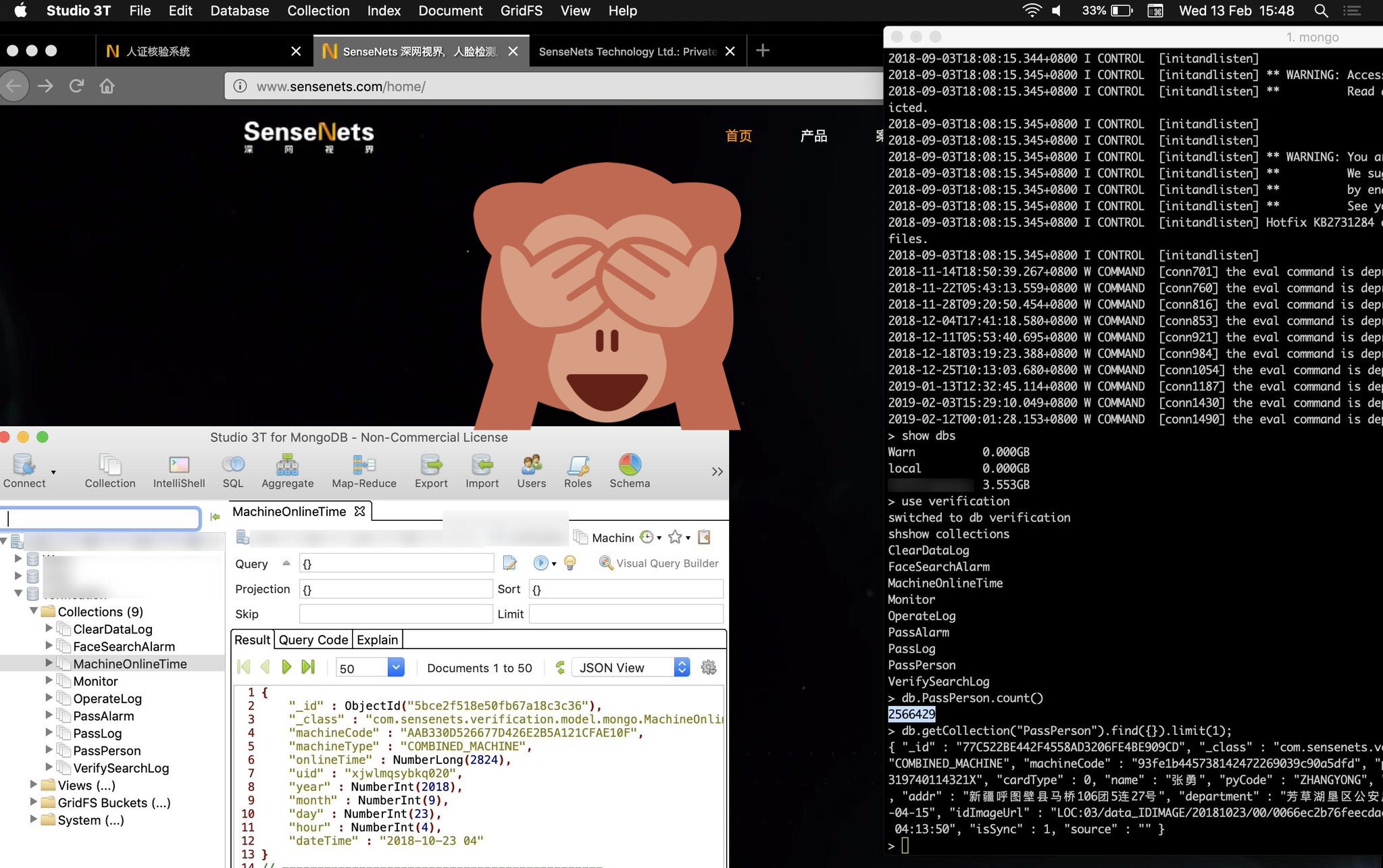
Courtesy: Victor Gevers/GDI.foundation

First off, it is bad enough that the government is using facial recognition systems to target minorities and track their movements, especially considering the treatment many of these people have already received. The ethical failure on full display here is colossal but unfortunately no more than we have come to expect from an increasingly authoritarian China.

Using technology as a tool to track and influence the populace is a proud bullet point on the country’s security agenda, but even allowing for the cultural differences that produce something like the social credit rating system, the wholesale surveillance of a minority group is beyond the pale. (And I say this in full knowledge of our own problematic methods in the U.S.)

But to do this thing so poorly is just embarrassing, and should serve as a warning to anyone who thinks a surveillance state can be well administrated — in Congress, for example. We’ve seen security tech theater from China before, in the ineffectual and likely barely functioning AR displays for scanning nearby faces, but this is different — not a stunt but a major effort and correspondingly large failure.

The duty of monitoring these citizens was obviously at least partially outsourced to SenseNets (note this is different from SenseTime, but many of the same arguments will apply to any major people-tracking tech firm), which in a way mirrors the current controversy in the U.S. regarding Amazon’s Rekognition and its use — though on a far, far smaller scale — by police departments. It is not possible for federal or state actors to spin up and support the tech and infrastructure involved in such a system on short notice; like so many other things the actual execution falls to contractors.

And as SenseNets shows, these contractors can easily get it wrong, sometimes disastrously so.

MongoDB, it should be said, is not inherently difficult to secure; it’s just a matter of choosing the right settings in deployment (settings that are now but were not always the defaults). But for some reason people tend to forget to check those boxes when using the popular system; over and over we’ve seen poorly configured instances being accessible to the public, exposing hundreds of thousands of accounts. This latest one must surely be the largest and most damaging, however.

Gevers pointed out that the server was also highly vulnerable to MySQL exploits among other things, and was of course globally visible on Shodan. “So this was a disaster waiting to happen,” he said.

In fact it was a disaster waiting to happen twice; the company re-exposed the database a few days after securing it, after I wrote this story but before I published:

Living in a glass house

The truth is, though, that any such centralized database of sensitive information is a disaster waiting to happen, for pretty much everyone involved. A facial recognition database full of carefully organized demographic data and personal movements is a hell of a juicy target, and as the SenseTimes instance shows, malicious actors foreign and domestic will waste no time taking advantage of the slightest slip-up (to say nothing of a monumental failure).

We know major actors in the private sector fail at this stuff all the time and, adding insult to injury, are not held responsible — case in point: Equifax. We know our weapons systems are hackable; our electoral systems are trivial to compromise and under active attack; the census is a security disaster; and unsurprisingly the agencies responsible for making all these rickety systems are themselves both unprepared and ignorant, by the government’s own admission… not to mention unconcerned with due process.

The companies and governments of today are simply not equipped to handle the enormousness, or recognize the enormity, of large scale surveillance. Not only that, but the people that compose those companies and governments are far from reliable themselves, as we have seen from repeated abuse and half-legal uses of surveillance technologies for decades.

Naturally we must also consider the known limitations of these systems, such as their poor record with people of color, the lack of transparency with which they are generally implemented, and the inherently indiscriminate nature of their collection methods. The systems themselves are not ready.

A failure at any point in the process of legalizing, creating, securing, using, or administrating these systems can have serious political consequences (such as the exposure of a national agenda, which one can imagine could be held for ransom), commercial consequences (who would trust SenseNets after this? The government must be furious), and most importantly personal consequences — to the people whose data is being exposed.

And this is all due (here, in China, and elsewhere) to the desire of a government to demonstrate tech superiority, and of a company to enable that and enrich itself in the process.

In the case of this particular database Gevers says that although the policy of the GDI is one of responsible disclosure, he immediately regretted his role. “Personally it made angry after I found out that I unknowingly helping the company secure its oppression tool,” he told me. “This was not a happy experience.”

The best we can do, and which Gevers did, is to loudly proclaim how bad the idea is and how poorly it has been done, is being done, and will be done.


19 Feb 2019

When surveillance meets incompetence

Last week brought an extraordinary demonstration of the dangers of operating a surveillance state — especially a shabby one, as China’s apparently is. An unsecured database exposed millions of records of Chinese Muslims being tracked via facial recognition — an ugly trifecta of prejudice, bureaucracy, and incompetence.

The security lapse was discovered by Victor Gevers at the GDI Foundation, a security organization working in the public’s interest. Using the infamous but useful Shodan search engine, he found a MongoDB instance owned by the Chinese company SenseNets that stored an ever-increasing number of data points from a facial recognition system apparently at least partially operated by the Chinese government.

Many of the targets of this system were Uyghur Muslims, an ethnic and religious minority in China that the country has persecuted in what it considers secrecy, isolating them in remote provinces in what amount to religious gulags.

This database was no limited sting operation: some 2.5 million people had their locations and other data listed in it. Gevers told me that data points included national ID card number with issuance and expiry dates; sex; nationality; home address; DOB; photo; employer; and known previously visited face detection locations.

This data, Gevers said, plainly “had been visited multiple times by visitors all over the globe. And also the database was ransacked somewhere in December by a known actor,” one known as Warn, who has previously ransomed poorly configured MongoDB instances. So it’s all out there now.

A bad idea, poorly executed, with sad parallels

Courtesy: Victor Gevers/GDI.foundation

First off, it is bad enough that the government is using facial recognition systems to target minorities and track their movements, especially considering the treatment many of these people have already received. The ethical failure on full display here is colossal but unfortunately no more than we have come to expect from an increasingly authoritarian China.

Using technology as a tool to track and influence the populace is a proud bullet point on the country’s security agenda, but even allowing for the cultural differences that produce something like the social credit rating system, the wholesale surveillance of a minority group is beyond the pale. (And I say this in full knowledge of our own problematic methods in the U.S.)

But to do this thing so poorly is just embarrassing, and should serve as a warning to anyone who thinks a surveillance state can be well administrated — in Congress, for example. We’ve seen security tech theater from China before, in the ineffectual and likely barely functioning AR displays for scanning nearby faces, but this is different — not a stunt but a major effort and correspondingly large failure.

The duty of monitoring these citizens was obviously at least partially outsourced to SenseNets (note this is different from SenseTime, but many of the same arguments will apply to any major people-tracking tech firm), which in a way mirrors the current controversy in the U.S. regarding Amazon’s Rekognition and its use — though on a far, far smaller scale — by police departments. It is not possible for federal or state actors to spin up and support the tech and infrastructure involved in such a system on short notice; like so many other things the actual execution falls to contractors.

And as SenseNets shows, these contractors can easily get it wrong, sometimes disastrously so.

MongoDB, it should be said, is not inherently difficult to secure; it’s just a matter of choosing the right settings in deployment (settings that are now but were not always the defaults). But for some reason people tend to forget to check those boxes when using the popular system; over and over we’ve seen poorly configured instances being accessible to the public, exposing hundreds of thousands of accounts. This latest one must surely be the largest and most damaging, however.

Gevers pointed out that the server was also highly vulnerable to MySQL exploits among other things, and was of course globally visible on Shodan. “So this was a disaster waiting to happen,” he said.

In fact it was a disaster waiting to happen twice; the company re-exposed the database a few days after securing it, after I wrote this story but before I published:

Living in a glass house

The truth is, though, that any such centralized database of sensitive information is a disaster waiting to happen, for pretty much everyone involved. A facial recognition database full of carefully organized demographic data and personal movements is a hell of a juicy target, and as the SenseTimes instance shows, malicious actors foreign and domestic will waste no time taking advantage of the slightest slip-up (to say nothing of a monumental failure).

We know major actors in the private sector fail at this stuff all the time and, adding insult to injury, are not held responsible — case in point: Equifax. We know our weapons systems are hackable; our electoral systems are trivial to compromise and under active attack; the census is a security disaster; and unsurprisingly the agencies responsible for making all these rickety systems are themselves both unprepared and ignorant, by the government’s own admission… not to mention unconcerned with due process.

The companies and governments of today are simply not equipped to handle the enormousness, or recognize the enormity, of large scale surveillance. Not only that, but the people that compose those companies and governments are far from reliable themselves, as we have seen from repeated abuse and half-legal uses of surveillance technologies for decades.

Naturally we must also consider the known limitations of these systems, such as their poor record with people of color, the lack of transparency with which they are generally implemented, and the inherently indiscriminate nature of their collection methods. The systems themselves are not ready.

A failure at any point in the process of legalizing, creating, securing, using, or administrating these systems can have serious political consequences (such as the exposure of a national agenda, which one can imagine could be held for ransom), commercial consequences (who would trust SenseNets after this? The government must be furious), and most importantly personal consequences — to the people whose data is being exposed.

And this is all due (here, in China, and elsewhere) to the desire of a government to demonstrate tech superiority, and of a company to enable that and enrich itself in the process.

In the case of this particular database Gevers says that although the policy of the GDI is one of responsible disclosure, he immediately regretted his role. “Personally it made angry after I found out that I unknowingly helping the company secure its oppression tool,” he told me. “This was not a happy experience.”

The best we can do, and which Gevers did, is to loudly proclaim how bad the idea is and how poorly it has been done, is being done, and will be done.
19 Feb 2019

Airtable CEO Howie Liu on the continued importance of getting a “unicorn” valuation

When in 2015, Slack raised money at a $1 billion valuation, founder Stewart Butterfield spoke candidly about why it was important to him, and why if Slack wasn’t assigned a valuation north of that number at that point in time, Slack wouldn’t raise anything. Said Butterfield, speaking to Fortune, it “means that we’re a part of that conversation about companies worth $1 billion.”

Fast forward nearly four years, and things apparently haven’t changed much. Indeed, Howie Liu, the cofounder and CEO of Airtable — a 5.5-year-old, San Francisco-based company that sees itself as a coding platform for non-techies — says Airtable was very much focused on being valued at north of $1 billion when it closed its most recent round in November.

“There’s unquestionably a market signaling effect in raising money at a valuation that, in our opinion, doesn’t come close to the ultimate expected value of the company,” said Liu, in conversation with senior Recode editor Teddy Schleifer at a recent industry event hosted by this editor.  “It externalizes a little bit the progress we’ve made and addresses a lot of the open questions that companies face when they first start out. It sends a signal to our customers, to potential future team members, and just the general community that talks about these things.”

The continued relevance of that billion-dollar number is interesting, particularly given that there were more than 300 so-called unicorn companies in operation as of last month, according to the research firm CB Insights. Even Liu acknowledged at the event that the number is pretty “arbitrary.” At the same time, he noted, it’s “something that I think carries gravitas in the minds of the general public. So I do think it matters to some extent.”

Airtable raised most of the money it has secured to date last year, raising $59 million last March from CRV, Caffeinated Capital and Slow Ventures before raising another $100 million in November from Benchmark, Thrive Capital and Coatue Management at a post-money valuation of $1.1 billion.

Liu suggested to Schleifer that Airtable didn’t need to raise outside funding, presumably thanks to the momentum its tools are enjoying with more than 80,000 organizations. According to a Forbes report late last year, one in six customers is paying for its freemium products, which includes a collaborative spreadsheet that can store images, videos, documents and URLs, all of which can be dragged around easily and make sense of otherwise disjointed endeavors.

“We’ve always had this long road ahead of us, and until somewhat recently, we’ve been able to sustain our operations without any external capital [owing to] a product that monetizes itself, from a customer base that gets real value from us.”

Asked then why Airtable would raise so much, giving up some company ownership to its investors in the process, Liu said there’s validity in the adage that the “best time to raise is when you don’t need to raise. You’re in the best position to make a case for investment if you’re at a point where you don’t need capital to survive.”


Indeed, don’t be surprised to see Airtable raise more money in the not-too-distant future, given its ambitions to be viewed as far more than a maker of productivity tools or spreadsheets or database products, though it offers all of these things.

“We’ve always been motivated by the fact that software is the most important medium ever created, or, at least, in the last 100 years, yet its potency is completely inaccessible to most of the world,” said Liu to Schleifer. “If you’re a programmer in Silicon Valley, you can tap into this very powerful technology as a medium for creative expression or economic value creation. Yet for everyone else, you get this kind of prefabricated result.”

Rather boldly, Liu continued on to say Airtable is creating a new category around democratizing software value to the entire world —  and that it sees itself as peerless, for now. “For us at least, the way we see the world today, as we define the category that we’ve pioneered ourselves, it’s really more of this open territory. Maybe a serious competitor will enter at some point,” but Airtable plans to gather up as much marketshare as it can in the interim, he said.

Of course, there are many (many) productivity tools in the market with which Airtable competes. Liu, who reportedly favors simple black jackets, pants, and shoes and was dressed accordingly for the event, doesn’t seem to care. In fact, he insisted at the event that an acquisition couldn’t be further from his mind. He noted that he’d sold his previous, very early-stage startup to Salesforce as a then recent-graduate of Duke University, but he suggested that Airtable is very much a long-term play that’s just getting started.

“We don’t entertain offers,” said Liu when asked who has been kicking the tires. “In order to get an offer, you have to at last accept an inbound invitation . . . and it’s literally not worth the time of day, talking. You do that if you want to hedge your bets and if you want a Plan B, if you need to bail out at some point, so you have this [potential partner].”

“So zero talks,” said Schleifer.

“Zero,” said Liu.

“And you think you think you can be a hundred billion, two hundred billion dollar company at some point.”

“We do,” Liu said with a shrug.

19 Feb 2019

Airtable CEO Howie Liu on the continued importance of getting a “unicorn” valuation

When in 2015, Slack raised money at a $1 billion valuation, founder Stewart Butterfield spoke candidly about why it was important to him, and why if Slack wasn’t assigned a valuation north of that number at that point in time, Slack wouldn’t raise anything. Said Butterfield, speaking to Fortune, it “means that we’re a part of that conversation about companies worth $1 billion.”

Fast forward nearly four years, and things apparently haven’t changed much. Indeed, Howie Liu, the cofounder and CEO of Airtable — a 5.5-year-old, San Francisco-based company that sees itself as a coding platform for non-techies — says Airtable was very much focused on being valued at north of $1 billion when it closed its most recent round in November.

“There’s unquestionably a market signaling effect in raising money at a valuation that, in our opinion, doesn’t come close to the ultimate expected value of the company,” said Liu, in conversation with senior Recode editor Teddy Schleifer at a recent industry event hosted by this editor.  “It externalizes a little bit the progress we’ve made and addresses a lot of the open questions that companies face when they first start out. It sends a signal to our customers, to potential future team members, and just the general community that talks about these things.”

The continued relevance of that billion-dollar number is interesting, particularly given that there were more than 300 so-called unicorn companies in operation as of last month, according to the research firm CB Insights. Even Liu acknowledged at the event that the number is pretty “arbitrary.” At the same time, he noted, it’s “something that I think carries gravitas in the minds of the general public. So I do think it matters to some extent.”

Airtable raised most of the money it has secured to date last year, raising $59 million last March from CRV, Caffeinated Capital and Slow Ventures before raising another $100 million in November from Benchmark, Thrive Capital and Coatue Management at a post-money valuation of $1.1 billion.

Liu suggested to Schleifer that Airtable didn’t need to raise outside funding, presumably thanks to the momentum its tools are enjoying with more than 80,000 organizations. According to a Forbes report late last year, one in six customers is paying for its freemium products, which includes a collaborative spreadsheet that can store images, videos, documents and URLs, all of which can be dragged around easily and make sense of otherwise disjointed endeavors.

“We’ve always had this long road ahead of us, and until somewhat recently, we’ve been able to sustain our operations without any external capital [owing to] a product that monetizes itself, from a customer base that gets real value from us.”

Asked then why Airtable would raise so much, giving up some company ownership to its investors in the process, Liu said there’s validity in the adage that the “best time to raise is when you don’t need to raise. You’re in the best position to make a case for investment if you’re at a point where you don’t need capital to survive.”


Indeed, don’t be surprised to see Airtable raise more money in the not-too-distant future, given its ambitions to be viewed as far more than a maker of productivity tools or spreadsheets or database products, though it offers all of these things.

“We’ve always been motivated by the fact that software is the most important medium ever created, or, at least, in the last 100 years, yet its potency is completely inaccessible to most of the world,” said Liu to Schleifer. “If you’re a programmer in Silicon Valley, you can tap into this very powerful technology as a medium for creative expression or economic value creation. Yet for everyone else, you get this kind of prefabricated result.”

Rather boldly, Liu continued on to say Airtable is creating a new category around democratizing software value to the entire world —  and that it sees itself as peerless, for now. “For us at least, the way we see the world today, as we define the category that we’ve pioneered ourselves, it’s really more of this open territory. Maybe a serious competitor will enter at some point,” but Airtable plans to gather up as much marketshare as it can in the interim, he said.

Of course, there are many (many) productivity tools in the market with which Airtable competes. Liu, who reportedly favors simple black jackets, pants, and shoes and was dressed accordingly for the event, doesn’t seem to care. In fact, he insisted at the event that an acquisition couldn’t be further from his mind. He noted that he’d sold his previous, very early-stage startup to Salesforce as a then recent-graduate of Duke University, but he suggested that Airtable is very much a long-term play that’s just getting started.

“We don’t entertain offers,” said Liu when asked who has been kicking the tires. “In order to get an offer, you have to at last accept an inbound invitation . . . and it’s literally not worth the time of day, talking. You do that if you want to hedge your bets and if you want a Plan B, if you need to bail out at some point, so you have this [potential partner].”

“So zero talks,” said Schleifer.

“Zero,” said Liu.

“And you think you think you can be a hundred billion, two hundred billion dollar company at some point.”

“We do,” Liu said with a shrug.

19 Feb 2019

This is the best VR headset I’ve ever demoed

Before Oculus kickstarted a lot of the fervor around consumer headsets, the VR headsets that were being built for enterprise rigs were multi-thousands-dollar rigs that still sucked. As Oculus and HTC expanded their platforms, a lot of these enterprise-focused VR companies shriveled up or were forced to significantly retool how they approached fat-wallet customers.

Things are even more complicated now, Oculus has priced pretty much every other manufacturer out of the consumer market, now a good deal of those consumer VR companies are chasing enterprise customers. Microsoft has been doing so with its Mixed Reality platform as well, but the customer base really doesn’t seem to be large enough to necessitate like 14 hardware competitors.

Varjo has a unique strategy to stand out from competitors called actual product differentiation.

The Swedish VR startup’s new VR-1 headset is a bulky solution that runs on SteamVR tracking but the high-resolution sweet spot which delivers a Retina-type display’s worth of pixel-density transforms this into an entirely different type of product. I don’t want to give this team more much credit than the deserve because the technical solution is novel but not like mind-boggling complex from a hardware point-of-view, nevertheless this headset delivers a pretty transformative experience.

The headset works by pairing a more conventionally-resolutioned VR display with miniature ultra high-res displays that lens and mirrors reflect to fall in the center of the user’s vision. The company says this sweet spot (which is about the size of the current-gen HoloLens field-of-view) offers about 20x the resolution of other consumer VR headset out now. There are a few optical quirks with the current setup and it’s a much different setup than the prototype I demoed in 2017.

HTC Vive Pro vs. Varjo VR-1 (courtesy of Varjo)

The company is called Varjo, but the company’s first commercial product notably ditches the varifocal lens approach which was one of the hallmarks of early prototypes. Varifocal lenses allow users to focus on different areas of an environment, including things within a few inches of their face which is impossible on current headsets. Other perks include not having to wear glasses because the lenses can adjust for your prescription. The systems are mechanically operated which surely has more potential as a failure point than fixed lens setups. Ultimately by ditching the varifocal approach, Varjo was able to expand the field-of-view of the high-resolution sweet spot with a fixed lens. Given the tradeoffs, they seemed to make a wise choice.

The substantial pixel bump also makes it feel like a completely different type of device. It’s insane. Pixels just aren’t visible so most of the limitations are one what’s being rendered. It’s a decidedly premium experience, the VR-1 retails for just under $6,000 or 17 times the price of the Oculus Rift.

The solution Varjo built out stands on its own for now but the limitations are quickly apparent in terms of where other headsets can surpass the experience. Future hardware will need some type of varifocal approach and will assuredly rely on tech like foveated rendering to determine where full resolution is rendered rather than a fixed high-res reflection. To VR hardware aficionados looking at pushing scalable solutions, I’m sure the VR-1 feels a bit like cheating, but cheating feels good sometimes.

The VR-1 is, again, $5,995 and that price doesn’t even include the controllers or SteamVR tracking sensors. It exists and it’s on sale now for business customers.

19 Feb 2019

EF raises $115M new fund, aiming to create another 300-plus startups in the next three years

Entrepreneur First (EF), the London-headquartered “talent investor” that recruits and backs individuals pre-team and pre-idea to enable them to found startups, has raised a new fund of its own to continue scaling globally.

The $115 million first close was led by a number of leading (mostly unnamed) institutional investors across the U.S., Europe and Asia, including new anchor LP Trusted Insight. A number of well-known European entrepreneurs also invested. They include Taavet Hinrikus (co-founder of TransferWise), Alex Chesterman (co-founder of Zoopla), and EF alumnus Rob Bishop (who co-founded Magic Pony Technology which was bought by Twitter for a reported $150m in 2016).

This new fund — which EF says is one the largest pre-seed funds ever raised – will enable the talent investor to back more than 2,200 individuals who join its various programs over the next three years. EF currently operates in Bangalore, Berlin, Hong Kong, London, Singapore and Paris.

This will translate to the creation of around 300-plus venture-backed companies, three times the number of startups it has helped create in total since EF was founded by McKinsey colleagues Matt Clifford and Alice Bentinck all the way back in 2011.

As part of the same announcement, EF says that General Partner Joe White has relocated to Silicon Valley where he’ll focus on growing EF’s investor network on the West Coast. Perhaps the move shouldn’t come as a total surprise — White is the husband of Wendy Tan White, who was recently recruited by Alphabet’s X (formerly Google X) in Mountain View — but either way it feels like a smart move from EF’s perspective as the talent investor, which is also backed by Reid Hoffman’s Greylock, seeks to create further ties to Silicon Valley.

Comments co-founder and CPO Bentinck: “We pioneered a new model of talent investing, and it’s encouraging to see this become a new frontier for venture capital. We believe the world is missing out on some of its best founders because of ecosystem constraints, a lack of co-founders and difficulties getting early pre-company funding. Entrepreneur First is changing that”.

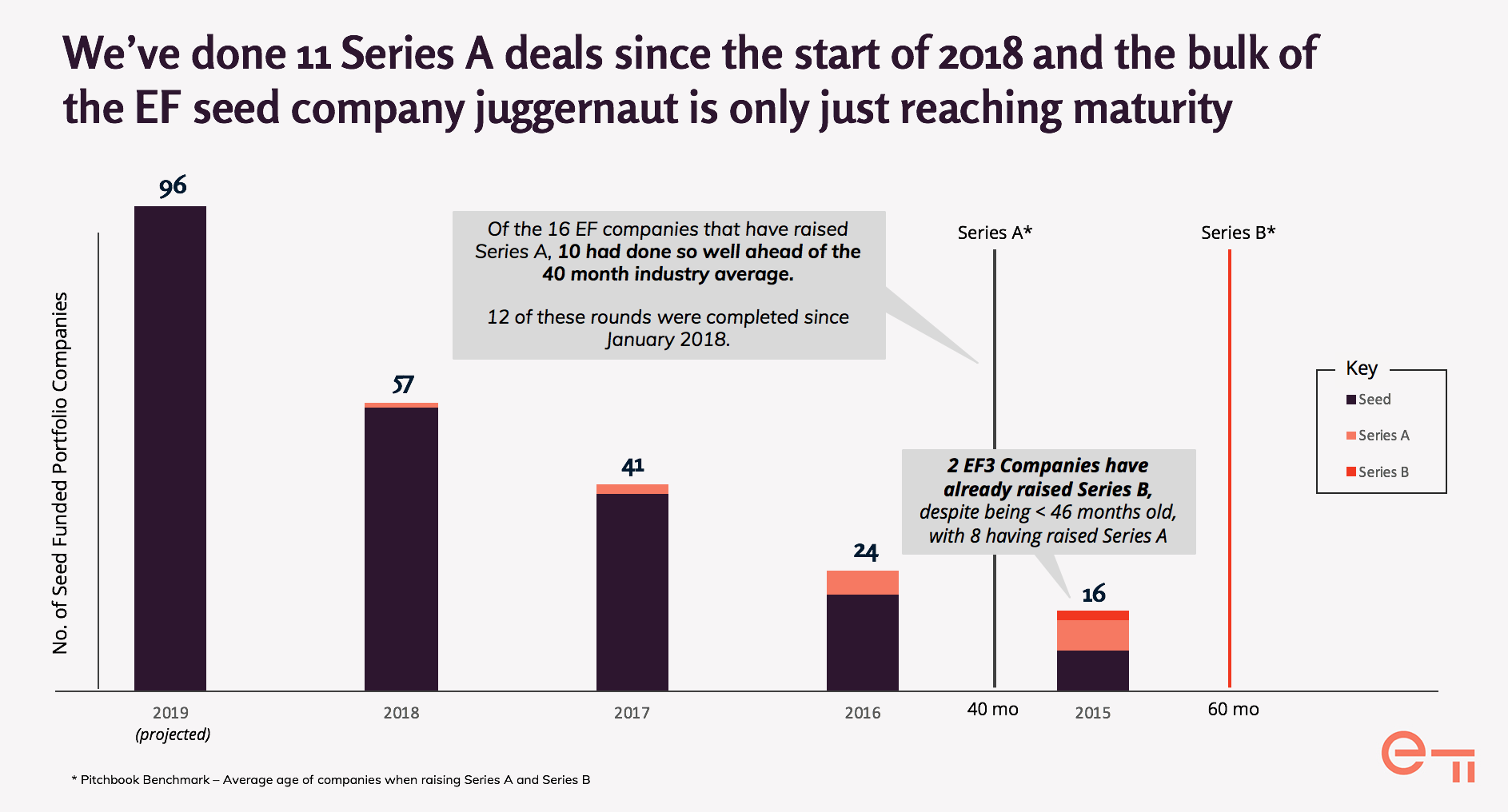
EF is also sharing some data with TechCrunch, revealing for the first time numbers related to the number of EF graduating startups that have gone on to raise outside capital. For the 2015 “vintage” cohort, there were 16 seed rounds, 8 Series A, and now 2 Series Bs. For 2016, 24 seeds, and 5 A rounds so far. For 2017, 41 seeds, and 2 A rounds. And for 2018, 57 seeds, and 1 Series A already.

A slide thought to be from EF’s recent LP pitch deck

“The graph shows the volume of EF companies funded by VCs each year since 2015 (e.g only those that raise a successful seed, not just those funded by EF),” White tells me. “The average age to series A is 40 months according to Pitchbook or 60 months to series B. Many of our companies are already ahead of that schedule, but many more will reach these milestones in the next 12 months”

Below follows an email Q&A with EF co-founder Matt Clifford to find out more about the new fund and where it positions the so-called talent investor going forward.

TC: You’ve announced the first close of a new fund — $115m. What is the remit for the fund and how does it fit into the broader EF program and funnel? I.e. is it mainly for follow on funding so EF doesn’t get too diluted for the most promising companies it helps create?

MC: The main thing we’re doing with this fund is taking our talent investing model global. We’ve always said the world’s missing out on some of its best founders and now we’ve got the capital to change that. It’s true it’s a lot bigger than our last fund, but that’s mainly driven by scaling internationally, not by a change in investment strategy. This fund will do stipends, pre-seed, seed and Series A investing in all our companies globally. It gives us capacity to fund 2,000 individuals around the world over the next three years.

We’ll absolutely be backing the best Entrepreneur First companies up to their Series A, but we’ve been doing that since 2016, so no change there.

TC: An earlier SEC filing suggested the fund was going to be much bigger. What happened?

MC: As far as I know, you have to file the hard cap with the SEC, but that’s not a target. This is a first close, not a final close, but with $115m we can fully fund all six sites for three years, which is great.

TC: Like previous EF funds, the new fund’s LPs include many known founders and angel investors from the London tech scene and beyond. But this time around I gather you have some quite large institutional LPs, too, including from the U.S. How were those conversations different this time or was it simply the Reid Hoffman effect after Greylock Partners became an investor in EF itself?

MC: Yes, this is definitely a “growing up” fund for us. Our first “fund” in 2013 was under £400K, so a lot’s changed! Almost all this capital comes from institutional LPs and they include some of the best investors in venture capital funds globally. EF is a totally new stage of VC – talent investing – and LPs are quite rightly naturally fairly conservative. So Joe and I and the rest of the team have put in a lot of work to get institutions comfortable with something radically different and we feel it’s really paid off.

Certainly having Reid and others involved has helped a lot, but EF is just generally a very different beast from when we closed the last fund: the portfolio is now valued at well over $1.3bn; we’ve had $300m of exits; the fastest growing alumni companies have been funded by some of the best VCs in Europe and the US, etc. So across the board we had a lot more to show.

TC: EF began life calling itself a “talent-first” investor based on the EF program recruiting potential founders pre-team and pre-idea, which made you an outlier at the time. In that sense, you were — and I hesitate to use the word — ‘disrupting’ startup founding and traditional career paths. But now it’s starting to look like the EF model is a ruse to disrupt early stage venture capital or is that too simple an analysis?

MC: Haha! Alice and I are still much more interested in disrupting careers than disrupting VC. What I would say is that we believe we’re heading for a world where many more of the most talented people will become founders and most of those people won’t be in established tech ecosystems. We think that makes the opportunity hard to capture for traditional VC, because it assumes away the real problems – above all, where to find a world-class co-founder.

But we’re very much ecosystem players. I think we’ve now co-invested with pretty much every seed fund in Europe and SE Asia and I think they’d all tell you we play nice.

TC: It’s been reported that in a bid to expand globally, EF has come up against scaling issues with regards to matching founders and company formation. I’ve heard from my own sources that there were teething problems in Berlin, for example. What’s really going on?

MC: It’s definitely the conventional wisdom that VC isn’t scaleable, but I think we’re proving that wrong. If you take our core metric of co-founder matching, our most recent European cohorts had the highest matching rate so far – over 80% of people who joined us found a co-founder (though of course we don’t fund every team that forms). Similarly if you look at our first Paris cohort, it has one of the highest investment rates of any cohort we’ve ever done (and we’ve done 21 cohorts so far). Honestly, we’re really happy with the way the international expansion went, though I’d be the first to say that scaling is hard and we’ll make mistakes!

TC: We’ve seen a few EF clones appear. Sincerest form of flattery or blatant opportunism? And which, if any, part of EF is defensible?

MC: I always remember Paul Graham being asked this about YC clones and saying he felt “like how JK Rowling would feel if someone wrote a book called Henry Potter”. Joking aside though, I think YC has shown that highly defensible network effects in VC are possible. There are literally hundreds of YC clones and yet 95% of the value in accelerators has accrued to YC. I think we’re on track for something similar in the talent investing space.

The key way to think about defensibility is at the level of the customer – i.e. the founder. Which talent investor do you want to join? You want to join the one with the highest quality potential cofounders. Which one has that? Well, unsurprisingly, the one with the track record, the best alum, the best network, etc. Once you’ve established that – and EF is 5 or 6 years ahead of the clones – it’s very difficult to catch up and the advantage compounds quickly.

TC: You shared some stats with regards the success rate of EF startups and the figures look encouraging. But what we don’t yet still have are many exits. This isn’t surprising given that you invest incredibly early so it will take time for startups to move through the cycle, but it also means that LPs backing EF continue to take a leap of faith. Is that a fair statement and what was the major pushback you got from LPs that declined not to join EF on this next phase of your journey?

MC: For sure, that’s fair. The numbers look great on paper, but it’s way too early to see significant cash returns. In fact, right now we don’t want more exits, as we want our best companies to keep growing privately for as long as possible. Last year, the portfolio raised more money than they had in the history of EF before that put together, so we’re feeling very positive.

It’s definitely true that some LPs don’t want to invest until you’ve returned a whole fund, but fortunately lots of them put in a lot of time to understand the model and were willing to partner with us for the long-term. This will be a big year for the portfolio – no big exits, I hope, but lots of momentum on revenue, product and funding for sure.

TC: Lastly, you now have a General Partner and EF’s CFO Joe White (who I understand was instrumental in helping to raise this new fund) posted to Silicon Valley, where he’ll be helping to grow EF’s investor network on the West Coast. How important is U.S. venture capital to EF’s future and when can we expect to see EF launch a program across the pond?

MC: Yes, Joe and I spent a lot of time on planes and in the US last year to pitch LPs! The vast majority of the capital in this fund is US-based and, of course, Reid and Greylock are there too. What Joe, Alice and I all believe is that Silicon Valley remains perhaps the best place in the world to scale a tech company, even if it’s no longer the essential place to start one. This means that being able to build relationships with the best US VCs is a key competitive advantage for an EF company.

We’ve already seen some of this, with Insight leading Tractable’s B round and Founders Fund leading Massless’s (EF LD9) seed. But Joe being there full time is an ideal way for us to accelerate this and I think you’ll see a bunch of EF companies raise US-led B and C rounds this year. The key is the right capital at the right time.

We’re still thinking hard about our next stage of expansion. It’s hard to see a major need for EF in Silicon Valley itself, but there may be a big opportunity in other parts of North America. Watch this space…

19 Feb 2019

Space Force will be a Marines-like branch under Air Force authority

President Trump is expected to sign into creation the Space Force today, as a special branch of the military overseen by the Air Force Department, according to a report in The Washington Post.

The President’s decision is considered a win for the Air Force and Defense Department broadly, which had argued against setting up an independent military department based on their concerns that it would add new layers of bureaucracy, according to the Pentagon .

Speaking at an event at The Brookings Institute, Air Force chief of staff Gen. David L. Goldfein discussed the decision-making process around the creation of the Space Force — saying that Defense Department officials had discussed a range of options from creating an entire department to establishing a smaller, professional core of personnel, like the Army’s Medical Corps.

With the decision, the Trump Administration is likely to establish a service that looks more like the Marine Corps, which is part of the Navy but unique within it, than an entirely new branch of the military. The Space Force will be led by a four-star general who will have a set on the Joint Chiefs of Staff, but it will not have a secretary-level post, according to the Post report.

Perhaps more significantly, the Trump administration is reviving the U.S. Space Command, which will be headed by a four-star officer and will coordinate military operations in space.

These days, those operations consist of communications, surveillance and satellite defense, but as plans continue to set up more permanent bases on the Moon and eventually Mars, these efforts could expand to protect personnel as well.

The U.S. disestablished the Space Command in 2002 under the George W. Bush administration. Created in 1985 during the Reagan administration’s second term when the “Star Wars” missile defense program was in full swing, the Space Command was tasked with defining strategic objectives for the U.S. in space, and executing them.

When President Trump announced the new Space Command in December, Air Force Secretary Heather Wilson said that the surge in threats to America’s space program warranted the resurrection of the program.

“We are shifting to a war fighting culture at the explicit recognition that it is a war fighting domain,” Wilson was quoted by Space News as saying at the time. “Adversaries are developing capabilities to deny us the use of space in crisis or war. The creation of a unified command puts focus on the ability to protect our assets on orbit and prevail if called upon.”

19 Feb 2019

Amazon’s Audible expands its original programming with new comedy series

Over the past few years, Amazon -owned Audible has been expanded beyond audiobooks to include more original content, like the short-form audio programming offered through Audible Channels, for example. Today, the company announced a new partnership for original comedy projects, in collaboration with Lorne Michaels’ Broadway Video. The first production from this effort is “Heads Will Roll,” a program created, produced by and starring Kate McKinnon and Emily Lynne.

The production itself is a workplace comedy about an evil queen in search of peace and quiet. It will also feature performances by Meryl Streep, Tim Gunn, Peter Dinklage, Andrea Martin, Carol Kane, Audra McDonald, Aidy Bryant, Alex Moffat, Heidi Gardner, Chris Redd, Steve Higgins, Bob the Drag Queen, Esther Perel and “Queer Eye’s” Fab Five.

Following “Heads Will Roll,” the next production will be “63rd Man,” from senior SNL writer Bryan Tucker and Zack Phillips. WWE Superstar John Cena will star as Billy Foster, a college football star who’s just barely not good enough to play in the pros.

The two new shows will join Audible’s collection of original content which today includes programming in areas like journalism, literature, theater, romance, sci-fi and fantasy, and kids. Last year, Audible announced plans to partner with Reese Witherspoon’s media empire, Hello Sunshine, on original content in addition to the Reese Book Club on Audible, but those originals haven’t yet arrived, it seems.

Though its operates as a separate business unit from Amazon, the retailer leverages Audible’s programming to serve as another perk for Amazon Prime subscribers. Audible Channels, for example, are available to Prime members for free.

In addition, Audible content now ties into Amazon’s Alexa business, too. In addition to offering Audible’s audiobooks and originals on its Amazon Echo devices, the company recently launched choose-your-own-adventure stories on Alexa.

The launch dates for the new comedy series have not yet been announced.

19 Feb 2019

Watch the historic first private mission to the Moon launch Thursday night

For the first time later this week, a privately developed moon lander will launch aboard a privately built rocket, organized by a private launch coordinator. It’s an historic moment in space and the Israeli mission stands to make history again if it touches down on the Moon’s surface as planned on April 11.

The Beresheet (“Genesis”) program was originally conceived as an entry into the ambitious but ultimately unsuccessful Google Lunar Xprize in 2010, which challenged people to accomplish a lunar landing, with $30 million in prizes as the incentive. The prize closed last year with no winner but as these Xprize competitions aim to do, it had already spurred great interest and investment in a private moon mission.

SpaceIL and Israel Aerospace Industries worked together on the mission, which will bring cameras, a magnetometer, and a capsule filled with items from the country to, hopefully, a safe rest on the lunar surface.

The Beresheet lander ahead of packaging for launch.

The launch plan as of now (these things do change with weather, technical delays, and so on) is for takeoff at 5:45 Pacific time on Thursday — 8:45 PM in Cape Canaveral — aboard a SpaceX Falcon 9 rocket. A live stream should be available shortly before, which I’ll add here later or in a new post.

30 minutes after takeoff the payload will detach and make contact with mission control, then begin the process of closing the distance to the Moon, during which time it will circle the Earth six times.

Russia, China, and of course the U.S. are the only ones ever to successfully land on the Moon; China’s Chang’e 4 lander was the first to soft-land (as opposed to impact) the “dark” (though really only far — it’s often light) side and is currently functional.

But although there has been one successful private lunar flyby mission (the Manfred Memorial probe) no one but a major country has ever touched down. If Beresheet is a success it would be both the first Israeli moon mission and the first private mission to do so. It would also be the first lunar landing to be accomplished with a privately built rocket, and the lightest spacecraft on the Moon, and at around $100M in costs, the cheapest as well.

Landing on the Moon is, of course, terribly difficult. Just as geosynchronous orbit is far more difficult than low Earth orbit, a lunar insertion orbit is even harder, a stable such orbit even harder, and accomplishing a controlled landing on target even harder than that. The only thing more difficult would be to take off again and return to Earth, as Apollo 11 did in 1969 and other missions several times after. Kind of amazing when you think about it.

Seattle’s Spaceflight coordinated the launch, and technically Beresheet is the secondary payload; the primary is the Air Force Research Labs’ S5 experimental satellite, which the launch vehicle will take to geosynchronous orbit after the lunar module detaches.

Although Beresheet may very well be the first, it will likely be the first of many: other contenders in the Lunar Xprize, as well as companies funded or partnering with NASA and other space agencies, will soon be making their own attempts at making tracks in the regolith.

19 Feb 2019

Audi’s new V2I feature helps drivers hit every green light

Audi has added a new feature to the vehicle-to-infrastructure technology embedded in its newer models that’s designed to help drivers catch every green light.

The tech, called GLOSA or Green Light Optimized Speed Advisory, is part of the automaker’s built-in traffic light-reading technology. And Audi says it’s the first automaker to include this GLOSA feature in its cars.

It all began in 2016 when Audi launched traffic light information, a system that enables the car to communicate with the infrastructure in certain cities and metropolitan areas across the United States. 

It was rather limited at the time, but in principle, the car would receive information from the sensor on a traffic light (via a 4G LTE hot spot) and be able to tell the driver how long before it turned from red to green. 

GLOSA builds on this by advising drivers what speed they should drive to catch a green light. The system is able to do this by combining traffic signal information, the current position of a vehicle as well as other important data such as the distance to stop, the area’s speed limit and signal timing plans.

It then displays a speed recommendation intended to help drivers pass traffic lights on green. The end goal is to slash the number of stops at red lights, and in turn, the amount of time stuck in traffic. This helps reduce emissions and boosts fuel savings. For the average American driver, nearly 300 hours are spent behind the wheel, according to AAA.

Today, there are more than 4,700 intersections that support the “time to green” feature as well as this GLOSA function in 13 metro areas that include Dallas, Denver, Gainesville, Houston, Kansas City, Las Vegas, Los Angeles, New York City, Orlando, Phoenix, Portland, San Francisco, and Washington, D.C. and northern Virginia.

The feature is still somewhat limited, despite the expansion to more cities. Traffic Light Information is an Audi connect PRIME feature (a paid subscription) that is only available on select 2017, 2018 and newer models.

Audi says it intends to roll out more V2I-capable features in the future and could include integration with the vehicle’s start/stop function — which would reduce emissions — optimized navigation routing, and other predictive services.