Author: azeeadmin

19 Feb 2019

India’s state gas company leaks millions of Aadhaar numbers

Another security lapse has exposed millions of Aadhaar numbers.

This time, India’s state-owned gas company Indane left exposed a part of its website for dealers and distributors, even though it’s only supposed to be accessible with a valid username and password. But the part of the site was indexed in Google, allowing anyone to bypass the login page altogether and gain unfettered access to the dealer database.

The data was found by a security researcher who asked to remain anonymous for fear of retribution from the Indian authorities. Aadhaar’s regulator, the Unique Identification Authority of India (UIDAI), is known to quickly dismiss reports of data breaches or exposures, calling critical news articles “fake news,” and threatening legal action and filing police complaints against journalists.

Baptiste Robert, a French security researcher who goes by the online handle Elliot Alderson and has prior experience investigating Aadhaar exposures, investigated the exposure and provided the results to TechCrunch. Using a custom-built script to scrape the database, he found customer data for 11,000 dealers, including names and addresses of customers, as well as the customers’ confidential Aadhaar number hidden in the link of each record.

Robert, who explained more about his findings in a blog post, found 5.8 million Indane customer records before his script was blocked. In all, Robert estimated the total number affected could surpass 6.7 million customers.

We verified a sample of Aadhaar numbers from the site using UIDAI’s own web-based verification tool. Each record came back as a positive match.
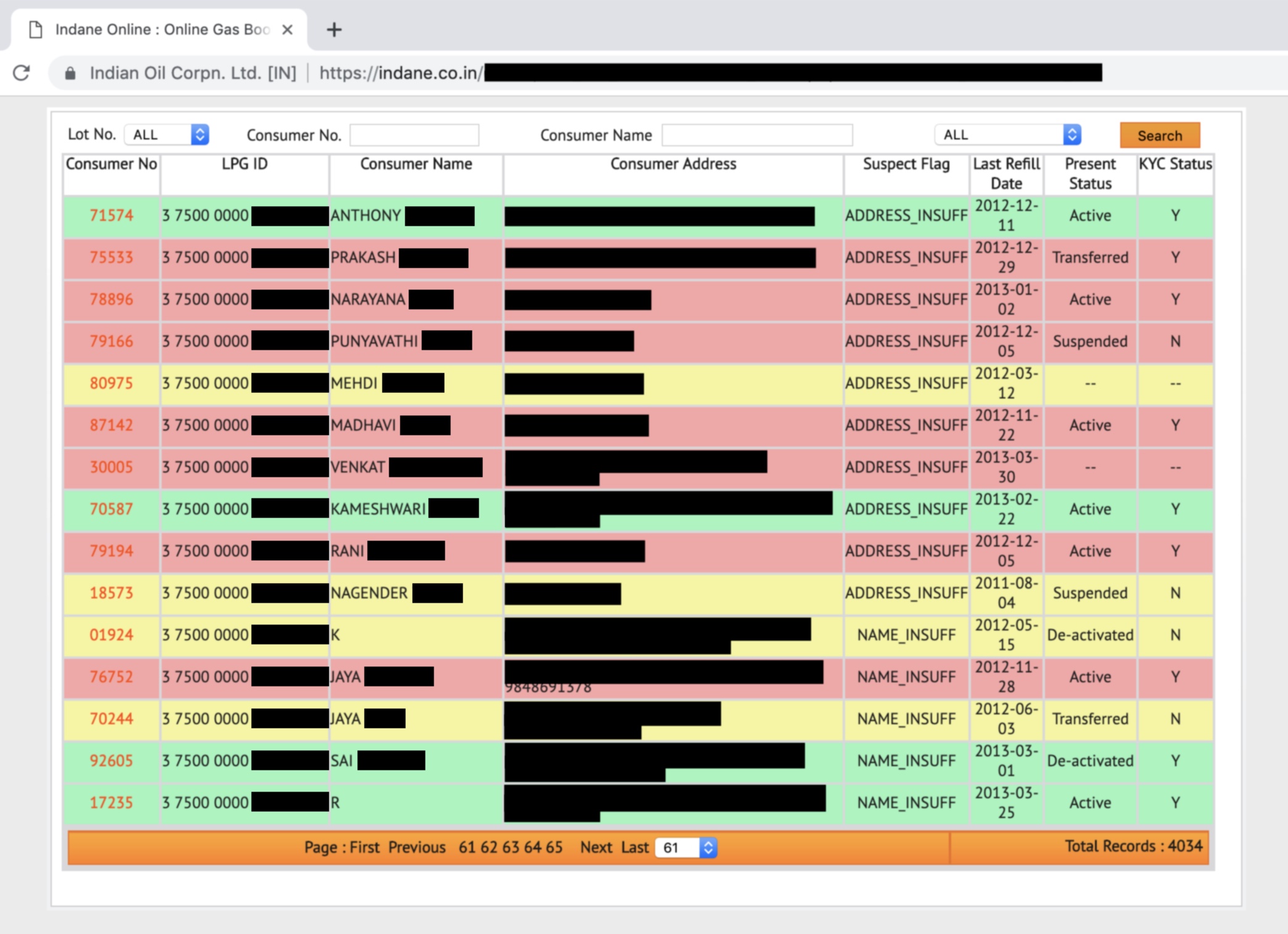
A screenshot showing the unauthenticated access to Indane’s dealer portal, which included sensitive information on millions of Indian citizens. This was one dealer who had 4,034 customers. (Image: TechCrunch)

It’s the latest security lapse involving Aadhaar data, and the second lapse to embroil Indane. Last year, the gas and energy company was found leaking data from an endpoint with a direct connection to Aadhaar’s database. This time, however, the leak is believed to be limited to its own data.

Indane is said to have more than 90 million customers across India.

The exposure comes just weeks after an Indian state leaked the personal information of more than 160,000 government workers, including their Aadhaar numbers.

Aadhaar numbers aren’t secret, but are treated as confidential and private information similar to Social Security numbers. More than 90 percent of India’s population, some 1.23 billion citizens, are enrolled in Aadhaar, which the government and some private enterprises use to verify identities. The government uses Aadhaar to enroll citizens in state services, like voting, or applying for welfare or financial assistance. Some companies also pushed customers to enroll their bank accounts or phone service to their Aadhaar identity, but this was recently struck down by the country’s Supreme Court. Many say linking their Aadhaar identities to their bank accounts has led to fraud.

The exposure is likely to reignite fresh concerns that the Aadhaar system is not as secure as UIDAI has claimed. Although few of the security incidents have involved a direct breach of Aadhaar’s central database, the weakest link remains the companies or government departments that rely on the data.

We contacted both Indane and UIDAI, but did not hear back.
18 Feb 2019

What an American artificial intelligence initiative really needs

At a high level, the American AI Initiative seems to be headed in the right direction. We absolutely need a holistic approach that considers all the various areas that are critical to building innovative AI solutions. This seems to be an underlying concept of the Initiative, as the executive order places priority on making data available across government agencies, allocating cloud computing resources to support AI R&D and training the workforce. Commitment to AI innovation is critical to maintaining our leadership position in technology with the increasing level of global AI competition.

We know that China, France and the U.K. have invested and committed billions already to their own AI initiatives. The American AI Initiative as it stands does little to blunt the fears that America will fall behind in its technological edge. In fact, its lack of particulars sends exactly the opposite message.

If the government wants to demonstrate its support for AI, it needs to commit significant funding and investment in education to retain, attract and grow the talent necessary to support such a critical industry that has the potential to define our future and truly increase American competitiveness.

We have started to see momentum from some institutions that have already announced funding initiatives for AI research and advanced computer science education, such as MIT’s $1 billion commitment to AI, but we need government agencies and other private institutions to follow suit in order to effectively change the landscape. Such investments and focus on advanced technology development must become the baseline expectation for competition in our country.

We also need continuous and robust investments from VCs for AI startups across industries and markets, as there exists ample opportunity for backing transformative AI startups. Now is the time for the government and private capital to come together and jointly put our monies where our mouths are.

Beyond funding, the government must take a hard look at the global AI talent pool and accelerate the incoming flow of talent to our country, whether through academia or industry. According to NVCA (National Venture Capital Association), an estimated 51 percent of domestic private companies valued at $1 billion or more had one or more founders who were born outside of the U.S.

Overall, 31 percent of venture-backed founders are immigrants. A large number of these are leading technology companies at the forefront of developing new American products and services, many of which will leverage some form of AI in the next few years if they aren’t already. Attracting and retaining fresh talent, educators and data scientists must be a part of our national agenda, as the talent pool necessary to take a leadership position in AI is currently cannibalizing itself.

With respect to the American AI Initiative, success comes down to the details and specific plans, which will be determined over the course of the next three to six months. Each of the milestones outlined in the executive order are important advancements, but the Initiative will only truly succeed if it is built holistically.

Access (and the necessary protections) to data, access to cloud computing and a commitment to computer science must be embraced by the government as an integral part of our technology-driven businesses and personal lifestyles. These cannot be viewed as separate components in disparate silos.

If the government can champion a frontier technology and data-centric approach, the American AI Initiative has the potential to both reduce barriers to entry for AI startups and elevate the entire tech, business and innovation landscape. But it starts with a commitment to academic education, training for the workforce and a deliberate and concerted focus on ensuring public trust in AI. While no small feat, this is what is required to guarantee the intelligent future of America, and its leadership role in global innovation.

18 Feb 2019

Oculus co-founder shipping free Rift repair kits to users with VR headset audio issue

Oculus co-founder Palmer Luckey isn’t in the VR hardware business these days since getting canned by Facebook (he’s focused on smart border security at his new company Anduril), but he still wants people to like the product he helped design.

A couple of months back he detailed some of the rather intricate mods he had made to the company’s Oculus Go headset to better tailor the headset to his use cases. Today, he’s showcasing a fix for an audio hardware issue in the original Rift that he says is causing problems for some Rift users, cutting off audio in the headset’s right headphone.

Affected users haven’t been left without audio entirely, but the process of using third-party headphones and a super-long audio extension cord to plug into your PC is cumbersome, to say the least. Luckey goes as far as to refer to the issue as a design flaw with the Rift headset; he also notes that Oculus will repair faulty headsets under warranty but that he’s found that it’s also affected plenty of out-of-warranty Rift owners.

Over the past few weeks Luckey says he’s been buying from users headsets that had audio issues to get a full overview of the problem, and now he’s figured out a fix. Luckey writes on his blog that he’ll ship a free repair kit to any users that have reported their issue. You can check out his post linked above for full details.

Luckey doesn’t work at Facebook anymore, so why is he even bothering himself with this? From his blog post, it seems to be a little bit of founder’s guilt.

“The Oculus Rift CV1 is not perfect. Some issues are the result of carefully considered design tradeoffs, but others are design flaws that did not become apparent as such until well after launch,” Luckey writes. “I am doing this because I feel bad for people who bought a Rift from me and can’t use it properly anymore.”

It’s very cool to see Luckey continue to take ownership of a product that he helped create. Facebook is preparing to release an update to the Rift this year, but for users that bet on VR’s first-generation and are suffering from some audio issues it seems their headsets can keep plugging along with a little bit of tinkering.

18 Feb 2019

TCL leaks foretell a weird future for foldable phones

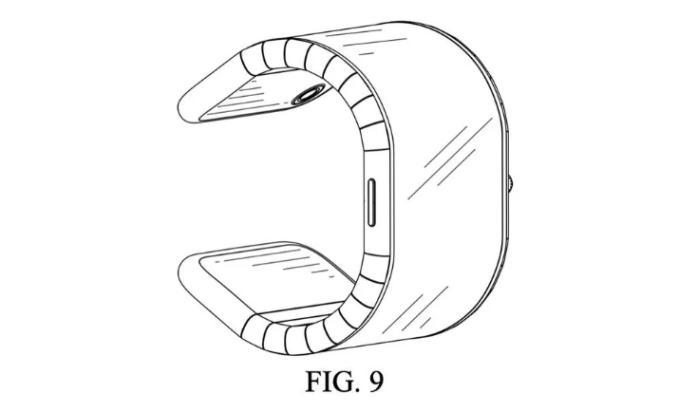
Foldables are going to get weird. And I’m here for it. Just check out these leaked TCL renders from CNET. All manner of strange and wonderful folding devices — two tablets and three smartphones, including one that flips all the way around into a Futurama-style bracelet. There are renders for tablets and phones that fold both in and out.

Granted, few if any will actually come to fruition, but if this first wave of foldables opens up smartphone design in new and interesting ways like these, the industry will be all the better for it. Of course, we’re still in the early stages of all of this — and the first wave of foldables have yet to prove themselves of interest to the smartphone-buying audience beyond simple novelties.

We’ll be seeing a fair bit more of the space week at Mobile World Congress, along with Wednesday’s Samsung event, which is expected to give us another peek at the upcoming Galaxy foldable. For now, however, the Royale FlexPai is the only device that’s actually come to market, and that one still feels like little more than a developer product.

However, while TCL’s not a household name here in the space, the Chinese company certainly has experience in the display department, both through its TV business of the same name and smartphone brands like Alcatel, Palm and BlackBerry.

These sorts of renders are probably pretty standard for all companies currently experimenting with a flexible form factor. If there’s one thing all of the announced devices have proven, it’s that the industry is still a ways away from settling on a consistent design language for these devices. And it’s certainly possible that the industry will never settle on a consistent form factor.

18 Feb 2019

HiHello raises $2.5 million to finally fix contact management

HiHello, the latest startup to take aim at business cards with its own digital alternative, has now raised a $2.5 million seed round to continue its efforts in building a better contact management solution designed for the mobile era. The new financing was led by August Capital, K9 Ventures and TenOneTen Ventures, and will see Villi Iltchev from August Capital joining the HiHello board as a result.

The now six-month-old startup was dreamed up by K9 Ventures founder Manu Kumar, along with co-founder and Caltech and Columbia alum Hari Ravi. Notably, Kumar has been trying to solve the problem of contact management for years, having co-founded and sold his startup CardMunch to LinkedIn — a decision he later regretted, saying last year he was “still peeved” at LinkedIn for ruining and eventually killing the product. (LinkedIn later pawned off its ashes to Evernote.)

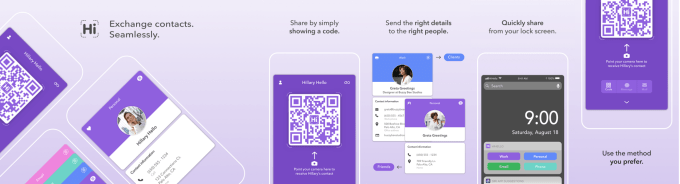
With HiHello, Kumar is giving contact management and business networking another shot. Version 1 of the app offered a simple solution that lets users exchange contact information by way of scanning a QR code with their phone’s native camera app, or by sharing information using SMS or email. The mobile app lets you create custom profiles in order to share with another person either your work contact information, personal details or any other custom profiles you want.

As HiHello enters its next phase, the company aims to pick up some of the better ideas from past apps in this space — like Plaxo, Bump and even CardMunch — while also overcoming their limitations.

For example, Bump had once required that both people have the app installed in order to work. HiHello today already works if only one person has the app. But it will roll out a more elegant solution for when two HiHello users are present. A “Nearby” screen in the app will allow people to share contact information with one another based on a dual opt-in system.

From Plaxo, HiHello will adopt the idea of automatically updating contact information for everyone who has the user in their address book when information is changed.

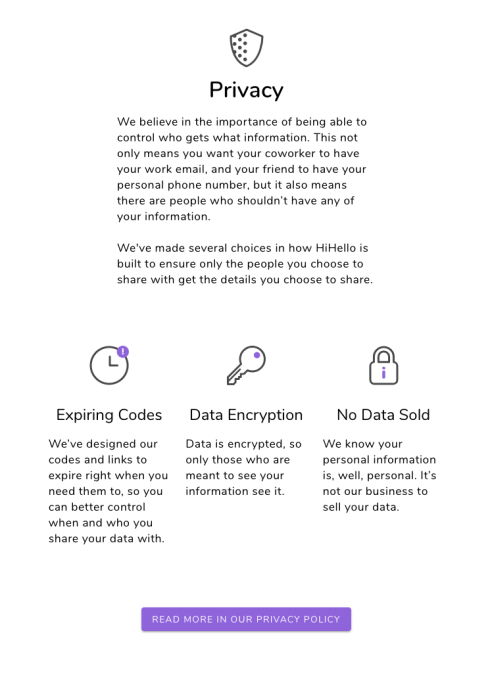
The startup is taking a different approach to privacy than Plaxo did, saying it won’t spam or sell user data, nor will it ask permission to access your contacts. Instead, HiHello will act as an address book provider whose database of contacts you can add to your device. This keeps it isolated and separate from other address sources, and ensures it won’t “mess up” your own contacts in the process.

Some of the forthcoming features will be paid features, but the company will continue to offer a free tier as well.

Kumar says he doesn’t want to make the same mistake he did with CardMunch. Instead, he wants the company to be sustainable, “so that we never have to sell HiHello to an acquirer who will then proceed to ruin the service and kill it.”

Yep, that LinkedIn deal still stings, it seems… Hopefully HiHello will meet a better fate.

18 Feb 2019

Instagram’s fundraiser stickers could lure credit card numbers

Mark Zuckerberg recently revealed that commerce is a huge part of the 2019 roadmap for Facebook’s family of apps. But before people can easily buy things from Instagram etc, Facebook needs their credit card info on file. That’s a potentially lucrative side effect of Instagram’s plan to launch a Fundraiser sticker in 2019. Facebook’s own Donate buttons have raised $1 billion, and bringing them to Instagram’s 1 billion users could do a lot of good while furthering Facebook’s commerce strategy.

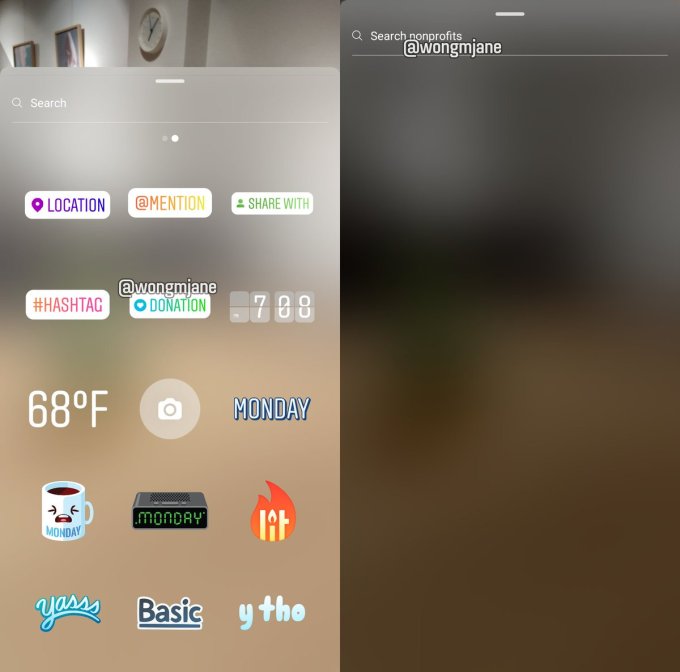
New code and imagery dug out of Instagram’s Android app reveals how the Fundraiser stickers will allow you to search for non-profits and add a Donate button for them to your Instagram Story. After you’ve donated to something once, Instagram could offer instant checkout on stuff you want to buy using the same payment details.

Back in 2013 when Facebook launched its Donate button, I suggested that it could add a “remove credit card after checkout” option to its fundraisers if it wanted to make it clear that the feature was purely altruistic. Facebook never did that. You still need to go into your payment settings or click through the See Receipt option after donating and then edit your account settings to remove your credit card. We’ll see if Instagram is any different. We’ve also asked whether Instagrammers will be able to raise money for personal causes, which would make it more of a competitor to GoFundMe — which has sadly become the social safety net for many facing healthcare crises.

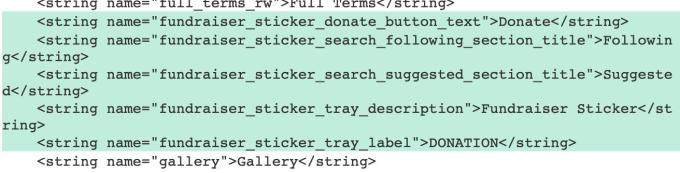
Facebook mentioned at its Communities Summit earlier this month that it’d be building Instagram Fundraiser stickers, but the announcement was largely overshadowed by the company’s reveal of new Groups features. This week, TechCrunch tipster Ishan Agarwal found code in the Instagram Android app detailing how users will be able search for non-profits or browse collections of Suggested charities and ones they follow. They can then overlay a Donate button sticker on their Instagram Story that their followers can click through to contribute.

We then asked reverse engineering specialist Jane Manchun Wong to take a look, and she was able to generate the screenshots seen above that show a green heart icon for the Fundraiser sticker plus the non-profit search engine. A Facebook’s spokespeople tell me that “We are in early stages and working hard to bring this experience to our community . . . Instagram is all about bringing you closer to the people and things you love, and a big part of that is showing support for and bringing awareness to meaningful communities and causes. Later this year, people will be able to raise money and help support nonprofits that are important to them through a donation sticker in Instagram Stories. We’re excited to bring this experience to our community and will share more updates in the coming months.”

Zuckerbeg said during the Q4 2018 earnings call last month that “In Instagram, one of the areas I’m most excited about this year is commerce and shopping . . . there’s also a very big opportunity in basically enabling the transactions and making it so that the buying experience is good”. Streamlining those transactions through saved payment details means more people will complete their purchase rather than abandoning their cart. Facebook CFO David Wehner noted on the call that “Continuing to build good advertising products for our e-commerce clients on the advertising side will be a more important contributor to revenue in the foreseeable future”. Even though Facebook isn’t charging a fee on transactions, powering higher commerce conversion rates convinces merchants to buy more ads on the platform.

With all the talk of envy spiraling, phone addiction, bullying, and political propaganda, enabling donations is at least one way Instagram can prove it’s beneficial to the world. Snapchat lacks formal charity features, and Twitter appears to have ended its experiment allowing non-profits to tweet donate buttons. Despite all the flack Facebook rightfully takes, the company has shown a strong track record with philanthropy that mirrors Zuckerberg’s own $47 billion commitment through the Chan Zuckerberg Initiative. And if having some relatively benign secondary business benefit speeds companies towards assisting non-profits, that’s a trade-off we should be willing to embrace.

18 Feb 2019

Google Assistant Actions up 2.5x in 2018 to reach 4,253 in the U.S.

In addition to competing for smart speaker market share, Google and Amazon are also competing for developer mindshare in the voice app ecosystem. On this front, Amazon has soared ahead – the number of available voice skills for Alexa devices have grown to top 80,000 the company recently announced. According to a new third-party analysis from Voicebot, Google is trailing that by a wide margin with its own voice apps, called Google Assistant Actions, which total 4,253 in the U.S. as of January 2019.

For comparison, 56,750 of Amazon Alexa’s total 80,000 skills are offered in the U.S.

The report notes that the number of Google Assistant Actions have grown 2.5 times over the past year – which is slightly faster growth than seen on Amazon Alexa, whose skill count grew 2.2 times during the same period. But the total is a much smaller number, so growth percentages may not be as relevant here.

In January 2018, there were 1,719 total Google Assistant Actions in the U.S., the report said. In 2017, the number was in the low hundreds in the beginning of the year, and reached 724 by October 2017.

Voicebot also examined which categories of voice apps were popular on Google Assistant platforms.

It found that three of the eighteen categories accounted for over one-third of all Google Assistant Actions: Education & Reference; Games & Fun; and Kids & Family.

The Education category topped the list with over 15 percent of all Actions, while Games & Fun was 11.07 percent and Kids & Family was 9.29 percent.

Local and Weather were the least popular.

On Alexa, the top categories differ slightly. Though Games & Fun is popular on Google, its Alexa equivalent – Games & Trivia – is the No. 1 most popular category, accounting for 21 percent of all skills. Education was second most popular at around 14 percent.

It’s interesting that these two top drivers for voice apps are reversed on the two platforms.

That could indicate that Alexa is seen to be the more “fun” platform, or one that’s more oriented towards use by families and gaming. Amazon certainly became aware of the trend towards voice gaming, and fanned the flames by making games the first category it paid developers to work on, by way of direct payments. That likely encouraged more developers to enter the space, and subsequently helped boost the number of games – and types of gaming experiences – available for Alexa.

Voicebot’s report rightly raises the question as to whether or not the raw skill count even matters, though.

After all, many of the Alexa skills offered today are of low quality, or more experimental attempts from developers testing out the platform. Others are just fairly basic – the voice app equivalent of third-party flashlight apps for iPhone before Apple built that feature into iOS. For example, there now are handful of skills that turn on the light on Echo speakers so you can have a nightlight by way of the speaker’s blue ring.

But even if these early efforts sometimes fall short, it does matter that Alexa is the platform developers are thinking about, as it’s an indication of platform commitment and an investment on developers’ part. Google, on the other hand, is powering a lot of its Assistant’s capabilities itself, leaning heavily on its Knowledge Base to answer users’ questions, while also leveraging its ability to integrate with Google’s larger suite of apps and services, as well as its other platforms, like Android.

In time, Google Assistant may challenge Alexa further by capitalizing on geographic expansions, but for the time being, Alexa is ahead on smart speakers as well as, it now seems, on content.


18 Feb 2019

SoftBank and Mubadala grow closer

The Japanese conglomerate SoftBank and Mubadala, the Abu Dhabi state investment company, have a closely intertwined relationship, and it’s one that the two are further cementing. According to the Financial Times, SoftBank has just committed half the capital for a new $400 million fund from Mubadala that aims to back European startups.

Industry observers might remember that Mubadala committed $15 billion to SoftBank’s massive Vision Fund as it was first being put together in 2017. Soon after, Mubadala opened a San Francisco office, as well as structured a $400 million fund designed to invest in early-stage startups to which SoftBank committed some capital.

The pact was understandable, including because Mubadala’s early-stage fund could theoretically provide SoftBank with a better idea of what’s happening at companies that are earlier in their trajectories than SoftBank typically sees. The move was also meant to better enable Mubadala to oversee the money it committed to SoftBank.

The newer fund appears to be raising questions, however. At least, the FT notes that the timing is “unusual,” given that SoftBank is currently saddled with $154 billion in gross debt. The new fund also “raises the prospect that Mubadala’s influence with the Vision Fund will only grow by allowing it to shape SoftBank’s tech investments,” as suggest by the FT’s sources.

Yet SoftBank may not have much choice but to work increasingly closely with Abu Dhabi. As the company’s CEO, Masayoshi Son, said earlier this month, the Vision Fund has spent about $50 billion of its approximately $99 billion in capital. Given the rate at which it has been investing (it just plugged nearly $1 billion into a company last week), its remaining funds might not last through 2020.

Meanwhile, it isn’t clear whether SoftBank enjoys the solid relationship that it once did with the Vision Fund’s biggest anchor investor, the kingdom of Saudi Arabia, which provided SoftBank with a $45 billion commitment for its current fund and that SoftBank was largely counting on to be its biggest backer in a second Vision Fund.

On October 3rd of last year, Bloomberg journalists talked with Saudi Arabia’s Crown Prince Mohammed bin Salman (or MBS), and he said he planned to invest a further $45 billion in SoftBank. Yet what few knew then was that five days earlier, journalist and Saudi regime critic Jamal Khashoggi had vanished after going into the Saudi consulate in Istanbul. As questions, and concern, began to spread over MBS’s involvement in the disappearance, many business executives canceled plans to visit Riyadh, where Saudi Arabia hosted an investment conference in the middle of October. Son was among them, even as he tried hedging his bets by visiting privately with MBS in Riyadh the night before the event began.

Whether that move angered MBS remains to be seen. It also isn’t clear whether the CIA’s eventual findings that MBS ordered Khashoggi’s murder, or the unflattering attention paid to Saudi Arabia because of that murder, is impacting where SoftBank is able to invest its capital.

Son, for his part, declined to say earlier this month whether he would consider taking more money from Saudi sources — which is perhaps telling in itself.

In the meantime, it’s barreling ahead with Mubadala, which will reportedly use its new fund to write to European startups checks of between $5 million and $30 million.

As with Mubadala’s San Francisco-based team, the idea appears to be to act as a funnel for SoftBank’s Vision Fund, steering it deals that Mubadala’s team sees as the most promising in its portfolio.

Mubadala’s European venture fund will be run out of a new office in London, which is expected to open this spring. The Vision Fund is currently also headquartered in London, with another office in San Francisco and, soon, offices expected in Shanghai, Beijing and Hong Kong.

18 Feb 2019

SoftBank and Mubadala grow closer

The Japanese conglomerate SoftBank and Mubadala, the Abu Dhabi state investment company, have a closely intertwined relationship, and it’s one that the two are further cementing. According to the Financial Times, SoftBank has just committed half the capital for a new $400 million fund from Mubadala that aims to back European startups.

Industry observers might remember that Mubadala committed $15 billion to SoftBank’s massive Vision Fund as it was first being put together in 2017. Soon after, Mubadala opened a San Francisco office, as well as structured a $400 million fund designed to invest in early-stage startups to which SoftBank committed some capital.

The pact was understandable, including because Mubadala’s early-stage fund could theoretically provide SoftBank with a better idea of what’s happening at companies that are earlier in their trajectories than SoftBank typically sees. The move was also meant to better enable Mubadala to oversee the money it committed to SoftBank.

The newer fund appears to be raising questions, however. At least, the FT notes that the timing is “unusual,” given that SoftBank is currently saddled with $154 billion in gross debt. The new fund also “raises the prospect that Mubadala’s influence with the Vision Fund will only grow by allowing it to shape SoftBank’s tech investments,” as suggest by the FT’s sources.

Yet SoftBank may not have much choice but to work increasingly closely with Abu Dhabi. As the company’s CEO, Masayoshi Son, said earlier this month, the Vision Fund has spent about $50 billion of its approximately $99 billion in capital. Given the rate at which it has been investing (it just plugged nearly $1 billion into a company last week), its remaining funds might not last through 2020.

Meanwhile, it isn’t clear whether SoftBank enjoys the solid relationship that it once did with the Vision Fund’s biggest anchor investor, the kingdom of Saudi Arabia, which provided SoftBank with a $45 billion commitment for its current fund and that SoftBank was largely counting on to be its biggest backer in a second Vision Fund.

On October 3rd of last year, Bloomberg journalists talked with Saudi Arabia’s Crown Prince Mohammed bin Salman (or MBS), and he said he planned to invest a further $45 billion in SoftBank. Yet what few knew then was that five days earlier, journalist and Saudi regime critic Jamal Khashoggi had vanished after going into the Saudi consulate in Istanbul. As questions, and concern, began to spread over MBS’s involvement in the disappearance, many business executives canceled plans to visit Riyadh, where Saudi Arabia hosted an investment conference in the middle of October. Son was among them, even as he tried hedging his bets by visiting privately with MBS in Riyadh the night before the event began.

Whether that move angered MBS remains to be seen. It also isn’t clear whether the CIA’s eventual findings that MBS ordered Khashoggi’s murder, or the unflattering attention paid to Saudi Arabia because of that murder, is impacting where SoftBank is able to invest its capital.

Son, for his part, declined to say earlier this month whether he would consider taking more money from Saudi sources — which is perhaps telling in itself.

In the meantime, it’s barreling ahead with Mubadala, which will reportedly use its new fund to write to European startups checks of between $5 million and $30 million.

As with Mubadala’s San Francisco-based team, the idea appears to be to act as a funnel for SoftBank’s Vision Fund, steering it deals that Mubadala’s team sees as the most promising in its portfolio.

Mubadala’s European venture fund will be run out of a new office in London, which is expected to open this spring. The Vision Fund is currently also headquartered in London, with another office in San Francisco and, soon, offices expected in Shanghai, Beijing and Hong Kong.

18 Feb 2019

VPN protocol WireGuard now has an official macOS app

WireGuard could be the most promising VPN protocol in years. It lets you establish a connection with a VPN server that is supposed to be faster, more secure and more flexible at the same time. The developers launched a brand new app in the Mac App Store today.

WireGuard isn’t a VPN service, it’s a VPN protocol, just like OpenVPN or IPsec. The best thing about it is that it can maintain a VPN connection even if you change your Wi-Fi network, plug in an Ethernet cable or your laptop goes to sleep.

But if you want to use WireGuard for your VPN connection you need to have a VPN server that supports it, and a device that supports connecting to it. You can already download the WireGuard app on Android and iOS, but today’s release is all about macOS.

The team behind WireGuard has been working on a macOS implementation for a while. But it wasn’t as straightforward as an app. You could install WireGuard-tools using Homebrew and then establish a connection using a command line in the Terminal.

It’s much easier now, as you just have to download an app in the Mac App Store and add your server profile. The app is a drop-down menu in the menu bar. You can manage your tunnel and activate on-demand connections for some scenarios. For instance, you could choose to activate your VPN exclusively if you’re connected to the internet using Wi-Fi, and not Ethernet.

I tried the app and it’s as snappy and reliable as expected. The app leverages Apple’s standard Network Extension API to add VPN tunnels to the network panel in the settings.

If you want to try WireGuard yourself, I recommend building your own VPN server using Algo VPN. Don’t trust any VPN company that sells you a subscription or lets you access free VPN servers. A VPN company can see all your internet traffic on their own servers, which is a big security risk.

Assume that those companies analyze your browsing habits, sell them to advertisers, inject their own ads on non-secure pages or steal your identity. The worst of them can hand to authorities a ton of data about your online life.

They lie in privacy policies and often don’t even have an About page with the names of people working for those companies. They spend a ton of money buying reviews and endorsements. You should avoid VPN companies at all costs.

If you absolutely need a VPN server because you can’t trust the Wi-Fi network or you’re traveling to a country with censored websites, make sure you trust the server.