Author: azeeadmin

14 Feb 2019

Atrium, Justin Kan’s legal tech startup, launches a fintech and blockchain division

Atrium, the legal startup co-founder by Justin Kan of Twitch fame, is jumping into the blockchain space today.

The company has raised plenty of money — including $65 million from A16z last September — so rather than an ICO or token sale, this is a consultancy business. Atrium uses machine learning to digitize legal documents and develops applications for client use, and now it is officially applying that to fintech and blockchain businesses.

The division has been operating quietly for months and the scope of work that it covers includes the legality and regulatory concerns around tokens, but also business-focused areas including token utility, tokenomics and general blockchain tech.

“We have a bunch of clients wanting to do token offerings and looking into the legality,” Kan told TechCrunch in an interview. “A lot of our advisory work is around the token offering and how it operates.”

The commitment is such that the company is even accepting Bitcoin and Bitcoin Cash for payments through crypto processing service BitPay.

While the ICO market has quietened over the past year following to huge valuation losses market-wide, up to 90 percent in some cases with many ICO tokens now effectively worthless, there’s a new anticipation around regulatory-friendly security token offering (STO) options. Coinbase, for one, has backed STO platforms and its CEO Brian Armstrong has spoken of his belief that the cap table of the future is tokenized, allowing company tokens to be freely traded worldwide.

According to Armstrong, Coinbase could potentially host “millions” of STOs in the future.

If even a fraction of that number is to exist, companies will need advisors to help with structure and regulatory compliance. Many legal firms are already making a proverbial killing and, just like its core business, Atrium wants to use its tech-centric platform to offer a more efficient and cheaper alternative to expensive legal firms.

“People are doing private offerings, but the number of ICOs has definitely dropped,” Kan admitted. “Interest, though, has continued to grow, as people try to navigate this new regulatory regime. We spend a lot of time trying to focus on only taking on high-quality clients.”

Atrium Fintech and Blockchain also includes fintech work — as the name implies — but blockchain is likely to account of the majority of client work, so said Ross Barbash, who leads the 10-person team.

“We currently work with a mix of companies across the U.S, with some in Asia and Europe,” he said.
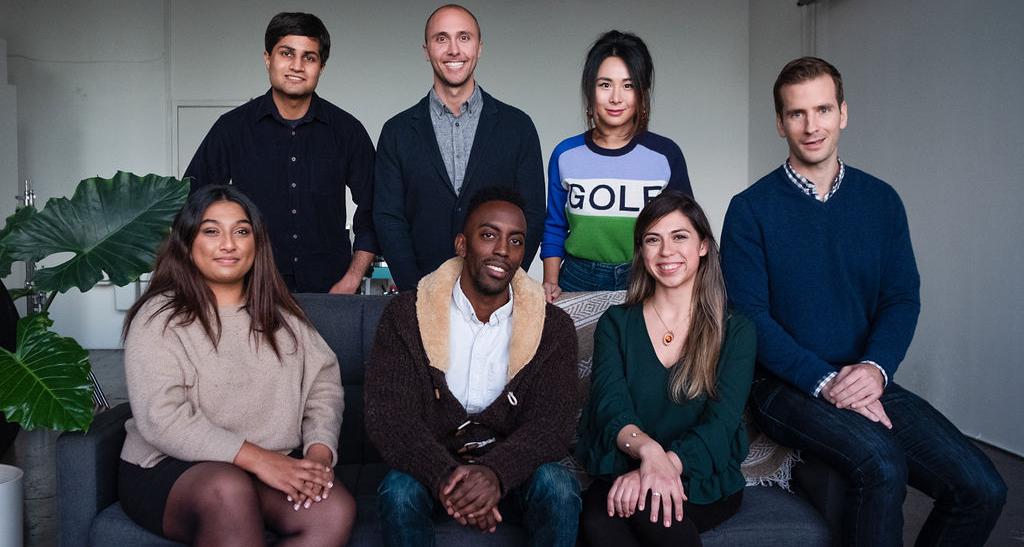
Members of Atrium’s fintech and blockchain team

The fintech work has tended to be more U.S-centric at this point, Barbash said, because Atrium’s expertise is particular to licenses at federal and state level in America.

Regulation is, of course, far trickier when it comes to blockchain as it remains a work in progress. The SEC has made periodic statements, often taking legal action to establish expectations and boundaries as it decides exactly how to respond to the explosion of blockchain and cryptocurrencies.

“The level of challenge and regulatory frameworks have evaluated blockchain analysis to business level” work rather than simply legal counsel, Barbash explained. “We’re working closely with some regulators to better understand some elements of the ecosystem.”

“With the shift from HODL to BUIDL, we are finding it easier to identify and collaborate with the teams that both have the necessary dev chops and are committed to compliance,” he added via a statement.

Some of Atrium’s disclosed clients include credit card startup Final (which was bought by Goldman Sachs) and solar financial services firm Wunder Capital.

More generally, Kan said that the blockchain and fintech division serves as a blueprint for how Atrium will go after specific verticals. He said that the startup, which now has 150 staff, will spin out different units for specific legal practices.


14 Feb 2019

Daily Crunch: Facebook (possibly) considered buying Unity

The Daily Crunch is TechCrunch’s roundup of our biggest and most important stories. If you’d like to get this delivered to your inbox every day at around 9am Pacific, you can subscribe here.

1. Facebook mulled multi-billion-dollar acquisition of gaming giant Unity, book claims

Less than a year after making a $3 billion investment into the future of virtual reality with the purchase of Oculus VR, Facebook CEO Mark Zuckerberg was considering another multi-billion-dollar bet by buying Unity, the popular game engine that’s used to build half of all gaming titles.

At least, that’s the claim made in a new book, “The History of the Future,” by Blake Harris, which digs deep into the founding story of Oculus and the drama surrounding the Facebook acquisition, subsequent lawsuits and personal politics of founder Palmer Luckey.

2. Alibaba’s Ant Financial buys UK currency exchange giant WorldFirst reportedly for around $700M

Although the companies were relatively quiet about the deal, it could end up being pretty significant, showing both the market connections between China and Europe and the margin pressures that many smaller remittance companies are under in the wake of larger companies like Amazon building their own money-moving services.

3. Nintendo makes the old new again with Mario, Zelda, Tetris titles for Switch

We round up everything Nintendo announced yesterday, from Super Mario Maker 2 to the unexpected remake of Game Boy classic Link’s Awakening.

Tesla dog mode

4. Tesla ‘Dog mode’ and ‘Sentry mode’ are now live to guard your car and pets

Dog mode is meant to accomplish two things: to keep dogs (or perhaps a hamster or cat) in a climate-controlled environment if left unattended in a vehicle, and to let passersby know their status.

5. Happy Valentine’s Day: your dating app account was hacked, says Coffee Meets Bagel

Users of the dating app Coffee Meets Bagel woke up this morning to find an email in their inboxes warning that their account information had been stolen by a third-party who gained unauthorized access to the company’s systems.

6. Apple is selling the iPhone 7 and iPhone 8 in Germany again

Apple was forced to pull the iPhone 7 and iPhone 8 models from shelves in the country last month, after chipmaker Qualcomm posted security bonds to enforce a December court injunction.

7. Malt raises $28.6M for its freelancer platform

Malt has created a marketplace for companies and engineers working as freelancers. There are currently 100,000 freelancers on the platform and 15,000 companies using Malt regularly.

14 Feb 2019

Figma gets $40 million Series C to put design tools in the cloud

With more industries and organizations recognizing design as a pillar of business, a battle is brewing among makers of design tools. And with a fresh $40 million in Series C funding, Figma is ready to fight.

Cofounder and CEO Dylan Field explains that when he and cofounder Evan Wallace started the company, in 2012, IBM employed one designer for every 72 engineers. Today, IBM has eight engineers to every designer, and that ratio goes to 3:1 on mobile.

This shift, which is reflected more broadly across various industries, has led more people within their organizations to want to be involved in the design process. Which means that tools that once ‘got the job done’ for small design teams and individual freelancers working in a silo stopped being useful.

Field saw the need for real-time collaborative design tools, and dropped out of Brown to join the Thiel fellowship to build Figma . Since launch, the company has grown to 1 million sign-ups, with a total of $82.9 million raised on a $440 million post-money valuation.

Figma offers a freemium model, with the product remaining free up to three editors. From there you bump into the Pro tier, which offers unlimited version history and the ability to create a Design System for $15/month/editor. The org tier bundles in an extra layer of security and content control for $45/month/editor.

A big part of what sets Figma apart is its home on the web. Figma allows designers and collaborators to take care of every part of the process — from initial design to collaboration to storage to prototyping — right within a web app.

“We set out to make a cloud version of these traditional design tools,” said Field. “And what we realized is that once you put it all in the cloud, and make it so that the entire workflow across design and storage and prototyping and developer handoff and version control… once you connect all that, you’re not actually creating all those different products. You’re creating one integrated system.”

Because of this, common design problems like file versioning and real-time collaboration aren’t really an issue for Figma. Designers can work together, or make changes on their own, and those changes are reflected across the file in real time with a complete revision history. To share something new, they can simply send over a link.

Adobe and InVision, the two other big players in the ring, have both built native apps to handle the same full-stack problem of bundling design tools, collaborative prototyping, and file versioning together. Adobe has addressed its growing competition through its collaborative design tool Adobe XD. InVision, which started out as a collaborative prototyping platform in 2011, has either built or bought its products that expand up and downstream in the workflow.

And it seems that, for some big design teams, Figma’s web app has prevailed.

Which explains why Sequoia partner Andrew Reed changed his mind. Figma actually went to Sequoia when raising their Series B in 2018, and the VC firm passed up the opportunity.

“At the time, the product was interesting but the people we talk to about these products weren’t pointing to Figma as transforming their companies,” said Reed. “Over the past 12 months, things changed. We called people to ask their opinions and people were calling us proactively and telling us how impactful it was in their companies.”

After looking at the data, Reed said he discovered that there were Figma users at half of Sequoia’s portfolio companies. He reached out to Field, sent over a cap table in Figma, and within a week Figma closed on what could be seen as an opportunistic round, considering how recently Figma picked up its Series B.

But one perk of the deal is Reed’s experience from investing in GitHub, which is a great exemplar for design tool companies looking to bring some level of cohesiveness to a fragmented landscape.

“Collaboration is going to be embedded in the future of software,” said Reed.

14 Feb 2019

Amazon Moments lets developers reward customers with actual gifts, not just virtual ones

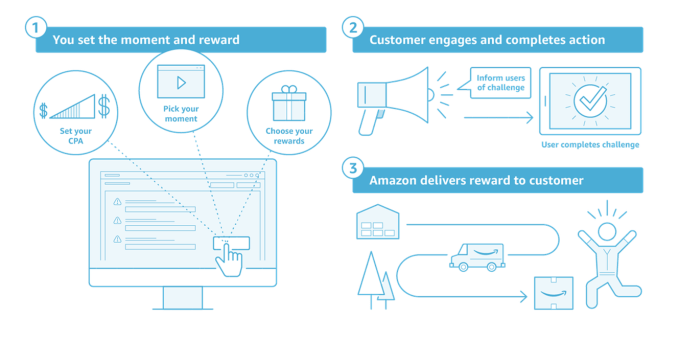
App and web developers are always trying to figure out better ways of keeping their users engaged on their platforms for longer. Today, Amazon is launching a service that it hopes those developers will use to do just that. Amazon Moments — as it is called — will let developers create actions — “moments” — that it wants users to perform, such as watching several episodes of a series if its a streaming service; or taking out a subscription if its a news site — and giving users actual physical gifts in exchange for doing so.

The service is going live in 100 countries today, Amazon said. Items that are eligible to be gifted as part of the Moments scheme will come in a catalogue — Amazon said that there are “millions” of products in it already, both from Amazon and select third-party vendors — and will sit alongside other kinds of products that incentivize users to be more engaged in apps, games and other digital services such as virtual currencies and gift cards.

“This adds to the variety and lets developers do something they haven’t been able to do before,” said Amir Kabbara, Amazon’s head of Moments, in an interview.

He added that they are providing to be very effective so far in pilots that Amazon has run with a number of publishers and other developers — Washington Post, TikTok, Sony Crackle, Sesame Workshop, USA TODAY, Sago Mini, and Bell Canada were among the early testers — with customers on average two to three times more likely to complete actions versus test using virtual items.

While offering a “gift with purchase” is nothing new in the world of retail, it’s been a trickier proposition when it comes to online commerce, since then the company setting up the promotion has to handle the fulfilment of the gifts, and that may stray far from its core competency as a business. For Amazon, this simply maximises the infrastructure that the e-commerce giant has already built to run its own Marketplace, and it gives and another opportunity to sell items from that Marketplace.

Moments comes in the form of an API that the developer and marketing team can build into an app or website, and for now there are a couple of ways that a company can be flexible in terms of what actually gets gifted.

There can be a specific item as the reward — for example, the Washington Post offered Echo Dots to people who subscribed — or it can be a gift certificate towards the purchase of an item like a book, which then the customer gets to choose.

They pay for the service by way of CPA — cost per “action” — meaning only when the action is completed and the reward is redeemed. Amazon, as a result, gets two different revenue streams from this, as the Marketplace operator and as the exchange selling the marketing unit to the developer/marketer.

Moments can also be segmented by customer types. Amazon notes: “If keeping an active payer engaged is worth $50, you can set a high-value action and offer $40 headphone sets with a comfortable margin of error. In addition, customer targeting allows you to tailor rewards to the lifetime value of each user segment. You could offer a $5 reward to new users, a $25 reward to active payers, and a $200 reward to top spenders.”

Over time, it will be interesting to see if Amazon applies more of its personalisation prowess to the product.

Just as advertising — or visiting Amazon’s homepage — is an exercise in seeing how your interests are tracked and aggregated to present you with what you are most likely to buy, you could imagine Moments promotions that will know that I already own an Echo Dot (or two) and that what I probably really want is an Eero. Given Amazon’s wider ambitions to grow its advertising and adtech businesses, it’s not outside the realm of possibility.

14 Feb 2019

Opera teases new desktop browser design

Browser maker Opera has been teasing a new project called R3 or ‘Reborn3’. The new project is now available as a beta version — and it’s a brand new design for the company’s desktop browser.

For now, the new design is only available in the developer version of Opera. But that doesn’t mean we can’t talk about it.

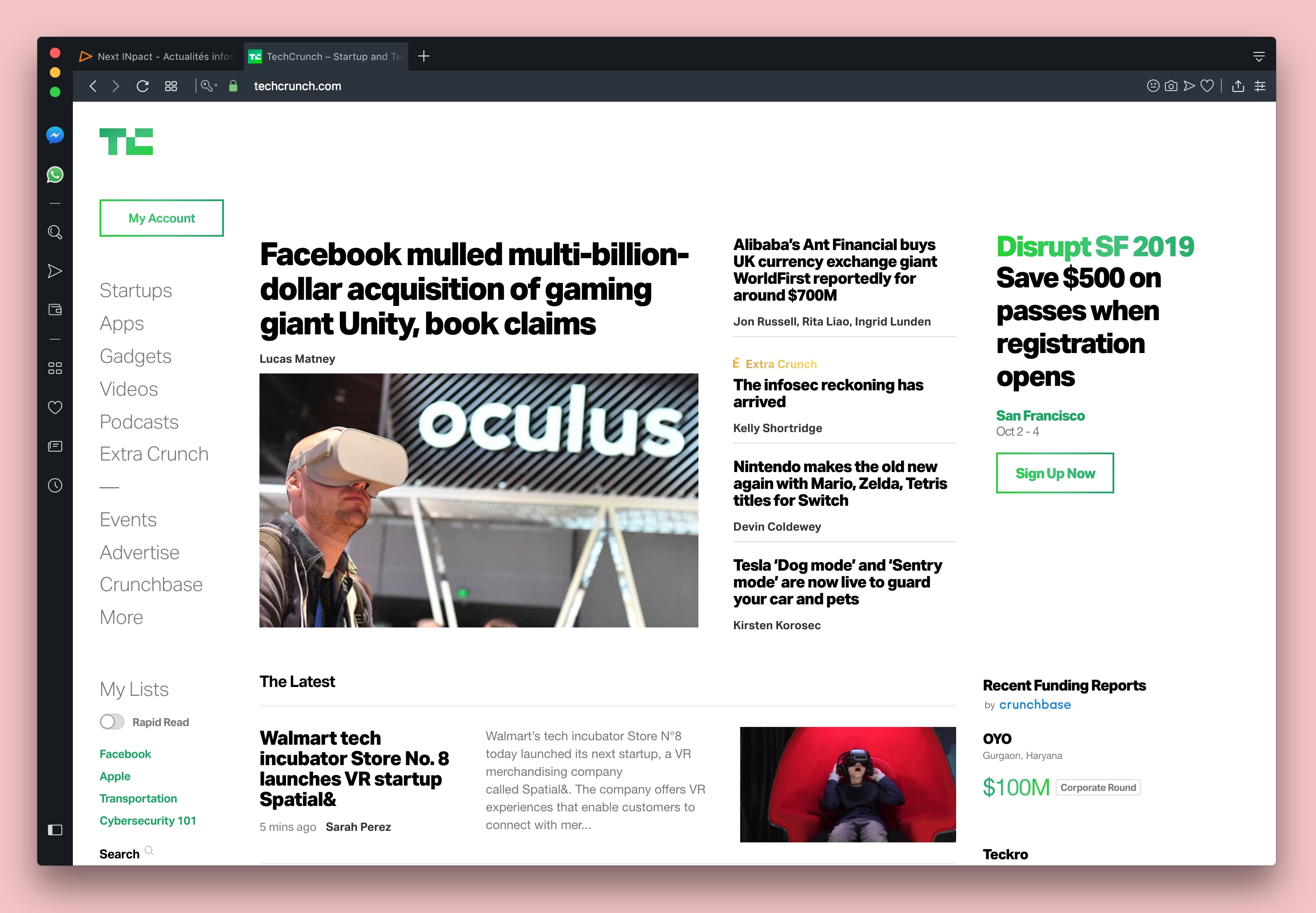
The main difference with this new version is that the sidebar and tab bar are now the same color. The sidebar no longer stands out as a black bar with a bunch of buttons. It feels like those buttons are part of the browser instead of an afterthought.

The webpage, active tab and address bar are now a single element. It’s quite visible when you visit a website with a white background and you’re using the light theme. There are subtile shadows that make this unit of content stands out from the rest of the browser.

It’s getting a bit crowded in the top right corner with a snapshot button, a bookmarking button, a ‘My Flow’ button to find your current page across all your devices, etc. Fortunately those buttons don’t take a lot of space and remain discrete.

The company has integrated a cryptocurrency wallet into its mobile browsers, and you’ll now be able to access those wallets from the desktop app as well. it works pretty much like WhatsApp on the desktop. Opera displays a QR code that you scan with your phone. Everything happens on your phone, but the desktop browser acts as an interface for your mobile wallet.

The Windows version of the browser looks exactly like the macOS version, but with standard Windows buttons in the corner.

14 Feb 2019

Biotech AI startup Sight Diagnostics gets $27.8M to speed up blood tests

Sight Diagnostics, an Israeli medical devices startup that’s using AI technology to speed up blood testing, has closed a  $27.8 million Series C funding round.

The company has built a desktop machine, called OLO, that analyzes cartridges manually loaded with drops of the patient’s blood — performing blood counts in situ.

The new funding is led by VC firm Longliv Ventures, also based in Israel, and a member of the multinational conglomerate CK Hutchison Group.

Sight Diagnostics said it was after strategic investment for the Series C — specifically investors that could contribute to its technological and commercial expansion. And on that front CK Hutchison Group’s portfolio includes more than 14,500 health and beauty stores across Europe and Asia, providing a clear go-to-market route for the company’s OLO blood testing device.

Other strategic investors in the round include Jack Nicklaus II, a healthcare philanthropist and board member of the Nicklaus Children’s Health Care Foundation; Steven Esrick, a healthcare impact investor; and a “major medical equipment manufacturer” — which they’re not naming.

Sight Diagnostics also notes that it’s seeking additional strategic partners who can help it get its device to “major markets throughout the world”.

Commenting in a statement, Yossi Pollak, co-founder and CEO, said: “We sought out groups and individuals who genuinely believe in our mission to improve health for everyone with next-generation diagnostics, and most importantly, who can add significant value beyond financial support. We are already seeing positive traction across Europe and seeking additional strategic partners who can help us deploy OLO to major markets throughout the world.”

The company says it expects that customers across “multiple countries in Europe” will have deployed OLO in actual use this year.

Existing investors OurCrowd, Go Capital, and New Alliance Capital also participated in the Series C. The medtech startup, which was founded back in 2011, has raised more than $50M to date, only disclosing its Series A and B raises last year.

The new funding will be used to further efforts to sell what it bills as its “lab-grade” point-of-care blood diagnostics system, OLO, around the world. Although its initial go-to-market push has focused on Europe — where it has obtained CE Mark registration for OLO (necessary for commercial sale within certain European countries) following a 287-person clinical trial, and went on to launch the device last summer. It’s since signed a distribution agreement for OLO in Italy.

“We have pursued several pilots with potential customers in Europe, specifically in the UK and Italy,” co-founder Danny Levner tells TechCrunch. “In Europe, it is typical for market adoption to begin with pilot studies: Small clinical evaluations that each major customers run at their own facilities, under real-world conditions. This allows users to experience the specific benefits of the technology in their own context. In typical progress, pilot studies are then followed by modest initial orders, and then by broad deployment.”

The funding will also support ongoing regulatory efforts in the U.S., where it’s been conducting a series of trials as part of FDA testing in the hopes of gaining regulatory clearance for OLO. Levner tells us it has now submitted data to the regulator and is waiting for it to be reviewed.

“In December 2018, we completed US clinical trials at three US clinical sites and we are submitting them later this month to the FDA. We are seeking 510(k) FDA clearance for use in US CLIA compliant laboratories, to be followed by a CLIA waiver application that will allow for use at any doctor’s office. We are very pleased with the results of our US trial and we hope to obtain the FDA’s 510(k) clearance within a year’s time,” he says.

“With the current funding, we’re focusing on commercialization in the European market, starting in the UK, Italy and the Nordics,” he adds. “In the US, we’re working to identify new opportunities in oncology and pediatrics.”

Funds will also go on R&D to expand the menu of diagnostic tests the company is able to offer via OLO.

The startup previously told us it envisages developing the device into a platform capable of running a portfolio of blood tests, saying each additional test would be added individually and only after “independent clinical validation”.

The initial test OLO offers is a complete blood count (CBC), with Sight Diagnostics applying machine learning and computer vision technology to digitize and analyze a high resolution photograph of a finger prick’s worth of the patient’s blood on device.

The idea is to offer an alternative to having venous blood drawn and sent away to a lab for analysis — with an OLO-based CBC billed as taking “minutes” to perform, with the startup also claiming it’s simple enough for non-professional to carry out, whereas it says a lab-based blood count can take several days to process and return a result.

On the R&D front, Levner says it sees “enormous potential” for OLO to be used to diagnose blood diseases such as leukemia and sickle cell anemia.

“Also, given the small amount of blood required and the minimally-invasive nature of the test when using finger-prick blood samples, there is an opportunity to use OLO in neonatal screening,” he says. “Accordingly, one of the most important immediate next steps is to tailor the test procedures and algorithms for neonate screening.”

Levner also told us that some of its pilot studies have looked at evaluating “improvements in operator and patient satisfaction”. “Clearly standing out in these studies is the preference for finger-prick-based testing, which OLO provides,” he claims. 

One key point to note: Sight Diagnostics has still yet to publish peer reviewed results of its clinical trials for OLO. Last July it told us it has a publication pending in a peer-reviewed journal.

“With regards to the peer-reviewed publication, we’ve decided to combine the results from the Israel clinical trials with those that we just completed in the US for a more robust publication,” the company says now. “We expect to focus on that publication after we receive FDA approval in the US.”

14 Feb 2019

Marc Raibert will be speaking at TC Sessions: : Robotics + AI April 18 at UC Berkeley

So, we’ve already announced that Anca Dragan, Alexei Efros, Hany Farid, Melonee Wise, Peter Barrett, Rana el Kaliouby, Arnaud Thiercelin and Laura Major will all be appearing at April’s big robotics show on April 18 at UC Berkeley (Early Bird sale is on now!)

This week we’ve got another big name to add to the list. Once again, we’ll be joined by none other than Marc Raibert.

As both founder and CEO for Boston Dynamics, Raibert been a principle force in pushing the limits for cutting edge robots. Developed as a pack robot for military applications, the company’s Big Dog has become both an important piece in the evolution of biologically inspired devices and a major online sensation.

Boston Dynamics has continued to innovate with the humanoid Atlas, wheeled robot Handle and the quadruped Spot. At our event last year, Raibert was joined on stage with the latest iteration of the SpotMini, which the company announced will become its first productized offering.

We’re excited to welcome Raibert — and a special robotic guest — back for this year’s event.


Early Bird tickets are on sale now for $249! Book today and you’ll save $100 before prices go up. You’ll join over 1000 engineers, researchers, entrepreneurs, and investors for this single-day event at UC Berkeley.

Students, grab your tickets for just $45 here.

14 Feb 2019

Amazon drops plans for New York HQ2

In a surprise turn, Amazon has announced that it’s pulling out on plans to open one of two HQ2 locations in New York City. The move follows much push back from local government and citizens, who have pushed back on the company’s proposed Long Island City location, cited tax breaks and Amazon’s long-standing anti-unionization policies.

Amazon has offered a lengthy statement to TechCrunch, which also notes that it has no plans to re-open its search for a new location, instead sticking with already announced plans for Northern Virginia and Nashville.

Here’s the statement in full,

After much thought and deliberation, we’ve decided not to move forward with our plans to build a headquarters for Amazon in Long Island City, Queens. For Amazon, the commitment to build a new headquarters requires positive, collaborative relationships with state and local elected officials who will be supportive over the long-term. While polls show that 70% of New Yorkers support our plans and investment, a number of state and local politicians have made it clear that they oppose our presence and will not work with us to build the type of relationships that are required to go forward with the project we and many others envisioned in Long Island City.

We are disappointed to have reached this conclusion — we love New York, its incomparable dynamism, people, and culture — and particularly the community of Long Island City, where we have gotten to know so many optimistic, forward-leaning community leaders, small business owners, and residents. There are currently over 5,000 Amazon employees in Brooklyn, Manhattan, and Staten Island, and we plan to continue growing these teams.

We are deeply grateful to Governor Cuomo, Mayor de Blasio, and their staffs, who so enthusiastically and graciously invited us to build in New York City and supported us during the process. Governor Cuomo and Mayor de Blasio have worked tirelessly on behalf of New Yorkers to encourage local investment and job creation, and we can’t speak positively enough about all their efforts. The steadfast commitment and dedication that these leaders have demonstrated to the communities they represent inspired us from the very beginning and is one of the big reasons our decision was so difficult.

Unlike the other announced locations, Amazon’s plans for a Queens location have been the subject of criticism since day one, owing in part to deals that were brokered behind closed doors with Mayor Bill de Blasio. The city’s already shaky infrastructure and strained housing also came under scrutiny, as did the location of the proposed build, which had already been set aside for schools, affordable housing and parks, along with smaller commercial space. 

Amazon reps were grilled in multiple city council meetings, and met with statements like, “New York is a Union town,” by council members. Last week, the company was reported to be rethinking the move, but shook off the suggestion, telling TechCrunch, “We’re focused on engaging with our new neighbors – small business owners, educators, and community leaders. Whether it’s building a pipeline of local jobs through workforce training or funding computer science classes for thousands of New York City students, we are working hard to demonstrate what kind of neighbor we will be.”

A mere two days ago, de Blasio called the plan “mission critical.” For now, however, that mission appears to have failed.

14 Feb 2019

First look at Twitter’s Snapchatty new Camera feature

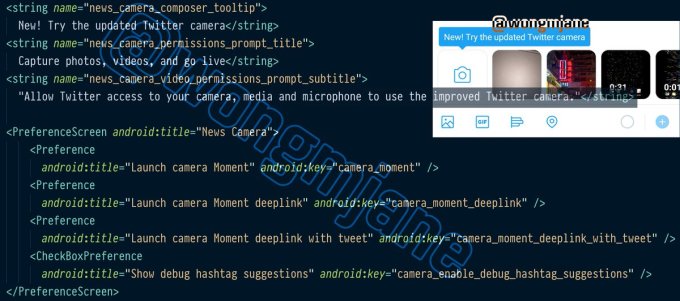
Twitter has been secretly developing an enhanced camera feature that’s accessible with a swipe from the home screen and allows you to overlay captions on photos, videos, and Live broadcasts before sharing them to the timeline. Twitter is already used by people to post pictures and videos, but as it builds up its profile as a media company, and in the age of Snapchat and Instagram, it is working on the feature in hopes it will get people doing that even more.

Described in Twitter’s code as the “News Camera”, the Snapchat-style visual sharing option could turn more people into citizen journalists… or just get them sharing more selfies, reaction shots, and the world around them. Getting more original visual content into Twitter spices up the feed and could also help photo and video ads blend in.

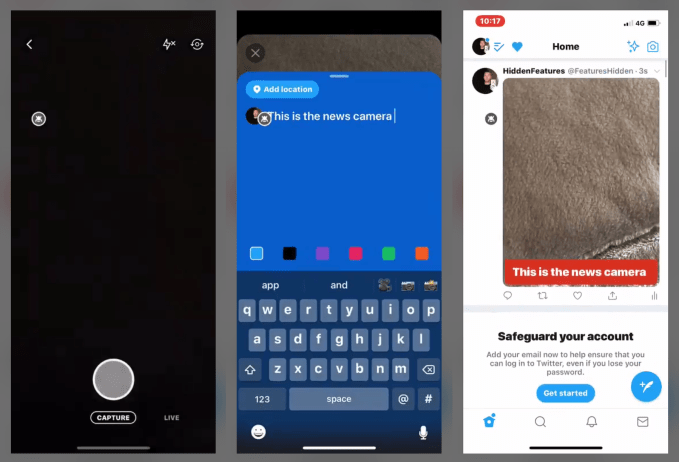
Prototypes of the new Twitter camera were first spotted by social media consultant Matt Navarra a week ago, and he produced a video of the feature today.

He describes the ability to swipe left from the homescreen to bring up the new unified capture screen. After you shoot some media, overlays appear prompting you to add a location and a caption to describe “what’s happening”. Users can choose from six colored backgrounds for the caption and location overlay card before posting, which lets you unite words and imagery on Twitter for the first time to make a splash with your tweets.

Meanwhile, code digger and frequent TechCrunch tipster Jane Manchun Wong has found Twitter code describing how users should “Try the updated Twitter camera” to “capture photos, videos, and go live”. Bloomberg and CNBC had previously reported that Twitter was building an improved camera, but without feature details or screenshots.

Twitter confirmed to TechCrunch that it’s currently developing the new camera feature. A Twitter spokesperson told us “I can confirm that we’re working on an easier way to share thing like images and videos on Twitter. What you’re seeing is in mid-development so it’s tough to comment on what things will look like in the final stage. The team is still actively working on what we’ll actually end up shipping.” When asked when it would launch, the spokesperson told us “Unfortunately we don’t have a timeline right now. You could expect the first half of this year.”

Twitter has largely sat by as visual sharing overtook the rest of the social media landscape. It’s yet to launch a Snapchat Stories feature like almost every other app — although you could argue that Moments was an effort to do that — and it seems to have neglected Persicope as the Live broadcasting trend waned. But the information density of all the words on Twitter might make it daunting to mainstream users compared to something easy and visual like Instagram.

This month, as it turns away from reporting monthly active users, Twitter reported daily active users for the first time, revealing it has 126 million that are monetizable compared to Snapchat’s 186 million while Instagram has over 500 million.

The new Twitter camera could make the service more appealing for people who see something worth sharing, but don’t always know what to say,

14 Feb 2019

Walmart tech incubator Store No. 8 launches VR startup Spatial&

Walmart’s tech incubator Store N°8 today launched its next startup, a VR merchandising company called Spatial&. The company offers VR experiences that enable customers to connect with merchandise, and is kicking things off by collaborating with DreamWorks Animation VR tour. At select Walmart locations across the U.S., Spatial& will set up a VR experience in the parking lot, allowing customers to visit DreamWorks’ “How to Train Your Dragon: The Hidden World” through VR. Afterwards, customers are directed to a branded, physical gift shop where they can make purchases.

The experience is meant to help DreamWorks market their film ahead of its February 22 release, while Walmart gets to hawk film merchandise to its customers.

It’s not all that different from the “exit through the gift shop” concept found at theme parks.

Upon entering the experience, customers are greeted by the film’s characters Ruffnut and Tuffnut, and are then led into a “dragon’s cave” where they’ll put on VR headsets and get seated in Positron motion VR chairs powered by the HP VR backpack.

The VR story they engage with will take them on a five-minute journey into the movie’s world, where they interact with other characters, including  Astrid, Hiccup, Toothless, Hookfang and more. During this experience, participants will have a multi-sensory encounter, thanks to hand tracking and 6DOF (6 degrees of freedom) in the Voyager VR motion chair.

When the experience wraps, customers are guided into a themed gift shop where they can buy merchandise like plush toys, action figures, DVDs, video games, and more.

Some merchandise from this collection will also be sold across 2,000 Walmart stores – not only those with the VR experience.

On the technology side, Spatial& and DreamWorks leveraged servers and workstations with Intel Xeon Scalable processors to stitch together high-res images and 360-degree VR videos. For the experience itself, the startup uses HP Windows Mixed Reality headsets, Omen by HP Mindframe Headsets, and PCs with Intel Core processors. Outside, parents can follow along with what their children are viewing via Intel-powered Omen by HP Gaming Laptops.

“We have set an extremely high bar for quality and innovation for the How to Train Your Dragon franchise, and our partners at Spatial& exceeded our expectations with their incredible work on this project,” said Abhijay Prakash, chief operating officer of DreamWorks Feature Animation, in a statement about the launch.“This latest Dragon film displays DreamWorks’ best in class creative abilities combined with state of the art advances in animation technology, and we are thrilled that this experience created by Spatial& lives up to that reputation while allowing fans to journey straight to the center of this unique world we’ve created for the film. It’s a truly exhilarating experience,” Prakash added.

Walmart says the experience will go live at 16 stores in the U.S., starting this weekend and continuing through early April.

Those locations include the following:

  • Burbank, California (1301 N Victory Place) – February 15-16
  • Pico Rivera, California (8500 Washington Boulevard) – February 17-19
  • Anaheim, California (440 Euclid Street) – February 22-23
  • San Bernardino, California (4001 Hallmark Parkway) – February 24-26
  • Las Vegas, Nevada (5200 S Fort Apache Road) – March 1-2
  • North Las Vegas, Nevada (6464 N Decatur Boulevard) – March 3-5
  • Glendale, Arizona (5010 N 95th Avenue) – March 8-9
  • Gilbert, Arizona (2501 S Market Street) – March 10-12
  • San Antonio, Texas (8923 W Military Drive) – March 15-16
  • New Braunfels, Texas (1209 S Interstate 35) – March 17-19
  • Grand Prairie, Texas (2225 I-20) – March 22-23
  • Allen, Texas (730 W Exchange Parkway) – March 24-26
  • Sugar Land, Texas (345 Highway 6) – March 29-30
  • Katy, Texas (1313 N Fry Road) – March 31-April 2
  • Rogers, Arkansas (4208 S Pleasant Crossing Boulevard) – April 5-6
  • Bentonville, Arkansas (406 S Walton Boulevard) – April 7-9

Spatial& is one of several tech startups being incubated by Walmart’s Store No. 8, which launched in 2017 to focus on retail innovation. Other businesses being incubated there include conversational commerce startup Jetblack, from Rent the Runway co-founder Jenny Fleiss; stealth startup Franklin from Wim Yogurt founder Bart Stein; and AI lab Project Kepler.