Author: azeeadmin

14 Feb 2019

Ebay restructures regional operations, lays off a percentage of its workforce

E-commerce marketplace eBay has been rethinking its operations in a bid to bring the company back to growth amid strong competition from the likes of Amazon and a plethora of other online marketplaces. Today came the latest chapter in that development. The company announced that it would be reorganizing its business units, and specifically consolidating its geographical regions into a single team, to be led by Jay Lee, as SVP and GM for markets. As part of that, TechCrunch understands that the company will be laying off a percentage of its global workforce.

According to eBay, the company currently employs 14,100 people, and it’s not specifying exactly how many employees will be affected. (At least one source on Twitter appears to have a specific number of around 400, which we are hearing might be within the range of the actual number.)

The company said all geographic regions will be reporting to Lee. These include Americas, APAC, UK, Central and Southern Europe, and well as Cross-Border Trade. Also as part of the restructure, Scott Cutler, who had been SVP of the Americas for the company and before that the president of StubHub, will be leaving the company. Lee will oversee that role as well in the interim until a new head of the Americas is appointed.

The company has been under a lot of heat from activist investors such as Elliott and Starboard, who believe the company needs to be shaken up and reorganised to return to growth. (Indeed, in its last quarterly earnings, the company performed well in terms of analysts’ expectations for revenue and earnings per share, but it only saw gross merchandise value go up by one percent, pointing to very sluggish growth.) Earlier this year, Elliott published an open letter calling for eBay to overhaul its main Marketplace, refresh management and rethink its other businesses like StubHub and classifieds.

Ebay, naturally, would say that it’s not responding directly to those activist investors by making this change — even if it happens to be one of the moves that was requested. Instead, in a statement announcing the management shifts (but not the layoffs… we confirmed those ourselves), it highlights that this will give it “strategic alignment of global priorities (buyer growth, conversion, payments, advertising) across the company’s largest markets; faster decision making and execution; streamlined resource allocation with a greater impact on global priorities; and improved and simplified collaboration with the Core Product and Technology (CPT) organization, led by CTO Steve Fisher.”

Lee is a longtime veteran of the company, having been with eBay since 2002 leading APAC, and then EMEA. There will always be a debate in business about whether veterans, who “knew the company when it was in better shape”, are the best to restructure it, or if fresh talent and a fresh pair of eyes are what is best. (There have been examples in favor of both.) eBay may not be what it once was, but there is still a huge and profitable business there, and given that e-commerce is only going one way — up — that means the opportunity for eBay to come back is still there.

We’ll update this post as we learn more.

14 Feb 2019

AWS announces new bare metal instances for companies who want more cloud control

When you think about Infrastructure as a Service, you typically pay for a virtual machine that resides in a multi-tenant environment. That means, it’s using a set of shared resources. For many companies that approach is fine, but when a customer wants more control, they may prefer a single tenant system where they control the entire set of hardware resources. This approach is also known as “bare metal” in the industry, and today AWS announced five new bare metal instances.

You end up paying more for this kind of service because you are getting more control over the processor, storage and other resources on your own dedicated underlying server. This is part of the range of products that all cloud vendors offer. You can have a vanilla virtual machine, with very little control over the hardware, or you can go with bare metal and get much finer grain control over the underlying hardware, something that companies require if they are going to move certain workloads to the cloud.

As AWS describes it in the blog post announcing these new instances, these are for highly specific use cases. “Bare metal instances allow EC2 customers to run applications that benefit from deep performance analysis tools, specialized workloads that require direct access to bare metal infrastructure, legacy workloads not supported in virtual environments, and licensing-restricted Tier 1 business critical applications,” the company explained.

The five new products, called m5.metal, m5d.metal, r5.metal, r5d.metal, and z1d.metal (catchy names there, Amazon) offer a variety of resources:

Chart courtesy of Amazon

These new offerings are available starting today as on-demand, reserved or spot instances, depending on your requirements.

14 Feb 2019

DigitalOcean launches its managed database service

DigitalOcean started as an affordable but basic virtual private server offering with a pleasant user interface. Over the last few years, the company started adding features like object and block storage, load balancers and a container service. Today, it’s expanding its portfolio once again by launching a feature that was sorely missing in its lineup: a managed database service.

The first edition of these DigitalOcean Managed Databases only supports PostgreSQL, the popular open-source relational database. Later this year, it’ll add MySQL and Redis support (likely in Q2 or Q3). As for other databases, the company says that it’ll listen to customer feedback and use that to prioritize other offerings.

Like similar services from other vendors, Managed Databases promises to make life easier for developers. DigitalOcean users will be able to launch a database within a few seconds and the service then handles all the maintenance tasks, including updates. Like with the company’s other services, developers can either use a graphical user interface or the company’s API, in addition to third-party Terraform providers.

Daily backups are free and DigitalOcean promises end-to-end security of your data both at rest and in transit.

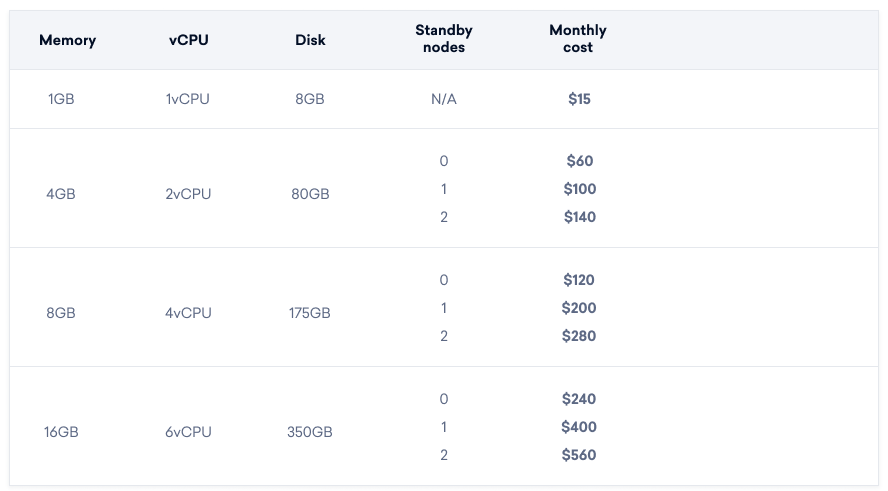
Here is what the pricing for the new service will look like:

“Our product development is driven by one vital question: How do we empower developers to do more valuable work in less time?,” said DigitalOcean’s vice president of Product, Shiven Ramji. “With Managed Databases, developers and their teams can focus on creating meaningful applications and sharing them with their communities, without the headache of having to manage the database infrastructure that enables the process.”

14 Feb 2019

Happy Valentine’s Day: your dating app account was hacked, says Coffee Meets Bagel

Good news for love-seekers this Valentine’s Day. In a bit of odd timing, users of the dating app Coffee Meets Bagel woke up this morning to find an email in their inboxes warning that their account information had been stolen by a third-party who gained unauthorized access to the company’s systems.

The email keeps most details about the situation vague, saying only that some data from users’ accounts “may” have been acquired by a third-party who gained access to a partial list of user details. It doesn’t say how that breach occurred, or how many users were affected.

This breach was discovered as part of a larger data dump of some 617 million account details, which recently went up for sale on the dark web. According to the seller, the stolen account databases came from a number of sites, including also Dubsmash, MyFitnessPal, MyHeritage, Whitepages, Animoto, HauteLook, 500px, and several others.

The Coffee Meets Bagel breach reportedly included 673MB of data taken in late 2017 and mid-2018. Earlier reports indicated that it could include a name, email, age, registration data and gender.

According to the Coffee Meets Bagel email to users sent out overnight, however, the affected information only included names and emails prior to May 2018.

The company also reminded users that it never stores any financial information or passwords, which means the impact of this particular breach is relatively minor. (In fact the most newsworthy thing about it could be why the company chose to disclose the breach today of all days!)

Coffee Meets Bagel says it’s now taking several steps to better protect its community going forward, including the hiring of forensic security experts to audit its systems and infrastructure, and its vendor and external systems. In addition, the company notes it’s still monitoring for suspicious activity and engaged with law enforcement about the incident. And it’s working to enhance its systems to better detect and prevent unauthorized access in the future.

Users were reminded to be extra precautious about any unsolicited communications that ask for personal data or direct you to a web page where personal data is collected. But the user passwords were not being proactively reset, according to this notice.

Coffee Meets Bagel isn’t the only dating app under attack as of late. This week, TechCrunch’s Zack Whittaker reported that many users were complaining their OKCupid accounts had been hacked, as well.

However, OKCupid denied a security breach had taken place. That means those account takeovers could be the result of hackers using login information they discovered by way of some other breach – that is, users had re-used the same email/password combination when signing up for OKCupid as had been leaked through another attack on another site.

We’ve asked Coffee Meets Bagel if it would disclose how many accounts were impacted and other details, and will update if the company responds or comments.

The full email from Coffee Meets Bagel is below:

Hello,

We recently discovered that some data from your Coffee Meets Bagel account may have been acquired by an unauthorized party. We would like to make sure you have the facts about what happened, what information was involved, and the steps we are taking to help protect you.

What happened?
On February 11, 2019, we learned that an unauthorized party gained access to a partial list of user details. Once we became aware, we quickly took steps to determine the nature and scope of the problem.

What information was involved?
The affected information only includes your name and email address prior to May 2018. As a reminder, we never store any financial information or passwords.

What are we doing
We have taken steps to protect our community, including the following:

• We have engaged forensic security experts to conduct a review of our systems and infrastructure.
• Vendor and external systems are being audited and reviewed to ensure there are no compliance issues or third party breaches.
• We continue to monitor for suspicious activity and we are coordinating with law enforcement authorities regarding this incident.
• We continue to make enhancements to our systems to detect and prevent unauthorized access to user information.

What you can do
As always, we recommend you take extra caution against any unsolicited communications that ask you for personal data or refer you to a web page asking for personal data. We also recommend avoiding clicking on links or downloading attachments from suspicious emails.

The security of your information is important to us, and we apologize for any inconvenience this may have caused you. As always, if you have any questions or need any additional information, please do not hesitate to contact us at contact@coffeemeetsbagel.com


14 Feb 2019

Pinpoint grabs $13.5M Series A to bring data discipline to engineering

Sales and marketing are steeped in data to explain just how well they are doing, but engineering, the department charged with creating the products these departments sell has lacked the tools to measure engineering effectiveness. Pinpoint wants to change that by making engineering a more data-driven endeavor. Today it announced a $13.5 million Series A round.

The round was led by Bessemer Venture Partners with participation from seed investors Storm Ventures, Boldstart Ventures, Bloomberg Beta, Slack Fund, Social Capital and Cherubic Ventures. That’s quite a lineup of investors for an early-stage startup.

Perhaps that’s because the company was founded by a couple of industry veterans, Jeff Haynie and Nolan Wright, who co-founded Appcelerator. That company was acquired by Axway in 2016. One of the issues the two founders observed running a company was the difficulty in measuring the effectiveness of their engineering group, and that there were a dearth of tools to help.

Sure if you were Facebook, Google, Apple or similarly large organization, maybe you could create such a product in-house, but the founders saw that engineering groups at most companies lacked a centralized, data-driven approach to understand how well the group’s efforts aligned with the broader goals of the organization. So they did what all good entrepreneurs do, they started a company to do just that.

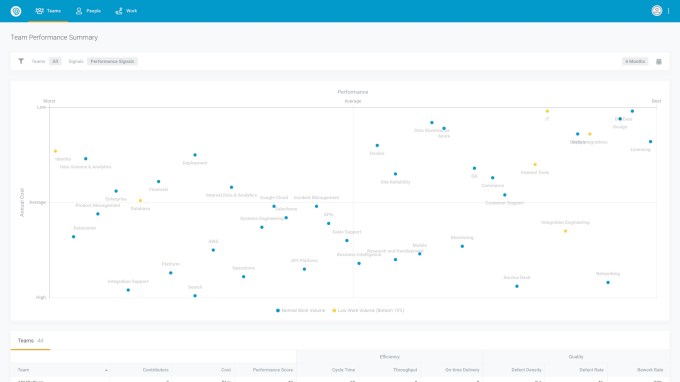
Taking advantage of machine learning, the company built an application that taps into engineering tools like Jira and Github to manage, understand and even predict engineering outcomes. The approach doesn’t actually require engineers to do anything differently. They simply use their regular systems of organization and connect Pinpoint to them to gather data.

Team performance graph. Screenshot: Pinpoint

It wasn’t an easy tool to build because they needed actual data to train the machine learning models. The company used its own engineering efforts and those of several design partners to help launch the product. The founders also recognized that companies may be reluctant to move their engineering data to the cloud, so they came up with a solution, using an open source agent that sits on the customer’s systems, and only moves metadata to the cloud.

Pinpoint was founded in 2016. It’s based in Austin and currently has 25 employees. That is likely to increase fairly dramatically as they put today’s investment to use.

14 Feb 2019

China’s Didi reportedly lost a staggering $1.6 billion in 2018

China’s largest car-hailing company is facing relentless pressure from all fronts. Beijing-based Didi Chuxing reportedly lost a staggering 10.9 billion yuan ($1.6 billion) in 2018, according to financial data that Chinese news site 36Kr obtained.

For some context, Uber posted a net loss of $939 million on a pro forma basis and an EBITA loss at $527 million during Q3 2018.

Didi has not responded to TechCrunch’s inquiry about its losses, but an internal letter leaked in September offers a glimpse at the depth of Didi’s troubles. According to the memo from founder and chief executive Cheng Wei, Didi had been operating in the red for six consecutive years and lost 4 billion yuan in the first half of 2018. At this moment, the transportation giant’s predicament appears to be multipronged.

Public backlash

The ride-booking app capped off 2018 with a bleak outlook after two female passengers were killed by their Didi drivers in separate instances, drawing ire of the government and triggered a nationwide backlash underpinned by a #DeleteDidi campaign that’s reminiscent of the #DeleteUber movement.

Didi responded with a fold of security measures, including stricter identity checks on drivers and a major reorganization to place customer safety ahead of growth. Hitch, the carpooling service that was complicit in both accidents and was popular among riders for its relatively cheap fares, is suspended indefinitely, a move that could exclude the more price-sensitive consumers.

Cash-burning model

Didi’s struggles had preceded the passenger murders. Cheng admitted in his memo that the company’s expansion was getting out of hand. “The expansion frenzy planted seeds of trouble and our internal system couldn’t keep up with our expansion.”

During the first six months of 2018, Didi shelled out about $1.7 billion in subsidies for drivers and steep discounts for passengers as competition intensified, Bloomberg reported citing sources. In the entire year, Didi burnt through a total of 11.3 billion yuan ($1.67 billion) on driver subsidies according to the 36Kr report.

Subsidies have played a key role in the rise of Didi and many other aspiring consumer-facing services in China. Investors dole out big bucks for early movers to gain market share rather than strive for profitability. That tactic has helped catapult tiny startups into billion-dollar businesses such as bike-rental service Mobike, but it has also led to the dramatic fall of some, Mobike’s peer Ofo being one alarming example.

Regulatory hurdles

Following Didi’s safety incidents, Chinese authorities hastened their pace to reinforce rules they had long laid out for the fledgeling industry, and some of the policies prove costly to uphold. For one, ride-booking drivers now need to obtain two licenses — one for the drivers themselves and the other for their vehicles to operate commercially.

The new requirement discourages part-time drivers as the costs of owning a commercial vehicle outpace the returns of taking up the gig work. Didi has tried to neutralize the constraint by offering test preps to drivers and teaming up with car rental businesses to equip drivers with the licensed vehicles. But these moves are set to incur new costs for Didi’s already money-burning business. The mobility startup was mulling a multi-billion-dollar initial public offering in 2018 that could value it upwards of $70 billion, Wall Street Journal reported last April.

New rivals

Another stumbling block for the firm is the swarm of new contenders eyeing a market long dominated by Didi after it swallowed up competitor Uber China. Neighborhood services marketplace Meituan, for instance, began to offer shared rides last year though it later put a hold on the capital-intensive new business to stay focused on its dining and hotel-booking units. On the other hand, traditional automakers, including a few that are state-owned such as BAIC, are charging full speed ahead by luring drivers with more favorable commission rates.

These newcomers have a long way to go before they could threaten Didi’s share, but Alibaba has a tool that can potentially help them grow. The ecommerce titan is not competing directly against Didi. Instead, its AutoNavi map service doubles as a ride-hailing platform that lets users book cars from a list of third-party operators. The model in effects levels the playing field for smaller players to challenge Didi, as they all compete on equal terms to court AutoNavi’s 1 billion daily active users.

14 Feb 2019

Firefox for iOS gets persistent private browsing tabs

Firefox for iOS is getting an update today that brings a new layout for its menu and settings, as well as new organization settings in the New Tabs features to iPhone and iPad users. But more importantly, it is also introducing persistent Private Browsing tabs that allow you to keep private browsing tabs alive across sessions.

Typically, when you exit Firefox, your private browsing sessions will exit, too. Now, when you relaunch Firefox, you’ll be right back in your private browsing sessions. And while it’s important to remember that private browsing doesn’t render you anonymous, it does automatically erase your cookies, passwords and browsing history. Sometimes you want those to persist across your sessions, though, given that it’s annoying to have to re-enter your passwords every time you quite the app, for example, and now Firefox lets you do that until you actively exit the private browsing mode.

“Keeping your private browsing preferences seamless is just another way we’re making it simple and easy to give you back control of the privacy of your online experience,” Mozilla explains in today’s announcement.


With this updates, users now also get different options to organize the view they see when they open a blank new tab. You can now chose between having new tabs open to your bookmarks list, Firefox Home (which features your top sites and recommendations from the Mozilla-owned Pocket), a list of your recent history or a custom URL (with your own homepage, for example). Or, if you just like to see a white page, you can also opt to see a blank page.

As for the new settings and menu layout, Mozilla notes that these now closely mirror the Firefox desktop version. That means you can now access your bookmarks, history, Reading List and download from the Library menu item, for example.

14 Feb 2019

LEGO launches eight AR-focused sets

LEGO’s long been  leader among traditional toy companies when it comes to embracing tech trends, from mobile apps to robotics. The toy maker’s been talking up its plans to embrace augmented reality since a couple of WWDCs ago, and now it’s finally ready to go all-in with the launch of eight AR-focused sets.

All are part of Hidden Side, a new series of sets designed to skirt the line between the physical and virtual. All are haunted buildings that tell a larger story about a couple of kids tasked with using a ghost hunting app to uncover mysterious goings on in their hometown.

The sets range from $20 to $130 and offer experiences that adapt as the story continues to roll out. The addition of a digital component gives the company a bit of leeway here, when it comes to building out things out over time. Those who don’t buy a set can also use the app to play a standalone game from the point of view of the ghosts — though obviously the whole thing is more heightened if you own the physical LEGO.

The sets are completely new — built from the ground up to support AR, unlike those shown at WWDC. Also, interestingly, the company didn’t use ARKit or ARCore to build out the experiences, instead opting to for the more robust model recognition of Vuforia’s SDK.

The sets will arrive in “late summer,” along with the app, which will hit both the App Store and Google Play.

14 Feb 2019

Zoho’s office suite gets smarter

As far as big tech companies go, Zoho is a bit different. Not only has it never taken any venture funding, it also offers more than 40 products that range from its online office suite to CRM and HR tools, email, workflow automation services, video conferencing, a bug tracker and everything in-between. You don’t often hear about it, but the company has more than 45 million users worldwide and offices in the U.S., Netherlands, Singapore, Dubai, Yokohama and Beijing — and it owns its data centers, too.

Today, Zoho is launching a major update to its core office suite products: Zoho Writer, Sheet, Show and Notebooks. These tools are getting an infusion of AI — under Zoho’s “Zia” brand — as well as new AppleTV and Android integrations and more. All of the tools are getting some kind of AI-based feature or another, but they are also getting support for Zia Voice, Zoho’s conversational AI assistant.

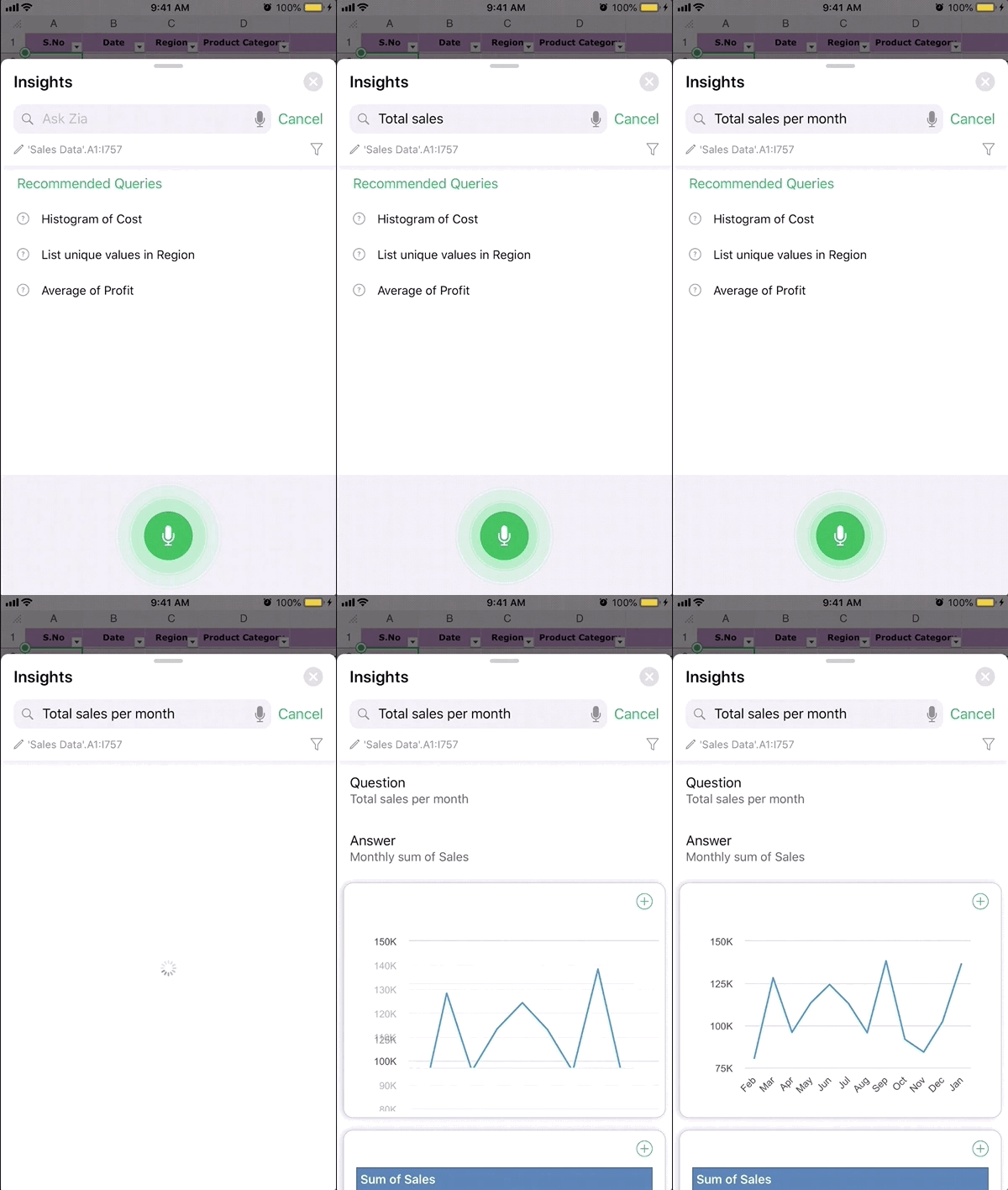
With this, you can now ask questions about data in your spreadsheets, for example, and Zia will create charts and even pivot tables for you. Similarly, Zoho is using Zia in its document editor and presentation tools to provide better grammar and spellchecking tools (and it’ll now offer a readability score and tips for improving your text). In Zoho Notebook, the note-taking application that is also the company’s newest app, Zia can help users create different formats for their note cards based on the content (text, photo, audio, checklist, sketch, etc.).

“We want to make AI helpful in a very contextual manner for a specific application,” Raju Vegesna, Zoho’s chief evangelist, told me. “Because we do AI across the board, we learned a lot and were are able to apply learnings on one technology and one piece of context and apply that to another.” Zoho first brought Zia to its business intelligence app, for example, and now it’s essentially bringing the same capabilities to its spreadsheet app, too.

It’s worth noting that Google and Microsoft are doing similar things with their productivity apps, too, of course. Zoho, however, argues that it offers a far wider range of applications — and its stated mission is that you should be able to run your entire business on its platform. And the plan is to bring some form of AI to all of them. “Fast-forward a few months and [our AI grammar and spellchecker] is applied to the business application context — maybe a support agent responding to a customer ticket can use this technology to make sure there are no typos in those responses,” Vegesna said.

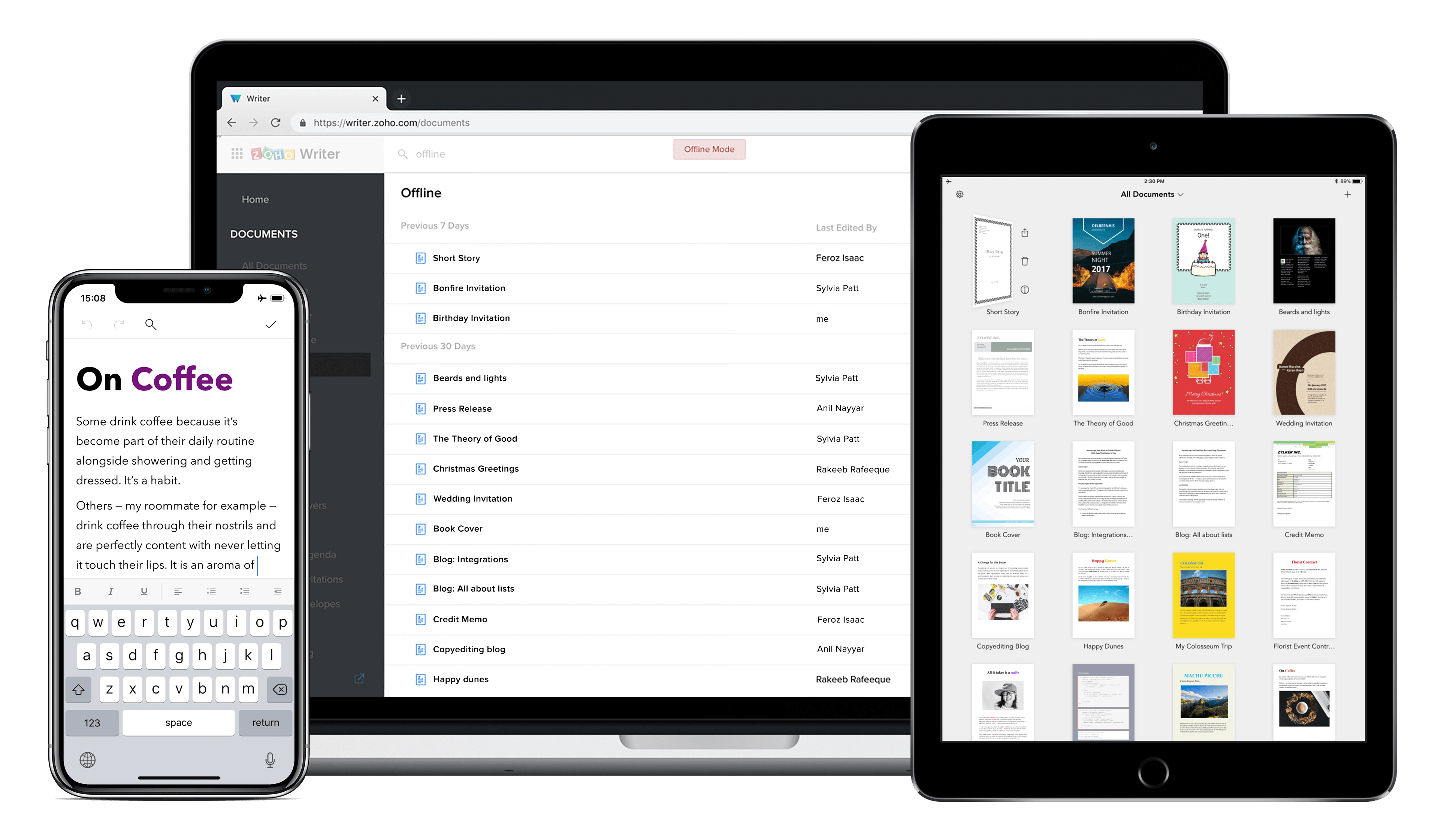
There are plenty of other updates in this release, too. Zoho Show now works with AppleTV-enabled devices for example, and Android users can now use their phones as a smart remote for Show. Zoho Sheet now lets you build custom functions and scripts and Zoho Writer’s web, mobile and iPad versions can now work completely offline.

The broader context here, though, is that Zoho, with its ridiculously broad product portfolio, is playing a long game. The company has no interest in going public. But it also knows that it’s going up against companies like Google and Microsoft. “Vertical integration is not something that you see in our industry,” said Vegesna. “Companies are in that quick mode of getting traction, sell or go public. We are looking at it in the 10 to 20-year time frame. To really win that game, you need to make these serious investments in the market. The improvements you are seeing here are at the surface level. But we don’t see ourselves as a software company. We see ourselves as a technology company.” And to build up these capabilities, Vegesna said, Zoho has invested hundreds of millions of dollars into its own data centers in the U.S., Europe and Asia, for example.

14 Feb 2019

Amazon, WesternUnion debut PayCode to sell goods in emerging markets and let shoppers pay in cash

While Amazon has been methodical (read: a little slow) in launching local versions of its site for various global markets, it has now embarked on a secondary track to snag more business outside the 14 countries where it has built out full operations.

Amazon has partnered with WesternUnion to set up a service called PayCode, which lets people shop and pay for Amazon items using local currencies that would not have been accepted on the site before, starting with services in 10 countries: Chile, Columbia, Hong Kong, Indonesia, Kenya, Malaysia, Peru, Philippines, Taiwan and Thailand.

Specifically, shoppers in these markets will now be able to go into Western Union outposts and pay for their Amazon purchases in cash, which also means that payment cards or other virtual payment methods will also not be required to buy from Amazon — one of the barriers to expanding the service up to now into more emerging economies, where card and bank account penetration is much lower than in developed markets like the US and Europe.

“Amazon is committed to enabling customers anywhere in the world to shop on Amazon.com, and a big part of that is to allow customers to pay for their cross-border online purchases in a way that is most convenient for them,” said Ben Volk, Director, Payment Acceptance and Experience at Amazon, in a statement. “Amazon PayCode leverages the reach of Western Union to make cross-border online shopping a reliable and convenient experience for customers who do not have access to international credit cards, or prefer to pay in cash.”

In terms of what they will be able to buy, people can shop across the breadth of the Amazon marketplace, but Amazon notes that they will only be able to use PayCode if it’s offered as an option at checkout (which will only happen in the markets where PayCode is supported); if the item that is chosen is “export eligible”, and if the item’s value “exceeds the maximum value allowed for use on this payment type” — although Amazon doesn’t appear to specify what that maximum value is. Once you complete the purchase online (or possibly more likely, on mobile), you get a “PayCode” QR code that you will have 48 hours to take to a Western Union to pay for the goods; otherwise your order gets cancelled.

The deal between Amazon and Western Union was initially announced last October, with very little detail and fanfare. The PayCode name then appeared to leak out a month later around what appeared to be a test in India (where it has not launched… yet). Today was the first time that the companies unveiled the first launch countries.

PayCode is a significant advance for Amazon as it seeks to step up to the next level of being a global e-commerce powerhouse to compete against the likes of Alibaba.

The latter company has made a lot of inroads to work in a wider array of markets beyond its home base of China, specifically tapping into a long tail of supply from its home market and demand for those goods abroad. Alibaba is also taking care of business when it comes to making transactions related to those trades more seamless. Just today, its financial services affiliate Ant Financial announced that it would acquire UK’s WorldFirst, which provides foreign money transfer for businesses and individuals, for a price that we heard from sources was in the region of $700 million.

Amazon currently operates 14 Amazon websites globally: in the US, UK, Australia, Brazil, Canada, China, France, Germany, India, Italy, Japan, Mexico, Netherlands, Spain and Turkey. (It appears also to have a Prime-only site in Singapore.) Up to now, these would have been the only countries where Amazon would offer goods in local currencies.

Adding a new tranche of countries using PayCode will potentially massively expand how many people can shop on Amazon without Amazon going through the steps of setting up full-fledged operations in those countries to serve those consumers and sellers. (Or, this being Amazon, this would be a key way for the company to start testing the waters to figure out which market might do best with a full-fledged store.) Over time, you might imagine that Amazon might extend PayCode also to markets where it has sites, too, to give shoppers more flexibility in how they pay for goods for themselves or that they are buying for others.

It’s a big market opportunity. Amazon cites estimates from Forrester Research that say cross-border shopping will represent 20 percent of e-commerce by 2022, accounting for $630 billion.

For Western Union, this is a potentially big partnership, too.

Today, PayCode allows people to use Western Union to act as a physical pay station for their Amazon goods, giving Western Union a small cut on those transactions. But you might imagine how this could evolve over time, where remittances sent from family members abroad via Western Union — a very common use of remittance networks — might immediately get redeemed to cover purchases on Amazon.

Similarly, Western Union is working closer with MPesa, the African mobile wallet service that lets people essentially use their phone top-up account as a payment account, and you could imagine how this too could get incorporated into the PayCode experience to facilitate buying and paying on devices, without having to go into Western Union shops and use actual cash.

“We’re helping to unlock access to Amazon.com for customers who need and want items that can only be found online in many parts of the world,” said Khalid Fellahi, SVP and General Manager of Western Union Digital, in a statement. “This is a great example of two global brands innovating and collaborating to bring customers more convenience and choice. In a world where cross-border buyers and sellers are often located on different continents and in completely different financial ecosystems, our platform is ideally suited to solving the complexity of collecting local currency and converting it into whatever currency merchants need on the other end.”