Author: azeeadmin

13 Feb 2019

Medivis has launched its augmented reality platform for surgical planning

After two years of development, Medivis, a New York-based company developing augmented reality data integration and visualization tools for surgeons, is bringing its first product to market.

The company was founded by Osamah Choudhry and Christopher Morley who met as senior residents at NYU Medical Center.

Initially a side-project, the two residents roped in some engineers to help develop their first prototypes and after a stint in NYU’s Summer Launchpad program the two decided to launch the company.

Now, with $2.3 million in financing led by Initialized Capital and partnerships with Dell and Microsoft to supply hardware, the company is launching its first product, called SurgicalAR.

In fact, it was the launch of the HoloLens that really gave Medivis its boost, according to Morley. That technology pointed a way toward what Morley said was one of the dreams for technology in the medical industry.

“The Holy Grail is to be able to holographically render this a,” he said.

For now, Medivis is able to access patient data and represent it visually in a three dimensional model for doctors to refer to as they plan surgeries. That model is mapped back to the patient to give surgeons a plan for how best to approach an operation.

“The interface between medical imaging and surgical utility from it is really where we see a lot of innovation being possible,” says Morley.

So far, Medivis has worked with the University of Pennsylvania and New York University to bring their prototypes into a surgical setting.

The company is integrating some machine learning capabilities to be able to identify the most relevant information from patients’ medical records and diagnostics as they begin to plan the surgical process.

“What we’ve been working on over this time is developing this really disrupt 3D pipeline,” says Morley. “What we have seen is that there is a distinct lack of 3D pipelines to allow people to directly interface… very quickly try to automate the entire rendering process.”

For now, Medivis is elling a touchscreen monitor, display and a headset. The device plugs into a hospital network and extracts medical imaging to display from their servers in about 30 seconds, according to Choudhry.

“That’s where we see this immediately being useful in that pre-surgical planning stage,” Choudhry says. “The use in surgical planning and being able to extend this through surgical navigation.. Streamline the process that requires a large amount of pieces and components and setups so you only need an AR headset to localize pathology and make decisions off of that.”

Already the company has performed 15 surgeries in consultation with the company’s technology.

“When we first met Osamah and Chris, we immediately understood the magnitude of the problem they were out to solve. Medical imaging as it relates to surgical procedures has largely been neglected, leaving patients open to all sorts of complications and general safety issues,” said Eric Woersching, General Partner, Initialized Capital, in a statement. “We took one look at Medivis platform and knew they were poised to transform the operating room. Not only was their hands-free approach to visualization meeting a real need for greater surgical accuracy, but the team has the passion and expertise in the medical field to bring it all to fruition. We couldn’t be more thrilled to welcome Medivis to the Initialized family.”

13 Feb 2019

The infosec reckoning has arrived

2018 represented a record year for venture capital investment into information security, but this isn’t a positive trend – and it definitely doesn’t mean we’re more secure.

An unwarranted percentage of solutions being funded are not solving the problems defenders face the most. And with high numbers of lackluster information security startups failing to meet the needs of their customers, you might expect downward pressure on valuations. 

Instead, 2018 also saw record valuations, both because venture capital firms benefit from them, as will be explained in this article, and because so many investors are unfamiliar with the information security space and simply don’t know better. Defenders are beginning to be fed up, and there has to be a reckoning if we want progress in securing our digital systems.

In March 2019, tens of thousands of security professionals will descend upon San Francisco, making their way through a labyrinth of security solutions on display at the RSA Conference in a quest to find a solution that fits their specific needs. In their way stand 650 exhibitors, a cacophony of booth distractions ranging from delightful to distasteful, buzzwords assaulting their eyes in hundred-point font offering a cure for the latest and most vicious threats – threats that are more likely fantasy than reality for most attendees. 

In classical Greek mythology, the heart of the labyrinth contains a Minotaur who devours all who come pass. In our modern information security reality, startups devour the dollars of security professionals and investors alike, with unproven promises luring the less informed into their grasp.

In 2018, over $5 billion was invested into information security startups in about 300 funding deals total, according to Crunchbase data. How does this large influx of capital improve security? Where does it get all of us, the people whose data needs protecting? Unfortunately, the answers are unclear. 

It is entirely possible that the raging furnace of the information security startup / VC cycle actually is hurting our ability to defend against attacks. First, we must understand how these solutions are failing to meet the market’s needs. Second, we must look to investors and see how their incentives propel them to increase valuations despite lack of value.

Reading time for this article is about 20 minutes. Featured Infosec Bingo Composition by Kelly Shortridge, Image by Nipitpon Singad / EyeEm via Getty Images.

Solutions in search of a problem 

Information security startups are not addressing their customers’ most pressing challenges. Arguably, the more money flowing in, the less they are carefully researching how they can make the highest positive impact in a security program. It is fruitless to point a finger at one cause. 

One factor is a gravitation towards what is cool from a technical perspective, compounded by a lack of consideration towards sustainable customer value. Another factor is a predilection for incremental improvements on existing solutions. Finally, the potency of flashy marketing can obfuscate deficiencies in the value security startups provide. All are worth exploring.

It is often easy to sniff out when founders wanted to flex their technical muscle and build something they thought was cool, rather than finding a customer problem they wanted to solve and figuring out how best to do so it. This backwards approach then requires these startups to search for – or worse, invent – a customer problem to solve with their ostensibly sexy technology. 

As Esteban Gutierrez, Director of Information Security at a publicly-traded SaaS company, observed, “The VC crowds approach things from the perspective of ‘what problems can we find to make money off of?’ and not the perspective of what are actually the problems people are having with keeping their data safe, having easy control over access to their digital stuff, or how can we actually make things better (so much blockchain).” 

There is a dreadful disconnect between what is important to security practitioners and the problems the majority of startups being funded are supposedly solving. The vast majority of information security teams do not spend their days stopping an unknowable threat, referred to as a “zero-day.” 

Instead, they are focused on the routine and frustrating tasks such as threat modeling, policy definition and enforcement, risk reviews, configuration management – or if they’re lucky, working on automating these mundane tasks through custom scripting. Further, only after basics are met in the security “hierarchy of needs” can defenders even begin to consider addressing unknowable threats in a meaningful way. 

Regulatory compliance – from HIPAA, PCI, and SOX to, most recently, GDPR – drives a substantial portion of budgets in information security, despite being considered the dullest segment of the industry. Compliance violations are what most often lead to fines or customer losses – not ultra-sophisticated attacks by nation-state actors. So, information security teams are instructed to spend their time avoiding these violations as the first priority of what their security program should cover.

Regrettably, the information security industry thrives on the drama of devastating vulnerabilities. In many cases, founders with security backgrounds concentrate on building technology to exclusively detect or stop the most sophisticated possible attacks. This pursuit represents the flipside of finding noteworthy vulnerabilities and developing elite exploits – the currency of respect within the industry with which these founders are familiar. 

In contrast, one of the industry’s most recent massive successes happens to be an example of a good case of user research, despite investors initially disregarding its potential for explosive growth. Duo Security, which was acquired last year for $2.35 billion by Cisco, was founded by people with notable accomplishments in vulnerability research. 

Yet, to their credit, they understood that the foundation of most attacks affecting enterprises is not the stuff of groundbreaking research papers, but attackers with databases of passwords, simply trying them out to see which still worked – hence Duo Security’s innovation of two-factor authentication that was exceptionally easy to use. By understanding the typical enterprise user’s workflows, Duo Security’s team figured out the best way to integrate security into the enterprise’s work, without adding friction. 

Few information security startups are following Duo Security’s lead, however. As Gutierrez noted, “A lot of VC-backed information security startups don’t actually start their conversation with ‘is this problem you’re having?’ There are some startups that do it this way, and those are the interesting ones I talk to.” 

This general lack of customer understanding includes assumptions about the effectiveness of startups’ products within the customer’s environment. Information security startups’ value propositions are often predicated on the assumption of underlying orderliness within their customers’ security programs. This assumption couldn’t be further from reality. 

Anne Marie Zettlemoyer, who sits on the board of SSH Communications Security, pointed out, “The reality is that the functionality of many tools requires the hygiene of an environment to be pretty strong to begin with and substantially maintained as well. Why is there so much ‘consulting’ added onto the product for implementation? Because the tool has no chance of either working or showing the business that it is working if you don’t have basics like identity and access management, inventory of assets, network visibility, data classification, incident response plans, etc., in a decent place.”

There’s too much focus on incremental tools

Another reason why information security startups’ tools fail to provide value in customer environments is because they focus on developing a niche feature, rather than a true product. A product solves a problem in a range of contexts. A feature adds value to a product, but is likely for a specific context. 

In other words, a product is valuable on its own; a feature needs something else to provide its full value. It is far easier for a customer to describe the bit of supplemental value they’d like to extract from an existing product than to articulate how the way they do their work might need a fundamental overhaul. 

For example, when asked, you might wish your vacuum cleaner had a more comfortable grip or more power to reduce cleaning time. You would likely be unimpressed by a company that sold an add-on to your vacuum that provided just one of those improved features, but you might be delighted by the prospect of an autonomous robot vacuum cleaner, which saves both your grip and your time. 

In information security, we often only see the incremental progress upon existing solutions, slight tweaks that create only a sliver of value more than what is currently deployed – not innovative products that reflect a deep understanding of why customers are dissatisfied. This lack of any significant alleviation of customer pain points results from the willingness of investors to fund concepts and the pervasiveness of limited trials – both of which distract from investing in the less-glamorous and more exacting goal of long-term value creation. 

Zettlemoyer explained, “Why are we failing when there are so many ‘solutions’ out there? I think a very strong causation is that many of these tools are good ‘in concept.’ They might have a limited PoC [Proof of Concept] or PoV [Proof of Value], but are they [the vendor, the VC, and the customer] asking the question, ‘What does it take to make sure this tool is adding sustained value?’”

This trend towards incremental improvement is also what leads to the extreme fragmentation of solutions within information security, making it even harder for defenders to figure out what will actually solve their challenges. To those outside of the industry, you may view “information security” as a singular category of products. However, there are dozens of subsectors within security that each have their own cluster of vendors.

As Will Lin, a Founding Investor and Principal at Forgepoint Capital, noted, “It’s possible to invest in 40+ security companies that don’t compete against each other. There are multiple customer categories in security and customers on average have 75 security vendors in their environment.” One investment bank lists a stunning 46 sub-categories within information security in their market map. 

By way of analogy, imagine if you look around your house and notice it’s dirty. The logical approach would be to create a list of things to do to clean each room, identify the tools needed to do each of those things (vacuum, mop, duster, etc.), buy the tools if you don’t have them, and then go room by room, cleaning. 

Now imagine that the only stores from which you can buy vacuums, mops, and dusters tell you things like, “your old vacuum cleaner just won’t do, this one is nuclear-powered and also self-propelled.” They also start identifying rooms in your house that are dubiously rooms, like crawl spaces, and propose solutions to clean those rooms. 

If you spend all day at the department store being pitched on increasingly outlandish cleaning products – perhaps a trained army of rats with dusters, and a cat to catch and eat all the rats after they’re done – not only will you probably buy something very useless, but your house also won’t get cleaned.

You can imagine the frustration and helplessness you might feel at being pushed to buy all these unnecessary solutions. You might even be angry when realizing investors were pouring money into these startups to power marketing meant to overwhelm you, rather than to create tools that actually help you. Information security startups overcome the need to prove usefulness with aggressive marketing. 

13 Feb 2019

Lime loses appeal to operate electric scooters in SF

Lime, similar to its competitors Spin and JUMP, just got word that while its appeal to operate electric scooters in phase one of San Francisco’s pilot program was denied, it may be able to deploy scooters during phase two. This comes following San Francisco Municipal Transportation Agency Neutral Hearing Officer James Doyle’s decision regarding Ford’s Spin, Uber’s JUMP and now, Lime’s appeals of the permitting process.

Currently, Skip and Scoot are the only two companies permitted to operate shared electric scooter services in the city. After the first six months of the program, in April, the SFMTA can potentially increase the number of scooters from the current max of 625 to 2,500. This juncture, Doyle said, should be able to accommodate the addition of other operators.

“As a well-experienced and well-qualified vendor, I would expect that Lime’s entry into the city’s Pilot Program should result not only in increased services on our streets, but allowing additional capable operators in the Pilot Program can only enhance the probability of an eventual success of the powered scooter share program in San Francisco,” Doyle wrote in his decision.

Moving forward, it’s unclear if the SFMTA will take the recommendation, but Jose previously told TechCrunch, “The SFMTA will be consulting with the City Attorney’s Office to determine next steps as we near the second half of the pilot.”

In a statement to TechCrunch, Lime said it appreciates the hearing officer’s recommendation that Lime be considered to operate its shared electric scooters during phase two of the program. A Lime spokesperson also said they appreciate Doyle’s note that Lime has the expertise and operational capacity to meet the SFMTA’s requirements.

“We couldn’t agree more,” the Lime spokesperson said. “Lime looks forward to continuing our work with the SFMTA, and to expanding consumer choice and the quality of the scooter share program in Lime’s hometown.”

Lime has been one of the more outspoken companies following the SFMTA’s electric scooter decision. When, in October, the SFMTA selected Skip and Scoot as the only two electric scooter companies permitted to operate in the city, competitor Lime took legal steps to attempt to prevent Skip and Scoot from deploying. A San Francisco judge, however, promptly denied Lime’s request for a temporary restraining order. Then, in December, Lime held a protest on the steps of SF City Hall to challenge the decision.

In its appeal, Lime argued the SFMTA was biased against it, as well as Spin and Bird, for deploying its scooters without explicit permission back in March. In Doyle’s decision, he said, while the “instances that Lime highlights may establish possible bias on the part of the SFMTA,” there was no credible evidence to show the SFMTA was biased against Lime.

“My review of Lime’s application proposals, when compared side-by-side with those of Scoot and Skip, confirms my opinion that an even-handed evaluation of Lime’s written descriptions in its application of its planned scooter rollout was conducted by the SFMTA scorers,” he said.

13 Feb 2019

Wattpad’s latest deal will turn its stories into TV shows and movies in Korea

Wattpad’s ambitions to grow beyond a storytelling community for young adults took another leap forward today with the announcement of a new partnership that will help expand its reach in Asia. The company has teamed up with Huayi Brothers in Korea, who will now be Wattpad’s exclusive entertainment partner in the region. The two companies will co-produce content sourced from Wattpad’s community, as it’s adapted for film, TV and other digital media projects in the country.

Development deals like this are not new to Wattpad at this point.

In the U.S., the storytelling app made headlines for bringing the teen hit “The Kissing Booth” to Netflix, which shot up to become the No. 4 movie on IMDb for a time.

Wattpad also recently announced a 2nd season for “Light as a Feather,” which it produces with AwesomenessTV and Grammnet for Hulu.

It additionally works with eOne, Sony, SYFY, Universal Cable Productions (a division of NBCUniversal), and Germany’s Bavaria Fiction.

Outside the U.S., Wattpad has 26 films in development with iflix in Indonesia.

And WattPad’s feature film “After,” based on Anna Todd’s novel, will arrive in theaters on April 12.

Key to these deals is Wattpad’s ability to source the best content from the 565 million some stories on its platform. Do to so, it uses something it calls its “Story DNA Machine Learning technology,” which helps to deconstruct stories by analyzing things like sentence structure, word use, grammar and more in order to help identify the next big hits using more than just readership numbers alone.

The stories it identifies as promising are then sent over to content specialists (aka human editors) for further review.

This same combination of tech and human curation has been used in the past to help source its writing award winners and is now being used to find the next stories to be turned into novels for its new U.S. publishing arm, Wattpad Books.

In addition to its hit-finding technology, studios working with Wattpad also have a way to reach younger users who today are often out of touch with traditional media, as much of youth culture has shifted online.

These days, teens and young adults are more likely to know YouTube stars than Hollywood actors. They’re consuming content online in communities like Reddit, TikTok, Instagram, YouTube, Twitter, and elsewhere. And when it comes to reading, they’re doing more of that online, too – whether that’s through chat fiction apps like Hooked or by reading Wattpad’s longer stories.

Wattpad says it now has 70 million uses worldwide, who now spend 22 billion combined minutes per month engaged with its website and app.

With the Korean deal, Wattpad is further growing its international footprint after several other moves focused on its international expansions.

For example, today’s news follows Wattpad’s raise of $51 million in funding from Tencent; its appointment of its first Head of Asia for Wattpad Studios, Dexter Ong, last year; and its hiring of its first GM of India, Devashish Sharma, who is working with local partners to turn its stories into movies, TV, digital and print in the region.

Huayi Brothers Korea hasn’t announced any specific projects from the Wattpad deal at this point, but those will follow.

“Wattpad’s model is the future of entertainment, using technology to find great storytellers and bring them to an international audience,” said, Jay Ji, CEO, Huayi Brothers Korea, in a statement. “In an era of entertainment abundance, working with Wattpad means access to the most important things in the industry: a data-backed approach to development, and powerful, proven stories that audiences have already fall in love with,” he said.

13 Feb 2019

Bill Gates-backed Vicarious Surgical adds a virtual reality twist to robots in the operating room

In an operating room in rural Idaho, doctors prep a patient for surgery. They make a tiny, thumb-sized incision into the patient and insert a small robot while across the country a surgeon puts on a virtual reality headset, grabs their controllers, and prepares to operate.

While this scene may seem like science fiction now, a Charlestown, Mass.-based startup called Vicarious Surgical, is developing the technology to make that vision a reality.

The company’s co-founders, Adam Sachs and Sammy Khalifa, have been developing and refining the technology almost since they met at the Massachusetts Institute of Technology as undergraduates.

The 27 year-old Sachs said that he and Khalifa formally launched the company roughly five years ago when they graduated from MIT and have been working on it ever since.

“We’ve been working on ways to miniaturize robotics and put all of the motion of surgery into the abdominal cavity,” says Sachs. “If you put all of the motion inside the abdominal cavity you are not confined to motion around the incision sites.”

What really set the founders’ brains buzzing was the potential for combining their miniature robots with the ability to see inside the body using virtual reality headsets like the Oculus Rift.

“It wasn’t a ‘Eureka!’ moment, but more like two-or-three weeks as the vision came together,” says Sachs. “We can make robotics more human-like and virtual reality would give you that presence in the body.”

The two founders initially bootstrapped their startup and then raised a small seed round and then began steadily closing larger tranches of a rolling round from luminaries like Bill Gates through his Gates Frontier fund, Khosla Ventures, Eric Schmidt’s Innovation Endeavors, AME Cloud Ventures (investment firm from Yahoo founder Jerry Yang) Singularity Ventures investor Neil Devani and Salesforce founder, Marc Benioff.

In all, the company has raised some $31.8 million to support the development of its technology.

For Sachs and Khalifa, even though the technology was broadly applicable in areas that would yield faster results than healthcare, tackling the health market first was important, Sachs says.

A lot of people pointed out that our technology has a lot of applications. [But] healthcare for all of the reasons that people talk about really is meaningful to us,” says Sachs. “I have the luxury of being able to work on a project that’s fascinating from a technology standpoint and meaningful from a social good aspect.”

Vicarious Surgical chief medical officer Dr. Barry Greene, chief executive, Adam Sachs, and chief technology officer, Sammy Khalifa

Science and entrepreneurship runs in the Sachs family. Adam’s father, Eli Sachs, is a professor at MIT and one of the co-founders of the revolutionary three d printing company, Desktop Metal .

According to Sachs, a number of innovations in robotics has led the company to develop what Sachs calls tiny humanoid robots. 

Picture a very robotic version of a two human arms and a human head,” says Sachs. “Two robotic arms that have the same degrees of freedom and proportions of a human arms and a camera that is placed above the shoulders of the robot… it’s a few inches across.”

Using the motorized robot a surgeon can remotely control the robots movements to operate on a patient. “They can be in another room or they can be hundreds of miles away (with an excellent internet connection,” says Sachs. 

For Vicarious Surgical’s founders and its investors the mission is to drive down both the cost of higher impact surgeries and access to the best surgeons through remote technologies.

The market for medical robots is highly lucrative. Earlier today, Johnson and Johnson announced the $3.4 billion acquisition of Auris Health — a maker of robotic diagnostics and surgical tools. In all, estimates put the robotic surgery market at somewhere around $90 billion according to a report from Allied Market Research.

“We like to invest in things if they work they truly change the industry.. Minimally invasive surgeries and surgical robotics is definitely the future and it’s just getting started,” says Dror Berman, a managing director with Innovation Endeavors.

There were 900,000 surgeries done using surgical robotics out of a total of 313 million surgical procedures. It’s a low percentage and it’s very expensive to buy those… In general that’s not offered to the vast majority of patients. Vicarious is about democratizing that access… if it works it will open a huge market for people who can use much better procedures for much better surgeries.,” Berman says. 

“One of the problems with that is that smaller hospitals can’t afford these $2 million robots,” says Sachs.  “By making the devices tiny and fitting the motion inside a patient we can expand access long-term and in smaller hospitals where a surgeon might be able to start a procedure.”

Later, as Vicarious is able to build up taxonomies of different surgical practices and methods, the hospitals could begin to automate more aspects of the procedures to the point where many of these surgeries may just be handled by the robot.

The company is currently testing its miniature robots in laboratories and would not comment on whether it was using animal subjects. Vicarious is also modeling the human abdomen and conducting as many virtual tests as possible.

The new funding, Sachs says, will take the company through its applications for the Food and Drug Administration.

“A lot of our long term vision is about growing and scaling our technology to the point where it’s accessible not just to big cities and major hospitals in the U.S. and also the small cities and towns in the rural U.S. and around the world as well,” says Sachs. “Long term it’s about the democratization of surgery that can come from surgical robotics.”

13 Feb 2019

Asteroid is building a human-machine interaction engine for AR developers

When we interact with computers today we move the mouse, we scroll the trackpad, we tap the screen, but there is so much that the machines don’t pick up on, what about where we’re looking, the subtle gestures we make and what we’re thinking?

Asteroid is looking to get developers comfortable with the idea that future interfaces are going to take in much more biosensory data. The team has built a node-based human-machine interface engine for macOS and iOS that allows developers to build interactions that can be imported into Swift applications.

“What’s interesting about emerging human-machine interface tech is the hope that the user may be able to “upload” as much as they can “download” today,”Asteroid founder Saku Panditharatne wrote in a Medium post.

To bring attention to their development environment, they’ve launched a crowdfunding campaign that gives a decent snapshot of the depth of experiences that can be enabled by today’s commercially available biosensors. Asteroid definitely doesn’t want to be a hardware startup, but their campaign is largely serving as a way to just expose developers to what tools could be in their interaction design arsenal.

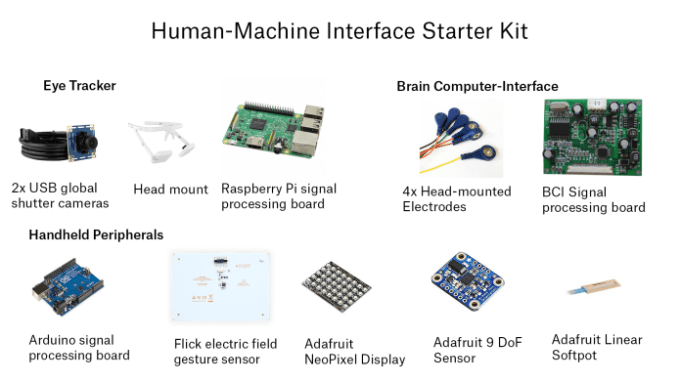
There are dev kits and then there are dev kits, and this is a dev kit. Developers jumping on board for the total package get a bunch of open hardware, i.e. a bunch of gear and cases to build out hacked together interface solutions. The $450 kit brings capabilities like eye-tracking, brain-computer interface electrodes, and some gear to piece together a motion controller. Backers can also just buy the $200 eye-tracking kit alone. It’s all very utility-minded and clearly not designed to make Asteroid those big hardware bucks.

“The long-term goal is to support as much AR hardware as we can, we just made our own kit because I don’t think there is that much good stuff out there outside of labs,” Panditharatne told TechCrunch.

The crazy hardware seems to be a bit of a labor of love for the time being, while a couple AR/VR devices have eye-tracking baked-in, it’s still a generation away from most consumer VR devices and you’re certainly not going to find too much hardware with brain-computer interface systems built-in. The startup says their engine will do plenty with just a smartphone camera and a microphone, but the broader sell with the dev kit is that you’re not building for a specific piece of hardware, you’re experimenting on the bet that interfaces are going to grow more closely intertwined with how we process the world as humans.

Panditharatne founded the company after stints at Oculus and Andreessen Horowitz where she spent a lot of time focusing on the future of AR and VR. Panditharatne tells us that Asteroid has raised over $2 million in funding already but that they’re not detailing the sources of that cash quite yet.

The company is looking to raise $20k from their Indiegogo but the platform is the clear sell here, exposing people to their human-machine interaction engine. Asteroid is taking sign-ups to join the waiting list for the product on their site.

13 Feb 2019

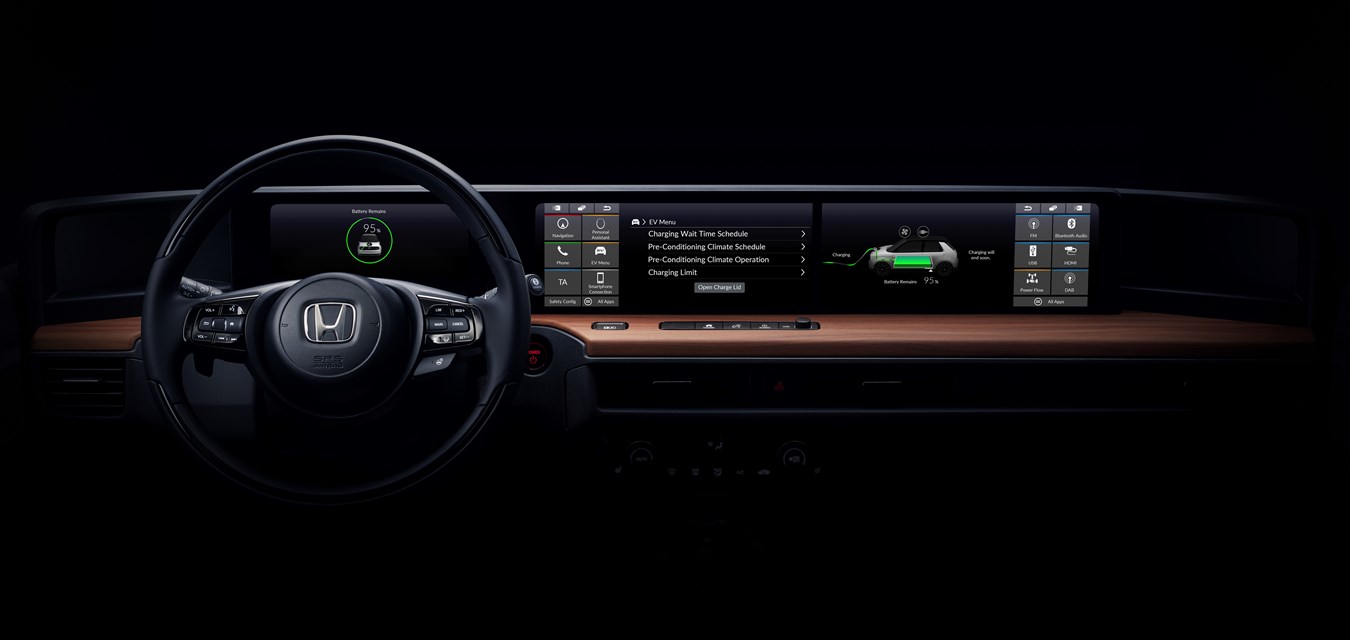
Check out the first interior view of Honda’s Urban EV prototype

Honda has been teasing its all-electric urban vehicle in 2017, when the automaker showed off its vision of the future — that had a distinct 1970s first generation Civic flare.

Now, two years later a production version of the Urban EV is nearly here. And the automaker is finally giving a glimpse —albeit the tiniest of peeks — of the Urban EV’s interior.

The full reveal of the Urban EV will come next month at the 2019 Geneva Motor Show. And from there, it won’t be long before the electric vehicle hits the marketplace. The automaker has said it plans to bring the EV to the European market by late 2019.

Honda reveals first glimpse at interior of electric vehicle prototype bound for the 2019 Geneva Motor Show

The image shows a dash with a tech-forward and uncluttered feel. An expansive digital screen on the right and a digital instrument cluster in the driver’s line of sight. The steering wheel is equipped with toggles, which will likely be used to access features in the vehicle.

Observers will note two areas, one directly to the right of the steering wheel and the other on the far right, which appear to be designed for the driver and the passenger, respectively. The placement and lay out suggests this is a touchscreen display.

Honda says the “interior is designed to create a warm and engaging atmosphere inspired by the Urban EV Concept launched at 2017 Frankfurt Motor Show.”

Honda has big plans for the Urban EV, and more broadly electric vehicles. Way back in 2017, Honda Motor Co. President and CEO Takahiro Hachigo emphasized that the Urban EV wasn’t some “vision of the distant future.”

Honda plans to bring electrification, which can mean hybrid, plug-in or all-electric, to every new car model launched in Europe. The automaker is aiming for two thirds of European sales to feature electrified technology by 2025.

13 Feb 2019

HyperSciences wants to ‘gamechange’ spaceflight with hypersonic drilling tech

It’s no coincidence that Elon Musk wants to both tunnel down into and soar above the Earth. If you ask the team at HyperSciences, the best way to get to space is to flip drilling technology upside down and point it at the sky. In the process, that would mean ditching the large, expensive fuel stages that propel what we generally think of as a rocket — massive cylindrical thing, tiny payload at the tip — into space.

This month, the company hit a major milestone on its quest to get to suborbital space, capping off Phase I of a research grant with NASA with a pair of successful proof-of-concept launches demonstrating the company’s one-two punch of ram acceleration and chemical combustion.

HyperSciences put its vision to the test at Spaceport America, conducting a series of low altitude tests at the desolate launch site an hour outside of Truth or Consequences, New Mexico. The company launched “a number of projectiles,” ranging from 1.5 ft long to over 9 ft long. HyperSciences sent up some off-the-shelf electronics in the process, in a partnership with an aerospace research group at the University of Texas.

“We targeted hitting 600 to 1000 G’s (multiples of Earth’s gravity) on the payloads and accomplished that,” HyperSciences Senior Adviser Raymond Kaminski said. “The payloads felt similar levels to what commercial off-the-shelf electronics (like a cell phone) would feel when getting dropped on the floor.” Kaminski returned to aerospace with HyperSciences after a turn in the startup world following an earlier career with NASA, where he worked as an engineer for the International Space Station.

While the 1.5 ft. system launch was enough to meet its goals for NASA’s purposes, the company was testing the waters with an admittedly more impressive 9 ft. 18” projectile. “We’re going to launch a nine foot section — you can’t deny this anymore,” Kaminski said.

Oddly enough, the whole thing started after HyperSciences founder and CEO Mark Russell drilled a bunch of really, really deep holes. Russell formerly led crew capsule development at Jeff Bezos space gambit Blue Origin before leaving to get involved in his family’s mining business. At Blue Origin, he was employee number ten. Russell’s experience with mining and drilling led him to the idea that by elongating the chemical-filled tubes that he’d use to drill in the past, the system he used to break up rock could go to space.

“You have a tube and you have a projectile. It’s got a sharp nose and you’ve pre filled your tube with natural gas and air,” Russell explained. “It rides on the shock wave like a surfer rides on the ocean”

The team believes that launching something into space can be faster, cheaper and far more efficient, but it requires a total reimagining of the process. If SpaceX’s reusable first stages were a sea change for spaceflight, the technology behind HyperSciences would be a revelation, but that’s assuming the vision — and the hypersonic tech that propels it — could be scaled up and adapted to the tricky, high-stakes business of sending things to space.

A hypersonic propulsion system can launch a projectile at at least five times the speed of sound, causing it to reach speeds of Mach 5 or higher — more than a mile a second. Most of of the buzz in hypersonic tech right now is around defense technology — missiles that travel fast enough to evade even sophisticated missile defense systems or strike targets so quickly they can’t be intercepted — but aerospace and geothermal energy are two other big areas of interest.

Last December, the Washington Post reported that moving from rocket-boosted weapons to hypersonic weapons is the “first, second, and third” priority for defense right now. The Pentagon’s 2019 budget currently has $2 billion earmarked for its hypersonics program and that funding grew by almost a third year-over-year.  “You never want to put out a tech when the government is asking for it,” Kaminski said. “At that point it’s too late and you’re playing catch up.”

In spite of the opportunity, HyperSciences isn’t keen to get into the world of weaponry. “We are a platform hypersonics company, we are not weapons designers,” the team told TechCrunch. “We do not plan on being a weapon provider. HyperSciences is focused on making the world a better place.”

To that end, HyperSciences is maneuvering to the fore of non-weaponry hypersonics applications. The company sponsors the University of Washington lab that’s pioneered applications for ram accelerator technology it uses and has sole right to the tech invented there. 

On the geothermal energy note, with $1 million from Shell, HyperSciences was able to develop what it calls a “common engine” — a hypersonic platform that call drill deep to reach geothermal energy stores or point upward to launch things toward the stars. “HyperSciences is about getting really good on earth first,” Russell said, pointing to one advantage of the cross-compatible system that lets the company apply lessons it learns from drilling to its plans for flight.

“Our HyperDrone technology can be used to test new air-breathing hypersonic engines for NASA or aircraft companies that want to build the next gen super- and hypersonic aircraft to go point-to-point around the world in an hour or two,” the team explained. “Right now, you need a rocket on a big aircraft, just to get experiments up to speed. We can do that at the end of our tube right from the ground.”

Though there have been rumors of acquisition interest, for now HyperSciences is pursuing an offbeat crowdfunding model that’s certainly out of the ordinary in a literally nuts and bolts aerospace business. The company is currently running a SeedInvest campaign that allows small, unaccredited investors put as little as a thousand dollars toward the team’s vision. At the time of writing, the campaign was sitting at around five million dollars raised from nearly 2,000 relatively small-time investors. 

“SpaceX’s seed rounds were run by big VCs,” Russell said. “Where do you get access? These are big industries the public never usually gets to invest in.”

Russell prefers to keep HyperSciences flexible in its pursuits and believes that relying on venture capital would force the company to narrow the scope of its mission.  The team is quick to note that in spite of its relationship with Shell, the oil and energy giant doesn’t own any equity in the company. By hopping between industry-specific contracts with a boost from crowdfunding, HyperSciences hopes to continue pursuing its platform’s applications in parallel.

The next overall architecture for spaceflight will be using hypersonics,” Russell said. “We obviously started this with the idea that you could gamechange spaceflight. By removing the first and potentially the second stage of a rocket [and] putting all of that energy in the ground… you could gamechange spaceflight, no doubt.”

13 Feb 2019

Opportunity Mars Rover goes to its last rest after extraordinary 14-year mission

Opportunity, one of two rovers sent to Mars in 2004, is officially offline for good, NASA and JPL officials announced today at a special press conference. “I declare the Opportunity mission as complete, and with it the Mars Exploration Rover mission as complete,” said NASA’s Thomas Zurbuchen.

The cause of Opportunity’s demise was a planet-scale sandstorm that obscured its solar panels too completely, and for too long, for its onboard power supply to survive and keep even its most elementary components running. It last communicated on June 10, 2018, but could easily have lasted a few months more as its batteries ran down — a sad picture to be sure. Even a rover designed for the harsh Martian climate can’t handle being trapped under a cake of dust at -100 degrees celsius for long.

The team has been trying to reach it for months, employing a variety of increasingly desperate techniques to get the rover to at least respond; even if its memory had been wiped clean or instruments knocked out, it could be reprogrammed and refreshed to continue service if only they could set up a bit of radio rapport. But every attempt, from ordinary contact methods to “sweep and beep” ploys, was met with silence. The final transmission from mission control was last night.

Spirit and Opportunity, known together as the Mars Exploration Rovers mission, were launched individually in the summer of 2003 and touched down in January of 2004 — 15 years ago! — in different regions of the planet.

Each was equipped with a panoramic camera, a macro camera, spectrometers for identifying rocks and minerals, and a little drill for taking samples. The goal was to operate for 90 days, traveling about 40 meters each day and ultimately covering about a kilometer. Both exceeded those goals by incredible amounts.

Spirit ended up traveling about 7.7 kilometers and lasting about 7 years. But Opportunity outshone its twin, going some 45 kilometers over 14 years — well over a marathon.

And of course both rovers contributed immensely to our knowledge of the Red Planet. It was experiments by these guys that really established a past when Mars not only had water, but bio-friendly liquid water that might have supported life.

Opportunity did a lot of science but always had time for a selfie, such as this one at the edge of Erebus Crater.

It’s always sad when a hard-working craft or robot finally shuts down for good, especially when it’s one that’s been as successful as “Oppy.” The Cassini probe went out in a blaze of glory, and Kepler has quietly gone to sleep. But ultimately these platforms are instruments of science and we should celebrate their extraordinary success as well as mourn their inevitable final days.

“Spirit and Opportunity may be gone, but they leave us a legacy — a new paradigm for solar system exploration,” said JPL head Michael Watkins. “That legacy continues not just in the Curiosity rover, which is currently operating healthily after about 2,300 days on the surface of Mars. But also in our new 2020 rover, which is under construction here at the Jet Propulsion Laboratory.”

“But Spirit and Opportunity did something more than that,” he continued. “They energized the public about the spirit of robotic Mars exploration. The infectious energy and electricity that this mission created was obvious to the public.”

Mars of course is not suddenly without a tenant. The Insight lander touched down last year and has been meticulously setting up its little laboratory and testing its systems. And the Mars 2020 rover is well on its way to launch. It’s a popular planet.

Perhaps some day we’ll scoop up these faithful servants and put them in a Martian museum. For now let’s look forward to the next mission.

13 Feb 2019

Reddit says government data requests more than doubled in 2018

Reddit has said the number of government requests for user data has more than doubled in 2018 than on the previous year.

The news and content sharing site said in its latest transparency report, posted Wednesday, it received a 752 requests from governments during the year, up from 310 requests a year earlier.

Broken down, that’s 171 requests to preserve account data — up from 79 requests in 2017; and 581 requests to produce user data — up from 231 requests.

Reddit said it complied with 77 percent of requests to turn over user data, and 91 percent of preservation requests. However, the company says it “only processes preservation requests” that originate in the U.S.

For the year, the company said it was asked by the U.S. government to remove “an image and a large volume of comments made underneath it for potential breach of a federal law,” without saying what the post was. But Reddit said it did not comply with the “overbroad” request as the government didn’t demonstrate illegality.

Noticeably absent from the transparency report are any figures relating to national security. There hasn’t been an update since 2016.

The company had posted a warrant canary in its debut 2014 report, confirming that at the time it had “never received a National Security Letter, an order under the Foreign Intelligence Surveillance Act, or any other classified request for user information.” In its transparency report a year later, the notice was removed, indicating that Reddit had received a national security request but was permitted from disclosing it.

We contacted Reddit for comment but didn’t hear back at the time of writing.

Reddit, a platform known for its freedom of speech (sometimes infamously) has come under increase scrutiny by its users in recent days following a $300 million Series D investment from Chinese tech giant Tencent, prompting the mass posting of Winnie The Pooh, a symbol said to represent Chinese president Xi Jinping, as a protest against Beijing’s vast internet censorship.

In response to questions taken by users following the posting of its transparency report, Reddit chief executive Steve Huffman, who goes by the username u/spez, said: