Author: azeeadmin

13 Feb 2019

J&J spends $3.4 billion in cash for Auris Health’s lung cancer diagnostics and surgical robots

Johnson & Johnson’s robotic surgery and medical device division, Ethicon, is dropping $3.4 billion in cash to pick up Auris Health, a developer of robotic diagnostics and surgical devices initially focused on detecting and treating lung cancer.

The healthcare giant said an additional $2.35 billion in payouts may be possible if Auris hits certain milestones.

Auris’ acquisition is likely a windfall for investors including Lux Capital and Coatue Management, which both invested as part of a whopping $280 million round the company closed two years ago.

Founded by serial entrepreneur Fred Moll, whose previous companies included the 22-year-old, publicly traded Intuitive Surgical, a robotic surgical systems manufacturer now worth around $61.4 billion, and Hansen Medical, a company that developed tools to manipulate catheters; Auris recently received approval from the Food and Drug Administration for its novel, robotic approach to surgery.

Last year, the company unveiled its Monarch platform, which takes an endoscopic approach to surgical procedures that is less invasive and more accurate to test for — and treat — cancer.

“A CT scan shows a mass or a lesion,” Dr. Moll said in an interview at the time. “It doesn’t tell you what it is. Then you have to get a piece of lung, and if it’s a small lesion. It isn’t that easy — it can be quite a traumatic procedure. So you’d like to do it a very systematic and minimally invasive fashion. Currently it’s difficult with manual techniques and 40-percent of the time, there is no diagnosis. This is has been a problem for many years and [inhibits] the ability of a clinician to diagnose and treat early-stage cancer.”

Monarch uses an endoscopy procedure to insert a flexible robot into hard to reach places inside the human body. Doctors trained on the system use video game-style controllers to navigate inside, with help from 3D models.

“In this new era of health care, we’re aiming to simplify surgery, drive efficiency, reduce complications and improve outcomes for patients, ultimately making surgery safer,” said Ashley McEvoy, Executive Vice President, Worldwide Chairman, Medical Devices, Johnson & Johnson, in a statement. “We believe the combination of best-in-class robotics, advanced instrumentation and unparalleled end-to-end connectivity will make a meaningful difference in patient outcomes.”

As part of the deal, J&J is bringing Dr. Moll in-house (which may be as much of a coup for the company as the acquisition of Auris and its patent portfolio.

“We’re thrilled to be joining Johnson & Johnson to help push the boundaries of what is possible in medical robotics and improve the lives of patients across the globe. Together, we will be able to dramatically accelerate our collective product innovation to develop new interventional solutions that redefine optimal patient outcomes,” said Dr. Moll, in a statement. “This combination is a testament to the incredible work of the Auris Health team and the innovation engine behind the Monarch Platform, which represents a huge step forward in endoluminal technology. We look forward to continuing to shape the future of intervention with the added expertise and resources of the world’s largest healthcare organization.”

J&J says that the Monarch robotics platform will play an important role within the Lung Cancer Initiative within the company, and, more broadly, will be used to support the company’s approach to open, laparoscopic, robotic, and endoluminal surgeries.

Other robotics initiatives are underway at J&J through work with Verb, the partnership it has with Verily, a subsidiary of Google’s parent company, Alphabet, and through its acquisition of Orthotaxy, a robotics company focused on knee surgeries.

“We are very committed to our partnership with Verily on the development of the Verb Surgical Platform. Collectively, these technologies, together with our market-leading medical implants and solutions, create the foundation of a comprehensive digital ecosystem to help support the surgeon and patient before, during and after surgery,” said Ms. McEvoy, in a statement.

13 Feb 2019

Apple’s iOS update makes it easier to get to your subscriptions

Apple has made a small but important change to iOS that will allow users an easier way to manage their app subscriptions. In the latest release of the mobile operating system (iOS 12.1.4 and 12.2 beta), the company has relocated the “Manage Subscriptions” setting so it’s only one click away when you tap on your profile in the App Store, instead of being buried more deeply within the settings.

This may seem like a minor change, but it was a much-needed one.

As more mobile apps have adopted subscriptions as a means of generating revenue, it’s become critical to ensure consumers knew how to turn their subscriptions off. And, based on a reading of many angry App Store app reviews, many people don’t know how to do this. Most assume that they should reach out to the developer to have their subscription disabled – after all, it’s the developer who’s charging them.

It’s not really the customer’s fault for being unaware of how the process works, as Apple had made getting to the subscription management screen far more difficult than it should be.

In iOS Settings, for example, you would have to click iTunes & App Store –> Apple ID: –> View Apple ID –> then scroll all the way to the bottom of the screen to find the hidden setting.

In the iOS App Store app, it was a bit simpler.

You would first have to tap your profile icon on the top right of the Home page, then your Apple ID, then scroll down to the bottom of the page again.

By comparison, Google Play put subscriptions in its top-level navigation with no scrolling or extra clicks required.

With the iOS update, when you now tap your profile icon in the App Store, “Manage Subscriptions” is right there – and it’s accessible without scrolling. That’s a huge help in making this critical feature more accessible.

Unfortunately, Apple hasn’t made a similar change to simplify the path to subscription management in iOS’s main Settings.

The change was first spotted by MacStories Editor-in-Chief Federico Viticci, who shared a screenshot on Twitter.

Subscriptions are now one of the main driving forces behind the increase in consumer spending on iPhone.

A recent Sensor Tower report said that iPhone users in the U.S. spent $79 on apps in 2018, up 36% from last year. Much of that is due to mobile gaming, as always, but subscription-based apps are now playing a large role.

Unfortunately, not all developers have been playing by the rules. Many app makers were using misleading tactics to force users to subscribe – like hiding the true costs, using confusing buttons and user interfaces, or suggesting they join a free trial that ends up only lasting for 3 days.

Apple later updated its App Store guidelines to further spell out what is and is not allowed.

But making the rules and enforcing them are two different matters. In the meantime, being able to figure out what subscriptions you have and turning off those you don’t want needed to be simpler.

Also related to this is the fact that Apple is preparing to launch some new subscriptions of its own – presumably, its long-awaited streaming video service and perhaps the news subscription service as well – at a press event in March.

The update to subscriptions to appears to be rolled out worldwide for those on the latest version of iOS.

13 Feb 2019

Former Snap employees are launching Forge Platform for Ethereum devs

Chris Lorenz, Geoffrey Anderson, and James Borow may have spent their days over the past few years working at Snap, but on nights and weekends Anderson and Lorenz were laboring on a different project — improving Ethereum development tools. 

Now the three men are finally ready to take the covers off of the labor of love they’ve been working on and launch Forge Platform, a new toolkit for distributed applications.

Both Lorenz and Anderson were heavily involved in monetization at Snap, but over the past eight months the two had dabbled in building distributed apps — and realized that the toolkits that existed for Ethereum just weren’t on par with what’s available for traditional programming.

“I’ve been interested in Ethereum for about two years now and it was about six months ago that I started to really dig in,” says Lorenz. “We saw the opportunity to prop the ecosystem up and give better tools to developers and basically provide them with what they’re used to in analogous platforms.”  

Ultimately Forge will bring a suite of products to market for distributed application developers, but for now the company is focused on a service to provide insight into the performance of smart contracts over the Ethereum network.

The first tool is designed to give distributed application developers detailed analysis of how their apps are performing across a variety of smart contracts.

“We wanted to pick a platform where the majority of developers are,” says Lorenz of the decision to work with Ethereum. “The others are really interesting projects but they were also where Ethereum was a few years ago.”

The Ethereum protocol has the most support and is making advances in its quest to improve scalability, according to Lorenz.

The company’s SDK will launch in a few months, and Forge in the process of staffing up, thanks to a $1 million seed investment from Manta Ray Ventures and Upfront Ventures.

“Over the course of the past few months we’ve had 15 companies playing with the product and jumping in and providing feedback,” says Lorenz. “We were really working on scalability testing.”

In what are still early days for blockchain-based protocols and applications, Lorenz says its important for a robust set of tools to come onto the market and help ease developers into the new computing paradigm.

“It’s ideally to make it more successful for developers to come in and offer value to customers outside of gambling,” says Lorenz of his new toolkit. “This year we’ll see a lot of interesting projects get launched.”


13 Feb 2019

Instagram confirms that a bug is causing follower counts to change

Instagram confirmed today that an issue has been causing some accounts’ follower numbers to change. Users began noticing the bug about 10 hours ago and the drastic drop in followers caused some to wonder if Instagram was culling inactive and fake accounts, as part of its fight against spam.

“We’re aware of an issue that is causing a change in account follower numbers for some people right now. We’re working to resolve this as quickly as possible,” the company said in a Twitter.

The Instagram bug comes a few hours after a Twitter bug messed with the Like count on tweets, causing users to wonder if accounts were being suspended in mass or if they were just very bad at tweeting.

13 Feb 2019

3Doodler wants you to draw directly onto your iPhone with its new app

With New York ToyFair right around the corner, 3Doodler is taking the opportunity to announce its first ever mobile app. Rather than simply launching a drawing program that mimics the company’s popular 3D drawing pens, however, the simply named 3Doodler app invites users to use their hardware to draw directly onto the phone or tablet’s screen.

The app makes sense in theory, at least. Using an iPhone or iPad (or insert Android device name here) is a much simpler and quicker way to generate stencils than asking people to shell out of for paper versions.

The app features step by step video instructions, tutorials and projects than can be used to construct much larger structures. As the company puts it in its press material, “As companies continue to develop pens that encourage artist to gravitate to screens, 3Doodler’s 3D printing pens aspire to take creators away from them.”

How exposure to the hot gun and a load of plastic will ultimately effect the screen over time remains to be seen, of course. Meantime, the app is available today in the App Store and Google Play.

13 Feb 2019

Elevate Security announces $8M Series A to alter employee security behavior

It’s well understood that many network breaches begin with phishing emails designed to trick users into giving hackers their credentials. They don’t even have to work to find a vulnerability, they can just waltz in the front door. Elevate Security, a San Francisco startup, wants to change that by helping employees understand phishing attacks better using behavioral techniques. Today, the company announced an $8 million Series A round to build on this idea.

The investment was led by Defy Partners. Existing investor Costanoa Ventures also participated. Today’s round brings the total raised to $10 million, according to the company.

What has the company created to warrant this investment? “We have a solution that motivates, measures and rewards employees to change their security habits, while at the same time giving security teams unprecedented visibility into the security habits and actions of their employees,” co-founder Masha Sedova told TechCrunch.

Specifically, the company has built a Security Behavior platform. “Our platform pulls in data sets that allow employees or security teams to see where the strengths and weaknesses of their organization lie, and then apply a suite of solutions that are rooted in behavioral science that helps them change behavior,” she explained.

Sedova and co-founder Robert Fly started working on this problem when both were part of the Salesforce security team. They began working with the idea of gamifying security to teach employees and customers how to be more security aware.

Elevate Security dashboard

When Fly’s team at Salesforce dug into the root of security problems, it found that it was often simply human error. He said it wasn’t malicious on the employee’s part, but they had jobs to do, and expected the security team to handle these issues. He realized that shifting employees to become more security aware was as much a behavioral psychology problem as a technology one and the roots of Elevate began to take shape.

The first product they built on top of the platform is called Hacker’s Mind, a tool designed to help employees understand how hackers think and operate.

The company launched in 2017 and currently has 15 employees, half of which are women. It also boasts an entirely female board of directors, and the startup plans to continue this trend as it staffs up with the new funding. Its headquarters are in San Francisco, but it just opened an engineering office in Montreal. Current customers include AutoDesk, Exxon and Illumio.

13 Feb 2019

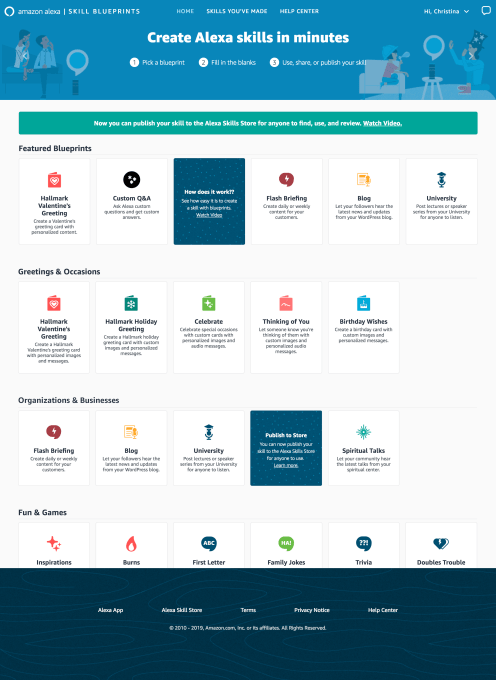
Amazon’s ‘Alexa Blueprints’ can now be published publicly on the US Alexa Skills Store

Last year, Amazon introduced Alexa Blueprints, a way for an Alexa device owner to create their own customized voice skills and Alexa responses without needing to know how to code. These skills — like family trivia or tips for your babysitter — could then be published for personal use. Later, Amazon added the ability to share the skills with others by way of a link. Today, Amazon is taking things a step further — you’ll now be able to publish these skills publicly to the U.S. Alexa Skills Store.

Alongside the launch, Amazon is also adding four new blueprints aimed at content creators, bloggers and organizations.

The idea with blueprints is to offer Alexa device owners a simple, online tool for building voice skills using templates you customize and edit to your liking.

Originally designed for use in the home and among families, some of the first “blueprints” included those offering instructions to houseguests and sitters or games and trivia you could play with family and friends, among other things. Others let you create your own stories for Alexa to narrate, or helped you build your own flashcards, quizzes and other educational tools.

Amazon continued to expand the Blueprints service following its April 2018 launch. For example, last summer it rolled out more customizable templates for families and roommates, like the Chore Chart or Roommate templates, for instance.

As of yesterday, there were 50 voice blueprints available across a half dozen categories, including a newer set of special-occasion and greetings skills from Hallmark.

Today, Amazon is launching four more templates.

The most interesting is the Flash Briefing blueprint, which allows any content creator to publish their news and updates to the Alexa Skills Store in the U.S. Their audience can then opt to include the skill in their own daily briefing, alongside the news from larger organizations, like the BBC or NPR, for example.

Another allows bloggers using WordPress to deliver their blogs as audio, by way of Alexa. That’s similar to something Amazon previously offered via its Amazon Polly WordPress plugin, now called the Amazon AI Plugin. The new skill leverages that same plugin to turn the blog’s text to speech, which can then be published as an Alexa skill.

These two new blueprints allow smaller publishers or local news, local weather providers or local sports groups to reach Alexa users, but they may represent a new challenge for Amazon, too.

Because of their ease-of-use, these skills could be co-opted by extremists or conspiracy theorists who don’t have an official path to broadcast their “fake news” otherwise. Amazon will need to be careful in its vetting and approval process.

The other two new blueprints are aimed at organizations — specifically, universities and churches. The University and Spiritual Talks blueprints let anyone make their live and recorded audio content accessible on Alexa devices.

To create these skills, the organization only has to add their audio feed URL, then customize their welcome and exit messages.

In addition to the new blueprints, the current set of templates may be used by a wide range of businesses, brands and individuals, ranging from personal trainers who want to offer their clients personalized routines, to tutors who offer their students flashcards and facts, to authors who want to share their short stories with the world.

Amazon declined to say how many people have used Blueprints to date, but says it’s “excited” about the level of adoption. When asked if people could monetize their blueprints, a rep responded “that’s an interesting idea.” (Which is Amazon PR speak for “yes, but not now.”)

“We’re always thinking about ways to make the experience better for customers,” a company spokesperson said.

Allowing anyone to publish Blueprints to the Skills Store could allow it to quickly grow beyond the 80,000 voice apps it offers today. But it could also fill the store with lower-quality apps, as templated apps aren’t unique in their design, have simple flows and don’t use voice talent or sound effects as part of their experience.

Users can begin publishing Blueprints today from blueprints.amazon.com.

13 Feb 2019

JibJab, one of the first silly selfie video makers, acquired by private equity firm Catapult Capital

JibJab, one of the first companies that let people insert selfies into videos, gifs, and e-cards, has been acquired by Catapult Capital. The Los Angeles-based private equity firm announced the deal today, but did not disclose financial terms. A portion of financing was provided by investment firm Cloud Capital.

According to Catapult Capital’s site, it focuses on middle-market transactions, targeting internet, consumer, and tech companies that are profitable, or nearing profitability, and past the venture stage. The firm’s investment size is usually $10 million to $100 million and it works with portfolio companies to “develop a China angle,” including new revenue channels. JibJab COO Paul Hanges was promoted to CEO after the acquisition.

Founded in 1999 by brothers Evan and Gregg Spiridellis after they saw “an animated dancing doodie streaming over a 56K modem,” JibJab’s big break came during the 2004 presidential campaign, when its satirical “This Land” racked up more than 80 million views. Two years later, JibJab launched JokeBox, allowing users to upload their own videos, photos, audios, and text jokes. In 2012, JibJab branched into children’s entertainment with StoryBots, which is now part of independent production company StoryBots Inc and known for the popular Netflix series “Ask the StoryBots.” According to Crunchbase, JibJab raised a total of $17.9 million, including its last round, a $7.5 million Series C announced in 2009.
.
JibJab’s current products include an app that (similar to JokeBox) lets users turn selfies into e-cards, music videos, and gifs, but of course it is now one of many apps in a very crowded marketplace, competing to insert your likeness into Bitmojis, Memojis, filters and other content.

Gary Hsueh, founding partner of Catapult Capital, said in a press statement that “JibJab has created a successful business through a combination of product innovation, premium content, and entrepreneurial spirit. With the addition of our product, operational, and distribution resources to support the company’s evolution, we intend to accelerate JibJab’s new growth phase. We look forward to working with Paul, our co-investors, and the JibJab team to continue growing the business and expanding into new markets and formats.”

13 Feb 2019

A new Congress means a new opportunity for consumer privacy protections

The 2018 mid-term elections, for the first time in U.S. history, resulted in a Congress that has the look and feel of America…our very diverse America. There are now 102 women serving in Congress and a record number of Members representing all Americans. Our Members now represent the African American, Hispanic, LGBTQ, and interfaith communities.

Thirteen new members are under the age of 35. This evolution of the legislative branch provides an opportunity to represent the best interests of all consumers. In our digital world, what is it that consumers, from each and every community represented by this new diverse Congress, have asked for? Online privacy protections.

As consumers enjoy the benefits of the great range of services that ride on the internet, they have increasingly lost confidence in once trusted companies who, we now know, have offered false promises of protections for their private online information. In 2018, consumers experienced one of the greatest losses of their personal information when Facebook revealed that Cambridge Analytica gathered the personal data of millions of Facebook users without their consent.

In another significant incident, Marriott had its database hacked and the information about over 500 million individuals was accessed from their guest reservation system. Uniquely personal information including phone numbers, passport numbers and dates of birth could all be accessed from the Marriott database. These are just two examples, with many other incidences of loss of consumers’ personal data over the past several years by companies small and large.

These data breaches all come at a significant cost to consumers and companies. According to an IBM study last year, the average cost of a data breach per comprised record in 2018 was $148. The total cost of a breach that impacts 50 million comprised records (an average size breach) costs a total of over $350 million – and these dollar amounts increase every year.

While the monetary costs of a data breach are significant to business, the real, and perhaps even greater costs, are borne by consumers. The loss of privacy, the potential for identity theft, and the years it takes to repair the damages that result from identity theft are seemingly immeasurable.

Consumers are now very aware that the country lacks a reliable solution to online privacy threats and concerns. It’s time for Congress to pass legislation that will implement a set of national privacy rules, offering consumers strong privacy and data security protections, and data breach notifications. These privacy rules should be uniformly applied to all companies in the online ecosystem.

Consumers cannot distinguish between the companies they engage with in the online world, so neither should the rules. The best arbiter to manage and enforce these national rules is the Federal Trade Commission. The FTC has the expertise in consumer protection in privacy and security matters and should continue to build on this role with new and enhanced privacy protections.

While state legislative initiatives are noble efforts to offer privacy protections, this approach is not ideal for consumers, or for the digital economy.

They don’t offer uniform rules and they will protect a microcosm of consumers at best. As Representative Susan DelBene recently stated in reference to states moving forward on privacy legislation, “If we are not careful, we risk creating digital borders… within the (United) States causing massive disruptions in digital supply chains and digital trade…” A patchwork of state laws versus a national law could result in other implications for our digital economy as well. Congress must realize the immediate need of this privacy crisis and act; limited state protections cannot fill this void.

The best, and most long-lasting, resolution for consumers is for Congress to approve bipartisan privacy protections, providing national rules of the road for all companies to adhere to in this digital ecosystem.

With the unprecedented diversity represented by this Congress, we can feel confident that all points of view are being heard. It’s time to renew consumer confidence in our online services and devices. Let’s get it done, Congress. Our online privacy is an important protection that just can’t wait.

13 Feb 2019

Fiverr acquires ClearVoice to double down on content marketing

Fiverr is acquiring ClearVoice, a company that helps customers like Intuit and Carfax find professionals to write promotional content.

The two companies seem like a natural fit, since they both operate marketplaces for freelancers. Fiverr covers a much broader swath of freelance work, but CEO Micha Kaufman (pictured above) said the marketplace’s professional writing category grew 220 percent between the fourth quarters of 2017 and 2018, and he predicted that the need for content marketing will only increase.

“The types of channels that brands and companies need to be involved in and engaging in conversation with their audience are just growing,” Kaufman said. “I think any brand today that wants to be relevant needs to create a lot of engaging, interesting, creative content in their space, and I think that that creates a high demand for good content writers.”

Kaufman also noted that this is Fiverr’s third acquisition in two years, and he said he’s a “big believer … in the consolidation of vertical businesses into horizontal businesses such as ours — the fact that we cover over 200 categories gives us a tremendous amount of power to serve customers across many different types of needs.”

So what does the acquisition bring to the table that Fiverr wasn’t offering already? Kaufman said the ClearVoice team has “a lot of know how, both in technology side and the actual content side,” which will allow Fiverr to “cater to customers of all sizes and all needs.”

ClearVoice editorial calendar

ClearVoice editorial calendar

More specifically, he said most of Fiverr’s content marketing customers are small businesses, while ClearVoice is able to work with large enterprises, especially with its collaboration and workflow tools that allow those enterprises to create content at “high velocity.”

Founded in 2014 by Jay Swansson and Joe Griffin (who still serve as co-CEOs), ClearVoice has raised a total of $3.1 million in funding from investors including PC Ventures, Desert Angels, Peak Ventures and Service Provider Capital, according to Crunchbase.

Fiverr is not disclosing the financial terms of the acquisition. The company says ClearVoice will continue to operate as an independent subsidiary.

“We are thrilled to be joining a company that is changing how people and companies work together in the modern era,” Swansson said in a statement. “This new chapter is a chance for us to use Fiverr’s depth and knowledge to globally scale our business and advance our mission of creating a platform that allows for worldwide creative collaboration.”