Author: azeeadmin

13 Feb 2019

Eight Sleep unveils The Pod, a bed that’s smarter about temperature

Smart mattress company Eight Sleep is announcing its newest product today, The Pod. Co-founder and CEO Matteo Franceschetti described it, succinctly, as “Nest for your bed.”

Eight has been focused on bed temperature for a while, first by offering a smart mattress cover and then a smart mattress that allows owners to adjust the surface temperature and even set different temperatures for different sides of the bed. But The Pod goes even further, with a smart temperature mode that will change bed temperature throughout the night to improve your sleep.

“Our vision is to use technology to personalize the environment while you’re unconscious and asleep,” Franceschetti said. “The biggest factor in the environment in temperature. The reason is … your body temperature changes during the night. If you sleep in an environment with a flat and stable temperature, you’re clearly going to feel hot or cold.”

When it comes to adjusting temperature for better sleep, Franceschetti argued that The Pod will be more effective than a smart thermometer, because it reacts to your behavior and is in direct contact with your body.

So The Pod will cool down so that you can fall asleep more quickly and sleep more soundly. It can also use artificial intelligence and biofeedback sensors to determine the best temperature for you (anywhere from 55 to 115 degrees Fahrenheit) throughout the night, and adjust accordingly.

The Pod

And there’s a “thermal alarm,” which will cool the bed in the minutes before you wake up — hopefully, you’ll be ready to wake up when your regular alarm goes off, or you can avoid the alarm in the first place.

The Pod is powered by The Hub, a device attached to the bed that essentially functions as its computer, connecting to WiFi and also storing the water tank that’s used for changing the temperature.

“The most impressive new technologies for improving sleep and enabling sleep research are the instrumented beds being developed by Eight Sleep,” said Craig Heller, a biology professor at Stanford University and a member of the startup’s scientific advisory board, in a statement. “Their goal of modifying thermal environment using in-home data is a huge opportunity to advance sleep science.”

The Pod does offer other features besides temperature adjustment. Like previous Eight Sleep products, it also allows you to track your sleep and vitals over time, then offers sleep coaching tips. It also connects to other smart home products like Amazon Alexa and Philips Hue light bulbs. And the mattress is supposed to be pretty good too, with four layers of adaptive foam.

The Pod is currently available for preorder today, with pricing starting at $1,995 for a full bed and $2,195 for a queen. Eight Sleep says it will start shipping in April.

13 Feb 2019

btov Partners closes €80M for its fund aimed at industrial tech startups

European Deep-Tech and ‘industrial tech’ start-ups working in the field of industrial applications get a shot in the arm today with the news that btov Partners has closed 80 million Euros in backing for the second closing of its new btov Industrial Technologies Fund. btov Partners is a European venture capital firm with offices in Berlin, Munich, St. Gallen and Luxembourg.
The cash was raised from industry, strategic investors, family offices, foundations, a number of banks, the European Investment Fund – and the management team itself. The fund will aim to invest in European start-ups specifically aimed at industrial applications
Such as AI for industrial process optimisation, so-called Industry 4.0, IIoT (Industrial Internet of Things), cyberphysical security, electronics and photonic, power generation and storage, as well as medical and quantum technologies.
DyeMansion, a Munich-based start-up, in which the fund invested in August 2018, specializes in just these kinds of technologies: the post-processing of 3D-printed polymer parts.
Partner Christian Reitberger said: “We usually invest EUR 1-3 million as lead or co-lead investor in Seed, Series A, possibly also Series B rounds and reserve significant further capital for subsequent rounds; we like to understand the underlying IP and favor cross-domain innovations, ie. bringing maturing technologies to new industrial applications – for example the application of new quantum technologies for sensor technology, the use of new computer architectures for hybrid high-performance computing, generative algorithms for design automation or photonic integration for medical technologies.”
The launch of the new btov Industrial Technologies Fund was supported by LfA Förderbank Bayern. Other public investors are NRW.BANK and the European Investment Fund. The fund is supported by InnovFin Equity, with the financial backing of the European Union under Horizon 2020 Financial Instruments and the European Fund for Strategic Investments (EFSI) set up under the Investment Plan for Europe.

13 Feb 2019

PayPal shutters Malaysia office as part of customer service reorg

Payment giant PayPal has closed its office in Malaysia as part of a restructuring of its customer support teams.

The office, located in capital city Kuala Lumpur, was home to a team of customer service agents that catered to PayPal users across Asian region and beyond. Now, its responsibility will be assumed by other offices, which include locations in the Philippines, China and India.

A PayPal spokesperson explained to TechCrunch that the move is aimed at consolidating a range of different employees at PayPal offices to help blend a range of employees under the same roof. The closure of the office doesn’t impact the PayPal service in Malaysia.

PayPal confirmed the office will close this year in a statement. The company emphasized its efforts to transition affected staff into new jobs both inside PayPal and with other companies:

We have made the difficult decision to close PayPal’s Operations Centre in Malaysia by the end of this year. The work currently being delivered at our Operations Centre in Malaysia will gradually move to other locations. This internal reorganization does not affect our customers in Malaysia, who can continue to use our products and services as normal.

We regularly review our global site structure and staffing to ensure the support and services we provide at each site best meet the evolving demands of our customers. Our Operations Centre in Malaysia has done a remarkable job serving our customers since the site opened in 2011. However, this decision was made to align our investment in sites that are better equipped to support the future needs of our customers and our company.

Our priority now is to do everything we can to set up our employees for future success and we are fully committed to helping them as they transition to the next step in their careers. As well as offering comprehensive separation packages, we have built an on-site careers center to promote job opportunities and provide immediate assistance to employees.

PayPal was the first company to pioneer digital payments but it has fallen behind in Asia and other emerging markets as mobile payment players and messaging apps have stepped up.

WeChat, which offers integrated QR code payments, dominates China, while WhatsApp is experimenting with payments in India, its largest market with 200 million active users, in a move that may well expand to other markets including Southeast Asia, where it is widely used. Other challengers with digital payments include Line, which offers payments in Japan, Taiwan and Thailand, and Alibaba’s Ant Financial, a major player in China that is making aggressive moves in Korea and Southeast Asia.

News of the Kuala Lumpur office closure was first reported by Malaysian media.

13 Feb 2019

DJI is updating its geofencing system across Europe after Gatwick drone debacle

Following the pre-Christmas drone debacle in the UK — which plunged thousands of people into travel misery after repeated drone sightings closed the runway at Gatwick, and later also briefly suspended departures at Heathrow — consumer drone maker DJI has announced it’s upgrading its geofencing system across Europe.

It says its Geospatial Environment Online (GEO) 2.0 system will be rolled out to the 19 European countries that did not already have the GEO system in phases — “starting later this month”.

“GEO 2.0 creates detailed three-dimensional “bow tie” safety zones surrounding runway flight paths and uses complex polygon shapes around other sensitive facilities, rather than just simple circles used in earlier geofencing versions,” it writes.

We’ve asked how long it will take for the update to be fully rolled out across the region.

A further 13 local markets that had the GEO system already will also now get the 2.0 update.

In all, 32 European countries will be covered by GEO 2.0 — which DJI bills as offering “enhance protection of European airports and facilities”.

Here’s how it explains the new geofencing approach in Europe:

GEO 2.0 applies the strictest geofencing restrictions to a 1.2 kilometer (3/4 mile) wide rectangle around each runway and the three-dimensional flight paths at either end, where airplanes ascend and descend. More flexible geofencing restrictions apply to an oval area within 6 kilometers (3.7 miles) of each runway. This bow tie shape opens more areas on the sides of runways to beneficial drone uses, as well as low-altitude areas more than 3 kilometers (1.9 miles) from the end of a runway, while increasing protection in the locations where traditional aircraft actually fly.

DJI’s new boundary areas around airport runways are based on the International Civil Aviation Organization’s Annex 14 standard for airspace safety near runways. DJI also consulted with aviation organizations on ways to enhance geofencing features near airport facilities. DJI’s categorisation of airports is based on airport types, numbers of passengers, operations and other factors, influencing the sensitivity of the airspace around a given location.

The countries getting GEO for the first time are: Bulgaria, Croatia, Cyprus, Czech Republic, Estonia, Finland, Greece, Hungary, Iceland, Latvia, Liechtenstein, Lithuania, Malta, Norway, Poland, Romania, Slovakia, Slovenia and Sweden.

While those countries set for an upgrade to GEO 2.0 are: Austria, Belgium, Denmark, France, Germany, Ireland, Italy, Luxembourg, the Netherlands, Portugal, Spain, Switzerland and the UK.

Update: A spokesman confirmed it will be live in all 32 countries later this month. He also confirmed that DJI drones operating in the nineteen European countries that are getting GEO for the first time had no geoblocks at all prior to this roll out.

It’s not clear what took DJI so long to implement stricter and more detailed geofencing — and, well, any geofencing at all in most regional markets — around critical infrastructure sites like airports. We asked and it didn’t respond to the question.

But it has also announced a change of data provider — from California-based AirMap to Altitude Angel — in Europe. So appears to have needed to source better European mapping data. (Although the latter company launched its unmanned traffic management platform back in 2016.)

Altitude Angel, a UK-based startup which was founded in 2014, says its GuardianUTM platform is being used by DJI to extend the functionality of GEO 2.0 so it “more accurately reflects the highest safety risks around particular facilities”.

DJI claims the upgrade not only better reflects actual safety risks around airports but describes it as “more flexible in lower-risk areas” — saying, for example, that it would permit “authorized users to conduct drone activities in locations parallel to runways”. (Albeit UK airports might not be in a huge rush to permit any kind of nearby drone flights given the recent chaos… )

Another difference for the platform flagged by Altitude Angel itself is the claim it better maps other “sensitive facilities” too, such as prisons and nuclear power stations — which it says are represented by “more accurate ‘polygon’ shapes, rather than large, static cylinders”.

“By more accurately mapping the highest risk zones, DJI can improve safety while opening up more of the airspace to drone pilots,” is its claim.

Another change coming via the GEO update is that DJI’s geofencing system will also include Temporary Flight Restrictions (TFRs) imposed during major events or natural disasters.

“The TFRs will be based on authoritative data from Eurocontrol,” it says.

When the drone maker announced the launch of its GEO geofencing system in Europe and North America, back in 2015, its VP of policy and legal affairs wrote: “Our years of actual user experience have shown that in most instances, strict geofencing is the wrong approach for this technology, and instead we are helping operators make informed, accountable decisions.”

As it turned out there’s rather more work to be done to ensure human nature combined with affordable, powerful drone tech doesn’t turn a consumer gadget into a weapon of mass disruption.

Another wrinkle, vis-a-vis geofencing as a mechanism for regulating drone use, is that individual (DJI) drone owners must update their DJIGO 4 flight control app and aircraft firmware for the new geoblocks to apply. So a push button fix for drone misuse this most definitely is not.

Add to that, modded/hacked drones can and do circumvent baked in geoblocks. And of course other drone brands, with different geofencing systems, are available.

Regulators have been caught on the hop around drone safety but aren’t likely to stand still for too much longer.

Last month the UK government announced new powers for police to tackle illegal use of drone technology — including powers to land, seize and search drones.

It also said it would beef up stop-gap flight restriction rules on drones by expanding a 1km flight exclusion zone around airports to circa 5km.

A full drone bill is still pending but the Gatwick drone chaos will have concentrated ministerial minds on the expeditious need to better regulate the tech.


13 Feb 2019

Rapyd nabs $40M led by Stripe and GC for ‘fintech as a service’, a single API for payments, money transfer and more

As ever more transactions move on to digital platforms, a startup that is building a swiss army knife of financial services — from payments to currency transfers, ID verifications and card issuing — for companies to use by way of a single API — is announcing funding. Rapyd, a “fintech as a service startup akin to AWS for financial services” according to its CEO, has raised $40 million. The company plans to use the funds to continue to add more financial services to its platform, more staff to build them, and to expand its customer base.

This Series B is notable because it is being co-led by Stripe, the payments giant that is now valued at $22 billion, as well as General Catalyst, one of Stripe’s biggest backers, which has for years also co-invested with it in strategic startups. Others in this round include Target Global (a previous investor) IGNIA and other strategic payments and fintech companies that Rapyd is not disclosing.

It’s not clear if Stripe is investing as a customer, or simply an interested party (as it has in other startups it has backed): Arik Shtilman, the co-founder and CEO of Rapyd, said in an interview that he couldn’t say how and if his company and Stripe were working together. Stripe, as you might know, has made a big move to expand the kinds of services it provides to its customers beyond basic payments, and it has also continued to expand its coverage to more of the world, so there is potential for Rapyd to be involved in a number of areas.

This takes the total raised by the company to $60 million. Shtilman would not comment on the startup’s valuation.

(Notably, his previous company — an Israeli-based cloud services startup called ITNavigator — was sold to Avaya several years ago, reportedly for less than $100 million.)

Rapyd opened for business at the end of 2017 and Shtilman says it is on track to make “tens of millions” in revenues this year.

While it will not disclose any specific names, it currently has around 50 customers in areas like e-commerce and “gig economy”-based businesses (ie Uber-style transport services), as well as other types of companies where financial transactions may not be a company’s core competency, but are central to how it operates.

Like other fintech startups such as Adyen (as well as Stripe, PayPal and others), which aim to simplify complex problems behind easy-to-integrate APIs, Rapyd has built a suite of services — currently numbering five: funds collection, funds payouts, currency transfers, ID verification and card issuing, with the idea that more will be added on soon — that knit together several steps behind the scenes to make the process of offering that service easy for the company, and ultimately easy for the customer to use.

For example, in payments, it works with some 100 banks around the world to enable fund collection and disbursement across a wider geography, and it’s working on extending that to 150. It can handle payments and transfers in 65 currencies and can pay out funds in more than 170 countries. Its commissions on payments are straightforward — 3.5 percent plus 30 cents for funds in; $1.50 plus one percent in cases of currency exchange for funds out — although you have to contact the company for pricing on other services.

But Rapyd’s rapid rise also runs counter to a strong trend that we’ve seen up to now in the growth of fintech. Over the last several years, there have been a plethora of startups that have launched, and thrived, by offering very streamlined products, serving a single or a small handful of related purposes. Rapyd, however, believes that ultimately that isn’t how businesses want to work.

“Simplicity is the name of the game,” Shtilman said. “It doesn’t make sense to connect five to seven different providers into your backend when you can connect just one.”

Indeed, that need will likely also lead to more consolidation in the wider, fragemented fintech market, which will also create more competition for Rapyd. But for now, it’s a compelling enough and fast-enough moving market that there is an opportunity for a startup building this in a clever way to pick up speed — and maybe even a strategic buyer who also needs this exact functionality — quickly.

“Rapyd’s product offering helps merchants, banks, telcos and fintech companies expand the scope of the products they offer, increase the number of customers they reach, and improve the overall customer experience, said Adam Valkin, Partner of General Catalyst, in a statement. “Rapyd does this by helping drive the ubiquity of payment and payout options beyond debit and credit cards, towards cash, bank transfers, instant payments, e-wallets, and mobile money.”


13 Feb 2019

Starling Bank, now with 460K consumer accounts, raises further £75M for European expansion

Starling Bank, founded by banking veteran Anne Boden, has raised £75 million in further funding. The new capital breaks down as £60 million in a Series C round led by Merian Global Investors, including Merian Chrysalis, with £15 million in follow-on funding from Starling’s existing backer and major shareholder Harald McPike. It brings total funding to date for the London-based challenger bank to £133 million.

Starling says the new funding will support increased investment in the bank’s financial products in retail and SME banking as well as banking services. This will include ramping up international expansion, starting with Europe. The bank is thought to be applying for an additional banking license in Ireland to ensure those expansion plans aren’t interrupted post-Brexit.

Meanwhile, breaking with tradition, Starling is formally disclosing its latest customer numbers, presumably now that it has hit a respectable number: the challenger bank now has 460,000 personal current accounts and 30,000 SME accounts, and says it expects to hit one million customers by the end of 2019.

To put this into some context, long-term rival Monzo claims around 1.5 million customers and neobank Revolut claims 3.5 million users. Of course, for any current account offering, perhaps a better metric is accounts where a regular salary is paid in. Starling is likely to be punching above its weight here, having launched with a fully fledged current account from the get-go and targeting a slightly broader demographic.

On the SME banking front, a good point of reference is SME banking app Tide, which has been around for significantly longer than Starling’s much more recently launched business account. Last month Tide, which has had growing pains of its own and recruited a new CEO in August, disclosed that it has 60,000 SME customers.

However, the less well-told story of Starling is really its “Banking Services” division, which arguably makes it less reliant on core bank accounts. Along with consumer and small business banking, Starling makes its modern banking and payments infrastructure available to third parties. The banking-as-a-service has 20 institutional clients, including the U.K. government, while its payments volume is said to be “doubling month on month”.

The third aspect of Starling’s business is its marketplace of third-party financial products, which resides inside of the Starling banking app and is supported by its open API. It now has 11 partners, with many more in the pipeline. Notably, however, Boden has previously said the Starling Marketplace aimed to establish 25 marketplace partners by the end of 2018, while the bank’s Chief Platform Officer departed for Barclays in December.

In a statement related to today’s new funding, which TechCrunch reported was in motion last May, Boden talks up Starling Bank’s European expansion: “Building our platform and launching in the U.K. to provide genuine choice to retail, SME and Banking-as-a-Service customers was just the first step. Our ambition is to use our technology to build a next-generation global, digital banking platform, starting with our launch across Europe this year”.

Adds Nick Williamson, Merian Chrysalis co-portfolio manager: “Financial services is a market undergoing considerable change, driven by technology and users’ desire for better and more convenient offerings. The Starling team has developed a highly impressive and efficient platform, which we believe positions it well to continue to take share in core banking markets, as well as the ability to offer innovative new services in the future”.

13 Feb 2019

Manipulating an Indian politician’s tweets is worryingly easy to do

Here’s a concerning story from India, where the upcoming election is putting the use of social media in the spotlight.

While the Indian government is putting Facebook, Google and other companies under pressure to prevent their digital platforms from being used for election manipulation, a journalist has demonstrated just how easy it is to control the social media messages that published by government ministers.

Pon Radhakrishnan, India’s minister of state for finance and shipping, published a series of puzzling tweets today after Pratik Sinha, a co-founder of fact-checking website Alt News, accessed a Google document of prepared statements and tinkered with the content.

Among the statements tweeted out, Radhakrishnan said Prime Minister Modi’s government had failed the middle classes and not made development on improving the country’s general welfare. Sinha’s edits also led to the official BJP Assam Pradesh account proclaiming that the Prime Minister had destroyed all villages and made women slaves to cooking.

These are the opposite of the partisan messages that the accounts intended to send.

The messages were held in an unlocked Google document that contained a range of tweets compiled for the Twitter accounts. Sinha managed to access the document and doctor the messages into improbable statements — which he has done before — in order to show the shocking lack of security and processes behind the social media content.

Sinha said he made the edits “to demonstrate how dangerous this is from the security standpoint for this country.”

“I had fun but it could have disastrous consequences,” he told TechCrunch in a phone interview. “This is a massive security issue from the point of view of a democracy.”

Sinha said he was able to access the document — which was not restricted or locked to prevent changes — through a WhatsApp group that is run by members of the party. Declining to give specifics, he said he had managed to infiltrate the group and thus gain access to a flow of party and government information and, even more surprisingly, get right into the documents and edit them.

What’s equally as stunning is that, even with the message twisted 180 degrees, their content didn’t raise an alarm. The tweets were still loaded and published without any realization. It was only after Sinha went public with the results that Radhakrishnan and BJP Assam Pradesh account begin to delete them.

The Indian government is rightly grilling Facebook and Google to prevent its platform being abused around the election, as evidence suggested happened in the U.S. Presidential election and the U.K’s Brexit vote, but members of the government themselves should reflect on the security of their own systems, too. It would be too easy for these poor systems to be exploited.

13 Feb 2019

Toronto’s OneEleven launches space in London, but will its scale-up services fly?

Last time I checked London was awash with co-working spaces, shared office spaces, spaces of every shape, size and color. If there’s one sector that always makes money during a boom, it’s the sector that makes the spades and pick-axes for the gold-rush. And that’s exactly what’s happened to London’s tech scene: a property boom.
In the last year at least we’ve seen WeWork expand to 31 locations in London alone. Meanwhile, it’s well-funded native US challenger from New York, Knotel (which has a polar opposite approach to WeWork in the way it brands its spaces) is expanding rapidly across the city.

Now the Canadian are coming!

Toronto’s OneEleven thinks it has a new take on helping London’s fast-growth businesses with space. They call it “scale as a service”. Yes, this also sounds like marketing hype to me, but, the company insists, there’s more to it than that.
What this boils down to is giving its tenants access to turn-key services such as HR, brand and marketing support, sales tools and the like. The idea being that founders and their teams get freed-up to focus on their business. That’s aside from the usual selection of office spaces and meeting rooms etc etc.
In its native Toronto, OneEleven claims to have seen 70 member companies raise more than $500 million at a collective valuation of more than $2 billion since 2013 by applying this methodology to its customer base.
Dean Hopkins, CEO of OneEleven, says the company is addressing a real need: “London offers incredible support for early-stage businesses as they start out, and once they reach Series A funding – but there simply isn’t enough of an infrastructure out there at the moment to help companies at that crucial in-between stage. Many companies will go through accelerator or incubator programmes that provide them a valuable kickstart, but when the fixed term is up they are too often left to fend for themselves with little support in maintaining that momentum.”

He’s engaged UK managing director Rob McPherson who wants to “create a truly bespoke version of the OneEleven experience that is best suited to the London ecosystem.”

So far so good.

But wait a second, do the startups pay for these services?

A spokesperson told me that the services are provided “a-la-carte as individual subscriptions – our members can buy only what they need for only as long as they need.” So in other words, although OneEleven doesn’t take equity in its members’ companies, these extra services don’t come free for businesses in the building.

That’s not the approach of other competitors in the London ‘tech spaces’ space.

Natasha Guerra of Runway East tells me: “Runway East provides free investment support for its startups, running monthly VC office hours as well as updating leading London VC’s on a monthly basis with details on which members are raising… We provide this service for free as part of our commitment to supporting our members.”

Meanwhile, over at TechHub, CEO and co-founder Elizabeth Varley says: “At TechHub our entire support programme is included in the membership price and we run at least one VC event a week for our members. No fee, no percentage, no equity.”

So this approach of offering paid-for support services to companies which sign up to office space is clearly a fairly new one for London’s tech scene. The question is will it fly? With Brexit storm clouds on the horizon, it’s frankly impossible to predict anything these days.

13 Feb 2019

2018 really was more of a dumpster fire for online hate and harassment, ADL study finds

Around 37 percent of Americans were subjected to severe hate and harassment online in 2018, according to a new study by the Anti-Defamation League, up from about 18 percent in 2017. And over half of all Americans experienced some form of harassment according to the ADL study.

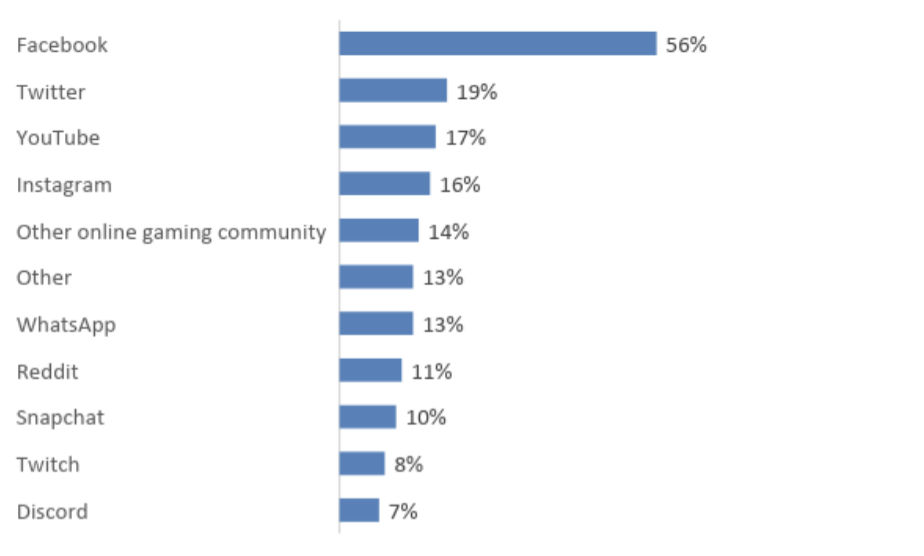
Facebook users bore the brunt of online harassment on social networking sites according to the ADL study, with around 56 percent of survey respondents indicating that at least some of their harassment occurred on the platform. — unsurprising given Facebook’s status as the dominant social media platform in the U.S.

Around 19 percent of people said they experienced severe harassment on Twitter (only 19 percent? That seems low); while 17 percent reported harassment on YouTube; 16 percent on Instagram; and 13 percent on WhatsApp .

Chart courtesy of the Anti-Defamation League

In all, the blue ribbon standards for odiousness went to Twitch, Reddit, Facebook and Discord, when the ADL confined their surveys to daily active users. nearly half of all daily users on Twitch have experienced harassment, the report indicated. Around 38% of Reddit users, 37% of daily Facebook users, and 36% of daily Discord users reported being harassed.

“It’s deeply disturbing to see how prevalent online hate is, and how it affects so many Americans,” said ADL chief executive Jonathan A. Greenblatt. “Cyberhate is not limited to what’s solely behind a screen; it can have grave effects on the quality of everyday lives – both online and offline. People are experiencing hate and harassment online every day and some are even changing their habits to avoid contact with their harassers.”

And the survey respondents seem to think that online hate makes people more susceptible to committing hate crimes, according to the ADL.

The ADL also found that most Americans want policymakers to strengthen laws and improve resources for police around cyberbullying and cyberhate. Roughly 80 percent said they wanted to see more action from lawmakers.

Even more Americans, or around 84 percent, think that the technology platforms themselves need to do more work to curb the harassment, hate, and hazing they see on social applications and websites.

As for the populations that were most at risk to harassment and hate online, members of the LGBTQ community were targeted most frequently, according to the study. Some 63 percent of people identifying as LGBTQ+ said they were targeted for online harassment because of their identity.

“More must be done in our society to lessen the prevalence of cyberhate,” said Greenblatt. “There are key actions every sector can take to help ensure more Americans are not subjected to this kind of behavior. The only way we can combat online hate is by working together, and that’s what ADL is dedicated to doing every day.”

The report also revealed that cyberbullying had real consequences on user behavior. Of the survey respondents 38 percent stopped, reduced or changed online activities, and 15 percent took steps to reduce risks to their physical safety.

Interviews for the survey were conducted between Dec. 17 to Dec. 27, 2018 by the public opinion and data analysis company YouGov, and was conducted by the ADL’s Center for Technology and Society. The non-profit admitted that it oversampled for respondents who identified as Jewish, Muslim, African American, Asian AMerican or LGBTQ+ to “understand the experiences of individuals who may be especially targeted because of their group identity.”

The survey had a margin of error of plus or minus three percentage points, according to a statement from the ADL.

13 Feb 2019

2018 really was more of a dumpster fire for online hate and harassment, ADL study finds

Around 37 percent of Americans were subjected to severe hate and harassment online in 2018, according to a new study by the Anti-Defamation League, up from about 18 percent in 2017. And over half of all Americans experienced some form of harassment according to the ADL study.

Facebook users bore the brunt of online harassment on social networking sites according to the ADL study, with around 56 percent of survey respondents indicating that at least some of their harassment occurred on the platform. — unsurprising given Facebook’s status as the dominant social media platform in the U.S.

Around 19 percent of people said they experienced severe harassment on Twitter (only 19 percent? That seems low); while 17 percent reported harassment on YouTube; 16 percent on Instagram; and 13 percent on WhatsApp .

Chart courtesy of the Anti-Defamation League

In all, the blue ribbon standards for odiousness went to Twitch, Reddit, Facebook and Discord, when the ADL confined their surveys to daily active users. nearly half of all daily users on Twitch have experienced harassment, the report indicated. Around 38% of Reddit users, 37% of daily Facebook users, and 36% of daily Discord users reported being harassed.

“It’s deeply disturbing to see how prevalent online hate is, and how it affects so many Americans,” said ADL chief executive Jonathan A. Greenblatt. “Cyberhate is not limited to what’s solely behind a screen; it can have grave effects on the quality of everyday lives – both online and offline. People are experiencing hate and harassment online every day and some are even changing their habits to avoid contact with their harassers.”

And the survey respondents seem to think that online hate makes people more susceptible to committing hate crimes, according to the ADL.

The ADL also found that most Americans want policymakers to strengthen laws and improve resources for police around cyberbullying and cyberhate. Roughly 80 percent said they wanted to see more action from lawmakers.

Even more Americans, or around 84 percent, think that the technology platforms themselves need to do more work to curb the harassment, hate, and hazing they see on social applications and websites.

As for the populations that were most at risk to harassment and hate online, members of the LGBTQ community were targeted most frequently, according to the study. Some 63 percent of people identifying as LGBTQ+ said they were targeted for online harassment because of their identity.

“More must be done in our society to lessen the prevalence of cyberhate,” said Greenblatt. “There are key actions every sector can take to help ensure more Americans are not subjected to this kind of behavior. The only way we can combat online hate is by working together, and that’s what ADL is dedicated to doing every day.”

The report also revealed that cyberbullying had real consequences on user behavior. Of the survey respondents 38 percent stopped, reduced or changed online activities, and 15 percent took steps to reduce risks to their physical safety.

Interviews for the survey were conducted between Dec. 17 to Dec. 27, 2018 by the public opinion and data analysis company YouGov, and was conducted by the ADL’s Center for Technology and Society. The non-profit admitted that it oversampled for respondents who identified as Jewish, Muslim, African American, Asian AMerican or LGBTQ+ to “understand the experiences of individuals who may be especially targeted because of their group identity.”

The survey had a margin of error of plus or minus three percentage points, according to a statement from the ADL.