Author: azeeadmin

12 Feb 2019

Mode, a collaborative analytics platform focused on empowering data scientists, just landed $23 million in fresh funding

Mode, a five-year-old collaborative analytics platform based in San Francisco, has raised $23 million in Series C funding led by Valor Equity Partners.

Foundation Capital and REV Venture Partners, who led Mode’s Series A and B financing rounds, respectively, also joined the round, which brings the company’s total funding to $50 million altogether.

In some ways, the investment is a bet on the continuing need for data scientists, despite the many companies that are focused on making data analysis available and understandable to a broader swath of employees, like Snowflake and BigQuery.

The way Mode cofounder and CEO Derek Steer sees it, owing to today’s tools, organizations may need fewer data scientists. But they need also to better empower those individuals to quickly and effective answer key questions, like how clients are using their product in unexpected ways, and how companies can take advantage of trends they are seeing in the data, and other business intelligence questions. Mode does this through an integrated SQL editor, Python, R notebooks, and visualization builder that it says give users the flexibility to choose the level of abstraction they want for a given dataset.

The investment is also a bet on Steer, says David Obrand, a partner at Valor who is joining the board, and who worked previously with Steer at Yammer, the enterprise-level social networking site that was acquired by Microsoft in 2012.

Obrand, who’d been Yammer’s chief customer officer, credits Steer as “key in accelerating [Yammer’s]  path as a data driven business.” He says further that Steer “embodies the persona of the customer he’s serving.”

As importantly, at Yammer, Steer learned how to build a “freemium” software business that’s adopted by an organization after a small set of employees begins actively using its free version. Indeed, Mode’s playbook is much the same, giving data scientists access to a free product called Mode Studio with the hope that, for many, it will become core to their workflow, and they’ll then ask a broader team of decision-makers across the organization to use it, too.

That plan appears to be working. Steer tells us 600 organizations now use Mode, including Twitch, Lyft, Shopify, Meredith, and Conde Nast. And while he says he isn’t certain of the exact percentage of users that are paying the company for its tools, its newest round suggests the number is meaningful.

Right now, Mode targets companies with up to 5,000 seats. It also caters largely to a U.S. audience.

With its new capital, the company plans to expand geographically, including hiring employees outside of San Francisco for the first time. Steer suggests to expect new features. The company also plans to expand each of its departments, focusing on its community efforts in particular.

12 Feb 2019

Dandelion Energy, the Alphabet X spinout, raises another $16M led by GV and Comcast

As tech companies continue their race to control the smart home, a promising energy startup has raised a round of funding from traditionally-tech and strategic investors, for a geothermal solution to heat and cool houses. Dandelion Energy, a spinout from Alphabet X, has raised $16 million in a Series A round of funding, with strategic investors Comcast Ventures leading the round along with GV, the investment arm of Alphabet formerly known as Google Ventures.

Lennar Corporation, the home building giant, is also coming in as an investor, as are previous backers NEA, Collaborative Fund, Ground Up, and Zhenfund, and other unnamed investors. Notably, Lennar once worked with Apple but is now collaborating with Amazon on smart homes.

As a side note, Dandelion’s investment is a timely reminder of how central “new home” startups are right now in smart home plays. Amazon just yesterday announced one more big move in its own connected home strategy with the acquisition of Mesh WiFi startup eero, which helps extend the range and quality of WiFi coverage in a property.

This is the second funding round for Dandelion in the space of a year, after the company raised a seed round of $4.5 million in March 2018, a mark of how the company has been seeing a demand for its services and now needs the capital to scale. In the past year, it had accrued a waitlist of “thousands” of homeowners requesting its services across America, where it is estimated that millions of homeowners heat their homes with fossil fuels, which are estimated to account for 11 percent of all carbon emissions.

The company is based out of New York, and for now New York is the only state where its services are offered. The funding may help change that. It will be used in part for R&D, but also to hire more people, open new warehouses for its equipment and supplies, and for business development.

It’s not clear what Dandelion’s valuation is — we will be asking — but in its last round the company had a modest post-money valuation of $15 million, according to PitchBook. It has now raised $23 million in total since spinning out from Alphabet X, the company’s moonshot lab, in May 2017.

The premise of Dandelion’s business is that it provides a source of heating and cooling homes that takes people away from consuming traditional, energy grid-based services — which represent significant costs, both in terms of financial and environmental impact. If you calculate usage over a period of years, Dandelion claims that it can cut a household’s energy bills in half while also being significantly more friendly for the environment compared to conventional systems that use gas and fossil fuels.

While there have been a number of efforts over the years to tap geothermal currents to provide home heating and cooling, many of the solutions up to now have been challenging to put in place, with services typically using wide drills and digging wells at depths of over 1,000 feet.

“These machines are unnecessarily large and slow for installing a system that needs only a few 4” diameter holes at depths of a few hundred feet,” Kathy Hannun, cofounder and CEO of Dandelion, has said in the past. “So we decided to try to design a better drill that could reduce the time, mess and hassle of installing these pipes, which could in turn reduce the final cost of a system to homeowners.”

The smaller scale of what Dandelion builds also means that the company can do an installation in one day.

While a pared-down approach this means a lower set of costs (half the price of traditional geothermal systems) and quicker installation, that doesn’t mean that upfront costs are non-existent. Dandelion installations run between $20,000 and $25,000, although home owners can subsequently rack up savings of $35,000 over 20 years. (Many choose to finance the installation which also brings down the upfront cost.)

This is also where Lennar comes in. The company is in the business of building homes, and it has been investing in particular in the idea of building the next generation of homes by incorporating better connectivity, more services — and potentially alternative energy sources — from the ground up.

“We’re incredibly excited to invest in Dandelion Energy,” said Eric Feder, Managing General Partner for Lennar Ventures, in a statement. “The possibility of incorporating geothermal heating & cooling systems in our new homes is something we’ve explored for years, but the math never made sense. Dandelion Energy is finally making geothermal affordable and we look forward to the possibility of including it in the homes Lennar builds.”

The fact that Comcast is among the investors in Dandelion is a very notable development.

The company has been acquiring, and taking strategic stakes in, a number of connected-home businesses as it builds its own connected home offering, where it not only brings broadband and entertainment to your TV and come computers, and also provides the tools to link up other connected devices to that network to control them from a centralised point.

Dandelion is literally “off grid” in its approach to providing home energy, and while you might think that it doesn’t make sense for a company that is investing in and peddling services and electronic devices connected to a centralised (equally electricity-consuming) internet to be endorsing a company that’s trying to build an alternative, it actually does.

Viewed in terms of the segment of customers that Comcast is targeting, it’s selling a bundle of connected home services to a demographic of users who are not afraid of using (and buying) new and alternative technology to do things a different way from how their parents did it. Dandelion may not be “connected” but even its approach to disconnecting will appeal to a person who may already be thinking of ways of reducing his or her carbon footprint and energy bills (especially since they may be consuming vast amounts of electricity to run their connected homes).

“The home heating and cooling industry has been constrained by lack of innovation and high-costs,” said Sam Landman, managing director of Comcast Ventures, in a statement. “The team at Dandelion and their modern approach to implementing geothermal technology is transforming the industry and giving consumers a convenient, safe, and cost-effective way to heat and cool their homes while reducing carbon emissions.”

Landman and Shaun Maguire, a partner at GV, will both be joining Dandelion’s board with this round.

“In a short amount of time, Dandelion has already proven to be an effective and affordable alternative for home heating and cooling, leveraging best-in-class geothermal technology,” said Maguire, in a statement. “Driven by an exceptional leadership team, including CEO Kathy Hannun, Dandelion Energy is poised to have a meaningful impact on adoption of geothermal energy solutions among homeowners.”


12 Feb 2019

Walmart ends delivery partnership with Deliv

Walmart in 2016 said it would begin testing last-mile delivery using services like Uber, Lyft, and Deliv to bring customers’ orders, including groceries, to their homes. Last year, Walmart ended its grocery delivery deal with Uber and Lyft, and today it’s ending the deal with Deliv as well, according to a report from Reuters.

Deliv had started working with Walmart in pilot markets, including Miami and San Jose, as one of the few services Walmart was testing for last-mile deliveries at the time. The retailer has since significantly expanded its delivery operations through an array of partners to markets across the U.S., in relatively short order.

Walmart this morning confirmed to TechCrunch that Deliv was not a large part of its operations. The retailer said Deliv was only working with 3 Walmart stores out of the total 800, and in only 1 market out of 100, at the time the deal ended.

The retailer in 2018 said it was on track to expand grocery delivery to more than 40 percent of U.S. households by year-end, meaning a jump from just 6 markets to over 100 metros during a year’s time. Uber and Lyft, however, were dropped in May 2018, as Walmart shifted more of its deliveries to other partners, like Postmates and DoorDash.

Last month, Walmart added a handful of new partners, as well, including Point Pickup, Skipcart, AxleHire and Roadie. It said it planned to expand grocery delivery from the 800 stores in 100 U.S. metros where it’s live now, to double that number by the end of 2019.

In Canada, Walmart works with Instacart, which also partners with Walmart’s Sam’s Club in the U.S.

Despite the quick expansion, Walmart’s decision to work with third-party courier services instead of bringing delivery operations in-house has led to some problems. Simple tasks, like allowing customers to change pickup orders to delivery or vice versa, are often impossible. Technical and logistical issues also often can’t be communicated directly from drivers to Walmart, but have to go through the third-party delivery partner.

According to Reuters, Deliv drivers were frequently having to wait up to 40 minutes for grocery orders when they arrived at the store for pickup, as Walmart was unable to process the online orders fast enough, the report claimed. The report also said delivery volume was low in some Walmart delivery markets, and orders had to travel long distances, which caused both Walmart and Deliv to lose money at times.

Related to Walmart’s decision to end its partnership with Deliv, the companies will also no longer operate the keyless entry test in partnership with smart lock maker August Home. Announced in fall 2017, the test would allow customers with August smart home devices to have their packages delivered inside their home, instead of left on the doorstep.

This gives Amazon an advantage in keyless entry, as its Key by Amazon product last month expanded to include garage and business delivery, new locks and Ring compatibility.

“In 2017 we began a pilot program with Deliv in San Jose to understand how the Walmart Grocery Delivery model would work with a scheduled platform,” a Walmart spokesperson told TechCrunch, confirming the news.

“As with any pilot, the intent is to learn and ultimately came to the conclusion that Deliv’s platform was not the best fit for our program. Today, we work with a number of third-party delivery companies operating an on-demand based platform, and we will continue to test different delivery approaches that will help us continue to learn,” they added.

Deliv raised $40 million in Series C funding last October, from Google, Clayton Venture Partners, UPS, General Catalyst Partners, The Macerich Company, PivotNorth Capital, RPM Ventures, and Upfront Ventures. It also works with Best Buy, Macy’s, Home Depot and Walgreens.


12 Feb 2019

Datadog acquires app testing company Madumbo

Datadog, the popular monitoring and analytics platform, today announced that it has acquired Madumbo, an AI-based application testing platform.

“We’re excited to have the Madumbo team join Datadog,” said Olivier Pomel, Datadog’s CEO. “They’ve built a sophisticated AI platform that can quickly determine if a web application is behaving correctly. We see their core technology strengthening our platform and extending into many new digital experience monitoring capabilities for our customers.”

Paris-based Madumbo, which was incubated at Station F and launched in 2017, offers its users a way to test their web apps without having to write any additional code. It promises to let developers build tests by simply interacting with the site, using the Madumbo test recorder, and to help them build test emails, password and testing data on the fly. The Madumbo system then watches your site and adapts its check to whatever changes you make. This bot also watches for JavaScript errors and other warnings and can be integrated into a deployment script.

The team will join Datadog’s existing Paris office and will work on new products, which Datadog says will be announced later this year. Datadog will phase out the Madumbo platform over the course of the next few months.

“Joining Datadog and bringing Madumbo’s AI-powered testing technology to its platform is an amazing opportunity,” said Gabriel-James Safar, CEO of Madumbo. “We’ve long admired Datadog and its leadership, and are excited to expand the scope of our existing technology by integrating tightly with Datadog’s other offerings.”

12 Feb 2019

Amazon buys Eero: What does it mean for your privacy?

In case you hadn’t seen, Amazon is buying router maker Eero. And in case you hadn’t heard, people are pretty angry.

Deluged in a swarm of angry tweets and social media posts, many have taken to reading tealeaves to try to understand what the acquisition means for ordinary privacy-minded folks like you and me. Not many had much love for Amazon on the privacy front. A lot of people like Eero because it wasn’t attached to one of the big tech giants. Now it’s to be part of Amazon, some are anticipating the worst for their privacy.

Of the many concerns we’ve seen, the acquisition boils down to a key concern: “Amazon shouldn’t have access to all internet traffic.”

Rightfully so! It’s bad enough that Amazon wants to put a listening speaker in every corner of our home. How worried should you be that Amazon flips the switch on Eero and it’s no longer the privacy-minded router it once was?

This calls for a lesson in privacy pragmatism, and one of cautious optimism.

Don’t panic — yet

Nothing will change overnight. The acquisition will take time, and any possible changes will take longer. Eero has an easy to read privacy policy, and the company tweeted that the company will “continue to protect” customer privacy, noting that Eero “does not track customers’ internet activity and this policy will not change with the acquisition.”

That’s true! Eero doesn’t monitor your internet activity. We scoured the privacy policy, and the most the router collects is some basic information from each device connecting to the router that it already broadcasts, such as device name and its unique networking address. We didn’t see anything beyond boilerplate language for a smart router. And there’s nothing in there that says even vaguely that Eero can or will spy on your internet traffic.

Among the many reasons, it (mostly) couldn’t even if it wanted to.

Every single time you open an app or load a website, most now load over HTTPS. And most do because Google has taken to security-shaming sites that don’t. That’s an encrypted connection between your computer and the app or website. Not even your router can see your internet traffic. It’s only rare cases like Facebook’s creepy “research” app that forces you to give it “root” access to your device’s network traffic when companies can snoop on everything you do.

If Eero starts asking you to install root certificates on your devices, then we have a problem.

Fear the internet itself

The reality is that your internet service provider knows more about your internet activity than your router does.

Your internet provider not only processes your internet requests, it routes and directs them. Even when the traffic is HTTPS-encrypted, your internet provider for the most part knows which domains you visit, and when, and with that it can sometimes figure out why. With that information, your internet provider can piece together a timeline of your online life. It’s the reason why HTTPS and using privacy-focused DNS services are so important.

It doesn’t stop there. Once your internet traffic goes past your router, you’re into the big wide world of the world wide web. Your router is the least of your troubles: it’s a jungle of data collection out there.

Props to the spirited gentleman who tweeted that he trusts Google “way more with my privacy than Amazon” for the sole reason that, “Amazon wants to use the data to sell me more stuff vs. Google just wants to serve targeted ads.” Think of that: Amazon wants to sell you products from its own store, but somehow that’s worse than Google selling its profiles of who it thinks you are to advertisers to try to sell you things?

Every time you go online, what’s your first hit? Google. Every time you open a new browser window, it’s Google. Every time you want to type something in to the omnibar at the top of your browser, it’s Google. Google knows more about your browsing history than your router does because most people use Google as their one-stop directory for all they need on the internet. Your internet provider may not be able to see past the HTTPS domain that you’re visiting, but Google, for one, tracks which search queries you type, which websites you go to, and even tracks you from site-to-site with its pervasive ad network.

At least when you buy a birthday present or a sex toy (or both?) from Amazon, that knowledge stays in-house.

Knock knock, it’s Amazon already

If Amazon wanted to track you, it already could.

Everyone seems to forgets Amazon’s massive cloud business. Most of the internet these days runs on Amazon Web Services, the company’s dedicated cloud unit that made up all of the company’s operating income in 2017. It’s a cash cow and an infrastructure giant, and its retail prowess is just part of the company’s business.

Think you can escape Amazon? Just look at what happened when Gizmodo’s Kashmir Hill tried to cut out Amazon from her life. She found it “impossible.” Why? Everything seems to rely on Amazon these days — from Spotify and Netflix’s back-end, popular consumer and government websites use it, and many other major apps and services rely on Amazon’s cloud. She ended up blocking 23 million IP addresses controlled by Amazon, and still struggled..

In a single week, Hill found 95,260 total attempts by her devices to communicate with Amazon, compared to less than half that for Google at 40,527 requests, and a paltry 36 attempts for Apple. Amazon already knows which sites you go to — because it runs most of them.

So where does that leave me?

Your router is a lump of plastic. And it should stay that way. We can all agree on that.

It’s a natural fear that when “big tech” wades in, it’s going to ruin everything. Especially with Amazon. The company’s track record on transparency is lackluster at best, and downright evasive at its worst. But just because Amazon is coming in doesn’t mean it’ll necessarily become a surveillance machine. Even Google’s own mesh router system, Eero’s direct competitor, promises to “not track the websites you visit or collect the content of any traffic on your network.”

Amazon can’t turn the Eero into a surveillance hub overnight, but it doesn’t mean it won’t try.

All you can do is keep a close eye on the company’s privacy policy. We’ll do it for you. And in the event of a sudden change, we’ll let you know. Just make sure you have an escape plan.

12 Feb 2019

InVision acquires design file versioning startup Trunk

InVision, the design company valued at $1.9 billion, has today announced the acquisition of Australia-based Trunk.

Trunk is focused wholly on file versioning for designers. In the world of engineering, GitHub has provided a way for developers to keep versions organized — developers can track changes, create a separate branch to experiment, and collaborate more easily with other developers by merging branches. But the same courtesy hasn’t properly been extended to designers, who usually spend plenty of time scrolling through long email chains searching for the latest version of the attachment.

The deal, the terms of which were not disclosed, came about after Trunk applied for funding from InVision’s Design Forward Fund. After taking a look at the Trunk business and getting to know the team better, InVision decided to take it a step further with a proper acquisition offer.

“We’re truly inverting the workflow,” said InVision CEO and founder Clark Valberg . “It’s gone from engineering first to design first because, in the process of building, design is the best place to have conversations across the company. Everyone can understand it and strategize. Engineers have had version control since the very early days.”

The Trunk team will be focusing their energy on Studio, InVision’s design tool, which launched about a year ago.

The launch of Studio was the first time that InVision truly showed its hand, revealing efforts to go well beyond a simple collaboration tool and become the Salesforce of the design world.

In order to do so, InVision is building bridges between itself and other design focused startups, whether its through integrations, investment, or straight-up acquisition.

“As a growing company with some 800 employees, we’re always looking for people who are passionate about each individual slice of this design pie as possible,” said Valberg. “After using Trunk’s technology, we realized that they really really really care about this slice around design file versioning.”

The InVision collaboration suite currently boasts a place at 98 percent of the Fortune 100 companies, with more than 5 million users. This means the company is shifting its focus squarely to Studio. Design collaboration software was a relatively novel idea back when InVision launched, but design software wasn’t. With Studio, InVision is taking on incumbents like Adobe and other newcomers such as Sketch.

Of course, the feature set of Studio itself is important in beating out other design tools, but InVision believes that the real deal closer is integration with the deeper back-end of InVision’s suite of tools, such as InVision collaboration and now, design file versioning.

12 Feb 2019

Consumer-focused healthcare can save lives by focusing on changing behavior

Everything we do in the $3 trillion healthcare market today only affects 10% of outcomes to premature death.

You read that right. All of that, for just 10% of outcomes:

That 10% exists for a reason. Genetic predisposition is hard to change. So, unfortunately, are social circumstances and environmental behavior. But that 40% of behavioral patterns — why can’t we tackle that? This is what real prevention would look like: nothing comes even close to mattering as much towards whether you will die prematurely as your behavior does.

We can do better than simply focusing on that small 10% slice of the pie; in fact, we’re looking in the wrong place. Doctors, entrepreneurs and founders need to be thinking (and treating with) lifestyle as medicine. Because behavioral change is the best and most powerful way to impact that whopping 40% slice.

Too often we think of this as the “just eat right and exercise” problem. As we know very well, that platitude will not solve our healthcare problem. The true problem is the difficulty of modifying behavior. We know this, because the platitude doesn’t work. We like to eat what we want, to exercise or not exercise if we choose. In short, humans like our patterns. They’re hard to change.

Tech, on the other hand, modifies behavior very well. Just look at the phone you’re probably reading this on, which has foundationally changed the way we communicate — along with huge other swaths of human behavior, in both positive and negative ways — from the ability to call a ride service in practically any city at any time to tracking your health to screen addiction. We know technology modifies behavior; we live this every day. So the question is, how can we target this superpower ability of tech to have 4x the ability to impact that the $3 trillion healthcare budget does?

How does it work?

Let’s think about why technology actually does work for modifying behavior. For one, it’s always there, thanks to the leap in mobile tech, whether that be phones or fitness trackers. Second, technology’s ability to do constant A/B testing essentially enables RCTs, or Randomized Clinical Trials, every moment that technology is present and being used. These RCTs are invaluable laboratories for learning about what is effective therapeutic behavior modification, or improving efficacy — and it’s not toxic. Most medical products are released and then rarely get updated (think about how old the stethoscope is!). Rolling out new versions of products has been difficult and expensive. But that no longer has to be true. The same kind of A/B testing that Amazon does, for example, to optimize ecommerce — everything from the look of the website to the flow of the experience to the nature of the shipping that you get — can be now applied to behavior modification for health. Comparing the immediate efficacy of two algorithms for lifestyle behavior modification on two different populations can happen not just over years or months — as a RCT would have to be — but over weeks and even days, improving our responses and lifestyles that much faster.

Second, applying Machine Learning to vast amounts of new data is identifying all kinds of nuances of human behavior that we aren’t nearly as good, as humans, at noticing. For example, correlating patterns with data like where you shop, when you eat lunch, what activities do you do, what shows you watch, what your exercise routine has been, how much you sleep, even perhaps whether you remember to charge your phone. Identifying the clues in our behavior that eventually add up to significant lifestyle risk is the first step towards changing and improving that behavior. Like it or not, we live our lifestyles now through our phones — ML allows us to learn from it.

And last, technology allows us to scale existing therapies in new orders of magnitude.  Programs which have proven extremely effective at behavior modification through personal interaction — such as Diabetes Prevention Program for Type 2 Diabetes — have been by definition hard to scale; computation can extend their reach into the billions. Or take for another example depression, a complex disease where the molecules involved are poorly understood: drug therapies have been challenging, but therapy, specifically CBT, has a very strong track record, and computational CBT — ie, CBT scaled with technology — the strongest.

Even conditions as mysterious and difficult as cognitive decline can be treated much more effectively with technology. This is another fascinating example where the biology is so complex at the molecular level that breakthroughs have been far and few between. On the other hand, cognitive is painfully clear at the behavior level. And it is also very clear that behavioral treatment in the form of cognitive stimulation helps significantly. In this study, for example, the auditory memory and attention capability of patients who received cognitive stimulation training 1 hour per day, 5 days per week, for 8 weeks improvement was significantly greater than those who did not.

These are big challenges to meet. Behavior is the result of thousands of small decisions at every moment of every day: do I sit or do I stand? Do I drink this beer? Even, do I take regular deep breaths? One of the biggest challenges to face is how we ‘read’ this behavior and turn it into reliable data. There’s also the issue of small sample sizes: in order to narrow down to a meaningful experiment, you need, at the moment, to have very clear definitions of behavior, which often means small sample sizes of people who always do X in Y conditions. The science of behavior and decision making itself is complex, debatable, and often evolving. And there’s the company building practicalities: to build a company in this space, you need to find people who understand clinical science, data science, experimentation approaches, behavioral science *and* product and UI.

But that’s exactly the opportunity. These things are coming; we understanding more about behavior every day, as devices enter our daily lives and health data becomes more and more fine-grained. New conceptions of roles that blend behavioral science and product design are clearly emerging. All of these means are not exclusive and can be combined into powerful ways of modifying behavior for health. Those that can connect all these dots have the ability to build companies that can take a giant bite out of that 40% — and have tremendous impact on mortality for huge swaths of the population.

There’s an old joke that plumbers have saved more lives than doctors, because improving sewers and sanitation (and eradicating the disease that went along with that) was so impactful on longevity for humans. By cleaning up the modern day ‘sewers’ of our lifestyles — not through magical drugs, complex procedures, or platitudes about prevention — but through a real infrastructure of technology that is being built right now — technology will bring an analogous impact.

12 Feb 2019

The UK now has a law against upskirting

A law change that comes into force in the UK today makes the highly intrusive practice of ‘upskirting’ illegal.

The government said it wants the new law to send a clear message that such behaviour is criminal and will not be tolerated.

Perpetrators in the UK face up to two years in prison under the new law if they’re convicted of taking a photograph or video underneath a person’s clothes for the purpose of viewing their underwear or genitals/buttocks without their knowledge or consent for sexual gratification or to cause humiliation, distress or alarm.

There have been prosecutions for upskirting in England and Wales under an existing common law offence of outraging public decency. But following a campaign started by an upskirting victim the government decided to legislate to plug gaps in the law to make it a sexual offence.

The Voyeurism (Offences) (No. 2) Bill was introduced on June 21 last year and gains royal assent today.

Where the offence of upskirting is committed in order to obtain sexual gratification it can result in the most serious offenders being placed on the sex offenders register.

Under the new law victims are also entitled to automatic protection, such as from being identified in the media.

While the UK government is intending the law change to send a clear message that upskirting is socially unacceptable, there’s no doubt that legislation alone can’t do that. Robust enforcement is essential to counter any problematic attitudes that might be contributing to encourage antisocial uses of technologies in the first place.

For example, in South Korea a law against upskirting carries a maximum sentence of five years in prison yet the legislation has failed to curb an epidemic of offences fuelled by cheap access to tiny hidden spy cameras and baked in societal sexism — the latter seemingly also influencing how police choose to uphold the law, with campaigners complaining most perpetrators get off with small fines.

12 Feb 2019

Techstars and Starburst Aerospace are launching a space industry accelerator in Los Angeles

With the help of NASA’s Jet Propulsion Lab, the U.S. Air Force, Lockheed Martin, Maxar Technologies, SAIC and the Israel Aerospace Industries company, Techstars and Starburst Aerospace are launching an accelerator focused on the space industry in Los Angeles.

Already a major hub for the space and aerospace startup industry, with companies like SpaceX, Relativity Space, Virgin Orbit, Rocket Lab, Phase Four, and others calling Los Angeles home, the new accelerator will provide another booster for LA’s growing startup scene.

The new aerospace program, called the Techstars Starburst Space Accelerator, will be managed by longtime Techstars managing director, Matt Kozlov, who previously helmed Techstars’ efforts at its health-focused accelerator done in partnership with Cedars Sinai.

Van Espahbodi, the co-founder and managing director of Starburst Aerospace, a multinational aerospace investor and consultant, will be advising Kozlov on the program and bringing his firm’s expertise with government partners to the table.

Corporate sponsors for this program include, NASA’s Jet Propulsion Laboratory, Lockheed Martin, Maxar Technologies, SAIC and Israel Aerospace Industries, and the U.S. Air Force.

Investments in space and aerospace technologies are picking up, thanks in part to estimates like the one from Bank of America Merrill Lynch, which put the size of the space economy at roughly $3 trillion by 2045.

Even if those estimates are overblown, investor have already backed companies developing reusable rockets, 3D printing technologies, advanced materials, miniature satellites and other space-related technologies to the tune of at least $2.3 billion over the last year.

“The space industry is both massively exciting but also quite complex,” said Matt Kozlov, managing director of the Techstars Starburst Space Accelerator program, in a statement. “We are bringing together vital industry leaders, both public and private, who will help entrepreneurs navigate the industry and provide unprecedented commercial support and mentorship. We will help founders achieve two years of commercial traction in three months. Given the pedigree of our sponsors, I expect this program will very quickly become a vital resource for entrepreneurs building frontier tech.”

Applications for the accelerator are open today and the program will begin in July. And startup companies looking to connect with program staff prior to applying, or get feedback on their companies – are welcome to request Office Hours.

“The list of incredible companies just keeps growing,” said Espahbodi, the co-founder and managing director of Starburst, in a statement. “The broader aerospace industry has finally embraced the notion of ‘open innovation’ by partnering with entrepreneurs to co-develop products, with a compelling business plan to match. Starburst is excited to advise the program to ensure early-stage businesses have the appropriate tools to compete in this emerging marketplace.”

12 Feb 2019

Sub-brands are the new weapon in China’s smartphone war

One of China’s top smartphone brands Vivo appears to have joined its fellows Oppo, Huawei and Xiaomi in setting up a new sub-brand as a softening market and heightened competition at home drive players to venture upon their original reach.

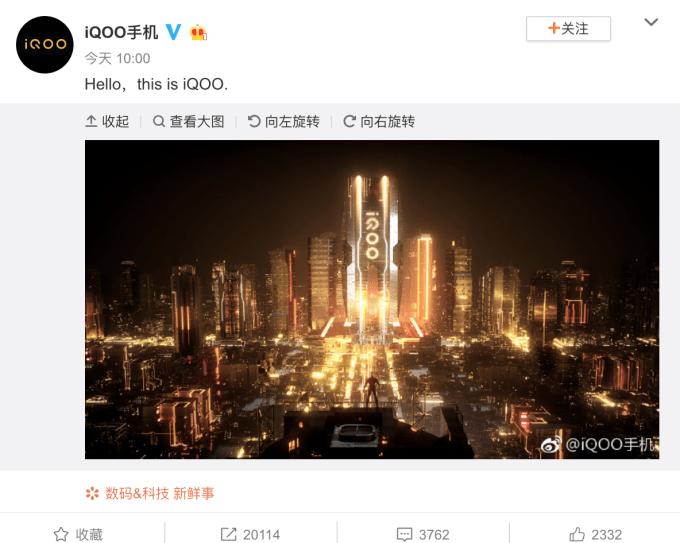
A new smartphone brand called iQoo made its debut on Weibo, China’s answer to Twitter, on Tuesday by greeting in English: “Hello, this is iQoo.” It also playfully encouraged people to guess how its name is pronounced, as the spelling doesn’t resonate with either Chinese or English speakers. Vivo immediately reposted iQoo’s message, calling iQoo a “new friend.”

Vivo has not further revealed its ties with iQoo, although the latter’s Weibo account is verified under Vivo’s corporate name. TechCrunch has contacted Vivo and will update the story when we have more information.

vivo iqoo

Screenshot of iQoo’s first Weibo post

Sub-brands have become a popular tactic for Chinese smartphone makers to lure new demographics without undermining and muddling their existing brand reputation. As the third-ranked player by shipments in 2018 according to research firm Counterpoint, Vivo is the only one in China’s top five smartphone companies without a subsidiary brand.

“Sub-brands can help fill the gap in parent companies,” Counterpoint’s research director James Yan told TechCrunch. “I think iQoo is a brand born for the gaming market, the online sales channel, or young consumers, similar to what Honor did to Huawei.”

Huawei cemented its top spot with solid growth in shipments last year by playing a two-pronged strategy. Its sub-brand Honor has its eyes on the mid-range and Huawei stays at the top end. Vivo’s sibling Oppo, which falls under the same electronics manufacturing outfit BBK, came up with an exclusively online brand Realme in 2018 to go after Xiaomi’s Redmi in India’s burgeoning smartphone market. Xiaomi pressed on by launching Poco for India’s high-tier market. To further solidify its multi-faceted approach, Redmi shed the Xiaomi branding in January to start operating as an independent brand focusing on cost efficiency.

These moves arrived as years of breakneck growth in China’s smartphone space comes to an end. Overall smartphone sales contracted 11 percent in 2018 according to Counterpoint, as users become more pragmatic and less likely to upgrade their handsets. Local players reacted swiftly by going global and introducing headline-grabbing features like Xiaomi’s folding screen and Honor’s pole-punch display, putting a squeeze on global players Apple and Samsung. In 2018, Huawei shored up a 25 percent market share to take the crown. Trailing behind was Oppo, Vivo, Xiaomi and Apple . Samsung plunged 67 percnet to take seventh place.