Author: azeeadmin

11 Feb 2019

I’m digging this ridiculous $19 folding laptop stand

Ask me in a couple of months what I think about the Moft. Right now, I’m actually digging it. Granted, I didn’t have particularly high hopes for a $19 (for Kickstarter early birds) fiberglass and faux leather gizmo you slap on the bottom of the laptop, but I’m into it.

The “invisible” stand is pretty silly on the face of it. It ships flat, you take it out, pull off the protective paper and stick it on the bottom of your laptop toward the rear. The company says it works with laptops up to 15.6 inches. I can only speak for the 15 inch MacBook Pro — but there, at least, it works like a charm.

The thing operates like your standard laptop/tablet origami case. It folds up flush with the system, and when you pull it out, you can adjust it to prop up the laptop from a couple of different angles. Simplicity is the best and worst thing about the Moft.

I found myself wanting some kind of magnetic latch to keep it in place when not in use. As it is, the thing kind of flaps around a bit. My MacBook goes in and out of my backpack several times a day. After a few months of that kind of use, it’s easy to imagine ripping the thing to shreds. The price is right, though — at $19 for Kickstarter backers and $24 at retail, running though a couple of these a year won’t break the bank.

Also, maybe it’s my own imperfect placement, but there’s a bit of a wobble when I type. That’s addressed pretty easily by resting my palms of the laptop — something I tend to do when typing anyway.

All in all, a pretty solid — and clever — addition to the arsenal. I like typing at an angle, so this should help with speed and comfort. There are a few qualms here, as it to be expected with any first gen crowdfunded project, but the Moft’s not a bad little buy for the price.

11 Feb 2019

Taali takes its popped water lily snacks from Y Combinator to the world

Aditya and Aarti Kochhar Kaji didn’t set out to start the snack food business Taali Foods when they were studying for their business degrees at Harvard.

The couple both hail from Mumbai and met at the University of Pennsylvania . They were married before starting at Harvard’s Business School and initially were interested in other areas — Aarti was exploring a career in venture capital and Aditya Kaji was looking at the food and beverage industry broadly in his classes at Harvard, Kochhar Kaji said.

Addicted to snack foods like chips and popcorn to fuel her Harvard study sessions, Kochhar Kaji started making popped water lily seeds as a snack — a food both she and her husband had grown up eating in India, she said.

The seeds, which are high in anti-oxidants, low in fat, have been a staple of Ayurvedic medicine — thank to their purported  anti-inflammatory properties and are a staple of Indian snacking traditions. Now, with American consumers on the hunt for healthier snacks, they’re becoming a big business in the U.S. as well.

Y Combinator is very on trend, with its decision to invest and accelerate Taali as part of its most recent cohort of startups. But in this instance you may call the accelerator a fast follower rather than a progenitor of this trend.

No less auspicious a food tastemaker than Whole Foods named water lily seeds as one of the top ten new food trends of 2019. With that attention competitors to Taali abound.

Bohana and AshaPops are just two new snack food companies floating on the popped water lily seed movement. Bohana even managed to nab the attention of PepsiCo’s Nutrition Greenhouse competitive accelerator.

It’s no secret that technology investors are investing more heavily in consumer businesses — everything from snack foods to period products and baby formula — and startups need only point to the success of Amazon as the everything store to show that there’s always money to be made in the category.

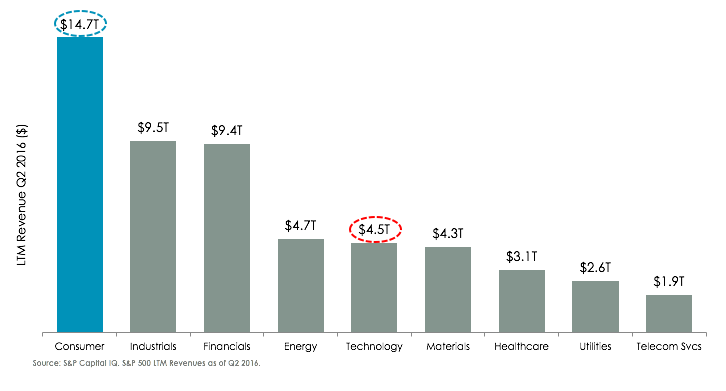
Indeed, at $1.47 trillion, the consumer packaged goods industry dwarfs technology as a share of the nation’s economy.

As Ryan Caldbeck, the head of the consumer-focused investment firm CircleUp noted last year.

The uptick in tech VC dollars going to the CPG market is partly because tech investing is brutally competitive and saturated, and largely because these VCs are awakening to the strong historical returns in CPG, especially with the trend leaning towards small brands stealing market share.

Consumer is a massive market – about 3x the size of tech, as seen below.

Despite the size of the market, the early-stage has historically been underserved by investors due to market inefficiencies like the geographic dispersion of brands and a lack of structured information sources (i.e. there is no Silicon Valley for consumer, and certainly no Crunchbase equivalents – yet).

Strong exits are already possible for consumer brands — and not necessarily from the big ticket, headline grabbing acquisitions like Dollar Shave Club. Last week This is L — the condom and period product retailer — sold for roughly $100 million after raising seed funding from investors including 500 Startups and Y Combinator.

Taali was similarly bootstrapped before it was accepted into Y Combinator . The company is already selling its snacks through Amazon and in retail locations like Fairway in New York and Central Market in Texas. The founders expect to be in stores in California in the next few months.

11 Feb 2019

Daily Crunch: SoftBank bets big on autonomous delivery

The Daily Crunch is TechCrunch’s roundup of our biggest and most important stories. If you’d like to get this delivered to your inbox every day at around 9am Pacific, you can subscribe here:

1. SoftBank’s next bet: $940M into autonomous delivery startup Nuro

Nuro has raised $940 million in financing from the SoftBank Vision Fund, a whopping amount that will be used to expand its delivery service, add new partners, hire employees and scale up its fleet of self-driving bots.

The autonomous delivery startup’s focus has been developing a self-driving stack and combining it with a custom unmanned vehicle designed for last-mile delivery of local goods and services. The vehicle has two compartments that can fit up to six grocery bags each.

2. Trump’s planned AI initiative includes education, but lacks key details

This weekend, the Trump administration shed more light on the “American A.I. Initiative,” a plan the president is set to sign today, in hopes of helping keep the U.S. at the forefront of innovation.

3. What to expect from Mobile World Congress 2019

2019 just might be the year that smartphones get fun again.

Amazon's Jeff Bezos Makes Surprise Visit To Employee Veterans Day Event

LONG BEACH, CA – NOVEMBER 12: Jeff Bezos, founder and CEO of Amazon, speaks to a group of Amazon employees that are veterans during an Amazon Veterans Day celebration. (Photo by Leonard Ortiz/Digital First Media/Orange County Register via Getty Images)

4. Saudi Arabia denies involvement in leak of Jeff Bezos’ private messages

In his extraordinary Medium post last week accusing American Media Inc. of “extortion and blackmail,” Jeff Bezos hinted that there may be a connection between Saudi Arabia and the publication of his personal messages with Lauren Sanchez. Now Saudi Minister of State for Foreign Affairs Adel al-Jubeir has denied it was involved.

5. Dating apps face questions over age checks after report exposes child abuse

The U.K. government has said it could legislate to require age verification checks on users of dating apps, following an investigation into underage use of dating apps published by the Sunday Times this weekend.

6. Apple partners with VA to bring Health Records to veterans

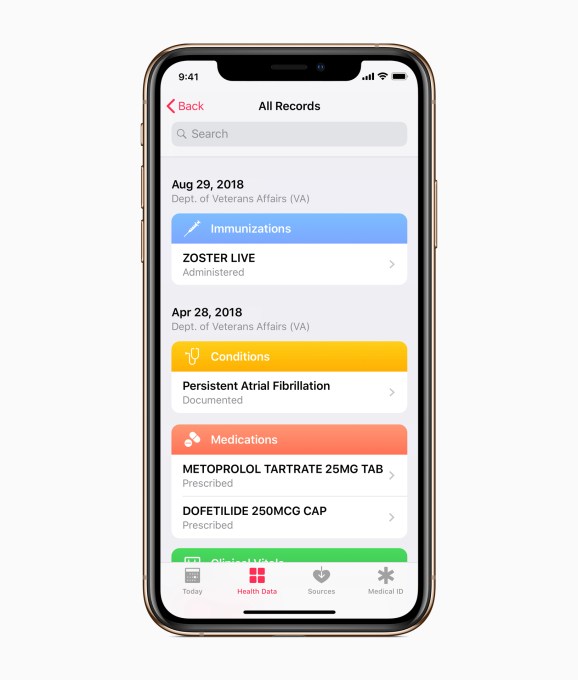
The deal will allow the veterans to view their medical information across participating institutions, including the VA, organized in the Apple Health app. These health records include allergies, conditions, immunizations, lab results, medications, procedures and vitals, and will be displayed alongside other information, like Apple Watch data.

7. Monday podcast roundup

This week, Equity discussed Spotify’s big move into podcasts, Mixtape looked at Instacart’s tipping controversy and Original Content reviewed the (terrible) Netflix movie “Velvet Buzzsaw.”

11 Feb 2019

Marketing company Zeta Global hires Ben Hayes as its first chief privacy officer

Zeta Global, the well-funded marketing technology company founded by CEO David A. Steinberg and former Apple CEO John Sculley, has hired its first chief privacy officer — Ben Hayes, who was previously chief privacy officer at Nielsen.

Steinberg said the company already has a “global privacy team” and has been taking the issue “very seriously.” However, he said that by hiring Hayes, he’s hoping to make Zeta a “global thought leader.”

“We want to send a message to the world that the end users that hit our platform are important to us, your privacy is important to us,” he said. And he noted, “When we sit down with our customers — and these are very, very large customers — the first two things they always want to talk about are data security and data privacy.”

For his part, Hayes said Zeta is “poised to deliver a unique value to the marketplace and, in my estimation, disrupt multiple industries in so doing.” He also said he was impressed by Zeta’s approach to protecting user data, specifically the fact that “it’s not a data broker.” In other words, even though it helps marketers target customers based on user data, it’s not selling that data to others.

I wondered whether that distinction might get lost in the broader backlash against the way online companies vacuum up personal data, but Hayes said, “I believe that paranoia grows in the shadows and the privacy backlash is largely about people feeling a loss of control over their data.”

“Explaining the value proposition to users is crucially important,” he added. “People are rational. If they understand it to be a net benefit to themselves they will like that thing.”

11 Feb 2019

Reddit confirms $300M Series D led by China’s Tencent at $3B value

Last week TechCrunch reported that Reddit was raising $150 million from Chinese tech giant Tencent and up to $150 million more in a Series D that would value the company at $2.7 billion pre-money or $3 billion post-money. After no-commenting on our scoop, today Reddit confirmed it’s raised $300 million at $3 billion post-money, with $150 million from Tencent.

The deal makes for an odd pairing between one of the architects of China’s Great Firewall of censorship and one of America’s most lawless free-speech forums. Some Redditors are already protesting the funding by trying to post content that would rile Chinese’s internet watchdogs, like imagery from Tiananmen Square and Winnie The Pooh memes mocking Chinese President Xi Jinping’s appearance.

The round brings the Conde Nast-majority owned Reddit to $550 million in total funding. Beyond Tencent, the rest of the round came from previous investors potentially including Andreessen Horowitz, Sequoia, and Fidelity. Apparently frustrated that we had disrupted its PR plan, Reddit today handed confirmation of the round to CNBC which re-reported our scoop without citation. [Update: CNBC eventually updated its article to credit TechCrunch.]

Reddit’s CEO Steve Huffman has had his own problems with attribution after the exec was caught editing users’ comments to mislead viewers into thinking they were insulting their Subreddit’s moderators. Huffman managed to get off with just an apology and vow not to do it again, though he seemed to laugh off and excuse the abuse of power by saying “I spent my formative years as a young troll on the Internet.”

Reddit will have to compete for ad dollars with the Google-Facebook duopoly despite having less information about its users, who are often anonymous. Reddit sees 330 million users per month across its Subreddit forums for discussing everything from news and entertainment to niche types of pornography, conspiracy theories, and other highly brand-unsafe content. Meanwhile, users may be concerned that Reddit’s policy views could be tightened as it cosies up to Tencent.

Reddit has struggled with staff departures and user revolts over the years as it tries to balance freedom of expression with civility. The hope is the cash could help it pay for experienced leaders and more moderation staff to maintain that balance. But without proper oversight, the cash could simply scale up Reddit and its problems along with it.

11 Feb 2019

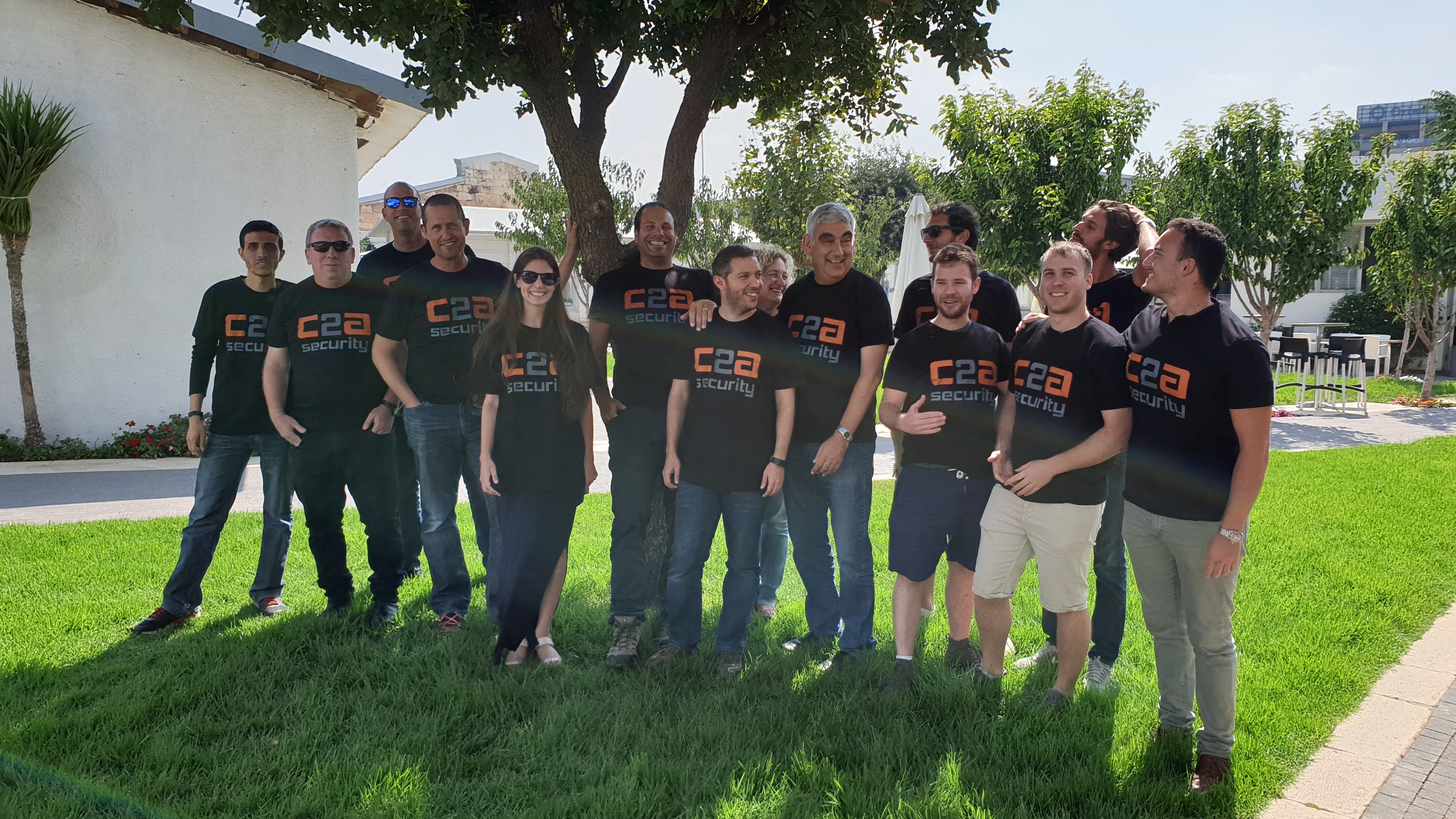
C2A raises $6.5M for its in-car cybersecurity platform

Cars are now essentially computers on wheels — and like every computer, they are susceptible to attacks. It’s no surprise then that there’s a growing number of startups that are working to protect a car’s internal systems from these hacks, especially given that the market for automotive cybersecurity could be worth over $900 billion by 2026.

One of these companies is Israel’s C2A Security, which offers an end-to-end security platform for vehicles, which today announced that it has raised a $6.5 million Series A funding round.

The round was led by Maniv Mobility, which previously invested in companies like Hailo, drive.ai and Turo, and ICV, which has invested in companies like Freightos and Vayyar. OurCrowd’s Labs/02 also participated in this round.

Like most companies at the Series A stage, C2A plans to use the new funding to grow its team, especially on the R&D side, and help support its customer base. Sadly, C2A does not currently talk about who its customers are.

The promise of C2A is that it offers a full suite of solutions to detect and mitigate attacks. The team behind the company has an impressive security pedigree, with the company’s CMO Nat Meron being an alumn of Israel’s Unit 8200 intelligence unit, for example. C2A founder and CEO Michael Dick previously co-founded NDS, a content security solution, which Cisco acquired for around $5 billion in 2012 (and then recently sold on to Permira, also for $5 billion).

“We are extremely proud to receive the support of such outstanding investors, who will bring tremendous value to the company,” said Dick. “Maniv’s expertise in autotech and strong network across the industry coupled with ICV’s rich experience in cybersecurity brings the perfect combination of skills to the table.”

11 Feb 2019

New figures highlight the iPhone’s rough quarter in China

When Apple issued revised guidance for its quarterly earnings last month, the company singled out China as a primary driver for its disappointing result. Sure enough, iPhone revenue declined 15 percent year over year, and now IDC’s got some more insight into the role the Chinese market may have played in that decline.

New figures out this week show right around a 20 percent dip in shipments in China y-o-y for the quarter. That’s a pretty dramatic drop for a market that’s been a key factor in Apple’s growth plans, going forward. That marks a drop from 12.9 to 11.5 percent of the market. Last month Tim Cook highlighted some of the reasons for the drop in the world’s largest smartphone market.

Among the reasons cited are international trade tensions and an overall slowing Chinese economy. Of course, Apple’s not alone in seeing a decline. Smartphone shipments are down almost across the board, owing to slower upgrade cycles. Most phones are already pretty good, so people are holding onto them for longer. It’s also worth noting that this year’s XS didn’t mark as dramatic an upgrade as its predecessor. 

Tellingly, however, a number of native smartphone makers are up in the country, including, notably, Huawei, which saw a 23.3 percent uptick for the quarter, suggesting that the ascendent company ate into Apple’s market share.

11 Feb 2019

Google Docs gets an API for task automation

Google today announced the general availability of a new API for Google Docs that will allow developers to automate many of the tasks that users typically do manually in the company’s online office suite. The API has been in developer preview since last April’s Google Cloud Next 2018 and is now available to all developers.

As Google notes, the REST API was designed to help developers build workflow automation services for their users, build content management services and create documents in bulk. Using the API, developers can also set up processes that manipulate documents after the fact to update them and the API also features the ability to insert, delete, move, merge and format text, insert inline images and work with lists, among other things.

The canonical use case here is invoicing, where you need to regularly create similar documents with ever-changing order numbers and line items based on information from third-party systems (or maybe even just a Google Sheet). Google also notes that the API’s import/export abilities allow you to use Docs for internal content management systems.

Some of the companies that built solutions based on the new API during the preview period include Zapier, Netflix, Mailchimp and Final Draft. Zapier integrated the Docs API into its own workflow automation tool to help its users create offer letters based on a template, for example, while Netflix used it to build an internal tool that helps its engineers gather data and automate its documentation workflow.


11 Feb 2019

Apple partners with VA to bring Health Records to veterans

Apple announced this morning it has partnered with the U.S. Department of Veterans Affairs (VA) to make the Health Records feature on iPhones available to veterans. The deal will allow the veterans to view their medical information across participating institutions, including the VA, organized in the Apple Health app.

These health records include allergies, conditions, immunizations, lab results, medications, procedures and vitals, and will be displayed alongside other information, like Apple Watch data. This gives VA patients a more comprehensive view of their medical history and health data, Apple says.

The medical information is also secured through encryption and protected by the iPhone user’s passcode, Touch ID or Face ID.

Apple was reported to be in discussions with the Department of Veterans Affairs about this deal back in November of last year. At the time, it was said that in addition to the health record integration on iPhones, Apple would provide engineering support to the agency.

The partnership is a big win Apple, as it provides the iPhone maker a means of reaching the over 9 million veterans currently enrolled in the VA’s system across its 1,243 facilities. It also represents another success by the company in terms of getting health care institutions to support its health records feature on iPhone. Today, that list includes a growing number of hospitals and clinics, across the U.S.

The Health Records feature on the iPhone will be the first record-sharing platform like this available the VA, Apple also noted,

“We have great admiration for veterans, and we’re proud to bring a solution like Health Records on iPhone to the veteran community,” said Tim Cook, Apple CEO, in an announcement about the new partnership. “It’s truly an honor to contribute to the improved healthcare of America’s heroes.”

“When patients have better access to their health information, they have more productive conversations with their physicians,” added Jeff Williams, Apple’s COO. “By bringing Health Records on iPhone to VA patients, we hope veterans will experience improved healthcare that will enhance their lives.”

A number of tech companies over the years have tried to offer platforms for centralizing health records, but have faced challenges because of the fragmentation across the industry as well as other technical hurdles. Google Health, for example, closed down in 2011 after failing to gain traction. To combat these issues, Apple has been putting together individual deals with various institutions to get them to support the Health app’s health records feature, following its January 2018 launch. However, the partnership with the VA is one of Apple’s most significant deals to date.

Apple is not the only major tech company today involved in the healthcare space.

Despite past failures with Google Health, Google parent Alphabet has current investments in life sciences (Verily) and anti-aging (Calico). It also recently hired a prominent hospital-system chief executive, David Feinberg, to oversee Google’s larger healthcare efforts. Amazon, meanwhile, last year teamed with JPMorgan Chase and Berkshire Hathaway to create a new healthcare company, and acquired online pharmacy PillPack for $753 million. And Microsoft develops software aimed at healthcare organizations powered by Microsoft 365 and Azure. It also runs a competing health records solution, called HealthVault.

11 Feb 2019

Facebook urged to offer an API for political ad transparency research

Facebook has been called upon to provide good faith researchers with an API to enable them to study how political ads are spreading and being amplified on its platform.

A coalition of European academics, technologists and human and digital rights groups, led by Mozilla, has signed an open letter to the company demanding far greater transparency about how Facebook’s platform distributes and amplifies political ads ahead of elections to the European parliament which will take place in May.

We’ve reached out to Facebook for a reaction to the open letter.

The company had already announced it will launch some of its self-styled ‘election security’ measures in the EU before then — specifically an authorization and transparency system for political ads.

Last month its new global comms guy — former European politician and one time UK deputy prime minister, Nick Clegg — also announced that, from next month, it will have human-staffed operations centers up and running to monitor how localised political news gets distributed on its platform, with one of the centers located within the EU, in Dublin, Ireland.

But signatories to the letter argue the company’s heavily PR’ed political ad transparency measures don’t go far enough.

They also point out that some of the steps Facebook has taken have blocked independent efforts to monitor its political ad transparency claims.

Last month the Guardian reported on changes Facebook had made to its platform that restricted the ability of an external political transparency campaign group, called WhoTargetsMe, to monitor and track the flow of political ads on its platform.

The UK-based campaign group is one of more than 30 groups that have signed the open letter — calling for Facebook to stop what they couch as “harassment of good faith researchers who are building tools to provide greater transparency into the advertising on your platform”.

Other signatories include the Center for Democracy and Technology, the Open Data Institute and Reporters Without Borders.

“By restricting access to advertising transparency tools available to Facebook users, you are undermining transparencyeliminating the choice of your users to install tools that help them analyse political ads, and wielding control over good faith researchers who try to review data on the platform,” they write.

“Your alternative to these third party tools provides simple keyword search functionality and does not provide the level of data access necessary for meaningful transparency.”

The letter calls on Facebook to roll out “a functional, open Ad Archive API that enables advanced research and development of tools that analyse political ads served to Facebook users in the EU” — and do so by April 1, to enable external developers to have enough time to build transparency tools before the EU elections.

Signatories also urge the company to ensure that all political ads are “clearly distinguished from other content”, as well as being accompanied by “key targeting criteria such as sponsor identity and amount spent on the platform in all EU countries”.

Last year UK policymakers investigating the democratic impacts of online disinformation pressed Facebook on the issue of what the information it provides users about the targeting criteria for political ads. They also asked the company why it doesn’t offer users a complete opt-out from receiving political ads. Facebook’s CTO Mike Schroepfer was unable — or unwilling — to provide clear answers, instead choosing to deflect questions by reiterating the tidbits of data that Facebook has decided it will provide.

Close to a year later and Facebook users in the majority of European markets are still waiting for even a basic layer of political transparency, as the company has been allowed to continue self regulating at its own pace and — crucially — by getting to define what ‘transparency’ means (and therefore how much of the stuff users get).

Facebook launched some of these self-styled political ad transparency measures in the UK last fall — adding ‘paid for by’ disclaimers, and saying ads would be retained in an archive for seven years. (Though its verification checks had to be revised after they were quickly shown to be trivially easy to circumvent.)

Earlier in the year it also briefly suspended accepting ads paid for by foreign entities during a referendum on abortion in Ireland.

However other European elections — such as regional elections — have taken place without Facebook users getting access to any information about the political ads they’re seeing or who’s paying for them.

The EU’s executive body has its eye on the issue. Late last month the European Commission published the first batch of monthly ‘progress reports’ from platforms and ad companies that signed up to a voluntary code of conduct on political disinformation that was announced last December — saying all signatories need to do a lot more and fast.

On Facebook specifically, the Commission said it needs to provide “greater clarity” on how it will deploy consumer empowerment tools, and also boost its cooperation with fact-checkers and the research community across the whole EU — with commissioner Julian King singling the company out for failing to provide independent researchers with access to its data.

Today’s open letter from academics and researchers backs up the Commission’s assessment of feeble first efforts from Facebook and offers further fuel to feed its next monthly assessment.

The Commission has continued to warn it could legislate on the issue if platforms fail to step up their efforts to tackle political disinformation voluntarily.

Pressuring platforms to self-regulate has its own critics too, of course — who point out that it does nothing to tackle the core underlying problem of platforms having too much power in the first place…