Author: azeeadmin

11 Feb 2019

Two former Qualcomm engineers are using AI to fix China’s healthcare problem

Artificial intelligence is widely heralded as something that could disrupt the jobs market across the board — potentially eating into careers as varied as accountants, advertising agents, reporters and more — but there are some industries in dire need of assistance where AI could make a wholly positive impact, a core one being healthcare.

Despite being the world’s second-largest economy, China is still coping with a serious shortage of medical resources. In 2015, the country had 1.8 physicians per 1,000 citizens, according to data compiled by the Organization for Economic Cooperation and Development. That figure puts China behind the U.S. at 2.6 and was well below the OECD average of 3.4.

The undersupply means a nation of overworked doctors who constantly struggle to finish screening patient scans. Misdiagnoses inevitably follow. Spotting the demand, forward-thinking engineers and healthcare professionals move to get deep learning into analyzing medical images. Research firm IDC estimates that the market for AI-aided medical diagnosis and treatment in China crossed 183 million yuan ($27 million) in 2017 and is expected to reach 5.88 billion yuan ($870 million) by 2022.

One up-and-comer in the sector is 12 Sigma, a San Diego-based startup founded by two former Qualcomm engineers with research teams in China. The company is competing against Yitu, Infervision and a handful of other well-funded Chinese startups that help doctors detect cancerous cells from medical scans. Between January and May last year alone, more than 10 Chinese companies with such a focus scored fundings of over 10 million yuan ($1.48 million), according to startup data provider Iyiou. 12 Sigma itself racked up a 200 million yuan Series B round at the end of 2017 and is mulling a new funding round as it looks to ramp up its sales team and develop new products, the company told TechCrunch.

“2015 to artificial intelligence is like 1995 to the Internet. It was the dawn of a revolution,” recalled Zhong Xin, who quit his management role at Qualcomm and went on to launch 12 Sigma in 2015. At the time, AI was cereping into virtually all facets of life, from public security, autonomous driving, agriculture, education to finance. Zhong took a bet on health care.

“For most industries, the AI technology might be available, but there isn’t really a pressing problem to solve. You are creating new demand there. But with healthcare, there is a clear problem, that is, how to more efficiently spot diseases from a single image,” the chief executive added.

An engineer named Gao Dashan who had worked closely with Zhong at Qualcomm’s U.S. office on computer vision and deep learning soon joined as the startup’s technology head. The pair both attended China’s prestigious Tsinghua University, another experience that boosted their sense of camaraderie.

Aside from the potential financial rewards, the founders also felt an urge to start something on their own as they entered their 40s. “We were too young to join the Internet boom. If we don’t create something now for the AI era, it will be too late for us to be entrepreneurs,” admitted Zhong who, with age, also started to recognize the vulnerability of life. “We see friends and relatives with cancers get diagnosed too late and end up  The more I see this happen, the more strongly I feel about getting involved in healthcare to give back to society.”

A three-tier playbook

12 Sigma and its peers may be powering ahead with their advanced imaging algorithms, but the real challenge is how to get China’s tangled mix of healthcare facilities to pay for novel technologies. Infervision, which TechCrunch wrote about earlier, stations programmers and sales teams at hospitals to mingle with doctors and learn their needs. 12 Sigma deploys the same on-the-ground strategy to crack the intricate network.
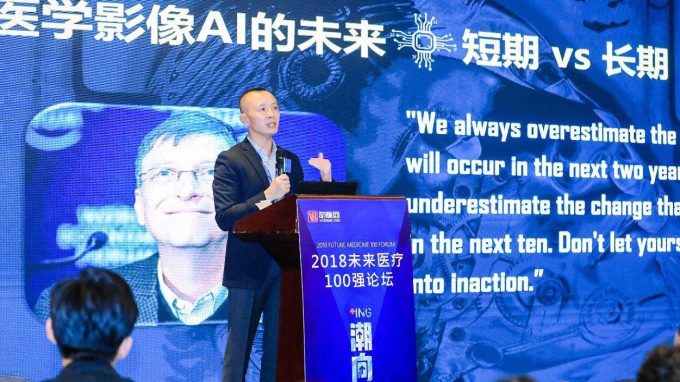
12 sigma

Zhong Xin, Co-founder and CEO of 12 Sigma / Photo source: 12 Sigma

“Social dynamics vary from region to region. We have to build trust with local doctors. That’s why we recruit sales persons locally. That’s the foundation. Then we begin by tackling the tertiary hospitals. If we manage to enter these hospitals,” said Zhong, referring to the top public hospitals in China’s three-tier medical system. “Those partnerships will boost our brand and give us greater bargaining power to go after the smaller ones.”

For that reason, the tertiary hospitals are crowded with earnest startups like 12 Sigma as well as tech giants like Tencent, which has a dedicated medical imaging unit called Miying. None of these providers is charging the top boys for using their image processors because “they could easily switch over to another brand,” suggested Gao.

Instead, 12 Sigma has its eyes on the second-tier hospitals. As of last April, China had about 30,000 hospitals, out of which 2,427 were rated tertiary, according to a survey done by the National Health and Family Planning Commission. The second tier, serving a wider base in medium-sized cities, had a network of 8,529 hospitals. 12 Sigma believes these facilities are where it could achieve most of its sales by selling device kits and charging maintenance fees in the future.

The bottom tier had 10,135 primary hospitals, which tend to concentrate in small towns and lack the financial capacity to pay the one-off device fees. As such, 12 Sigma plans to monetize these regions with a pay-per-use model.

So far, the medical imaging startup has about 200 hospitals across China testing its devices — for free. It’s sold only 10 machines, generating several millions of yuan in revenue, while very few of its rivals have achieved any sales at all according to Gao. At this stage, the key is to glean enough data so the startup’s algorithms get good enough to convince hospital administrators the machines are worth the investment. The company is targeting 100 million yuan ($14.8 million) in sales for 2019 and aims to break even by 2020.

China’s relatively lax data protection policy means entrepreneurs have easier access to patient scans compared to their peers in the west. Working with American hospitals has proven “very difficult” due to the country’s privacy protection policies, said Gao. They also come with a different motive. While China seeks help from AI to solve its doctor shortage, American hospitals place a larger focus on AI’s economic returns.

“The healthcare system in the U.S. is much more market-driven. Though doctors could be more conservative about applying AI than those in China, as soon as we prove that our devices can boost profitability, reduce misdiagnoses and lower insurance expenditures, health companies are keen to give it a try,” said Gao.

11 Feb 2019

Xiaomi-backed electric toothbrush Soocas raises $30 million Series C

China’s Soocas continues to jostle with global toothbrush giants as it raises 200 million yuan ($30 million) in a series C funding round. The Shenzhen-based oral care manufacturer has secured the new capital from lead investor Vision Knight Capital, with Kinzon Capital, Greenwoods Investment, Yunmu Capital and Cathay Capital also participating in the round.

The new proceeds arrived less than a year after Soocas, one of Xiaomi’s home appliance portfolio startups, snapped up close to 100 million yuan in a Series B round last March. Best known for its budget smartphones, Xiaomi has a grand plan to construct an Internet of Things empire that encompasses smart TVs to electric toothbrushes, and it has been gearing up by shelling out strategic investments for consumer goods makers such as Soocas.

Founded in 2015, Soocas’s rise reflects a growing demand for personal care accessories as people’s disposable income increases. Electric toothbrushes are a relatively new concept to most Chinese consumers but the category is picking up steam fast. According to data compiled by Alibaba’s advertising service Alimama, gross merchandise volume sales of electric toothbrushes grew 97 percent between 2015 and 2017. Multinational brands still dominate the oral care space in China, with Procter & Gamble, Colgate and Hawley & Hazel Chemical occupying the top three spots as of 2017, a report from Euromonitor International shows, but local players are rapidly catching up.

Soocas faces some serious competition from its Chinese peers Usmile and Roaman. Like Soocas, the two rivals have also placed their offices in southern China for proximity to the region’s robust supply chain resources. Part of Soocas’s strength comes from its tie-up with Xiaomi, which gives its portfolio companies access to a massive online and offline distribution network worldwide. That comes at a cost, however, as Xiaomi is known to impose razor-thin margins on the companies it backs and controls.

According to a statement from Soocas’s founder Meng Fandi, the company has achieved profitability since its launch and has seen its margin increase over the years. It plans to spend its fresh proceeds on marketing in a race to lure China’s increasingly sophisticated young consumers with toothbrushes and its new lines of hair dryers, nasal trimmers and other tools that make you squeaky-clean.

11 Feb 2019

Saudi Arabia denies involvement in leak of Jeff Bezos’ private messages

In his extraordinary Medium post last week accusing American Media Inc of “extortion and blackmail,” Bezos hinted (but did not explicitly state) that there may be a connection between Saudi Arabia and the publication of his personal messages with Lauren Sanchez. Now Saudi Arabia’s minister of foreign affairs has denied it was involved, stating during an interview with CBS’ “Face the Nation” that the Saudi government had “nothing to do with it.”

Last month, the National Enquirer published a series of texts between Bezos, who is separated from wife MacKenzie Bezos, and Sanchez. In his post last Thursday, Bezos claimed AMI, the owner of the National Enquirer, threatened to release messages that included intimate photos unless he cancelled an investigation into the source of the leaks and stopped claiming AMI was “politically motivated or influenced by political forces.” Bezos wrote that “the Saudi angle seems to hit a particularly sensitive nerve with” AMI CEO David Pecker, a close associate of President Donald Trump.

(The Daily Beast reported earlier today that Lauren Sanchez’s brother Michael Sanchez was the original source of the messages. Michael Sanchez is a close friend of Trump adviser Roger Stone.)

During his interview with “Face the Nation,” al-Jubeir said “This sounds to me like a soap opera. I’ve been watching it on television and reading about it in the paper. This is something between the two parties. We have nothing to do with it.”

Bezos did not directly accuse Saudi Arabia of being involved in the leaks, but he did note the web of connections between AMI, Pecker, Trump and Saudi Arabia. Bezos owns the Washington Post, which has reported extensively on the connection between crown prince Mohammed bin Salman and Jamal Khashoggi’s murder. Khashoggi was a Saudi Arabian dissident who wrote opinion pieces critical of bin Salman for the Post before he was killed in October. Though the Central Intelligence Agency concluded that bin Salman ordered the killing, Trump has repeatedly downplayed or disputed the crown prince’s involvement.

“Here’s a piece of context: My ownership of the Washington Post is a complexifier for me. It’s unavoidable that certain powerful people who experience Washington Post news coverage will wrongly conclude I am their enemy,” Bezos wrote. “President Trump is one of those people, obvious by his many tweets. Also, The Post’s essential and unrelenting coverage of the murder of its columnist Jamal Khashoggi is undoubtedly unpopular in certain circles.”

He added “Several days ago, an AMI leader advised us that Mr. Pecker is ‘apoplectic’ about our investigation. For reasons still to be better understood, the Saudi angle seems to hit a particularly sensitive nerve.”

AMI reached an immunity deal with the Department of Justice in December over a hush money payment to Karen McDougal, who claimed she had an affair with Trump. If Bezos’ accusations of blackmail and extortion are true, its deal could be jeopardized.

Pecker’s lawyer Elkan Abramowitz told ABC’s “This Week” on Sunday, before the Daily Beast named Michael Sanchez as the National Enquirer’s source, that “it is absolutely not extortion and blackmail. The story was given to the National Enquirer by a reliable source that had been giving information to the National Enquirer for seven years prior to this story. It was a source that was well-known to both Mr. Bezos and Miss Sanchez.”

11 Feb 2019

Aurora cofounder and CEO Chris Urmson on the company’s new investor, Amazon, and much more

You might not think of self-driving technologies and politics having much in common, but at least in one way, they overlap meaningfully: yesterday’s enemy can be tomorrow’s ally.

Such was the message we gleaned Thursday night, at a small industry event in San Francisco, where we had the chance to sit down with Chris Urmson, the cofounder and CEO of Aurora, a company that (among many others) is trying to transform how both people and goods are moved.

It was a big day for Urmson. Earlier the same day, his two-year-old company announced a whopping $530 million in Series B funding, a round that was led by top firm Sequoia Capital and that included “significant investment” from T. Rowe Price and Amazon.

The round for Aurora — which is building what it calls a “driver” technology that it expects to eventually integrate into cars built by Volkswagen, Hyundai, and China’s Byten, among others —  is highly notable, even in a sea of giant fundings. Not only does it represent Sequoia’s first biggest bet yet on any kind of self-driving technology, it’s also an “incredible endorsement” from T. Rowe Price, said Urmson Thursday night, suggesting it shows the outfit “thinks long term and strategically [that] we’re the independent option to self-driving cars.”

Yet perhaps the most interesting facet to the round is that it includes Amazon, one of the world’s most valuable companies, which could lead to variety of scenarios down the road, from Aurora powering delivery fleets overseen by Amazon, to being acquired outright by the company. Amazon has already begun marketing more aggressively to global car companies and and Tier 1 suppliers that are focused on building connected products, saying its AWS platform can help them speed their pace of innovation and lower their cost structures. In November, it also debuted a global, autonomous racing league for 1/18th scale, radio-controlled, self-driving four-wheeled race cars that are designed to help developers learn about reinforcement learning, a type of machine learning. Imagine what it could learn from Aurora.

Indeed, at the event, Urmson said that as Aurora had “constructed our funding round, [we were] very much thinking strategically about how to be successful in our mission of building a driver and one thing that a driver can do is move people, but it can also move goods, and it’s harder to think of a company where moving goods is more important than Amazon.” Calling Amazon “incredibly technically savvy,” to boot, he said that “having the opportunity to have them partner with us in this funding round, and [talk about] what we might build in the future is awesome.”

Aurora’s site also now features language about “transforming the way people and goods move.”

The interest of Amazon, T. Rowe, Sequoia and Aurora’s other backers isn’t surprising. Urmson was the formal technical lead of Google’s self-driving car program (now Waymo). One of his cofounders, Drew Bagnell, is a machine learning expert who still teaches at Carnegie Mellon and was formerly the head of Uber’s autonomy and perception team. His third cofounder is Sterling Anderson, the former program manager of Tesla’s Autopilot team.

Aurora’s big news seemingly spooked Tesla investors, in fact, with shares in the electric car maker drooping as a media outlets reported on the details. The development seems like just the type of possibility that had Tesla CEO Elon Musk unsettled when Aurora got off the ground a couple of years ago, and Tesla almost immediately filed a lawsuit against it, accusing Urmson and Andersonn of trying poach at least a dozen Tesla engineers and accusing Anderson of taking confidential information and destroying the  evidence “in an effort to cover his tracks.”

That suit was dropped two and a half weeks later in a settlement that saw Aurora pay $100,000. Anderson said at the time the amount was meant to cover the cost of an independent auditor to scour Aurora’s systems for confidential Tesla information. Urmson reiterated on Thursday night was purely an “economic decision,” meant to keep Aurora from getting further embroiled in an expansive spat.

But invited to talk about his relationship with Musk on Thursday, Urmson, who has previously called Tesla’s lawsuit “classy,” declined to take the bait, telling the audience instead that Aurora and Musk, “got off on the wrong foot.” Laughing a bit, he went on to lavish some praise on the self-driving technology that lives inside Tesla cars, adding that “if there’s an opportunity to work them in the future, that’d be great.”

Aurora, which is also competing for now against the likes of Uber, also sees Uber as a potential partner down the line, said Urmson. Asked about the company’s costly self-driving efforts, whose scale has been drastically downsized in the eleven months since one of its vehicles struck and killed a pedestrian in Tempe, Arizona, Urmson noted again that Aurora is “in the business of delivering the driver, and Uber needs a lot of drivers, so we think it would be wonder to partner with them, to partner with Lyft, to partner [with companies with similar ambitions] globally. We see those companies as partners in the future.” (He’d added that there’s “nothing to talk about right now.”)

Before Thursday’s event, Aurora had sent us some more detailed information about the four divisions that currently employ the 200 people that make up the company, a number that will obviously expand with its new round, which it plans to use to grow its current talent, hire many people, and to expand the testing it’s doing, both on California roads and in Pittsburgh, where it also has a sizable presence.

We didn’t have a chance to run them during our conversation with Urmson, but we thought they were interesting and that you might think so, too.

Below is the “hub” of the Aurora Driver. This is the computer system that powers, coordinates and fuses signals from all of the vehicle’s sensors, executes the software and controls the vehicle. Aurora says it’s designing the Aurora Driver to seamlessly integrate with a wide variety of vehicle platforms from different makes, models and classes with the goal of delivering the benefits of its technology broadly.

Below, is a visual representation of Aurora’s perception system, which it says is able to understand complex urban environments where vehicles need to safely navigate amongst many moving objects including bicycles, scooters, pedestrians and cars.

It didn’t imagine it would at the outset, but Aurora is building its mapping system to ensure what it naturally calls the highest level of precision and scalability so that vehicles powered by the company can accurately understand where they are, and easily update the maps as the world changes. We asked Urmson if, when the tech is finally ready to go into cars, they will white label the technology or use Aurora’s brand as a selling point. He said the matter hasn’t been decided yet but seemed to suggest that Aurora is leaning in the latter direction. He also said the technology would be installed on the carmakers’ factory floors (with Aurora’s help).

One of the ways that Aurora says it’s able to efficiently develop a robust “driver” is to build its own simulation system. It uses its simulator to test its software with different scenarios that vehicles encounter on the road, which it says enables repeatable testing that’s impossible to achieve by just driving more miles.

Aurora’s motion planning team works closely with the perception team to create a system that both detects the important objects on and around the road, and tries to accurately predict how they will move in the future. The ability to capture, understand and predict the motion of other objects is critical for building a technology that can navigate real world scenarios in dense urban environments and Urmson has said in the past that Aurora has crafted this workflow in a way that’s superior to competitors that send the technology back and forth. Specifically, he told The Atlantic last year: “The classic way you engineer a system like this is that you have a team working on perception. They go out and make it as good as they can and they get to a plateau and hand it off to the motion-planning people. And they write the thing that figures out where to stop or how to change a lane and it deals with all the noise that’s in the perception system because it’s not seeing the world perfectly. It has errors. Maybe it thinks it’s moving a little faster or slower than it is. Maybe every once in a while it generates a false positive. The motion-planning system has to respond to that.

“So the motion-planning people are lagging behind the perception people, but they get it all dialed in and it’s working well enough—as well as it can with that level of perception—and then the perception people say, ‘Oh, but we’ve got a new push [of code].’ Then the motion-planning people are behind the eight ball again, and their system is breaking when it shouldn’t.”

We also asked Urmson about Google, whose self-driving unit was renamed Waymo as it spun out from the Alphabet umbrella as its own company. He was highly diplomatic, saying only good things about the company and, when asked if they’d ever challenged him on anything since leaving, answering that they had not. Still, he told as, as he has said in previous interviews, that the biggest advantage that Aurora enjoys is that it was able to use the learnings of its three founders and to start from scratch, whereas the big companies from which they’ve each come cannot.

As he told TechCrunch in a separate interview last year in a question about how Aurora tests its technology, “There’s this really easy metric that everyone is using, which is number of miles driven, and it’s one of those things that was really convenient for me in my old place [Google] because we’re out there and we were doing a hell of a lot more than anybody else was at the time and so it was an easy number to talk about. What’s lost in that, though, is it’s not really the volume of the miles that you drive. It’s really about the quality of them.”

10 Feb 2019

Users complain of account hacks, but OkCupid denies a data breach

It’s bad enough that dating sites are a pit of exaggerations and inevitable disappointment, they’re also a hot target for hackers.

Dating sites aren’t considered the goldmine of personal information like banks or hospitals, but they’re still an intimate part of millions of people’s lives and have long been in the sights of hackers. If the hackers aren’t hitting the back-end database like with the AdultFriendFinder, Ashley Madison, and Zoosk breaches, the hackers are trying break in through the front door with leaked or guessed passwords.

That’s what appears to be happening with some OkCupid accounts.

A reader contacted TechCrunch after his account was hacked. The reader, who did not want to be named, said the hacker broke in and changed his password, locking him out of his account. Worse, they changed his email address on file, preventing him from resetting his password.

OkCupid didn’t send an email to confirm the address change — it just blindly accepted the change.

“Unfortunately, we’re not able to provide any details about accounts not connected to your email address,” said OkCupid’s customer service in response to his complaint, which he forwarded to TechCrunch. Then, the hacker started harassing him strange text messages from his phone number that was lifted from one of his private messages.

It wasn’t an isolated case. We found several cases of people saying their OkCupid account had been hacked.

Another user we spoke to eventually got his account back. “It was quite the battle,” he said. “It was two days of constant damage control until [OkCupid] finally reset the password for me.”

Other users we spoke to had better luck than others in getting their accounts back. One person didn’t bother, he said. Even disabled accounts can be re-enabled if a hacker logs in, some users found.

But several users couldn’t explain how their passwords — unique to OkCupid and not used on any other app or site — were inexplicably obtained.

“There has been no security breach at OkCupid,” said Natalie Sawyer, a spokesperson for OkCupid. “All websites constantly experience account takeover attempts. There has been no increase in account takeovers on OkCupid.”

Even on OkCupid’s own support pages, the company says that account takeovers often happen because someone has an account owner’s login information. “If you use the same password on several different sites or services, then your accounts on all of them have the potential to be taken over if one site has a security breach,” says the support page.

That’s describes credential stuffing, a technique of running a vast lists of usernames and passwords against a website to see if a combination lets the hacker in. The easiest, most effective way against credential stuffing is for the user to use a unique password on each site. For companies like OkCupid, the other effective blocker is by allowing users to switch on two-factor authentication.

When asked how OkCupid plans to prevent account hacks in the future, the spokesperson said the company had “no further comment.”

In fact, when we checked, OkCupid was just one of many major dating sites — like Match, PlentyOfFish, Zoosk, Badoo, JDate, and eHarmony — that didn’t use two-factor authentication at all.

As if dating wasn’t tough enough at the best of times, now you have to defend yourself from hackers, too.

10 Feb 2019

Original Content podcast: Netflix’s ‘Velvet Buzzsaw’ is lethally dull

Jake Gyllenhaal, Rene Russo and writer-director Dan Gilroy — who worked together on the creepy crime thriller “Nightcrawler” — have reunited for a new Netflix Original film, “Velvet Buzzsaw.”

While “Nightcrawler” wasn’t perfect, it was tense and unsettling, filled with eerily beautiful shots of nighttime L.A., plus a career-best performance from Gyllenhaal. It’s hard to believe that the same team was responsible for the muddled “Buzzsaw,” a film that tries to combine art-world satire and horror movies scares, ultimately failing on both counts.

The setup involves the death of a mysterious artist, leaving behind a trove of strangely compelling paintings. Soon, though, everyone involved in promoting or selling these paintings starts dying too.

On the latest episode of the Original Content podcast, we’re joined by Jon Shieber to try to understand what went wrong here. The movie isn’t particularly funny or scary — instead, we’re stuck with obvious jabs at the hypocrisy of the art world, interrupted by boring, unimaginative death scenes. And while Gyllenhaal is trying something in his portrayal of pompous art critic Morf Vandewalt, the results are more head-scratching than compelling.

This episode isn’t just one long pan, though. We also offer our (considerably more positive) impressions of the Netflix series “Russian Doll,” which stars co-creator Natasha Lyonne as a New Yorker who keeps dying and repeating the night of her 36th birthday. And we discuss Super Bowl streaming numbers and new details about Disney’s streaming service.

You can listen in the player below, subscribe using Apple Podcasts or find us in your podcast player of choice. If you like the show, please let us know by leaving a review on Apple. You also can send us feedback directly. (Or suggest shows and movies for us to review!)

10 Feb 2019

Companies raising supergiant VC aren’t getting any younger

This week, point-to-point “microtransit” service company Lime announced it raised $310 million in a Series D round, which valued the company at $2.4 billion, post-money. That is pretty impressive for a startup founded just a couple of years ago. Since 2017, Lime has raised more than $765 million in venture funding, which is due in part to the pretty daunting economics of the bike and scooter business. It takes a lot of capital to acquire and deploy that hardware.

Lime isn’t the only company to raise supergiant ($100 million or more) VC rounds right out of the gate. Despite the fact that supergiant venture capital rounds have recently become an almost everyday occurrence, the age at which companies close their first nine-figure funding deal hasn’t really changed over the past several years.

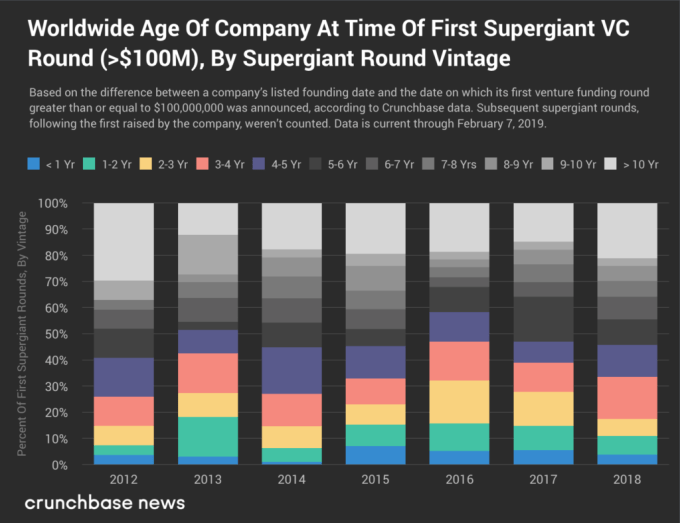
In the chart below, we plot the distribution of startups’ age at the time of their first supergiant venture round of $100 million or more. (The age of a company at any subsequent supergiant round was excluded.) In prior reporting, we found that supergiant deal volume began accelerating in 2013, which is why we chose that year to start. For reasons we’ll explain after the chart, it’s best to think of the numbers presented here as a very good estimation rather than a highly precise measurement. There are still lessons to learn though.

Note from the get-go that company ages were calculated by finding the number of days elapsed between their founded date listed in Crunchbase and the date on which the company’s first supergiant VC round was announced. It sometimes takes several weeks between when a deal is finalized and when it’s publicly announced (even in the case of these really big deals). We excluded companies with no listed founding date. Also note that the founding dates listed in Crunchbase are often not precise, so that introduces some fuzziness as well.

However, these caveats aside, there are some general trends to be found here. The mix of companies raising their first really big rounds hasn’t changed all that much over time. On average, a little less than half of supergiant rounds are raised by companies roughly five years old or younger. Some years, like 2016, had above-average representation of younger companies raising their first nine-figure deals. Perhaps coincidentally, 2016 was also a year where supergiant VC (and, indeed, venture activity in general) slowed slightly.

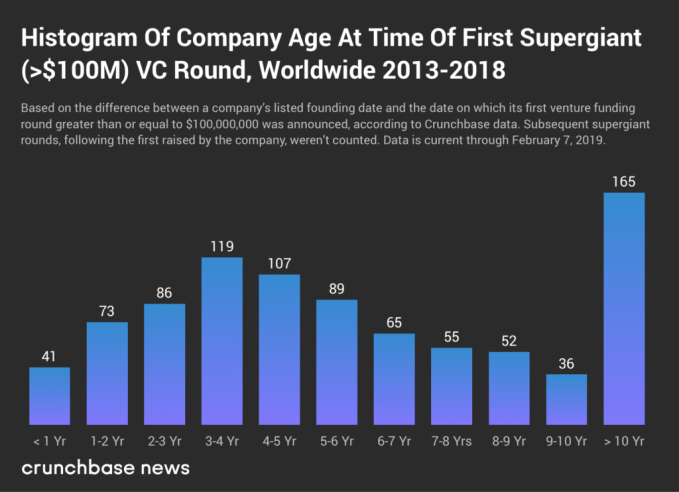
If a company is going to raise their first supergiant VC round (which, recall, are still exceedingly rare), a majority of companies do so within the first five or six years in business. Of nearly 888 first supergiant rounds (raised since 2013) we analyzed, the largest number were struck between years three and five. There is a long tail of companies that raise their first nine-figure deals more than a decade after being founded.

Generally, this isn’t too surprising. Most VC funds operate on a 10-year cycle, as do many startups. Many companies raise their first big rounds of funding within the first few years after launch. Some of these rounds are bigger than others, and that’s what’s reflected above.

In entrepreneurial finance, up-front costs matter. Founded in December 2016, Elon Musk’s tunnel-digging endeavor The Boring Company was a little less than 15 months old when it raised $113 million in venture funding in April of 2018. Tunnel boring machines aren’t cheap. The company aims to dig tunnels for the low, low price of $10 million per mile.

It’s not just Mr. Musk who can raise supergiant sums so speedily. Some sectors are more capital-intense than others, requiring some companies to seek large funding deals early, to bring a product or service to market. For example, a number of companies cropped up in the residential real estate space with the goal of streamlining the home-buying process. In practice, it means that the company acquires the home itself, before ultimately signing it over to the homeowner. Ribbon is one such venture. The fintech company was founded in September 2017 and raised $225 million in Series A funding a little over one year later, in late October 2018.

Most companies aren’t a good fit for VC funding. Of those that try to raise VC funding, most fail. Of those that do raise VC money, the surpassing majority of those deals are less than $100 million. To be clear: We’re talking about very rarified air here. But it helps to confirm another side of a trend we found earlier, through some trial and error. Startups aren’t really raising money any faster than they used to. There’s just more of them. And the rounds are bigger.

10 Feb 2019

Privacy is a commons

“The commons is the cultural and natural resources accessible to all members of a society,” quoth Wikipedia, “held in common, not owned privately.” We live in an era of surveillance capitalism in a symbiotic relationship with advertising technology, quoth me. And I put it to you that privacy is not just a virtue, or a value, or a commodity: it is a commons.

You may well wonder: isn’t privacy pretty much definitionally “owned privately”? What does it matter to you, or to me, much less to society as a whole, if some 13-year-old somewhere (and her legal guardians) decide to sell her privacy to Facebook for $20 a month? OK, maybe you think rootcerting a teenager is sketchy — but if an adult chooses to sell their privacy, isn’t that entirely their own business?

The answer is: no, actually, not necessarily; not if there are enough of them; not if the commodification of privacy begins to affect us all. Privacy is like voting. An individual’s privacy, like an individual’s vote, is usually largely irrelevant to anyone but themselves … but the accumulation of individual privacy or lack thereof, like the accumulation of individual votes, is enormously consequential.

As I’ve written before, “This accumulation of data is, in and of itself, not a “personal privacy” issue, but a massive public security problem. At least three problems, in fact.” Those are:

  1. The absence of privacy has a chilling effect on dissidence and individual thought. Private spaces are the experimental petri dishes for societies. No privacy means no experimentation with anything of which society disapproves, especially if it’s illegal. (Which, please note, in recent memory includes things like marijuana and homosexuality; there is a long, long history of “illegal today” becoming “acceptable tomorrow” as societies become less authoritarian.)
  2. If privacy becomes a commodity, one that only the rich afford, then the rich can and will use this information asymmetry threaten and persecute people who challenge the status quo, thereby perpetuating it.
  3. Accumulated private data can and probably will increasingly be used to manipulate public opinion on a massive scale. Sure, Cambridge Analytica were bullshit artists, but in the not-too-distant future, what they promised their clients could conceivably become reality. No less an authority than François Chollet has written “I’d like to raise awareness about what really worries me when it comes to AI: the highly effective, highly scalable manipulation of human behavior that AI enables, and its malicious use by corporations and governments.”

We may conclude that while individually, our privacy may usually be mostly meaningless, collectively, it is a critically important commons. Anything which eats away at our individual privacy, especially at scale, is a risk to that commons.

I’m not saying a single person selling rootcerted access to everything they do to Facebook for $20 a month is a major civic problem, or that it’s ethically wrong for them to do so. Selling their privacy may be a perfectly reasonable and justifiable individual decision, in the same way that letting one’s cow graze on Midsummer Common probably makes a lot of sense for both cow and owner.

What I am saying is that selling privacy cheaply isn’t any better for society than letting it be seized without any compensation. In fact, if privacy commoditization leads to a more rapid degradation of the commons, it’s actually worse. Similarly, again, individual votes are essentially never that important … but would you think it OK for a company to purchase citizens’ voting rights for $20 per person per month? If we need to defend privacy as a commons — and we do — then we can’t start thinking of it as an individual asset to be sold to surveillance capitalists. It, and we, are more important than that.

10 Feb 2019

Is Europe closing in on an antitrust fix for surveillance technologists?

The German Federal Cartel Office’s decision to order Facebook to change how it processes users’ personal data this week is a sign the antitrust tide could at last be turning against platform power.

One European Commission source we spoke to, who was commenting in a personal capacity, described it as “clearly pioneering” and “a big deal”, even without Facebook being fined a dime.

The FCO’s decision instead bans the social network from linking user data across different platforms it owns, unless it gains people’s consent (nor can it make use of its services contingent on such consent). Facebook is also prohibited from gathering and linking data on users from third party websites, such as via its tracking pixels and social plugins.

The order is not yet in force, and Facebook is appealing, but should it come into force the social network faces being de facto shrunk by having its platforms siloed at the data level.

To comply with the order Facebook would have to ask users to freely consent to being data-mined — which the company does not do at present.

Yes, Facebook could still manipulate the outcome it wants from users but doing so would open it to further challenge under EU data protection law, as its current approach to consent is already being challenged.

The EU’s updated privacy framework, GDPR, requires consent to be specific, informed and freely given. That standard supports challenges to Facebook’s (still fixed) entry ‘price’ to its social services. To play you still have to agree to hand over your personal data so it can sell your attention to advertisers. But legal experts contend that’s neither privacy by design nor default.

The only ‘alternative’ Facebook offers is to tell users they can delete their account. Not that doing so would stop the company from tracking you around the rest of the mainstream web anyway. Facebook’s tracking infrastructure is also embedded across the wider Internet so it profiles non-users too.

EU data protection regulators are still investigating a very large number of consent-related GDPR complaints.

But the German FCO, which said it liaised with privacy authorities during its investigation of Facebook’s data-gathering, has dubbed this type of behavior “exploitative abuse”, having also deemed the social service to hold a monopoly position in the German market.

So there are now two lines of legal attack — antitrust and privacy law — threatening Facebook (and indeed other adtech companies’) surveillance-based business model across Europe.

A year ago the German antitrust authority also announced a probe of the online advertising sector, responding to concerns about a lack of transparency in the market. Its work here is by no means done.

Data limits

The lack of a big flashy fine attached to the German FCO’s order against Facebook makes this week’s story less of a major headline than recent European Commission antitrust fines handed to Google — such as the record-breaking $5BN penalty issued last summer for anticompetitive behaviour linked to the Android mobile platform.

But the decision is arguably just as, if not more, significant, because of the structural remedies being ordered upon Facebook. These remedies have been likened to an internal break-up of the company — with enforced internal separation of its multiple platform products at the data level.

This of course runs counter to (ad) platform giants’ preferred trajectory, which has long been to tear modesty walls down; pool user data from multiple internal (and indeed external sources), in defiance of the notion of informed consent; and mine all that personal (and sensitive) stuff to build identity-linked profiles to train algorithms that predict (and, some contend, manipulate) individual behavior.

Because if you can predict what a person is going to do you can choose which advert to serve to increase the chance they’ll click. (Or as Mark Zuckerberg puts it: ‘Senator, we run ads.’)

This means that a regulatory intervention that interferes with an ad tech giant’s ability to pool and process personal data starts to look really interesting. Because a Facebook that can’t join data dots across its sprawling social empire — or indeed across the mainstream web — wouldn’t be such a massive giant in terms of data insights. And nor, therefore, surveillance oversight.

Each of its platforms would be forced to be a more discrete (and, well, discreet) kind of business.

Competing against data-siloed platforms with a common owner — instead of a single interlinked mega-surveillance-network — also starts to sound almost possible. It suggests a playing field that’s reset, if not entirely levelled.

(Whereas, in the case of Android, the European Commission did not order any specific remedies — allowing Google to come up with ‘fixes’ itself; and so to shape the most self-serving ‘fix’ it can think of.)

Meanwhile, just look at where Facebook is now aiming to get to: A technical unification of the backend of its different social products.

Such a merger would collapse even more walls and fully enmesh platforms that started life as entirely separate products before were folded into Facebook’s empire (also, let’s not forget, via surveillance-informed acquisitions).

Facebook’s plan to unify its products on a single backend platform looks very much like an attempt to throw up technical barriers to antitrust hammers. It’s at least harder to imagine breaking up a company if its multiple, separate products are merged onto one unified backend which functions to cross and combine data streams.

Set against Facebook’s sudden desire to technically unify its full-flush of dominant social networks (Facebook Messenger; Instagram; WhatsApp) is a rising drum-beat of calls for competition-based scrutiny of tech giants.

This has been building for years, as the market power — and even democracy-denting potential — of surveillance capitalism’s data giants has telescoped into view.

Calls to break up tech giants no longer carry a suggestive punch. Regulators are routinely asked whether it’s time. As the European Commission’s competition chief, Margrethe Vestager, was when she handed down Google’s latest massive antitrust fine last summer.

Her response then was that she wasn’t sure breaking Google up is the right answer — preferring to try remedies that might allow competitors to have a go, while also emphasizing the importance of legislating to ensure “transparency and fairness in the business to platform relationship”.

But it’s interesting that the idea of breaking up tech giants now plays so well as political theatre, suggesting that wildly successful consumer technology companies — which have long dined out on shiny convenience-based marketing claims, made ever so saccharine sweet via the lure of ‘free’ services — have lost a big chunk of their populist pull, dogged as they have been by so many scandals.

From terrorist content and hate speech, to election interference, child exploitation, bullying, abuse. There’s also the matter of how they arrange their tax affairs.

The public perception of tech giants has matured as the ‘costs’ of their ‘free’ services have scaled into view. The upstarts have also become the establishment. People see not a new generation of ‘cuddly capitalists’ but another bunch of multinationals; highly polished but remote money-making machines that take rather more than they give back to the societies they feed off.

Google’s trick of naming each Android iteration after a different sweet treat makes for an interesting parallel to the (also now shifting) public perceptions around sugar, following closer attention to health concerns. What does its sickly sweetness mask? And after the sugar tax, we now have politicians calling for a social media levy.

Just this week the deputy leader of the main opposition party in the UK called for setting up a standalone Internet regulatory with the power to break up tech monopolies.

Talking about breaking up well-oiled, wealth-concentration machines is being seen as a populist vote winner. And companies that political leaders used to flatter and seek out for PR opportunities find themselves treated as political punchbags; Called to attend awkward grilling by hard-grafting committees, or taken to vicious task verbally at the highest profile public podia. (Though some non-democratic heads of state are still keen to press tech giant flesh.)

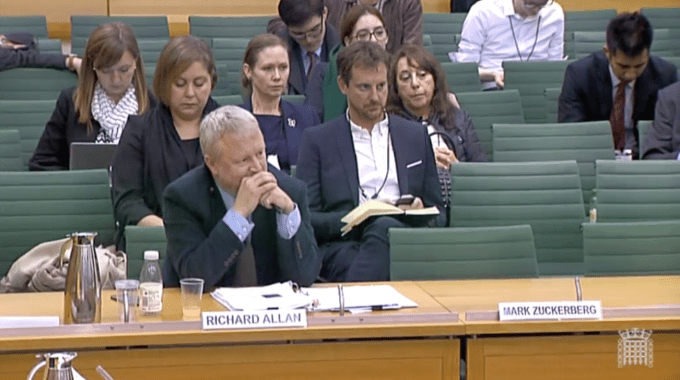
In Europe, Facebook’s repeat snubs of the UK parliament’s requests last year for Zuckerberg to face policymakers’ questions certainly did not go unnoticed.

Zuckerberg’s empty chair at the DCMS committee has become both a symbol of the company’s failure to accept wider societal responsibility for its products, and an indication of market failure; the CEO so powerful he doesn’t feel answerable to anyone; neither his most vulnerable users nor their elected representatives. Hence UK politicians on both sides of the aisle making political capital by talking about cutting tech giants down to size.

The political fallout from the Cambridge Analytica scandal looks far from done.

Quite how a UK regulator could successfully swing a regulatory hammer to break up a global Internet giant such as Facebook which is headquartered in the U.S. is another matter. But policymakers have already crossed the rubicon of public opinion and are relishing talking up having a go.

That represents a sea-change vs the neoliberal consensus that allowed competition regulators to sit on their hands for more than a decade as technology upstarts quietly hoovered up people’s data and bagged rivals, and basically went about transforming themselves from highly scalable startups into market-distorting giants with Internet-scale data-nets to snag users and buy or block competing ideas.

The political spirit looks willing to go there, and now the mechanism for breaking platforms’ distorting hold on markets may also be shaping up.

The traditional antitrust remedy of breaking a company along its business lines still looks unwieldy when faced with the blistering pace of digital technology. The problem is delivering such a fix fast enough that the business hasn’t already reconfigured to route around the reset. 

Commission antitrust decisions on the tech beat have stepped up impressively in pace on Vestager’s watch. Yet it still feels like watching paper pushers wading through treacle to try and catch a sprinter. (And Europe hasn’t gone so far as trying to impose a platform break up.) 

But the German FCO decision against Facebook hints at an alternative way forward for regulating the dominance of digital monopolies: Structural remedies that focus on controlling access to data which can be relatively swiftly configured and applied.

Vestager, whose term as EC competition chief may be coming to its end this year (even if other Commission roles remain in potential and tantalizing contention), has championed this idea herself.

In an interview on BBC Radio 4’s Today program in December she poured cold water on the stock question about breaking tech giants up — saying instead the Commission could look at how larger firms got access to data and resources as a means of limiting their power. Which is exactly what the German FCO has done in its order to Facebook. 

At the same time, Europe’s updated data protection framework has gained the most attention for the size of the financial penalties that can be issued for major compliance breaches. But the regulation also gives data watchdogs the power to limit or ban processing. And that power could similarly be used to reshape a rights-eroding business model or snuff out such business entirely.

The merging of privacy and antitrust concerns is really just a reflection of the complexity of the challenge regulators now face trying to rein in digital monopolies. But they’re tooling up to meet that challenge.

Speaking in an interview with TechCrunch last fall, Europe’s data protection supervisor, Giovanni Buttarelli, told us the bloc’s privacy regulators are moving towards more joint working with antitrust agencies to respond to platform power. “Europe would like to speak with one voice, not only within data protection but by approaching this issue of digital dividend, monopolies in a better way — not per sectors,” he said. “But first joint enforcement and better co-operation is key.”

The German FCO’s decision represents tangible evidence of the kind of regulatory co-operation that could — finally — crack down on tech giants.

Blogging in support of the decision this week, Buttarelli asserted: “It is not necessary for competition authorities to enforce other areas of law; rather they need simply to identity where the most powerful undertakings are setting a bad example and damaging the interests of consumers.  Data protection authorities are able to assist in this assessment.”

He also had a prediction of his own for surveillance technologists, warning: “This case is the tip of the iceberg — all companies in the digital information ecosystem that rely on tracking, profiling and targeting should be on notice.”

So perhaps, at long last, the regulators have figured out how to move fast and break things.

09 Feb 2019

Fitbit’s newest fitness tracker is just for employees and health insurance members

Fitbit has a new fitness tracker, but it’s one that you can’t buy in stores.

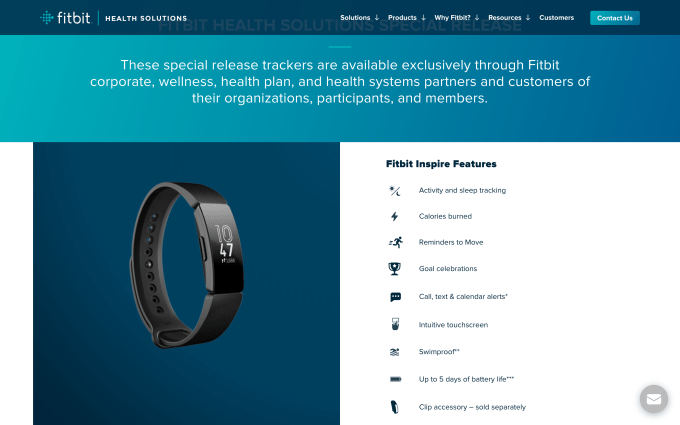
The company quietly uncorked the Inspire on Friday, releasing its first product that is available only to corporate employees and health insurance members. The idea is to offer a fully subsidized wearable that helps the company dig deeper into the corporate and business worlds.

The new devices are available as a wristband with the option of a clip. The basic tracker’s features are pretty standard and include activity and sleep tracking, calory burn and alerts from a connected phone. A higher specced model includes heart rate tracking, GPS for fitness tracking and deeper analytics on sleep. No prices are displayed on the website, but eligible customers won’t need to pay.

In an interview with CNBC, CEO James Park said the company has 6.8 million users on wellness programs include Fitbit devices via employers, health plans or hospital programs. In offering the Inspire — which is Fitbit’s cheapest device yet — the goal is to grow that number further still. Indeed, Park said Fitbit is a named covered fitness benefit in 42 Medicare Advantage plans across 27 U.S. states while it is working with insurance firms like UnitedHealth.

It makes sense that Fitbit is moving into that space because the consumer market is a tough one. Wearables are no longer an early novelty and competition is fierce. Apple dominates at the high end with the Apple Watch — which has doubled down on health features — while, at the cheaper end, companies like Xiaomi and its partner Huami offer basic trackers from as little as $30.

Fitbit went public in 2015. While its share price rallied to $6.48 on Friday on this news, it is still down massively from its list price of $20 and first-day trading close of $29.68. Today the company’s market cap stands at around $1.6 billion.