Author: azeeadmin

08 Feb 2019

Spotify will now suspend or terminate accounts it finds are using ad blockers

Spotify will take a harder stance on ad blockers in its updated terms of service. In an email to users today, the streaming music and podcast platform said its new user guidelines “mak[e] it clear that all types of ad blockers, bots and fraudulent streaming activities are not permitted.” Accounts that use ad blockers in Spotify face immediate suspension or termination under the new terms of service, which go into effect on March 1.

The new guidelines specify that “circumventing or blocking advertisements in the Spotify Service, or creating and distributing tools designed to block advertisements in the Spotify Service” may now result in “immediate termination or suspension of your Spotify account.”

Ad blockers have long been a headache for Spotify. The company disclosed in March 2018 while preparing for its initial public offering that it discovered two million users, or about 1.3 percent of its total user base at the time, had been using ad blockers on the free version of Spotify, enough to force it to restate usage metrics. Around that time, Spotify also began cracking down on unauthorized Android apps that let people access Spotify without ads.

During its fourth-quarter earnings report yesterday, Spotify reported positive operating profit, net income and free cash flow for the first time since it was founded in 2006. The company, which went public in May 2018, fell below analysts’ expectations for revenue, but is continuing to grow quickly despite intense competition from other streaming services, with subscribers increasing 36 percent to 96 million. Revenue from paid subscriptions now account for nearly all of Spotify’s turnover, or 88 percent. Ad-supported revenue makes up a much smaller slice, but as public company, Spotify is under more scrutiny to prevent ad-blocking, piracy or anything else that might cut into its earnings or subscriber growth.

Spotify also announced the acquisition of two podcast startups this week, Gimlet Media and Anchor, as it focuses on gathering all of the audio content its users might listen to into its service.

08 Feb 2019

Dixa, the ‘customer friendship’ platform, raises $14M

Dixa, a Copenhagen-based startup that offers a platform to help companies provide better and more consistent customer service across multiple channels, has raised $14 million in Series funding. The round is led by Project A Ventures, with participation from early investor SEED Capital.

Founded in 2015 by Jacob Vous Petersen and Mads Fosselius, Dixa is on mission to end bad customer service with the help of smarter technology to facilitate more personalised customer support. Dubbed a “customer friendship” platform, the cloud-based software works across multiple channels — including phone, chat, e-mail, and Facebook messenger — and employs a smart routing system so that the right support requests reach the right people within an organisation.

“The problem for customer facing support teams today is that tickets, shared in boxes and legacy call center solutions limit brand’s ability to connect to their customers where they want to and add extra administrative burdens that ultimately harms the customer experience,” co-founder and CEO Mads Fosselius tells me.

“Despite companies and brands have promised stellar customer experiences and service the past 5 years based on digital transformation (example chatbots, self-service etc.) and technology vendors has promised even more, the facts are that 75 percent of all customers have had a bad customer experience within the past 6 months, and 70 percent say they will leave a brand after just one bad experience,” he says, citing Salesforce’s recent ‘State of the Connected Customer’ 2018 report.

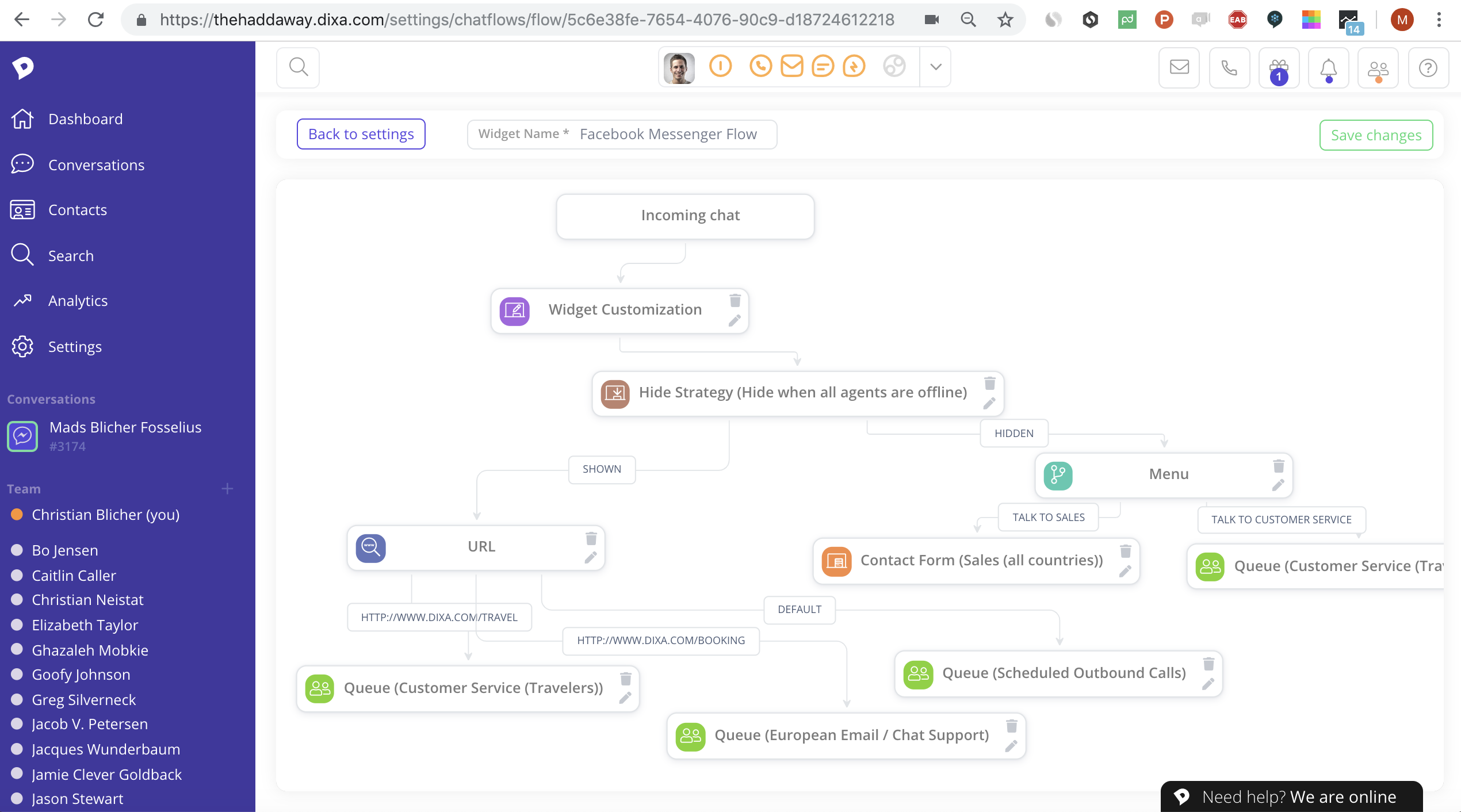
Dixa’s solution is described by Fosselius as a “next-gen” customer engagement platform built for personal and insightful conversations across all channels. To various degrees, it competes with Zendesk, Freshdesk, Salesforce Servicecloud and Avaya, Cisco, and 8×8. “Dixa is different as it’s a one channel-neutral platform and it works [how[ friends connect and communicate, but for engagement between brands and their customers. We call it a ‘Customer Friendship’ platform”.

This sees Dixa help companies ensure that customers can always get the help they need when they need it and on the channel they prefer. The software’s algorithms smartly re-route requests to the correct human or bot based on a raft of data. This includes past conversations, orders, reviews, and sentiment. Additionally, the context is taken into account, such as the communication channel used, webpage visited, device etc., and the skills plus availability of the relevant customer facing employee.

The result, says Dixa, is a system that makes it possible to deliver a consistent level of personal service, regardless of how the customer reaches out.

To that end, the Dixa platform is targeting “customer-centric” brands with 5-500 customer-facing agents, such as scale-ups and companies in the travel, e-commerce, fintech and transport/delivery sectors. Its current customer base spans 23 countries and includes brands like Bosch, Interflora, Danish design icon Hay, and food waste movement company Too Good to Go.

Adds Fosselius: “We don’t believe in tickets and siloed ‘silver bullet’ customer support solutions doing one thing or one channel very well, the world of customer support is moving towards conversational customer engagement or ‘customer friendship’ as we like to call it, where the strong bond and relation between brands and customers are the center piece”.

08 Feb 2019

NASA releases the “last light” image taken by Kepler before it retired last year

NASA Kepler space telescope’s “last light” image

NASA has released the final view taken by Kepler in September, shortly before the space telescope was retired after nearly a decade of unprecedented discoveries about the universe beyond our solar system.

“It bookends the moment of intense excitement nine and a half years earlier when the spacecraft first opened its eye to the skies and captured its ’first light’ image,” wrote NASA Ames Research Center public affairs officer Alison Hawkes. “Kepler went on to discover more than 2,600 worlds beyond our solar system and statistically proved that our galaxy has even more planets than stars.”

The “last light” image was taken on September 25, about a month before Kepler retired. The space telescope was pointed in the direction of the Aquarius constellation and the image encompasses the TRAPPIST-1 system, containing “seven rocky planets, at least three of them believed to be temperate worlds,” Hawkes wrote, and the GJ 9827 system, a star with an orbiting super Earth exoplanet (or planet outside the Solar System) that is “considered an excellent opportunity for follow up observations with other telescopes to study an atmosphere of a faraway world.”

Kepler’s field of view also slightly overlapped with NASA’s TESS (Transiting Exoplanet Survey Satellite), its planet-hunting successor, so astronomers will be able to compare data from the two. TESS launched last year and is expected to catalogue more than 1,500 exoplanets.

Kepler’s legacy is even more extraordinary because its primary mission was originally planned to last for 3.5 years. Instead, the space craft, named for 17th-century German astronomer and mathematician Johannes Kepler operated for nine years, thanks a combination of its sturdy construction and fuel reserve. During that time, it discovered more than 4,500 confirmed planets and planet candidates, including 3,912 exoplanets.

Significantly, many of the planets Kepler discovered may be similar to Earth in size, with NASA analysis concluding that 20 to 50 percent of the stars in the sky are likely orbited by “small, possibly rocky planets that are in the habitable zone of their stars where liquid water could pool on the surface” and potentially host life.

Kepler also continued recording specific targets every 30 seconds, doing so for a few hour after the “last light” image was taken. “Although Kepler’s transmitters have been turned off and it is no longer collecting science, its data will be mined for many years to come,” Hawkes wrote.

08 Feb 2019

Google makes it easier for cheap phones and smart devices to encrypt your data

Encryption is an important part of the whole securing-your-data package, but it’s easy to underestimate the amount of complexity it adds to any service or device. One part of that is the amount of processing encryption takes — an amount that could be impractical on small or low-end devices. Google wants to change that with a highly efficient new method called Adiantum.

Here’s the problem. While encryption is in a way just transforming one block of data reversibly into another, that process is actually pretty complicated. Math needs to be done, data read and written and reread and rewritten and confirmed and hashed.

For a text message that’s not so hard. But if you have to do the same thing as you store or retrieve megabyte after megabyte of data, for instance with images or video, that extra computation adds up quick.

Lots of modern smartphones and other gadgets are equipped with a special chip that performs some of the most common encryption algorithms and processes (namely AES), just like we have GPUs to handle graphics calculations in games and such.

But what about older phones, or cheaper ones, or tiny smart home gadgets that don’t have room for that kind of thing on their boards? Just like they can’t run the latest games, they might not be able to efficiently run the latest cryptographic processes. They can still encrypt things, of course, but it might take too long for certain apps to work, or drain the battery.

Google, clearly interested in keeping cheap phones competitive, is tackling this problem by creating a special encryption method just for low-power phones. They call it Adiantum, and it will be optionally part of Android distributions going forward.

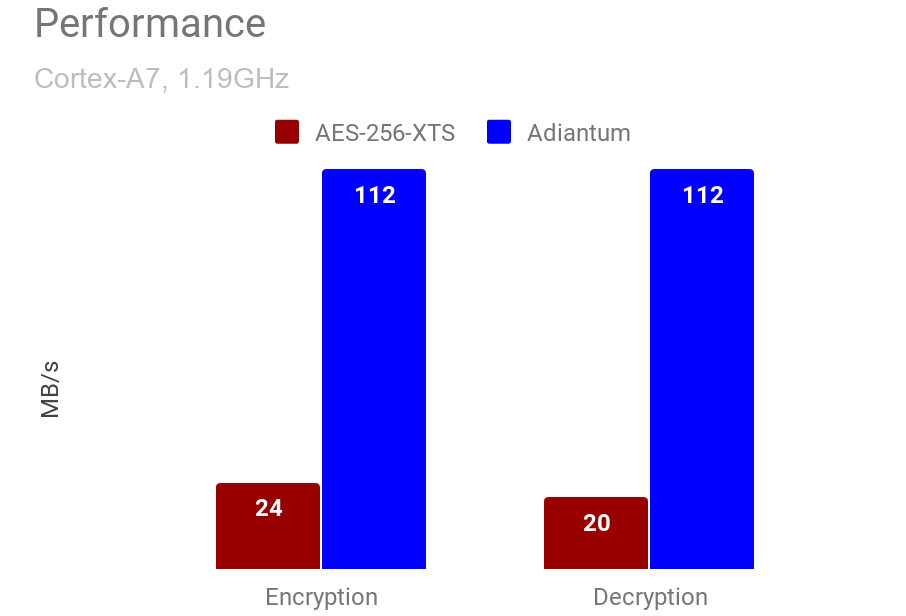
The technical details are all here, but the gist is this. Instead of using AES it relies on a cipher called ChaCha. This cipher method is highly optimized for basic binary operations, which any processor can execute quickly, though of course it will be outstripped by specialized hardware and drivers. It’s well documented and already in use lots of places — this isn’t some no-name bargain bin code. As they show, it performs way better on earlier chipsets like the Cortex A7.

The Adiantum process doesn’t increase or decrease the size of the payload (for instance by padding it or by appending some header or footer data), meaning the same number of bytes come in as go out. That’s nice when you’re a file system and don’t want to have to set aside too many special blocks for encryption metadata and the like.

Naturally new encryption techniques are viewed with some skepticism by security professionals, for whom the greatest pleasure in life is to prove one is compromised or unreliable. Adiantum’s engineers say they have “high confidence in its security,” with the assumption (currently reasonable) that its component “primitives” ChaCha and AES are themselves secure. We’ll soon see!

In the meantime don’t expect any instant gains, but future low-power devices may offer better security without having to use more expensive components — you won’t have to do a thing, either.

Oh, and in case you were wondering:

Adiantum is named after the genus of the maidenhair fern, which in the Victorian language of flowers (floriography) represents sincerity and discretion.

08 Feb 2019

Jeff Bezos accuses National Enquirer of blackmailing him — and publishes the details himself

Amazon CEO Jeff Bezos says he is being blackmailed with nude selfies by AMI, owner of the National Enquirer and reportedly protector of the president’s reputation, over claims the publisher has acted as a political operative. The events feel almost as if they have been arranged by mysterious forces as a microcosm of the “tech elite vs. the President” narrative.

Bezos, who has been in the news recently owing to a rather dramatic and public divorce, published a post on a fresh Medium instance describing in detail the process by which he has been targeted by AMI.

It began when Bezos commissioned private security provider and investigator Gavin de Becker to look into how the National Enquirer obtained (and published) private texts and images of his, part of which was apparently to look into connections with Saudi Arabia and potential interference with The Washington Post, which Bezos of course owns.

This apparently did not sit well with David Pecker, AMI’s CEO and Chairman:

Several days ago, an AMI leader advised us that Mr. Pecker is ‘apoplectic’ about our investigation. For reasons still to be better understood, the Saudi angle seems to hit a particularly sensitive nerve… They said they had more of my text messages and photos that they would publish if we didn’t stop our investigation.

They wanted Bezos to publicly state that he has “no knowledge or basis for suggesting that AMI’s coverage was politically motivated or influenced by political forces.” This, he writes, is simply not true, and he decided rather to publish the threats in full than to capitulate to the demands.

In emails purportedly from AMI, the publisher details the exact nature of the images they have obtained. Bezos, presumably in order to take away any ammunition they have short of shooting their whole shot, published the list in his post. The images sound suitably personal and they are exactly what you suspect, and include some of the woman with whom he is reportedly involved.

Apparently AMI says the images can and should be published as newsworthy in order to show Amazon shareholders that Bezos has poor judgment. Obviously Bezos disagrees, and he’d rather air his dirty laundry (rather more literally than that is usually meant) than compromise himself and the Post.

In a touching aside, he notes that although the newspaper is “a complexifier” for him, he is completely dedicated to it. “My stewardship of The Post and my support of its mission, which will remain unswerving, is something I will be most proud of when I’m 90 and reviewing my life,” he writes.

Notably Bezos chose not to publish this information with any kind of official connection with The Washington Post (such as a letter from the owner or the like, or with Post lawyers); considering this is more of a personal issue for him and that he is accusing AMI of poor journalistic practices (in fact of masquerading as journalism for nefarious purposes), it is well for him to keep a wide berth from potential accusations that he is abusing the Post in any way.

Some may be wondering: What about these images? How could AMI possibly claim they were obtained lawfully? In the email published by Bezos, they say:

Please be advised that our newsgathering and reporting on matters involving your client, including any use of your client’s “private photographs,” has been, and will continue to be, consistent with applicable laws. As you know, “the fair use of a copyrighted work, including such use by reproduction in copies . . . for purposes such as criticism, comment, news reporting . . . is not an infringement of copyright.” 17 USC Sec. 107.

Whether “fair use” protects them from publishing photos that I can’t imagine could be acquired by anything but illegal means, is a question that may have to be decided in court. On the other hand, AMI and the National Enquirer are surely old hands at this type of thing considering the nature of their business.

This story is developing, and how. Check back for updates.

07 Feb 2019

Gametime lets you buy tickets for games and concerts that have already started

Ticketing app Gametime is taking its last-minute approach about as far as it can go, with the launch of a new feature called LastCall. This allows users to purchase tickets through Gametime until 90 minutes after an event has started.

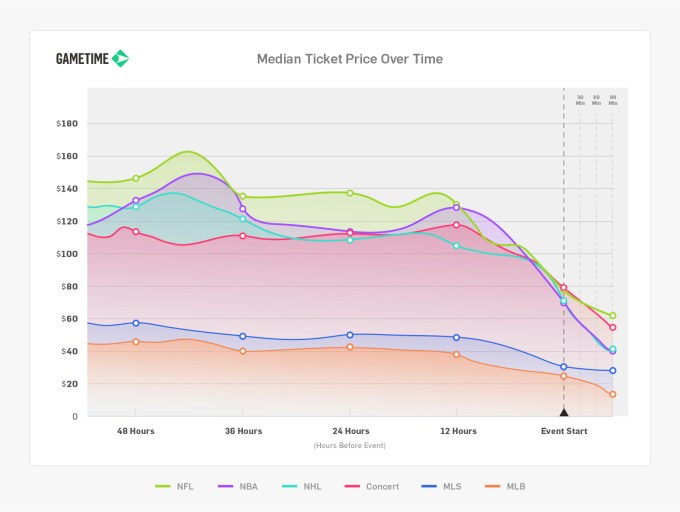
Why would you want to do that? Well, prices usually drop precipitously after the event starts — for example, Gametime said that 48 hours before a game, the median price for a Major League Baseball is (coincidentally?) $48, but it’s dropped to $13 by 90 minutes after the first pitch.

Founder and CEO Brad Griffith acknowledged that most fans probably aren’t interested in just showing up for the fourth quarter or ninth inning of a game, or for the last song in a concert. On the other hand, if you could get a big discount and still catch most of the event, then it might be worth it.

Meanwhile, if you’re a team or a venue with empty seats, or if you’re a ticket-holder who realizes at the last minute that you can’t attend, then it’s good to have one last shot at selling those tickets.

In fact, it sounds like this is one of those “announcements” that’s partly acknowledging what’s already happening, both in the Gametime app and elsewhere. Griffith said the company is “doubling down” on this seriously-last-minute category of tickets, adding that it’s “constantly working through” what it’s actually including under the LastCall umbrella.

LastCall graphic

“The key element is the research that we’ve done, how it relates to the growth of this phenomenon” he said.

That research includes a survey of 287 event attendees, some who use Gametime and some who don’t. Apparently 27 percent said they’ve already purchased tickets after an event’s start time, and 62 percent of those late buyers were either Generation Z or millennials.

And while Gametime started out with a focus on sports, LastCall will include tickets from a variety of live events. In fact, Griffith said concerts are now the app’s fastest-growing category, and he suggested that this approach could help with the declining number of total concert tickets sold.

“We’re starting to see a bifurcation of windows, where the on-sale is still healthy, is strong, and the middle is maybe cratering in terms of transaction volume,” he said. “And then last-minute is vibrant and growing and fast. That is where we aim to do our best work.”

07 Feb 2019

Instagram thinks you want IGTV previews in your home feed

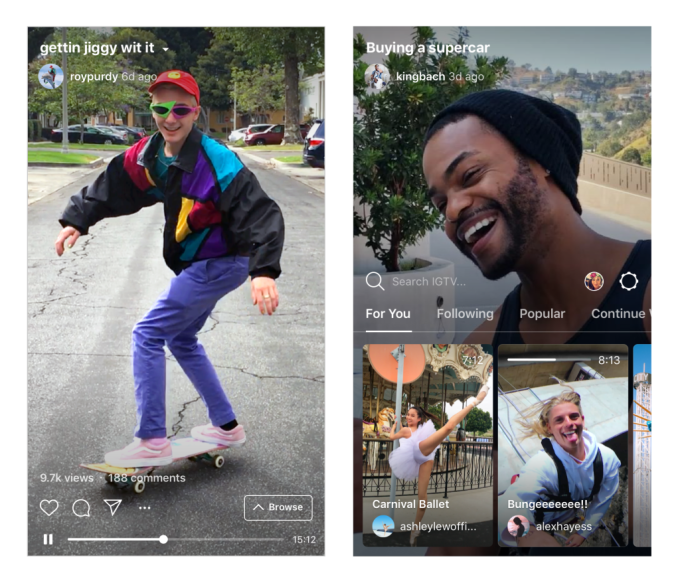
If you can’t beat or join them… force feed ’em? That appears to be Instagram’s latest strategy for IGTV, which is now being shoved right into Instagram’s main feed, the company announced today. Instagram says that it will now add one-minute IGTV previews to the feed, making it “even easier” to discover and watch content from IGTV.

Uh.

IGTV, you may recall, was launched last year as a way for Instagram to woo creators. With IGTV, creators are able to share long-form videos within the Instagram platform instead of just short-form content to the Feed or Stories.

The videos, before today, could be viewed in Instagram itself by tapping the IGTV icon at the top-right of the screen, or within the separate IGTV standalone app.Instagram’s hope was that IGTV would give the company a means of better competing with larger video sites, like Google’s YouTube or Amazon’s Twitch.

Its users, however, haven’t found IGTV as compelling.

As of last fall, few creators were working on content exclusively for IGTV, and rumor was the viewing audience for IGTV content remained quite small, compared with rivals like Snapchat or Facebook. Many creators just weren’t finding it worth investing additional resources into IGTV, so were repurposing content designed for other platforms, like YouTube or Snapchat.

That means the bigger creators weren’t developing premium content or exclusives for IGTV, but were instead experimenting by replaying the content their fans could find elsewhere. Many are still not even sure what the IGTV audience wants to watch.

IGTV’s standalone app doesn’t seem to have gained much of a following either.

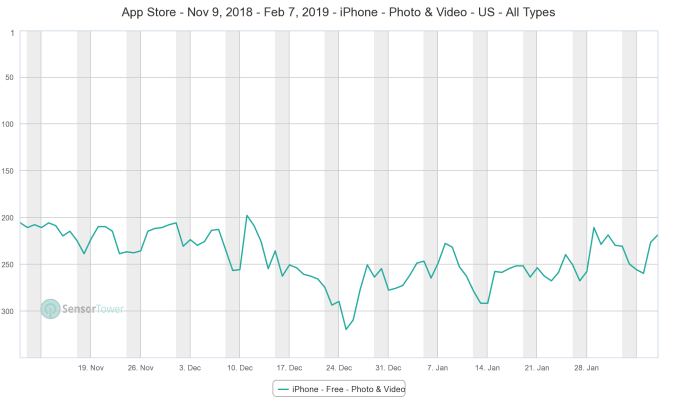
The app today is ranked a lowly No. 228 on the U.S. App Store’s “Photo and Video” top chart. Despite being run by Instagram — an app that topped a billion monthly users last summer, and is currently the No. 1 free app on iOS — fewer are downloading IGTV.

After seeing 1.5 million downloads in its first month last year — largely out of curiosity — the IGTV app today has only grown to 3.5 million total installs worldwide, according to Sensor Tower data. While those may be good numbers for a brand-new startup, for a spin-off from one of the world’s biggest apps, they’re relatively small.Instagram’s new video initiative also represents another shot across the bow of Instagram purists.

As BuzzFeed reporter Katie Notopoulos opined last year, “I’m Sorry To Report Instagram Is Bad Now.” Her point of concern was the impact that Stories had on the Instagram Feed — people were sharing to Stories instead of the Feed, which made the Feed pretty boring. At yet, the Stories content wasn’t good either, having become a firehose of the throwaway posts that didn’t deserve being shared directly on users’ profiles.

On top of all this, it seems the Instagram Feed is now going to be cluttered with IGTV previews. That’s. Just. Great.

Instagram says you’ll see the one-minute previews in the Feed, and can tap on them to turn on the audio. Tap the IGTV icon on the preview and you’ll be able to watch the full version in IGTV. When the video is finished, you’re returned to the Feed. Or, if you want to see more from IGTV, you can swipe up while the video plays to start browsing.

IGTV previews is only one way Instagram has been developing the product to attract more views in recent months. It has also integrated IGTV in Explore, allowed the sharing of IGTV videos to Stories, added the ability to save IGTV Videos and launched IGTV Web Embeds.

07 Feb 2019

Instagram thinks you want IGTV previews in your home feed

If you can’t beat or join them… force feed ’em? That appears to be Instagram’s latest strategy for IGTV, which is now being shoved right into Instagram’s main feed, the company announced today. Instagram says that it will now add one-minute IGTV previews to the feed, making it “even easier” to discover and watch content from IGTV.

Uh.

IGTV, you may recall, was launched last year as a way for Instagram to woo creators. With IGTV, creators are able to share long-form videos within the Instagram platform instead of just short-form content to the Feed or Stories.

The videos, before today, could be viewed in Instagram itself by tapping the IGTV icon at the top-right of the screen, or within the separate IGTV standalone app.Instagram’s hope was that IGTV would give the company a means of better competing with larger video sites, like Google’s YouTube or Amazon’s Twitch.

Its users, however, haven’t found IGTV as compelling.

As of last fall, few creators were working on content exclusively for IGTV, and rumor was the viewing audience for IGTV content remained quite small, compared with rivals like Snapchat or Facebook. Many creators just weren’t finding it worth investing additional resources into IGTV, so were repurposing content designed for other platforms, like YouTube or Snapchat.

That means the bigger creators weren’t developing premium content or exclusives for IGTV, but were instead experimenting by replaying the content their fans could find elsewhere. Many are still not even sure what the IGTV audience wants to watch.

IGTV’s standalone app doesn’t seem to have gained much of a following either.

The app today is ranked a lowly No. 228 on the U.S. App Store’s “Photo and Video” top chart. Despite being run by Instagram — an app that topped a billion monthly users last summer, and is currently the No. 1 free app on iOS — fewer are downloading IGTV.

After seeing 1.5 million downloads in its first month last year — largely out of curiosity — the IGTV app today has only grown to 3.5 million total installs worldwide, according to Sensor Tower data. While those may be good numbers for a brand-new startup, for a spin-off from one of the world’s biggest apps, they’re relatively small.Instagram’s new video initiative also represents another shot across the bow of Instagram purists.

As BuzzFeed reporter Katie Notopoulos opined last year, “I’m Sorry To Report Instagram Is Bad Now.” Her point of concern was the impact that Stories had on the Instagram Feed — people were sharing to Stories instead of the Feed, which made the Feed pretty boring. At yet, the Stories content wasn’t good either, having become a firehose of the throwaway posts that didn’t deserve being shared directly on users’ profiles.

On top of all this, it seems the Instagram Feed is now going to be cluttered with IGTV previews. That’s. Just. Great.

Instagram says you’ll see the one-minute previews in the Feed, and can tap on them to turn on the audio. Tap the IGTV icon on the preview and you’ll be able to watch the full version in IGTV. When the video is finished, you’re returned to the Feed. Or, if you want to see more from IGTV, you can swipe up while the video plays to start browsing.

IGTV previews is only one way Instagram has been developing the product to attract more views in recent months. It has also integrated IGTV in Explore, allowed the sharing of IGTV videos to Stories, added the ability to save IGTV Videos and launched IGTV Web Embeds.

07 Feb 2019

Autonomous cars are driving the reinvention of IP protection

Early 1900s society struggled to transition from horse-drawn buggies to automobiles. It may seem odd today, but there was a time when there was no concept of “right of way,” speed limits or traffic signs and signals. Those rules had to be invented so that cars encountering carriages would not frighten horses into runaways — or run each other off the traveled dirt paths that sufficed for “roads” — and require help from their four-legged counterparts to free them.

Fast-forward a hundred years. Quo Vadis is Latin for “whither goest thou,” an apt phrase for the free-ranging lifestyle enabled by the modern automobile. Come and go when you want, where you want and with whom you want. Take a Forrest Gump-inspired drive across the country in your dinosaur-fueled car or zap across town in your EV for a midnight snack. We have become a truly mobile society.

But crowded streets and highways full of distracted or inept drivers have turned “autopia” into “disautopia.” Enter the promise of the autonomous vehicle, enabled by artificial intelligence. All of the benefits of driving, without having to drive. Cars guide themselves in perfect harmony, easing congestion, promoting traffic flow and optimizing road utilization. Even better, you can sit back and let the car guide itself while you catch a TED talk and sip your latte.

Well, not quite. The state of technology at present can only account for, at best, a high percentage of driving situations, but not the marginal. The edge case/remaining 5-10 percent still depends on human intervention. Such cases may be benign, like the car not knowing what to do when it confronts an unplanned pothole repair crew. Or, a more Machiavellian example could involve human-operated vehicles approaching a stopped autonomous vehicle from 90 degrees at a four-way stop. Realizing that the AI vehicle would not endanger its occupants, the human drivers could serially execute “rolling stops,” effectively freezing the AI vehicle in place while the slow-rolling train of human-controlled cars continued unending during rush hour.

In either case, a human (or remote operator) may easily take over control and follow the flag person’s hand gestures, or out-bluff the human-controlled cars at the intersection. But what if the need for human intervention arose on the freeway, perhaps when dirt dropped by the truck ahead obscures the lane markings? The autonomous car might well begin to steer itself into a concrete barrier and the only hope would be for a human driver to instantly take over — if they were even to look up from watching their video in time before everything went dark amid the thunder of crunching metal and glass…

A major concern is that current patent laws are inadequate to protect AI systems.

Artificial intelligence is a glamorous term that suggests human-like thinking. It conjures images of popular movie characters who can speak and interact as would a person. But AI is more accurately described as “machine learning.” Present-day machine learning attempts to duplicate human intelligence by interacting with the world and receiving corrective input. Almost like teaching a child right from wrong through praise and scolding, present-day AI machines learn based on similar binary corrections. Go 35, not the posted 30 mph, and feedback that this is wrong behavior is processed until the machine “knows” not to exceed 30 mph down Maple street, and knows that use of all three lanes in the westbound direction is permissible at the present time because Maple is one-way westbound during rush hour.

Hundreds if not thousands of test vehicles are sharing the road with people-guided cars and trucks, logging the millions of miles needed to teach the machines until they can replicate or at least approximate the knowledge of an experienced driver so that they can be relied on to obey the road repair crewperson, or learn to deal with the rolling-stop human drivers. Unlike technology taught in patents, which allow a newcomer to catch up (provided they are willing to pay a license fee or can design around), present-day machine learning takes time and experience that can’t be avoided. Or can it?

A major concern is that current patent laws are inadequate to protect AI systems. For example, patents cannot be used to protect data compilations, such as AI training sets, or a programmer’s particular expression of source code. Further, given the machine learning process and iterative/incremental evolution of the underlying algorithms, it can be difficult to accurately, and narrowly, describe the methods or functions of an AI system as required for a patent grant.

And what of inventorship? The self-learning process of AI means that subject matter could be developed autonomously by the AI itself. Even if the result is patentable, would HAL be named as the inventor? This is an unsettled area of law, likely requiring action by Congress to resolve. A practical problem also is that the field may be evolving so rapidly that a patent, which can take years to fully prosecute from application to issuance, may be useless or antiquated before it issues, if allowed at all.

Given these concerns, most autonomous vehicle (and AI) developers rely on trade secret laws to protect their intellectual property. But this creates a significant technological hurdle for new companies entering the field. Rather than being able to rely on the publicly disclosed information that would be required, for example, if the AI developers were patenting their technology, new competitors would essentially have to start from scratch — a severe disadvantage. With fewer competitors able to enter the market, consumers will no doubt be limited to fewer choices.

There are numerous drawbacks, as well, to developers relying on trade-secret protection, not the least of which is the temptation of competitors to shortcut the multi-million-mile learning process by hiring away valued employees and encouraging theft of the learned data. To be protectable, and thus actionable in the event of a breach, the trade secrets must be kept confidential, which can translate into cumbersome security measures and “need to know” protocols and limitations.

All of this is somewhat reminiscent of how rules of the road, signage and traffic signals had to be developed to facilitate transition from our horse-drawn age. In the same way, our concepts of intellectual property protection will need to evolve if not require invention of new concepts to enable transition to autonomous vehicles. Stay tuned — and buckle up for a fascinating ride.


07 Feb 2019

Autonomous cars are driving the reinvention of IP protection

Early 1900s society struggled to transition from horse-drawn buggies to automobiles. It may seem odd today, but there was a time when there was no concept of “right of way,” speed limits or traffic signs and signals. Those rules had to be invented so that cars encountering carriages would not frighten horses into runaways — or run each other off the traveled dirt paths that sufficed for “roads” — and require help from their four-legged counterparts to free them.

Fast-forward a hundred years. Quo Vadis is Latin for “whither goest thou,” an apt phrase for the free-ranging lifestyle enabled by the modern automobile. Come and go when you want, where you want and with whom you want. Take a Forrest Gump-inspired drive across the country in your dinosaur-fueled car or zap across town in your EV for a midnight snack. We have become a truly mobile society.

But crowded streets and highways full of distracted or inept drivers have turned “autopia” into “disautopia.” Enter the promise of the autonomous vehicle, enabled by artificial intelligence. All of the benefits of driving, without having to drive. Cars guide themselves in perfect harmony, easing congestion, promoting traffic flow and optimizing road utilization. Even better, you can sit back and let the car guide itself while you catch a TED talk and sip your latte.

Well, not quite. The state of technology at present can only account for, at best, a high percentage of driving situations, but not the marginal. The edge case/remaining 5-10 percent still depends on human intervention. Such cases may be benign, like the car not knowing what to do when it confronts an unplanned pothole repair crew. Or, a more Machiavellian example could involve human-operated vehicles approaching a stopped autonomous vehicle from 90 degrees at a four-way stop. Realizing that the AI vehicle would not endanger its occupants, the human drivers could serially execute “rolling stops,” effectively freezing the AI vehicle in place while the slow-rolling train of human-controlled cars continued unending during rush hour.

In either case, a human (or remote operator) may easily take over control and follow the flag person’s hand gestures, or out-bluff the human-controlled cars at the intersection. But what if the need for human intervention arose on the freeway, perhaps when dirt dropped by the truck ahead obscures the lane markings? The autonomous car might well begin to steer itself into a concrete barrier and the only hope would be for a human driver to instantly take over — if they were even to look up from watching their video in time before everything went dark amid the thunder of crunching metal and glass…

A major concern is that current patent laws are inadequate to protect AI systems.

Artificial intelligence is a glamorous term that suggests human-like thinking. It conjures images of popular movie characters who can speak and interact as would a person. But AI is more accurately described as “machine learning.” Present-day machine learning attempts to duplicate human intelligence by interacting with the world and receiving corrective input. Almost like teaching a child right from wrong through praise and scolding, present-day AI machines learn based on similar binary corrections. Go 35, not the posted 30 mph, and feedback that this is wrong behavior is processed until the machine “knows” not to exceed 30 mph down Maple street, and knows that use of all three lanes in the westbound direction is permissible at the present time because Maple is one-way westbound during rush hour.

Hundreds if not thousands of test vehicles are sharing the road with people-guided cars and trucks, logging the millions of miles needed to teach the machines until they can replicate or at least approximate the knowledge of an experienced driver so that they can be relied on to obey the road repair crewperson, or learn to deal with the rolling-stop human drivers. Unlike technology taught in patents, which allow a newcomer to catch up (provided they are willing to pay a license fee or can design around), present-day machine learning takes time and experience that can’t be avoided. Or can it?

A major concern is that current patent laws are inadequate to protect AI systems. For example, patents cannot be used to protect data compilations, such as AI training sets, or a programmer’s particular expression of source code. Further, given the machine learning process and iterative/incremental evolution of the underlying algorithms, it can be difficult to accurately, and narrowly, describe the methods or functions of an AI system as required for a patent grant.

And what of inventorship? The self-learning process of AI means that subject matter could be developed autonomously by the AI itself. Even if the result is patentable, would HAL be named as the inventor? This is an unsettled area of law, likely requiring action by Congress to resolve. A practical problem also is that the field may be evolving so rapidly that a patent, which can take years to fully prosecute from application to issuance, may be useless or antiquated before it issues, if allowed at all.

Given these concerns, most autonomous vehicle (and AI) developers rely on trade secret laws to protect their intellectual property. But this creates a significant technological hurdle for new companies entering the field. Rather than being able to rely on the publicly disclosed information that would be required, for example, if the AI developers were patenting their technology, new competitors would essentially have to start from scratch — a severe disadvantage. With fewer competitors able to enter the market, consumers will no doubt be limited to fewer choices.

There are numerous drawbacks, as well, to developers relying on trade-secret protection, not the least of which is the temptation of competitors to shortcut the multi-million-mile learning process by hiring away valued employees and encouraging theft of the learned data. To be protectable, and thus actionable in the event of a breach, the trade secrets must be kept confidential, which can translate into cumbersome security measures and “need to know” protocols and limitations.

All of this is somewhat reminiscent of how rules of the road, signage and traffic signals had to be developed to facilitate transition from our horse-drawn age. In the same way, our concepts of intellectual property protection will need to evolve if not require invention of new concepts to enable transition to autonomous vehicles. Stay tuned — and buckle up for a fascinating ride.