Author: azeeadmin

07 Feb 2019

Interior Define and Monica + Andy collaborate to make children’s furniture

It isn’t super common to find two entrepreneurs in one marriage, especially two entrepreneurs that want to work together. But married couple Rob and Monica Royer are making it happen with a new collaboration between Interior Define and Monica + Andy.

Interior Define, founded by Rob Royer, looks to offer super customizable, high-quality furniture at an affordable price point. Users can pick the style of their furniture, the materials used, and even specify dimensions to ensure that their stuff fits perfectly in their space.

Monica + Andy, on the other hand, was founded by Monica Royer and Brian Bloom, launched in 2014 to provide high-quality baby and children’s apparel, all of which is made with Global Organic Textile Standard certified cotton. Both Interior Define and Monica + Andy are digitally native brands, but both have various physical guide shops across the country.

One of Monica + Andy’s claims to fame is the brand’s limited edition prints. With that in mind, Monica and Rob Royer hatched a plan to collaborate on child-sized furniture using fun Monica + Andy prints. The children’s furniture is real furniture, shrunken down, according to Rob Royer. However, the slip covers are 100 percent washable to ensure that kids can still play happily without completely destroying the furniture in the play room.

“To be brutally honest, working together as married, founding CEOs is probably a really bad idea and I do not recommend trying this yourself,” said Monica Royer with a laugh. “But we stumbled into it with this idea, and we’re incredibly passionate about the brands we’ve created. And we have a unique understanding of each other, both as partners, but also as fellow founding CEOs.”

Rob and Monica said that part of the reason the collaboration made sense is because of the faith they have in their teams to execute.

“We both have fantastic teams,” said Rob Royer. “Teams are the ones that do all of the great work. We came to the table with an idea and our teams were the ones who really executed on the vision.”

The children’s furniture, which includes chairs, loveseats, couches and even sectionals, will be sold through the Interior Define website, but Monica + Andy will be selling extra throw pillows through the M+A website.

“We cut our teeth on children’s apparel,” said Monica Royer. “To expand into additional product categories is a unique opportunity for us in general, but it’s made better by working with a brand that aligns from a customer experience, aesthetic, and team perspective.”

07 Feb 2019

Amazon, Sequoia invest in self-driving car startup Aurora

Aurora, the buzzy startup founded by early pioneers of self-driving car technology who led programs at Google, Tesla, and Uber, has raised more than $530 million in a Series B round led by Sequoia and includes “significant investment” from Amazon and T. Rowe Price Associates.

The monster round pushes Aurora’s valuation near $2.5 billion. Aurora announced a $90 million Series A round last February from Greylock Partners  and Index Ventures, bringing its total raised to date to more than $620 million.

Sequoia partner Carl Eschenbach is joining Aurora’s board, which already includes external directors Mike Volpi of Index Ventures, LinkedIn co-founder and venture capital investor Reid Hoffman, and Ian Smith.

Lightspeed Venture Partners, Geodesic, Shell Ventures and Reinvent Capital are also participating in the round, as well as previous investors Greylock and Index Ventures.

The size of the raise — and the company’s new valuation — are certainly notable. But it’s the collection of new investors that provide the best view into Aurora’s ambitions.

The company has already ramped up in its considerably short life. Since Sterling Anderson, Drew Bagnell and Chris Urmson founded the company in early 2017, they have set up offices in Palo Alto, San Francisco and Pittsburgh and announced partnerships with Volkswagen Group, Hyundai and Chinese electric vehicle startup Byton. The company has also made some key hires, including SpaceX’s former head of software engineering, Jinnah Hosein, who is leading a software engineering team.

Sequoia’s “stamp of approval,” (as Urmson calls it) at such an early stage is significant. The inclusion of Amazon and T. Rowe Price are the two investors that show a long-term strategy has been put into play.

Aurora will likely need more capital as it develops a “full-stack solution” for self-driving vehicles. So, it’s choice of investors are critical.

“We’re trying to be strategic about it and have people around the table who share the vision of where we want to go as a company and who understand how hard the problem is — this is not a short-term play —and knowing that ultimately we will need more capital.” Urmson told TechCrunch.

T. Rowe Price, which Urmson notes is savvy about macro trends, can provide the kind of long-term thinking Aurora will need if it hopes to survive in this ever-changing, and still nascent autonomous vehicle industry.

Amazon, meanwhile, has the kind of logistical prowess and sheer amount of capital that could prove to be particularly beneficial to Aurora.

Aurora engineers are focusing on Level 4 autonomy, a designation by SAE International that means the car takes over all of the driving in certain conditions. Level 4 autonomy can be applied in different ways. And while, most might assume it translates into moving people around in robotaxis, autonomy can also be applied to the movement of goods. Enter Amazon.

“We are always looking to invest in innovative, customer-obsessed companies, and Aurora is just that,” Amazon said in an emailed statement. “Autonomous technology has the potential to help make the jobs of our employees and partners safer and more productive, whether it’s in a fulfillment center or on the road, and we’re excited about the possibilities.”

07 Feb 2019

Microsoft Azure sets its sights on more analytics workloads

Enterprises now amass huge amounts of data, both from their own tools and applications, as well as from the SaaS applications they use. For a long time, that data was basically exhaust. Maybe it was stored for a while to fulfill some legal requirements, but then it was discarded. Now, data is what drives machine learning models, and the more data you have, the better. It’s maybe no surprise, then, that the big cloud vendors started investing in data warehouses and lakes early on. But that’s just a first step. After that, you also need the analytics tools to make all of this data useful.

Today, it’s Microsoft turn to shine the spotlight on its data analytics services. The actual news here is pretty straightforward. Two of these are services that are moving into general availability: the second generation of Azure Data Lake Storage for big data analytics workloads and Azure Data Explorer, a managed service that makes easier ad-hoc analysis of massive data volumes. Microsoft is also previewing a new feature in Azure Data Factory, its graphical no-code service for building data transformation. Data Factory now features the ability to map data flows.

Those individual news pieces are interesting if you are a user or are considering Azure for your big data workloads, but what’s maybe more important here is that Microsoft is trying to offer a comprehensive set of tools for managing and storing this data — and then using it for building analytics and AI services.

(Photo credit:Josh Edelson/AFP/Getty Images)

“AI is a top priority for every company around the globe,” Julia White, Microsoft’s corporate VP for Azure, told me. “And as we are working with our customers on AI, it becomes clear that their analytics often aren’t good enough for building an AI platform.” These companies are generating plenty of data, which then has to be pulled into analytics systems. She stressed that she couldn’t remember a customer conversation in recent months that didn’t focus on AI. “There is urgency to get to the AI dream,” White said, but the growth and variety of data presents a major challenge for many enterprises. “They thought this was a technology that was separate from their core systems. Now it’s expected for both customer-facing and line-of-business applications.”

Data Lake Storage helps with managing this variety of data since it can handle both structured and unstructured data (and is optimized for the Spark and Hadoop analytics engines). The service can ingest any kind of data — yet Microsoft still promises that it will be very fast. “The world of analytics tended to be defined by having to decide upfront and then building rigid structures around it to get the performance you wanted,” explained White. Data Lake Storage, on the other hand, wants to offer the best of both worlds.

Likewise, White argued that while many enterprises used to keep these services on their on-premises servers, many of them are still appliance-based. But she believes the cloud has now reached the point where the price/performance calculations are in its favor. It took a while to get to this point, though, and to convince enterprises. White noted that for the longest time, enterprises that looked at their analytics projects thought $300 million projects took forever, tied up lots of people and were frankly a bit scary. “But also, what we had to offer in the cloud hasn’t been amazing until some of the recent work,” she said. “We’ve been on a journey — as well as the other cloud vendors — and the price performance is now compelling.” And it sure helps that if enterprises want to meet their AI goals, they’ll now have to tackle these workloads, too.

07 Feb 2019

Match Group fully acquires relationship-focused app Hinge

Last year, Match Group acquired a 51 percent stake in the relationship-focused dating app Hinge, in order to diversify its portfolio of dating apps led by Tinder. The company has now confirmed that it fully bought out Hinge in the past quarter, and today owns 100 percent of the app which has been gaining momentum both inside and outside of the U.S. following last year’s deal.

Terms of the acquisition were not disclosed.

Match believes Hinge can offer an alternative to those who aren’t interested in using casual apps, like Tinder. As the company noted on its earnings call with investors this morning, half of all singles in the U.S. and Europe have never tried dating products. And of the 600 million internet-connected singles in the world, 400 million have never used dating apps.

That leaves room for an app like Hinge to grow, as it can attract a different type of user than Tinder and other Match-owned apps – like OKCupid or Plenty of Fish, for example – are able to reach.

As Match explained in November, it plans to double-down on marketing that focuses on Tinder’s more casual nature and use by young singles, while positioning Hinge as the alternative for those looking for serious relationships. The company said it would also increase its investment in Hinge going forward, in order to grow its user base.

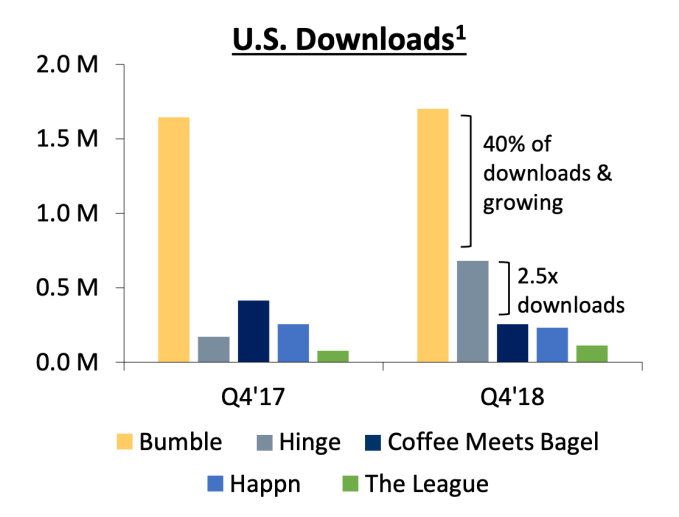
Those moves appear to be working. According to Match Group CEO Mandy Ginsberg, Hinge downloads grew 4 times on a year-over-year basis in the fourth quarter of 2018, and grew by 10 times in the U.K. The app is particularly popular in New York and London, which are now its top two markets, the exec noted.

Match may also see Hinge as a means of better competing with dating app rival Bumble, which it has been unable to acquire and continues to battle in court over various disputes.

Bumble’s brand is focused on female empowerment with its “women go first” product feature, and takes a more heavy-handed approach to banning, ranging from its prohibition on photos with weapons to its stance on kicking out users who are disrespectful to others.

Match, in its earnings announcement, made a point of comparing Hinge to other dating apps, including Bumble.

“Hinge downloads are now two-and-a-half times more than the next largest app, and 40 percent of Bumble downloads,” said Ginsberg, referring to a chart (below) which positions Hinge next to competitors like Happn, The League, Coffee Meets Bagel and Bumble.

“We expect Hinge to continue to strengthen its position in this relationship-minded market,” she added. “We believe that Hinge can be a meaningful revenue contributor to match group beyond 2019, and we have confidence that can carve out a solid position in the dating app landscape amongst relationship-minded millennials, and serve as a complimentary role in our portfolio next to Tinder,” Ginsberg said. 

Match has big plans for Hinge in 2019, saying that it will expand Hinge to international markets, double the size of its team, and build new products featured focused on helping people get off the app and go on dates.

Hinge today claims to be the fastest-growing dating app in the U.S., U.K., Canada and Australia, and is setting up a date every four seconds. 3 out of 4 first dates on Hinge also lead to second dates, it says.

Hinge is now one of several dating apps own by Match Group, which is best known for Tinder and its namesake, Match.com. But the company has been diversifying as of late, not only with Hinge, but also its newest addition, Ship, which was developed in partnership with media brand Betches. But Ship could be a miss if it doesn’t even out its demographics – currently, the subscriber base is 80 percent female, Match says.

Tinder, meanwhile, still drives Match Group’s revenue, which rose to $457 million from $379 million a year ago, and exceeded analysts’ expectations for $448 million, per MarketWatch. In the quarter, Tinder added 233,000 net new subscribers, bringing its total subscriber count to 4.3 million. Combined with Match’s other apps, overall subscribers totalled 8.2 million.


07 Feb 2019

Optimus Ride deploys more self-driving vehicles

Optimus Ride, an MIT spinoff, is gearing up to deploy its self-driving vehicles within a mixed-use development located in Reston, Virginia. Thanks to a partnership with Brookfield Properties, Optimus Ride will deploy an autonomous vehicle service throughout Halley Rise, a development that features housing, retail, offices and public spaces in June.

“We are pleased to announce our partnership with Brookfield, the world’s leading real estate developer,” Optimus Ride CEO Dr. Ryan Chin said in a press release. “We will deploy our self-driving system at Brookfield’s Halley Rise location this summer to provide users with autonomous mobility access between office buildings as we continue to scale our business. In the future, we will advance our partnership by deploying our self-driving systems at additional Brookfield sites around the world.”

During phase one of the deployment, just three Optimus Ride autonomous vehicles will in service to transport people within the development. In the greater D.C. area alone, Brookfield owns 40 properties.

Given that Brookfield has properties throughout the world, Optimus Ride plans to deploy its autonomous services in additional Brookfield developments. Optimus Ride has previously deployed autonomous driving services near Boston, in an urban development called Union Point.

07 Feb 2019

Meet the tiny startup that helped build Amazon’s Scout robot

When Amazon unveiled a six-wheeled urban delivery robot called Scout a couple of weeks ago, its website was pretty definitive about who was behind it.

“These devices were created by Amazon,” the page reads. “We developed Amazon Scout at our research and development lab in Seattle.”

But that is only part of the story, TechCrunch has discovered. Some of the intellectual property and technology behind Scout likely came from farther afield a small San Francisco startup called Dispatch that Amazon stealthily acquired in 2017.

Although the Dispatch.AI website is still active, and press reports have even called its robot a rival to Scout, the talent behind Dispatch has actually been working for Amazon for well over a year.

Back in 2014, Estonian start-up Starship Technologies revealed a prototype urban delivery robot.  It caught the attention of three young engineers who were working together at a New York real estate visualization company. Stav Braun was a computer vision expert, Uriah Baalke an alumnus of legendary robotics lab Willow Garage, and Sonia Jin a computer scientist from MIT.

The trio realized that they had all the necessary skills to build a U.S. rival to Starship. In the spring of 2015, they incorporated Dispatch Inc., in the Californian seaside town of Marina.

Within six months, they had moved the company to South San Francisco and, with the help of mechatronics engineer Buddy Gardineer, built an electric semi-autonomous robot called Carry that could transport up to 100 pounds. Dispatch launched pilot programs on two college campuses in California — ideal environments to perfect their robot without having to navigate public rules and regulations.

Steven Weiner, president of Menlo College, told TechCrunch its pilot was “both utilitarian as well as engaging. The devices had something of a following on our campus — literally and otherwise.”

With successful tests behind it, the company secured a $2 million seed round in early 2016 from VCs at Andreessen Horowitz and Precursor Ventures. Dispatch grew to around 10 employees, and late that year, filed its first patent application. The company appeared to be on the verge of becoming a major player in robotic delivery.

Then in 2017 everything suddenly went quiet. Baalke made his last tweet in June, and the official Dispatch Twitter account fell silent at the start of August 2017. The Menlo College pilot finished, and the university has not had contact with Dispatch since.

The Dispatch website is still live, however, and none of the founders have updated their LinkedIn profiles.

Public records suggest that Amazon acquired the company around the same time. Dispatch’s sole patent was transferred to Amazon Technologies, Amazon’s R&D subsidiary, on November 22, 2017. Six days later, Braun surrendered Dispatch’s business registration in California. Amazon confirmed to TechCrunch that it did buy Dispatch, although it would not provide further details.

Dispatch’s founders and employees have kept a very low profile since then, although the available evidence points to them having moved with the company.

Braun registered to vote in Seattle last fall. Xiaodong Lan, a robotics engineer whose LinkedIn profile says he is still at Dispatch, is mentioned in the resume of his PhD mentor as now working as a research engineer at Amazon.

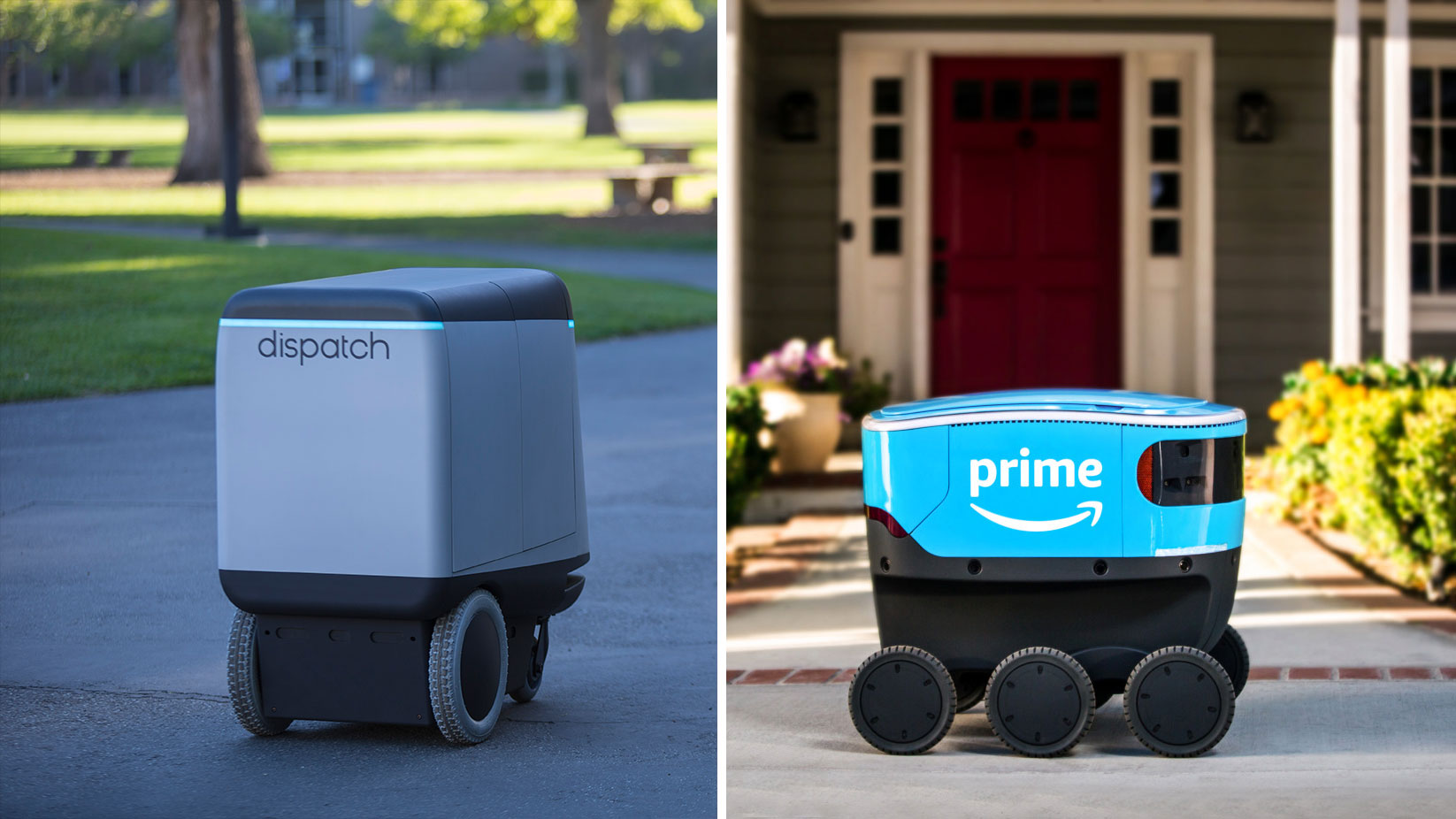
Amazon’s robot has superficial physical differences from Dispatch’s. Scout has six wheels to Carry’s four, and opens at the top instead of the side. But the vision, obstacle avoidance and navigation algorithms it requires for urban and suburban deployments will need to solve the very same problems such as uneven paving, curbs, street furniture, pedestrians and animals.dispatch-amazon-scout

Amazon likely had many more people than just the Dispatch team working on Scout. The LinkedIn profile of one of Amazon’s scientists says the company has been working on relevant robotic perception, planning and localization (mapping) technologies since 2015. But two other profiles suggest that the Scout project only became a serious business, including buy-in from Jeff Bezos, around the time that Dispatch was acquired in 2017.

Amazon never announced the acquisition of Dispatch. The company’s big news that year was buying Whole Foods for $13.2 billion.

In its latest 10-K filing with the SEC, Amazon noted, “During 2017, we also acquired certain other companies for an aggregate purchase price of $204 million. The primary reason for our other 2017 acquisitions was to acquire technologies and know-how to enable Amazon to serve customers more effectively.” Among these were home automation, e-commerce and AI businesses.

Amazon continued its buying spree in 2018, spending nearly $2.2 billion on smart security camera firm Ring, online pharmacy PillPack, and $57 million on “certain other companies.” Whether these turn out to be robotics or transportation startups like Dispatch is something we might only learn when someone notices their founders have suddenly gone quiet, too.

07 Feb 2019

Motorola’s G7 line arrives this spring, starting at $199

Weeks of leaks haven’t left much to the imagination. But for those waiting for the real thing, the latest iteration of Motorola’s budget G line just became officially official as of this morning — and with a few weeks to spare ahead of Mobile World Congress. Of course, the Moto G7 line isn’t really aimed at the MWC crowd.

That show tends to be far more focused on premium flagships, while, as Motorola put it to me ahead of launch, this line is for “people who say, ‘I don’t need all this phone.’” In other words, people who don’t want to spend $1,000+ for a flagship. As such, the line starts at $199, putting it in line with earlier models.

As ever, the line will be available in three somewhat convoluted models. There’s the G7, the G7 Play, G7 Power and G7 Plus. The Plus, which brings a number of camera effects that have trickled down from the Moto Z line, won’t be available here in the States. It is, however, available today in Brazil and Mexico and will be rolling out in Europe, Australia and other parts of Latin American, packing a 16-megapixel dual camera, OIS and “auto-smile” image capture.

As for the base-level G7, that sports a 6.2-inch display, 12-megapixel dual cameras and a beefy 5,000 mAh battery, coupled with a middling Snapdragon 632. That, too, is already available in Brazil and Mexico, priced at $299. For $249 you can get the G7 Power, which has the same screen and battery, but drops the dual cameras.

Cheapest of all is the $199 Moto G7 Play. That shrinks the screen down to 5.7 inches and pops a single 13-megapixel camera on back. The G7, G7 Play and G7 Power will be available in the States this spring. 

07 Feb 2019

Gong.io nabs $40M investment to enhance CRM with voice recognition

With traditional CRM tools, sales people add basic details about the companies to the database, then a few notes about their interactions. AI has helped automate some of that, but Gong.io wants to take it even further using voice recognition to capture every word of every interaction. Today, it got a $40M Series B investment.

The round was led by Battery Ventures with existing investors Norwest Venture Partners, Shlomo Kramer, Wing Venture Capital, NextWorld Capital and Cisco Investments also participating. Battery general partner Dharmesh Thakker will join the startup’s Board under the terms of the deal. Today’s investment brings the total raised so far to $68 million, according to the company.

$40 million is a hefty Series B, but investors see a tool that has the potential to have a material impact on sales, or at least give management a deeper understanding of why a deal succeeded or failed using artificial intelligence, specifically natural language processing.

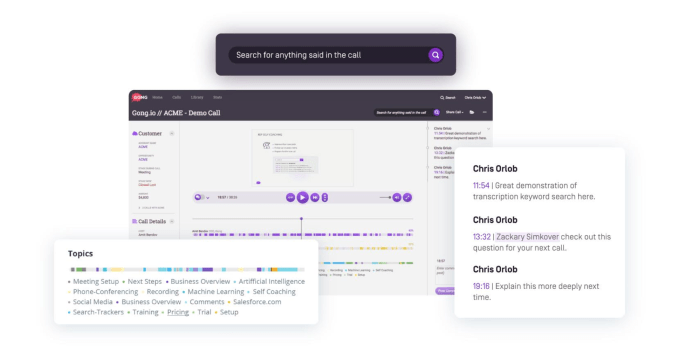
Company co-founder and CEO Amit Bendov says the solution starts by monitoring all customer-facing conversation and giving feedback in a fully automated fashion. “Our solution uses AI to extract important bits out of the conversation to provide insights to customer-facing people about how they can get better at what they do, while providing insights to management about how staff is performing,” he explained. It takes it one step further by offering strategic input like how your competitors are trending or how are customers responding to your products.

Screenshot: Gong.io

Bendov says he started the company because he has had this experience at previous startups where he wants to know more about why he lost a sale, but there was no insight from looking at the data in the CRM database. “CRM could tell you what customers you have, how many sales you’re making, who is achieving quota or not, but never give me the information to rationalize and improve operations,” he said.

The company currently has 350 customers, a number that has more than tripled since the end of 2017 when it had 100. He says it’s not only that it’s adding new customers, existing ones are expanding, and he says that there is almost zero churn.

Today, Gong has 120 employees with headquarters in San Francisco and a 55-person R&D team in Israel. Bendov expects the number of employees to double over the next year with the new influx of money to keep up with the customer growth.

07 Feb 2019

Gong.io nabs $40M investment to enhance CRM with voice recognition

With traditional CRM tools, sales people add basic details about the companies to the database, then a few notes about their interactions. AI has helped automate some of that, but Gong.io wants to take it even further using voice recognition to capture every word of every interaction. Today, it got a $40M Series B investment.

The round was led by Battery Ventures with existing investors Norwest Venture Partners, Shlomo Kramer, Wing Venture Capital, NextWorld Capital and Cisco Investments also participating. Battery general partner Dharmesh Thakker will join the startup’s Board under the terms of the deal. Today’s investment brings the total raised so far to $68 million, according to the company.

$40 million is a hefty Series B, but investors see a tool that has the potential to have a material impact on sales, or at least give management a deeper understanding of why a deal succeeded or failed using artificial intelligence, specifically natural language processing.

Company co-founder and CEO Amit Bendov says the solution starts by monitoring all customer-facing conversation and giving feedback in a fully automated fashion. “Our solution uses AI to extract important bits out of the conversation to provide insights to customer-facing people about how they can get better at what they do, while providing insights to management about how staff is performing,” he explained. It takes it one step further by offering strategic input like how your competitors are trending or how are customers responding to your products.

Screenshot: Gong.io

Bendov says he started the company because he has had this experience at previous startups where he wants to know more about why he lost a sale, but there was no insight from looking at the data in the CRM database. “CRM could tell you what customers you have, how many sales you’re making, who is achieving quota or not, but never give me the information to rationalize and improve operations,” he said.

The company currently has 350 customers, a number that has more than tripled since the end of 2017 when it had 100. He says it’s not only that it’s adding new customers, existing ones are expanding, and he says that there is almost zero churn.

Today, Gong has 120 employees with headquarters in San Francisco and a 55-person R&D team in Israel. Bendov expects the number of employees to double over the next year with the new influx of money to keep up with the customer growth.

07 Feb 2019

Africa Roundup: Zimbabwe’s net blackout, Partech’s $143M fund, Andela’s $100M raise, Flutterwave’s pivot

A high court in Zimbabwe ended the government’s restrictions on internet and social media last month.

After days of intermittent blackouts at the order of the country’s Minister of State for National Security, ISPs restored connectivity per a January 21 judicial order.

Similar to net shutdowns around the continent, politics and protests were the catalyst. Shortly after the government announced a dramatic increase in fuel prices on January 12, Zimbabwe’s Congress of Trade Unions called for a national strike.

Web and app blackouts in the southern African country followed demonstrations that broke out in several cities. A government crackdown ensued, with deaths reported.

On January 15, Zimbabwe’s largest mobile carrier, Econet Wireless, confirmed that it had complied with a directive from the Minister of State for National Security to shutdown internet.

Net access was restored, taken down again, then restored, but social media sites remained blocked through January 21.

Throughout the restrictions, many of Zimbabwe’s citizens and techies resorted to VPNs and workarounds to access net and social media, as reported in this TechCrunch feature.

Global internet rights group Access Now sprung to action, attaching its #KeepItOn hashtag to calls for the country’s government to reopen cyberspace soon after digital interference began.

The cyber-affair adds Zimbabwe to a growing list of African countries — including Cameroon, Congo and Ethiopia — whose governments have restricted internet expression in recent years.

It also provides another case study for techies and ISPs regaining their cyber rights. Internet and social media are back up in Zimbabwe — at least for now.

Further attempts to restrict net and app access in Zimbabwe will likely revive what’s become a somewhat ironic cycle for cyber shutdowns. When governments cut off internet and social media access, citizens still find ways to use internet and social media to stop them.
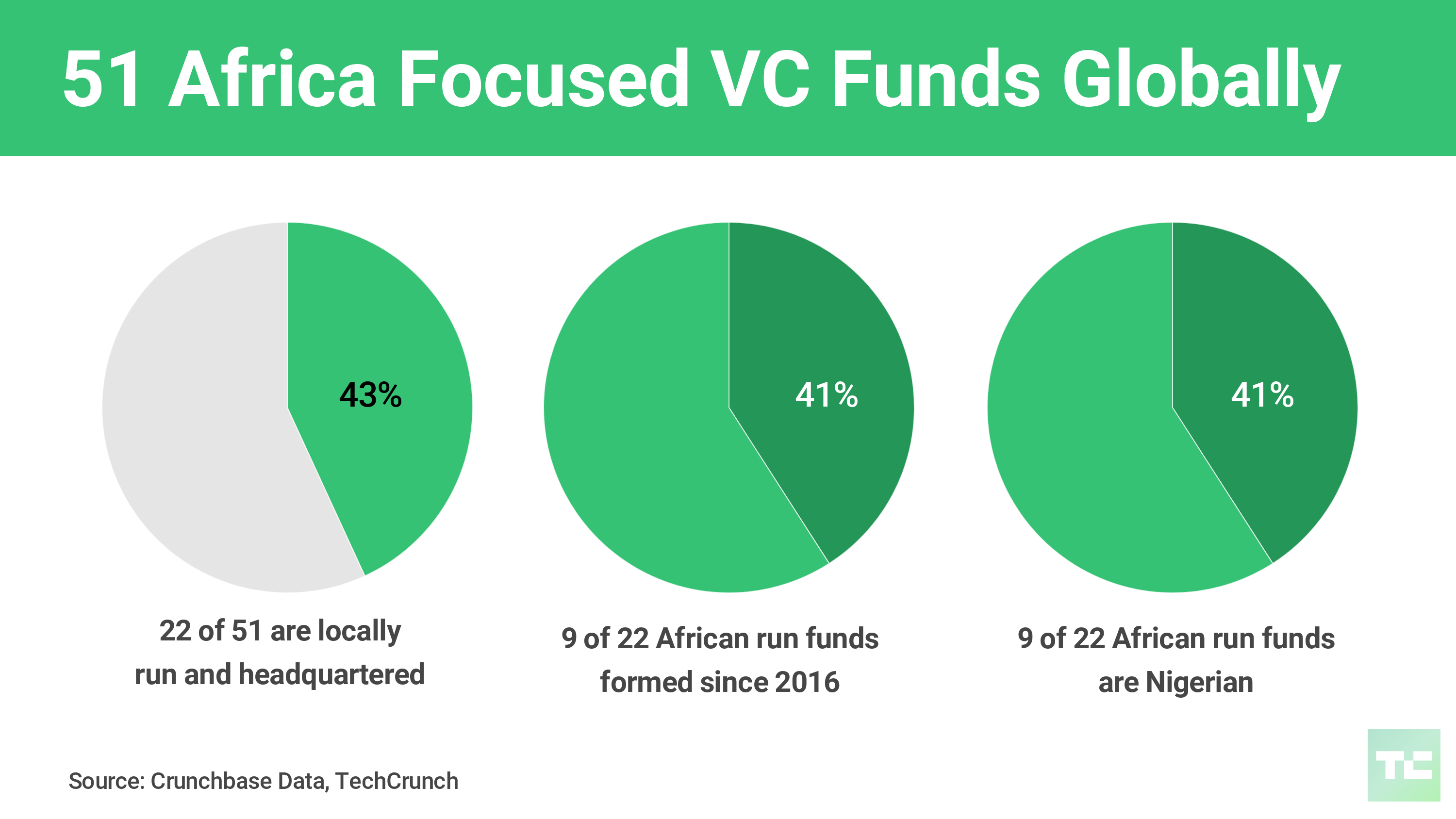
Partech doubled its Africa VC fund to $143 million and opened a Nairobi office to complement its Dakar practice.

The Partech Africa Fund plans to make 20 to 25 investments across roughly 10 countries over the next several years, according to general partner Tidjane Deme. The fund has added Ceasar Nyagha as investment officer for the Kenya office to expand its East Africa reach.

Partech Africa will primarily target Series A and B investments and some pre-series rounds at higher dollar amounts. “We will consider seed-funding — what we call seed-plus — tickets in the $500,000 range,” Deme told TechCrunch for this story on the new fund. Partech is open to all sectors “with a strong appetite for people who are tapping into Africa’s informal economies,” he said.

Partech Africa joined several Africa-focused funds over the last few years to mark a surge in VC for the continent’s startups. Partech announced its first raise of $70 million in early 2018 next to TLcom Capital’s $40 million, and TPG Growth’s $2 billion.

Africa-focused VC firms, including those locally run and managed, have grown to 51 globally, according to recent Crunchbase research.
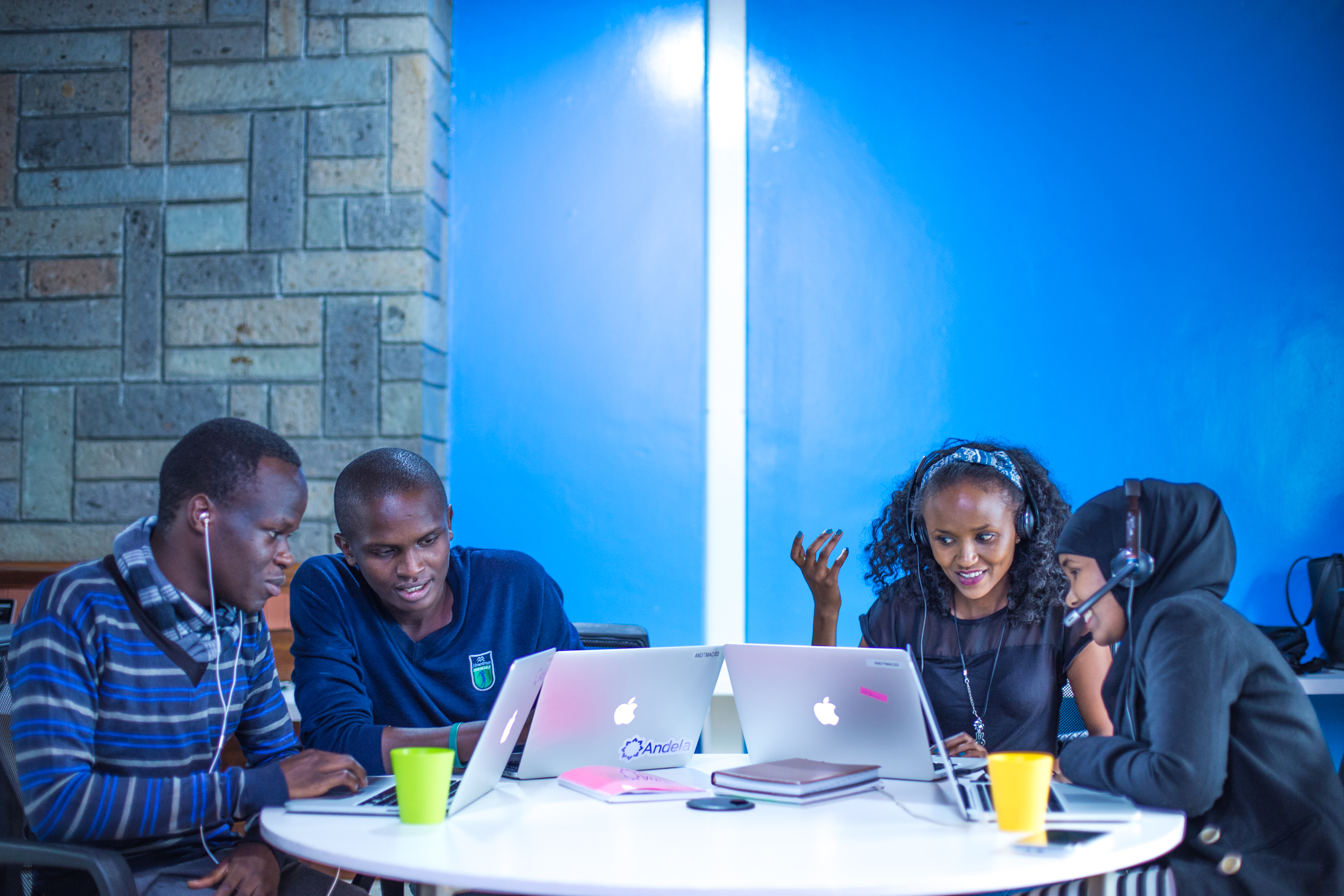
Andela, the company that connects Africa’s top software developers with technology companies from the U.S. and around the world, raised $100 million in a new round of funding.

The new financing from Generation Investment Management (an investment fund co-founded by former VP Al Gore) puts the valuation of the company at somewhere between $600 million and $700 million—based on data available from PitchBook on the company’s valuation.

The company now has more than 200 customers paying for access to the roughly 1,100 developers Andela has trained and manages.

With the new cash in hand, Andela says it will double in size, hiring another thousand developers, and invest in new product development and its own engineering and data resources. More on Andela’s recent raise and focus here at TechCrunch.
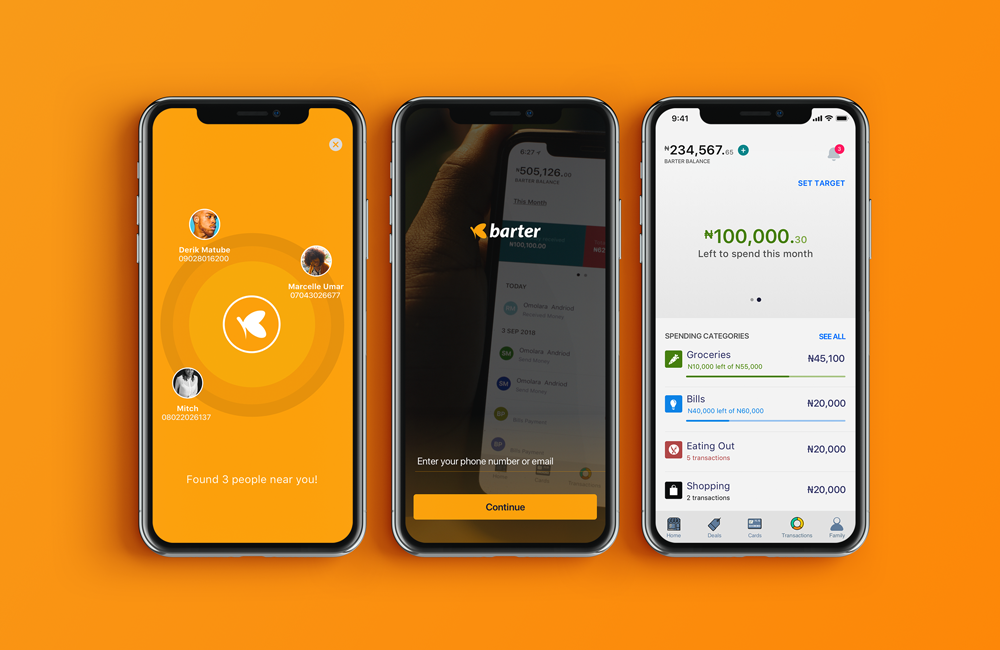
Fintech startup Flutterwave announced a new consumer payment product for Africa called GetBarter, in partnership with Visa.

The app-based offering is aimed at facilitating personal and small merchant payments within and across African countries. Existing Visa  cardholders can send and receive funds at home or internationally on GetBarter.

The product also lets non-cardholders (those with accounts or mobile wallets on other platforms) create a virtual Visa card to link to the app.  A Visa spokesperson confirmed the product partnership.

GetBarter allows Flutterwave  — which has scaled as a payment gateway for big companies through its Rave product — to pivot to African consumers and traders.

The app also creates a network for clients on multiple financial platforms to make transfers across payment products and national borders, and to shop online.

“The target market is pretty much everyone who has a payment need in Africa. That includes the entire customer base of M-Pesa,  the entire bank customer base in Nigeria, mobile money and bank customers in Ghana — pretty much the entire continent,” Flutterwave CEO Olugbenga Agboola told TechCrunch in this exclusive.

Flutterwave and Visa will focus on building a GetBarter user base across mobile money and bank clients in Kenya, Ghana, and South Africa, with plans to grow across the continent and reach those off the financial grid.

Founded in 2016, Flutterwave has positioned itself as a global B2B payments solutions platform for companies in Africa to pay other companies on the continent and abroad. It allows clients to tap its APIs and work with Flutterwave developers to customize payments applications. Existing customers include Uber,  Facebook,  Booking.com and African e-commerce unicorn Jumia.com.

Flutterwave added operations in Uganda in June and raised a $10 million Series A round in October The company also plugged into ledger activity in 2018, becoming a payment processing partner to the Ripple and Stellar blockchain networks.

Headquartered in San Francisco, with its largest operations center in Nigeria, the startup plans to add operations centers in South Africa and Cameroon, which will also become new markets for GetBarter.

And sadly, Africa’s tech community mourned losses in January. A terrorist attack on Nairobi’s 14 Riverside complex claimed the lives of six employees of fintech startup Cellulant and I-Dev CEO Jason Spindler. Both organizations had been engaged with TechCrunch’s Africa work over the last 24 months. Condolences to  family, friends, and colleagues of those lost.

More Africa Related Stories @TechCrunch

African Tech Around The Net