Author: azeeadmin

06 Feb 2019

Uber competitor Chauffeur-Privé rebrands to Kapten

French company Chauffeur-Privé is going to expand aggressively over the next couple of years. That’s why the company is changing its name to Kapten — a name that sounds less French.

“We wanted to share with you a very important piece of news,” Kapten co-founder and CEO Yan Hascoet said in a press conference. “We changed our name while keeping the same positioning.”

Kapten is one of the leading ride-sharing players in France and recently launched in Lisbon (2 million users in France, 80,000 users in Lisbon). The company is going to launch in Geneva next week and London in the coming weeks. By 2020, Kapten should be in 15 major cities.

Kapten within Intelligent Apps

As a reminder, Daimler AG acquired a majority stake in Chauffeur-Privé/Kapten back in December 2017. Daimler AG and BMW Group later merged their mobility service businesses into a single entity called Intelligent Apps.

Kapten confirmed that Intelligent Apps will become Jurbey. Intelligent Apps’ free-floating services, parking services, charging services and itinerary apps will merge to simplify the product offering.

But Intelligent Apps’ ride-sharing services (Chauffeur-Privé, mytaxi, Clever Taxi and Beat) won’t merge for now.

“It seems obvious that there will be some consolidation in five years in one way or another,” Hascoet said. “But this is not on today’s agenda.”

Hascoet thinks that the ride-sharing space is still extremely competitive and there’s room for growth. It seems smarter to keep multiple services for now to see how it plays out in the coming years. Kapten is thinking about integrating Intelligent Apps’ scooter service Hive in its app though.

A new name and some new features

Kapten is also using today’s rebranding to launch an aggressive advertising campaign. The company will spend “millions of euros.”

There will be some tweaks to the service as well. The minimum price is now €6 instead of €8 just like on Uber. Kapten will compensate that change by paying drivers the equivalent of an €8 ride for the time being. Eventually, Kapten wants drivers to generate as much revenue with €6 rides. In all cases, Kapten takes a 20 percent cut on each ride.

Drivers are also getting new features starting today. Free waiting time has been lowered from 5 minutes to 3 minutes, which should help drivers waste less time. There’s also a new feature to go back home and accept rides on the way.

The company also used this opportunity to share some numbers. Over the past 7 years, the company managed to attract 2 million clients and 200 companies who generated 20 million rides in total. In 2018 alone, Kapten handled 7.5 million rides with an average price of €17 to €18. It currently works with 22,000 drivers and 250 employees. Kapten will hire around 100 employees in 2019.

Kapten has generated $54.9 million in revenue in 2016, $113 million in 2017 and $180.8 million in 2018 (€48.6 million, €100 million, €160 million respectively). Kapten wants to multiply its revenue by 5 by 2020.

In its announcement video, Kapten also differentiated its service from Uber by saying that they’ll keep paying taxes in local markets where they operate. The company wants to be the good guy, let’s see if that’s enough to capture some market share.

06 Feb 2019

Hatch, Rovio’s ‘Netflix for gaming’, picks up NTT Docomo as a strategic investor

Rovio’s efforts to diversify beyond its Angry Birds franchise is getting a little investment boost today. The company announced that Japan’s NTT Docomo is taking a stake in Hatch, a Rovio subsidiary that describes itself as the “Netflix of gaming”, providing subscribers with a rotating mix of freemium games from a mix of publishers, with the option of paying a single monthly fee for a wider mix.

Docomo and Rovio are not discussing the size or value of the stake, but a spokesperson for Rovio told TechCrunch that prior to this deal, Hatch was 80 percent owned by Rovio and 20 percent by Hatch personnel. He didn’t specify who had sold shares to Docomo in this latest transaction.

The deal will cover not just investment to expand the Hatch platform and number of games on offer — currently the selection numbers over 100 — but to bring Hatch specifically to the Japanese market.

This will include, starting next week (February 13), a soft launch of Hatch on Android devices in the country, as well as prominent placement of Hatch on Docomo’s Android TV service, sweetening the deal with three-month free trials of the Premium tier.

The Android TV offering is a key OTT play for Docomo. Known primarily as one of the country’s biggest mobile carriers (and, historically, a trail blazer in mobile services, setting the pace for how much was building in the world of mobile content globally in the earliest days of mobile phones), like other network service providers, Docomo has been hit hard by the huge wave of services that bypass carriers and strike billing deals directly with consumers.

Hatch will be one more feather in Docomo’s cap to try to lure more people to its service, which can be subscribed to and paid for by way of Docomo’s ‘d Account’, an iTunes-style platform that people can use regardless of which network carrier they contract with.

Like Netflix, Amazon and other OTT video streaming plays, the concept behind Hatch is to offer a mix of games from various publishers, as well as developing its own selection of games in house that it hopes will be popular enough to help differentiate the service from the rest of the field.

That is critical, because Hatch and Rovio are not the only ones vying for the title of “Netflix for gaming.” Other formidable hopefuls include AmazonMicrosoft, Apple, Google, and perhaps maybe even Netflix itself.

The current selection of games on Hatch include Monument Valley, Space Invaders Infinity Gene and Hitman GO, with a new game called Arkanoid Rising — “a bold new reimagining of the arcade classic produced in association with Japanese gaming legends TAITO” — coming in the spring, which will be “the first Hatch Original exclusive to the platform.”

Down the line, there will also be collaborations to develop eSports events and more titles, Rovio said.

The move is a natural one for Hatch, given gaming culture and how strong it is in Japan.

“Japan is the world’s third largest games market and where the video games industry as we know it was born. In this extremely competitive market we couldn’t be happier to work with a partner like Docomo to help take our vision of cloud gaming mainstream,” says Juhani Honkala, Hatch founder and CEO, in a statement. “Docomo’s leading contributions to 5G technology and infrastructure and commitment to amazing new 5G-enabled services make the company an ideal strategic partner in Japan, and we look forward to a long and fruitful collaboration.”

“We are excited to work together with Hatch, a great example of the new type of consumer services, which can bring out its potential towards the 5G era,” added Takanori Ashikawa, Director, Consumer Business Department of Docomo, in a separate statement. “Hatch’s vision for cloud gaming changes the way people play and discover games, and our shared goal to enrich the everyday lives of our customers makes Hatch an excellent strategic partner for the long term.”

Since its lacklustre public debut in September 2017, Rovio has been facing a lot of growth challenges,   in part because of strong competition in the gaming industry and the company’s over-reliance on a nearly ten-year-old franchise amid a bigger industry shift to new tastes in games — marked by the rise of streamed, multiplayer titles like Fortnite.

But while overall profits have continued to decline at the company, sales of some titles have actually grown, with Angry Birds 2 — now almost three years old — surprisingly seeing a surge of growth in 2018.

In that context, a different focus by way of Hatch, with a little financial help from NTT, could be the bet that helps catapult Rovio to a new level of the gaming playing field.

06 Feb 2019

Chinese e-commerce challenger Pinduoduo is raising over $1 billion more

The price of competing with e-commerce giants Alibaba and JD.com is immense. That’s evidenced by challenger Pinduoduo, commonly known as PDD, which is raising more than $1 billion in fresh capital just six months after it went public.

The company announced plans to sell 37 million shares in a move that will raise over $1 billion, going potentially as high as $1.25 billion if underwriters exercise their full share purchase option. The secondary event will also see a number of existing backers sell a portion of their stock, those sellers including Sequoia China, Lightspeed China and Banyan, according to a filing.

PDD went public in July when it raised $1.6 billion through a Nasdaq listing.

Founded in September 2015 by ex-Googler Colin Huang, it adds a social twist to e-commerce by offering discounts for shoppers who gang up with friends or family to make group orders. That’s resonated in particular with consumers, who tend to be female, the company said. PDD claims 385.5 million active buyers with an annual GMV of RMB 344.8 billion, or $250.2 billion, as of Q3 2018.

That’s helped it make a dent in China’s e-commerce market, which is dominated by Tencent and Alibaba, although it has come at some cost. PDD isn’t profitable, and it isn’t likely to be for some time. Since going public, it has recorded net losses of RMB 6.49 billion ($981.4 million) in Q2 and RMB 1.10 billion ($159.9 million) in Q4.

Yes, there has been heady growth, revenue in Q4 surged by 697 percent year-on-year to reach RMB 3.37 billion ($491.0 million), but the corresponding operating loss increased five-fold.

Huang has described his business as a combination of Costco and Disney, which signifies “value-for-money and entertainment combined.” In a letter to shareholders, he emphasized that his vision will require a decade before it begins to reach its potential.

“It is not easy to take the leap of faith believing in such an unconventional company, which strives to meet both economic and social needs of users, and to make a positive impact to the society. The pursuit and focus of our long-term vision and intrinsic value may not always translate into near-term profits. Instead, we hope to show you the true colors of our company no matter how bumpy or rough the numbers may seem to be. We ask you to ride the journey with us for the long term. We believe it will be wonderful,” he wrote.

06 Feb 2019

Raisin raises $114M for its pan-European marketplace for savings and investment products

Raisin, the pan-European fintech marketplace for savings and investment products, is disclosing that it has raised $114 million in Series D funding. Existing investors Index Ventures, PayPal, Ribbit Capital and Thrive Ventures all participated in the round, which brings the total raised to date to $200 million.

Tellingly, the fast-growing Berlin fintech says it plans to use the new capital for “strategic acquisitions” and further internationalisation. Although available to customers across the EU from the get-go, Raisin had dedicated market launches in the Netherlands and the U.K. last year, seeing the company expand beyond Germany. It plans to add at least two additional international markets this year.

Originally founded in 2013, Raisin set out to open up the savings deposit market in Europe by taking advantage of EU-wide banking regulation, which goes someway to creating a financial services single market. Specifically, the problem the startup solves is that saving deposit rates differ not only from one local bank offer to another but more noticeably across Europe as a whole.

The Raisin marketplace lets you shop around and compare different rates European-wide. However, the key difference to a comparison site is that, via its own bank partner, the company offers consumers a single interface that includes account opening and anti-money laundering checks, making it easy to switch and continually ensure you get a competitive interest rate.

For the banks that integrate with the Raisin marketplace, especially smaller and midsize banks, they get exposure to customers across Europe that might otherwise never be reached. It also gives them potential access to many more deposits, which helps with their own balance sheet lending and scale.

To that end, Raisin says that it has brokered more than $11 billion in deposits for its 62 partner banks. It claims more than 160,000 customers from 31 different European countries, and says that to date Raisin has helped savers earn $90 million in interest.

Meanwhile, Raisin says the new “infusion” of capital will enable the fintech to strengthen its position as the preeminent online platform that gives Europeans access to the “single financial market” for savings.

Comments Raisin CEO and co-founder Dr. Tamaz Georgadze: “We want to break through unnecessary barriers to profitable saving and share the benefits of open markets – with both consumers and banks. Our central aim is to give savers and financial institutions the ‘Schengen experience’ for banking. Our first five years demonstrate that, indeed, Raisin stands for the saving and investing of the future”.

06 Feb 2019

YouTube’s CEO says it will continue addressing monetization issues, admits Rewind 2018 was “cringey”

In an open letter to YouTube creators today, YouTube CEO Susan Wojcicki admitted that even her kids think Rewind 2018 is “cringey.” Meant as a celebratory recap, the video has garnered a record-setting 15 million dislikes so far.

“We hear you that it didn’t accurately show the year’s key moments, nor did it reflect the YouTube you know. We’ll do better to tell our story in 2019,” Wojcicki wrote.

Wojcicki also mentioned important issues like Article 13, proposed legislation in the European Union nicknamed the “meme ban” for its potentially chilling effect on user-generated content and monetization. Many creators saw their revenue hurt during “Adpocalypse” last year after YouTube introduced new policies to placate advertisers.

Intended to keep ads from running in front of videos with objectionable content, creators said the policies also resulted in the demonetization of many videos without a clear reason. But the letter is unlikely to address the concerns of creators who are still trying to recover revenue or gain a better understanding of how YouTube’s policies are enforced.

For example, Wojcicki repeated the statistic that the number of YouTube creators “earning five or six figures in the last year grew more than 40 percent,” which the platform has said since at least December 2017, when Adpocalypse began. (That month, Bloomberg published a story that said YouTube claimed channels making six figures or more in revenue had increased 40 percent over the last year).

But YouTube doesn’t provide much more detail than that and though Wojcicki said that number is proof that creators are “creating the next generation of media companies and we’re thrilled to see how much the YouTube creator economy is thriving,” researchers have found that a very thin sliver of YouTubers ever make it into that revenue bracket.

For example, a professor at Germany’s Offenburg University of Applied Sciences found last year that breaking into the top three percent of most-viewed channels on YouTube might bring in advertising revenue of about $16,800 a year. Those at the very top, or top one percent, often earn revenue through other deals like sponsorships, making it even more difficult to estimate how much of their revenue comes from advertising on YouTube.

Wojcicki also did not address the fact that YouTube has been kicking off many channels that were part of multi-channel networks (MCN), often used by creators who don’t to deal directly with YouTube AdSense.

Videos are removed because they may be at risk of violating YouTube’s terms of service, but creators and MCNs have complained about the lack of transparency into how they are enforced.

Wojcicki acknowledged the communication issues and said YouTube had taken steps to improve it. YouTube Studio, to provide more insight into how videos are performing, will be available to all creators this year. YouTube is also now more responsive on social media channels. Wojcicki said it has increased the number of its responses by 50 percent and made response times 50 percent faster.

Wojcicki also noted that monetization “remains a pain point” for many creators. “Just as a reminder, we started last year with many of our largest advertisers paused because of brand safety concerns,” she wrote.

“We worked incredibly hard to build the right systems and tools to make sure advertisers feel confident investing in YouTube, and most are now back,” she continued. “On the creator side, we’ve been improving our classifiers so that we make the right monetization decision for each video,” adding that YouTube has increased the accuracy of its monetization icon system (which gives creators details about why a video has been monetized or not) by 40 percent and made it easier for creators to appeal decisions.

But she conceded that YouTube still has more work to do. Part of that effort includes giving creators other potential revenue streams, like YouTube Music and YouTube Premium, which has expanded to 29 countries from five at the beginning of 2019. It also lowered the subscriber threshold for channel memberships, which allows viewers to purchase memberships, to 30,000 from 100,000.

The “meme ban”

YouTube creators and other people who rely on the platform as a source of revenue in the EU will have an extra set of headaches to deal with next year. Last September, the EU Parliament voted to back Article 13 of the European Union Directive on Copyright in the Digital Market. Nicknamed the “meme ban” because it would mandate sites with large amounts of user-generated content to take down content that infringes on copyright, the legislation’s vague wording has led to concerns about how it would be enforced.

For YouTube in particular, Article 13 means that it would have automatically scan and filter user uploads for copyright violations, but it is unclear if its existing Content ID system would be enough for it to comply. Although memes and parodies are protected by laws in many countries, upload filters still aren’t advanced enough to differentiate between copyright violations and memes. Article 13’s opponents worry that this can have a chilling effect. Wojcicki wrote last year that it could potentially shut down the ability of millions of people to upload to YouTube and threaten “thousands of jobs” in the EU. YouTube is campaigning for the legislation to be reworded.

In today’s letter, Wojcicki said videos about the issue have been viewed “hundreds of millions of times,” but added that policymakers “lacked an understanding of the European creator community’s impact and size.”

“I shared with legislators the huge economic benefit you all bring to your home countries,” she said. “In France alone, we have more than 190 channels with more than 1 million subscriptions, with the number of E.U. channels reaching that milestone up 70% year over year.”

06 Feb 2019

Instacart faces class-action lawsuit regarding wages and tips

Instacart is facing another class-action lawsuit pertaining to the way it pays its independent contractors, NBC News reports. Instacart guarantees its workers at least $10 per job, but workers are alleging Instacart offsets wages with tips from customers.

The suit alleges Instacart “intentionally and maliciously misappropriated gratuities in order to pay plaintiff’s wages even though Instacart maintained that 100 percent of customer tips went directly to shoppers. Based on this representation, Instacart knew customers would believe their tips were being given to shoppers in addition to wages, not to supplement wages entirely.”

Instacart has had a rocky relationship over the years with its drivers and shoppers. In 2016, Instacart removed the option to tip in favor of guaranteeing higher delivery commissions. About a month later, following pressure from shoppers, the company reintroduced tipping.

In 2017, Instacart settled a $4.6 million suit regarding claims that the company misclassified its personal shoppers as independent contractors, and also failed to reimburse them for work expenses. As part of the settlement, Instacart was required to change the way it described a service fee, which many people mistakenly thought meant tip. Then, last April, Instacart began suggesting a 5 percent default tip.

In addition to the lawsuit, workers have taken to Reddit and other online forums to speak out against Instacart’s paying practices. Since introducing a new payments structure in October, which includes things like payments per mile, quality bonuses and customer tips, workers have said the pay has gotten worse — far below minimum wage. In one case, Instacart paid a worker just 80 cents for over an hour of work. Instacart has since said it was a glitch — caused by the fact that the customer tipped $10 — and has introduced a new minimum payment for orders. So, Instacart paid the worker $10.80, but just 80 cents of it came from Instacart.

“In other words, Instacart is now confirming what workers have been saying since the change in pay structure: that the company is actually using customers’ tips to pay workers’ wages,” Working Washington, a workers’ organization that represents nearly 2,000 Instacart shoppers, wrote on its blog. “When a customer tips up-front, it doesn’t mean extra money for the worker. Instacart just pays the worker less to make up for it.”

While Instacart has said this was an edge case, Working Washington says this has happened in other cases. In another case, Instacart paid a worker just $7.26 (including cost of mileage) for over two hour’s worth of work.

“Obvious explanation: the customer tipped $25,” the organization writes.

It’s not totally clear how widespread this issue is, but it does not appear to be an anomaly, according to Working Washington.

“My sense is that the pay cuts are pretty much universal — workers pretty consistently reporting getting 25% or so less after the change,” Sage Wilson, an organizer at Working Washington, told TechCrunch. “The taking tips part they have admitted is policy for smaller jobs but we have seen good evidence that it extends further than that. We have a page with some collected screenshots here: https://www.workingwa.org/instacart/receipts.”

Next week, this group plans to hold a meeting for Instacart workers nationwide. Similarly, DoorDash is also under fire, with workers alleging DoorDash is paying drivers less, depending on how much they get tipped.

TechCrunch reached out to Instacart several hours ago and has yet to receive a response. We are also awaiting comment from DoorDash.

06 Feb 2019

Two more bangers for the Switch’s NES selection: Kirby and Super Mario Bros 2

Nostalgia for the NES is high following the success of Nintendo’s classic mini consoles and the launch of its Switch Online service, which just got a couple more great additions to its selection of 8-bit games: Kirby’s Adventure and the immortally weird Super Mario Bros 2.

Kirby had just made his debut on the Game Boy, but the NES follow-up really improved things. Better controls, better graphics, still hard as hell.

Super Mario Bros 2 is remembered as a curiosity, but it deserves more than that. Sure, it’s just an asset swap for Doki Doki Panic, but that doesn’t matter. It’s a fantastic game and you should take this opportunity to play it all the way through.

As long as you’re here, I feel I should also plug the games added a couple weeks back that probably didn’t get the love they deserved, then or 30 years ago.

Blaster Master is one of my favorite games of all time and massively underplayed. It’s an early “Metroidvania,” as we call such things these days, with amazing controls both in the side-scrolling and top-down portions, and a huge, crazy world to explore. This is an absolute classic and anyone who loves the NES should play it — or, if you find the original a bit clumsy, try the recent remake, which was both faithful and added some serious upgrades.

Zelda 2 also got added two weeks ago, and while it definitely has its problems, it’s actually a really compelling game and worthy of the name. But cast aside your associations and just play it as if it’s an old gem — use a walkthrough or VGmaps to help, though, because this game is a real bastard.

So far the selections for NSO have been quite good, and they play well. The service is still extremely barebones even for its paltry asking price, but at least you can’t complain (too much anyway) about the selection of free NES titles. With a few more trickling in every month, the library will soon be quite formidable and I might even start using it instead of my hacked SNES Classic. Especially with the rumor (and near certainty) that SNES games are soon to join their 8-bit cousins.

Nintendo is definitely going through some growing pains with its online service, but I feel that in a year it’ll be up to snuff. They tend to approach everything by first establishing essentials, and then adding bit by bit. No doubt we’ll hear more at GDC and E3 later this year.

06 Feb 2019

Watch the 2019 State of the Union address here (or not)

It’s that time again — time to hear what kind of state our precious union is in. For those of you inclined to watch the temporarily delayed speech by the President, you can of course watch it in a bar and invent your own drinking game, but you can also stay home and watch it on YouTube or C-SPAN. The drinks are cheaper — and stronger.

Of course C-SPAN will have it raw, and the White House stream will probably also be a plain one. But if you want a bit of partisan spice and occasional pull quotes along the bottom, many networks are also doing live YouTube coverage. There’s a list here; pick your poison. The broadcast starts at 6 PM Pacific time. 9 for you East coasters, of course.

Here’s the PBS stream if you want to just dip in right now. It’s live now and should be fairly straightforward:

Cord cutter? If you have a smart TV or a gadget that makes your TV smart, hop onto the YouTube app or any of the major networks and you should find a link there. You could also try to get the networks via your local channels, but why?

Honestly if you don’t particularly want to watch, and I don’t blame you, it’s going to be pretty tough to avoid. Twitter will be a mess, or more so than usual; News sites will be all SOTU quotes and fact checks; YouTube will be full of snips and clips and horrible comments; Reddit and the rest of the social web will be overrun.

Your best bet is to turn on airplane mode for a little bit and sit quietly and read. Doesn’t that sound nice?

06 Feb 2019

The next integration evolution — blockchain

Here is one way to look at distributed ledger technologies (DLT) and blockchain in the context of integration evolution. Over the years, businesses and their systems are getting more integrated, forming industry-specific trustless networks, and blockchain technology is in the foundation of this evolutionary step.

Enterprise integration

Large organizations have a large number of applications running in separate silos that need to share data and functionality in order to operate in a unified and consistent way. The process of linking such applications within a single organization, to enable sharing of data and business processes, is called enterprise application integration (EAI).

Similarly, organizations also need to share data and functionality in a controlled way among themselves. They need to integrate and automate the key business processes that extend outside the walls of the organizations. The latter is an extension of EAI and achieved by exchanging structured messages using agreed upon message standards referred to as business-to-business (B2B) integration.

Fundamentally, both terms refer to the process of integrating data and functionality that spans across multiple systems and sometimes parties. The systems and business processes in these organizations are evolving, and so is the technology enabling B2B unification.

Evolution of integration

There isn’t a year when certain integration technologies became mainstream; they gradually evolved and built on top of each other. Rather than focusing on the specific technology and year, let’s try to observe the progression that happened over the decades and see why blockchain is the next technology iteration.
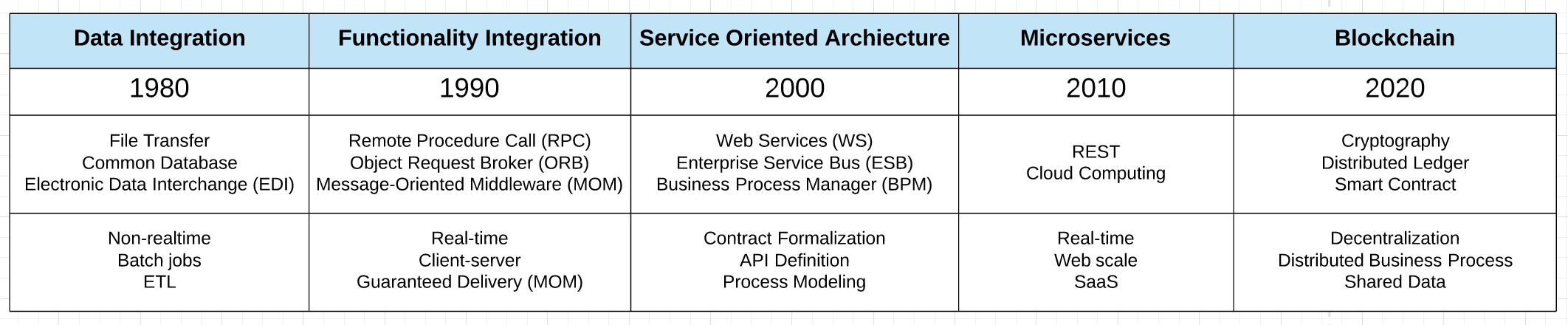
Evolution of integration technologies

Next we will explore briefly the main technological advances in each evolutionary step listed in the table above.

Data integration

This is one of the oldest mechanisms for information access across different systems with the following two primary examples:

  • Common database approach is used for system integration within organizations.
  • File sharing method is used for within and cross-organization data exchange. With universal protocols such as FTP, file sharing allows exchange of application data running across machines and operating systems.

But both approaches are non-real-time, batch-based integrations with limitations around scalability and reliability.

Functionality integration

While data integration provided non-real-time data exchange, the methods described here allow real-time data and importantly functionality exchange:

  • Remote procedure call provides significant improvements over low-level socket-based integration by hiding networking and data marshaling complexity. But it is an early generation, language-dependent, point-to-point, client-server architecture.
  • Object request broker architecture (with CORBA, DCOM, RMI implementations) introduces the broker component, which allows multiple applications in different languages to reuse the same infrastructure and talk to each other in a peer-to-peer fashion. In addition, the CORBA model has the notion of naming, security, concurrency, transactionality, registry and language-independent interface definition.
  • Messaging introduces temporal decoupling between applications and ensures guaranteed asynchronous message delivery.

So far we have seen many technology improvements, but they are primarily focused on system integration rather than application integration aspects. From batch to real-time data exchange, from point-to-point to peer-to-peer, from synchronous to asynchronous, these methods do not care or control what is the type of data they exchange, nor force or validate it. Still, this early generation integration infrastructure enabled B2B integrations by exchanging EDI-formatted data for example, but without any understanding of the data, nor the business process, it is part of.

With CORBA, we have early attempts of interface definitions, and services that are useful for application integration.

Service-oriented architecture

The main aspects of SOA that are relevant for our purpose are Web Services standards. XML providing language-independent format for exchange of data, SOAP providing common message format and WSDL providing an independent format for describing service interfaces, form the foundation of web services. These standards, combined with ESB and BPM implementations, made integrations focus on the business integration semantics, whereas the prior technologies were enabling system integration primarily.

Web services allowed systems not to exchange data blindly, but to have machine readable contracts and interface definitions. Such contracts would allow a system to understand and validate the data (up to a degree) before interacting with the other system.

I also include microservices architectural style here, as in its core, it builds and improves over SOA and ESBs. The primary evolution during this phase is around distributed system decomposition and transition from WS to REST-based interaction.

In summary, this is the phase where, on top of common protocols, distributed systems also got common standards and contracts definitions.

Blockchain-based integration

While exchanging data over common protocols and standards helps, the service contracts do not provide insight about the business processes hidden behind the contracts and running on remote systems. A request might be valid according to the contract, but invalid depending on the business processes’ current state. That is even more problematic when integration is not between two parties, as in the client-server model, but among multiple equally involved parties in a peer-to-peer model.

Sometimes multiple parties are part of the same business process, which is owned by no one party but all parties. A prerequisite for a proper functioning of such a multi-party interaction is transparency of the common business process and its current state. All that makes the blockchain technology very attractive for implementing distributed business processes among multiple parties.

This model extends the use of shared protocols and service contracts with shared business processes and contained state. With blockchain, all participating entities share the same business process in the form of smart contracts. But in order to validate the requests, process and come to the same conclusion, the business processes need also the same state, and that is achieved through the distributed ledger. Sharing all the past states of a smart contract is not a goal by itself, but a prerequisite of the shared business process runtime.

Looked at from this angle, blockchain can be viewed as the next step in the integration evolution. As we will see below, blockchain networks act as a kind of distributed ESB and BPM machinery that are not contained within a single business entity, but spanning multiple organizations.
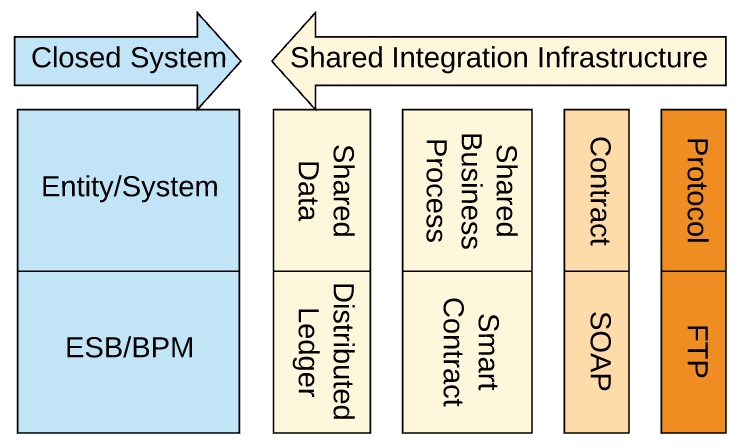
Integration technology moving into the space between systems

First the protocols (such as FTP), then the API contracts (WSDL, SOAP) and now the business processes themselves (smart contracts) and their data are moving outside of the organizations, into the common shared space, and become part of the integration infrastructure. In some respect, this trend is analogous to how cross-cutting responsibilities of microservices are moving from within services into the supporting platforms.

With blockchain, common data models and now business processes are moving out of the organizations into the shared business networks. Something to note is that this move is not universally applicable and it is not likely to become a mainstream integration mechanism. Such a move is only possible when all participants in the network have the same understanding of data models and business processes; hence, it is applicable only in certain industries where the processes can be standardized, such as finance, supply chain, health care, etc.

Generations of integrations

Having done some chronological technology progression follow-up, let’s have a more broad look at the B2B integration evolution and its main stages.

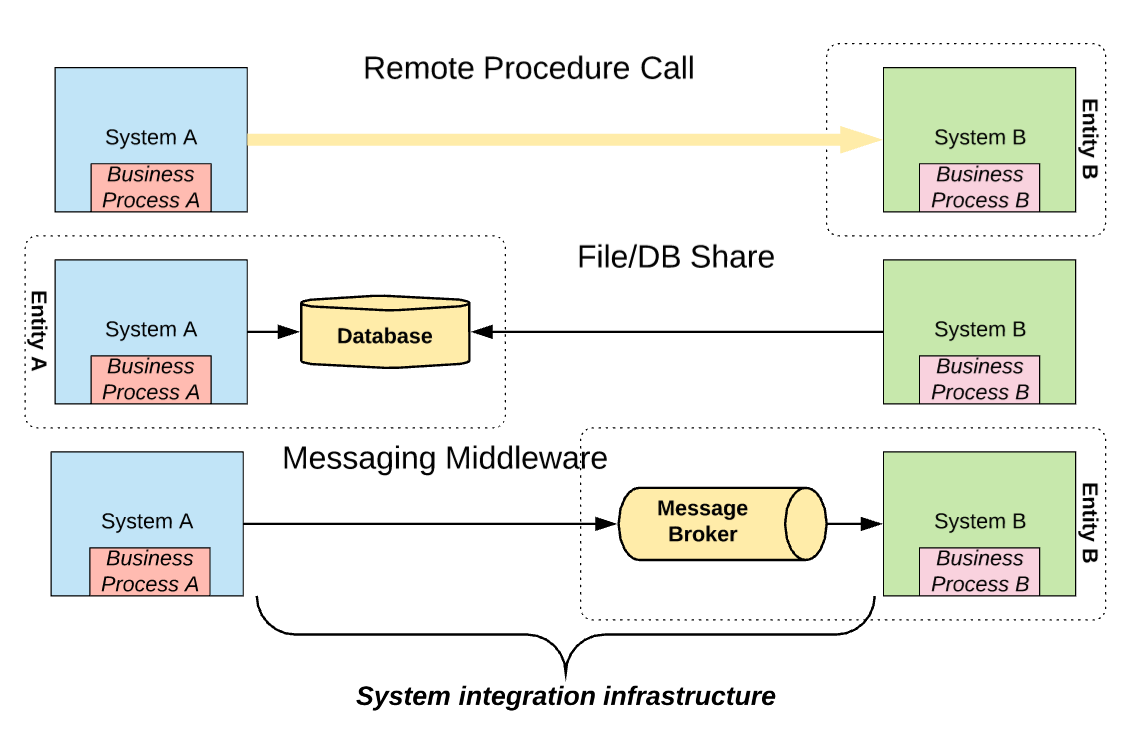
First generation: system integration protocols

This is the generation of integration technology before CORBA and SOA, enabling mainly data exchange over common protocols but without an understanding of the data, contracts and business processes:

  • Integration model: client-server, where the server component is controlled by one party only; examples are databases, file servers, message brokers, etc.
  • Explicit, shared infrastructure: low-level system protocols and APIs such as FTP.
  • Implicit, not shared infrastructure: application contracts, data formats, business processes not part of the common integration infrastructure.
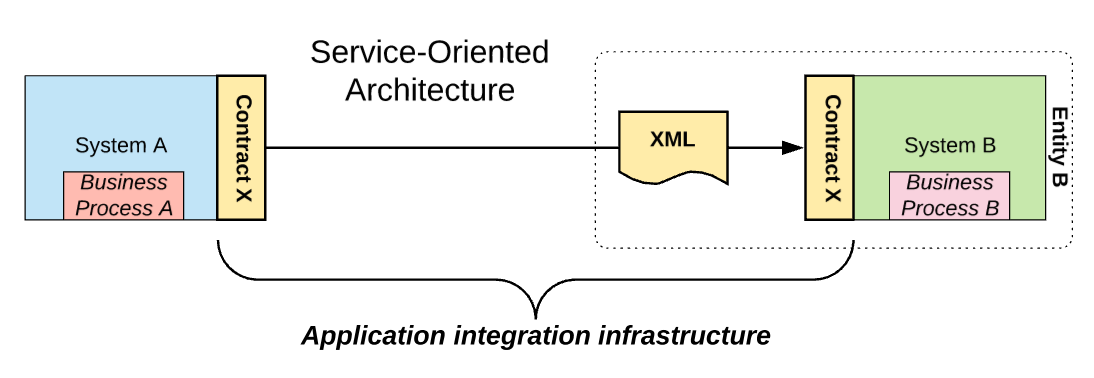
Second generation: application integration contracts

This generation of integration technology uses the system protocols from previous years and allows applications to share their APIs in the form of universal contracts. This is the next level of integration, where both applications understand the data, its structure, possible error conditions, but not the business process and current state behind it in the other systems:

  • Integration model: client-server model with APIs described by contracts.
  • Explicit, shared infrastructure: protocols, application contracts, and API definitions.
  • Implicit, not shared infrastructure: business processes and remote state are still private.
Third generation: distributed business processes

The blockchain-based generation, which still has to prove itself as a viable enterprise architecture, goes a step further. It uses peer-to-peer protocols, and shares business processes with state across multiple systems that are controlled by parties not trusting each other. While previous integration generations required shared understanding of protocol or APIs, this relies on common understanding of the full business process and its current state. Only then it makes sense and pays off to form a cross-organization distributed business process network:

  • Integration model: multi-party, peer-to-peer integration, by forming business networks with distributed business processes.
  • Explicit, shared infrastructure: business process and its required state.
  • Implicit, not shared infrastructure: other non-process related state.
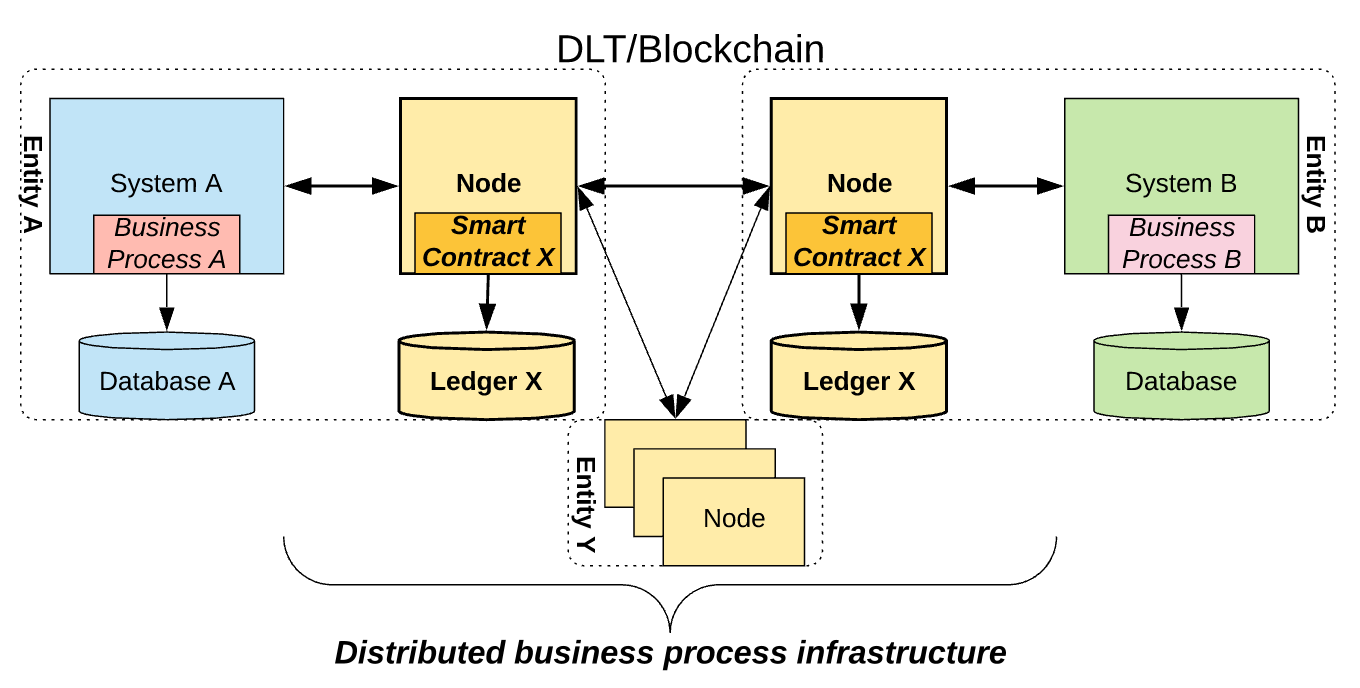
There are many blockchain-based projects that are taking different approaches for solving the business integration challenges. In no particular, order here are some of the most popular and interesting permissioned open-source blockchain projects targeting the B2B integration space:

  • Hyperledger Fabric is one of the most popular and advanced blockchain frameworks, initially developed by IBM, and now part of Linux Foundation.
  • Hyperledger Sawtooth is another Linux Foundation distributed project developed initially by Intel. It is popular for its modularity and full component replaceability.
  • Quorum is an enterprise-focused distribution of Ethereum.
  • Corda is another project that builds on top of existing JVM-based middleware technologies and enables organizations to transact with contracts and exchange value.

There are already many business networks built with the above projects, enabling network member organizations to integrate and interact with each other using this new integration model.

In addition to these full-stack blockchain projects that provide network nodes, there also are hybrid approaches. For example, Unibright is a project that aims to connect internal business processes defined in familiar standards such as BPMN with existing blockchain networks by automatically generating smart contracts. The smart contracts can be generated for public or private blockchains, which can act as another integration pillar among organizations.

Recently, there are many blockchain experiments in many fields of life. While public blockchains generate all the hype by promising to change the world, private and permissioned blockchains are promising less, but are advancing steadily.

Conclusion

Enterprise integration has multiple nuances. Integration challenges within an organization, where all systems are controlled by one entity and participants have some degree of trust to each other, are mostly addressed by modern ESBs, BPMs and microservices architectures. But when it comes to multi-party B2B integration, there are additional challenges. These systems are controlled by multiple organizations, have no visibility of the business processes and do not trust each other. In these scenarios, we see organizations experimenting with a new breed of blockchain-based technology that relies not only on sharing of the protocols and contracts but sharing of the end-to-end business processes and state.
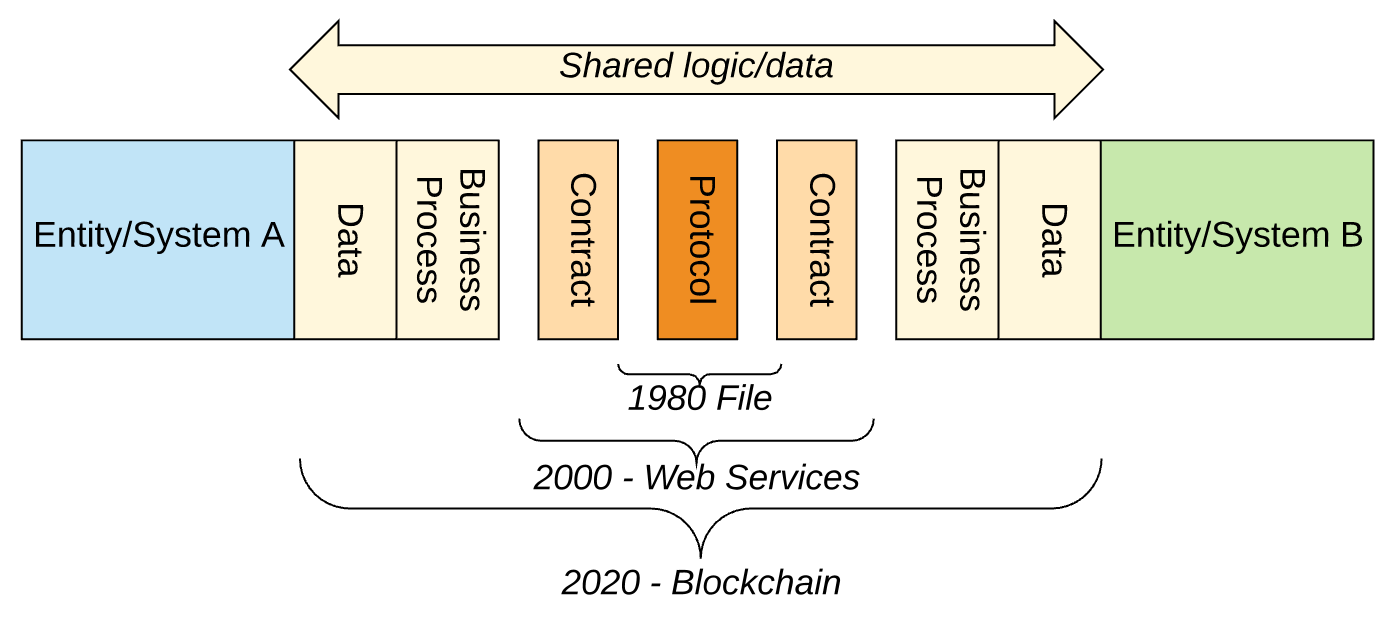
And this trend is aligned with the general direction integration has been evolving over the years: from sharing the very minimum protocols, to sharing and exposing more and more in the form of contracts, APIs and now business processes.

This shared integration infrastructure enables new transparent integration models where the previously private business processes are now jointly owned, agreed, built, maintained and standardized using the open-source collaboration model. This can motivate organizations to share business processes and form networks to benefit further from joint innovation, standardization and deeper integration in general.


05 Feb 2019

Tesla has opened an Amazon store to spread its swag far and wide

Tesla has had a brisk merch business for years now, thanks to its fervent owner base and fans, who are enthusiastic supporters of the company and its CEO Elon Musk.

But until now, those Tesla-branded items — everything from water bottles and hats to jackets, chargers and once a surfboard — have been sold through the automaker’s own website.

Tesla has now expanded it merch ambitions and opened a store on Amazon. (A reader tipped TechCrunch off to the store; however, the story was first reported by Electrek). Tesla confirmed the store opened earlier this week.

It should be noted that, for now, the store on Amazon isn’t as robust as the one on Tesla’s website. However, there are at least two items that can only be found on the Amazon page: an iPhone 8+ case and a Tesla iPhone  X folio case. No prices are listed for the items and they’re currently “unavailable.”


Tesla Amazon store

In fact, every item on the store is “unavailable.”

It’s not clear when these items will be back in stock or why they aren’t available now. Did the company sell out already? Has it simply failed to make the items available? So many questions.

Tesla merchandise, especially specialty items, do tend to sell out quickly. For instance, the Tesla branded surfboard priced at $1,500 sold out in a day. However, the mini diecast Tesla models sold on the Amazon store appear to be in stock over at Tesla’s website. We’ll update the story when the mystery is solved.