Author: azeeadmin

05 Feb 2019

Signal Sciences secures $35 million investment to protect web apps

Signal Sciences, an LA-based firm that helps customer secure their web applications, announced a $35 million Series C investment today.

Leading Edge Capital led the round (which seems appropriate, given its name). CRV, Index Ventures, Harrison Metal and OATV also participated. Today’s investment brings the total raised to around $52 million, according to the company.

The company helps protect web applications like online banking, shopping carts, email or any application you access online. It acts as a protection layer or firewall around the application, Andrew Peterson, CEO and company co-founder told TechCrunch.

“We protect people’s websites or mobile sites. We have software that actually fits in line between the internet and traffic coming into those web application and all of the data that are behind it,” Petersen explained. It sounds simple enough, but given the onslaught of breaches we have seen across the internet, it’s obviously a difficult problem to solve.

Signal Sciences looks at behavior and tries to determine if it’s malicious. “We combine attack information with behavior about what attacker is doing.” He says this gives customers a real understanding of the behavior of the attacker and what they’re trying to do against their site, instead of trying to randomly trying to determine if each suspicious activity is an attack or not.

Petersen won’t identify a specific number of customers. He feels it’s a misleading metric because some of his large enterprise customers have multiple business units running almost as independent entities and it doesn’t necessarily reflect the size of the business. He will say that Signal Sciences is protecting over 10,000 applications involving 1 trillion requests every month from companies like Adobe, Under Armour and WeWork.

The company is up to 150 employees, a number Petersen says has been doubling every year. That trend is expected to continue with this new influx of money. The company wants to get the word out to more customers and help people understand there is a way to attack this problem.

“We started this company to build an innovative technology. We want to continue to drive the bar up for what customers should be expecting from their web protection in the future,” Petersen said.

05 Feb 2019

By Humankind picks up $4M to rid your morning routine of single-use plastic

Single-use plastics are the scourge of the environment, which is why many lawmakers are working to eliminate them.

Today, a new brand is launching to try and eliminate single-use plastic in the area of personal care. With $4 million in seed funding led by Lerer Hippeau (with participation from Red Sea Ventures, BoxGroup, SV Angel, Great Oaks, SoulCycle Co-founder Elizabeth Cutler, and CPO of Adobe, Scott Belsky, among others), By Humankind offers deodorant, shampoo and mouthwash.

But unlike your typical personal care products, the By Humankind portfolio products are rethought from the ground up to eliminate single-use plastic and be kind to the environment.

For example, the mouthwash doesn’t come in a big plastic container, but rather in tablet form. Users can drop a tablet into a small cup of water and the mouthwash, which is alcohol-free, dissolves into a liquid. With the shampoo, the By Humankind team decided to eliminate the plastic bottle by simply taking a page out of the old’ soap bar playbook, creating a shampoo bar.

Meanwhile, the By Humankind deodorant comes in a refillable plastic roller, with paper-pod refills (which the company calls KindFills).

The company says that its products eliminate single-use plastic by 90 percent when compared to other products in their respective categories. Moreover, By Humankind has designed its shipping packages with biodegradable, bamboo fiber-based materials.

“Keeping our packaging footprint to a minimum is an extension of our mission, which is enabling our customers to reduce their single-use plastic waste, while not sacrificing quality or convenience,” said cofounder and CEO Brian Bushell.

Bushnell came from Baked By Melissa, where he was co-founder and CEO. A couple years after leaving the company, Bushnell went on a trip with his girlfriend to Southeast Asia. On a scuba excursion, he noticed a large amount of plastic trash in the ocean, which took him by surprise as he believed to be in one of the few untouched, idyllic parts of the planet.

“We went to the hotel into the bathroom and looked at the stuff we brought on the trip and realized that we were part of the problem,” said Bushnell. “That’s when the idea was hatched to build a personal care brand that not only cared about ingredients but about the containers they come in.”

But Bushnell knew that the mission would only be successful if the products performed well. That’s why the company spent time and resources creating high-performance formulas for its products, such as the By Humankind deodorant which the company says kills odor-causing bacteria 40 percent faster than other leading natural deodorants.

According to By Humankind, customers that switch from their current products to all three By Humankind products, with normal usage, will save five pounds of single-use plastic over the course of a year.

05 Feb 2019

Famed investor Roger McNamee once advised Facebook. Now he’s certain it’s destroying our democracy

A year ago, renowned investor Roger McNamee had much of Silicon Valley baffled.

McNamee had made his name as a tech investor in the ’80s and ’90s before cofounding the private equity firm Silver Lake Partners, then cofounding the venture capital firm Elevation Partners with singer Bono.

A musician himself, McNamee had taken to spending more and more time playing with his band, Moonalice, and performing in other gigs across the country. Yet suddenly, he was seemingly on every media outlet after writing a 6,000-word piece in Washington Monthly that outlined his growing concern that that Facebook’s business model was increasingly dangerous, to both the U.S. economy and our democracy.

Given that McNamee had been an advisor to Mark Zuckerberg early in the company’s life and profited from an early investment in the company, reporters wanted to know exactly what he saw as the problem — and he was happy to tell them. He saw bad actors on the Facebook. He saw data being scraped and sold. He was frustrated, he said, and users needed to get frustrated, too. He’d tried to talk privately to both Zuckerberg and COO Sheryl Sandberg — who he says he helped connect with Zuckerberg years ago — and they treated his concerns not as a legitimate threat to their users but as a PR crisis. When he wrote them again, he was passed along to other executives at Facebook who similarly, politely, gave him the brush-off.

Facebook might have hoped McNamee would disappear after his media tour. Instead, he sat down and began writing a book, “Zucked,” which hits bookshelves, both real and virtual, today. The reason, he told us in sit-down late last week, is simple. Facebook – – and Google — grow more dangerous by the day. And while he might not be the right messenger to convey why, someone has to do it.

“I may be the wrong messenger, but i don’t see a lot of other volunteers at the moment,” he told us, going so far as to say that he thinks the boards of both Google and Facebook have “committed malpractice” by remaining steadfastly quiet while one scandal after another has grabbed the headlines, then dissipated into the background.

For what it’s worth, we read the book and we recommend it to anyone interested in Silicon Valley’s rich history. It also provides the clearest understanding we’ve read to date of why Facebook sprang into existence when it did, and why it has flourished in ways that are unprecedented, economically and politically. “They dominate the public square in every place where they operate, and there has been no election that put them in power,” notes McNamee — and no accountability, either.

The book is a useful reminder, too, that we do have power as users, and that the ways that we’ve begun changing our collective behavior is beginning, and can continue, to impact these companies, the reach of which we’ve never before experienced and are still grappling to understand.

You can check out a review of “Zucked” here. You can also get a better understanding of McNamee’s thought process by listening to our interview with him.

05 Feb 2019

Ritual raises $25M for its subscription-based women’s daily vitamin

In the era of #spirtual and #physical #wellness, everything needs to be Instagrammable, even dietary supplements.

Ritual, a subscription-based service that charges customers $30 per month for shipments of its women’s daily or prenatal vitamins, has effectively tapped into that Instagram crowd. The company admits its social media strategy has been key to harnessing a cult following of wellness enthusiasts. Since it was founded in 2015, the business has sold 1 million bottles of vitamins; today, it’s announcing a $25 million Series B funding led by Lisa Wu at Norwest Venture Partners, with participation from Kirsten Green at Forerunner Ventures and Brian Singerman at Founders Fund.

Wu, as part of the round, will join Ritual’s board of directors.

“We were the first to market in our space to have really built a direct-to-consumer brand in the vitamin supplement industry,” founder and chief executive officer Katerina Schneider told TechCrunch. “For us, that was about having direct touch points with customers online and, for instance, responding to every single question and statement on platforms like Facebook, Instagram and Twitter with depth and purpose … There’s no comparing our product to any product out there. We have reimagined the formulation.”

The Los Angeles-based company, which launched during TechCrunch Disrupt New York three years ago, brought in a $10 million Series A financing in 2017. Including a seed round, Ritual has raised $41.5 million to date. Schneider declined to disclose its valuation but shared the startup has used the latest investment to make key additions to the management team, including hiring of chief scientific officer Nima Alamdari, a Harvard-trained physiologist, and director of scientific and clinic affairs Mastaneh Sharafi.

Ritual also plans to launch two new products, a postnatal and a post-menopausal vitamin, in 2019: “Our vision is to be that single vitamin that she needs,” Schneider said.

The Ritual team has “reimagined the vitamin from the ground up,” Schneider says, sourcing new and different ingredients to create a best-in-class supplement. To distinguish its product from competitors and justify its $30 per month price tag, Ritual provides absolute transparency of its ingredients and benefits of the vitamins and cites multiple scientific studies on web pages created for each individual ingredient.

Ingredients found in Ritual’s women’s multivitamin.

“Women deserve to know what they are putting in their bodies and why,” Schneider said.

For reference, a container of 150 Walgreens-branded women’s daily multi-vitamin is $11, significantly less than Ritual’s. Care/of, however, another venture-backed vitamin startup, charges $25 per month for packages of its women’s prenatal vitamin.

“If you were to bring together these individual ingredients together it would cost over $200 but because we are direct-to-consumer, we are able to stomach the costs of a product that wouldn’t otherwise be accessible to most women,” Schneider explained. “We are trying to create an iconic brand that is accessible for most women and we believe $30 a month — $1 a day — is an investment in your health and your long term future.”

$30 per month, however, isn’t accessible to most women. It is, however, comparable to other vitamin makers with high-quality ingredients. Ritual’s target audience, women interested in paying for subscription-based vitamins — an item that’s pretty easily accessible at your neighborhood grocery market — are less likely to be deterred by a $360 annual price tag. After all, the service will also send you a calendar invite to remind you to take your vitamins — the grocery market will certainly not provide that level of service.

05 Feb 2019

Backed by Benchmark, Blue Hexagon just raised $31 million for its deep learning cybersecurity software

Nayeem Islam spent nearly 11 years with chipmaker Qualcomm, where he founded its Silicon Valley-based R&D facility, recruited its entire team and oversaw research on all aspects of security, including applying machine learning on mobile devices and in the network to detect threats early.

Islam was nothing if not prolific, developing a system for on-device machine learning for malware detection, libraries for optimizing deep learning algorithms on mobile devices, and systems for parallel compute on mobile devices, among other things.

In fact, because of his work, he also saw a big opportunity in better protecting enterprises from cyberthreats through deep neural networks that are able to process every single raw byte within a file without ignoring anything, and that can uncover complex relations within datasets. So two years ago, Islam and Saumitra Das, a former Qualcomm engineer with 330 patents to his name and another 450 pending, struck out on their own to create Blue Hexagon, a now 30-person Sunnyvale, Ca.-based company that is today disclosing that it has raised $31 million in funding from Benchmark and Altimeter.

The funding comes roughly one year after Benchmark quietly led a $6 million Series A round for the firm.

So what has investors so bullish on the company’s prospects, aside from its credentialed founders? In a word, speed, seemingly. According to Islam, Blue Hexagon has created a real-time, cybersecurity platform that he says can detect known and unknown threats at first encounter, then block them in “sub seconds” so the malware doesn’t have time to spread.

The industry has to move to real-time detection, he says, explaining that four new and unique malware samples is released every second, and arguing that traditional security methods can’t keep pace. He says that sandboxes, for example, meaning restricted environments that quarantine cyber threats and keep them from breaching sensitive files, are no longer state of the art. The same is true of signatures, which are mathematical techniques used to validate the authenticity and integrity of a message, software or digital document but are being bypassed by rapidly evolving new malware.

Only time will tell if Blue Hexagon is far more capable of identifying and stopping attackers, as Islam insists is the case. It is not the only startup to apply deep learning to cybersecurity, though it’s certainly one of the first.

Critics, some who are protecting their own corporate interests, also worry that hackers can foil security algorithms by targeting the warning flags they look for.

Still, with its technology, its team, and its pitch, Blue Hexagon is starting to persuade not only top investors of its merits, but a growing —  and broad — base of customers, says Islam. “Everyone has this issue, from large banks, insurance companies, state and local governments. Nowhere do you find someone who doesn’t need to be protected.”

Blue Hexagon can even help customers that are already under attack, Islam says, even if it isn’t ideal. “Our goal is to catch an attack as early in the kill chain as possible. But if someone is already being attacked, we’ll see that activity and pinpoint it and be able to turn it off.”

Some damage may already be done, of course. It’s another reason to plan ahead, he says. “With automated attacks, you need automated techniques.” Deep learning, he insists, “is one way of leveling the playing field against attackers.”

05 Feb 2019

BetterCloud can now manage any SaaS application

BetterCloud began life as a way to provide an operations layer for G Suite. More recently, after a platform overhaul, it began layering on a handful of other SaaS applications. Today, the company announced, it is now possible to add any SaaS application to its operations dashboard and monitor usage across applications via an API.

As founder and CEO David Politis explains, a tool like Okta provides a way to authenticate your SaaS app, but once an employee starts using it, BetterCloud gives you visibility into how it’s being used.

“The first order problem was identity, the access, the connections. What we’re doing is we’re solving the second order problem, which is the interactions,” Politis explained. In his view, companies lack the ability to monitor and understand the interactions going on across SaaS applications, as people interact and share information, inside and outside the organization. BetterCloud has been designed to give IT control and security over what is occurring in their environment, he explained.

He says they can provide as much or as little control as a company needs, and they can set controls by application or across a number of applications without actually changing the user’s experience. They do this through a scripting library. BetterCloud comes with a number of scripts and provides log access to give visibility into the scripting activity.

If a customer is looking to use this data more effectively, the solution includes a Graph API for ingesting data and seeing the connections across the data that BetterCloud is collecting. Customers can also set event triggers or actions based on the data being collected as certain conditions are met.

All of this is possible because the company overhauled the platform last year to allow BetterCloud to move beyond G Suite and plug other SaaS applications into it. Today’s announcement is the ultimate manifestation of that capability. Instead of BetterCloud building the connectors, it’s providing an API to let its customers do it.

The company was founded in 2011 and has raised over $106 million, according to Crunchbase.

05 Feb 2019

Self-driving truck startup Ike raises $52 million

Ike, the autonomous trucking startup founded by veterans of Apple, Google, and Uber Advanced Technologies Group’s self-driving truck program, has raised $52 million in a Series A funding round led by Bain Capital Ventures.

Redpoint Ventures, Fontinalis Partners, Basis Set Ventures, and Neo also participated in the round. Bain Capital Ventures partner Ajay Agarwal has joined Ike’s board. 

Ike’s funding round will help the company expand beyond its 30-person team as it drives forward with its mission to build a commercial product at scale. It’s a mission — expand and deploy — that sounds a lot like other autonomous vehicle startups. But that’s where the parallels end.

Ike’s three founders — Jur van den BergNancy Sun, and Alden Woodrow — aren’t pushing to have the first self-driving trucks on the road. It’s a declaration, and one the company outlined Tuesday in a blog post on Medium, that lies in contrast with a budding and cutthroat industry often described as being in a frantic race.
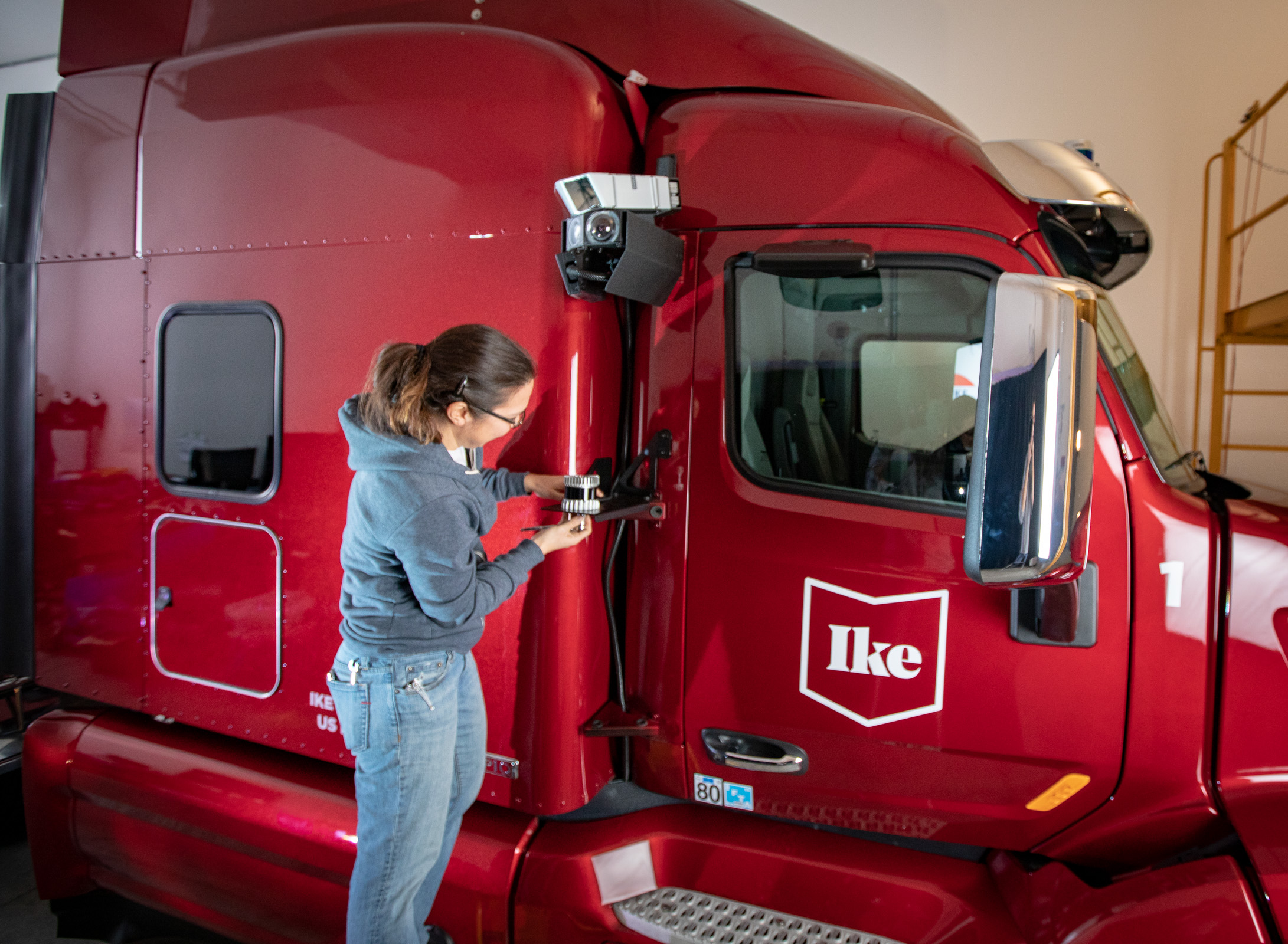
ike trucking sensors

But then again, these founders were in the thick of those buzzy, heady days of 2016 and 2017, when startups were being snapped up by automakers and big tech companies and term sheets were raining down.

Van den Berg and Sun were both working at Apple’s special projects group when they left to join Otto, an autonomous trucking startup that was acquired by Uber in 2016. Woodrow, who was product lead of Google X’s Makani project, would also end up at Uber ATG by February 2017 as group product manager of its self-driving truck program.

By 2018, the last of Otto’s founders had left Uber and the self-driving trucks program was in free fall. Sun, Woodrow, and van den Berg had left Uber by spring 2018 to launch Ike. A few months later, Uber announced it would shutter its self-driving trucks unit to focus on autonomous cars.

In short, Ike’s founders have seen a thing or two, including missteps and exciting breakthroughs, splashy reveals and a heaping spoonful of hubris.

“The temptation when you’re working on this technology — because there’s so much potential and because there’s so much excitement for it — especially for small companies in the early stages is to try and hack something together and try to get up and running really quickly,” Alden Woodrow, co-founder and CEO of Ike told TechCrunch in a recent interview.

That’s not what Ike is doing, Sun noted. Instead, the company is taking a systems engineering approach and sprinkling in a little Silicon Valley agility, Sun said.

What this means is Ike engineers aren’t focused just on quickly building out integrating self-driving software and sensors to get on the road. Instead, the company says it’s laser-focused on a systems-based philosophy. Ike is working on determining the design and architecture first before laying the foundation — to use a comparison to building a home.

It’s focused on an entire system that accounts for everything in the self-driving truck from its wire harnesses, alternator and steering column to durable sensors designed for the highway, computer vision and deep learning that allows it to see and understand its environment and make the proper decisions based on that information. That systems approach also includes proper validation before testing on public roads.

This will likely mean Ike’s self-driving trucks will launch after others. But its founders believe that when they do hit the road at scale, it will be a validated and valuable product that won’t need constant tweaks or even a pivot.

There are trade offs between all of these functional areas, Sun noted. “That’s why we need to get it right from a systems perspective and not over-rely on any one view,” Sun said.

The heads down, systems approach is a reflection of broader changes within the industry, which has since sobered up. Many companies, even those “ahead” in the race to deploy autonomous vehicles have discovered the problem is harder than expected. The days of time-lapsed self-driving videos, demos and bold claims have largely been replaced with a quieter lets-get-to-work now approach.

Ike’s plan for trucks

Ike, which is named after President Dwight D. Eisenhower and the U.S. interstate system he helped create when he signed the Federal Aid Highway Act, is trying to build a system that allows trucks to drive safely and reliably on the highway without a human driver.

However, that doesn’t mean there isn’t a place for human drivers under Ike’s model. The company intends for its trucks to only drive autonomously on highways. From there, human truck drivers would move the loads between the highways.

Ike stands apart from other self-driving truck startup in other ways too, namely its decision to license autonomous delivery company Nuro’s vehicle software stack. The copy of Nuro’s autonomous vehicle stack was a “hard fork,” Woodrow explained, meaning Ike doesn’t have an ongoing technical connection with the company. Nuro does have a minority stake in Ike.

Instead, Ike gained a copy of relevant items (and the IP rights to it) that Nuro built, including some hardware designs, the autonomous software stack and the core infrastructure, which includes data logging, maps and simulation.

“We’re making a lot of progress today on hardware, software, systems engineering without driving trucks on the road,” Woodrow said. “That’s partly because of the team we’ve assembled, but it’s also due to the licensing agreement with Nuro that has given us a set of really robust tools.”

Ike won’t be staying off the roads for long. The company is planning to begin testing its self-driving trucks (with human safety drivers behind the wheel) on public roads this year.

Still, Ike’s founders aren’t set, or even focused yet, on where it will first deploy commercially.

“Because our roadmap is measured in years, we’ve got some time to get that right,” Woodrow said.

05 Feb 2019

Vinli raises $13.5m Series B to expand its vehicle data intelligence platform

Connected car service provider Vinli today announced it closed a $13.5 million Series B financing round. The company says this infusion of capital allows it broaden its mobility services and integrations as it attempts to connect cars around the world.

The funding came from new and existing investors and brings the total amount the company raised to over $20 million.

Based in Dallas, TX, Vinli launched in 2014 in TechCrunch Startup Battlefield as a direct consumer company that allowed owners to add cloud services to automobiles. It was a clever concept, and when it launched four years ago, it was ahead of the curve. Now, in 2019, the focus of the business is different as the company seeks to provide deep data intelligence to auto makers and transportation providers.

“The investment validates our place in the industry. In the last five years, we have seen the industry unfold and evolve into an industry driven by digital services,” said Mark Haidar, CEO of Vinli, in a press release released to TechCrunch. “Companies today need viable data solutions — not only to support the growing number of data sources but to deliver on the multiple service offerings to their end customers. We’re focused on making it easier for large fleets and automakers to access smarter data intelligence. It’s in helping those partners scale and be successful is what we look forward to most at Vinli.”

Now, with the latest round of investment, Vinli is looking to integrate its platform with electric vehicles and turned to an energy company, E.ON, to examine the market. Vinli says it will expand its offerings for electric mobility and fleets of electric vehicles.

Vinli’s approaching a largely untapped market. As vehicles become more connected, there are countless data points that can be examined and expanded. With Vinli’s deep background in vehicle intelligence, it’s well suited to continue to grow and provide rich data sets of vehicle information.

05 Feb 2019

Plaid expands financial service API to include all US banks

Plaid, developers of financial services APIs, has been helping developers connect an app to a major US bank account for several years, but today they expanded that API to include all US banks, including smaller banks that might not have as advanced technology.

The product in question is called Auth. Prior to today’s announcement, this ability to easily connect to a bank account quickly was only available to roughly 3800 banks. The others required a more manual process or couldn’t participate. With this expansion, 11,500 US banks and credit unions can now connect using the Auth tool, meaning just about every bank or credit union, regardless of the backend technology.

The problem says, William Hockey, CTO and co-founder at Plaid, is that there are a variety of authentication options, depending on how sophisticated the bank’s technology might be. That meant leaving out banks or meticulously trying to code for every possibility. Plaid wanted to automate that for developers.

“Everybody in the US can actually use this product now. And some of those [connections] are super quick and instant, and some of those maybe take a day to verify, but what we’re doing is we’re wrapping all of that in the product. And so you as a developer, you don’t have to worry about all of the different authentication methods at some of these banks,” Hockey explained.

This is of course the major value proposition of any tool of this ilk, whether Stripe or Twilio or any similar product. It strips the complexity for developers, and allows them to add sophisticated functionality to an application with a couple of lines of code.

From a consumer perspective, you would select your bank from the list and the Plaid Auth tool would find the fastest connection method automatically, based on the bank’s technology.

Plaid was founded in 2013 and has raised over $300 million. The most recent round was $250 million on a $2.65 billion valuation.

05 Feb 2019

Thriva expands its range of test-at-home kits to add female hormone and cortisol stress tests

UK home health analysis kit startup Thriva is adding three more products to its range later this month: A saliva-based cortisol stress test and two female hormone kits.

The Seedcamp-backed UK startup has been offering blood-prick-based health monitoring kits since 2016, and says it’s had more than 50,000 customers sign up to stab their own finger with its spring-loaded plastic lancet and massage a drop of blood into a tube to post away for lab-based analysis.

The new saliva kit lowers the barrier to entry for DIY ‘quantified selfers’ by only requiring the recipient chew on a piece of material, and remember to do so four times the same day, before sending it away for analysis of their cortisol levels — with a result promised within 48 hours.

Thriva says the idea is to offer a snapshot of a person’s stress levels across the day to “help users to understand if their cortisol level is outside the normal range, and at what points of the day this is occurring”.

Though clearly the test isn’t going to offer a comprehensive monitoring of cortisol levels, and Thriva only suggests the test “could help” identify parts of the day which are “causing a lot of stress, or explain why someone is finding it hard to get up in the morning or get to sleep at night”.

The price for its Stress Test — £79 — does therefore seem steep. Though users get four pieces of fabric so they can perform the ‘snapshot of a day’ stress test a full four times (at ~£20 a pop).

Thriva confirmed to us that subscription pricing is not being offered for this kit.

The Stress Test kit will be available on February 18.

Female hormone testing kits

Thriva also has two female hormone tests in the pipe (also available from February 18).

One is targeted at women of child-bearing age who want to monitor their fertility levels; and another for women approaching the menopause who wish to check whether their hormones are within the menopausal range.

Both are blood-prick based tests. Each test also requires the user to answer seven questions — on topics such as fertility, physical symptoms and type of contraception used — to provide additional context for the lab that analyzes their blood.

“The questionnaire allows the doctors to tailor the interpretation of your blood results (hormone levels) to your particular symptoms/needs. It also ensures that any other relevant symptoms (e.g. irregular periods) are considered in line with the results so that recommendations of when to seek further treatment from a health professional are correct (e.g. for PCOS),” a Thriva spokeswoman told us.

The Female Hormones baseline kit tests a range of female hormones to see if levels are “in normal range”.

Tracked hormones include:

  • FSH and Luteinising hormone, which it says are essential to ovulation;

  • Oestradiol, the primary female sex hormone;

  • Testosterone, the primary male sex hormone;

  • SHBG, which affects the availability of other hormones;

  • plus hormones produced by the thyroid, which controls the body’s growth and metabolism;

Similarly, the menopause kit tests hormones including FSH and Luteinising hormone (high levels of which can be menopausal symptoms) and Oestradiol (which it says is indicative at low levels).

It also checks for thyroid problems, with Thriva saying symptoms can mimic those of menopause. And testers’ Vitamin D levels are also checked — with the company saying deficiency is common among women of this age.

As with all the kits Thriva offers, results are reviewed by “a UK-qualified GP” within 48 hours, and users are given recommendations for additional care to seek, where necessary.

Thriva suggests the home testing kits offer women a way to learn more about their bodies. Though the same hormone tests could always be requested via a GP — and would be free, under the UK’s National Health Service.

Whereas these kits are (also) priced at £79 apiece, with no subscription offers for the female hormone tests either.

The startup suggests women can benefit from obtaining hormone test results beforehand in order to have “informed discussions with healthcare professionals to improve their health and and quality of life”.

But as with many such products that pledge personal physical insight via lab-based analysis, core to the proposition is to sell the notion that the buyer gets to choose — and therefore control — the process of testing themselves. Though that ‘choice’ clearly comes with a price attached.