Author: azeeadmin

05 Feb 2019

Talia Goldberg just became the newest partner at Bessemer Venture Partners

Talia Goldberg didn’t know what venture capital was, growing up around professionals in the medical field whose favorite dinner-time game was to describe a symptom, then ask those around the table to guess the diagnosis.

Goldberg, who half-kiddingly describes herself today as a hypochondriac, says things changed during her college career at the University of Pennsylvania, where she entered into its liberal arts program but wound up spending increasing amounts of time at the business school. “I kind of recognized that business was happening at a faster pace than ever and started getting excited about the technology” driving that momentum.

Goldberg says she became particularly fascinated with how the internet was changing behaviors, including how people communicate, “though i was approaching at the time from an e-con and marketing perspective.” It was around then that she discovered First Round Capital, the Philadelphia-based seed-stage firm, which had decided during Goldberg’s senior year in 2012 to open up an office on Penn’s campus. It was the site of the firm’s first Dorm Room fund, a $500,000 vehicle for 11 students at Penn and Drexel to invest in student-led startups, and Goldberg, one of founding partners, was soon hooked. Indeed, though she worked at Foursquare as a business development associate while still at school, she knew that if she could, she’d prefer to keep investing.

Luckily, an introduction to Bessemer Venture Partners followed, along with a job offer for to join the firm as an analyst. She signed on, assuming the gig would last two years, after which she would either join a portfolio company or perhaps launch her own company. But she fell even further in love with VC and, more specifically, “spending my time thinking about new ideas and meeting with some of the most talented entrepreneurs in the world and learning about the fields in which they operate.”

Apparently, Bessemer thought she had a knack for turning those learnings into interesting deals. She was paired with Jeremy Levine, a partner who joined Bessemer more than 17 years ago. and he closely mentored Goldberg while also encouraging her to learn her own style and approach, she says. “I was very fortunate that Jeremy was in the New York office and that he offered me the opportunity to work alongside him as an apprentice for years.

“That kind of mentorship is super rare, and that’s really where I learned the craft of VC.” (While once common, many firms now eschew the apprenticeship model, preferring to hire either seasoned investors or else successful founders as partners and seldom hiring graduates directly from MBA or undergraduate programs.)

In fact, fast-forward six years and Goldberg, who joined Bessemer in 2012, has been a principal with the firm and a vice principal and today, she becomes its newest partner, a move that owes to numerous deals that she has either sourced or spearheaded, including in the home services software giant ServiceTitan, Korea’s top payment app Toss, and the password management startup Dashlane.

Goldberg has also supported the firm’s investments in Pinterest, Collective Medical Technologies, and Wikia.

Asked what she has learned from being immersed in the world of VC, the list is long, including that price does matter, and so does having a prepared mind. She also notes that more than ever, she appreciates the importance of patience. “You always have to stretch for great companies, but the culture at Bessemer is that when there’s something that seems expensive, we’re not under pressure to act in any way that’s unnatural.”

Goldberg has also been in the business long enough at this point to watch portfolio companies go out of business. “I’ve definitely been involved in situations like that, and they’re never easy.” It underscores the importance of picking the right partner, she adds. “When things are going up and to the right, it’s easier for everyone to be nice. It’s during hard times, when things become more challenging, that you see people’s true colors and realize that not everyone is there to support you.”

How does she handle it personally? “When we need to, we give the hard feedback. Having an intellectually honest relationship is crucial, because when you see that things aren’t working, making changes sooner than might feel comfortable is almost always the right decision.”

05 Feb 2019

Sonos unveils in-ceiling, in-wall and outdoor speakers

Sonos is partnering with Sonance for a new lineup of passive speakers. You can now pre-order in-ceiling, in-wall and outdoor Sonos speakers.

These are weird products as you still need to connect those speakers with a Sonos Amp. In other words, you can’t control those speakers from the Sonos app without the Sonos Amp.

But if you’re building a house and you want to put Sonos speakers around the house, this lineup is a good way to make sure that everything will be optimized for the Sonos ecosystem.

The in-wall and in-ceiling speakers are designed to blend in with your walls. You can even paint on the grilles to make them disappear even more. They’ll start shipping on February 26 and you can pre-order them now — each pair of speakers cost $599.

Outdoor speakers also come as a pair. They aren’t available just yet, but they’ll cost $799 a pair whenever they ship. And they should resist to extreme temperatures, water and UV rays.

According to the company, you can plug three pairs of speakers to a single Sonos Amp. If you plan on building a giant house, you can still buy multiple Amps and stack them up.

Like other Sonos speakers, you can tune them using Trueplay. This process uses your iPhone or iPad microphone to analyze the size of your room and how your furniture affects your speaker. Sonos then adjusts speaker settings.

05 Feb 2019

Amazon invests in Hatch Baby, launches Baby Skill Activity API as it eyes up the next generation of parenting products

Amazon today is one of the biggest retailers of gear for babies and other parenting aides, and today the company is taking another two steps into that business and how it might develop in the future.

Amazon today announced that it would be launching a new Baby Skill Activity API, so that baby apps and baby care devices can get updated and checked through voice commands, by way of Alexa and Alexa-powered devices. Available initially in the US, initial skills will include the ability to track weight, sleep, diaper changes and feeding, with more to be added down the line. Hatch Baby, Baby Connect and Wildflower Health are the first three partners developing skills using the API.

Alongside this, Amazon is is making an investment in Hatch Baby, the startup behind the Grow connected baby changing mat, the Rest children’s sleep-regulating light, and a service that offers Q&A with childcare professionals.

Ann Crady Weiss, the co-founder and CEO of Hatch Baby, said in an interview that the funding is part of a strategic partnership between Amazon and her company that will include Hatch developing content for Amazon’s Alexa voice-based interactive service — the funding is coming from Amazon’s Alexa Fund — as well as working longer-term on hardware and other initiatives.

The financial terms of Amazon’s investment are not being disclosed — the Alexa Fund, Amazon’s $200 million-or-so corporate venture fund focused on investing in startups strategic to Amazon’s ambitions in voice services and other new areas of business, generally does not disclose stakes.

Weiss did confirm that the investment was in addition to other funding that the startup has raised to date — $18.7 million to date, with its last valuation around $36.5 million — from investors that include True Ventures (where she is a partner), Shea Ventures, Geoff Ralston and Chris Sacca (who invested in Hatch after it appeared on Shark Tank). And it has come as Hatch is working on its next round of funding.

“Amazon is clearly an incredible force when it comes to everything consumer internet… so when they came calling, we were very eager to have them participate as a strategic investor,” she said.

(Weiss herself is a partner at True, and a repeat entrepreneur, having sold her previous startup, a parenting blog called Maya’s Mom, to Johnson & Johnson-owned BabyCenter in 2007.)

For Amazon, the deal with Hatch will give it a stronger link to one of the bigger startups targeting new parents. Hatch had already developed some content for Alexa — right now, its Alexa Skill includes the ability to track diaper changes, nursing sessions, bottle feeds, sleeps and a baby’s weight — and the investment will secure Hatch’s commitment to invest in and expand that functionality as part of a bigger push that Amazon is making into developing Skills specifically tailored to parents.

“The Alexa Fund was created to support companies embracing voice technology and exploring new and compelling uses for Alexa,” said Paul Bernard, director of the Alexa Fund, in a statement. “We see parenting and health and wellness as two areas where voice can make customers’ lives simpler, and Hatch Baby has a clear vision of how Alexa and other Amazon services can help them better support parents. We’re excited to give them the access and resources they need to expand their skill for Alexa and explore further integrations across Amazon.”

What Amazon is hoping to build up with expanded parenting Skills in Alexa is more engagement from parents. In that regard, its interest in building up that skill gives a glimpse into how the e-commerce giant links its voice-based activities with overall engagement and purchasing on its platform: the more that people find Amazon to be a useful platform for all things parenting — including advice and enhanced features for products people already own — the more likely they will be to use and trust Amazon for making more baby- and child-related purchases big and small. 

Today, Amazon already has a big business in baby and childcare goods. After streamlining its own storefront strategy by shutting down the less profitable Diapers.com today it sells a significant range of everyday products led by its own Amazon Elements line, which made its debut in 2014 with baby wipes and diapers and now accounts for 15 percent of all baby wipes sales on the platform, outpacing Huggies at 11 percent, according to figures from market research firm 1010data.

Amazon also sells a wide range of other items that might be purchased less frequently but represent higher gross merchandise value, such as strollers and other travel gear, food-related appliances and other accessories, toys, apparel, connected scales and so on.

Alongside this — and because of that breadth — the company runs one of the most popular baby registry services, a way for people to tag items in a wish list of what they would like to have, and for friends and family to buy all that for them.

Getting promoted better in the baby registry was one reason Weiss said her company wanted to work more closely with Amazon. In turn, it’s providing more content to keep parents tied into using Amazon as their go-to platform for all things parenting.

“Amazon typically do a great job with shopping, but not with engagement. We are interested as a registry partner for us to get more visibility, and they are interested in us as partner to help engage moms and dads beyond the sale,” Weiss said.

But while Alexa skills may be the order of the day, this is not the only area where Amazon and Hatch might collaborate in the future. Amazon has tapped other interesting hardware makers who first became connected to the company by way of the Alexa Fund. Perhaps most notably, it acquired smart doorbell maker Ring last year after initially investing in it.

“We believe very much will continue to create hardware,” Weiss said. “Our philosophy is to create better versions of the things people already use, and our roadmap is very consistent with that.” On the subject of how it might work with Amazon on that, all she would say is that “it is something we have engaged with Amazon on, and have been impressed about the quality of exchange with its experts.”

05 Feb 2019

Report: Smart speaker adoption in U.S. reaches 66M units, with Amazon leading

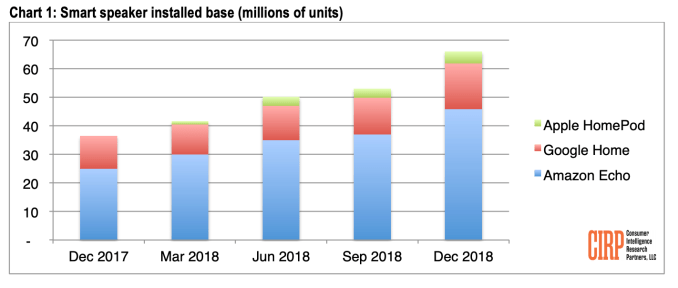
Smart speakers had a good holiday. Amazon already said its Echo Dot outsold all other items on its site this holiday season, which hinted toward the sizable growth for the voice-powered speaker market. Today, research firm CIRP is reporting the U.S. installed base for speakers grew to 66 million units in December 2018, up from 53 million in the September 2018 quarter and just 37 million in December 2017.

However, holiday sales didn’t have much impact on the market shares for the various speaker brands, the firm found.

Amazon Echo devices still lead the U.S. market with a 70 percent share of the installed base, followed by Google Home at 24 percent, then Apple HomePod at 6 percent, the report said.

“Holiday shoppers helped the smart speaker market take off again,” said Josh Lowitz, Partner and Co-Founder of CIRP, in a statement. “Relative market shares have remained fairly stable, with Amazon Echo, Google Home, and Apple HomePod accounting for consistent shares over the past few quarters. Amazon and Google both have broad model lineups, ranging from basic to high-end, with even more variants from Amazon. Apple, of course, has only its premium-priced HomePod, and likely won’t gain significant share until it offers an entry-level product closer to Echo Dot and Home mini,” Lowitz added.

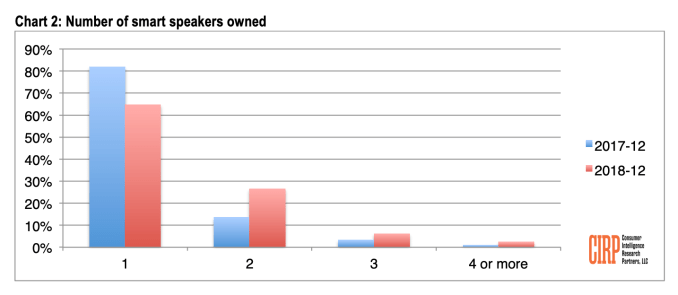
Also of interest is that some portion of those buying a smart speaker for their home already own one. According to CIRP, 35 percent of smart speaker owners now have multiple devices, as of December 2018. That’s up from 18 percent in December 2017.

This figure is key to the device markers’ larger strategies, because it means that once a company is able to get that first sale, the consumer may return to buy more devices from the same vendor.

Amazon had gained an early advantage here, initially convincing more users to buy another speaker compared with Google Home users. A year ago, almost double the number of Echo users had multiple devices, versus Google Home owners. But Google is catching up, and now about a third of Echo and Google Home users have multiple devices.

It’s worth noting that CIRP data – like much that’s produced by market research firms – isn’t always going to match up exactly with other firms’ estimates and forecasts.

For example, Strategy Analytics this fall said that Amazon’s Echo market share in the U.S. was 63 percent, to Google’s 17 percent and Apple HomePod’s 4 percent. Meanwhile, eMarketer’s 2019 U.S. forecast predicts Amazon Echo will end up with around a 63.3 percent market share this year, versus Google Home’s 31 percent, with all others like HomePod and Sonos, reaching 12 percent.

That said, the broad strokes across all reports point to the same general findings – that Amazon is leading the U.S. market by a wide margin, and while that margin may be shrinking, it’s not going away soon.

05 Feb 2019

Justice Department: No evidence of vote hacking during 2018 election

There is “no evidence to date” that any foreign government had a material impact on voting machines or infrastructure during the 2018 midterm elections, according to a new classified report sent to the president.

That’s the view from the Justice Department and Homeland Security, which were commissioned to report back following an order from President Trump last year to monitor the elections for foreign interference.

According to a brief statement from acting attorney general Matthew Whitaker and Homeland Security secretary Kirstjen Nielsen, there is “no evidence to date that any identified activities of a foreign government or foreign agent had a material impact on the integrity or security of election infrastructure or political/campaign infrastructure used in the 2018 midterm election.”

Although the final report remains classified and out of the public eye, the government said that the elections weren’t tampered with — or at least enough to swing an election.

That lack of distinction is likely to raise eyebrows, given that the state of election security is known for its vulnerabilities.

While much of the focus has been on foreign powers — like Russia and Iran — trying to influence elections in recent past by sowing discord using U.S. social media platforms as weapons, much less focus has been on the voting machines and election infrastructure themselves.

Security experts have long complained that the old, outdated machines can be easily hacked — either in person but also in some cases over the internet, allowing anyone — including state actors — to meddle with the results. Worse, many voting machines are electronic only and don’t print a paper confirmation, making it impossible to know if your vote was accurately counted. Security experts have long said the most secure way of counting a vote is using pencil and paper — like in the U.K. and Europe. Democratic lawmakers last year introduced a bill that would make a paper trail mandatory in future elections.

Tuesday’s statement isn’t likely to assuage fears for some — particularly those who first-hand know the risks that electronic election machines pose.

Neither Whitaker nor Nielsen said what evidence they had to say there was no direct meddling with election equipment, but said their advanced efforts to work with federal and local partners in all 50 states in the run-up to the midterm elections helped to secure infrastructure and “limit risk posed by foreign interference.”

But efforts to safeguard the 2020 elections are already underway, they said.

05 Feb 2019

Facebook now lets everyone unsend messages for 10 minutes

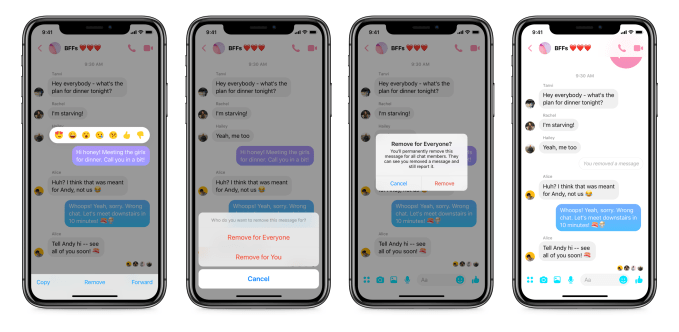
Facebook has finally made good on its promise to let users unsend chats after TechCrunch discovered Mark Zuckerberg had secretly retracted some of his Facebook Messages from recipients. Today Facebook Messenger globally rolls out “Remove for everyone” to help you pull back typos, poor choices, embarrassing thoughts, or any other message.

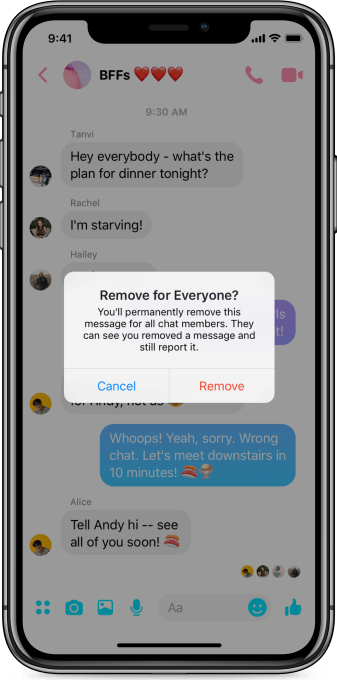
For up to 10 minutes after sending a Facebook Message, the sender can tap on it and they’ll find the delete button has been replaced by “Remove for you”, but there’s now also a “Remove for everyone” option that pulls the message from recipients’ inboxes. They’ll see an alert that you removed a message in its place, and can still flag the message to Facebook who’ll retain the content briefly to see if its reported. The feature could make people more comfortable having honest conversations or using Messenger for flirting since they can second guess what they send, but it won’t let people change ancient history.

The company abused its power by altering the history of Zuckerberg’s Facebook’s messages in a way that email or other communication mediums wouldn’t allow. Yet Facebook refused to say if it will now resume removing executives’ messages from recipients even long after they’re delivered after telling TechCrunch in April that “until this feature is ready, we will no longer be deleting any executives’ messages.”

For a quick recap, here’s how Facebook got to Unsend:

-Facebook Messenger never had an Unsend option, except in its encrypted Secret messaging product where you can set an expiration timer on chats, or in Instagram Direct.

-In April 2018, TechCrunch reported that some of Mark Zuckerberg’s messages had been removed from the inboxes of recipients, including non-employees. There was no trace of the chats in the message thread, leaving his conversation partners looking like they were talking to themselves, but email receipts proved the messages had been sent but later disappeared.

-Facebook claimed this was partly because it was “limiting the retention period for Mark’s messages” for security purposes in the wake of the Sony Pictures hack, yet it never explained why only some messages to some people had been removed.

-The next morning, Facebook changed its tune and announced it’d build an Unsned button for everyone, providing this statement: “We have discussed this feature several times . . . We will now be making a broader delete message feature available. This may take some time. And until this feature is ready, we will no longer be deleting any executives’ messages. We should have done this sooner — and we’re sorry that we did not.”

-Six months later in October 2018, Facebook still hadn’t launched Unesned, but then TechCrunch found Facebook had been prototyping the feature.

-In November, Facebook started to roll out the feature with the current “Remove for everyone” design and 10 minute limit

-Now every iOS and Messenger user globally will get the Unsend feature

So will Facebook start retracting executives’ messages again? It’d only say that the new feature would be available to both users and employees. But in Zuckerberg’s case, messages from years ago were removed in a way users still aren’t allowed to. Remove for everyone could make messaging on Facebook a little less anxiety-inducing. But it shouldn’t have taken Facebook being caught stealing from the inboxes of its users to get it built.

05 Feb 2019

Europe’s highest human rights court to hear challenge to UK’s bulk surveillance regime

The Grand Chamber of the European Court of Human Rights (ECHR) has agreed to hear a legal challenge to the use of bulk data collection surveillance powers by UK intelligence agencies.

Last September a lower chamber of the ECHR ruled that UK surveillance practices violated human rights law but did not find bulk collection itself to be in violation of the convention.

The civil and digital groups and charities behind the challenge, which include Liberty, Privacy International and Amnesty International, are hoping for a definitive judgement against bulk collection from Europe’s highest human rights court.

The legal challenge dates back around five years, and stems from the 2013 disclosures of government surveillance programs revealed by NSA whistleblower Edward Snowden .

The ECHR’s lower court heard an amalgam of complaints from three cases. And in a landmark judgement last fall it found the UK’s bulk interception regime had violated Article 8 of the European Convention on Human Rights (a right to respect for private and family life/communications); and Article 10 (the right to freedom of expression and information).

The court found there was insufficient oversight of the Internet infrastructure and communications selected for interception and searching; and also insufficient safeguards for journalistic material.

The court also ruled against the government’s regime for obtaining data from communications service providers, finding it violated both articles.

But the judges declined to find the state surveillance regime unlawful on the grounds that it constituted “general and indiscriminate” retention of data.

This is important because the legal framework around surveillance in the UK had already been superseded — with the Investigatory Powers Act, which was passed in 2016 — enshrining a number of bulk powers in law, alongside what the government bills as an adequate oversight framework. (Though it has since been forced by domestic courts to rework certain aspects of the legislation judged to be disproportionate.)

The groups behind the human rights challenge argue the lower court’s judgment “did not go far enough with regard to the unlawfulness of bulk interception powers and the fundamental shortcomings in inter-state intelligence sharing based on communications intercepts”.

Hence now pushing for an overarching judgement from judges in the Grand Chamber which — if it goes their way — could force the UK to radically rethink its approach to intelligence capabilities and put a check on the creeping encroachment of state surveillance.

Commenting in a statement, Caroline Wilson Palow, general counsel at Privacy International, said: “The UK Government continues to intercept enormous volumes of internet traffic flowing across its borders. And it continues to have access to similarly vast troves of information intercepted by the US Government. We call on the Court to reject these mass surveillance practices and find that they are fundamentally incompatible with the rights to privacy and freedom of expression enshrined in the European Convention on Human Rights.”

“The surveillance regime that the UK Government has built seriously undermines our freedom. Spying on vast numbers of people without suspicion of wrongdoing violates everyone’s rights to privacy and free expression, and can never be lawful,” added Megan Goulding, lawyer for Liberty, in another statement. “We welcome the opportunity from the Court to prove that indiscriminate state snooping is incompatible with our rights.  We need a rights-respecting and targeted surveillance system — not one where everyone is treated as a suspect as they go about their everyday lives.”

Also commenting in a statement, Lucy Claridge, director of strategic litigation at Amnesty International, said: “Industrial scale mass surveillance makes it incredibly difficult for organisations such as Amnesty International to carry out their vital human rights work. It’s critical that they are able to seek and receive information of public interest from their confidential sources, free from government intrusion.”

There’s little prospect of an imminent check on the UK’s current bulk-based surveillance modus operandi via this legal route, with what could be a wait of several years before the Grand Chamber even hears the case. 

Add to that, at that unknown future time it’s still anyone’s guess whether the UK — which is in the process of trying to determine how it will exit the European Union — will still be a party to the European Convention on Human Rights or not.

While the ECHR is attached to the Council of Europe, rather than the EU itself, some elements of the Conservative Party have been pushing to pull the UK out of the convention too. Which throws a potential future spanner in the works of this rights based challenge.

05 Feb 2019

Bots are cheap and effective. One startup trolls them into going away

Bots are ruining the internet.

When they’re not pummeling a website with usernames and passwords from a long list of stolen credentials, they’re scraping the price of hotels or train tickets and odds from betting sites to get the best data. Or, they’re just trying to knock a website offline for hours at a time. There’s an entire underground economy where bots are the primary tools used in automating fraudulent purchases, scraping content and launching cyberattacks. Bots are costing legitimate businesses money by stealing data, but also hogging system resources and costly bandwidth.

Clearly, the existing approach of playing bot Whac-A-Mole isn’t working.

“Until now you just had to suck it up as a cost of doing business,” said Johnny Xmas, director of field engineering at Kasada, an anti-bot startup that strikes at the heart of the bot economy itself by frustrating bots with complex tasks.

Their system is simple enough. Bots, said Xmas, are the “white noise” of the internet. Once a bot is started, they keep going until they’re told to stop or their job is done. Kasada tricks bots into thinking that their job is never done. By serving up a small but difficult math puzzle before the site even loads, it tricks the bot into spending its time solving the puzzle and not scraping the site as it thinks it’s doing.

Weeks earlier, Xmas tweeted a photo of Kasada’s proprietary platform Polyform. A single bot made close to four million requests to a website in a single day. Instead of loading the target website, Kasada pushed its randomly generated JavaScript code that loads silently in the browser to the bot instead. For more than 24 hours, the bot was sinking all of the cloud processing resources into trying to solve an impossible math challenge.

“This guy’s [cloud] bill is going to be nuts,” he tweeted.

The company’s aim isn’t to defeat the bot, but the reason for starting it in the first place, said Sam Crowther, Kasada’s co-founder, in a call with TechCrunch. “We cost them money, making their projects not fiscally viable,” he said.

Here’s how it works. Each time someone — or something — visits a website, Kasada accurately fingerprints the requester, using several methods to determine if it’s a bot or not. If not, the site loads as if nothing happened, taking only a few milliseconds off the load time. If it’s a bot, Kasada throws the bot the puzzle, keeping it busy. The bot thinks the website has loaded and doesn’t trigger any warnings on the back-end, all while busy plunging its resources into trying to understand and solve the math problem. “You don’t want to alert the person behind the bot, or they’ll just keep trying,” said Crowther. That’s when the bot starts churning more and more of its resources, and eventually topping out. “The human launches the bot and walks away,” he said. “Often the account maxes out and runs out of money long before the human comes back.” Even if the bot is automatically adding more resources, it won’t ever solve the puzzle. All while the processor usage is spiking, the bots don’t have the resources to target other sites — whether it’s a paying customer or not, said Crowther.

“We’re cleaning up the internet,” said Xmas. “We want to disenfranchise bots from operating to begin.”

Bot authors take weeks or even months to develop code that will target specific kinds of sites hoping for a big eventual payoff, Crowther explained. Retail outlets, hotels, major financial institutions, and realty listings — all revenue-making customers in the company’s portfolio — are at risk of bots that, if successful, could reap a huge reward.

“One bot targeted a betting company we protected, grabbing odds so that the most cost-effective bets are being placed at the micro-level — like stock trading,” said Xmas. “They’ll put months into a bot that’ll defeat every bot detection system.”

But already the team is finding some bot owners meeting their match.

In one case, Crowther and Xmas — both based in the company’s Chicago office — said they had one company, which they declined to name, was the target of account fraud and scraping. The company came in and stopped the automated logins and scraping of identity documents — preventing a wider attack hitting some 30,000 consumers from identity theft.

“One case we had a betting site where 95 percent of the traffic was bots,” said Xmas. “Think of that. You’re paying for tons of servers, tons of bandwidth because you think you’re doing a ton of business — and you’re making a lot of money so it seems rational,” he said. “Then you find out that 95 percent of that was trash.”

“At first we thought, ‘oh shit, what did we break?’,” he said. “It turns out we broke an insane botnet.”

The two recalled how one suspected bot operator was so frustrated by the company’s anti-bot countermeasures, he sent an abusive note to the company.

“The guy who was running some bots figured out it was us who was stopping them,” said Xmas. “And he went to our website, hit the contact us button, and wrote a very angry letter.” Crowther said that the company caught the bot controller’s IP address because he submitted the “not very nice email” through its contact form. “We found one that he was located that was in Sydney,” where one of the company’s offices is located. Xmas joked that he told Crowther, knowing who the bot operator was, to “send him a t-shirt.”

Or, better yet, Xmas said, “take that angry email, blow it up, and make it the wallpaper in our Sydney office.”

05 Feb 2019

Super Bowl LIII set streaming records, while TV viewership saw massive drop

Football fans didn’t tune into this year’s Super Bowl coverage on TV in as large numbers as in years past. According to Nielsen, the big game drew an average televised audience of around 98.2 million viewers. CBS, however, said the big game was watched across all platforms – including digital and streaming – by a combined total of 100.7 million viewers. In addition, the streaming coverage of the game broke new records this year, which helped to make up for the TV audience decline.

The network said the streamed event was watched across 7.5 million unique devices, up more than 20 percent from last year. Streaming viewers watched over 560 million total hours of live game coverage, up more than 19 percent from 2017. And the average minute audience of 2.6 million viewers during the game window was up over 31 percent year-over-year.

The live stream’s record-breaking numbers were aided by the fact that the stream itself was available unauthenticated across CBSSports.com, the CBS Sports app, NFL.com, the NFL app, and Verizon mobile properties – including Yahoo Sports, Yahoo, AOL, AOL Sports, and Tumblr. (Disclosure: TechCrunch is owned by Verizon.)

The live stream was also made available on CBS’s subscription streaming service, CBS All Access, which saw a record number of new subscriber sign-ups, unique viewers and time spent on Super Bowl Sunday – following the service’s recent record-breaking weekend attributed to the Season 2 premiere of Star Trek: Discovery and the AFC Championship Game.

CBS All Access sign-ups were up 84+ percent on Super Bowl Sunday, while unique viewers were up over 46 percent, and time spent was up over 76 percent, CBS said.

Streaming, combined with TV viewers and CBS digital properties like CBS Interactive, NFL digital properties, Verizon Media mobile properties, and ESPN Deportes TV and digital properties, brought the total audience to 100.7 million, as noted above. But 149.0 million watched the game either all or in part (meaning they watched at least 6 minutes of the TV broadcast), according to Nielsen data cited by CBS.

However, Nielsen also pointed out that TV viewership saw a massive drop this year for what was generally thought to be a pretty boring game (and boring halftime show.)

According to the measurement firm’s preliminary results released Monday evening, the telecast of Super Bowl LIII on CBS drew an average TV audience of about 98.2 million viewers.

That’s down 5 percent from last year, when 103.4 million people watched the Super Bowl on NBC, and a 12 percent drop from 2017’s game on Fox. The New York Times noted, attributing the declines to the forgettable game, New Orleans fans tuning out, NFL boycotts over Colin Kaepernick’s treatment, and other factors. It’s also the smallest TV audience since 2008, when the Giants beat the Patriots.


05 Feb 2019

Little Spoon gets $7M for its organic baby food delivery service

Little Spoon, a startup producing modular packages of nutritional, direct-to-consumer baby food, has raised a $7 million round of funding lead by Vaultier7.

The subscription-based service delivers meals — a fixed $3 apiece — to customers’ doorsteps. To date, Little Spoon said it has delivered 1 million meals. Other investors in the round include Kairos, Chobani’s executive vice president of sales Kyle O’Brien, Tinder founders Sean Rad and Justin Mateen, Interplay Ventures, the San Francisco 49ers and SoGal Ventures.

Among the business’s co-founders are Michelle Muller, chief executive officer Ben Lewis, chief product officer Angela Vranich and chief marketing officer Lisa Barnett, a former partner at Dorm Room Fund and Sherpa Foundry. The four launched the company a little over a year ago out of New York. Today, the site offers a rotating menu of 50 different recipes and 80 different ingredients.

“Our success is a testament to what we are seeing more broadly in the parenting space,” Barnett told TechCrunch. “There are a lot of demands for brands from this generation of parents.”

As an investor privy to rising trends within the technology and entrepreneurship space, Barnett became interested in the growing parenting tech sector.

“There has definitely been an eruption in the space,” she said. “I think there’s going to be the next big brand in this parenting space and I think that is what Little Spoon can be and is working toward becoming.”

Little Spoon members are given a personalized meal plan when they register with the service. The startup’s packaging is 100 percent recyclable, spoon included, which they say is a “developmentally advantageous form factor that promotes improved motor skills and mindful eating habits.”

The startup plans to use the capital to expand its line of baby meals.

And if you’re wondering why the 49ers invested in a baby food startup… “The 49ers were looking to partner with startups that drive innovation in and access to healthier lifestyles,” Lewis told TechCrunch. “They look for companies making it easier for the average American to live a healthier life, and we found a shared passion in our vision to make quality nutrition accessible to children everywhere.”