Author: azeeadmin

05 Feb 2019

Lunchr grabs $34 million for its corporate lunch card

French startup Lunchr is raising a $34 million funding round (€30 million) from Index Ventures, with existing investors Daphni, Idinvest and Kima Ventures also participating. The company had already raised $13 million 7 months ago (€11 million).

In France, companies of a certain size have to support employees in one way or another when it comes to their lunch break. Big companies usually build out a cafeteria while small companies hand out meal vouchers.

Lunchr focuses on meal vouchers. Originally, employees received paper vouchers at the beginning of each month. But meal voucher companies, such as Edenred or Sodexo, now also provide an alternative to paper vouchers. You can get a payment card to pay some or all of your food using a card reader.

While this is a a good idea on paper, many restaurants and supermarkets still don’t accept meal voucher cards as you have to update your card terminals. Apps also don’t work that well so it’s hard to know if you have money left on your account.

Lunchr wants to provide a better experience. And it starts with a card that works in more places. Restaurants don’t need to do anything as long as they already accept paper meal vouchers. Lunchr currently supports 200,000 places in France.

The company also takes advantage of the fact that a company is going to switch everyone to Lunchr, not just some employees. It means that everyone has a Lunchr account, the Lunchr app and a Lunchr card.

That’s why you can also use the Lunchr app to order food around your office. Other employees can add stuff to your order and one employee can pick up the order for everyone. Lunchr has negotiated discounts with restaurants — you unlock discount on big orders. On average, people who order food via the app get an 18 percent discount.

With today’s funding round, the company wants to attract 200,000 by the end of 2019. Redbull in France, LeLynx.fr, Spotify in France, Qonto and Payfit use Lunchr already.

While Lunchr is competing with bigger companies, 85 percent of meal vouchers in France are still paper vouchers. Companies will consider switching to payment cards in the coming years and it presents a big opportunity for Lunchr.

04 Feb 2019

Account linking could make Instagram the heir to Facebook Login

Teens’ aversion to Facebook jeopardizes not only the company’s feed ad revenue, but its dominance as an identity provider. The Facebook Login platform keeps people tied to the social network in order to easily access other apps without a separate username and password. But for younger users who ditch or neglect Facebook in favor of Instagram, the tech giant stands to lose one of its most powerful wedges into our lives. Meanwhile, Instagram loyalists are forced to juggle multiple sets of login credentials to manage their personal, Finsta and business accounts.

But a new feature in development could make it easy to operate multiple Instagram handles while poising the app as a successor to Facebook Login. Instagram has prototyped the “Main Account” feature that would let users set one of their profiles as a primary account and then link their other accounts to it. Logging into the main account would instantly log them in to the rest, as well. From then on, users would only need to remember a single email/username and password combo. Simpler login could get people switching accounts, posting and engaging more with Instagram.

Account linking could also power up Instagram’s existing login platform. Currently, third-party apps use it to let you compose feed posts and Stories and then share them to Instagram, or to measure the activity and mentions of business accounts. But Instagram could potentially expand the login platform to let you bring more of your identity or profile info to other apps similar to Facebook Login. That might work better if you could log in through your main Instagram account and then choose which profile you wanted to use or share back to from another app.

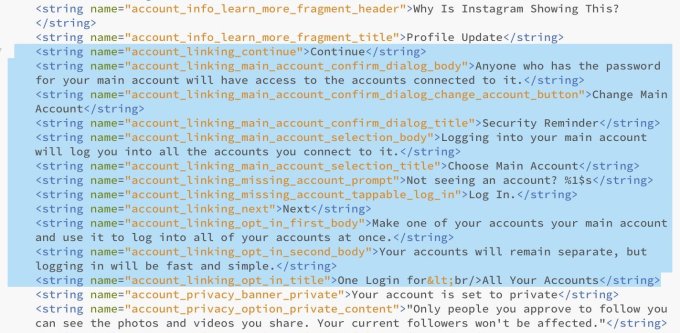
TechCrunch was tipped off to code for “Account Linking” in the Instagram for Android alpha version’s APK files by social media researcher Ishan Agarwal. The code explains “Quickly and securely log in to all of your Instagram accounts with one ID and password . . . Make one of your accounts your main account and use it to log in to all of your other accounts at once . . . Your accounts will remain separate but logging in will be fast and simple . . . Anyone who has the password for your main account will have access to the accounts connected to it.”

Instagram declined to comment regarding the feature. That’s standard for the company when it has prototyped something it is trying out with employees but hasn’t done any external testing. But many features first spotted in the app’s code at this stage go on to be fully rolled out, like Instagram video calling, nametags and soundtracks.

Facebook colonized the web using its login platform, scattering buttons with its logo on sites as an alternative to having to create a new account for every service. This helped grow Facebook’s user base, lock in users so it’d be harder for them to deactivate, develop new sources of feed content and gather data on what people did around the web. Many users who’ve stopped heavily posting to or reading Facebook still maintain a connection with the social network because they rely on it to log in to Spotify, Netflix and other services.

In fact, Facebook’s login platform is one of its most valuable features, where it lacks strong competition. Google runs its own identity platform, but with people increasingly using two-factor authentication and other security to protect their Gmail accounts, it can sometimes be a bit clumsy. Snapchat is trying to build up its own Snap Kit login platform with partners like Poshmark, but few mainstream apps have implemented it for account creation.

Instagram has been tinkering with other features around the concept of identity. It launched Close Friends for sharing Stories just with your besties, rolled out its own two-factor authentication option and is adding a way to syndicate your feed posts to multiple accounts you control. Getting users to establish a main account could also smooth Facebook’s plan to offer encrypted cross-app messaging between itself, Instagram and WhatsApp. Your main account might be a stand-in for your real identity as Instagram doesn’t force a real-name policy on users like Facebook does.

If you start to think of Instagram as not just a parallel social network to Facebook but as either an escape pod or heir to the throne, it’s important to consider how Facebook’s core assets will weather the transition. Recent profile redesigns have already tried to make your Instagram profile the center of your online personality. Uniting the prismatic shards of your identity through account linking could let you carry that personality with you across the web.

04 Feb 2019

Equity Shot: All about Slack’s confidential IPO filing

Hello, and welcome back to Equity, TechCrunch’s venture capital-focused podcast, where we unpack the numbers behind the headlines.

Today we’re bringing back an old Equity format: The Shot.

No, I haven’t started drinking again. Equity Shots are short takes on breaking news. And no news was more explosive recently than word that Slack has filed to go public confidentially. Confidentially in that we don’t get to see the numbers (yet), but publicly in that the company went ahead and told the world that it had filed, privately, with the SEC.

Which, as our own Danny Crichton points out, is open once again now that the government has reopened.

If you want to follow along with the numbers as we talk, this post is where most of my notes are, and you can read all of TechCrunch’s Slack coverage here.

We’re back in a flash with our regular weekly episode on Friday. Stay cool!

Equity drops every Friday at 6:00 am PT, so subscribe to us on Apple PodcastsOvercast, Pocket Casts, Downcast and all the casts.

04 Feb 2019

Alphabet revenues are up 22% but the stock is still dropping

Despite delivering a Q4 earnings beat, Google parent company Alphabet’s stock is dropping. The company reported revenue of $39.3 billion, up 22 percent year-over-year with an EPS of $12.77. Alphabet stock dropped more than 2 percent in after-hours trading.

Advertising revenues were up 20 percent YoY in Q4 to $32.6 billion. “Other” revenues (Cloud, hardware) were reported at $6.49 billion, up 31 percent year-over-year. “Other Bets,” which includes ventures like Waymo, Fiber and Verily, saw losses climb sharply to $1.3 billion with revenue sitting at $154 million, short of Wall Street estimates.

A number that analysts were increasingly looking closely at, traffic acquisition costs, climbed to $7.4 billion in Q4 up 15 percent year-over-year and up 13 percent from last quarter.

We’ll have more information from the investor call.

Updating

04 Feb 2019

Women’s networking company Elpha launches out of Y Combinator

Leap, the women’s networking group that was developed by Y Combinator, is spinning out of the company with a new name — Elpha.

Co-founded by Cadran Cowansage, 

The idea for Elpha came to Cowansage years ago, but was launched in 2017 with the support of Y Combinator. Initially Leap was a nights and weekends project (as Cowansage puts it), but it now boasts 7,500 active members. Including its co-founders Abadesi and Kuan. Abadesi started as the first community lead for the Leap group, where she joined from Product Hunt, and was also the founder of Hustle Crew — a group focused on inclusion in tech.

Kuan, a former New Yorker, is a startup veteran who led the design team at the New York database technology development company Cockroach Labs and the architect of a retreat for women leaders in tech called “For The Women”.

While the company is no longer directly affiliated with Y Combinator, it is going through the accelerator’s winter batch and YC has come on as an investor, according to Cowansage — taking the traditional 7% ownership stake for its $150,000 investment.

04 Feb 2019

Nest’s security system can now be a Google Assistant

A bit over a year after its release, Nest’s security alarm system is picking up a new trick: it can now double as a Google Assistant device.

Nest announced the new functionality this afternoon, saying that its being “pushed out to all Nest Secure systems both new and old” today.

This update effectively turns the Nest Secure’s keypad hub into a Google Home Mini, allowing you to do things like say “Hey Google, turn off the lights” or “Hey Google, arm the alarm” on the way out the door. It’s worth noting, though, that you can’t turn the alarm off with your voice — they don’t want people shouting through your door to disable your alarm, after all. To turn the alarm off, you’ll still need to use either the Nest app, one of Nest’s key fobs, or to punch your PIN into the hub.

Wondering how the heck the Nest Secure hears you? The current current spec page for the Nest Secure’s control hub (or “Nest Guard” as the hub is known), for example, makes no mention of a microphone. I can’t find any mention of it in the manual, either. And yet…

Turns out the Nest Guard has had a microphone all along, though it “has not been used up to this point.” That’s… a little strange, to say the least. It’s nice to be able to flip on new features when the time comes, but the spec page probably should’ve mentioned the microphone from the beginning (even just to say “There’s a microphone in there, but it’s not used for anything right now.”) There’s no shortage of Internet-connected devices with microphones built-in, but said mics are usually made a bit more obvious.

We reached out to Google for confirmation of the microphone hardware and more details on when the feature will go live. A Google spokesperson responded:

The Google Assistant on Nest Guard is an opt-in feature, and as the feature becomes available to our users, they’ll receive an email with instructions on how to enable the feature and turn on the microphone in the Nest app. Nest Guard does have one on-device microphone that is not enabled by default.

04 Feb 2019

YouTube expands test of its Instagram-like Explore tab to more devices

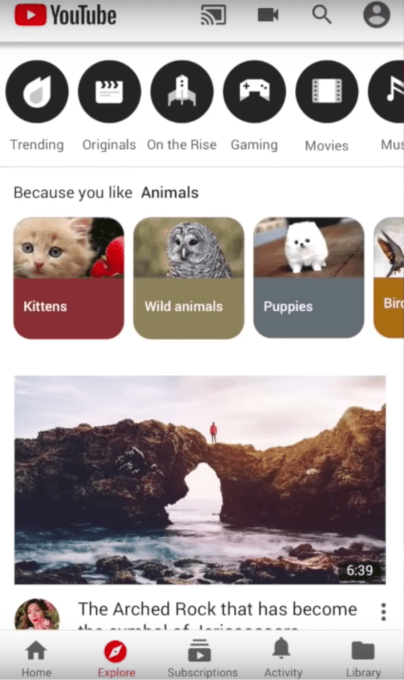
YouTube is expanding the test of its “Explore” feature, a new discovery tool it first introduced as an experiment within its iPhone app last year. Similar to Instagram’s Explore page, the new YouTube feature aims to introduce users to a diverse set of personalized recommendations so they can more easily find something new to watch. The test is now available across devices, and has been updated to also suggest smaller, up-and-coming YouTube creators, the company says.

The changes to Explore were announced in a recent Creator Insiders video, where the company shares ideas it’s thinking about or testing ahead of a public debut — like a change to the “dislike” button, for example.

Last year, the company published a video to Creator Insiders where it talked about a plan to develop a new place within the YouTube app that would help people broaden their horizons when looking for something different to watch.

Today, YouTube’s recommendation technology relies heavily on past viewing activity and other in-app behavior to make its content suggestions, the company explained. With the Explore tab, however, YouTube aims to widen recommendations to include various topics, videos and channels you may not have otherwise encountered.

For instance, the Explore section might recommend videos about high-end cameras after you watched videos about telescopes. Or it might recommend videos about kittens or puppies because you watched other animal videos.

When YouTube launched Explore last year, the test was only rolled out to 1 percent of YouTube’s iPhone app users.

On testers’ devices, Explore replaces the Trending tab in the app’s navigation at the bottom of the screen. The section of Trending videos then became just another sub-category within Explore, alongside other top-level sections like Gaming, Movies, Music, Originals and more.

While Explore was initially available only to iPhone users, the test has now gone live across devices, including iPhones, iPads, Android phones and tablets and on the desktop, YouTube confirmed to TechCrunch. But it’s still only available to a “small amount” of testers, the company says.

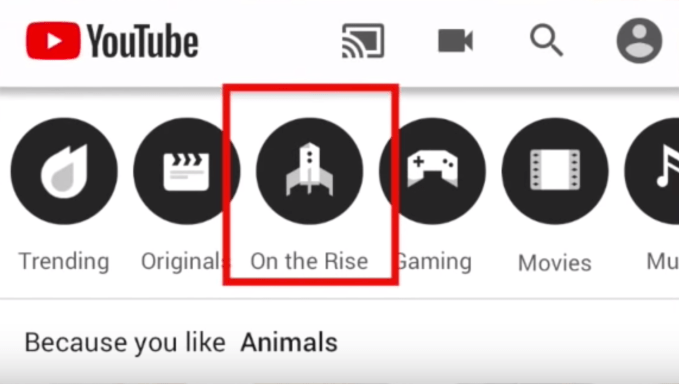
In addition, Explore has been updated to include a new section called “On the Rise,” which will feature up-and-coming YouTube creators.

Here, a shelf is shown showcasing creators with fewer than 10,000 subscribers. These suggestions are personalized to you, too, based on which channels you currently like and regularly watch.

Beneath the “Under 10K” section are other creators YouTube thinks you’ll like, based on your YouTube watch history as well as those whose channels are watched by other fans of your favorite creators.

These recommendations may include those channels with more than 10,000 subscribers, but there will be a cap on how many subscribers a creator can have to be categorized within this “On the Rise” section. (That cap is still TBD, though.)

We understand that while YouTube has expanded the experiment’s reach, it doesn’t yet have a definitive plan for rolling out to the public the Explore tab.

For now, Explore is still considered an experiment and the company is looking to gather more feedback before making a formal decision about the feature’s wider availability.

04 Feb 2019

VW’s Electrify America will use Tesla battery packs to lower charging costs

Electrify America, the entity set up by Volkswagen as part of its settlement with U.S. regulators over its diesel emissions cheating scandal, plans to install Tesla Powerpack battery systems at more than 100 of its electric vehicle charging stations this year.

Electrify America aims to use the Tesla Powerpacks to offset the cost of charging for customers. Owners of electric vehicles face high costs if they charge their vehicles during peak demand hours. The Tesla Powerpack battery systems store energy drawn from the grid during off-peak hours. That stored energy can then be used during peak demand hours when charging costs are higher. Each site will consist of a 210 kW battery system with roughly 350 kWh of capacity, according to Electrify America.

“Our stations are offering some of the most technologically advanced charging that is available,” Electrify America CEO Giovanni Palazzo said in a statement. “With our chargers offering high power levels, it makes sense for us to use batteries at our most high demand stations for peak shaving to operate more efficiently. Tesla’s Powerpack system is a natural fit given their global expertise in both battery storage development and EV charging.”

Electrify America has committed to investing $2 billion over 10 years in clean energy infrastructure and education. The VW unit expects to have 484 electric vehicle charging stations with more than 2,000 charging dispensers installed or under construction by July 1.

The company will begin the next phase of installations this summer.

Electrify America’s bet on Tesla battery systems illustrates the deep need for electric vehicle charging infrastructure that is low cost, easy to access and as fast as possible. It’s not enough to simply dot highways and urban areas with public chargers.

The deal also represents a small, yet possibly fruitful area for Tesla as it tries to grow its energy storage business.

Electrify America says it has designed its sites and electrical systems to enable future upgrades. Fast charging is part of that vision. The Electrify America charging system features liquid cooled-cable 350 kW chargers.  These chargers — which currently no EV can actually use — can theoretically charge a vehicle at speeds up to 20 miles per minute – seven times faster than today’s most commonly used 50 kW fast chargers.

Porsche Taycan, the automaker’s first all-electric vehicle, is designed to have an 800-volt battery that can take a 350 kW charge. The Taycan is coming out late this year.

Electrify America’s charging locations will have an average of five charging dispensers, with some having as many as 10. The highway stations will have a minimum of two 350 kW chargers per site, with additional chargers delivering up to 150 kW.

04 Feb 2019

Google brings Chrome OS Instant Tethering to more Chromebooks and phones

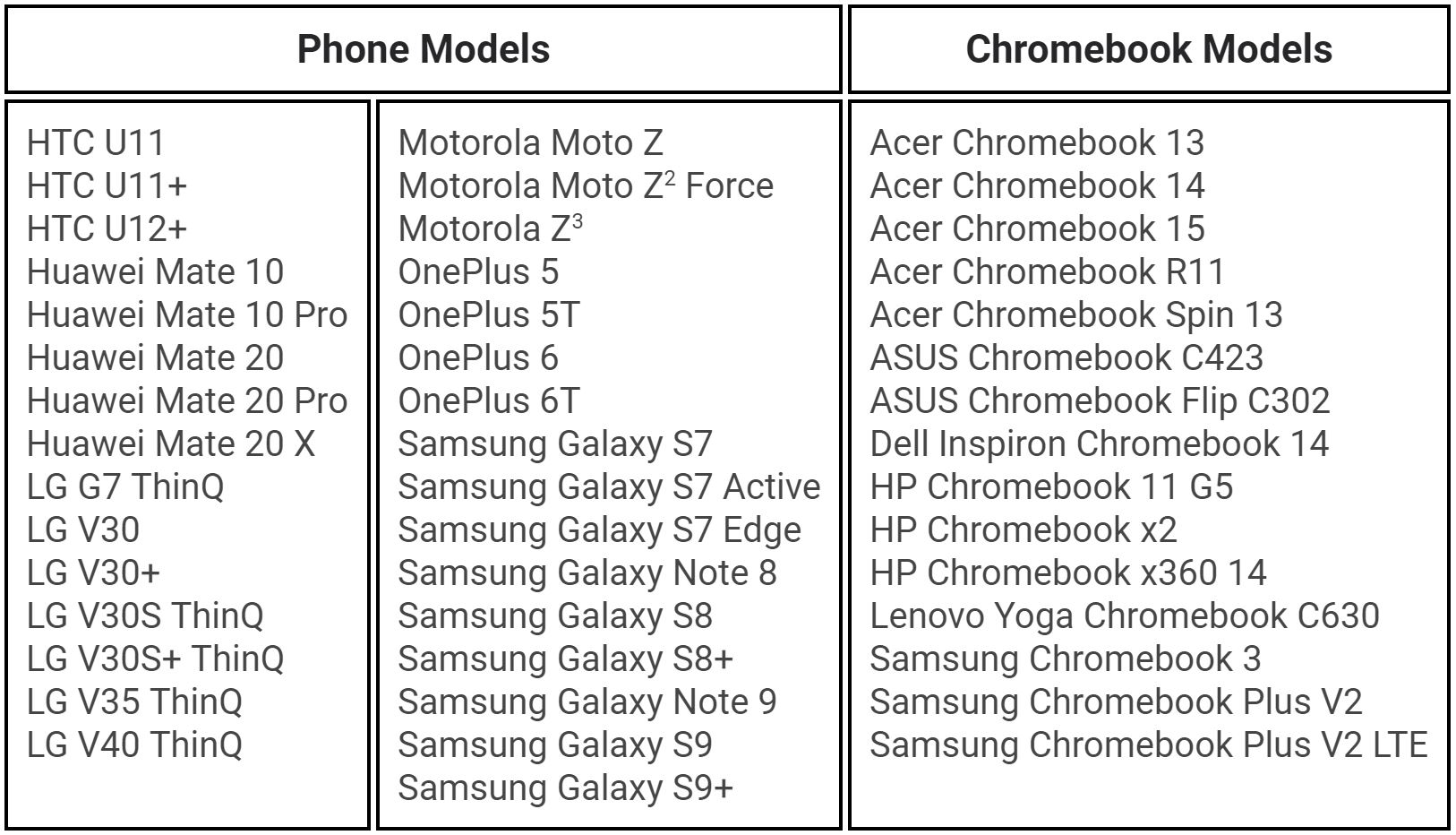
Tethering your laptop and phone can be a bit of a hassle. Google’s Chrome OS has long offered a solution called Instant Tethering that makes the process automatic, but so far, this only worked for a small set of Google’s own Chromebooks and phones, starting with the Nexus 6. Now Google is officially bringing this feature to a wider range of devices after testing it behind a Chrome OS flag for a few weeks. With this, Instant Tethering is now available on an additional 15 Chromebooks and more than 30 phones.

The promise of Instant Tether is pretty straightforward. Instead of having to turn on the hotspot feature on your phone and then manually connecting to the hotspot from your device (and hopefully remembering to turn it off when you are done), this feature lets you do this once during the setup process and then, when the Chromebook doesn’t have access to a Wi-Fi network, it’ll simply create a connection to your phone with a single click. If you’re not using the connection for more than 10 minutes, it’ll also automatically turn off the hotspot feature on the phone, too.

Tethering, of course, counts against your cell plan’s monthly data allotment (and even most “unlimited” plans only feature a limited number of GB for tethering), so keep that in mind if you decide to turn on this feature.

You can find the full list of newly supported devices, which include many of today’s most popular Android phones and Chromebooks, below.

04 Feb 2019

Daily Crunch: Google launches Live Transcribe

The Daily Crunch is TechCrunch’s roundup of our biggest and most important stories. If you’d like to get this delivered to your inbox every day at around 9am Pacific, you can subscribe here:

1. Google intros a pair of Android accessibility features for people with hearing loss

Live Transcribe is, perhaps, the more compelling of the two offerings. As its name implies, the feature transcribes audio in real time, so users with hearing loss can read text, in order to enable a live, two-way conversation.

Meanwhile, Sound Amplifier is designed to filter out ambient and unwanted noise, without boosting the volume on already loud sounds.

2. Amazon’s Audible brings Choose Your Own Adventure stories to Alexa devices

These are professionally performed, voice-controlled narratives from the publisher of the original Choose Your Own Adventure book series, ChooseCo.

3. Bird CEO on scooter startup copycats, unit economics, safety and seasonality

“2018 was about scaling,” he said. “2019 is about really focusing on the unit economics of the business.”

4. Crypto exchange Kraken acquires Crypto Facilities

This nine-figure deal is Kraken’s biggest acquisition to date. Following the deal, some Kraken users can now access both spot and futures trading.

5. Why no one really quits Google or Facebook

Danny Crichton weighs in on the latest Facebook and Google scandals. Rather depressingly, he argues that nothing will change.

6. Watch the tech-centric Super Bowl ads from Amazon, Microsoft and others

This year’s theme: Sad robots.

7. Your Monday podcast roundup

This week, Equity looks at $100 million funding rounds for everyone, Mixtape discusses allegations that Oracle underpaid minority employees and Original Content reviews the creepy Netflix series “You.”