Author: azeeadmin

04 Feb 2019

Firefox will soon mute all autoplaying videos

There are many things worse than autoplaying video and audio on the web. The world is a messy place, after all. But it sure is distracting when you surf to a website and suddenly some video starts playing at full volume. Google’s Chrome browser and Microsoft Edge both offer tools to disable these annoyances and, starting with the launch of its next version in March, Mozilla’s Firefox browser will, too.

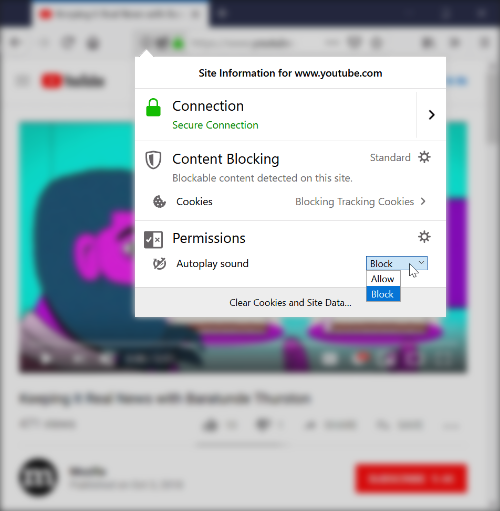
By default, Firefox will mute any audible audio and video when you arrive at a new site unless you actively initiate the audio through clicking the “play” button, for example. Mozilla has decided to allow muted autoplay, though, which is still annoying and eats up bandwidth, but it’s significantly less disruptive to your workflow than audible autoplays.

As Mozilla engineer Chris Pearce writes today, this new feature will go live with the launch of Firefox 66. He also stresses that users can always choose to opt out of this for specific sites. To do so, you only have to click on the new icon that will pop up in the Firefox URL bar whenever the browser blocks an autoplaying video or audio clip.

One exception here is sites where users allow the browser to access their camera and microphone. Those are typically sites for audio and video conferences using web technologies like WebRTC, so this exception makes sense.

If you are a Firefox user, this is surely a reason to rejoice. If you are a developer who uses autoplay videos on your sites, now is the time to repent and change your ways.

04 Feb 2019

Amazon’s 2018 acquisitions totaled $1.65B, led by PillPack and Ring

Amazon’s annual 10-K filing with the U.S. Securities and Exchange Commission confirmed the high prices the e-commerce giant paid for its two biggest M&A deals last year. According to the filing, the company paid approximately $839 million in cash for Ring and $753 million for PillPack, with all other acquisitions totaling $57 million.

GeekWire was first to spot and report on the filing.

Amazon bought Ring in the early part of the year to shore up its smart home business shortly after its 2017 acquisition of Blink. The deal was then reported to be worth more than a billion dollars. The PillPack deal, meanwhile, took place last summer, and came in around “just under a billion.”

The new filing, however, lists the acquisition prices as “net of cash acquired,” meaning it’s taking into account the cash and liabilities the acquired companies had on the books at the time of their deals. That’s why the final totals are lower than had been reported.

Amazon didn’t detail the prices paid or names of its other 2018 acquisitions, but said the focus was on acquiring “technologies and know-how to enable Amazon to serve customers more effectively.” Some of these had been discovered, though, including Amazon’s acquisition of Tapzo in India for $40 million and cybersecurity company Sqrrl, for example.

At $1.65 billion, this is Amazon’s second biggest year ever for acquisitions, following 2017, when it spent more than $13 million to buy Whole Foods.

04 Feb 2019

Periscope’s latest feature turns your broadcast into a radio talk show

When it comes to live streaming, the viewer contributions are pretty light. In Periscope, you can drop a comment of leave a floating heart icon, but there isn’t a deep way to contribute to a stream. Today, Twitter is rolling out a change to Periscope that hands broadcast viewers the microphone, allowing a video stream to bring audio-only call-ins from the audience.

To answer your first question, yes, Periscope is still around. To answer your second question, the streamer has to hand the microphone over to individual users, it’s not a free-for-all audio call, that would be unimaginably awful.

The feature seems to be a way to bring out deeper interactions with a streamer’s audience. The commenting systems on a lot of these live platforms turn into an indecipherable wall of text for most users even if the streamer is able to keep up with them, therefore the dialogue really ends up moving in whatever direction the broadcaster deems.

[gallery ids="1778403,1778402,1778394"]

In September, Periscope launched a feature that allowed users to serve up audio-only broadcasts, it was an interesting foray into a sort of live podcast, but this latest feature seems to be building that out a bit, bringing conversations with unseen participants to a standard periscope stream.

This feature brings a sort of talk radio vibe that can give a viewer an opportunity to really become part of what’s happening or contribute to the broadcast.

Twitter maintains that this feature sits firmly in its experimentation phase, but they want to see how Periscope users respond so they’re sending it out to all iOS and Android users. On desktop you’ll still be able to listen to the streams but you can’t participate just yet.

The company says that it’s looking to bring video-sharing to this feature and is flirting with these audio call-ins coming to the main Twitter app at some point in the future as well.

04 Feb 2019

Tesla’s $218M Maxwell acquisition aims to give its batteries a boost

Tesla has acquired energy storage company Maxwell Technologies in an all-stock deal valued at $218 million, a deal aimed at helping the electric automaker improve its batteries and lower costs as more competitors enter the market.

The offer will value each of Maxwell’s 45.9 million shares at $4.75. The merger is expected to close in the second quarter of 2019.

“We believe this transaction is in the best interests of Maxwell stockholders and offers investors the opportunity to participate in Tesla’s mission of accelerating the advent of sustainable transport and energy,” Maxwell CEO and President Franz Fink said in a company announcement.

Maxwell Technologies’ primary focus has been on ultracapacitors — energy storage devices that can charge and discharge rapidly, perform at a wide range of temperatures, have high power density and long operational life. In December, the company sold its high-voltage battery product line to Renaissance Investment Foundation for $55.1 million in cash and up to $15 million in potential future milestone payments.

The secret sauce is Maxwell’s dry electrode technology, which is used to make the ultracapacitors. The company says this dry electrode technology, which can be applied to batteries of varying chemistries, boosts performance and is more cost effective than the more commonly used wet electrode technology.

That application could give Tesla a boost in an increasingly competitive electric vehicle market. A number of automakers are introducing, or have introduced, electric vehicles in the past several months, including the Jaguar I-PACE, Audi e-tron SUV, Kia Niro EV and the Hyundai Kona.

“We are always looking for potential acquisitions that make sense for the business and support Tesla’s mission to accelerate the world’s transition to sustainable energy,” a Tesla spokesman said in an emailed statement.

Tesla CEO Elon Musk is a fan of uItracapacitors and has long viewed the technology as the possible path to a breakthrough in battery performance. He even tweeted back in 2013 that he was going to do his PhD at Stanford on ultracapacitors.

Tesla has put considerable effort and investment towards improving its batteries beyond this latest acquisition. In 2015, Tesla signed a 5-year exclusive partnership with Jeff Dahn, a leading lithium-ion battery researcher and professor at Dalhousie University in Nova Scotia. The exclusive partnership with Tesla will began in June 2016, after Dahn completed another research project.

04 Feb 2019

Instagram’s Adam Mosseri to meet UK health secretary over suicide content concerns

The still fresh-in-post boss of Instagram, Adam Mosseri, has been asked to meet the UK’s health secretary, Matt Hancock, to discuss the social media platform’s handling of content that promotes suicide and self harm, the BBC reports.

Mosseri’s summons follows an outcry in the UK over disturbing content being recommended to vulnerable users of Instagram, following the suicide of a 14 year old schoolgirl, Molly Russell, who killed herself in 2017.

After her death, Molly’s family discovered she had been following a number of Instagram accounts that encouraged self-harm. Speaking to the BBC last month Molly’s father said he did not doubt the platform had played a role in her decision to kill herself.

Writing in the Telegraph newspaper today, Mosseri makes direct reference to Molly’s tragedy, saying he has been “deeply moved” by her story and those of other families affected by self-harm and suicide, before going on to admit that Instagram is “not yet where we need to be on the issues”.

“We rely heavily on our community to report this content, and remove it as soon as it’s found,” he writes, conceding that the platform has offloaded the lion’s share of responsibility for content policing onto users thus far. “The bottom line is we do not yet find enough of these images before they’re seen by other people,” he admits.

Mosseri then uses the article to announce a couple of policy changes in response to the public outcry over suicide content.

Beginning this week, he says Instagram will begin adding “sensitivity screens” to all content it reviews which “contains cutting”. “These images will not be immediately visible, which will make it more difficult for people to see them,” he suggests.

Though that clearly won’t stop fresh uploads from being distributed unscreened. (Nor prevent young and vulnerable users clicking to view disturbing content regardless.)

Mosseri justifies Instagram’s decision not to blanket-delete all content related to self-harm and/or suicide by saying its policy is to “allow people to share that they are struggling even if that content no longer shows up in search, hashtags or account recommendations”.

We’ve taken a hard look at our work and though we have been focused on the individual who is vulnerable to self harm, we need to do more to consider the effect of self-harm images on those who may be inclined to follow suit,” he continues. “This is a difficult but important balance to get right. These issues will take time, but it’s critical we take big steps forward now. To that end we have started to make changes.”

Another policy change he reveals is that Instagram will stop its algorithms actively recommending additional self-harm content to vulnerable users. “[F]or images that don’t promote self-harm, we let them stay on the platform, but moving forward we won’t recommend them in search, hashtags or the Explore tab,” he writes.

Unchecked recommendations have opened Instagram up to accusations that it essentially encourages depressed users to self-harm (or even suicide) by pushing more disturbing content into their feeds once they start to show an interest.

So putting limits on how algorithms distribute and amplify sensitive content is an obvious and overdue step — but one that’s taken significant public and political attention for the Facebook -owned company to make.

Last year the UK government announced plans to legislate on social media and safety, though it has yet to publish details of its plans (a white paper setting out platforms’ responsibilities is expected in the next few months). But just last week a UK parliamentary committee also urged the government to place a legal ‘duty of care’ on platforms to protect minors.

In a statement given to the BBC, the Department for Digital, Culture, Media and Sport confirmed such a legal duty remains on the table. “We have heard calls for an internet regulator and to place a statutory ‘duty of care’ on platforms, and are seriously considering all options,” it said.

There’s little doubt that the prospect of safety-related legislation incoming in a major market for the platform — combined with public attention on Molly’s tragedy — has propelled the issue to the top of the Instagram chief’s inbox.

Mosseri writes now that Instagram began “a comprehensive review last week” with a focus on “supporting young people”, adding that the revised approach entails reviewing content policies, investing in technology to “better identify sensitive images at scale” and applying measures to make such content “less discoverable”. 

He also says it’s “working on more ways” to link vulnerable users to third party resources, such as by connecting them with organisations it already works with on user support, such as Papyrus and Samaritans. But he concedes the platform needs to “do more to consider the effect of self-harm images on those who may be inclined to follow suit” — not just on the poster themselves. 

“This week we are meeting experts and academics, including Samaritans, Papyrus and Save.org, to talk through how we answer these questions,” he adds. “We are committed to publicly sharing what we learn. We deeply want to get this right and we will do everything we can to make that happen.”

We’ve reached out to Facebook, Instagram’s parent, for further comment.

One way user-generated content platforms could support the goal of better understanding impacts of their own distribution and amplification algorithms is to provide high quality data to third party researchers so they can interrogate platform impacts.

That was another of the recommendations from the UK’s science and technology committee last week. But it’s not yet clear whether Mosseri’s commitment to sharing what Instagram learns from meetings with academics and experts will also result in data flowing the other way — i.e. with the proprietary platform sharing its secrets with experts so they can robustly and independently study social media’s antisocial impacts.

Recommendation algorithms lie at center of many of social media’s perceived ills — and the problem scales far beyond any one platform. YouTube’s recommendation engines have, for example, also long been criticized for having a similar ‘radicalizating’ impact — such as by pushing viewers of conservative content to far more extreme/far right and/or conspiracy theorist views.

With the huge platform power of tech giants in the spotlight, it’s clear that calls for increased transparency will only grow — unless or until regulators make access to and oversight of platforms’ data and algorithms a legal requirement.


04 Feb 2019

After 5 years, Microsoft CEO Satya Nadella has transformed more than the stock price

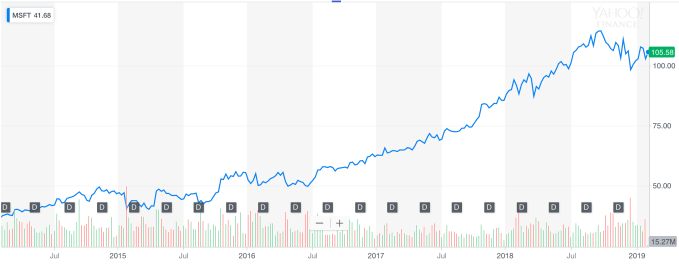
Five years ago today, Satya Nadella took over as CEO at Microsoft, and by most any measure has been wildly successful. It’s common to look at the stock price as the defining metric of Nadella’s tenure, but the stock price triumph has followed something more fundamental and harder to measure, how he changed the culture of the entire organization.

Nadella’s term at Microsoft has paralleled my own here at TechCrunch. I started in April of 2014, and in one of my first posts, I wrote about the difficulty of substantive change inside an organization the size of Microsoft. In those early moments of both of our tenures, I recognized a subtle shift was taking place, one towards service, something Microsoft hadn’t been exactly known for under his predecessors, Steve Ballmer and Bill Gates.

Microsoft’s five-year stock price journey under Satya Nadella. Stock chart: Yahoo Finance

But Nadella’s inauguration came at a time where technology itself was shifting, moving from a monolithic model where IT shopped mostly at one vendor, and they were a Microsoft shop or an Oracle shop or an IBM shop, buying a full stack of products, to one where they would subscribe to cloud services and choose the best of breed.

This was also happening agains the backdrop of the Consumerization of IT, where power was shifting from large administrative departments to users and teams. Nadella seemed to understand all of this.

The shift in strategy, as I wrote, probably began long before Nadella was handed the keys to the CEO office, but perhaps it took a different kind of leader like Nadella to turn that battleship that was Microsoft corporation. Every company has its own politics and biases and I’m sure Microsoft did as well, but Nadella seemed to manage those, reorganizing the company over time, and shifting priorities. It didn’t come without the pain of layoffs, including one in 2017 when thousands of employees people were let go. Long-time executives like COO Kevin Turner and head of Windows and devices, Terry Myerson, also left the company.

But Microsoft went from a company trying to compel customers to buy an all-Microsoft, all-the-time kind of approach to one that recognized it was important to work across platforms and to partner widely. To show how serious he was, a year after he started, Nadella set aside his differences with Marc Benioff and Salesforce, and appeared at Dreamforce, Salesforce’s massive customer conference. That was hugely symbolic given the two companies had engaged in dueling lawsuits over the years, but this was a new day at Microsoft and Nadella was out to prove it.

In a quote, I’ve come back to a number of times over the years, Nadella laid out his new vision of cooperation. While he was going to compete fiercely of course, he was also going cooperate where it made sense because customers demanded it, and under Nadella it was all about the customer.

“It is incumbent upon us, especially those of us who are platform vendors to partner broadly to solve real pain points our customers have,” Nadella said at the time. He wasn’t ceding markets, or failing to compete when it mattered, but he also recognized to make customers happy, he had to partner when it made sense.

Back in the days before Satya, partners and developers talked about a much more hostile environment where it was difficult to get things done, to get the resources they needed and the attitude was not one of cooperation, but almost hostility. That changed under Nadella and he should get credit for that.

That all matters, of course, because in the age of the cloud, Nadella’s Dreamforce quote is spot on. Customers expect vendors to cooperate. They expect open APIs. They expect the platform to be friendly to developers — and under Nadella’s leadership, all of this has happened.

The company has also paid closer to attention to issues like accessibility, with features such as real-time captions and the new Xbox adaptive controller. Microsoft has instituted programs under Nadella to use AI to improve accessibility, and he has also spoken frequently about responsible AI development.

Nadella has also led an aggressive acquisition strategy using his company’s cash to buy companies big and small. The splashiest acquisitions were LinkedIn for a whopping $26.2 billion in 2016 and Github for $7.5 billion last year, but there have been a host of much smaller purchases, most for well under a billion dollars, that have filled in holes around security, developer productivity, gaming and a wide variety of cloud services.

It exceedingly difficult to successfully navigate these kinds of broad cultural changes inside a large organization, and while it is probably still a work in progress, Nadella has been mostly effective to this point. The stock price has followed that broader change, but it is not the story here. The story is one of leadership and change management inside a large organization.

04 Feb 2019

Workplace messaging platform Slack has confidentially filed to go public

Slack, the provider of workplace communication and collaboration tools, has submitted paperwork with the Securities and Exchange Commission to go public later this year, the company announced on Monday.

This is its first concrete step toward becoming a publicly-listed company, five years after it launched.

Headquartered in San Francisco, Slack has raised more than $1 billion in venture capital investment, including a $427 million funding round in August. The round valued the business at $7.1 billion, cementing its position as one of the most valuable privately-held businesses in the U.S.

The company counted 10 million daily active users around the world and 85,000 paying users as of January 2019.

Slack’s investors include SoftBank’s Vision Fund, Dragoneer Investment Group, General Atlantic, T. Rowe Price Associates, Wellington Management, Baillie Gifford, Social Capital and IVP, as well as early investors Accel and Andreessen Horowitz.

Slack is one of several tech unicorns on deck to go public this year. Uber and Lyft have both similarly filed confidentially to go public in what are expected to be traditional initial public offerings. Slack, however, is expected to pursue a direct listing, following in Spotify’s footsteps. Instead of issuing new shares, Slack will sell existing shares held by insiders, employees and investors directly to the market, a move that will allow it to bypass a roadshow and some of Wall Street’s exorbitant IPO fees.

04 Feb 2019

Aurora Solar’s computer-generated installation maps pull in a $20M Series A

Solar installations are becoming a no-brainer for anyone with a roof in much of the country. But getting an estimate on how much it would cost and how much juice it would generate can be complicated and time consuming. Aurora Solar has made an automated process for doing this, and attracted $20 million in funding as a result.

A big part of the uncertainty anyone has about getting solar installed is the upfront cost and return on investment. An on-site visit may cost hundreds, or thousands for a commercial property, or that cost may be rolled up into the overall charge. But why send someone out when all the data you need can be acquired in bulk from the air?

Aurora uses lidar data for this — but not the kind of lidar where you have to fly a drone with the instrument over the house. That would hardly be less expensive and time-consuming than a normal visit. Instead they use lidar collected by small aircraft making low-altitude passes over the city.

The resulting data (you can see it above) produces detailed 3D models of the terrain and all the buildings on it; the exact size and slope of a roof can be determined with high precision. It’s actually similar in a way to how archaeologists used it to map out an ancient Mayan metropolis.

There are some programs and services out there that do virtual site visits, but many just estimate your roof area and orientation by looking at satellite imagery. That’s good for a basic estimate, but Aurora uses multiple sources of data to create a detailed 3D map of your roof, and its proud of its results.

“From the get go, we have been very ambitious about the way we address the problem, probably since we faced same issues our clients face ourselves,” said co-founder Christopher Hopper in an email to TechCrunch. That would have been in 2012, when he and co-founder Samuel Adeyemo experienced significant friction with a solar install in East Africa. The installation itself was a snap, they found, but the planning and design of the system took months.

“Aurora pioneered the concept of ‘remote site visits,’ which enables solar installers to precisely calculate how many solar panels fit on a property, and how much energy they produce without traveling to the site,” Hopper said. “We have a large dataset of LIDAR data pre-loaded in the application that’s accessible to our users. We estimate that that covers about 2/3 of the US population.”

This and other data lets Aurora create a detailed CAD model of the building in just a few minutes, and generate a basic plan for solar cell placement as well that accounts for slope, exposure, and any shade-producing obstacles like chimneys or trees nearby. (Shade reports are usually done in person, and are necessary to receive certain rebates.)

From there users can go straight into the sales and financing process, even including line diagrams for the electrical system you’ll be building. And theoretically it could all take under an hour, which is probably how much time you’d spend on the phone trying to get a local solar installer to come out.

The A round was led by Energize Ventures, whose managing director Amy Francetic will be joining the board, with S28 and seed investor Pear also contributing.

Once nice thing about companies relying on data and automation: they scale well. So Aurora won’t need to buy a thousand new trucks to get its next few thousand customers — it needs to hire engineers, sales and support people, which is exactly what it plans to do.

“We expect to expand all of the functions in our organization,” said Hopper. “We are particularly excited about all of the things we can do on the product side and in customer success. And finally, this funding means that we are here to stay. For companies [i.e. Aurora’s clients] that rely on a software provider for their day-to-day operations this is important factor.”

Adeyemo notes in the press release announcing the funding that “the solar professional” is the “fastest growing occupation in the U.S.” Hopefully making things easier for the customer will keep it that way for a while.

Disclosure: Former TechCruncher Rahul Nihalani now works for Aurora. Rahul’s great, but this does not affect our coverage.

04 Feb 2019

Microsoft acquires DataSense management from BrightBytes to step up its education play in Azure

One of Microsoft’s oldest and biggest verticals for its Azure cloud business has been education, and today it announced an acquisition that it hopes will help it deepen its reach: it has acquired DataSense — a data management platform that can be used to collect, integrate and report information from across a range of online education applications and services — from an educational technology company called BrightBytes, to integrate the functionality into Azure.

DataSense is a master platform that’s used by schools and educational authorities both to ingest information as well as report it to state and other authorities as part of their reporting, used to manage data for millions of students in the US, BrightBytes says.

It looks like the deal actually closed in December, according to data from PitchBook, although it’s only being announced today.

Terms of the deal are not being disclosed, but as a point of reference, BrightBytes was valued at $120 million when it last raised money, in 2015 — a $33 million round led by Insight Venture Partners, with participation from Bessemer, Learn Capital and Rethink Education.

The startup had raised just over $50 million in total, with other investors including New Schools Venture Fund and Andy Pechacke. It looks like BrightBytes will continue to operate, focusing on its Clarity data analytics platform, which itself is used by 25,000 schools in the US.

“We are excited about the global acceleration this sale provides to our mission,” said BrightBytes CEO, Traci Burgess, in a statement. “Schools around the world will benefit greatly from capabilities across data integration, interoperability, and provisioning.”

The deal will include people at BrightBytes who had been working on the DataSense product, both to continue supporting existing customers as well as to develop the future product. It’s unclear how many people that includes but we are asking.

Microsoft will be integrating DataSense into its Azure platform to expand how Microsoft serves schools and educators on its platform while continuing to keep a link between it and Clarity.

“In the coming months, we’re excited to begin the process of integrating DataSense technology into our products for schools, providing a single, more secure, Microsoft-based service that will unlock the power of data analytics for schools,” said GM of Education Strategy and Platforms at Microsoft, Steve Liffick, in a statement. It will also continue to serve existing customers of the product.

BrightBytes and Microsoft have a common goal in sight. Both have identified that education has become a very big data business, but one with a huge amount of legacy infrastructure and fragmentation. As education authorities have started to update their systems to work with government and other organizations better — and also to try to better organize the data that they already have in their systems — companies like Microsoft and BrightBytes have stepped in to provide assistance.

On the part of Microsoft, the company is working at a number of levels here — providing hardware, addressing different stakeholders from teachers and students through to IT administrators, and through software, cloud services, training and more. This deal specifically is aimed at the IT admins who help the wheels turn although it will ultimately touch data affecting many others.

04 Feb 2019

Productboard raises further $10M for its product management system

Productboard, the San Francisco and Prague-based startup that offers product management software, has raised $10 million in further funding, adding to its Series A in July last year. The round is led by Index Ventures, and sees Index General Partner Jan Hammer joining the board.

Also participating is previous backers Kleiner Perkins, Credo Ventures, Rockaway Capital, and Reflex Capital. It brings total funding for Productboard to $19.7 million, while I understand from sources that the company’s valuation increased three-fold since the A round and is “close to a 9-digit figure”.

Founded in 2014 by Hubert Palan and Daniel Hejl, Productboard has developed a “product management system” to help companies deliver better experiences for customers, faster. Specifically, the cloud software is designed to bridge the gap between customer feedback and feature requests and a company’s product roadmap, thus doing away with the use of desperate tools such as chat apps, email, spreadsheets and Powerpoint.

More broadly, the former Startup Battlefield company fits into and is helping to drive the trend that is seeing winning companies understand they need to become “product-first,” as a new generation of consumers set a much higher bar in terms of product experiences and future expectations.

“As competition in the digital space heats up, it takes only a couple of years for a great new product to dominate the market, [and] companies realize that their only way of survival is to deliver the right products to market faster than others,” Productboard co-founder and CEO Hubert Palan tells me. “That is why Product management has been increasingly critical and growing role. What was once a job based on simply gathering customer requirements to send to engineering teams has become a much more strategic role, gaining more influence in the C-suite”.

However, in spite of the growing importance of product management — from startups to much larger enterprises — Palan says there hasn’t before existed a dedicated system for product teams to ensure that they’re building the right products. While sales people have Salesforce and marketers have Marketo, he says product managers have traditionally had to use an assortment of Powerpoint, email, Post-It Notes, Slack, and “many other generic task management and engineering tools,” which aren’t really up to the job.

Productboard draws from the so-called “Product Excellence” framework, an approach to product management that emphasizes getting the right products to market faster through “deep user insight, a clear product strategy, and coherent roadmap”. The online software wants serve as the system of record — or “single source of truth” — for all customer insights, strategy, and roadmaps in order to help align everyone on what to build next.

Product managers can capture all of their feature ideas organized by user need or product area. Different feature ideas can be prioritised based on objectives, an auto-calculated “User Impact Score,” and other criteria.

Next product managers can consolidate all ideas, requests, and feedback from various channels, such as Intercom, Zendesk, email, Slack, surveys, CRM systems, NPS tools, etc. into a single repository for user insights. They can also import user research and submit notes from meetings with prospects and customers.

Finally, Palan says they’re able to rally everyone around their plans by creating interactive roadmaps. “They can share different versions with different audiences, and all roadmap versions automatically update as plans evolve,’ he explains. Productboard also integrates with engineering task management systems such as JIRA, PivotalTracker, GitHub, and Trello to support communication between product management and engineering teams.

“Our customers span a broad range of categories and industries including SaaS solutions, e-commerce platforms, medical device manufacturers, academic journals, news outlets, book publishers, on-demand services, and brick and mortar stores transitioning to digital storefronts,” adds Palan.

“Our main users are product management teams encompassing everyone from associate product managers to Chief Product Officers. Many of our users are also user researchers, designers, product marketers, project managers and similar roles, who may not have the title of Product Manager, but lead their company’s efforts to deliver the right products for their customers”.

To that end, Productboard claims 1,600 customers. They include UiPath, Envoy, MetroMile, Houzz, Macmillan, Unity, Twilio, SproutSocial, Avast, BambooHR, and many others.