Author: azeeadmin

30 Jan 2019

NYC Council questions tax breaks and economic impact of Amazon HQ2

Braving 20-degree weather, protesters crowded the steps of New York City Hall this morning with signs highlighting a “crumbling MTA” and rising tuition. Several held pro-union placards, while a man in a bright yellow warehouse vest claimed, “Amazon doesn’t let me pee.”

This morning, New York’s City Council held a hearing examining Amazon’s proposed HQ2 in Long Island City. Titled “Does the Amazon Deal Deliver for New York City Residents?,” the hearing follows one held last month that focused on the closed-door proceedings that delivered Amazon’s bid to the industrial Queens neighborhood.

The second time around, the council promised to explore the tax incentives that made the deal possible, along with the potential impact such a move could have on the city, residents and infrastructure.

Last year, New York was revealed to be one of two cities that would house a second headquarters for the retail giant. The other, Crystal City, North Virginia, approved $750 million in subsidies after a brief debate earlier this week.

The company has been subject to a larger pushback in New York, where rent prices and infrastructure are already feeling the strain of the city’s 8.6 million residents. Both the company and city officials came under scrutiny for backdoor dealings ahead of the official announcement.

“In this case, the deal was done backwards,” Speaker Corey Johnson said in his opening remarks. “The City and State made a deal with HQ2 in Long Island City and agreed to give away at least $3 billion in public subsidy before they did their due diligence.”

Amazon Vice President of Public Policy Brian Huseman attended the hearing to represent the retail giant’s position. “We believe our new headquarters should provide job opportunities for all New Yorkers,” he hold the Council. “Amazon’s investment in Long Island City will create 25,000 jobs over 10 years with an average salary of more than $150,000.”

Huseman was also quick to cite plans this week to fund high school classes in the city and used the opportunity to announce partnerships with LaGuardia Community College (LAGCC), the City University of New York (CUNY) and the State University of New York (SUNY), which would create a cloud computing certificate program for students. Both serve the clear function of demonstrating Amazon’s commitment to the community while providing a potential pipeline for future employees.

The site chosen for the office space, council members were quick to point out, was previously designated for two public schools, 5,000 units of affordable housing, parks and commercial space. 

An upcoming hearing will feature statements from the community. For now, however, those who made it through the chamber doors were asked to sit quietly. The crowd largely heeded the warning, save for a few outbursts and the constant presence of bright orange handbills reading, “Caution: Amazon Lies,” along with a frowning face playing off the company’s familiar “A to Z” logo.

As Huseman delivered his opening remarks, twin black banners were unfurled from the balcony, claiming that “Amazon Delivers Lies” and “Supports Deportation.” Police escorted protesters out, before a third shouted complaints about Amazon’s union policies. He, too, was escorted out, as security issued a warning that any additional outbursts would force the balconies to be cleared.

Union policies were a recurring theme throughout. Council member Daniel Dromm declared that “New York is a Union town,” while Deputy Leader Jimmy Van Bremmer shamed the company for an anti-union stance. 

Johnson pressed Huseman, asking whether the company would agree to remain neutral with regards to workers unionizing. “No sir,” the executive answered. Pushed whether Amazon’s surveillance technology has been employed by agencies like ICE to deport immigrants, Huseman answered, “We cannot disclose who our customers are without their consent.”

Huseman added that inclusion played a role in the company’s ultimate decision to settle in Queens. The borough is, notably, the most diverse county in the U.S. “We asked cities and locations to identity the diversity of the talent pool,” he told the council. “We are very excited about the diversity of the talent pool.”

Amazon also conceded that tax incentives were one of several motivating factors in the decision. “Labor was the primary driver,” a representative said. “The cost of doing business was also a driver.”

No date has been announced for the third hearing. 

30 Jan 2019

Daily Crunch: Apple bans Facebook Research app

The Daily Crunch is TechCrunch’s roundup of our biggest and most important stories. If you’d like to get this delivered to your inbox every day at around 9am Pacific, you can subscribe here:

1. Apple bans Facebook’s Research app that paid users for data

In the wake of TechCrunch’s investigation, Apple blocked Facebook’s Research VPN app before the social network could voluntarily shut it down.

The Research app asked users for root network access to all data passing through their phone in exchange for $20 per month. Apple says that yesterday evening, it revoked the Enterprise Certificate that allows Facebook to distribute the Research app without going through the App Store.

2. Foxconn pulls back on its $10 billion factory commitment

In 2017, Foxconn announced the largest investment of a foreign company in the United States when it selected Mount Pleasant, Wisconsin for a new manufacturing facility. In an interview with Reuters, a special assistant to Foxconn’s CEO says that those plans are being scaled back.

3. It’s time to pay serious attention to TikTok

The short-form video app hailing from Beijing’s ByteDance just had its biggest month ever with the addition of 75 million new users in December — a 275 percent increase from the 20 million it added in December 2017, according a recent report from Sensor Tower.

4. Apple’s global active install base of iPhones surpassed 900 million this quarter

It’s not surprising that Apple has a massive active install base of iPhones across the globe, but we now finally have an exact number to put behind it.

5. Amex blocks Curve as the fintech startup vows to fight ‘anti-competitive’ decision

Just 36 hours after Curve, the London fintech that lets you consolidate all of your bank cards into a single Curve card, re-instated support for Amex, the feature has once again been unceremoniously blocked by American Express.

6. AT&T misses on revenue for Q4 2018

AT&T has added 134,000 postpaid phone subscribers over the quarter (analysts had expected more). Revenue is up 15.2 percent year over year, but that’s mostly due to AT&T’s acquisition of Time Warner.

7. Sinemia drops ticket subscription prices, adds rollover feature

Beginning this week, one-ticket-a-month plans start at $4 per month — down two bucks from before. The price also includes a new rollover feature, letting subscribers carry over one unused ticket per month.

30 Jan 2019

Amazon partners with New York colleges on a cloud computing job training program

A day after Amazon detailed plans to fund computer science classes in New York area high schools, in an effort to expand its tech pipeline for its new HQ2 location in Queens, the company this morning announced a second educational initiative that sees it teaming up with New York City and state colleges. Amazon says it will work with LaGuardia Community College (LAGCC), the City University of New York (CUNY), and the State University of New York (SUNY) to create a cloud computing certificate program for students across New York. The goal will be to get students ready for entry-level tech roles – like those at Amazon or elsewhere.

The program, which begins this fall, will be offered to the tens of thousands of students across these universities, Amazon says. In addition, LAGCC will partner with at least one New York City high school to offer concurrent enrollment in the 15-credit certificate program.

While the new high school courses are being funded through the Amazon Future Engineer program, this certificate program for college students is being handled through Amazon’s AWS Educate program. The Educate program is today being used by over 1,500 institutions to train students in cloud computing by offering them hands-on experience in AWS technology. This skill can then be used to apply for jobs at Amazon and other companies.

The program includes curriculum development workshops and AWS trainings for faculty, while students receive free AWS Promotional Credits in order to perform their project assignments.

Another feature of the program is a job board that allows students to upload resumés, receive job alerts, connect with recruiters, and search for cloud computing jobs and internships at Amazon and other tech companies.

Amazon notes cloud computing is one of the highest-paying I.T. jobs, but its goal here is not altruistic, of course. It’s prepping the tech talent pipeline to ensure its new NYC “HQ2″ has room to grow. The company also adds that local demand for cloud computing talent will increase 17 percent by 2024, citing New York Department of Labor forecasts.

“As we continue to expand our presence in New York, we’re excited to work with the community to provide more opportunities for skills development,” said Ardine Williams, VP of Workforce Development at Amazon, in a statement about the program. “There is such rich talent in New York, and we want to ensure we’re reaching New Yorkers from diverse backgrounds, as we hire for 25,000 jobs across the region. We see this collaboration with LAGCC, CUNY, and SUNY as ensuring that more students have the opportunity to join companies like Amazon as we seek out more tech talent. This is the beginning of our workforce development efforts in New York – we’re looking forward to launching more initiatives to meet New Yorkers where they are, providing opportunities for new skill sets and even better paying jobs,” Williams said.


30 Jan 2019

Foxconn pulls back on its $10 billion factory commitment

Well that didn’t last long.

In 2017, Foxconn announced the largest investment of a foreign company in the United States when it selected Mount Pleasant, Wisconsin for a new manufacturing facility. Buttressed by huge economic development grants from Wisconsin, an endorsement from President Trump, and Foxconn CEO Terry Gou’s vision of a maker America, the plant was designed to turn a small town and its environs into the futuristic “Wisconn Valley.”

Now, those dreams are coming apart faster than you can say “Made in America.”

In an interview with Reuters, a special assistant to Gou says that those plans are being remarkably scaled back. Originally designed to be an advanced LCD factory, the new Foxconn facility will instead be a much more modest (but still needed!) research center for engineers.

It’s a huge loss for Wisconsin, but the greater shock may be just how obvious all of this was. I wrote about the boondoggle just a few weeks ago, as had Bruce Murphy at The Verge a few weeks before that. Sruthi Pinnamaneni produced an excellent podcast on Reply All about how much the economic development of Mount Pleasant tore the small town asunder.

The story in short: the economics of the factory never made sense, and economics was always going to win over the hopes and dreams of politicians like Wisconsin governor Scott Walker, who championed the deal. Despite bells and whistles, televisions are a commodity product (unlike, say, airfoils), and thus the cost structure is much more compatible with efficient Asian supply chains than with American expensive labor.

Yet, that wasn’t the only part of the project that never made any sense. Foxconn was building in what was essentially the middle of nowhere, without the sort of dense ecosystem of suppliers and sub-suppliers required for making a major factory hum. (Plus, as a native of Minnesota, I can also attest that Wisconsin is a pile of garbage).

Those suppliers are everything for manufacturers. Just this past weekend, Jack Nicas at the New York Times observed that Apple’s advanced manufacturing facility in Austin, Texas struggled to find the right parts it needed to assemble its top-of-the-line computer, the Mac Pro:

But when Apple began making the $3,000 computer in Austin, Tex., it struggled to find enough screws, according to three people who worked on the project and spoke on the condition of anonymity because of confidentiality agreements.

In China, Apple relied on factories that can produce vast quantities of custom screws on short notice. In Texas, where they say everything is bigger, it turned out the screw suppliers were not.

There are of course huge manufacturing ecosystems in the United States — everything from cars in Detroit, to planes in Washington, to advanced medical devices in several major bio-hubs. But consumer electronics is one that has for the most part been lost to Singapore, Taiwan, Korea, and of course, China.

Geopolitically, Foxconn’s factory made a modicum of sense. With the increasing protectionism emanating from Western capitals, Foxconn could have used some geographical diversity in the event of a tariff fight. The company is Taiwanese, but manufacturers many of its products on the mainland.

And of course, a research center is still an enormous gain for a region of Wisconsin that could absolutely use high-income, professional jobs. Maybe the process of rolling out a next-generation manufacturing ecosystem will take more time than originally anticipated, but nothing is stopping further expansion in the future.

Yet, one can’t help but gaze at the remarkable naïveté of Wisconsin politicians who offered billions only to find that even massive subsidies aren’t enough. It’s a competitive world out there, and the United States has little experience in these fights.

India may put friction on foreign firms to protect domestic startups

Indian Prime Minister Narendra Modi. (MONEY SHARMA/AFP/Getty Images)

One of the major battles for tech supremacy is over the future of the Indian IT market, which is rapidly bringing more than a billion people onto the internet and giving them robust software services. I’ve talked a bit about data sovereignty, which mandates that Indian data be stored in Indian data centers by Indian companies, pushing out foreign companies like Amazon, Google, and Alibaba.

Now, it looks like India is taking a page from the Asian tiger-school of development, and is going to increasingly favor domestic firms over foreign ones in key industries. Newley Purnell and Rajesh Roy report in the WSJ:

The secretary of India’s Telecommunications Department, Aruna Sundararajan, last week told a gathering of Indian startups in a closed-door meeting in the tech hub of Bangalore that the government will introduce a “national champion” policy “very soon” to encourage the rise of Indian companies, according to a person familiar with the matter. She said Indian policy makers had noted the success of China’s internet giants, Alibaba Group Holding Ltd. and Tencent Holdings Ltd. , the person said. She didn’t immediately respond to a request for more details on the program or its timing.

The idea of national champions is simple. Unlike the innovation world of Silicon Valley, there are obvious sectors in an economy that need to be fulfilled. Food and clothes have to be sold, deliveries made, all kinds of industrial goods need to be built. Rather than creating a competitive market that requires high levels of duplicate capital investment, the government can designate a few companies to take the lead in each market to ensure that they can invest for growth rather than in, say, marketing costs.

If done well, such policies can rapidly industrialize a country’s economic base. When done poorly, the lack of competition can create lethargy among entrepreneurs, who have already won their markets without even trying.

The linchpin is whether the government pushes companies to excel and sets aggressive growth targets. In Korea and China, the central governments actively monitored corporate growth during their catch-up years, and transferred businesses to new entrepreneurs if business leaders failed to perform. Can India push its companies as hard without market forces?

As the technology industry matures in the West, entrepreneurs will look for overseas as their future growth hubs. The challenge is whether they will be let in at all.

Video game geopolitics

Nexon’s MapleStory2 game is one of its most profitable (Screenshot from Nexon) .

Korea and Japan are two of the epicenters of the video game industry, and now one of its top companies is on the auction block, raising tough questions about media ownership.

Nexon founder Kim Jung Ju announced a few weeks ago that he was intending to sell all of his controlling $9 billion stake in the leading video game company. The company has since executed something of a multi-stage auction process to determine who should buy those shares. One leading candidate we’ve learned is Kakao, the leading internet portal and chatting app in Korea.

The other leading candidate is China-based Tencent, which owns exclusive distribution rights in China of some of Nexon’s most important titles.

Tencent has been increasingly under the sway of China’s government, which froze video game licensing last year as it worked to increase content regulation over the industry. Now the question is whether it will be politically palatable to sell a leading star of Korea’s video game industry to its economic rival.

From the Financial Times:

Mr Wi added that Nexon would be an attractive target for Tencent, which pays about Won1tn in annual royalties to the South Korean game developer. But selling the company to Tencent would be “politically burdensome” for Mr Kim, given unfavourable public opinion in South Korea towards such a sale, he cautioned.

“Political risks are high for the deal. Being criticised for selling the company to a foreign rival, especially a Chinese one, would be the last thing that Mr Kim wants,” said Mr Wi.

Such concerns around Chinese media ownership have become acute throughout the world, but we haven’t seen these concerns as much in the video game industry. Clearly, times have changed.

TechCrunch is experimenting with new content forms. This is a rough draft of something new – provide your feedback directly to the author (Danny at danny@techcrunch.com) if you like or hate something here.

Share your feedback on your startup’s attorney

My colleague Eric Eldon and I are reaching out to startup founders and execs about their experiences with their attorneys. Our goal is to identify the leading lights of the industry and help spark discussions around best practices. If you have an attorney you thought did a fantastic job for your startup, let us know using this short Google Forms survey and also spread the word. We will share the results and more in the coming weeks.

What’s Next

  • More work on societal resilience

This newsletter is written with the assistance of Arman Tabatabai from New York

30 Jan 2019

Facebook’s VPN app puts spotlight on kids’ consent

Facebook could face fresh scrutiny in Europe following a TechCrunch report on its use of a VPN app to monitor people’s smartphone activity — including teenagers as young as 13.

The Irish Data Protection Commission (DPC) told us it’s asked Facebook to provide more information on what data is collected via the market research program, codenamed ‘Project Atlas’, so that it can determine whether there are grounds for further investigation.

“The Irish DPC only became aware of this story through this morning’s media reporting. Before we can make any assessment as to whether or not there are any data protection concerns, we will need to understand better to what extent, how and on what basis the personal data in question is being processed and used. We have asked Facebook to provide us with this information,” said the DPC’s head of communications, Graham Doyle.

Under European union law there are special requirements for processing minors’ personal data. And, as we reported earlier, Facebook’s research program is open to people around the world — although the company has yet to confirm whether it has any teenage participants in Europe. (We’ve asked and will update this report with any response.)

If it turns out that European teens have been participating in the research effort Facebook could face another barrage of complaints under the bloc’s General Data Protection Regulation (GDPR) — and the prospect of substantial fines if any local agencies determine it failed to live up to consent and ‘privacy by design’ requirements baked into the bloc’s privacy regime. (Facebook’s international HQ is located in Ireland, which makes the Irish DPC the lead agency for any investigation of the project.)

Less aware of the risks

Setting out conditions applicable to consent for processing the personal data of children aged 13 or older, one section of text from the GDPR reads: “Children merit specific protection with regard to their personal data, as they may be less aware of the risks, consequences and safeguards concerned and their rights in relation to the processing of personal data.”

“Given that children merit specific protection, any information and communication, where processing is addressed to a child, should be in such a clear and plain language that the child can easily understand,” runs another.

The VPN app that Facebook has been using as a data-harvesting vehicle (since we reported on the story it’s closed down the iOS version of the app) requires participants give root access to their device — potentially affording the company a very high resolution view of their digital activity indeed.

According to an investigation we commissioned data continuously collected via the VPN app could include private messages in social media apps; chats from in instant messaging apps – including photos/videos sent to others; emails; web searches; web browsing activity; and ongoing location information.

Although Facebook has also not confirmed exactly what data types it pulls via the program.

Participants are offered payments of up to $20 (in e-gift tokens) to incentivize them to sign up to have their data harvested on an ongoing basis, with the program open to people aged 13-35.

Facebook says parental consent is required for minors aged 13-17. But it’s not clear how robust the company’s age verification process is — after BBC journalist Dave Lee reported being able to sign himself up to participate in Project Atlas, earlier today, as a “14-year-old boy… with two kids”.

“It required no proof of parental consent at all. I’ve just been sent a link to download the iOS app, ” he added via Twitter.

So while Facebook previously told us less than 5% of the (unknown number of) participants in the research program are teens it’s not clear whether it can make that sort of assertion — or indeed put any verifiable figure on children’s participation in the program — if its age verification process fails at the first hurdle.

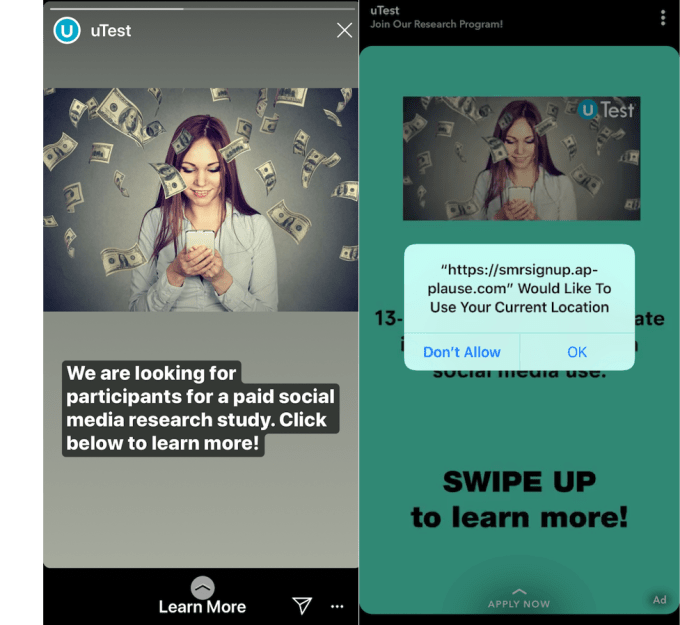
We’ve reached out to Facebook with questions and to the app testing companies it’s been working with to administer the program — namely Applause/uTest and BetaBound — to ask how they verify the age of participants and how parental consents are collected. At the time of writing none had replied.

In an earlier statement, provided in response to our first report on Project Atlas, Facebook defended the initiative, saying:

Like many companies, we invite people to participate in research that helps us identify things we can be doing better. Since this research is aimed at helping Facebook understand how people use their mobile devices, we’ve provided extensive information about the type of data we collect and how they can participate. We don’t share this information with others and people can stop participating at any time.

Questions over verification

Returning to the GDPR, Article 8 — which concerns conditions application to children’s consent for processing personal data — states data controllers must make “reasonable efforts” to verify consent when processing children’s personal data:

The controller shall make reasonable efforts to verify in such cases that consent is given or authorised by the holder of parental responsibility over the child, taking into consideration available technology.

And in further guidance on conditions for processing children’s data, the UK’s data protection agency says “data protection by design and by default” must be the baseline.

“Transparency is also key,” it continues. “You can raise children’s (and their parents’) awareness of data protection risks, consequences, safeguards and rights by: Telling them what you are doing with their personal data; Being open about the risks and safeguards involved; and letting them know what to do if they are unhappy. This will also help them make informed decisions about what personal data they wish to share.”

Facebook has said parental consent forms were “signed” and also claims it provided “extensive information” about the data being collected. But plenty of questions remain over exactly how robustly it verified participants’ ages; how parental consents were obtained; as well as the quality and accessibility of the information provided to parents and teens.

One UK-based EU data protection expert we asked for a view, Pat Walshe, suggested the approach to consent described in the article would not pass muster under GDPR.

As well as offering up to $20 a month in incentivize teens to sign away their privacy, Facebook’s program also included a referral scheme — which meant users could increase their ‘earnings’ by recommending a friend — aping the ‘growth hacking’ tactics deployed by app developers everywhere hoping to spark a viral run for their latest release.

But a viral run on kids’ privacy wouldn’t be at all cool.  

In instances where minors signed up to be watched by Facebook the program appears to have rewarded them for pestering their peers to do the same.

Yet an age verification system that can’t distinguish an adult male from a 14-year-old boy seems unlikely to be able to correctly identify a child younger than 13 who’s — say — pretending to be an adult in order to get some sweet e-gift rewards…

Last fall the children’s commissioner for England published a report raising concerns about how extensively minors’ data is being collected and shared across the board, in both the private and public sectors, writing that: “Children and parents need to be much more aware of what they share and consider the consequences.”

The UK’s ICO is currently working on an Age Appropriate Design Code of Practice — which a spokeswoman told us is due out later this year, following responses to a call for evidence last summer.

30 Jan 2019

Rebooted startup program WeWork Labs celebrates its one-year anniversary

It’s been just about a year since the relaunch of WeWork Labs, an accelerator-type program operating under the WeWork umbrella. Since then, it’s grown to 37 locations in 22 cities. And it’s truly international, operating in 12 countries, including Brazil, China, Germany and India.

These Labs offices are often — but not always — housed within a larger WeWork space, and, like an accelerator, they offer mentorship and programming. However, WeWork doesn’t take any equity; instead, it simply makes money by charging rent. (In New York, a desk costs between $450 and $550 a month, but the price varies by location.)

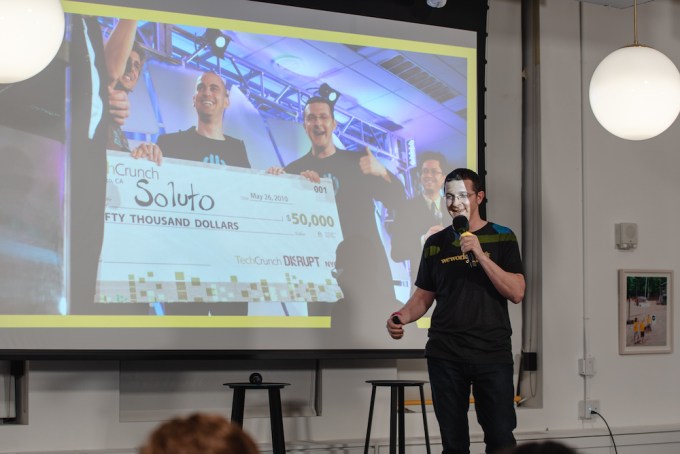
I spoke to Roee Adler, the program’s global head, about how Labs has evolved over the past year. Adler actually has a long history with startups — in fact, his company Soluto won the very first Startup Battlefield at TechCrunch Disrupt. He’s held a number of positions at WeWork, including chief product officer, and he said that as his role was evolving, he found himself asking, “What is the next startup we can build inside WeWork?”

The answer: “We decided to reevaluate our level of commitment and investment with the earliest of stages for startups.”

WeWork actually had a startup program called WeWork Labs back in 2011, but it languished in the years since. Adler relaunched the program with its first New York space in January of last year, and he’s been opening locations at a furious pace since then.

Roee Adler

Roee Adler

Each Labs office is supervised by a Labs Manager, who Adler said is usually “a former entrepreneur whose life’s mission is to manage startups.” For example, before Mor Barak joined the program last year to launch Labs in Tel Aviv, she was the general manager of Israel’s oldest accelerator program, The Junction.

“I got to a point where I felt like I finally found what I loved to do, which is to work with startups and to support startups and understand how our connections and our network can help them move forward,” Barak said. “And then I wanted to take that and do that on a bigger scale, as part of a company that can reach new geographies and bring forward local entrepreneurs.”

As a Labs Manager, Barak said her main role is to “be that business connector for the startups,” which means meeting with the entrepreneurs on a weekly basis to understand their needs and challenges. At the same time, she emphasized that Labs is a global program: “As a Labs Manager in Tel Aviv, I can quite easily connect to my colleagues around the world find the people that I need to get to in order to help the startup.”

Adler made a similar point about sharing resources between the different locations.

“A lecture that is at our Najing Xi Lu Road space in Shanghai will get captured, summarized, translated and become available to all of the entrepreneurs around the world,” he said. “Does that mean every piece of information is relevant for everyone? No. But truthfully, who knows?”

Adriana Vazquez of Lilu

Adriana Vazquez of Lilu

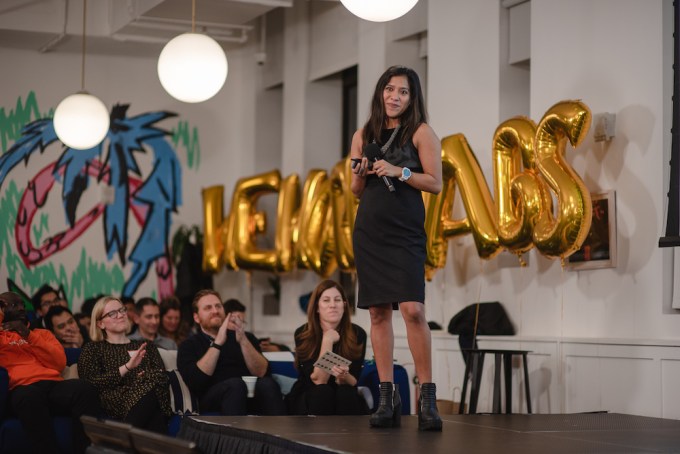
To celebrate the one-year anniversary, WeWork Labs held a pitch competition at the company’s New York City headquarters last week, with $250,000 in funding distributed among the winners. The $150,000 grand prize went to Lilu, a startup making a compression bra that helps mothers pump milk. (It’s another Startup Battlefield alum.)

CEO and co-founder Adriana Vazquez told me that Lilu has been working out of the WeWork Labs in Dumbo since August. Vazquez has participated in other accelerator programs and worked out of other coworking spaces, and she said Labs is something else — it allows you to “get the community of an accelerator without the prescribed schedule,” and it offers a very different feeling from a coworking space.

“There is that understanding and respect that everyone’s really busy and has fires to put out,” she said. “We had a brief stay at another coworking space with creatives and small businesses, and there wasn’t that camaraderie, where you see someone that’s working on a weekend and you know you’re not here because they want to hang out on a Friday. It’s almost an unspoken understanding: Yeah, I know what you’re going through.”

As for what Adler has planned for Labs’ second year, he said he wants to do more work connecting startups with larger corporations: “WeWork has really become the only natural nexus in the world where you can have a three-month-old startup entrepreneur bumping shoulders with a senior vice president of Microsoft going to get coffee from the same machine and engaging in a conversation about the future.”

WeWork Labs Dumbo

WeWork Labs Dumbo

And of course, he plans to open more offices, with the goal of reaching 100 locations by the end of 2019.

“The three of us are sitting in Manhattan right now, one of the wealthiest cities in the world … but it’s not about here,” Adler said said. “It’s about the people who aren’t sitting in the big tech hubs or bubbles. That is exciting.”

30 Jan 2019

AT&T’s DirecTV Now is losing the cord cutters

AT&T’s live TV streaming service, DirecTV Now, is not doing so well. Along with AT&T’s fourth quarter earnings released this morning, the company reported a sizable loss of 267,000 DirecTV Now subscribers. This left AT&T with fewer DirecTV Now customers at the end of the year (1.6 million), than it had in Q2 (1.8 million).

The company attributed the decline to the end of promotional package pricing, which sometimes saw the service priced as low as $10 per month for an introductory period. It had also offered device giveaways – like Roku streaming sticks or Apple TV boxes – to encourage sign-ups.

AT&T says its “discounted introductory offers ended,” which resulted in the dramatic loss.

But that’s masking a larger concern. DirecTV Now subscribers didn’t see the value in paying full price for streaming live TV via AT&T’s service, even though its streaming packages start at $40 per month – which is a competitive price point among similar live TV services. Hulu with Live TV, for example, just raised prices for its core live TV package to $45 per month, and YouTube TV raised its price to $40 per month last March.

Even the low-cost skinny bundle from Dish’s Sling TV inched up its base package by $5 per month last summer.

The subscribers who are ditching DirecTV Now aren’t necessarily doing so because they’re not interested in streaming TV – they may just find the DirecTV Now product lacking.

Its cloud DVR feature, for instance, only offers 20 hours of recording space and saves shows for a month. Sling TV and Hulu offer 50 hours of storage. YouTube TV’s DVR is unlimited. Several services today offer to save shows for far longer than 30 days, as well.

The DirecTV Now interface is fairly basic, compared to rivals, who are today competing on making services better personalized to customers. DirecTV Now, meanwhile, considers marking favorite channels or bookmarking shows to a library a form of personalization.

The company is also putting its eggs in a number of different baskets, when it comes to streaming. Instead of just offering one package that customers can customize with add-ons, it offers multiple streaming services. While DirecTV Now does offer tiered pricing plans that increase the number of channels available, AT&T additionally today operates a second, low-cost, entertainment-focused service called WatchTV, which is bundled with some AT&T wireless plans and largely meant to reduce wireless subscriber churn.

On top of that, the company’s WarnerMedia division is rolling out yet another service later this year, to leverage AT&T’s newly acquired WarnerMedia properties, like HBO. And HBO has its own over-the-top offering, too, with HBO NOW.

That means AT&T’s DirecTV Now won’t only be competing with other live TV services, it will be competing with other AT&T streaming services, too.

Of course, one could argue that it’s not fair to position a live TV streaming service against one that’s more movie-focused, as the upcoming direct-to-consumer WarnerMedia offering will be. But at the end of the day, consumers only have so many extra dollars per month to spending on streaming. And they don’t seem to be dropping Netflix.

Instead, they’re choosing from among dozens of options to customize their cord cutter bundles, ranging from true a la carte TV, as with Amazon Channels, to free TV and movies, as with The Roku Channel, to live TV streaming services and subscription videos services, like Hulu. Perhaps AT&T believes if it offers enough variety, at least one of its services will get inserted into that mix.

More concerning for DirecTV Now’s future is that AT&T believes the answer to concerns is to raise prices and reduce the number of channels. As The Wall St. Journal recently reported, AT&T execs think newcomers like Google’s YouTube TV are subsidizing an unprofitable service. AT&T CEO Randall Stephenson said in December that DirecTV Now will not do that – in fact, it’s in the process of “thinning the content out” to keep the price tag around “$50 to $60” – meaning, at least $10 per month more than it is today.


30 Jan 2019

Apple bans Facebook’s Research app that paid users for data

In the wake of TechCrunch’s investigation yesterday, Apple blocked Facebook’s Research VPN app before the social network could voluntarily shut it down. The Research app asked users for root network access to all data passing through their phone in exchange for $20 per month. Apple tells TechCrunch that yesterday evening it revoked the Enterprise Certificate that allows Facebook to distribute the Research app without going through the App Store.

TechCrunch had reported that Facebook was breaking Apple’s policy that the Enterprise system is only for distributing internal corporate apps to employees, not paid external testers. That was actually before Facebook released a statement last night saying that it had shut down the iOS version of the Research program without mentioning that it was forced by Apple to do so.

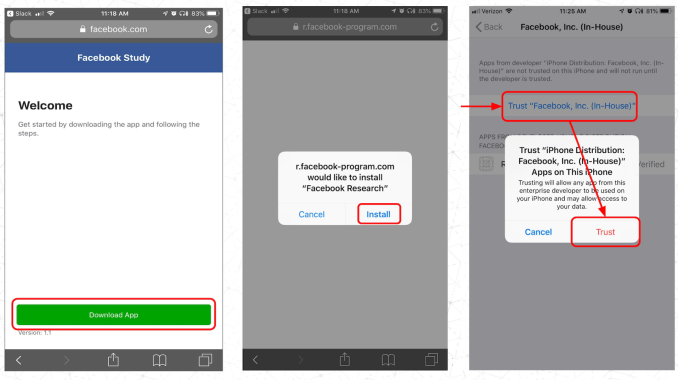
TechCrunch’s investigation discovered that Facebook has been quietly operated the Research program on iOS and Android since 2016, recently under the name Project Atlas. It recruited 13 to 35 year olds, 5 percent of which were teenagers, with ads on Instagram and Snapchat and paid them a monthly fee plus referral bonuses to install Facebook’s Research app, the included VPN app that routes traffic to Facebook, and to ‘Trust’ the company with root network access to their phone. That lets Facebook pull in a user’s web browsing activity, what apps are on their phone and how they use them, and even decrypt their encrypted traffic. Facebook went so far as to ask users to screenshot and submit their Amazon order history. Facebook uses all this data to track competitors, assess trends, and plan its product roadmap.

Facebook was forced to remove its similar Onavo Protect app in August last year after Apple changed its policies to prohibit the VPN app’s data collection practices. But Facebook never shut down the Research app with the same functionality it was running in parallel. In fact, TechCrunch commissioned security expert Will Strafach to dig into the Facebook Research app, and we found that it featured tons of similar code and references to Onavo Protect. That means Facebook was purposefully disobeying the spirit of Apple’s 2018 privacy policy change while also abusing the Enterprise Certificate program.

Facebook’s legitimate internal-use only apps like pre-launch versions of Facebook and Instagram as well as its employee logistics apps are still functioning for some employees, a source says. However, they could cease to function if Apple completely blocked Facebook from distributing employee-only apps even if they abide by its policies. As we predicted it might do, that would be a much stricter punishment than just blocking the Reseearch app that would disrupt Facebook’s business protocol. For reference, Facebook’s main iOS app still functions normally.

This morning, Apple informed us it had banned Facebook’s Research app yesterday before the social network seemingly pulled it voluntarily. Apple provided us with this strongly worded statement condemning the social network’s behavior:

“We designed our Enterprise Developer Program solely for the internal distribution of apps within an organization. Facebook has been using their membership to distribute a data-collecting app to consumers, which is a clear breach of their agreement with Apple. Any developer using their enterprise certificates to distribute apps to consumers will have their certificates revoked, which is what we did in this case to protect our users and their data.”

That comes in direct contradiction to Facebook’s initial response to our investigation. Facebook claimed it was in alignment with Apple’s Enterprise Certificate policy and that the program was no different than a focus group.

Seven hours later, a Facebook spokesperson said it was pulling its Research program from iOS without mentioning that Apple forced it to do so, and issued this statement disputing the characterization of our story:

“Key facts about this market research program are being ignored. Despite early reports, there was nothing ‘secret’ about this; it was literally called the Facebook Research App. It wasn’t ‘spying’ as all of the people who signed up to participate went through a clear on-boarding process asking for their permission and were paid to participate. Finally, less than 5 percent of the people who chose to participate in this market research program were teens. All of them with signed parental consent forms.”

We refute those accusations by Facebook. As we wrote yesterday night, Facebook did not publicly promote the Research VPN itself and used intermediaries that often didn’t disclose Facebook’s involvement until users had begun the signup process. While users were given clear instructions and warnings, the program never stresses nor mentions the full extent of the data Facebook can collect through the VPN. A small fraction of the users paid may have been teens, but we stand by the newsworthiness of its choice not to exclude minors from this data collection initiative.

The situation will surely worsen the relationship between Facebook and Apple after years of mounting animosity between the tech giants. Apple’s Tim Cook has repeatedly criticized Facebook’s data collection practices, and Facebook’s Mark Zuckerberg has countered that it offers products for free for everyone rather than making products few can afford like Apple. Flared tensions could see Facebook receive less promotion in the App Store, fewer integrations into iOS, and more jabs from Cook. Meanwhile, the world sees Facebook as having been caught red-handed threatening user privacy and breaking Apple policy.

30 Jan 2019

You can pre-order Meizu’s crazy phone with no port for $1,299

If you’re interested in Meizu’s insane smartphone that doesn’t have any port or button, you can now pre-order it on Indiegogo for $1,299. Supply is limited as the company is only selling 100 units for now.

The Meizu Zero looks like any modern phone at first sight. But if you look beyond the display, you’ll notice that there’s absolutely zero port or button.

The volume button has been replaced with a touch-sensitive surface. The fingerprint sensor is integrated in the display. Wireless charging is the only way to charge the device. And if you’re thinking about putting your SIM card in the phone, there’s no SIM slot either — I hope your carrier supports eSIM cards.

There’s no speaker grille either. Meizu is using the screen as a display by sending vibrations through the display. It also works as a microphone, apparently.

It’s unclear if this is just a giant joke or an actual product. But it’s an interesting experiment. For $1,299, you get a phone with a 5.99-inch AMOLED display and a Snapdragon 845 system-on-a-chip. The company expects to ship the device in April 2019.

30 Jan 2019

Cosmic JS wants to simplify web development, so you can focus on content

If you are a web developer, you know how complex many of the traditional web content management systems have been. One of the big problems has been managing the underlying infrastructure for the system. Cosmic JS, a member of the Winter 2019 Y Combinator class, wants to simplify that by taking care of the infrastructure part for you, while providing a flexible front end for content creators.

“Our customers benefit from using Cosmic because they can avoid the pain of building and maintaining their own CMS infrastructure. For a monthly service fee, we provide a seamless infrastructure for them, and it allows them to focus on what really matters, building great products and user experiences,” Cosmic JS CEO and co-founder Tony Spiro told TechCrunch.

As with so many YC companies, this one started with a pain point the founders were feeling in their jobs developing websites in an agency setting in 2014. Spiro was building the websites and CMO and co-founder Carson Gibbons was servicing accounts, and they saw a problem with the infrastructure piece.

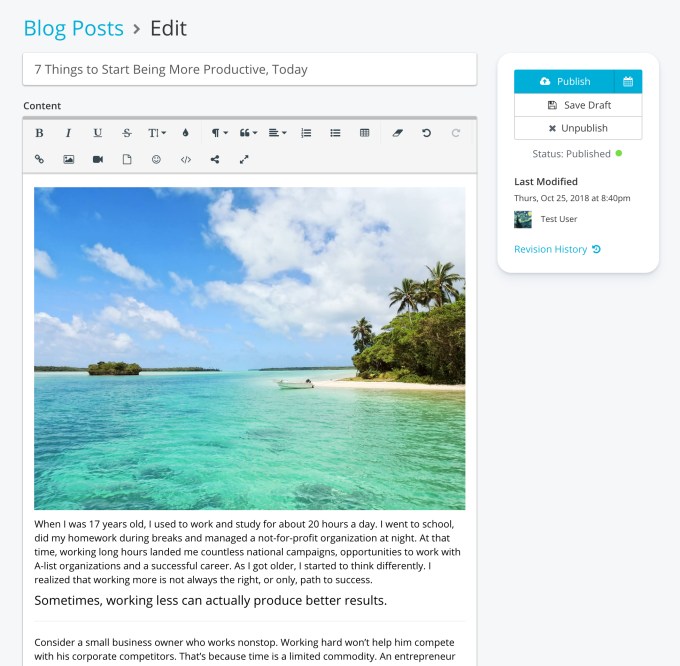
“We found that there was a huge bottleneck just installing and maintaining our own backend infrastructure management. So around that time, I began building out Cosmic on the side. I thought it would be great if there was just a web dashboard and an API to deliver content as a service. And so that’s how it all got started,” Spiro explained. By removing infrastructure management from the equation, Cosmic was freeing developers to concentrate solely on the customer-facing bits.

Cosmic JS content edit view. Screenshot: Cosmic JS

Spiro and Gibbons left their jobs to concentrate on Cosmic full time after the release of the initial version in 2016. They aim the product at web development teams with between 5 and 100 members. The product has three main user types: developers, site managers and content producers. So far, it has attracted 250 customers in 100 countries.

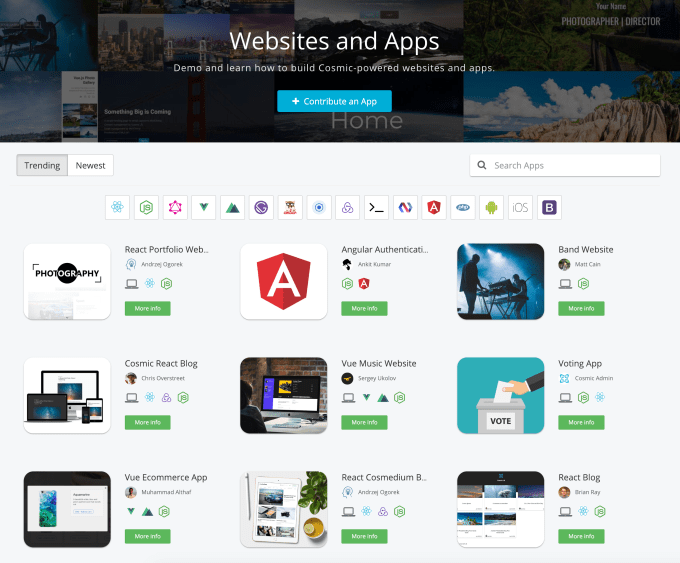
While it’s not open source, it does rely on community members to build extensions and apps. “We have hundreds of apps (ready-made websites and applications) and extensions built by our community,” Spiro said. These tools enable Cosmic to connect to best of breed services and tools like photos, videos or search without having to create them from scratch.

Cosmic JS website templates and apps. Screenshot: Cosmic JS

Spiro says that they joined Y Combinator at the behest of their advisors and investors and it has been a formative experience. “We applied and got in, and and now we’re surrounded by just some of the most impressive and intelligent people in technology.” Spiro said.

So far Cosmic JS includes the two co-founders with some contractors and freelancers helping out along with the extended development community. The company has received some funding, but the founders weren’t ready to share the amount just yet.

Their goal is to continue building the paid user base, and increase community participation through outreach and events.