Author: azeeadmin

30 Jan 2019

India’s largest bank SBI leaked account data on millions of customers

India’s largest bank has secured an unprotected server that allowed anyone to access financial information on millions of its customers, like bank balances and recent transactions.

The server, hosted in a regional Mumbai-based datacenter, stored two months of data from SBI Quick, a text message and call-based system used to request basic information about their bank accounts by customers of of the government-owned State Bank of India (SBI), the largest bank in the country and a highly ranked company in the Fortune 500.

But the bank had not protected the server with a password, allowing anyone who knew where to look to access the data on millions of customers’ information.

It’s not known for how long the server was open, but long enough for it to be discovered by a security researcher, who told TechCrunch of the leak, but did not want to be named for the story.

SBI Quick allows SBI’s banking customers to text the bank, or make a missed call, to retrieve information back by text message about their finances and accounts. It’s ideal for millions of the banking giant’s customers who don’t use smartphones or have limited data service. By using predefined keywords, like “BAL” for a customer’s current balance, the service recognizes the customer’s registered phone number and will send back current amount in that customer’s bank account. The system can also be used to send back the last five transactions, block an ATM card, and make inquiries about home or car loans.

It was the back-end text message system that was exposed, TechCrunch can confirm, storing millions of text messages each day.
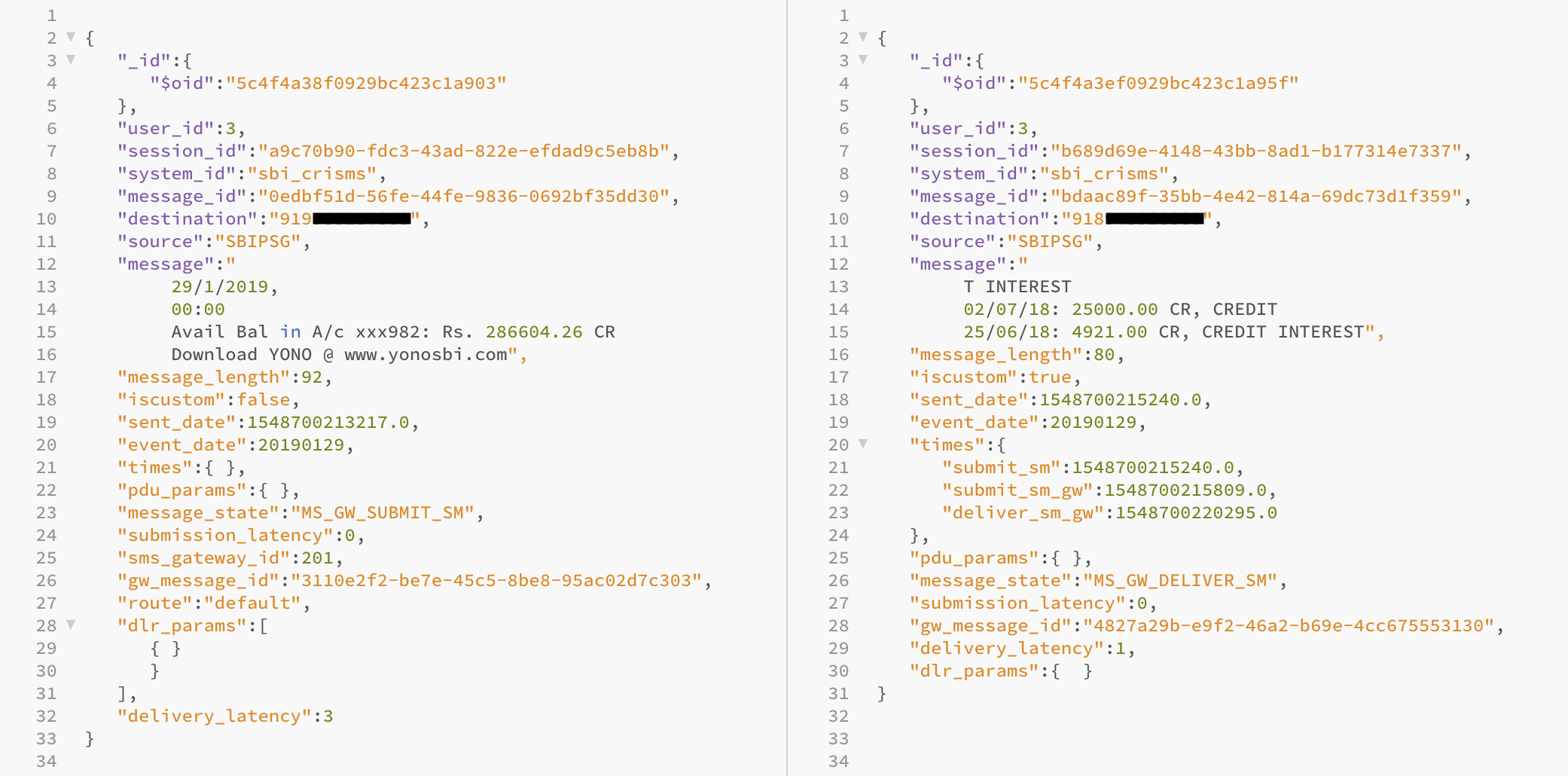
A redacted example of some of the banking and credit information found in the database. (Image: TechCrunch)

The passwordless database allowed us to see all of the text messages going to customers in real-time, including their phone numbers, bank balances, and recent transactions. The database also contained the customer’s partial bank account number. Some would say when a check had been cashed, and many of the bank’s sent messages included a link to download SBI’s YONO app for internet banking.

The bank sent out close to three million text messages on Monday alone.

The database also had daily archives of millions of text messages each, going back to December, allowing anyone with access a detailed view into millions of customers’ finances.

We verified the data by asking India-based security researcher Karan Saini to send a text message to the system. Within seconds, we found his phone number in the database, including the text message that he received back.

“The data available could potentially be used to profile and target individuals that are known to have high account balances,” said Saini in a message to TechCrunch. Saini previously found a data leak in India’s Aadhaar, the country’s national identity database, and a two-factor bypass bug in Uber’s ride-sharing app.

Saini said that knowing a phone number “could be used to aid social engineering attacks — which is one the most common attack vector here with regard to financial fraud,” he said.

SBI claims more than 500 million customers across the globe with 740 million accounts.

Just days earlier, SBI accused Aadhaar’s authority, UIDAI, of mishandling citizen data that allowed fake Aadhaar identity cards to be created, despite numerous security lapses and misuse of the system. UIDAI denied the report, saying there was “no security breach” of its system. (UIDAI often uses the term “fake news” to describe coverage it doesn’t like.)

TechCrunch reached out to SBI and India’s National Critical Information Infrastructure Protection Centre, which receives vulnerability reports for the banking sector. The database was secured overnight.

Despite several emails, SBI did not comment prior to publication.

30 Jan 2019

Sinemia drops ticket subscription prices, adds rollover feature

Sinemia’s ticket plans change about as often as box office receipts — but at least they appear to be a bit of good news for customers. The movie subscription service, which has made a name for itself in the wake of MoviePass’s on-going struggles, announced. this morning that it has dropped the pricing on its monthly plan.

Beginning this week, one ticket a month plans start at $4 a month — down two buck from before. That means three tickets a month now run $8. The price also includes a new roll over feature, letting subscribers grab one unused ticket per month, which sounds like a nice piece of added flexibility. The plans work with the company’s reintroduced card and will be in effect with Sinemia Enterprise, a white label service the company has introduced for theater chains.

The news comes as chief competitor MoviePass looks to right the ship. That service is set to announce the return of the unlimited movie plan that help get the company in hot water in the first place. Those details should be released later this week.

30 Jan 2019

How business-to-business startups reduce inequality

When considering the structural impact of technology companies on our economy and society, we tend to focus on questions of scale and monopoly.

It’s true that the FAANG companies and more recent winners (Airbnb, Uber) have surfed a combination of network effects, preferential access to capital and classic efficiencies of scale to generate tremendous value for their shareholders—to the detriment of new entrants who attempt to unseat them.

At their high water mark in mid-2018, FAANG alone made up 11% of the total market cap of the S&P 500 and 38% of the index’s year-to-date gain, representing a doubling in their influence in only five years. The question of regulating technology companies—to the point of instituting anti-trust actions—has even become a rare point of relative concord between Democrats and Republicans in Congress.

But is the narrative of tech companies in the 2010s only a story of economic consolidation and growing inequality? Many of the most successful B2B startups of the last decade are aligned by a theme that paints a different picture. By transforming the nature of the costs required to start a business, these startups are reducing the influence of capital and leveling the playing field for new entrants to share in the surplus generated by the secular shift to a tech-mediated economy.

Source: Getty Images/MIKIEKWOODS

A Path To Equal Opportunity: Turning Fixed Costs Into Variable Costs

What do AWSWeWorkStordGusto and RocketLawyer have in common? They provide cloud computing services, office space, warehouse storage, payroll management and access to legal templates, respectively—at first glance, not a particularly congruent set of services.

But they are alike in the economic purpose they serve for their customers. Each of these services takes a fixed cost—a bank of servers, a lease, a legal retainer—and transforms it into a variable cost. As a refresher, a fixed cost stays constant regardless of output, and variable costs scale with the output of a business.

When my father started his software consulting business in the early 1990s, I remember the giant boxes of AIX servers that arrived at our apartment, and tagging along to office tours in central New Jersey before he decided to run the company out of our spare bedroom. Back then, starting almost any kind of business was hard because of high fixed costs. Without AWS or WeWork, you shelled out up front for hardware and a lease.

Access to capital, whether in the form of a bank loan, savings, or friends and family was a prerequisite for entrepreneurship.

Today, startups make it possible to start and scale almost any kind of business while incurring few fixed costs. Want to found an ecommerce store? Start with a free Shopify account and dropship your inventory. Want to become a freelance designer? Put a shingle up on Fiverr and meet clients at a Breather you rent by the hour.

Whether software or hardware or labor, building a business is way easier when overhead is transformed into a string of flexible microservices that you only pay for as you grow.

Image courtesy of Getty Images

Lower Fixed Costs Means Capital Matters Less

Taken together, startups that turn fixed costs into variable costs make it less capital intensive to start a business. This decreases the influence of gatekeepers and aggregators of capital—an impact evident in the way entrepreneurs think about starting businesses today.

It’s no coincidence that the rise of B2B startups fitting this theme has coincided with the bootstrap movement, in which tech entrepreneurs with major ambitions demur from raising venture funding because—well, they don’t need the money anymore.

It has also coincided with a renaissance in freelance entrepreneurship: 56.7 million Americans freelanced in 2018. Beyond the economic benefits of working for yourself—the fastest growing segment of freelancers earns over $75,000 a year—freelancers can access the lifestyle and health benefits of owning their destiny, which aren’t directly captured but play a role in the economic picture. 51% of freelancers said no amount of money would lure them into a traditional job, and 64% reported feeling healthier and happier.

When capital plays a reduced role in new business formation, access to capital plays a smaller role in determining who will succeed. More companies are founded, and the economy becomes more likely to birth new Davids that will unseat the Goliaths. Economics 101: lower barriers to entry create markets that converge on perfect competition instead of oligarchic concentration.

Sourlce: Getty Images/ERHUI1979

Variable Costs Don’t Scale, But That’s OK

Variable costs have their downsides. A startup with a relatively higher proportion of fixed costs—the profile of the classic high-tech software business—can achieve higher profit margins as it scales. Compare Microsoft or Google, which pay high fixed costs in the form of salaries and servers but few costs in delivering their services and achieve operating margins of 25-30%, to Costco, which takes in more than $100B of annual revenue but earns an operating margin in the single digits.

That’s OK. Neither type of cost is “better” or “worse,” but having the option to decide how to structure costs through a company’s lifecycle can meaningfully impact an entrepreneur’s ability to execute a business idea.
Founders investigating startup ideas—and politicians debating the impact of technology—would do well to pay attention to how B2B companies have democratized access to entrepreneurship.

Equality of outcome arrives from equality of opportunity—and a future where millions of people can start businesses, differentiate, and succeed on the basis of their ability and value proposition, rather than their access to capital, sounds like a promising representation of the egalitarian ethos Silicon Valley wants to bring to pass.
30 Jan 2019

American Airlines taps Apple Music for in-flight entertainment

American Airlines and Apple Music have closed a deal that would give passengers access to the full library of Apple Music songs on AA flights.

Apple Music’s more than 50 million songs will be available on any domestic American Airlines flight equipped with Viasat satellite wifi at no extra cost to customers, marking the first commercial airline to offer exclusive access to Apple Music via in-flight wifi.

Here’s what VP of Apple Music Oliver Schusser had to say:

For most travelers, having music to listen to on the plane is just as important as anything they pack in their suitcases. With the addition of Apple Music on American flights, we are excited that customers can now enjoy their music in even more places. Subscribers can stream all their favorite songs and artists in the air, and continue to listen to their personal library offline, giving them everything they need to truly sit back, relax and enjoy their flight.

American Airlines has been investing in Viasat wifi, which has the bandwidth to allow for streaming video and music, as well as electrical outlets at every seat. This comes at a time when airlines are debating between seat-back entertainment and personal device entertainment.

American Airlines has also been rejuvenating its inflight entertainment library as a whole, adding new shows and movies as well as free live TV. In fact, American Airlines passengers flying on Super Bowl Sunday will be able to watch the big game in the air on select flights.

Here’s what American Airlines VP of Global Marketing Janelle Anderson had to say:

Our guests want to make the most of their time when flying us. That’s why we’re investing in faster Wi-Fi, a variety of entertainment options, and why we’re so excited to introduce Apple Music to more of our customers. Providing customers with more ways to stay connected throughout each flight is one way to show we value their business and the time they spend with us.

Meanwhile, Apple has yet another channel to market Apple Music in a competitive music streaming landscape. Just yesterday, Apple announced that Apple Music has hit 50 million global paid subscribers. The most recent number we have from industry leader Spotify is 87 million paying users as of November 2018.

30 Jan 2019

FabFitFun raises $80 million for its growing lifestyle brand

Nine years after launching its online magazine, and three years after diversifying into the subscription box business, FabFitFun has raised $80 million in a growth round of funding led by Kleiner Perkins with participation from its previous investors Upfront Ventures and NEA. 

The Los Angeles-based company has steadily expanded its retail and lifestyle empire through subscription boxes, video… and even an augmented reality app.

Last year the company crossed $200 million in revenue and managed to net over 1 million subscribers for the service.

In a statement the company said the new financing would be used to expand FabFitFun membership offerings and consolidate its position as a marketing partner and platform for brands.

As a result of the investment, Kleiner Perkins general partners Mood Rowghani and Mary Meeker will join as board members and observers, respectively.

It’s been a long ride for co-founders Daniel and Michael Broukhim and Katie Rosen Kitchens. From a newsletter and blog to the subscription box to the launch of live programming last year.

For brands, the pitch is a new way to find customers and engage with them. The seasonally curated boxes and special exclusive co-branded box opportunities with Los Angeles’ pool of influencers results in hundreds of millions of targeted impressions, according to the company.

“FabFitFun has emerged into an exciting and entirely new distribution channel that brings retail to the platforms where consumers are most engaged,” said Mood Rowghani, a General Partner at Kleiner Perkins, in a statement. “The company’s personalized connection with its community allows brands to better understand and interact with consumers – establishing a long-term relationship rather than simply a transaction.”

30 Jan 2019

Alibaba’s growth slows to lowest in 3 years

China’s Alibaba continues to see slowing expansion in the latest quarter, but the e-commerce giant’s effort to spur new growth from new arenas have started to bear fruit.

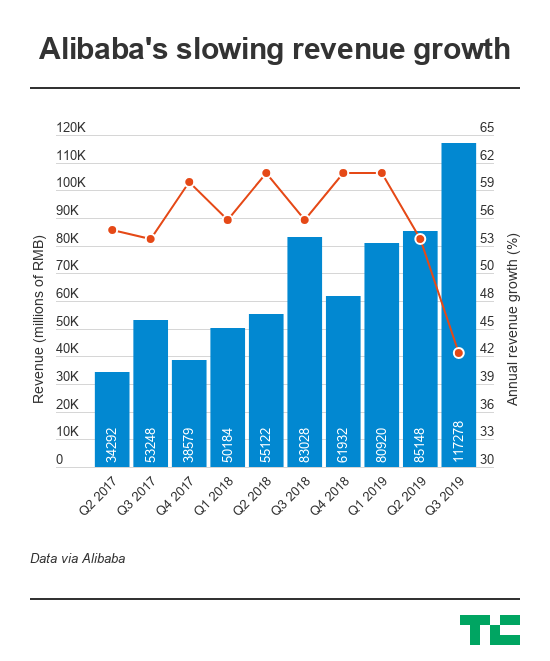
The Hangzhou-based firm rang up $17 billion in revenue during the third quarter of 2019. That’s a 41 percent increase from the previous year but it also marks the slowest pace of growth since early 2016. Revenue from the quarter was driven by growth in the firm’s core e-commerce unit, the newly formed local services business between Koubei and Ele.me, and its fledgling cloud business, which now commands more than half of the Chinese market, Alibaba executive Joe Tsai said (paywalled) this month.

Revenue growth to its lowest since early 2016 as Alibaba weathers saturation and an economic slowdown in China

Revenue from Alibaba’s core commerce, “new initiatives” including local services, and cloud computing was up 40 percent, 73 percent and 84 percent, respectively. The commerce arm is expected to kick up growth when the giant finally starts monetizing its revamped user recommendation system and search engine, features that the giant launched last quarter. Alibaba said there’s no exact timeline for the rollout but the redesigns have already boosted user engagement and purchase conversion.

Alibaba trimmed its forecasted annual revenue target by four to six percent last November as China confronted a weakening economy at home and trade tensions with the U.S. Nonetheless, Alibaba executives continue to remind investors that domestic spending remains robust as shoppers look to upgrade consumption and impact of trade tensions is limited as Alibaba’s business depends primarily on local sales.

One highlight from the past quarter is the 33 million new monthly active users added to Alibaba’s online marketplaces on mobile devices, bringing the overall mobile MAU number to 699 million. Many of the new users are from third-and-lower tier cities, a victory Alibaba attributes to “simpler interfaces for first-time or less frequent users.” The giant has long coveted the next billions of internet users with a two-sided strategy. Aside from hawking products at them, Alibaba also enables farmers to sell rural produce to shoppers across China.

Alibaba’s forays into new fronts, though holding promise, have also put a squeeze on profitability. Costs of revenue stood at 52 percent in the December quarter, compared to 42 percent last year. The spike was due to the Ele.me consolidation, inventory and logistics costs from Alibaba’s aggressive offline expansion and direct import businesses, as well as spending by video streaming unit Youku on original content and licensing.

Digital entertainment remains the more lackluster performer across Alibaba’s business units as it grew at only 20 percent year-over-year. Youku is besieged by Alibaba’s peers Tencent and Baidu which each has their own video streaming business. Youku’s daily subscribers grew 64 percent in the past quarter though it hasn’t announced the exact user base in recent quarters. Both Tencent Video and Baidu’s iQiyi recently claimed to have crossed the 80 million subscriber mark.

Update: The title has been corrected.

30 Jan 2019

Google is using 3D printers to re-create ancient artifacts

One of 3D printing’s biggest selling points has always been the ability to create objects that would otherwise be difficult or impossible to build with more traditional methods. A new collaboration between Google and industrial 3D printer manufacturer Stratasys, however, finds the companies working to re-create the familiar.

The latest addition to the Open Heritage Project finds Google Arts and Culture leveraging Stratsys’ multi-color prototyping machine, the J750 3D, to create models of ancient objects and landmarks. The project is designed to give museum-goers and researchers access to rare or on-off creations and to help preserve structures from the ravages of time.

“The project was to explore physically making these artifacts in an effort to get people hooked and excited about seeing pieces in a museum or research context,” Google Design Technologist Bryan Allen said in a statement tied to the announcement. “That’s when we turned to 3D Printing. “With the new wave of 3D Printed materials now available, we’re able to deliver better colors, higher finish, and more robust mechanical properties – getting much closer to realistic prototypes and final products right off the machines.”

The teams use 3D scanners to create a CAD design of objects and architecture from heritage sites. Those can then be accessed as a file or printed on one of the of these machines.

30 Jan 2019

AT&T misses on revenue for Q4 2018

AT&T just released its earnings report for the fourth quarter of 2018. The company generated $47.99 billion in revenue with adjusted earnings per share of 86 cents that exclude special items.

Wall Street analysts had expected earnings per share of 86 cents and $48.5 billion in revenue. In other words, earnings per share are right on track, revenue is slightly below expectations.

AT&T shares (NYSE:T) are currently trading down 0.78 percent in pre-market trading compared to yesterday’s closing price of $30.67.

“Our top priority for 2018 and 2019 is reducing our debt and I couldn’t be more pleased with how we closed the year. In 2018, we generated record free cash flow while investing at near-record levels. Our dividend payout as a percent of free cash flow was 46% for the quarter and 60% for the year, allowing us to increase the dividend for the 35th consecutive year,” AT&T chairman and CEO Randall Stephenson wrote in the release. “This momentum will carry us into 2019 allowing us to continue reducing our debt while investing in the business and continuing our strong record for paying dividends.”

AT&T has added 134,000 postpaid phone subscribers over the quarter. Analysts expected more from the company. Revenue is up 15.2 percent year over year, but that’s mostly due to AT&T’s acquisition of Time Warner.

30 Jan 2019

Amex blocks Curve as the fintech startup vows to fight “anti-competitive” decision

Well, that was short-lived: Just 36 hours after Curve, the London fintech that lets you consolidate all of your bank cards into a single Curve card, re-instated support for Amex, the feature has once again been unceremoniously blocked by American Express. This time, however, the context feels very different from 2016 when the startup was barely off the ground, with Curve telling customers in an email this morning that it intends to “fight Amex’s decision with our full might”.

Going up against the deep pockets and dominant market position of American Express will undoubtedly be a “David and Goliath” battle, although, unlike two years ago, Curve is now backed by an array of investors that includes Connect Ventures and Santander. Arguably, the startup will have U.K. and EU payments and competition regulations on its side, too, although it is hard to predict with certainly if the U.K. regulators will use their full teeth in a situation like this and how they will interpret those existing U.K. and EU regulations.

Curve’s position, however, is clear: In the same email to customers, the company has called the move “anti-competitive” and says the move is “entirely disproportionate and discriminatory” to Curve. “U.K. payment regulations clearly state that Curve should be allowed to access the Amex payment network on a level-playing field with every other fee-paying and legitimate merchant,” write the startup.

However, American Express disputes this, telling TechCrunch it doesn’t have regulatory obligations to work “with Curve or any individual merchants”.

Meanwhile, the credit card giant has been busy briefing journalists that it ended its merchant contract with Curve for business reasons, following what looked like a successful beta test with a small number of joint customers. Perhaps the trial was too successful, with American Express telling me Curve customers were using Amex added to Curve in ways that were different to its regular customers, which, one could argue, is the whole point. To truly innovate, you have to offer something new. Something truly new, has to be different.

With that said, the method with which Curve was accessing the Amex network is a well-established one. Technically, Curve had signed a “merchant” contract with American Express, just like any other merchant and many existing e-wallet products, such as PayPal or YoYo Wallet, which, notably, haven’t been blocked. As part of the trial period, the fintech had also made changes to its own product to accommodate Amex, requiring customers to top up their Curve card in advance if they wanted to spend from their Curve-Amex wallet.

In other words, this was definitely not a “don’t ask for permission, ask for forgiveness” situation on Curve’s part. The two companies had been working together for months, and in talks for even longer, to get Curve back on the Amex network. A merchant contract had been signed. What changed at the 11th hour is unclear, although we can be sure this one has a long way to play out just yet.

American Express provided TechCrunch with the following statement:

We participated in a limited Curve beta test in which we explored enabling Card Members to load funds onto an e-wallet using their Amex Card in the Curve app. A very small number of Amex Card Members participated in the test. Based on the results, we communicated to Curve that we would not participate in the further roll out of Curve because of concerns related to the overall American Express Card Member experience. Subsequently we terminated our contract with them.

And here’s the full email sent out by Curve to customers, myself included:

Dear Steve,

We are extremely sorry that the top-up functionality of your Amex wallet is currently disabled.

Like thousands of other UK merchants, Curve has a valid merchant agreement to accept Amex payments into its e-wallet. However, on Tuesday evening, Amex decided to terminate this agreement and block all Amex transactions to Curve with immediate effect.

Amex has given no good or fair reason for their decision and we believe it is entirely disproportionate and discriminatory to Curve and all our (joint) customers. UK payment regulations clearly state that Curve should be allowed to access the Amex payment network on a level-playing field with every other fee-paying and legitimate merchant.

Rest assured that you can still spend the funds that you have already topped up to your existing Amex Wallets. If you have contacted us for support, we apologise for the delay in response and will endeavour to do so as soon as possible. We will update you as soon as we have any further information.

With your interests in mind, and our mission to deliver a truly innovative product, we intend to fight Amex’s decision with our full might. We believe financial freedom is the future and we are prepared to fight for yours.

Team Curve

30 Jan 2019

Amex blocks Curve as the fintech startup vows to fight “anti-competitive” decision

Well, that was short-lived: Just 36 hours after Curve, the London fintech that lets you consolidate all of your bank cards into a single Curve card, re-instated support for Amex, the feature has once again been unceremoniously blocked by American Express. This time, however, the context feels very different from 2016 when the startup was barely off the ground, with Curve telling customers in an email this morning that it intends to “fight Amex’s decision with our full might”.

Going up against the deep pockets and dominant market position of American Express will undoubtedly be a “David and Goliath” battle, although, unlike two years ago, Curve is now backed by an array of investors that includes Connect Ventures and Santander. Arguably, the startup will have U.K. and EU payments and competition regulations on its side, too, although it is hard to predict with certainly if the U.K. regulators will use their full teeth in a situation like this and how they will interpret those existing U.K. and EU regulations.

Curve’s position, however, is clear: In the same email to customers, the company has called the move “anti-competitive” and says the move is “entirely disproportionate and discriminatory” to Curve. “U.K. payment regulations clearly state that Curve should be allowed to access the Amex payment network on a level-playing field with every other fee-paying and legitimate merchant,” write the startup.

However, American Express disputes this, telling TechCrunch it doesn’t have regulatory obligations to work “with Curve or any individual merchants”.

Meanwhile, the credit card giant has been busy briefing journalists that it ended its merchant contract with Curve for business reasons, following what looked like a successful beta test with a small number of joint customers. Perhaps the trial was too successful, with American Express telling me Curve customers were using Amex added to Curve in ways that were different to its regular customers, which, one could argue, is the whole point. To truly innovate, you have to offer something new. Something truly new, has to be different.

With that said, the method with which Curve was accessing the Amex network is a well-established one. Technically, Curve had signed a “merchant” contract with American Express, just like any other merchant and many existing e-wallet products, such as PayPal or YoYo Wallet, which, notably, haven’t been blocked. As part of the trial period, the fintech had also made changes to its own product to accommodate Amex, requiring customers to top up their Curve card in advance if they wanted to spend from their Curve-Amex wallet.

In other words, this was definitely not a “don’t ask for permission, ask for forgiveness” situation on Curve’s part. The two companies had been working together for months, and in talks for even longer, to get Curve back on the Amex network. A merchant contract had been signed. What changed at the 11th hour is unclear, although we can be sure this one has a long way to play out just yet.

American Express provided TechCrunch with the following statement:

We participated in a limited Curve beta test in which we explored enabling Card Members to load funds onto an e-wallet using their Amex Card in the Curve app. A very small number of Amex Card Members participated in the test. Based on the results, we communicated to Curve that we would not participate in the further roll out of Curve because of concerns related to the overall American Express Card Member experience. Subsequently we terminated our contract with them.

And here’s the full email sent out by Curve to customers, myself included:

Dear Steve,

We are extremely sorry that the top-up functionality of your Amex wallet is currently disabled.

Like thousands of other UK merchants, Curve has a valid merchant agreement to accept Amex payments into its e-wallet. However, on Tuesday evening, Amex decided to terminate this agreement and block all Amex transactions to Curve with immediate effect.

Amex has given no good or fair reason for their decision and we believe it is entirely disproportionate and discriminatory to Curve and all our (joint) customers. UK payment regulations clearly state that Curve should be allowed to access the Amex payment network on a level-playing field with every other fee-paying and legitimate merchant.

Rest assured that you can still spend the funds that you have already topped up to your existing Amex Wallets. If you have contacted us for support, we apologise for the delay in response and will endeavour to do so as soon as possible. We will update you as soon as we have any further information.

With your interests in mind, and our mission to deliver a truly innovative product, we intend to fight Amex’s decision with our full might. We believe financial freedom is the future and we are prepared to fight for yours.

Team Curve