Author: azeeadmin

29 Jan 2019

EFF lawyer joins WhatsApp as privacy policy manager

In an effort to bolster its public credibility in the wake of a very rough year, Facebook is bringing a fierce former critic into the fold.

Next month, longtime Electronic Frontier Foundation (EFF) counsel Nate Cardozo will join WhatsApp, Facebook’s encrypted chat app. Cardozo most recently held the position of Senior Information Security Counsel with the EFF where he worked closely with the organization on cybersecurity policy. As his bio there reads, Cardozo is “an expert in technology law and civil liberties” and already works with private companies on privacy policies that protect user rights.

Cardozo announced the move in a post to Facebook on Tuesday.

“Personal news!

After six and a half years at the Electronic Frontier Foundation (EFF), I’ll be leaving at the end of next week. I’m incredibly sad to be leaving such a great organization and I’ll miss my colleagues with all my heart.

Where to? Starting 2/19, I’ll be the Privacy Policy Manager for WhatsApp!! I could NOT be more excited.

If you know me at all, you’ll know this isn’t a move I’d make lightly. After the privacy beating Facebook’s taken over the last year, I was skeptical too. But the privacy team I’ll be joining knows me well, and knows exactly how I feel about tech policy, privacy, and encrypted messaging. And that’s who they want at managing privacy at WhatsApp. I couldn’t pass up that opportunity.

It’s going to be an enormous challenge professionally but I’m ready for it.”

Though it also does more cooperative work with major tech companies, the EFF frequently finds itself on the opposite side of the ring. Cardozo’s own background reflects that adversarial relationship, and he certainly hasn’t minced words about his new employer. In a 2015 op-ed, Cardozo hit the nail on the head about Facebook’s lucrative habit of tracking its users’ every move.

“It’s creepy, but maybe you don’t care enough about a faceless corporation’s data mining to go out of your way to protect your privacy, and anyway you don’t have anything to hide,” Cardozo wrote. “Facebook counts on that; its business model depends on our collective confusion and apathy about privacy.”

Personally, we’d sleep ever so slightly better at night knowing that the guy who wrote the sentence “If a business model depends on deception and apathy, it deserves to fail” is trying a turn on the inside.

The cognitive dissonance of a well-regarded privacy advocate moving over to Facebook is notable, though not without precedent. For all its privacy blunders, Facebook does own the most popular digital messaging app in most countries around the world — an app it opts to keep end-to-end encrypted by default (so far, anyway).

As far as WhatsApp goes, Cardozo’s hiring comes at a critical time: Last week, The New York Times reported Facebook’s intention to integrate WhatsApp, Instagram and Facebook Messenger. The massive change has some security and privacy-minded people happy (more end-to-end encryption!) and plenty more worried about what else the integration will mean.

Leading into the change, if it materializes, Facebook would be smart to hire as many prominent voices in online privacy as it can attract. Public criticism of the company hasn’t waned exactly, but hiring critics is a straightforward way to build trust in the meantime. For a company not known for public dissent and open dialogue, Facebook’s critics may prove a valuable asset if they can be recruited for a tour of duty behind the big blue line.

Update: Cardozo isn’t alone in making the switch from privacy advocacy to Facebook. The company has also hired Robyn Greene from the Open Technology Institute. As she announced in a tweet, Greene will focus on law enforcement access and data protection in her new role with Facebook.
29 Jan 2019

Data management giant Rubrik leaked a massive database of client data in security lapse

A server security lapse has exposed a massive database of customer information belonging to Rubrik, an IT security and cloud data management giant.

The company pulled the server offline Tuesday within an hour of TechCrunch alerting the company, after the data was found by security researcher Oliver Hough. The exposed server wasn’t protected with a password, allowing access to anyone who knew where to find the server.

The database itself, running on a hosted Amazon Elasticsearch server, was storing tens of gigabytes of data, including customer names, contact information, and case work for each corporate customer.

It’s believed the data goes back to October 2018, according to timestamps found inside.

A portion of the database was dedicated to all of the company’s corporate clients, allowing its customers to interact with Rubrik staff with issues or complaints. This included the contents emails that had been ingested into the system from customers — including, in many cases, their email signature with names, job titles and phone numbers. From a cursory review, we also found some emails included sensitive information about that customers’ setup and configuration.

Each company record also includes descriptive profile information, such as if it’s a Global 2000 or a Fortune 500 ranked company to determine the importance of the account, as well as the go-to person’s name and phone number.

It’s somewhat ironic, given that the IT unicorn, valued at $3.3 billion, recently announced that it’s expanding into security and compliance services.

Ribrik has thousands of major clients, and publicizes big names such as the Scottish Government, the U.S. Department of Defense, and CarePoint Health, among others, on its website.

But the client database disclosed what appears to be the company’s entire roster of corporate customers, including Deloitte, Shell, Amalgamated Bank, the U.K. National Health Service, and Homeland Security and other federal government departments.

In remarks, Rubrik said it was investigating.

“While building a new solution for customer support, a sandbox environment containing a subset of our customer corporate contact information and support interaction data was potentially accessible for a brief period of time,” said a spokesperson for Rubrik. “We rectified this issue immediately.”

“We also confirmed that no customer-owned data was exposed,” the spokesperson added. The company also said that, “other than the security researcher who discovered this issue, no one has accessed this environment,” without providing evidence for that claim.

It’s not known who might have accessed it beyond the security researcher, but the exposed server was indexed on Shodan, a search engine for exposed devices and databases, making it easily discoverable and accessible.

“We have traced the cause to human error, a default access setting was not changed per our standard practice. We have enacted changes to our processes to prevent this from happening again. Privacy and security is our top concern and we sincerely apologize for the mistake,” the spokesperson said.

Rubrik didn’t say if it would notify its customers or state regulators, per data breach notification laws.

Given that European businesses are included in the exposed data, Rubrik could face financial penalties of up to four percent of its global annual revenue if found to be in breach of the EU’s recently implemented GDPR data protection rules.

Rubrik’s data exposure came just months after data management and backup rival Veeam exposed millions of email addresses in its own data exposure.

29 Jan 2019

Announcing TC Sessions: Mobility, a one day event on the future of mobility and transportation

Mobility is changing and the world with it. Technology is upending century-old establishments, creating new lifestyles and routines. Regions across the globe are trying to replicate Silicon Valley, but all the while Silicon Valley has been replicating a different innovative American city: Detroit. Countless companies have sprung up around the Bay Area focused on the challenges around the industry. And the auto industry noticed, opening and expanding facilities on the West Coast. With its abundance of engineers and resources, Silicon Valley is uniquely suited to lead the mobility disruption.

TechCrunch is excited to announce a one-day event on July 10, 2019 in San Jose, CA that’s centered around future of mobility and transportation – TC Sessions: Mobility.

TC Sessions: Mobility will present a day of programming with the best founders, investors, and technologists who are hell-bent on inventing a future Henry Ford could have never imagined. These thinkers know that before autonomous vehicles are deployed as service, revolutionaries must forge rivers of regulation, consumer sentiment, embedded business thinking, and, perhaps most importantly, solutions to profound technological challenges. And that doesn’t include forging the relationships necessary outside of the industry, in fields such as blockchain, AI, satellite navigation and mobile networks.

The auto establishment and up-and-comers alike face similar questions. What’s the best way for mobility companies to navigation regulations and government bodies? How does a company scale manufacturing from MVP to thousands a week? And of course, every company developing autonomous vehicles need to examine the trolley problem — the ethical conundrum around who should autonomous vehicles hit in an accident, when unavoidable.

TC Sessions: Mobility is the latest in TechCrunch’s growing series of Sessions events that feature a deep dive into a specific topic. In the past, TechCrunch hosted similar events on robotics, the blockchain, and social justice. Through intimate interviews and in-depth discussions, attendees of TC Session events hear from the top individuals and companies pushing their respective field forward.

Through the coming weeks, TechCrunch will announce the participants of TechCrunch Mobility’s fireside chats, panels, and workshops.


Tickets
Early Bird Tickets are available now for $195 – that’s $100 savings before prices go up. Students can book a ticket for just $45 here.

Speakers/Demo Applications
We’re always looking for speakers/demos for our events. Apply here.

Sponsorship Opportunities
Fill out this form and someone from our sales team will get right back to you about sponsorship opportunities for this event.

29 Jan 2019

Slack now has more than 10 million daily active users

As Slack reportedly readies itself for an entry to the public markets, the high-flying startup is ready to brag a little bit about what it has accomplished in the past year.

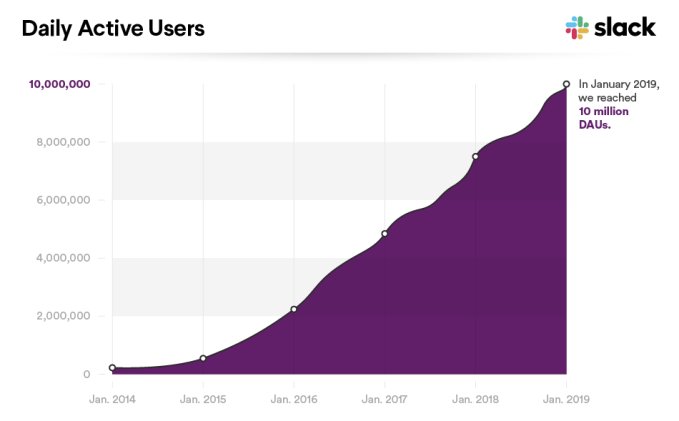
In a blog post, the company shared that it now has 10 million daily active users on the platform, up from 8 million DAUs in May. It’s not just tech companies in Silicon Valley using the service either, the company broke down the number a bit, clarifying that more than half of the DAUs are from outside the United States.

User numbers via Slack

We didn’t get an update on the number of paid users — the company also shared in May that it had 3 million paying users — but the company did say that the number of subscribers has grown to 85,000, a 50 percent over the past year. The company’s major challenge of the past couple years has been bringing on more big companies to its platform, it seems they’ve definitely had some success, detailing in the blog that 65 of the Fortune 100 companies were slacking away.

Even with its weird new logo, the company seems to be growing at a fairly consistent pace from a user standpoint. We got a look at how things were looking on the financial side via a recent report in The Information, which forecast its 2019 revenue at $640 million and detailed that the company had over $900 million in cash on its balance sheet.

The company was last valued at more than $7 billion.

29 Jan 2019

State Farm sponsors popular Fortnite streamer DrLupo

DrLupo, one of the biggest names and most recognizable voices in Fortnite streaming, has closed a sponsorship deal with State Farm.

Bejanmin “DrLupo” Lupo has nearly 3 million Twitch followers and often plays with the world’s most popular streamer, Tyler “Ninja” Blevins. Beloved for his talent and his personality alike, Lupo has also worked as a caster for various Fortnite tournaments and events. Last year, DrLupo held a charity stream for St. Jude’s Research Hospital and raised $1.3 million.

State Farm Marketing Director Ed Gold had this to say:

DrLupo is one of the world’s most followed Fortnite streamers. His philanthropic efforts and massive fanbase make him an ideal partner as we continue to amplify our esports programming and efforts with the gaming community.

This marks State Farm’s first sponsorship of an esports athlete. The sponsorship will include support of the stream through branded replays, live in-stream stunts and product integration (here’s me trying to imagine integrating insurance products into a video game stream), event-based remote streams, sponsored giveaways, and social content.

DrLupo announced the partnership on his stream, saying that he and his family have worked with State Farm for a long time and that he’s very thankful for the opportunity.

Sponsorships are certainly not new in the esports world — Newzoo reported that some $359 million would be spent in 2018 on esports sponsorships. That said, this does mark a grown-up shift in an industry whose sponsors have traditionally included energy drink brands, Taco Bell and Totinos Pizza Rolls.

Part of that has to do with the fact that both the viewership and the popular content creators, particularly in Fortnite, have grown up. DrLupo is married with a child, and his family frequently appears on his stream. If his viewers aren’t already age appropriate for insurance products, they soon will be.

But more importantly, the relationship DrLupo (or any other popular streamer) has with his audience is very different from the one Sofia Vergara has with Modern Family fans/Head & Shoulders customers. Streamers spend anywhere from six to twelve hours a day with their audience, often simply shooting the shit. Moreover, viewers can interact through the chat, having actual conversations with the creator.

The potential for brands to harness and translate that influence through esports sponsorships could be quite powerful, but streamers will have to remain diligent to stay authentic considering their audience is a generation that has become entirely numb to and/or incredulous toward advertising.

29 Jan 2019

Apple partners with Aetna to launch health app leveraging Apple Watch data

In its clearest move yet to woo the healthcare industry, Apple has collaborated with the health insurance provider Aetna to launch a new app called Attain that uses Apple Watch data to provide a window into users’ health.

The launch stems from a 2016 collaboration between the insurer and Apple which saw 90% of participants in a study reported a health benefit from using their Apple Watch.

Both Apple and Google (through its parent company, Alphabet) have been making headway into personalized health using wearables. Earlier this month, Alphabet’s Verily business unit had its wearable device approved by the FDA for tracking heart health. Apple had received its approval from the FDA in September 2018 when it launched a new version of the Apple Watch.

“We believe that people should be able to play a more active role in managing their well-being. Every day, we receive emails and letters from people all over the world who have found great benefit by incorporating Apple Watch into their lives and daily routines,” said Jeff Williams, Apple’s COO. “As we learn over time, the goal is to make more customized recommendations that will help members accomplish their goals and live healthier lives.”

Healthcare has been on Apple’s radar since at least 2016, when Tim Cook targeted it as an area the company was looking to pursue in an interview with Fast Company.

“We’ve gotten into the health arena and we started looking at wellness, that took us to pulling a string to thinking about research, pulling that string a little further took us to some patient-care stuff, and that pulled a string that’s taking us into some other stuff,” [Cook said at the time]. “When you look at most of the solutions, whether it’s devices, or things coming up out of Big Pharma, first and foremost, they are done to get the reimbursement [from an insurance provider]. Not thinking about what helps the patient. So if you don’t care about reimbursement, which we have the privilege of doing, that may even make the smartphone market look small.”

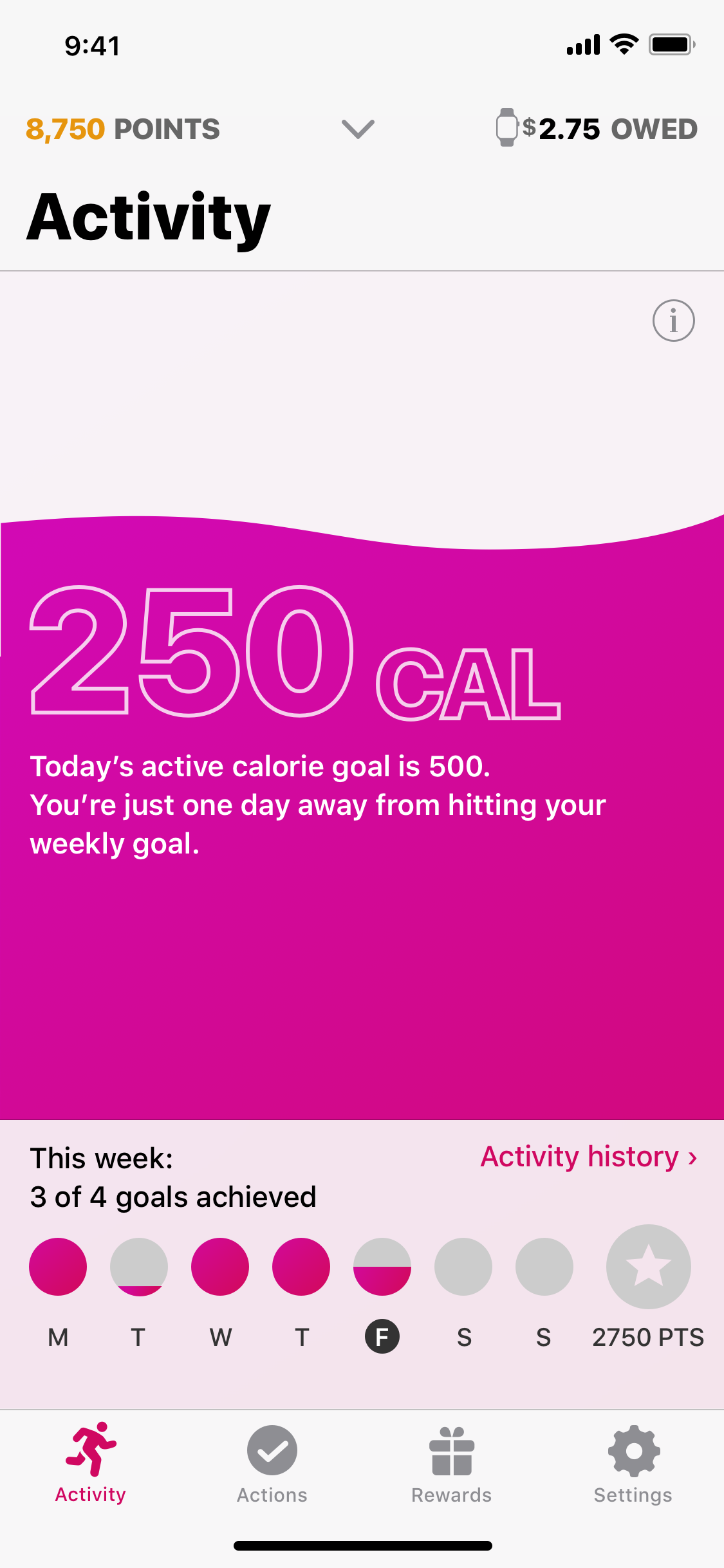
The new Attain app consists of four pillars divided into achieving activity goals; sustaining everyday health, personalized health notifications; and rewards for achievements.

The app determines personalized activity goals based on age, sex and weight, and includes a more varied array of potential activities than just steps taken — using the Apple Watch to measure swimming and yoga as potential activities.

Aetna’s app will also offer challenges where participants earn points for taking actions like getting more sleep, engaging in meditation activities and monitoring and improving their diet.

Attain will also recommend health actions based on the healthcare reports culled from the health records that Aetna’s patient populations shares through the app. Created alongside physicians the app uses doctor recommended clinical guidelines and will incorporate prompts for healthy actions like getting flu shots and vaccinations, refill medication prescriptions when they’re scheduled to run out; suggest visits to primary care physicians if checkups have lagged and prompt about lower-cost options for lab tests.

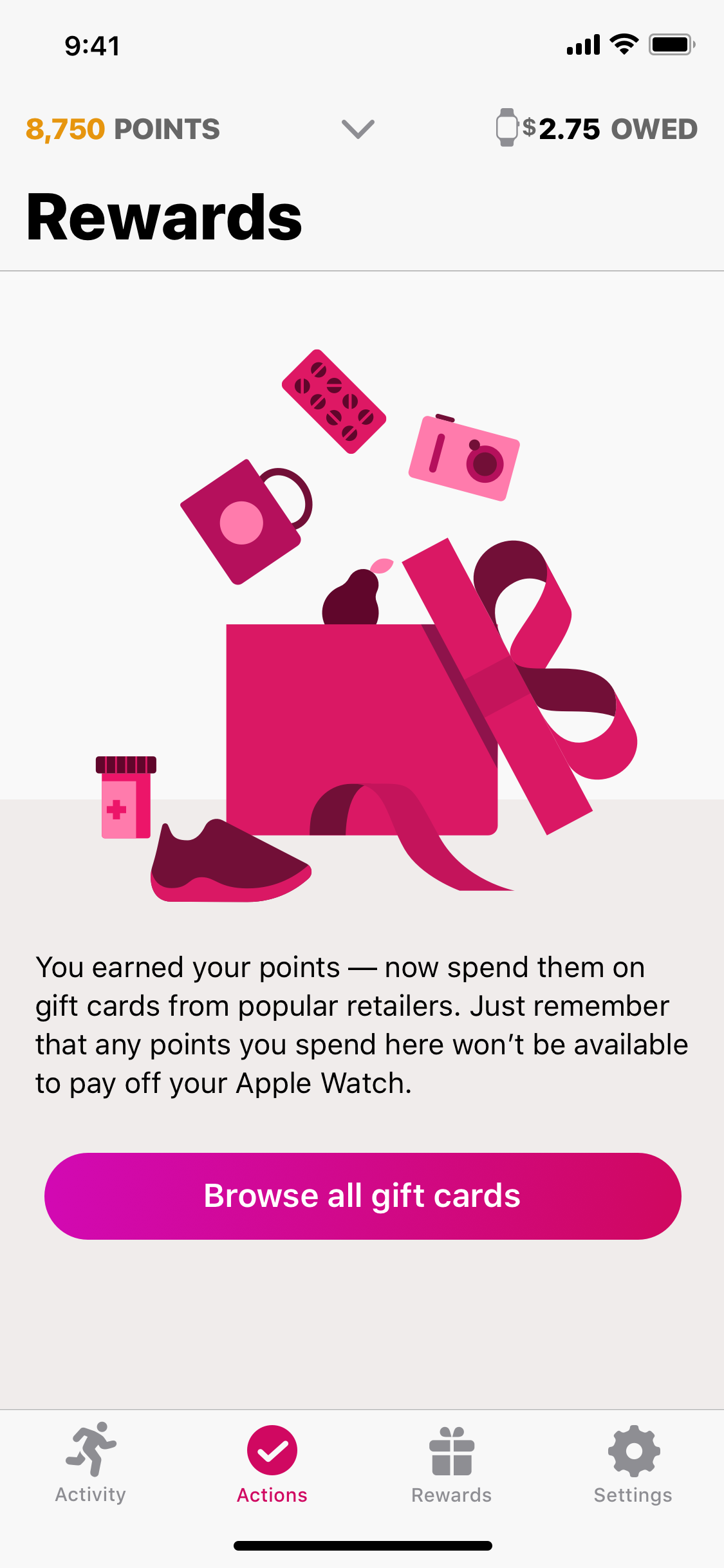
Finally, users can earn rewards — like points off the cost of their Apple Watch or gift cards to national stores. The app is available to Aetna members who have an iPhone 5s or later and an Apple Watch Series 1 or later.

“From fitness enthusiasts, to casual gym-goers, to parents who get all their exercise by keeping up with their kids – we designed Attain for everyone,” said Alan Lotvin, M.D., Executive Vice President of Transformation for CVS Health, in a statement. “We understand that you don’t need to be a personal trainer or work out several hours a day to be healthier. We’re designing Attain to be personalized and clinically relevant to where each individual is in their health journey. This is an ambitious challenge, and we will adapt and improve over time to create the best experience for our members.”

After users have signed up with the Attain app they can share data and health history with Apple, giving both companies access to data that can be used later for potential clinical trials or to make predictions abut population health… while the companies are pitching it as a way to get more personalized suggestions from the app.

According to a statement from the company all the health data is encrypted on the device, in transit and on Apple and Aetna’s servers where it is stored in a HIPAA compliant way.

The companies also say that the data won’t be used for underwriting, premium or coverage decisions.

In the future you could see Apple and Aetna collaborating to make Apple Watches an employee benefit — like computers — to track employee health and lower healthcare costs. It’d be a win-win for both.

But as Apple pushes deeper into collecting health records and data the company is setting a high bar for its security protocols at a time when the company is still cleaning up the mess from a bug that left Facetime users exposed.


29 Jan 2019

Mozilla streamlines Firefox tracker blocking controls

Mozilla has rolled out what it bills as enhanced and simplified controls for Firefox users to manage how they block trackers.

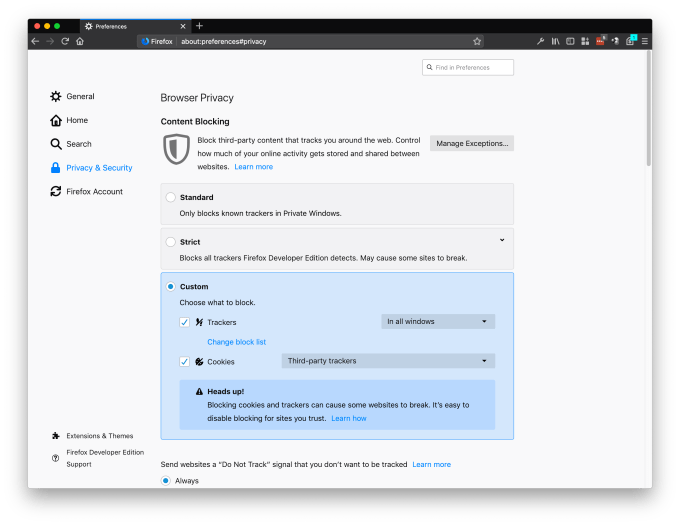
An update to its browser software, released today, offers a redesigned interface which includes new controls that let users choose from ‘standard’, ‘strict’ or ‘custom’ settings to help them control online trackers.

Trackers refer to content embedded on websites that surreptitiously harvests information about visitors’ browsing activity — often for ad targeting purposes.

Using a tracker blocker is therefore one way to claw back a little online privacy. Although trackers can be used for lots of functions. Hence you may not want to block ’em all.

With the latest version of the Firefox browser the ‘strict’ level of tracker blocking is “for people who want a bit more protection and don’t mind if some sites break”, according to Mozilla. This mode also blocks trackers in all Windows.

Whereas ‘standard’ is summed up as a “set it and forget it” mode that blocks known trackers — but only when the user is using Private Browsing mode.

The standard mode will also block third party tracking cookies “in the future”. Though Mozilla looks to still be tweaking and testing that.

The third option is a custom tracker blocker mode which it says is “for those who want complete control to pick and choose what trackers and cookies they want to block”. This mode lets users choose whether or not to block trackers in all windows, or only in Private Browsing windows; and also to select different block lists.

On cookies, the custom option also lets users pick from blocking third-party trackers; cookies from unvisited websites; all third-party cookies (which Mozilla warns “may” cause websites to break); and all cookies (which it says will cause websites to break).

Mozilla has updated Firefox with a redesigned interface for tracker blocking

The redesigned tracker blocking interface follows an announcement from Mozilla last summer, when it said it would expand its approach to privacy by introducing default settings that block trackers, as well as “offering a clear set of controls to give our users more choice over what information they share with sites” — flagging the “harms of unchecked data collection”.

Concern over behavioral advertising has generally been stepping up in recent years, fuelled by a string of data misuse and security scandals which have encouraged policymakers to take a closer interest in how personal data is collected and where it flows.

Rising concern over creepy ads has also encouraged a rise in activity in the tracker blocking space. So the latest tweaks to Firefox are part of a wider privacy trend.

“We initially announced in October that we would roll out Enhanced Tracking Protection off-by-default. This was just one of the many steps we took to help prepare users when we turn this on by default this year,” Mozilla writes today, teeing up the redesigned tracker blocking interface.

“We continue to experiment and share our journey to ensure we balance these new preferences with the experiences our users want and expect. Before we roll this feature out by default, we plan to run a few more experiments and users can expect to hear more from us about it.”

Firefox users can view the redesigned Content Blocking section via the Preferences menu, clicking on Privacy & Security — which will offer a Content Blocking section option. Or by clicking on the small “i” icon in the address bar, and then the small gear displayed next to Content Blocking.

A full list of changes in Firefox Release 65.0 can also be viewed here.

Among other listed improvements are a better pop-up blocker (“to prevent multiple pop-up windows from being opened by websites at the same time”); improved performance and web compatibility; and a better experience for multilingual users as also being among the updates.

29 Jan 2019

Gmail on mobile gets a fresh coat of Material Design paint

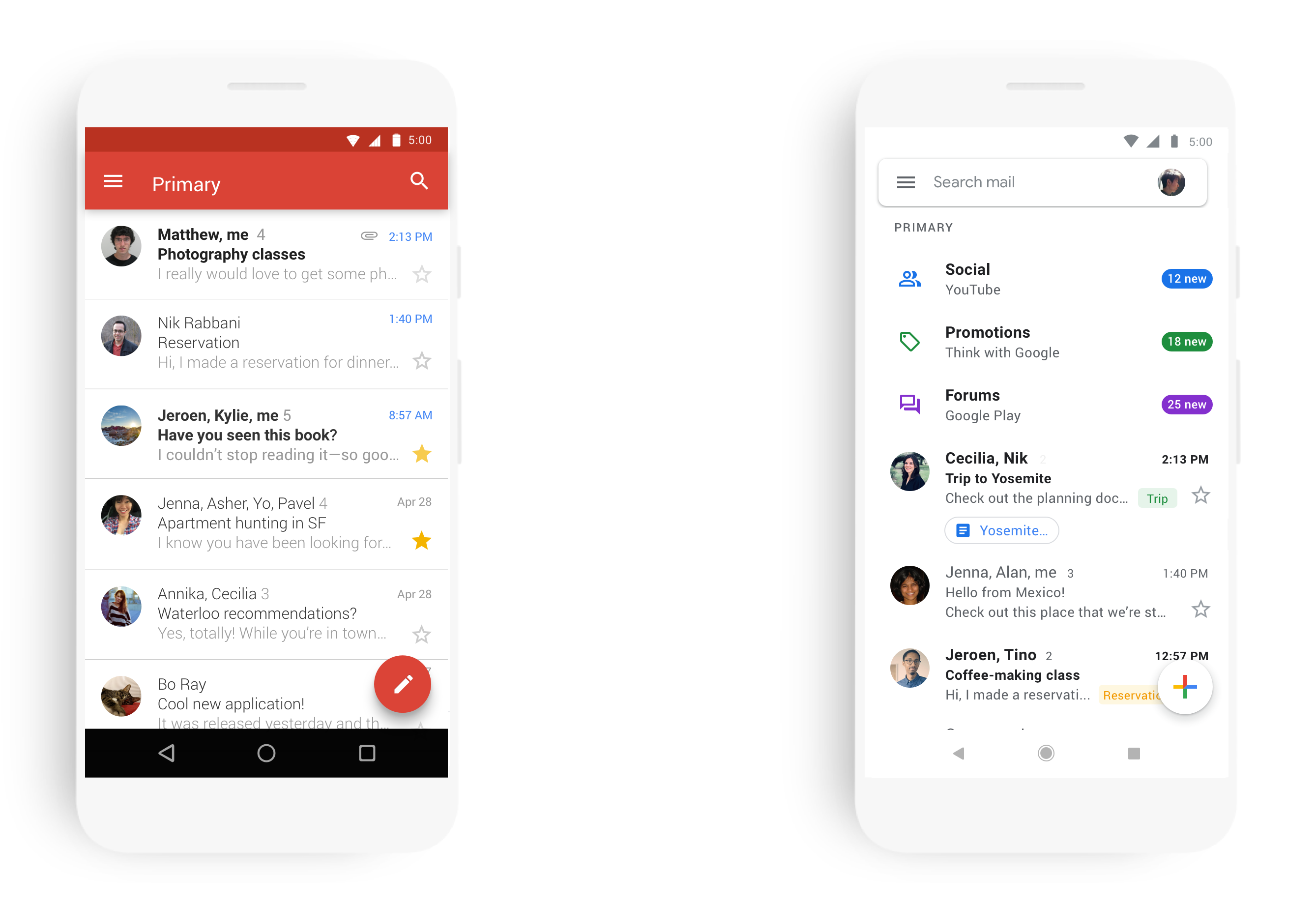
Gmail on mobile will soon get a new look. Google today announced that its mobile email apps for iOS and Android are getting a redesign that is in line with the company’s recent Material Design updates to Gmail, Drive, Calendar and Docs and Site. Indeed, the new UI will look familiar to anybody who has ever used the Gmail web app, including that versions ability to select three different density styles. You’ll also see some new fonts and other visual tweaks. In terms of functionality, the mobile app is also getting a few new features that put it on par with the web version.

Like on the desktop, you can now choose between the default view, as well as a comfortable and compact style.  The default view features a generous amount of white space and the same attachment chips underneath the email preview as the web version. The comfortable view does away with those chips and the compact view removes a lot of the space between messages to show you more emails at a glance.

I’ve been testing the new app for a bit and quickly settled on the comfortable view since I never found the attachment chips all that useful in day-to-day use.

In line with Google’s Material Design guidelines, all the styles feature relatively subtle but welcome animations that don’t take a lot of time but give you a couple of extra visual cues about what’s going on as you work your way to Inbox Zero.
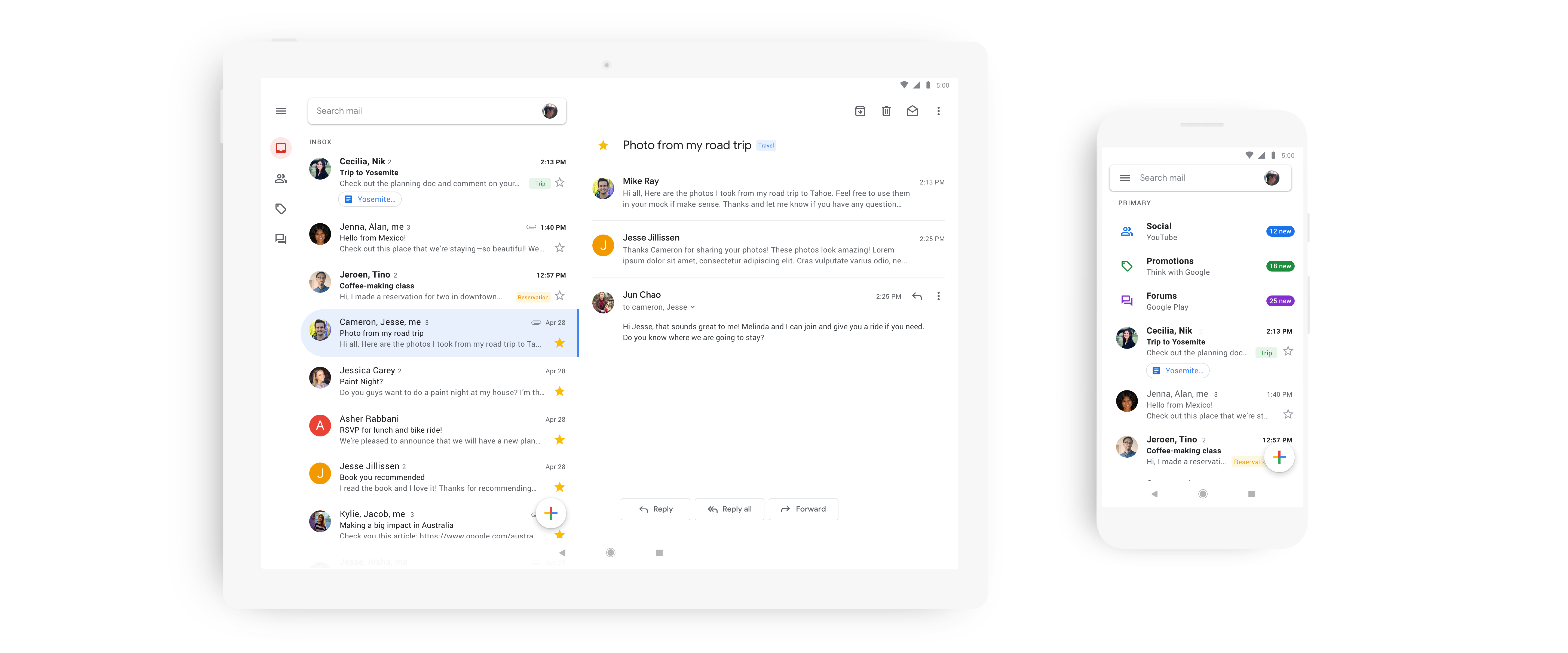
Google also notes that the new design makes it a bit easier to switch between accounts. I’m not sure I agree (I definitely find the implementation of this in Inbox, which is sadly going away soon, easier to use), but if you regularly use this feature, it’s still easy enough to use. The switcher is now part of the search bar, though, which is a bit confusing and took me a moment to find.

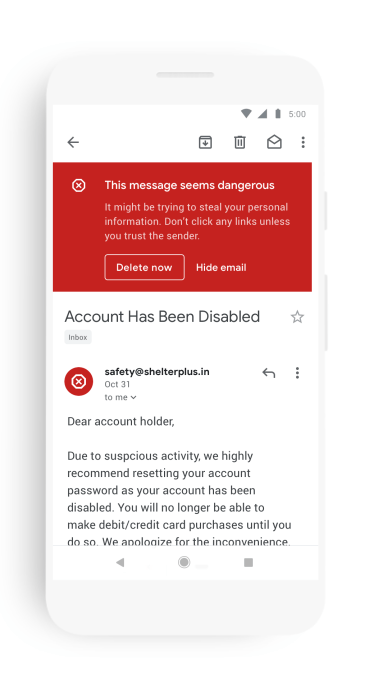
One nice addition to the mobile app is that the large red phishing and scam warning box from the web version now also appears in the mobile app.

29 Jan 2019

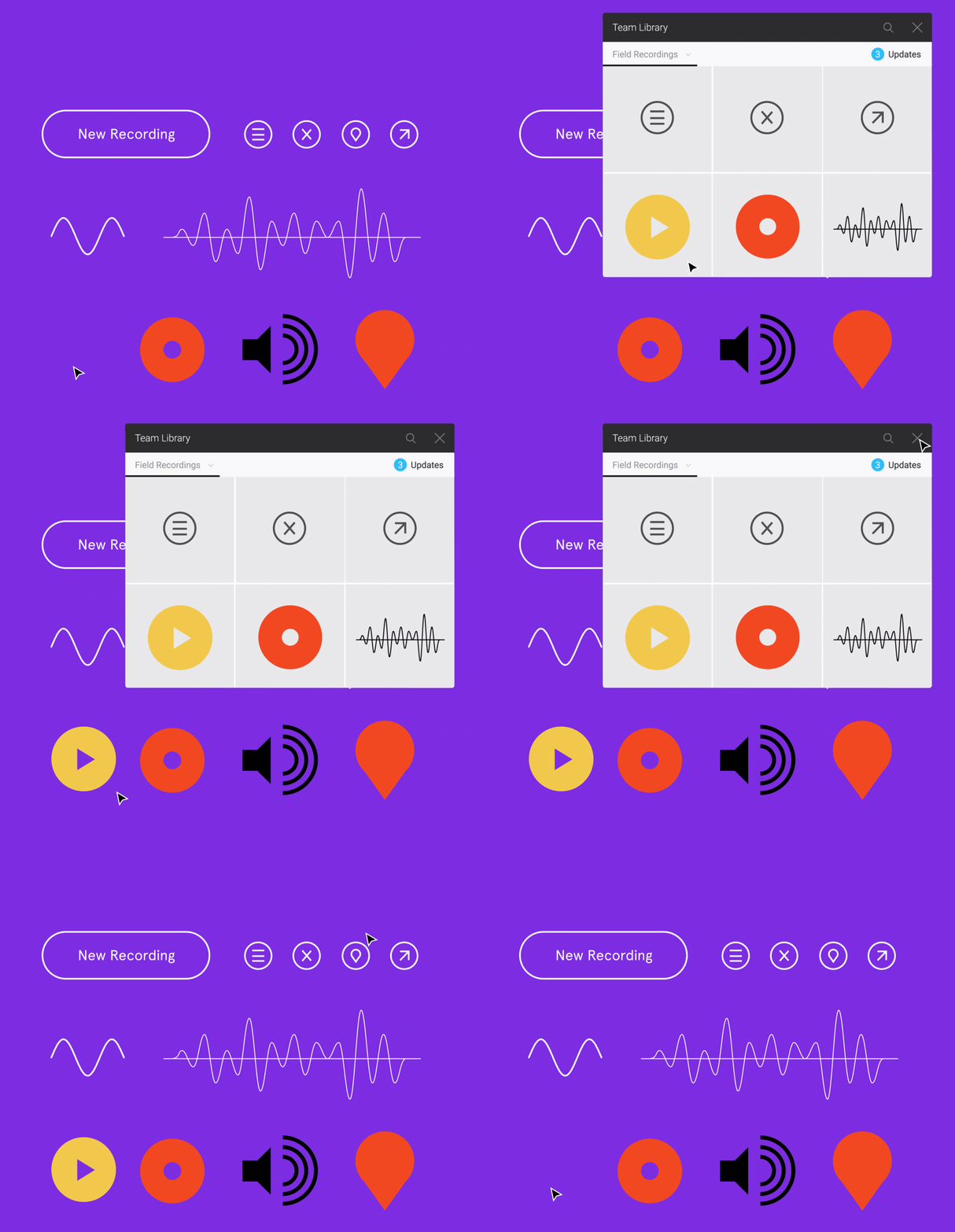
Figma’s design and prototyping tool gets new enterprise collaboration features

Figma, the design and prototyping tool that aims to offer a web-based alternative to similar tools from the likes of Adobe, is launching a few new features today that will make the service easier to use to collaborate across teams in large organizations. Figma Organization, as the company calls this new feature set, is the company’s first enterprise-grade service that features the kind of controls and security tools that large companies expect. To develop and test these tools, the company partnered with companies like Rakuten, Square, Volvo and Uber and introduced features like unified billing and audit reports for the admins and shared fonts, browsable teams and organization-wide design systems for the designers.

For designers, one of the most important new features here is probably organization-wide design systems. Figma already had tools to create design systems, of course, but this enterprise version now makes it easier for teams to share libraries and fonts with each other to ensure that the same styles are applied to products and services across a company.

Businesses can now also create as many teams as they would like and admins will get more controls over how files are shared and who they can be shared with. That doesn’t seem like an especially interesting feature, but since many larger organizations work with customers outside of the company, its something that will make Figma more interesting to these large companies.
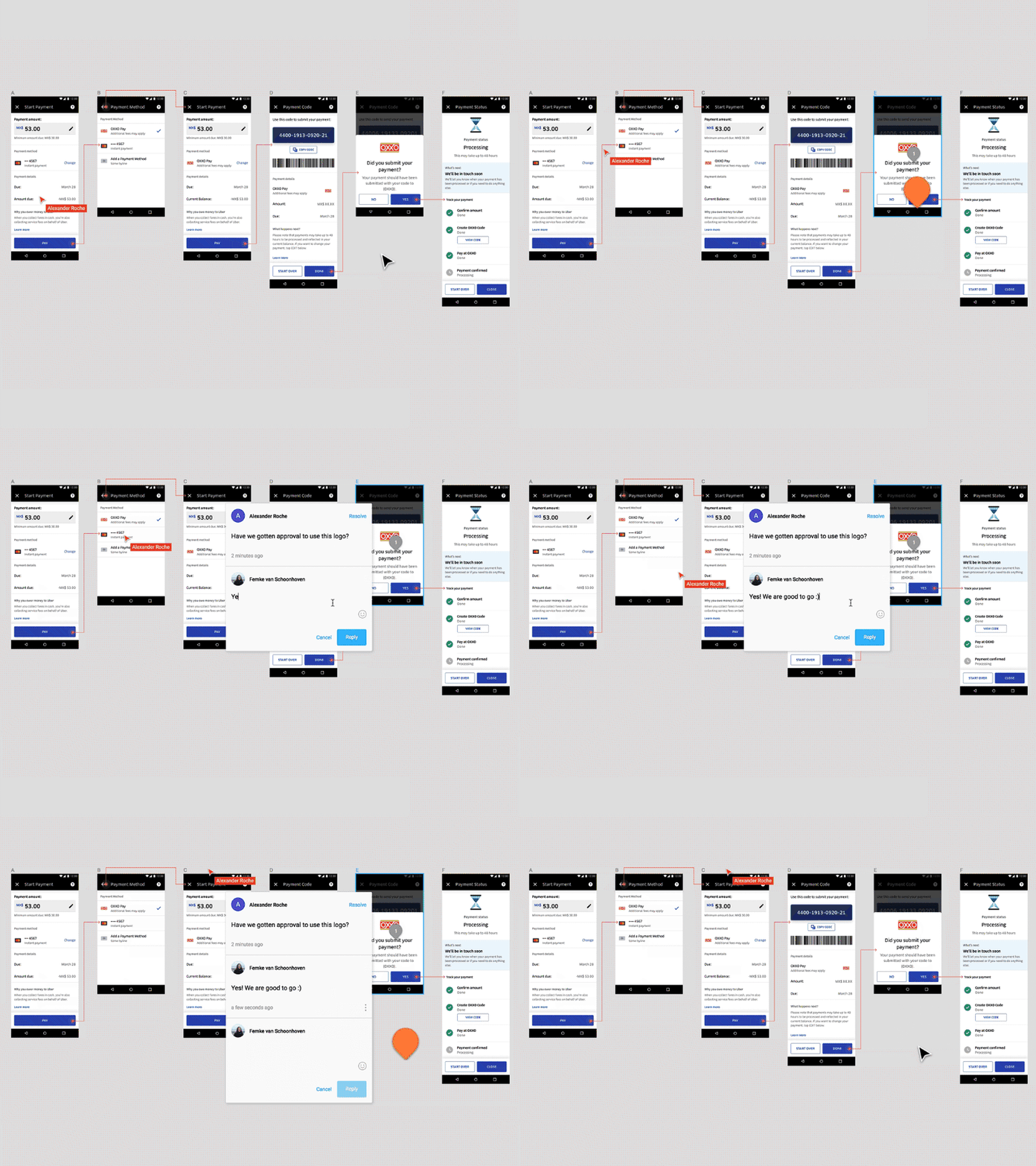

After working with Figma on these new tools, Uber, for example, moved all of its company over to the service and 90 percent of its product design work now happens on the platform. “We needed a way to get people in the right place at the right time — in the right team with the right assets,” said Jeff Jura, Staff Product Designer who focuses on Uber’s design systems. “Figma does that.”

Other new enterprise features that matter in this context are single sign-on support, activity logs for tracking activities across users, teams, projects and files, as well as draft ownership to ensure that all the files that have been created in an organization can be recovered after an employee leaves the company.

Figma still offers free and professional tiers (at $12/editor/month). Unsurprisingly, the new Organization tier is a bit more expensive and will cost $45/editor/month.

29 Jan 2019

Apple unveils new in-store sessions covering photography, Garage Band, health and more

Apple is launching 58 new Today at Apple sessions to beef up its in-store education offerings for people who want to explore Apple’s products. The sessions, which cover video, photography, accessibility, coding, music, health and more, are free to attend and available at all of Apple’s retail stores across the world.

For the unveiling, Apple brought a group of reporters to its Apple Park campus in Cupertino last week. Throughout the day, Apple took us through sample Today at Apple sessions across Apple’s three categories: Skills, Walks and Labs. Skills are quick, thirty-minute sessions designed to teach you new techniques, Walks are actual physical walks with certain Apple products and services and Labs are 90-minute sessions where you create a project.

“So I think of Skills, Walks, Labs almost as, you know, Spanish 1, Spanish 2, Spanish 3,” Apple SVP of Retail Angela Ahrendts told a group of reports at Apple’s spaceship campus last week. “I mean, most things have green diamond, blue diamond, red, black diamond, I mean, there’s always levels.”

When Today at Apple first launched, it was a bit more open. Now, it’s a lot more structured, Ahrendts said.

Beats, art and jump-cuts

First up, I participated in a Garage Band Skills session, where we learned how to quickly create a beat using the beat sequencer. This session is geared toward people who are new to Apple’s tech and may need an introduction to the product or the software.

That is designed to prepare you for the next level of sessions, Walks. At Apple’s campus, we did a photo walk using the iPad Pro with Pencil and digital illustration app Procreate. The task at hand was to walk around Apple’s spaceship campus, snap photos of colorful scenes, capture that color in Procreate and then use the app’s numerous drawing tools to create a portrait. Here’s my masterpiece.

Walks, Apple Senior Director Karl Heiselman said, has been the most popular type of session.

“We think the reason why they’re so popular is you can’t do them on the Internet,” he said.

Last, but not least, we did a Lab where we learned how to create jump-cuts in the Clips app.

All of these sessions are entirely free to attend. Since launching Today at Apple almost two years ago, Apple has hosted 18,000 sessions per week. Millions of people have attended the sessions, so far, but it’s hard to get a totally accurate number, Ahrendts said.

“If you sign up, we have a number but the minute the session starts around the big screen, usually three times more people, you know, kind of hover over it,” Ahrendts said.

Apple’s in-store sessions are a way for the company to build brand loyalty and differentiate itself from the likes of Google and other hardware companies. While Apple’s online store is geared toward purchasing products and receiving customer support, its retail stores are designed to be focused on people and their experiences, Ahrendts said.

“If you’re taking the time to come into a store, we’re assuming you want a much more human experience,” she said.

Today is the biggest launch of sessions to date, with Ahrendts likening the update to its in-store sessions to updates to Apple’s digital software, “but you could assume there will always continue to be updates on our store software forever.”