
Author: azeeadmin

29 Jan 2019

IBM builds a more diverse million-face dataset to help reduce bias in AI

Encoding biases into machine learning models, and in general into the constructs we refer to as AI, is nearly inescapable — but we can sure do better than we have in past years. IBM is hoping that a new database of a million faces more reflective of those in the real world will help.

Facial recognition being relied on for everything from unlocking your phone to your front door, and being used to estimate your mood or likelihood to commit criminal acts — and we may as well admit many of these applications are bunk. But even the good ones often fail simple tests like working adequately with people of certain skin tones or ages.

This is a multi-layered problem, and of course a major part of it is that many developers and creators of these systems fail to think about, let alone audit for, a failure of representation in their data.

That’s something everyone needs to work harder at, but the actual data matters as well. How can you train a computer vision algorithm to work well with all people if there’s no set of data that has all people in it?

Every set will necessarily be limited, but building one that has enough of everyone in it that no one is effectively systematically excluded is a worthwhile goal. And with its new million-image Diversity in Faces (DiF) set, that’s what IBM has attempted to create. As the paper introducing the set reads:

For face recognition to perform as desired – to be both accurate and fair – training data must provide sufficient balance and coverage. The training data sets should be large enough and diverse enough to learn the many ways in which faces inherently differ. The images must reflect the diversity of features in faces we see in the world.

The faces are sourced from a huge 100-million-image dataset (Flickr Creative Commons), through which another machine learning system prowled and found as many faces as it could. These were then isolated and cropped, and that’s when the real work started.
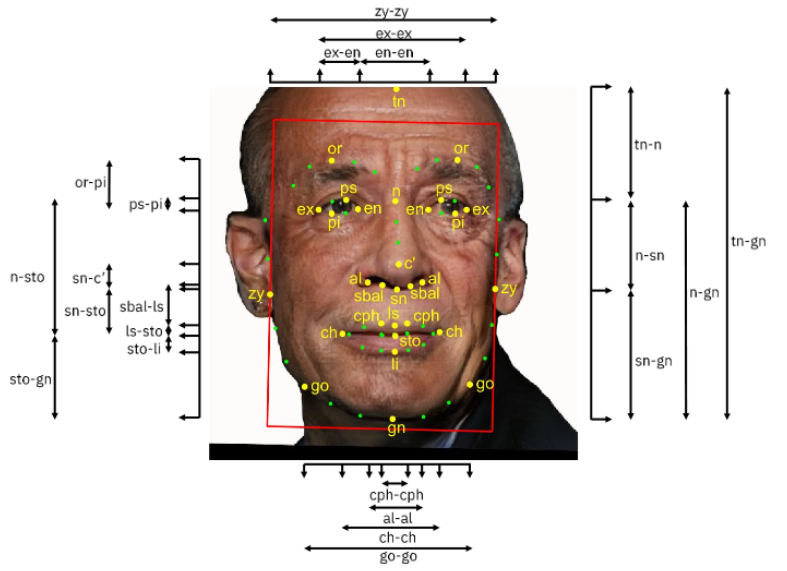
These sets are meant to be ingested by other machine learning algorithms, so they need to be both diverse and accurately labeled. So the DiF set has a million faces, and each one is accompanied by metadata describing things like the distance between the eyes, the size of the forehead, and all that. All these measurements together create the “faceprint” that a system would use to, for example, match one image to another of the same person.

But any given set of those measurements may or may not be good for identifying people, or accurate for a certain ethnic group, or what have you. So the IBM team put together a revised set that not only includes simple things like distances between features, but how those measures relate to one another, for example how the ratio of this area above the eyes to that area below the nose. Skin color, as well as contrast and types of coloration, are also included.

In a move that is long overdue, gender in the set is detected and encoded according to a spectrum, not a binary. As gender is itself nonbinary, it makes sense to represent it as any fraction between 0 and 1. So what you really have is a metric describing how individuals present on a scale from feminine to masculine.

Age is also automatically estimated, but for these two last values a sort of “reality check” is also included in the form of a “subjective annotation” field in which people were asked to label faces male or female and guess at age. Here there may be bias re-encoded, as sourcing from humans tends to introduce it. All these make for a considerably broader set of measurements than any other publicly available facial recognition training set.

You may wonder why race or ethnicity isn’t a category — IBM’s John R. Smith, who led the creation of the set, explained in an email to me:

Ethnicity and race are often used interchangeably, although the first is more related to culture and the second is related to biology. The boundaries within either are not distinct, and labeling is highly subjective and noisy as found in prior work. Instead, we chose to focus on coding schemes that could be determined reliably and have some kind of continuous scale that could feed diversity analysis. We may return to some of these subjective categories.

Even with a million faces, however, there’s no guarantee that this set is adequately representative — that enough of all groups and sub-sets are present to prevent bias. In fact, Smith seems sure it isn’t, which is really the only logical position.

We could not ensure this in this first version of the data set. But, it is the goal. First, we need to figure out the dimensions for diversity. We do that by starting with data and coding schemes as in this release. Then we iterate. Hopefully, we bring along the larger research community and industry in the process.

In other words, it’s a work in progress. But so is all of science, and despite the frequent missteps and broken promises, facial recognition is inarguably a technology we will all be engaging with in the future, whether we like it or not.

Any AI system is only as good as the data on which it’s built, so improvements to the data will trickle down for a long time. Like any other set DiF will likely go through iterations addressing shortcomings, adding more content, and integrating suggestions or requests from researchers using it. You can request access here.


29 Jan 2019

Report: Apple’s video streaming service to launch this spring

Apple’s new streaming service is poised to launch this spring, according to The Information, citing three unnamed sources. Tucked away in a report about Amazon’s plans to dial down its efforts with its subscription video offering, The Information noted that Apple has been telling entertainment partners to be ready for a mid-April launch for the streaming service. But the report also said the actual launch date could be within several weeks of that time frame.

A spring launch date would fall in line with earlier reports, which said Apple’s video streaming service would launch in the first half of 2019.

Apple CEO Tim Cook also vaguely confirmed its plans in this area, when speaking with CNBC earlier this month. He said that Apple would announce “material” new additions to its line of service offerings this year. These could include the upcoming news and magazine subscription service, which is also rumored for a spring arrival, and possibly new services in the health space.

Apple has been gearing up for its streaming service for some time, acquiring rights and making deals for a number of TV shows and movies — it even just brokered its first movie deal at Sundance 2019 on Monday.

However, Apple’s original content may not be the only thing to watch on the new service.

Apple may include an Amazon Channels-like offering as a part of its video service, the new report said. This, too, has been claimed previously by both Bloomberg and CNBC.

This Amazon Channels-like model has been copied throughout the competitive streaming market because of the low overhead and the big cut Amazon and Roku take on subscription sales — around 30 percent, The Information says.

For example, Roku this week launched its own video subscriptions in The Roku ChannelSling TV rolled out a selection of premium à la carte channels last year; and media center software maker Plex aims to do the same in 2019. Walmart had been rumored to be entering this market via Vudu, its video marketplace that’s now its key focus for competing on streaming.

Even Facebook is considering an Amazon Channels-like offering, the report said.

Apple’s decision to move forward with a spring — or possibly, even mid-April — launch date would see its service going head-to-head with Disney+, the Disney-owned Netflix competitor that will be shown off to investors on April 11.

But what’s still unclear is how Apple will be marketing and selling its streaming offering — reports have varied on this front, claiming everything from a bundle with Apple Music and news to being entirely free.

29 Jan 2019

Daily Crunch: FaceTime bug allows eavesdropping

The Daily Crunch is TechCrunch’s roundup of our biggest and most important stories. If you’d like to get this delivered to your inbox every day at around 9am Pacific, you can subscribe here:

1. Apple disables group calling in FaceTime in response to eavesdropping bug

Apple has disabled the group calling feature within its FaceTime calling service while it works on a patch to fix a nasty bug that allows eavesdropping. Apple’s status page shows that group calling via FaceTime is “temporarily unavailable” — that’s a stop-gap move while the company works to deliver a more permanent fix.

We were unable to set up a group call when we tried, having earlier been able to do so and replicate the issue.

2. Huawei ‘disappointed,’ denies charges

The long-simmering battle between the U.S. government and Huawei heated up last night when the U.S. DOJ announced that it is pursuing criminal charges against the Chinese hardware maker. Huawei has, unsurprisingly, denied all wrongdoing.

3. SAP job cuts prove harsh realities of enterprise transformation

While the company tried to put as positive a spin on the announcement as possible, there could be up to 4,000 job cuts as SAP shifts into more modern technologies.

Photo: Adam Gault/Getty Images

4. Petal raises $30M from Valar to bank the unbanked with credit cards

Petal uses a more holistic and comprehensive underwriting model to determine the creditworthiness of credit card applicants compared to traditional banks that rely predominantly on an applicant’s FICO score. The goal is to focus more on cash flows rather than a static score.

5. Casper announces the Glow — a portable, sleep-friendly light

The Casper team sent me a couple of Glows to try out for myself. The result? I found myself getting sleepier as the light dimmed, and I seemed to pass out more quickly and reliably than normal.

6. Home improvement platform Houzz lays off 180, reportedly gears up for public listing

We’ve confirmed that the company laid off around 110 people in the U.K. and Germany this month, along with an additional 70 in its U.S. home market in Q4 of last year.

7. Screen time inhibits toddler development, study finds

A study has found that kids 2-5 years old who engage in more screen time received worse scores in developmental screening tests. The apparent explanation is simple: when a kid is in front of a screen, they’re not talking, walking or playing, the activities during which basic skills are cultivated.

29 Jan 2019

Darkstore raises $7.5 million Series A round for its same-day fulfillment center

Darkstore, a technology-driven fulfillment solution for companies like Nike and others, has raised a $7.5 million Series A round. With the additional funding in hand, Darkstore plans to expand its fulfillment center into more categories.

Currently, Darkstore fulfills products for brands in the areas of footwear, home and consumer electronics. With the funding, Darkstore will expand into lifestyle, health and beauty, and athletic leisure, Darkstore founder and CEO Lee Hnetinka told TechCrunch over the phone.

“There are other categories where we get inbound and turn it town,” Hnetinka said. Down the road, Hnetinka said he envisions additional categories, including groceries and perishables.

Darkstore works by exploiting excess capacity in storage facilities, malls and bodegas and enables them to be fulfillment centers with just a smartphone. The idea is that brands without local inventory can store it in a Darkstore and then ship out same-day. Darkstore doesn’t charge brands anything to store inventory but charges 3 percent for every item that Darkstore ships, with a minimum of $2 and a maximum of $20.

“Up until now, Darkstore has really been behind the scenes,” Hnetinka said. “We want to continue to do that and to be a superpower to our brands. Our mission is to enable the brands to be direct to consumer and we believe we can help them do that even better by creating what we call a branded movement.”

Specifically, Darkstore envisions creating a badge for brands to place on their websites to signal that it offers same-day delivery via Darkstore. Brands currently see Darkstore as a competitive advantage, Hnetinka said, so they’re unwilling to promote its use of Darkstore, but he hopes to change that. That change would ideally help brands to increase trust with its customers, while also undoubtedly providing more visibility and therefore more business for Darkstore.

Also on the docket for 2019 is to explore a new giving initiative. Tentatively called Darkstore Giving, the idea is to make it easier for brands to reduce return-driven waste. Instead of throwing away lightly used items, Darkstore could facilitate the donation of those items to non-profit organizations.

Darkstore first launched in 2016, counting mattress startup Tuft & Needle as one of its first customers. To date, Darkstore has raised almost $10 million in funding.

29 Jan 2019

Nvidia’s Quadro Virtual Workstations are now available on Azure

Nvidia today announced that its Quadro Virtual Machine Workstation (vWS) is now available in the Microsoft Azure Marketplace. The promise of the Quadro vWS it to allow businesses to run high-end graphics applications in the cloud, using any of the Nvidia’s high-end and mid-level cloud  GPUs like the P100, V100, P4 or P40. For the Azure cloud, this specifically means that the Quadro vWS can use Nvidia’s Tesla GPUs with 24GB of frame buffer per GPU.

“We’re focused on delivering the best and broadest range of GPU-accelerated capabilities in the public cloud,” said Talal Alqinaw, senior director of Microsoft Azure, in today’s announcement. “NVIDIA Quadro vWS expands customer choice of GPU offerings on Azure to bring powerful professional workstations in the cloud to meet the needs of the most demanding applications from any device, anywhere.”

The promise of a virtual workstation, of course, is that you can easily spin them up and down as needed and only pay for when they are running. And all the underlying infrastructures is managed by somebody else, as are software and driver updates, in addition to all the financial calculations that come into effect when you are renting workstations in the cloud.

Nvidia argues that these workstations should be especially of interested to users in industries like architecture, entertainment, oil and gas and manufacturing.

It’s worth noting that Microsoft’s own Windows Virtual Desktop on Azure also supports the Quadro vWS on Tesla GPUs. Indeed, virtual desktops and enabling GPUs for them seems to have been an area of focus for the Azure team in recent months.

29 Jan 2019

Sam Altman’s Science Camp

You’d think that through Y Combinator‘s many initiatives — in person and online — the popular accelerator program would have its bases covered when it comes to creating and growing a talent network. Yet the organization’s president, Sam Altman, doesn’t see it that way. He’d far prefer that YC get to know the world’s brainiacs earlier in their lives, before they’re thinking about the kind of startup they might like to someday launch.

Enter Altman’s newest idea, a kind of annual weekend getaway for nerds in picturesque Boulder, Colorado. Called the YC120, the idea is bring together 120 people for a couple of days in April to mostly just hang out and, hopefully, stay in touch afterward, both with fellow attendees, as well as with YC, which is paying for lodging, travel, and food. The idea is to help create connections.

Naturally, this being YC, the weekend isn’t open to just anyone looking for a free weekend in the mountains. YC is looking for people who with an eye on the future, whether that means they are “interested in gene editing,” or “nuclear fusion” or “building a space colony,” says Altman in a new post about the initiative. We caught up with him yesterday morning to learn more in a chat that’s been lightly edited for length below.

TC: So two days in Boulder in the spring. What will take place there, exactly? 

SA: There will be a little bit of content, but it’s mostly unstructured time for attendees to hang out and meet other people. I rarely go to events anymore; the few that I go to and get value out of are [those] that [provide attendees with] time to spend with interesting people to go hiking or whatever.

TC: One hundred of the people you are welcoming will be people you’ve never met. Another 20 will be people who are already at the top of their fields. Do you know who these 20 people are? Is there anyone we can mention?

SA: We’ve made lists but we haven’t specifically invited anyone just yet.

TC: Do attendees have to have a budding company idea? Would you prefer that they not have a startup idea?

SA: In fact, they don’t. YC is good at many things, including identifying raw talent, but we’d like to get to know people earlier. If we get to know them now and five years from now they have a startup idea, [we want them to think of us]. [The weekend] is open to people who have startups, by the way, but it’s not a requirement in any way. We don’t want to dissuade anyone from applying.

TC: I guess, too, that anyone with venture funding has a bit more of a network in place already.

SA: Probably, though I think we bring together something special.

TC: You are asking applicants to submit one-minute long videos that answer three questions: ‘What are you interested in and what are you working on?’ ‘What have you done so far that shows your potential for greatness, adjusted for whatever life circumstances you were born into?’ And ‘In a best-case scenario, what do you want your obituary to say?’

How can you discern enough from a short video to know who to choose of the thousands of people who might reach out? What if you have three likable teams from Ivy League schools who want to build space colonies, for example?

SA:  You can’t get it perfectly, to be very clear. We’ll make mistakes, I’m 100 percent sure. But when YC first started, we didn’t ask for video, then we made it optional, then a couple of years later, we made it required because although it’s not as good as talking with people in person, which is how we make YC investing decisions, it’s surprisingly helpful. [You can get] 25 to 30 percent of the experience [from video] that you’d get from sitting across the table from someone, based on how someone comes across and their level of passion. Hopefully, we picked pretty good questions, too.

TC: The part about life circumstances is curious. We all know great founders who’ve come from nothing and great founders who’ve come from comfortable backgrounds. Why are someone’s circumstances of particular interest?

SA: A key skill for an entrepreneur is the ability to make the best of whatever situation you have in front of you, whether you were born into privilege or you weren’t. We’re looking for people who, whatever their situation was, did the absolute most possible. We can supply a lot of things — capital, a network– but we’re ultimately looking for raw talent.

TC: Given that you’re asking applicants about what their obituary would say in the best case scenario, we naturally have to ask you what you’d want yours to say.

SA: [Here, Altman answers but does so off the record, explaining in a non-obnoxious way that if we publish what he says, YC will begin to see the same wording in future applications as nascent founders wittingly and otherwise model his behavior.]

TC: Does YC really need yet another program to see some of the world’s best and brightest?

SA: It’s been a surprising lesson for me in my own life and my experience running YC that the most important thing for ambitious people — more than even resources or basically anything else — is a network of like-minded, super-talented people to network with and to help you, and that’s so hard to get in the world, and so easy for YC to create. And if we can do this well, we can unlock much more human potential.

TC: Do you ever worry about steering too many people into creating startups, when they could perhaps be enjoying financial stability and maybe better mental health, working for someone else?

SA: I think entrepreneurship is wrong for almost everyone. When I speak at college campuses, I try to put out a really big disclaimer first that starting a company and becoming a successful company founder is a miserable life that’s good in only a small number of ways. I explain first why not do it, and why for most people, it’s a terrible idea.

I expect one thing I’ll do is discourage [YC120 attendees] from starting a company right away and to be patient. If you’re 18, you have a long time horizon.

29 Jan 2019

Rules to rein in ride-hailing apps coming to Barcelona

Catalonia’s regional government in Spain has agreed new rules to regulate the vehicle for hire (VTCs) sector that will require ride-hailing companies such as Uber and Cabify to substantially change how they operate in Barcelona and other local cities as soon as this week.

The changes have been agreed by decree, ahead of a planned full restructuring of the law, with the Catalan generalitat saying it wants to ensure VTCs and taxis do not compete for the same work.

As a first step, the government says it will introduce a new rule that requires VTC bookings to be made a minimum of 15 minutes in advance of a pick-up, with municipalities or local metropolitan areas able to require a longer wait time.

It writes that such powers can be used to regulate “the use of public road domain, urban traffic management, environmental protection and the prevention of air pollution”.

Ride-hailing companies Uber and Cabify have previously said they will pull out of the Catalan capital, Barcelona, if a 15-minute wait time rule is introduced. But even if the companies change their mind about leaving they would likely have to suspend services to implement software tweaks to their apps to comply with new restrictions on how VTCs can operate. 

Under the decree, VTC companies will also be prohibited from displaying the real-time geolocation of vehicles for hire in their apps prior to a booking. Only once a booking has been made can the location of the vehicle be displayed.

The decree also bans VTC vehicles from plying for trade by freely circulating in the streets. Instead they will be required to return to a base, such as a parking lot or a garage, to wait for the next booking.

An Uber spokesman told us it’s not commenting at this stage as it waits for the decree to be published later this week.

The decree, which will be published on Thursday, is due to come into force next Friday, according to El Confidential. Although it will also need to be approved by the Catalan parliament — with a month provided for that process.

The Catalan government says fines of up to €1,400 (~$1,600) can be applied to VTC drivers caught infringing the provisions.

Local authorities will be allowed to create a register of VTC vehicles providing a service in their region, with local police forces tasked with carrying out inspections of suspected infringers.

“Impossible for us to continue… “

Safe to say, the incoming regulations aren’t popular with ride-hailing companies.

Last week an Uber spokesperson told us: “If approved, announced restrictions in Catalonia would make it impossible for us to continue offering our UberX service in Barcelona. We continue to call for dialogue with all local stakeholders, including taxis, to find a path forward for the thousands of drivers and users who rely on VTC services in Catalonia.”

A Cabify spokeperson also told us then that if the restrictions were approved the government “will essentially be forcing Cabify out of Barcelona and going against the interests of one million registered users and the wider VTC sector operating in the city”.

“Cabify is absolutely committed with Barcelona and its users, as it does in the 130 cities where the Company operates globally. In case negotiations don’t change this wrong decision, our strategic road map will remain the same. Innovation and Technology are our main drivers to improve mobility in the markets we operate,” the spokesperson added.

At the time of writing Cabify had not responded to a request for comment on the decree being agreed.

Earlier this month another round of taxi strikes kicked off in the Catalan capital, with local taxi drivers also furious about the proposed 15 minute wait. But they couched it as not stringent enough — calling for a minimum of at least 24 hours.

That huelga indefinida of taxis only ended after Barcelona’s mayor pledged to extend the minimum wait time to an hour, reports El Confidential.

The taxi industry’s complaint and long-time beef with ride-hailing companies is the apps represent unfair competition, with VTCs firms accused of operating a taxi service without having the same regulatory burden as taxis.

Last summer another series of taxi strikes in major Spanish cities only ended after the country’s government agreed to devolve regulatory power over the VTC sector to autonomous communities. And Catalonia is the first region to have pushed ahead with applying controls to the sector.

Though its planned changes are clearly not without controversy — and a slick PR campaign by a Spanish VTC association has pushed an online petition to close to 150,000 signatures. (Although local press reports that a signed-in-person petition against the decree that was handed to the Catalan government only had around 10,000 signatures.) 

Meanwhile, the looming prospect of the world’s biggest mobile tradeshow, Mobile World Congress, is likely concentrating local politicians’ minds. The event takes place in Barcelona in just under a month’s time, and in recent years it’s been a strategic ratchet for taxi associations to amp up the pressure of threats to ‘paralyze the city’.

This month the VTC sector has also taken to Barcelona’s streets, albeit to protest a little more quietly. Drivers parked their vehicles along a major road in protest at the proposed changes and some demonstrated outside parliament.

In a tweet in the last few hours following the announcement of today’s decree, the Unauto VTC association claims the sector will have no option but to quit Barcelona, saying it puts 1,000 drivers out of work.

Early reaction from the taxi industry to the government decree is jubilant — with one of the main associations campaigning for tighter regulation on the VTC sector, Elite Taxi BCN, tweeting a government response which gives short shrift to the VTC sector’s claim the changes mean the instant sack for thousands of VTC drivers.

In the cited quotation, the government also dubs the decree “proportionate and competitive”.

“We will not yield to the blackmail of the street nor the blackmail of the offices,” it adds.

The taxi industry’s campaign has also focused on criticising working conditions for drivers in the VTC sector, and claiming multinational companies like Uber offer only precarious work, rather than sustainable employment.

And there is certainly a large chunk of irony in a sector that contains gig economy platform giants trying to argue tighter controls will make its drivers ‘unemployed’ (when Uber, for example, classifies drivers as self-employed contractors, never employees… ).

If Uber does pull out of Barcelona it won’t be the first time either.

The company only relaunched a service in Barcelona last March after its original p2p (non-professional driver) play was forced out in late 2014, following legal challenges driven by the taxi sector.

For the relaunch Uber bought its way in by paying to obtain VTC licenses from existing operator/s. It’s unclear how many Uber drivers operate in the city but Barcelona remains very well served by affordable and accessible public transport options — in addition to plentiful taxis.   

Taxi associations in Madrid have also been striking in protest at VTCs this month, bringing a major road in the Spanish capital to a standstill, per this Reuters report.

There taxi drivers want the government to uphold a ratio of 1 VTC per 30 taxis as a matter of urgency, rather than giving VTC companies four years to comply with the regulation, as it said it would last fall.

29 Jan 2019

Waze expands its Bluetooth beacons to New York City to end GPS signal blackouts

Drivers in New York City will soon be able to use Waze — and other navigation apps — in places like tunnels or bridges where it’s common to lose a GPS signal.

The new capability is courtesy of small open source puck-like devices called Waze Beacons that were invented in-house by Gil Disatnik, an engineer who now heads up the beacons program.

These battery-powered beacons broadcast an open standard signal via Bluetooth, which takes over for GPS to provide location data when a car passes through a tunnel.  The beacons, which are powered by Eddystone beacon technology, can transmit messages directly to a smartphone or tablet via Bluetooth.

The company has partnered with New York’s MTA as well as the Port Authority of NY and New Jersey to install these beacons in bridges and tunnels used to enter and exit Manhattan. The Waze Beacons are live, as of Tuesday, in the Holland Tunnel, Lincoln Tunnel, Queens-Midtown Tunnel, and Hugh L. Carey (Brooklyn Battery) Tunnel. About 42 beacons per mile of tunnel are required, according to Waze.

“The Port Authority is strongly committed to leveraging new technology to improve the customer experience for the tens of thousands of travelers who use our crossings each day,” Port Authority Executive Director Rick Cotton said in a statement. “Last year, we launched our Crossing Time app that provides commuters with real-time traffic conditions at all agency bridges and tunnels. Today, we are activating new technology pioneered by Waze that will provide better GPS navigation capabilities for drivers as they drive through the Lincoln and Holland tunnels and MTA tunnels.”

The expansion to New York City follows a pilot launch last year in Chicago. Waze Beacons are installed in nine cities globally, including Boston, Pittsburgh, Rio de Janeiro, Paris,Oslo, Florence, Italy, Haifa, Israel, and Jihlava in the Czech Republic. The beacons, which cost $28.50 each, are open sourced. This means other navigation services can also use the program technology free of charge.

29 Jan 2019

Alphabet-backed Medicare Advantage startup Clover Health raises $500M

Despite a number of well-publicized hiccups, venture capitalists are betting another $500 million on health insurance provider Clover Health, TechCrunch has learned.

Existing investor Greenoaks Capital led the round, according to the startup, which confirmed it was closing a new round of capital in the coming weeks. Clover Health has raised a total of $925 million to date, garnering a valuation of $1.2 billion with a $130 million Series D funding in 2017. The company, backed by Alphabet’s venture arm GV, Sequoia Capital, Floodgate, Bracket Capital, First Round Capital and more, declined to disclose its latest valuation.

San Francisco-based Clover Health was founded in 2012 by chief executive officer Vivek Garipalli, the former founder of New Jersey healthcare system CarePoint Health; and Kris Gale, who served as the startup’s chief technology officer until transitioning into an adviser role in December 2017. As part of its latest funding round, the company told TechCrunch it’s promoting Andrew Toy, its chief technology officer since early 2018, to the role of president and CTO. He will also join its board of directors.

Varsha Rao, Airbnb’s former chief operating officer, joined the company in September 2017 as COO.

The tech-enabled health insurer differentiates itself from incumbents by collecting and analyzing health and behavioral data to lower costs and improve medical outcomes for its members. It’s part of a new cohort of heavily funded insurtech startups, including Devoted Health and Bright Health, both of which similarly provide Medicare Advantage plans. Devoted Health, backed by Andreessen Horowitz, raised a $300 million Series B funding round three months ago. Bright Health, for its part, brought in a $200 million Series C in late November at a $950 million valuation. It’s backed by Bessemer Venture Partners, Greycroft, NEA and Redpoint Ventures, among others.

Founded in 2012, Clover Health is years older than its aforementioned counterparts. The business, though supported by top-tier investors and plenty of capital, has struggled in the past to shrink its losses. In 2015, Clover Health posted a net loss of $4.9 million only to increase it 7x the following year to $34.6 million, according to financial documents obtained by Axios. At the time, Clover Health had 20,600 Medicare Advantage members, earning it $184 million in taxpayer revenue. According to reporting from CNBC, the company had initially planned to double its membership base each year but was only able to expand from 20,000 in 2016 to 27,000 in September 2017.

Clover Health currently has 40,000 members in Georgia, New Jersey, Arizona, Pennsylvania, South Carolina, Tennessee and Texas. The business earns roughly $10,000 in revenue per member from the Centers for Medicare and Medicaid Services, or currently about $400 million in annual revenue. As a Medicare Advantage plan, Clover Health makes a majority of its cash from the government.

“Clover’s continuously improving economic fundamentals have allowed us to build sustainably, thoughtfully enter new markets and increase our overall membership by 35 percent during the last 12 months, compared with nationwide growth of 8 percent for Medicare Advantage overall,” the company said in a statement provided to TechCrunch. “This has made Clover one of the fastest growing insurers in [Medicare Advantage] over the past three years. That said, there is much more to accomplish, which is why I am so excited about entering this next phase in our company’s history.”

29 Jan 2019

The key number to look out for when Apple drops its Q1 earnings report later today

Apple, the company formerly known by its trillion-dollar market cap, will be reporting its holiday quarter Q1 2019 earnings today and it may just have the health of the global markets riding on how the financials look.

No pressure.

Earlier this month, Apple CEO Tim Cook issued a letter to investors, slashing Q1 guidance from a range of between $89 billion and $93 billion to just $84 billion. Given that the company revised its guidance just a few weeks ago, there isn’t much of a reason to expect a major revenue miss from the company though things could still go awfully wrong if the company is pessimistic in its Q2 outlook or misses elsewhere.

Apple’s stock price cratered nearly 10 percent when Cook’s investor letter was released, a drop that represented the worst single day plunge for the company in more than five years. The stock has mostly recovered in the weeks since, but it is recovering from a 52-week low it reached earlier this month, a nearly 40 percent decline from its all-time-high in October.

Analysts are certainly going to be scouring the numbers today to get any sort of read into the health of the company’s mobile business moving forward, but they will have less data than ever to make these judgments off of.

During the company’s last investor call, Apple slid in an announcement that they would not be reporting unit sales in subsequent quarterly earnings reports, meaning that you won’t see any flashy “Apple sold XX.X iPhones this quarter” stories floating across your timeline. For the time being, revenue numbers are all we’re working with, though Apple contends that its financial success is growing less tightly correlated with unit sales, likely a result of the widening range of price points in its device categories and a general upward trend in these products’ average selling prices.

Despite the unit sales shift, a lot of analysts will be staring long and hard at a single number this quarter anyway: Greater China revenue.

In Cook’s investor letter, he detailed that “economic weakness in some emerging markets” had “turned out to have a significantly greater impact than we had projected.” India and China have been two incredibly difficult markets for Apple to crack, while the company has definitely made healthy inroads with the iPhone in China, it seems growth is slowing there with Cook going as far to say that the bulk of the company’s guidance reduction was a result of iPhone revenue declines in Greater China.

Investors are going to be left having to judge whether revenue declines are a result of weariness surrounding ongoing U.S./China trade negotiations, a general slowing in China’s economic growth rate, or whether — perhaps most frightening to investors — Apple has just begun to lost its grip to Chinese consumer tech companies. It’s obviously most likely a combination, but you can expect Apple to point to external factors wherever possible.

Q1 2019 was also the first full quarter of sales for Apple’s three newest smartphone models, the iPhone XS, iPhone XS Max and iPhone XR, so we’ll likely get our best look at how the new models are faring and whether existing users are upgrading in developed markets. Cook seemed to hedge bets in his investment letter, noting that a number of macroeconomic trends and more dialed-in factors like consumers taking advantage of Apple’s $29 battery replacement program, impacted iPhone upgrades.

The iPhone’s ability to keep plugging along in its key markets is obviously going to be pretty critical for Apple. The headlines surrounding Apple’s transition to a services company has always been predicated by the fact that iPhone revenues were still climbing, it’s just that Services revenue was climbing even faster. If there prove to be some key heat sinks for Apple in its bread-and-butter hardware verticals, it’s apparent these trends would keep some downward pressure on the stock.

We’ll see how the Cupertino consumer tech giant does when it reports earnings after the bell today, check back here to see how Apple fares.