Category: UNCATEGORIZED

15 Oct 2019

Google launches Nest Wifi mesh router and extender with built-in Google Assistant

Today at its Google hardware event, Google introduced new mesh routers called Nest Wifi. This is a successor tot he Google Wifi product it introduced a couple of years ago, but with a number of improvements. The new Nest Wifi consists of two types of devices, one a router that plugs into your modem, and one ‘point’ amplifies the signal and extends the network, and it’s more powerful so you only need these two things.

It’s available to pre-order, and will ship on November 4. It comes in a 2-pack or a 3-pack variant, for $249 or $349 respectively, and will be available in eight countries at launch.

Google says that Nest Wifi offers 2x better speed than Google Wifi, with up to 25% better coverage. That’s from the two-piece system, which Google says is probably enough to cover the same space as the three-puck Google Wifi original system.

The hardware is designed to be placed out in the open – Google paid attention to design here to make sure it looks good enough to keep it where it’ll work best to provide signal. And the ‘point’ has a built-in speaker and microphone array, with onboard Google Assistant support, making it double as a smart speaker – which really does add to the overall value in terms of what you’re getting for the money.

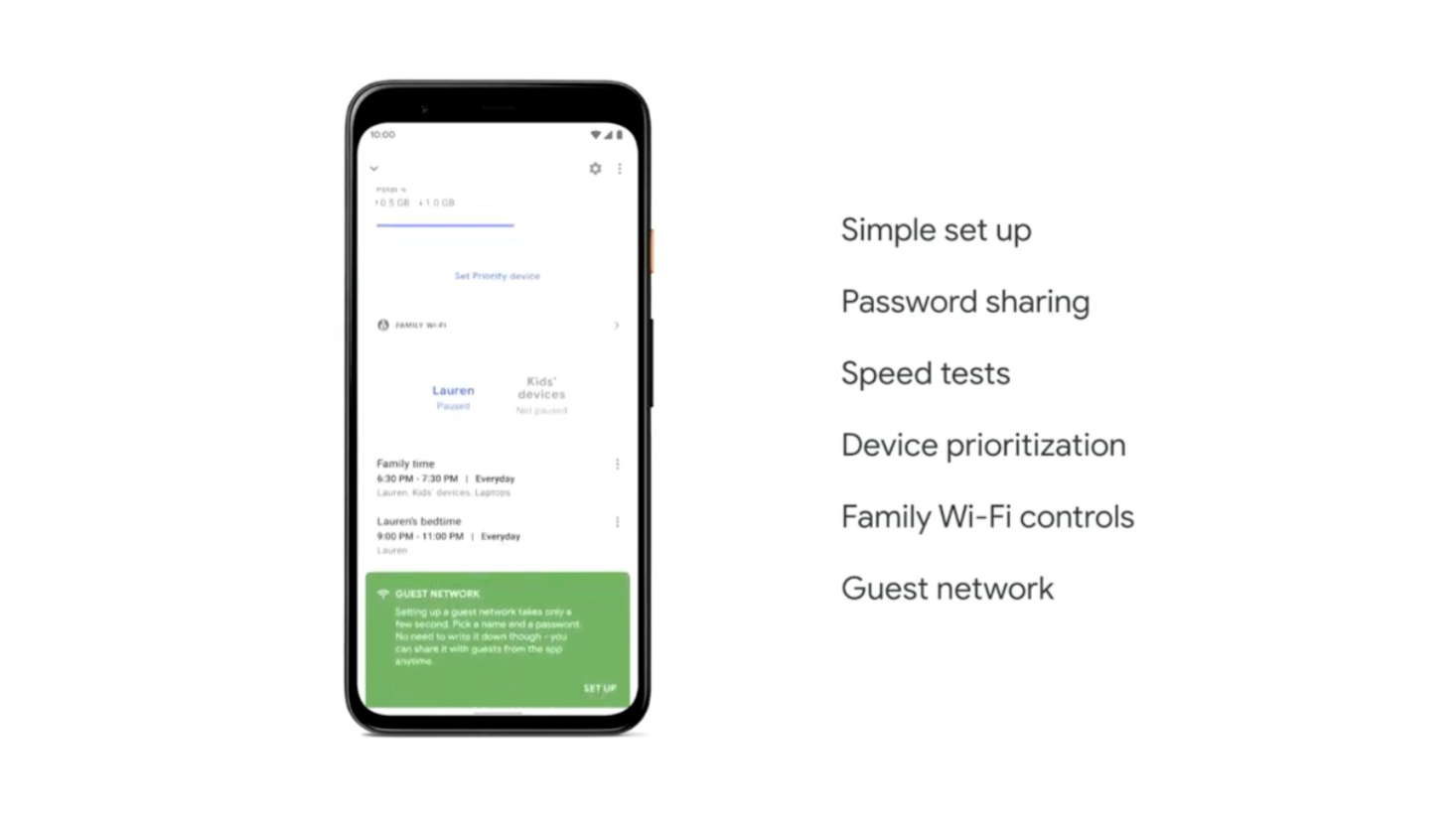
Like Google Wifi, it offers simple set-up, parental and guest controls, as well as “seamless setup” for smart home devices rom within the Google Home app.
Screen Shot 2019 10 15 at 10.36.01 AM
Interestingly, Google said that Google Wifi has been the top-selling mesh Wifi system in both the U.S. and Canada since its launch, so it’s clearly seeing a lot of success in this category. The company was also quick to point out that it has provided 15 updates to the original hardware since its launch, adding new features and improving performance, so expect a similar slew of post-purchase updates for Nest Wifi, too.

15 Oct 2019

Google’s Pixel 4 is official

The rumors and leaks have been pretty relentless. In fact, over the past three days, the Pixel 4 and Pixel 4 XL have gone up for preorder on at least two different sites. While it’s true that Google’s never been particularly great at keeping this stuff under wraps, this was pretty silly.

Anyway, the Pixel 4 is finally official, and it’s basically exactly what we were expecting from this year’s Google flagship. The device now features face unlock, another addition that brings Pixels in line with the competition, though Google claims it’s the fastest available. Using a new radar chip, the device is able to start the unlock when you reach for the phone and then fully unlock when it sees your face.

Radar also gives the device gesture recognition, via Motion Sense The concept is similar to what you’ll find on other Android handsets, but it’s significantly more sophisticated, distinguishing accidental gestures from intentional ones Use these, this can do things like skipping songs, turn the screen on and wave to your animated Pikachu wallpaper (actual example). All of the processing is done on device and users can turn it off for privacy.

The 4 maintains the familiar Active Edge squeeze, which launches a newly upgraded Google Assistant. As rumored, there’s a new recording app, which is capable of transcribing conversations in real-time. From the demo, at least, the feature is pretty impressive, with a more accurate transcript than I’ve seen from most AI software. Interestingly, it all works on-device, meaning that you can use it in airplane mode — and that that conversations aren’t automatically uploaded to the cloud

15 Oct 2019

The Apple TV app arrives on Roku, ahead of Apple TV+ streaming service launch

Ahead of the arrival of Apple TV+, the brand-new Apple TV app is launching on Roku devices, starting today. The app currently allows Apple customers to access their iTunes video library and subscribe to Apple TV channels directly from Roku devices. And, on November 1, it will also be home to the Apple TV+ streaming service, featuring Apple’s own original programming like The Morning Show, See, Dickinson, For All Mankind, Truth be Told, and others.

The new app will authenticate users with their Apple ID, so they can access their purchased content, get personalized recommendations, subscribe to paid channels (e.g. HBO, Starz, Showtime, etc.), and buy and rent over 100,000 movies and TV shows from iTunes. Additionally, Roku users will soon be able to subscribe to Apple TV+ right in the app for $4.99 per month.

Typically, Roku would take a cut of subscription revenue generated on its platform, but it’s not clear what sort of deal it may have with Apple.

The Apple TV+ streaming service is free for the first year with the purchase of a new Apple device, but it’s not limited to only those who own Apple hardware.

With Apple’s further expansion into services, it’s been learning to embrace third-party platforms. That’s especially true for its streaming services, like Apple Music and Apple TV+.

The TV streaming service, for example, is being made available on 2018, 2019 and newer Samsung smart TVs, Amazon Fire TV, LG, Roku, Sony and VIZIO platforms, in addition to AirPlay 2-enabled Samsung, LG and VIZIO smart TVs. And it will stream on the web through tv.apple.com.

The Apple TV app will be available on most streaming devices from Roku, including Roku TV models, streaming sticks, and streaming media players, both new and old. (A full list is here). However, select older model media players won’t offer the app.

The app will offer Apple TV+ in the U.S., Argentina, Canada, Chile, Colombia, Costa Rica, El Salvador, France, Guatemala, Honduras, Mexico, Nicaragua, Panama, Peru, Republic of Ireland and the United Kingdom.

“With the Apple TV app coming to Roku, our customers will enjoy an even broader range of exciting entertainment, including the highly anticipated Apple TV+ service,” said Scott Rosenberg, Roku Senior Vice President and General Manager of Platform Business, in a statement. “Roku is a valuable partner for content providers looking to reach a large and engaged audience, and we’re looking forward to bringing this new option to Roku users.”

15 Oct 2019

Google Home Mini is now Nest Mini

Google this morning unveiled the long awaited follow up to the Home Mini. The latest version of the company’s wildly popular entry-level smart speaker has been rebranded the Nest Home Mini, in keeping with the branding refresh of its smart home offerings. The new version of the device looks a lot like its predecessor, but features a number of internal upgrades.

Chief among the changes are improved sound and built-in machine learning that lets the device adapt power based on usage. The new version of the Mini smart speaker also doubles as an intercom and a conferencing speaker, so users can call the device directly, using Duo.

The most fun addition here, however, is the wall mount. With it, users can move the device from the shelf to the wall, giving it a greater flexibility for in-home placement. The Nest Mini’s familiar fabric covering is made using recycled bottles, as noted earlier in today’s event, in keeping with the company’s increased focus on sustainability.

The new Mini arrives October 22, priced at tempting $49 — same as its briskly selling predecessor. Along with the new Mini, Google’s also adding smart speaker functionality into the new Nest Wifi, which arrives early next month

15 Oct 2019

Google launches the $649 Pixelbook Go Chromebook

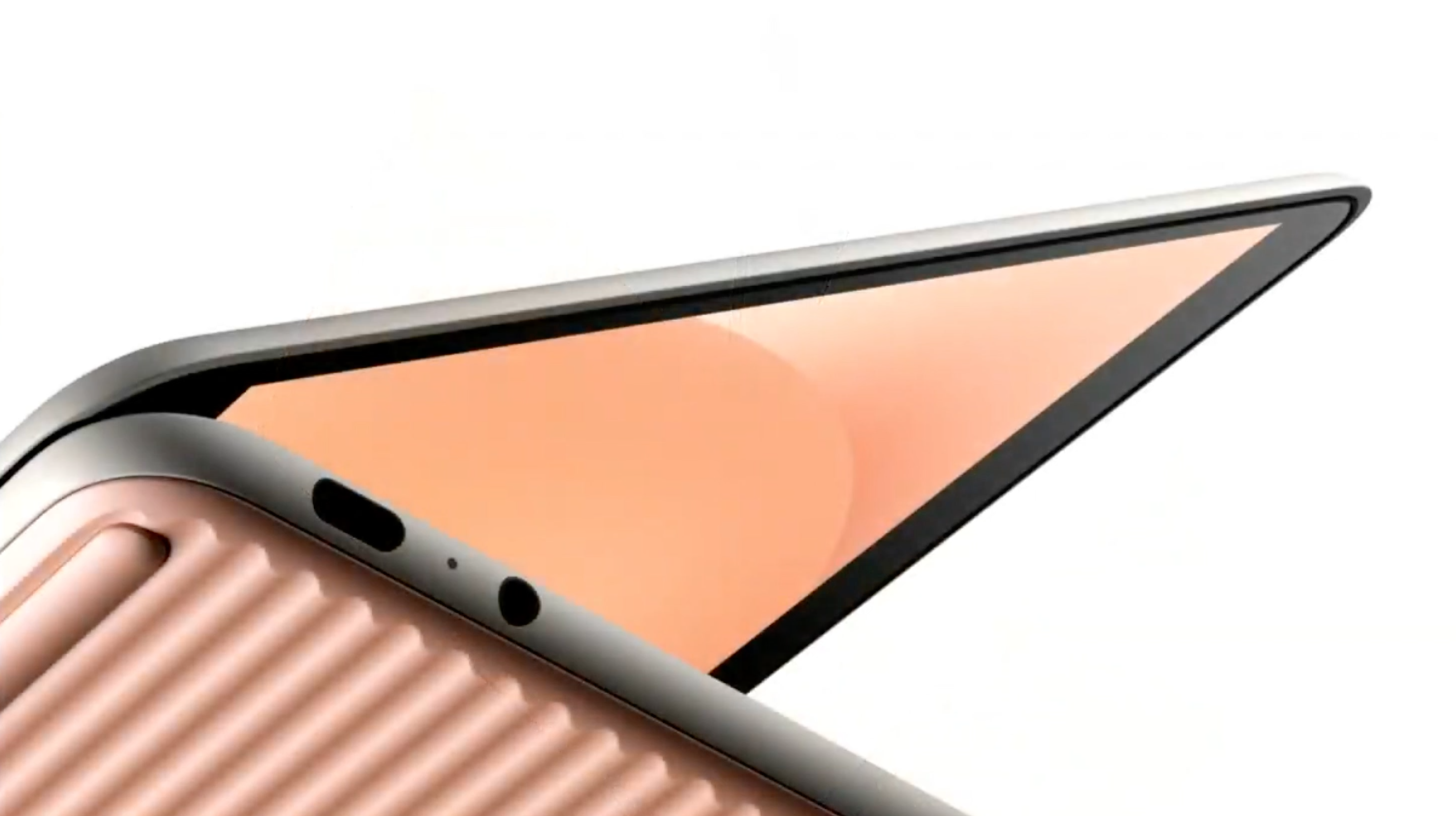
At its annual hardware event, Google today announced the launch of the Pixelbook Go, the latest iteration of its first-party Chromebook lineup. Starting at $649, the Pixelbook Go marks a return to the standard laptop format after last year’s Pixelbook with a 180-degree hinge and the Pixel Slate 2-in-1.

The Go will come with a 16:9 13.3-inch touch screen and either an HD or 4K display, a built-in Titan-C security chip, up to 16GB of RAM and up to 256GB of storage. It’s powered by Intel Core CPUs, starting with an m3 chip at the low end and an i7 at the top end. Available colors are black and “just pink” and pre-orders start now, but only for the black version. “Just pink” is coming soon.

Screen Shot 2019 10 15 at 10.25.38 AM

It has a rippled bottom, “that’s easy to grip” and a “Hush Keys,” which are supposedly quieter than the keys on previous Pixelbooks.

We wanted to create a thin and light laptop. That was really fast, and also have it last all day. And of course, we wanted it to look and feel beautiful,” Google’s Ivy Ross said in today’s announcement. Ross also stressed that the Pixelbook Go has a larger battery, yet is still lighter, thanks to its magnesium body.

Screen Shot 2019 10 15 at 10.24.49 AM

Unlike Microsoft, with its Surface line, Google’s laptops always seemed more like aspirational devices that defined the high end of the Chromebook spectrum. At $649, the Pixelbook Go is clearly more affordable than many of Google’s previous efforts in this area and the company clearly hopes to sell a few more of them.

EG7RBskXkAE9e6k

15 Oct 2019

For $164, Jaguar will let you co-pilot its I-Pace race taxi around the Nürburgring 

The Green Hell, as the famed Nürburgring Nordschleife was nicknamed back in the late 1960s, is a 73-corner nearly 13-mile track in Germany that can challenge even the most accomplished professional race car drivers.

Now, for about $164, thrill seekers can be a passenger for one lap. Jaguar announced a RACE eTAXI promotion that customers can buy a ride around the Nürburgring in an all-electric I-Pace vehicle piloted by a professional race car driver.

The promotion lasts through the end of November. The automaker also has a regular ol’ race taxi program that for about $274 gives customers a ride in the Jaguar XE SV Project 8.

The Nürburgring has become the place for automakers such as Volkswagen, Nio and Porsche to compete for “fastest electric car” bragging rights. Even Tesla CEO Elon Musk has said the company plans to put its Model S to test on the ‘ring.’

In August, the Porsche Taycan completed the course in 7 minutes and 42 seconds, which the German automaker said is the fastest lap for a four-door electric vehicle.

But it’s not the fastest lap for any electric vehicle. That honor goes to Volkswagen’s ID R electric race car, which completed the course in 6:05.336 minutes. The previous record was set in 2017 by Peter Dumbreck, who was driving a Nio electric vehicle.

15 Oct 2019

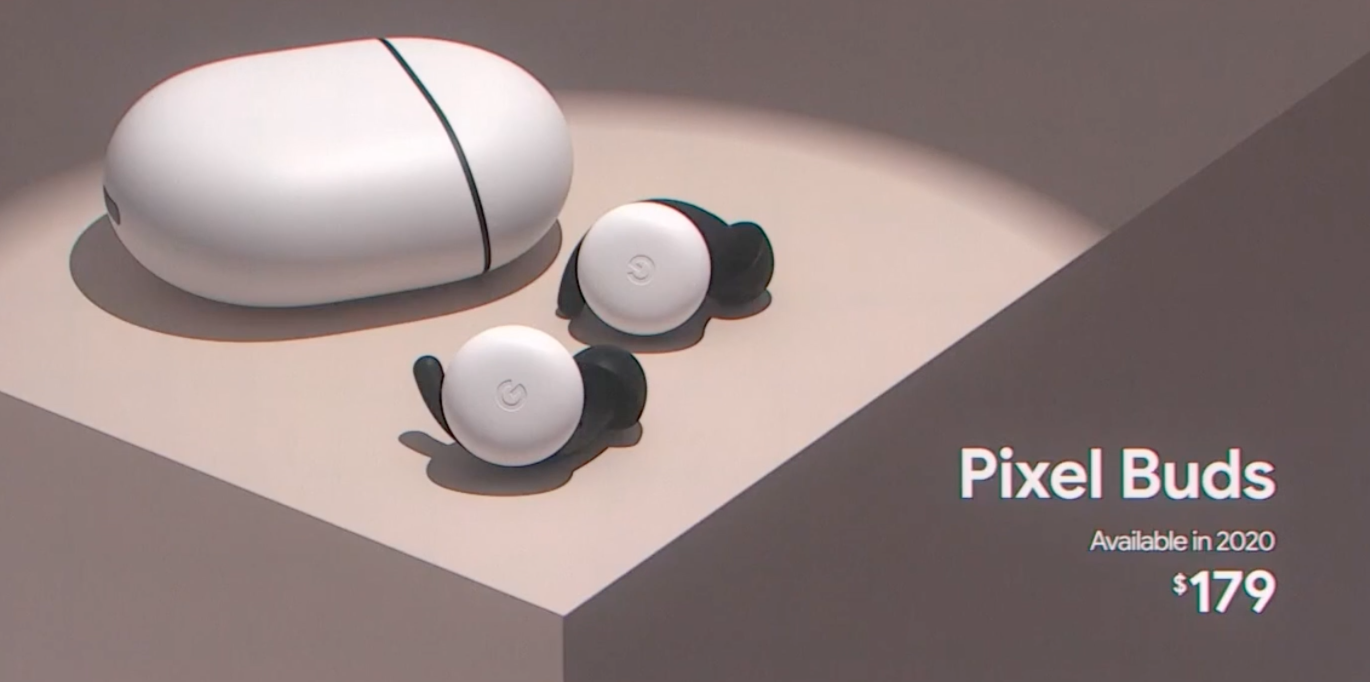
Google teases fully wireless Pixel Buds, arriving Spring 2020

As rumored, Google just dropped a little hint about its next generation Pixel Buds. The company unveiled a pair of fully wireless earbuds following the release of its promising, but fairly disappointing tethered earbuds. The new headphones are certainly nice looking, maintaining the same pastel color scheme it offers on its Pixel handsets.

The headphones are still a long ways out, arriving in spring of next year. Clearly the company wanted to let the world know that it still has a vested interest in the category, even as the likes of Apple, Samsung and Sony have taken most of the air out of the room. The headphones use long range bluetooth wireless, maintaining a connection up to three rooms away in doors and a full football field from its source when outside.

Google Pixel Buds with Case and Price

The on-board mics give the Pixel Buds adaptive sound, adjusting based on the wearer’s environment. The mics also focus in on the speaker during a phone conversation, while helping to remove ambient sound like the wind The battery should get five hours on a charge, with a full 24 hours in the included battery case. The case looks a bit like a streamlined version of the one that comes with Apple’s AirPods, though thankfully not as large as, say, the one that comes with Beats version.

When they arrive next year, the new Pixel Buds will run $179 — not a bad price, particularly if these ones live up to the (admittedly vague) promises made at today’s event. Once again, the company is focused on software here — not unlike Microsoft’s recently announced Surface earbuds. Though Google’s offerings, including Maps and translate are likely far more useful on a pair of headphones than, say, Office functionality.

[gallery ids="1897318,1897316,1897315,1897314,1897313"]

Perhaps second time is the charm here. And, admittedly, the wireless earbud market is significantly more mature than it was when the original Pixel Buds. That means Google’s got a better framework to work with here — but it also means that the company’s got a lot of competition, as well, if it wants to be the Android take on AirPods.

15 Oct 2019

Google’s cloud gaming service Stadia will launch on November 19th

Google dropped a bit of news right off the bat at this morning’s Made by Google event: Stadia, its on-demand cloud game streaming service, will launch on November 19th.

Stadia is Google’s experiment in changing up the way we play video games; rather than rendering video games on a console or a powerful local PC, Stadia games are rendered in the cloud and pushed to your Chromecast, smartphone, or browser on-the-fly.

Google has already announced a few dozen games they plan to support on the $10 per month service — you can find that list here.

15 Oct 2019

TiVo’s ad-supported streaming service, TiVo Plus, launches today

TiVo’s answer to The Roku Channel, TiVo Plus, is launching today. The company had already unveiled its plans for ad-supported streaming earlier this month with the debut of two new models of its DVR, the TiVo Edge. Like The Roku Channel, TUBI, Vudu’s Movies on Us, and others, TiVo Plus is available to stream for free. But unlike others in this space, TiVo Plus is available exclusively to TiVo devices owners.

The service is enabled by a TiVo partnership with XUMO, Jukin Media and other publishers.

It includes a variety of content from sources like TMZ, America’s Funniest Home Videos, FilmRise, Outside TV+, PowerNation, FailArmy, Hell’s Kitchen | Kitchen Nightmares, Food52, Ameba, BatteryPOP, Baeble Music, Kid Genius, Journy, NatureVision, People are Awesome, Puddle Jumper, The Asylum, The Pet Collective, The Preview Channel, Unsolved Mysteries, Adventure Sports Network, AllTime, Complex, and others.

TiVo also has deals with Gannett, Loop Media, Revry, Newsy, Tastemade, Latido Music and Mobcrush to expand TiVo Plus even further.

The company says there will be “thousands” of movies and TV shows available in an app-free environment.

tivo plus 18

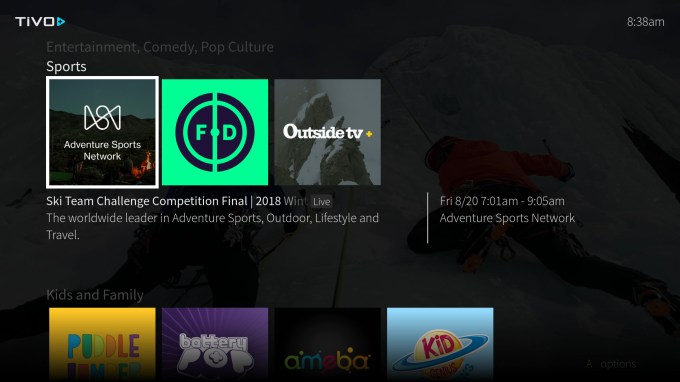
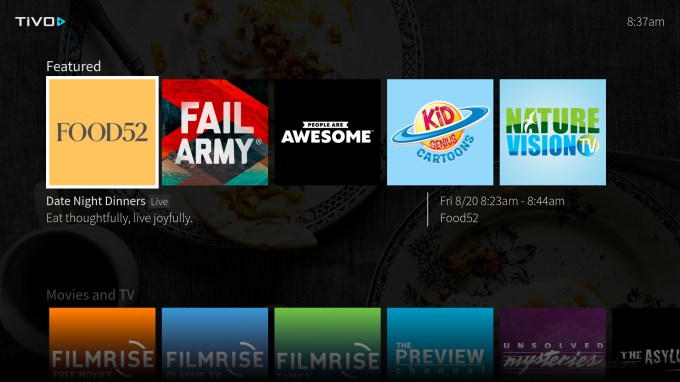
Despite the obvious comparisons to The Roku Channel, the TiVo Plus interface isn’t as well-designed. Where Roku puts the focus on the content that’s available for free streaming, TiVo Plus highlights the publishers. The content is organized in generic and broad groupings, like “Movies and TV,” “Sports,” “Kids and Family,” “Entertainment, Comedy Pop Culture,” and others, instead of being more editorially curated or personalized to the viewer.

Though TiVo Plus is a free service, being a TiVo owner is not. For example, the new TiVo Edge DVR for cable customers is $400, followed by a $14.99 per month service fee, which can be paid either as an annual fee ($149.99) or all at once with a lifetime plan ($549.99).

The same DVR for cord-cutters is $350 and the service fee is $6.99 per month, or $69.99 per year and $249.99 for a lifetime fee.

The DVRs include support for Dolby Atmos, Dolby Vision HDR, 2TB of storage, TiVo’s OnePass, SkipMode (automatic commercial skip),

tivo plus 1

This was the first time that TiVo lowered its subscriptions for the DVR for antenna users, in an effort to respond to market pressures. Most streaming media devices — like Fire TV, Roku, Apple TV, etc. — don’t require subscriptions, as the companies don’t license TV guide data for their users nor do they operate with cable TV-like business model involving ongoing service fees. That’s allowed customers, and particularly cord-cutters, to get comfortable with one-time purchase fees and has weakened TiVo’s position.

With a dwindling customer base, TiVo has turned to advertising — not only with its new ad-supported streaming service on its devices, but also with skippable pre-roll ads on DVR recordings, as recently reported and confirmed by TiVo. 

TiVo Plus is rolling out starting today and continuing over the next few weeks to customers with Series 6 devices with Experience 4 (TE4). It will be available on the Home screen, when it goes live.

15 Oct 2019

Beats brings noise-canceling to its on-ear Solo headphones

Beats this morning announced that it will be bringing its excellent noise-cancellation technology to its Solo line of on-ear headphones. The Solo Pro are the official followup to the Solo 3, a branding shift that’s in line with its other technologies.

The noise canceling is the same introduced with the Studio over-ear line, way back in 2017. It’s adaptive technology, meaning that rather being tuned to a specific sound like, say, an airplane drone, an array of microphones listen for ambient sound and adjust accordingly.

I was pretty impressed in the case of the Studio line and expect much of the same here. There’s also an on-board button for Transparency, which lets in ambient noise for those times when you need to hear what’s around you. Beats being an Apple company, the microphones are also optimized for Siri use, while the W1 and H1 chips mean quick syncing to iOS products, along with the new audio sharing.

Beats says the headphones should last “up to 22 hours” with either active noise canceling or Transparency on and “up to 40 hours” with them shut off. I might have to test them out on my upcoming trip to Asia. They’re charged up via Lightning — kind of a bummer, but Apple. A 10-minute charge should get you up to three hours of playback.

They arrive October 30, priced at $300.