Category: UNCATEGORIZED

15 Oct 2019

Newly-rebranded Thimble raises $22M to bring flexible insurance to the gig economy

Thimble, which offers flexible, short-term insurance to small businesses and freelancers, is announcing that it has raised $22 million in a Series A funding round led by IAC.

Until today, the startup was known as Verifly, a name tied to the company’s initial aim of providing insurance to drone pilots. However, founder and CEO Jay Bregman (who previously founded ridesharing company Hailo) said that thanks to customer demand, the team kept adding insurance for different types of businesses — and now it’s rebranding to reflect that broader vision.

While it’s easy to talk about Thimble customers as being part of the “gig economy,” Bregman noted that these aren’t just people driving for Uber or delivering for Postmates — only 4% of the company’s customers identify as gig economy workers.

“There is this larger thing called the gig economy: People working in flexible ways, on their own terms,” he said.

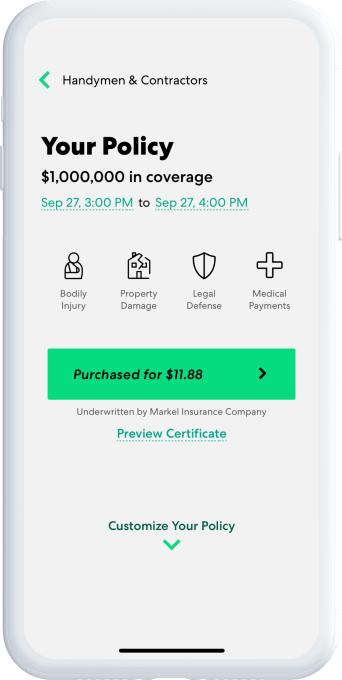
In fact, Thimble now says it provides liability coverage for customers in more than 100 professions, including handymen, landscapers, DJs, musicians, beauticians and dog walkers. Policies can be purchased directly from the Thimble website or app by the hour, day, week, month or year.

Thimble Policy Overview iPhone

The idea, Bregman said, is that as work becomes shorter term and “more transactional,” it doesn’t make sense to buy an annual insurance policy. To illustrate that point, he noted that 75% of customers didn’t have insurance before buying from Thimble, and that 50% of customers are buying policies to cover a single day or less. And the company says it’s on-track to sell 100,000 by the end of the year.

Thimble’s policies are underwritten by Markel, an insurance company that Bregman praised for its “infrastructure and talent.”

At the same time, he said, “We have always been the owner of the product itself. Basically, we worked with carrier partners to bring [our products] to market; the way we do that may evolve slightly as we get older and more mature.”

Thimble has received regulatory approval to sell insurance in 48 states so far. Asked whether the broader political debates about whether gig workers are employees could affect the company’s business, Bregman pointed again to the fact that the vast majority of Thimble customers don’t consider themselves gig workers.

“Our only fear here is that in trying to solve a very particular problem with long-term gig employment, that some of these laws may actually unintentionally scare off or capture legitimate freelancers,” he said.

As for the investment, IAC’s chief strategy officer Mark Stein acknowledged that the digital media holding company doesn’t make many early-stage, minority investments. But he said that deals like this are about “planting seeds.”

“What we think about at IAC is: How can we go about planting seeds of growth for the future? What will become the next ANGI Homeservices? What will become the next Match Group?” Stein said, alluding to two IAC-owned businesses that may get spun off.  “We need to find these kinds of large, addressable market opportunities now in the hopes of creating very large, industry-changing companies in the future.”

Previous investors Slow Ventures, AXA Venture Partners and Open Ocean also participated in the round, bringing Thimble’s total funding to $29 million.

15 Oct 2019

Germany says it won’t ban Huawei or any 5G supplier up front

Germany is resisting US pressure to shut out Chinese tech giant Huawei from its 5G networks — saying it will not ban any supplier for the next-gen mobile networks on an up front basis, per Reuters.

“Essentially our approach is as follows: We are not taking a pre-emptive decision to ban any actor, or any company,” government spokesman, Steffen Seibert, told a news conference in Berlin yesterday.

The country’s Federal Network Agency is slated to be publishing detailed security guidance on the technical and governance criteria for 5G networks in the next few days.

The next-gen mobile technology delivers faster speeds and lower latency than current-gen cellular technologies, as well as supporting many more connections per cell site. So it’s being viewed as the enabling foundation for a raft of futuristic technologies — from connected and autonomous vehicles to real-time telesurgery.

But increased network capabilities that support many more critical functions means rising security risk. The complexity of 5G networks — marketed by operators as “intelligent connectivity” — also increases the surface area for attacks. So future network security is now a major geopolitical concern.

German business newspaper Handelsblatt, which says it has reviewed a draft of the incoming 5G security requirements, reports that chancellor Angela Merkel stepped in to intervene to exclude a clause which would have blocked Huawei’s market access — fearing a rift with China if the tech giant is shut out.

Earlier this year it says the federal government pledged the highest possible security standards for regulating next-gen mobile networks, saying also that systems should only be sourced from “trusted suppliers”. But those commitments have now been watered down by economic considerations at the top of the German government.

The decision not to block Huawei’s access has attracted criticism within Germany, and flies in the face of continued US pressure on allies to ban the Chinese tech giant over security and espionage risks.

The US imposed its own export controls on Huawei in May.

A key concern attached to Huawei is that back in 2017 China’s Communist Party passed a national intelligence law which gives the state swingeing powers to compel assistance from companies and individuals to gather foreign and domestic intelligence.

For network operators outside China the problem is Huawei has the lead as a global 5G supplier — meaning any ban on it as a supplier would translate into delays to network rollouts. Years of delay and billions of dollars of cost to 5G launches, according to warnings by German operators.

Another issue is that Huawei’s 5G technology has also been criticized on security grounds.

A report this spring by a UK oversight body set up to assess the company’s approach to security was damning — finding “serious and systematic defects” in its software engineering and cyber security competence.

Though a leak shortly afterwards from the UK government suggested it would allow Huawei partial access — to supply non-core elements of networks.

An official UK government decision on Huawei has been delayed, causing ongoing uncertainty for local carriers. In the meanwhile a government review of the telecoms supply chain this summer called for tougher security standards and updated regulations — with major fines for failure. So it’s possible that stringent UK regulations might sum to a de facto ban if Huawei’s approach to security isn’t seen to take major steps forward soon.

According to Handelsblatt’s report, Germany’s incoming guidance for 5G network operators will require carriers identify critical areas of network architecture and apply an increased level of security. (Although it’s worth pointing out there’s ongoing debate about how to define critical/core network areas in 5G networks.)

The Federal Office for Information Security (BSI) will be responsible for carrying out security inspections of networks.

Last week a pan-EU security threat assessment of 5G technology highlighted risks from “non-EU state or state-backed actors” — in a coded jab at Huawei.

The report also flagged increased security challenges attached to 5G vs current gen networks on account of the expanded role of software in the networks and apps running on 5G. And warned of too much dependence on individual 5G suppliers, and of operators relying overly on a single supplier.

Shortly afterwards the WSJ obtained a private risk assessment by EU governments — which appears to dial up regional concerns over Huawei, focusing on threats linked to 5G providers in countries with “no democratic and legal restrictions in place”.

Among the discussed risks in this non-public report are the insertion of concealed hardware, software or flaws into 5G networks; and the risk of uncontrolled software updates, backdoors or undocumented testing features left in the production version of networking products.

“These vulnerabilities are not ones which can be remedied by making small technical changes, but are strategic and lasting in nature,” a source familiar with the discussions told the WSJ — which implies that short term economic considerations risk translating into major strategic vulnerabilities down the line.

5G alternatives are in short supply, though.

US Senator Mark Warner recently floated the idea of creating a consortium of ‘Five Eyes’ allies — aka the U.S., Australia, Canada, New Zealand and the UK — to finance and build “a Western open-democracy type equivalent” to Huawei.

But any such move would clearly take time, even as Huawei continues selling services around the world and embedding its 5G kit into next-gen networks.

15 Oct 2019

Smart home startup Level Home emerges from stealth with $71M and a new take on the smart lock

As companies like Google, Amazon and Apple hone their strategies to build the brain that helps you use the smart home of the future, where a new wave of internet-enabled appliances, climate and security systems and other connected objects can be connected and controlled through their hubs, a new smart home startup called Level Home is emerging from stealth today with a big packet of funding and a hope of bringing something new to the table, by focusing on ways of rethinking old things you own already, starting with the lock on your front door.

The Level Lock, the first patented product, is a system — tested for durability and powered by a basic CR2 battery (average life: one year) and equipped with ANSI GRADE 1/A security and encryption — that is fitted into the existing dead bolt on your door to make it “smart”.

The door will not look any different after you install the Level Lock, but linking it up with HomeKit, you can then use an Apple iPhone or Watch to unlock it (or, you can also still use the physical keys that come with the lock to open the door). Priced at $249 when it goes on sale (first in the US), the Lock is available now for preorder on Level’s site.

Screenshot 2019 10 15 at 09.36.52

There is a good chance that when the Lock does become generally available, you will be able to get it in more places beyond Level’s site. Along with the launch of the Level Lock and the company itself, Level Home is also announcing that it has raised $71 million in funding since the company was first founded in 2016, with investors including a firm called Hut 8 Ventures (unclear if connected to Hut 8 cryptocurrency mining, I’m asking), Lennar Homes — the home maker that has worked with the likes of Apple and Amazon to build in connected features into new properties — and Walmart.

The retail giant has been working double time to “level up” to Amazon on the e-commerce front, building a range of services online and increasing the ways in which it can connect with shoppers beyond visits to its large retail locations, and while Level is not disclosing any details yet on how it will work with its strategic investors, you could imagine its involvement having more than one touchpoint.

It could be a very strong sales channel for the Level Lock through its many well-visited retail locations.

But it could also be sold potentially as part of a bigger service offering, in competition with something like Amazon Key, where Walmart offers smart locks to its customers as part of a bigger home delivery business. (Walmart has already started down this road: back in 2017 it first partnered with smart lock maker August to test in-home delivery.)

Partnerships with the likes of Walmart and Lennar sound like a big deal, considering that the company hasn’t tested its product or brand in the market, and the area of smart home hardware is also very crowded already.

Part of the reason for the leap may be because of the background of the founders. John Martin (CEO) and Ken Goto (CTO) have worked together for decades across a range of major tech and other consumer companies including Microsoft, Starbucks and Apple. Very far from the image of young startup-guys, they are taking a measured and very confident approach to the bigger task of thinking about how to approach a new generation of hardware that isn’t so much as “disrupting” what is already being used, but is trying to augment it to bring in a wider population of adopters beyond those who embrace the cutting edge of tech.

“We could have made anything for the connected home, so and we thought for weeks about what to invent,” Martin told me about the pair’s decision to focus first on the front door lock three years ago. “We had a couple of fundamentals: we wanted products for everyday life, and we didn’t want home automation out of the mainline of what normally happens. We didn’t want lightbulbs to change color for the sake of it, and we didn’t want to appeal just to the tech professional. So we thought entry was the right point to start.” Or, entry was a good point of entry, if you will.

Of course, Level Home isn’t the first to come on this progression of logic. Smart doors and smart locks are everywhere now, although ironically, they are not being used all that much. “When we looked at first generation smart locks, we were offended by how aggressively the experience was departing from how people use locks today.” By this, Martin is referring to things like physical keys, or aesthetically pleasing doors and locks without large objects attached to them.

Indeed, the smart home market has not been a home run so far, but it shows some promise. The smart home market overall is projected to generate revenues of nearly $74 million this year, nearly doubling to $141 billion by 2023. A stream of hardware sales will underpin that growth, with some 140 million smart locks and other home security devices — the second-biggest category after video entertainment — expected to be shipped this year, growing to 352 million by 2023 globally.

But within that, penetration has not been massive: in Europe, only around 11 percent of homes have smart home devices in them (not counting phones), and in the US, the figure is only slightly higher, at 15%. That speaks to a still-nascent market, but also the fact that many people’s imaginations, and crucially wallets, have get to be captured by what is on offer today.

That spells opportunity for the smart home entrepreneurs, and investors willing to take the leap to back them.

Martin and Goto say that they have a pipeline of several other products that they will be working on, although for now, they are keeping quiet on what they might be. The basic idea will be to continue present an alternative version of the smart home: to quietly make our lives at home easier and more connected, but without any massively perceptible shifts. Move slow, don’t break things.

In a market with a lot of options for how to bring more modern objects into the mix that genuinely look like the future, this could be a good differentiator.

“We’re pleased to make an investment in Level Home as they unveil their latest technology, the Level Lock,” said Ashley Hubka, Senior Vice President of Corporate Strategy, Development and Partnerships, Walmart, in a statement. “Smart technology products and home automation provide us with more opportunities to serve customers in new ways today and into the future.”

“Level Home’s unique approach and technology is a game changer for homebuilders,” said Eric Feder, Managing General Partner, Lennar Ventures, in a statement. “As one of the nation’s leading home builders, Lennar is founded on a long tradition of quality craftsmanship and attention to detail. The Level Lock will transform the smart lock category by allowing home builders to offer innovation without having to compromise on their home experience.”


15 Oct 2019

True Balance raises $23M to bring its payments app to more small cities and towns in India

South Korean startup True Balance, which operates an eponymous financial services app aimed at tens of millions of users in small cities and towns in India, has closed a new financing round as it looks to court more first time users in the world’s second largest internet market.

True Balance said on Tuesday that it has raised $23 million in its Series C financing round from seven Korean investors — NH Investment & Securities, IBK Capital, D3 Jubilee Partners, SB Partners, Shinhan Capital, and existing partners IMM Investment, and HB Investment.

TechCrunch reported earlier this year that True Balance — which has raised $65 million to date including the $38 million that it closed in its previous financing round — was looking to raise as much as $70 million for this financing round.

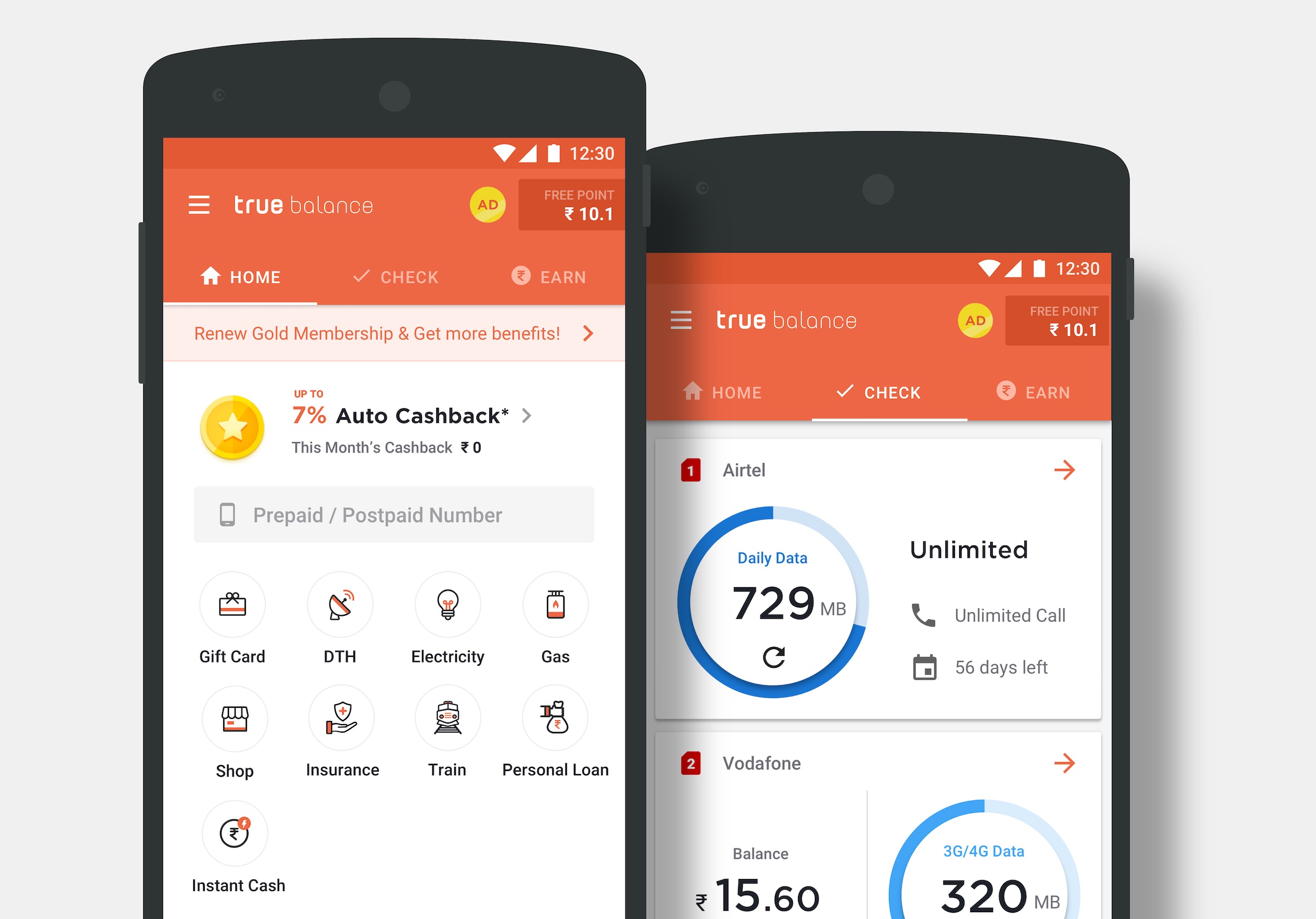
True Balance began its life as a tool to help users easily find their mobile balance, or top up pre-pay mobile credit. But in its four-year journey, its ambition has significantly grown beyond that. Today, it serves as a digital wallet app that helps users pay their mobile and electricity bills, and offer credit to customers so that they can pay later for their digital purchases.

true balance

The startup says it has amassed over 60 million registered users in India, most of whom live in small cities and towns — or dubbed India 2 and India 3. Most of these users are coming online for the first time and True Balance says it has an army of local agents — who get certain incentives — to help first time internet users understand the benefit of online transactions and start using the app.

True Balance says it clocks more than 300,000 digital transactions on its app each day. The startup, which recently introduced e-commerce shopping service on its app to sell products like smartphones, has clocked $100 million in GMV sales in the country to date.

Charlie Lee, founder of True Balance, said the startup will use the fresh capital to bulk up the offerings on the app. Some of the features that True Balance intends to add before the end of this fiscal year include the ability to purchase bus and train tickets, digital gold, and book cooking gas cylinders.

True Balance will also expand its lending and e-commerce services, Lee said. Its lending feature was used 1 million times in three months when it was introduced earlier this year. “We aim to strengthen our data and alternative credit scoring strategy to provide better financial services to our target — the next billion Indian users. Our goal is to reach 100 million digital touch points and become one of the top fin-tech companies in India by 2022,” he added in a statement.

Even as more than 600 million users in India are online today, just about as many remain offline. In recent years, many major companies in India have started to customize their services to appeal to users in India 2 and India 3 — who also have limited financial power.

15 Oct 2019

Watch Google unveil the Pixel 4 live right here

Google is about to unveil its new smartphone lineup, the Pixel 4 and Pixel 4 XL. And if you’re an Android fan, you know that the Pixel is one of the most interesting Android phones out there thanks to a bloatware-free operating system and some incredible cameras.

The conference starts at 10 AM Eastern Time (7 AM Pacific Time, 3 PM in London and 4 PM in Paris). You can watch it live right here.

Rumor has it that Google isn’t just going to announce some new phones. You can also expect some new products when it comes to the Pixelbook line, the Pixel Buds and its voice assistant devices.

The Google Home Mini has been quite successful. And the company is currently in the process of updating and rebranding its Google Home line to Google Nest devices.

We’ll have a team on the ground to report on the new devices and give you hands-on impressions.

15 Oct 2019

South Korea-based Mathpresso, developer of tutoring app Qanda, raises $14.5 million Series B

Seoul-based education technology startup Mathpresso announced today that it has raised $14.5 million in Series B funding. The company’s flagship app is Qanda, which provides students with math and science help and tutoring. Participants in the round include Legend Capital, InterVest, NP Investments and Mirae Asset Venture Investment.

This brings Mathpresso’s total funding so far to $21.2 million. Its previous round of funding was a $5.3 million Series A announced at the end of last year.

Mathpresso says Qanda (the name stands for “Q and A”) is currently used by a third of students in South Korea. The app launched in markets including Japan, Vietnam, Indonesia and Singapore last year and now has users in more than 50 countries. Qanda uses AI-based optical character recognition to scan math problems. Students take a photo of a problem and upload it to get instructions for how to solve it from the app or tutors.

In a statement, Legend Capital managing director Joon Sung Park said, “As an early investor of China’s leading mobile education companies such as Zuoyebang and Onion Math, Legend Capital has witnessed robust growth of China’s mobile education market. We strongly believe that Mathpresso has the technological and operation capabilities to expand overseas and grasp new opportunities emerging from the digitization of education, such as offering personalized learning for each student.”

15 Oct 2019

GoFundMe launches free platform for nonprofits and charities, rolls out button to donate anywhere

GoFundMe has made its name primarily as a platform for individuals to create fundraisers for personal causes — a service that has seen hundreds of campaigns go viral through social media to raise collectively well over $5 billion in funding to date. Now, the startup is taking the next step in its ambition to build what CEO Rob Solomon calls the “giving layer of the internet”.

GoFundMe is launching a new free-to-use fundraising platform for nonprofits of all sizes called GoFundMe Charity; and for the first time, it has created a button that can be integrated into any site or app to donate money wherever people want to do so. Both will roll out in November, but the charity platform already counts nonprofits like the American Cancer Society and the Boston Marathon among its customers.

To be clear, providing services to non-profits is not totally new territory for GoFundMe. The company acquired CrowdRise, which focused specifically on non-profits, in 2017 and gradually started to integrate some of the functionality and branding into the bigger platform a year later. And since last year it has offered a service for teams and groups (including nonprofit groups) to come together to raise for the same cause.

With this latest launch, teams fundraising remains, but GoFundMe will be sunsetting CrowdRise the brand and transitioning the platform’s nonprofit customers (which include high profile events like the Boston Marathon) to GoFundMe Charity.

With that change comes a new business model and a wider range of services for non-profits aimed at making GoFundMe a more useful and flexible platform.

On the business model, charity groups will now have the option either to pay fees to use the service (donor-covered fees), or use it for free by offering the tipping feature that GoFundMe uses on its consumer-focused site. This is a departure compared to the the platforms that power many nonprofit sites and events, which typically charge for their services. GoFundMe says it will specify what the the donor-covered fees will be public closer to the launch date.

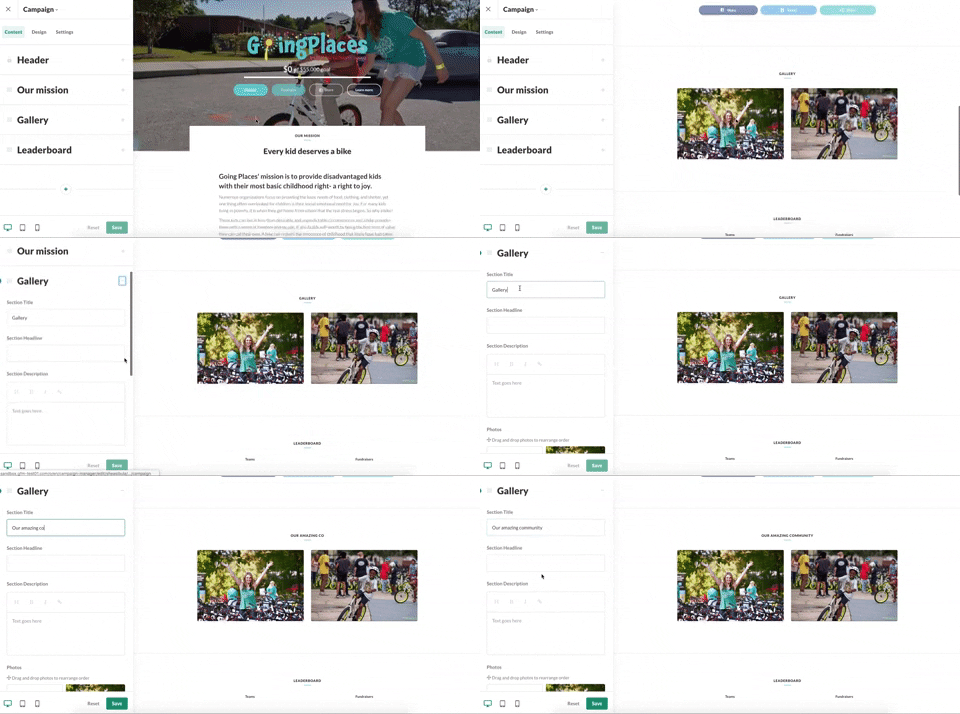
Then, moving away from the familiar, basic layout that GoFundMe offers for individual causes today, nonprofits will also be given more design freedom: They will have the option to customise their pages; or they can run GoFundMe campaigns on their own sites and apps by placing a customised button for people to donate — similar to how Facebook disseminated its “Like” buttons, or PayPal and other payment services created “buy” buttons.

Campaign Customization Editing Campaign Sections Katie Going Places

They will also be provided with analytics on how their campaigns are performing, and CRM integrations to link up GoFundMe campaigns with wider marketing efforts. And nonprofits running events where individuals are fundraising — for example, around charity runs — will be able to do this under the bigger GoFundMe umbrella, including enlisting and organising individual fundraisers, or selling tickets to charity events.

GoFundMe will also be leveraging its own traction in the fundraising market to grow this business.

The idea is twofold here: The first aim will be to bring to nonprofit groups the kind of storytelling and social media virality that has done so well on GoFundMe already.

The second aim will be to bring the mountain to Mohamed, so to speak: the platform currently has more than 50 million users, and like other funding platforms, GoFundMe has made a business out of recirculating those donors: once you give to one cause, your details are in the system and that makes it easier to donate elsewhere on the same platform. Now the non-profits will also have access to that pool of users that has been proven to be willing to step up financially.

The giving layer of the internet

The news comes at an interesting time for GoFundMe.

While its individual causes-based campaigns continue to be created and disseminated across social platforms, it is facing competition of two kinds: that of the platforms themselves (specifically, Facebook, which is using its billions of users to grow its own causes-donations platform rapidly: in September it passed the $2 billion mark in fundraising for causes); and that of user ennui, where people have been facing up to kind of fatigue when it comes to too many individuals asking for money, and sometimes not for the most worthy of causes.

Ramping up its business for nonprofits, on the other hand, catapults GoFundMe into a much bigger, older and (potentially?) more resilient sector of the charitable donations market. In the US alone, some $427 billion was donated to nonprofits in 2018, according to Giving USA. That’s up on an estimated $410 billion in nonprofit donations in in 2017.

Currently, only around a quarter of donations are made through digital platforms, with the remainder through more traditional channels such as events, door-to-door appeals and direct-mail campaigns. As digitally native consumers become targets for nonprofits, GoFundMe sees an opportunity in taking the tools and services it originally built for individuals, and tailoring them to these groups.

“Charities have the same challenges as individuals in reaching constituents,” said Solomon in an interview. “We’re talking about whole generations of people who will not donate to charities the same way that older generations did. Charity has been disrupted by the internet and those older methods won’t work anymore.”

Solomon said that GoFundMe is not commenting on whether it expects more nonprofits to pay fees or run the option for tipping among its users, nor would he say if GoFundMe has projected how much it might make from one or the other option.

He did note that the company is profitable and has been able to grow its business on the back of the tipping model it now uses for its individual campaigns (it dropped its platform fee in 2017 and then acquired YouCaring, a competitor that built a profitable business on tipping alone).

GoFundMe has never disclosed much on the financial front: it has only ever had one round of funding, of an undisclosed amount, from a group of investors that included Accel, Greylock, TCV, Iconic, Meritech and Stripes. We’d heard that at one point PayPal started preliminary talks to acquire the company for about $1 billion, but that never developed, and GoFundMe has continued to grow.

Solomon did add today that those investors will eventually want “a liquidity event,” whether that comes in the form of an IPO, or private equity investment, or an M&A move, but that won’t be for a while.

“We’re not focused on that at all, and don’t expect to see anything for another year or two,” he said.

15 Oct 2019

Surfing the reverse mullet with Alexis Ohanian

For many years the allure of Silicon Valley was contingent on the ability to move here. Its ecosystem didn’t work remotely. “We see a very strong indication that where you’re located does matter… come to Silicon Valley,” intoned Joe Kraus of Google Ventures at the first Disrupt conference I ever intended, speaking for essentially all VCs, including Y Combinator.

Easy enough if you’re American. Much, much trickier if you need a visa to get there. Is it still true that the Valley doesn’t work remotely? Or is there another path for startups from faraway countries these days? Last week I sat down with Alexis Ohanian in his ancestral homeland of Armenia to discuss this.

Every nation seems to have its own set of incubators and seed investors these days. Armenia is no exception: I met Ohanian at the launch event for Aybuben Ventures, a VC fund “for Armenia and The Armenians.” (As I wrote last week, the Armenian diaspora is a big deal.) But what happens next, when you need to raise a serious Series A, but your local market realistically isn’t big enough to support your company?

Even five years ago you would have had a lot of trouble tapping into the Valley. Since then, though, things have changed. The price of Bay Area talent — and real estate — has led to the rise of “mullet startups,” as coined by Andreessen Horowitz’s Andrew Chen. Such comapnies have their headquarters in the Bay to take advantage of the Valley, but their tech teams somewhere cheaper and more spacious. “Business up front, party out back.”

Ohanian’s point is that there’s no reason the mullet model can’t work backwards: launch a company with a strong tech team in some remote location, then, when you hit the inflection point, open a Bay Area office, move the executive team there, and turn yourself into a mullet startup. (Aided by the fact that if coming as a company, your visa options widen to include e.g. the EB-5 Immigrant Investor Visa.) Call it the “reverse mullet,” exemplified by e.g. PicsArt.

This model is especially viable for nations which have deep engineering / tech talent, so that the “party out back” tech team becomes an ongoing competitive advantage. (This is part of why Ohanian keeps hammering home the importance of learning to code during his visits to Armenia, something which is probably easier in a nation which already features compulsory chess education.) All of which sounds great in theory —

— but it’s not like we see a herd of unicorns with reverse mullets out there … yet. If we do, though, that will be an exceptionally interesting new growth model, with significant ramifications — a way for Silicon Valley to essentially metastasize to the rest of the world. This in turn will, ironically, reify its primacy as the center of the global tech industry, the sun around which all the faraway planets orbit, after so many prophecies of decentralization. Count the reverse mullet unicorns in three years, and if there are more than a mere few, we’ll know the answer.

15 Oct 2019

Bird’s chief legal & policy officer is leaving the company

Bird, the $2.5 billion electric scooter business, is losing its chief legal and policy officer. David Estrada, who was hired last year from Kitty Hawk, is joining another mobility company, SoftBank-backed Nuro.

A spokesperson for Bird tells TechCrunch Estrada is leaving the Santa Monica-based company to be closer to his family. Nuro, for its part, is based in Mountain View, CA.

davidestrada

Bird’s former chief legal officer, David Estrada.

Estrada, who previously oversaw public policy at the electric aircraft company Kitty Hawk as its chief legal officer, has been responsible for Bird’s compliance and government relations efforts as the company scaled to over 100 global cities. Prior to joining Kitty Hawk, Estrada spent nearly two years as Lyft’s vice president of government relations and worked as the legal director for Google X, partnering with states on legislation around autonomous vehicles, Google Glass and drone delivery.

Nuro, founded in June 2016, has emerged as a key player in the rapidly-expanding autonomous delivery sector. The company has attracted a whopping $1.03 billion in venture capital funding to date, according to Pitchbook. SoftBank funneled an astounding $940 million into the business earlier this year at an undisclosed valuation. In addition to SoftBank, Nuro is backed by Greylock and the Chinese venture capital firm Gaorong Capital.

The company has been developing a self-driving stack and combining it with a custom unmanned vehicle designed for last-mile delivery of local goods and services. It began piloting grocery delivery in 2018 in the Phoenix suburb of Scottsdale.

Bird has overcome a number of unique hurdles with many more afoot, including pushback from local governments who were aggravated by the sudden appearance of hundreds of scooters. At Nuro, Estrada will have the opportunity to focus on the future of unmanned delivery, another sector faced with regulatory challenges and political barriers.

14 Oct 2019

Harley pulls plug on LiveWire production shortly after EV debut

Harley Davidson has halted production and delivery of its first electric motorcycle LiveWire, after discovering what the Milwaukee-based manufacturer described as a non-standard condition.

Harley Davidson told TechCrunch it is not recalling LiveWire motorcycles already on the road. Reuters was the first to report that Harley Davidson had stopped production and deliveries.

“We recently discovered a non-standard condition during a final quality check; stopped production and deliveries; and began additional testing and analysis, which is progressing well,” HD said in a statement.

“We are in close contact with our LiveWire dealers and customers and have assured them they can continue to ride LiveWire motorcycles. As usual, we’re keeping high quality as our top priority.”

Harley Davidson has not said when production and sale could resume, nor did it provide more information on the non-standard condition.

The production stoppage threatens to derail Harley Davidson’s bet on electrification. The $29,799, 105 horsepower electric motorcycle was to be the first of a future line-up of EVs from HD spanning motorcycles, bicycles and scooters.

The LiveWire went into production in 2019 after years of hints and even concept electric motorcycle roadshow. Delivery to dealers began September 27.

The LiveWire and subsequent EV products are meant to compliment, not replace, Harley Davidson’s premium internal-combustion cruiser motorcycles.

New motorcycle sales in the U.S., particularly to customers aged under 40, have been in the doldrums since the recession. Harley Davidson’s revenues have dropped over the last decade. HD’s shift to electric motorcycles is a bid to hold down its loyal gas-motorcycle following, while creating products to appeal to millennial and the on-demand mobility market.

This puts the iconic American company in a position to hedge competition from a crop of e-moto startups — such as Zero — and jump out front as the EV leader among established motorcycle companies.

Now that strategy could be hampered by this production halt.