
Category: UNCATEGORIZED

14 Oct 2019

Libra claims 180 potential replacements for 7 mutineers

Attempting to signal its popularity despite high-profile defections from Visa, Stripe, and more, the Facebook-led cryptocurrency Libra Assocation announced that 1,500 organizations have expressed interest in joining the Libra project. 180 of those meet eligibility requirements to become members, which could replace the 7 companies that dropped out of the Association this month.

This new crop of potential recruits could help the Libra Association reach its 100-member goal ahead of a scheduled 2020 launch that looks likely to be delayed by intense regulator pushback.

The announcement came out of the first official meeting of the Libra Association today in Geneva, Switzerland. The group appointed its board of directors: Facebook’s head of its cryptocurrency Calibra team David Marcus, Andreessen Horowitz’s Katie Haun, Xapo’s Wences Cesares, Kiva Microsystems’ Matthew Davie, and PayU’s Patrick Ellis. Marcus’ inclusion should be no surprise given he’s been the public face of Libra, even though his former company PayPal pulled out of the Association.

Another former PayPal’er Bertrand Perez was formally named the Libra Association’s COO and Interim Managing Director after unofficially holding these titles. The former senior director of payments engineering at PayPal is now also the chairperson of Libra’s five-member board and full-membership council. “We have no vocation to play the pirates” he told news outlet Revyuh last month, noting “if, for example, the European Central Bank still refuses us the right to operate in Europe, we will not do it, we do not intend to play the pirates, we respect the legislation.”

Libra’s head of communications and policy Dante Disparte formerly of Risk Cooperative and head of business development Kurt Hemecker formerly of Zong had their roles confirmed too.

The remaining Libra Association members listed below signed the Libra charter. They’ve agreed that members can leave for any reason, and with some restrictions transfer their membership plus $10 million in Libra Investment Tokens stake to another eligible organization.

  • Payments: PayU (Naspers’ fintech arm)
  • Technology and marketplaces: Facebook/Calibra, Farfetch, Lyft, Spotify AB, Uber Technologies, Inc.
  • Telecommunications: Iliad, Vodafone Group
  • Blockchain: Anchorage, Bison Trails, Coinbase, Inc., Xapo Holdings Limited
  • Venture Capital: Andreessen Horowitz, Breakthrough Initiatives, Ribbit Capital, Thrive Capital, Union Square Ventures
  • Nonprofit and multilateral organizations, and academic institutions: Creative Destruction Lab, Kiva, Mercy Corps, Women’s World Banking
  • No Longer Members: Visa, Mastercard, PayPal, Stripe, Booking Holdings, eBay, Mercado Pago
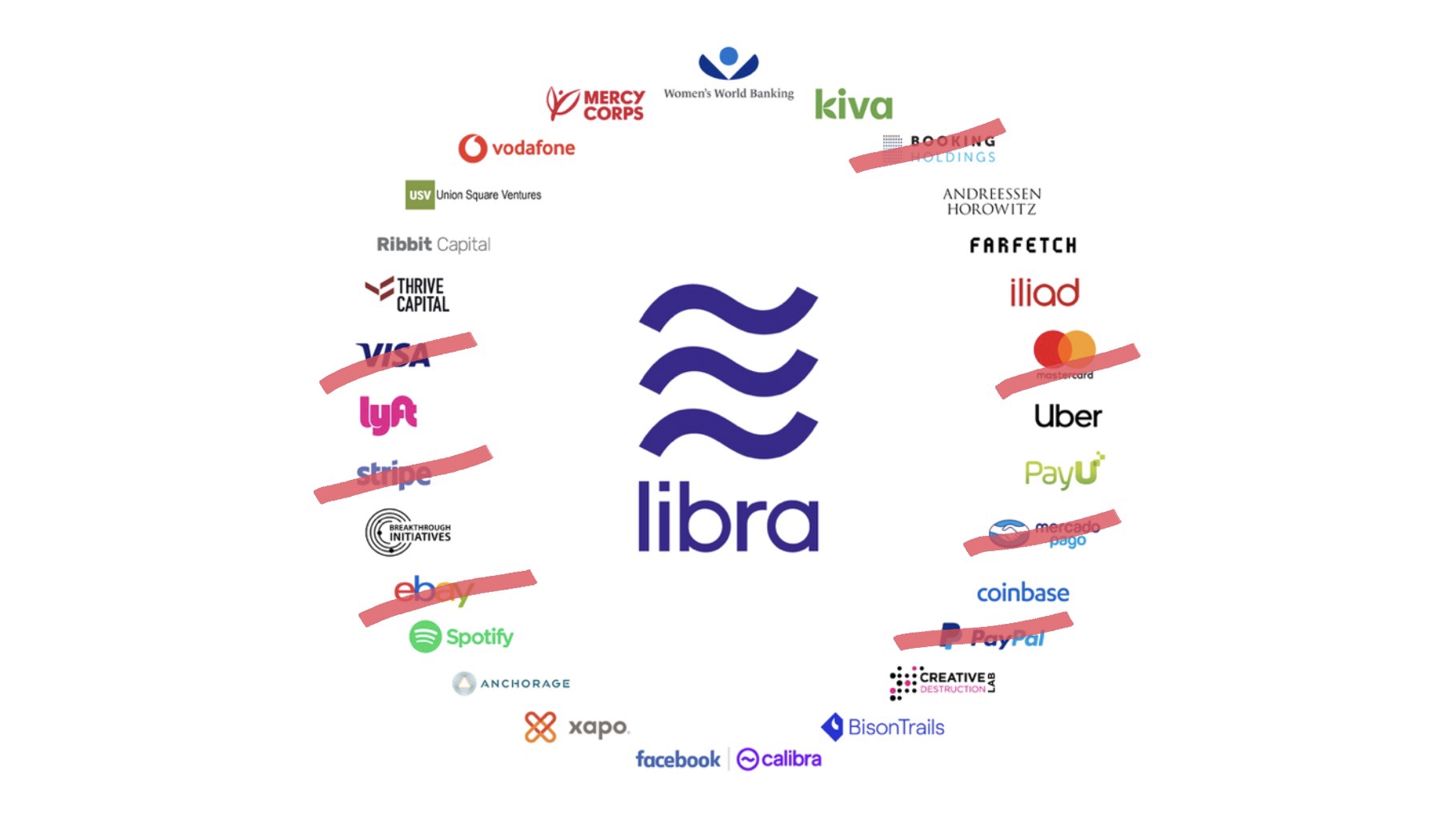
Libra Association 21 Members

The Libra Association did not announce any changes in strategy or other plans that could help the organization assuage regulators’ fears. One path suggested by Libra Association member Andreessen Horowitz’s partner Chris Dixon was to move to Libra being denominated in U.S. dollars rather than being pegged to a basket of international currencies. That might quiet concerns about Libra potentially competing directly with the US dollar.

This leaves the reveal of the 180 potential members as the biggest news from the meeting. A Libra Association spokeperson writes:

“Since the Libra project was announced on June 18th, 2019, it has generated excitement around the world. the Libra Association confriemd that over 1,500 entities have indicated interest in joining the Libra project effort, and approximately 180 entities have met the preliminary membership criteria shared at Libra.org.”

Those requirements include businesses hitting two of three thresholds of a $1 billion USD market value or $500 million in customer balances, reaching 20 million people a year, or being recognized as a top 100 industry leader. There are other criteria for cryptocurrencies businesses, non-profits, and universities.

Bertrand Perez

The Libra Association chairperson, COO, and interim managing director Bertrand Perez

However, we don’t have information on when the interest of those 1500 potential partners was tallied. The withdrawl of Mastercard, PayPal, and more, comments from regulators intent on blocking the currency, and Marcus’ tense questioning on Capitol Hill could have since scared off some would-be allies.

Marcus and Perez face an uphill battle to get Libra to market. Not only do they have to prove it’s safeguarded against fraud, moneylaundering, and hurting sovereign currencies. They also must tangle with the toxic brand Facebook has developed over the years. Legislators who feel like the social network is too big are seizing on their second chance to constrain it with Libra.

14 Oct 2019

Leo Labs and its high-fidelity space radar track orbital debris better than ever — from New Zealand

Ask anyone in the space business and they’ll tell you that orbital debris is a serious problem that will only get worse,but dealing with it is as much an opportunity as it is a problem. Leo Labs is building a global network of radar arrays that can track smaller debris than we can today, and with better precision — and the first of its new installations is about to start operations in New Zealand.

There are some 12,000 known debris objects in low Earth orbit, many of which are tracked by the U.S. Air Force and partners. But they only track debris down to 10 centimeters across — meaning in reality there may be hundreds of thousands of objects up there, just as potentially destructive to a satellite but totally unknown.

“Everyone’s flying blind and no one’s really talking about it,” said Leo Labs CEO Dan Ceperly. But his company hopes to change that with a set of advanced radars dedicated to the purpose, and to construct which the company raised $13 million last year.

“We’re extremely excited to show this New Zealand radar, because it’s the first instance of our next generation technology. We launched the company on the strength of this radar,” Ceperly said.

The installation uses what’s called a phased array radar, very different from the traditional big dishes one generally thinks of. The beam is electronically steered, letting it change targets in milliseconds or sweep the sky faster than any physically controlled dish could.

radar halfpipe

The phased array radar has no moving parts, the beam is steered from many identical small antennas electronically.

Not only that, but it can detect and track objects down to 2 centimeters across. They’re small, yes, but moving at thousands of miles per hour. Something the size of an M&M still hits hard enough to take out a satellite at that speed.

The ability to see objects of that size in orbit could increase the number tracked to a quarter of a million, Ceperly estimated. And with other radars able to track about a thousand objects per hour, they couldn’t possibly do the job even if they could draw a bead on them.

“A lot of these new satellites maneuver pretty frequently — so you want to be able to track them closely,” he said. “But if you have one radar, you can measure its orbit at one point, maybe every day or two, and of course on the far side of the Earth your coverage isn’t any good. With our radar network you’ll be able to check ten times a day.”

The increasingly common phenomenon of shared-ride launches with dozens of satellites on board presents a new opportunity. Ground based radars just aren’t designed to track 40 or 50 new objects in the sky all scooting off in different directions from the same spot. You might wait a week or more to be be able to ground-truth your satellite’s telemetry. Leo’s quick-acquisition, high-precision arrays are designed with this in mind, meaning trajectories and orbits can be verified in hours instead of days. That can be the difference between saving and losing a multi-million dollar investment.

The biggest player in this market is the U.S. Air Force, which has been the main tracking provider for years. But it relies on a hodgepodge of Cold War and newer tech, and because it’s military it’s limited in the type of information it can provide. Powerful radars are out there, but they’re often restricted by government contracts and cost hundreds of millions or more. And there are no good tracking stations in the Southern hemisphere. Leo Labs aims to pick up where the competition leaves off.

“We’re happy to announce that construction is complete on the New Zealand radar and we’re getting data out of it,” Ceperly said.

This first array will soon (after some testing but before the end o the year) join another in Texas and soon others around the world in producing data for Leo Labs’ SaaS platform — yes, it’s orbital debris tracking as a service, with a web portal and everything.

“All that intel goes into the second part of the company, a bunch of software in the cloud where the data gets analyzed,” Ceperly said. “We look for risky situations like satellites starting to tumble, potential collisions, et cetera. We send out alerts through a RESTful API, we have a dashboard with 3D visualizations, tables and maps, all that stuff. In the past there were no SaaS services for tracking satellites in flight. Governments can spend a decade and a billion dollars building a radar, but these new space companies can’t — so we thought that was a huge opportunity for us.”

leo gif

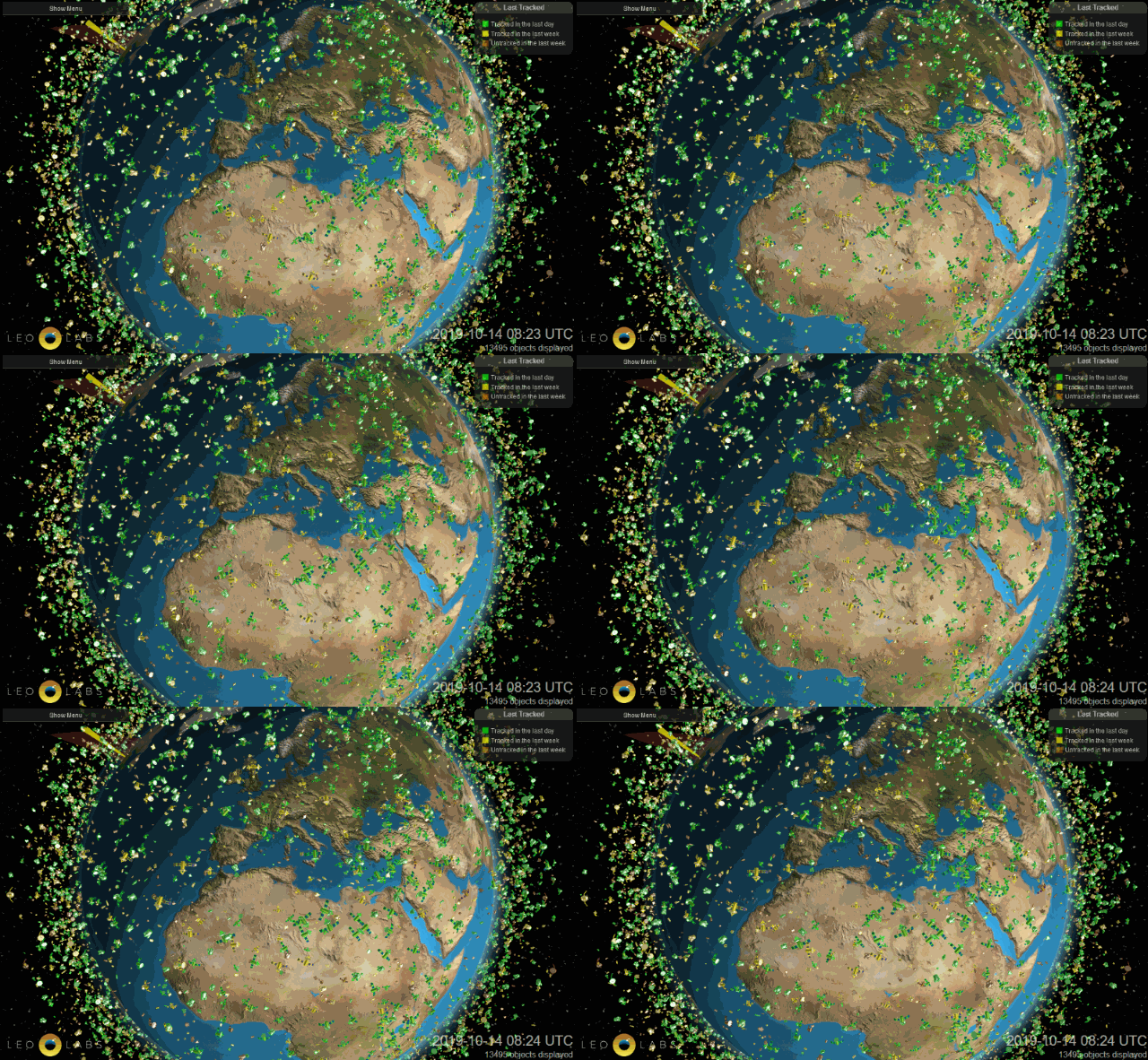
You can see a visualization of what it all looks like here — obviously it’s not to scale, but space is getting crowded, isn’t it?

Already they have plenty of supporters and subscribers: Planet, Digital Globe, Black Sky and the Air Force Research Lab are all sold. Swarm Technologies, whose satellites are so small that existing radar solutions barely cut it, was a natural customer. In fact Swarm founder Sara Spangelo just recently emphasized the importance of tracking space debris in a panel I moderated at Disrupt SF.

The company was spun out of SRI in 2016, its founding team experienced in building radars and doing debris tracking, and apparently just in time. The orbital economy is heating up and the infrastructure to support it is starting to creak.

14 Oct 2019

WeWork pulls thousands of phone booths out of service over formaldehyde scare

WeWork, the co-working empire once valued at $47BN before reality struck plunging the business and its investors into crisis, has another problem to add to its growing pile — one which doesn’t exactly reflect well on its core business of kitting out and maintaining modern working environments.

The problem is a safety concern affecting users of WeWork co-working spaces in the US and Canada. Today the company emailed members in the regions to warn that around 1,600 phone booths installed at WeWork locations have been found to have elevated levels of formaldehyde — which it warns could cause health issues for people exposed to the gas.

WeWork blames the issue on a manufacturer of the booths.

The booths are provided in its co-working spaces for WeWork members to be able to take calls in private — given other common areas are shared by all users. 

“After a member informed us of odor and eye irritation, WeWork performed an analysis, including having an outside consultant conduct a series of tests on a sampling of phone booths. Upon receiving results late last week, we began to take all potentially impacted phone booths out of service,” it writes in an email to members.

Affected phone booths “are being taken out of service immediately, and will be removed from your location as soon as possible”, it adds. 

In addition to ~1,600 booths it has confirmed are affected, a further 700 booths are being taken out of service in what WeWork describes as “an abundance of caution” — i.e. while it carries out more checks — with the promise of a further update once it’s concluded its tests. 

Members wanting to know which booths are safe to use in the meanwhile are told to contact the community team at their WeWork location.

WeWork also says alternative quiet spaces will be provided, such as in conference rooms and unused offices. 

Discussing the health risks of formaldehyde gas — a chemical which is used in various building materials –WeWork’s email warns: “Short-term exposure to formaldehyde at elevated levels may cause acute temporary irritation of the nose, throat, and respiratory system, including coughing or wheezing. These effects are typically transient and usually subside after removal of the formaldehyde source.

“Long-term exposure to formaldehyde, such as that experienced by workers in jobs who experience high concentrations over many years, has been associated with certain types of cancers. You can find additional information in this FAQ from the Occupational Safety and Health Administration.”

The email encourages any WeWork members with health concerns to contact a doctor.

A tipster who sent us the email reported experiencing a sensation of “burning eyes” after using the booths.

They also said several people in their team had experienced the same issue.

“Some complained that they felt nauseous after spending time inside the booths,” the tipster wrote. “I never felt that, but the burning eyes was 100% there for me several times. Scary stuff.”

Reached for comment, a WeWork spokesperson confirmed the formaldehyde issue, saying it’s taking “a number” of booths out of service at “some” locations in the US and Canada — due to “potentially elevated levels of formaldehyde caused by the manufacturer”.

“The safety and well-being of our members is our top priority, and we are working to remedy this situation as quickly as possible,” it adds in a statement.

It is not clear exactly how many WeWork locations contain affected booths at this point.

Nor has WeWork provided more detailed information about how long members might have been exposed to elevated levels of formaldehyde — with its email merely suggesting some of the booths have been in place for “months”. 

“The potentially impacted phone booths have been installed over the past few months, exact timing varies based on location,” it writes.

Although clearly the level of exposure will vary from person to person depending on their use of the booths.

The company did not respond to a question asking whether any of its international WeWork locations are affected by the issue.

14 Oct 2019

Hulu rolls out 4K content to Xbox One, with Amazon Fire TV and others coming ‘soon’

Hulu this summer finally brought back 4K content to its service, after abruptly removing it in 2018 while it focused on other priorities. Initially, its 4K content was only available on Apple TV 4K and Chromecast Ultra. Today, Hulu says it’s available on Xbox One devices, with support for Amazon Fire TV and LG WebOS in the works. More devices will also be supported soon, the company notes.

The streaming service had never really prioritized 4K content, having first rolled out support in December 2016 — years after rivals Netflix and Amazon Prime Video had done the same. Its lineup was also fairly minimal at the time, with 20 James Bond films and a handful of Hulu Originals. And then it was pulled.

Today, Hulu’s 4K lineup is again focused largely on its original programming, including shows like The Handmaid’s Tale, The First, Castle Rock, Catch-22, and others. The company’s FAQ says most of its originals are available in 4K Ultra HD, and stream at 16 Mbps.

Netflix, by comparison, has a much larger library, thanks in part to its more sizable investment in original programming, which it has increasingly shot in 4K over the past few years. Amazon Prime Video also includes its own originals in 4K and around 50 other licensed films.

However, access to Netflix’s 4K library requires its more expensive ($15.99/mo) Premium plan. Accessing Hulu’s 4K library does not require an upgrade.

There are plenty of other ways to get to 4K content, including through iTunes and Google Play Movies & TV — the latter which began offering 4K content for purchase back in 2016. Roku also dedicates a section to 4K content within its main navigation. Apple TV+ originals will also be available in 4K HDR and Dolby Atmos, when it launches in November. Disney+ is also promising 4K at no extra cost. And there’s 4K content available on Vudu, YouTube, FandangoNow, fuboTv, and others.

Hulu’s lack of attention to 4K hasn’t stalled its growth, however, as most consumers don’t consider 4K availability as a reason not to subscribe. In fact, Hulu’s subscriber growth in the U.S. has been steadily climbing, reaching 28 million earlier this year, up 12% from the end of 2018. And with a Disney+ bundle deal now in the works, Hulu is set to grow even faster in the near future.


14 Oct 2019

Jackson Square Ventures just closed its third fund with $193 million; here’s how it plans to invest it

Jackson Square Ventures (JSV), an eight-year-old, San Francisco-based early-stage venture firm that takes its name from the neighborhood in San Francisco where it’s headquartered, has closed its third fund with $193 million in capital commitments — a sizable step up from its first two funds, which had both rounded up roughly $120 million from the firm’s limited partners.

The firm, whose founding partners originally spun out of Sigma Partners, invests primarily in U.S.-based software-as-a-service and marketplace companies, with occasional outliers if it can find a way to rationalize the investment. Such was the case with Cornershop, a Latin American online grocery delivery service that JSV cofounder Greg Gretsch first came to know when one of the company’s cofounders, Oskar Hjertonsson, moved in across the street from him.

Recalls Gretsch, “This ‘Swede from Chile’ had sold his earlier company, Needish to Groupon and it later became Groupon Latin America. Afterward, I advised him a bunch and told him, ‘I’d invest in anything you do.’ Then he said he and his team were working on a group photo-sharping application, and I was like, ‘I’d invest in anything but that.'” Gretsch laughs now, but Hjertonsson and company soon realized that a much bigger opportunity was to start a kind of Instacart for Latin America.

That particular pitch resonated with Gretsch, who invested as an angel investor. A year later, he brought the team to JSV with one caveat. “I told everyone, ‘I know this is out side the norm for us. It’s outside the U.S. in Latin America. But it is a marketplace.” Soon after Gretsch’s colleagues — including fellow managing directors Pete Solvik and Josh Breinlinger — met the team and JSV led Cornershop’s Series A round.  Cornershop went on to raise roughly $32 million altogether before selling a majority stake in its business last week to Uber for undisclosed terms.

Gretsch says that Hjertonsson and his cofounders are exactly the type of founders that JSV seeks out. “They’re humble and not cocky or overly promotional.”

He says that more broadly, JSV avoids companies in hyped up spaces, sticking instead to what it knows, which includes enterprise software (DocuSign was among its portfolio companies), and network effects businesses, whether they’re business-to-business or business-to-consumer companies (Gretsch counts portfolio companies OfferUp and Strava in the latter category).

As for how much the firm puts to work, Gretsch says that its sweet spot is Series A deals and that JSV tends to write initial checks of between $4 million and $6 million, preferring a more concentrated portfolio to spreading its bets.

When it does pull the trigger, it’s typically to fund a company that’s already seeing a million dollars in annual recurring revenue, though he says marketplaces can be “pre-revenue” as long as they’re able to show traction on both the supply and demand side. For example, JSV led the Series A round last year in L.A.-based CREXi, a four-year-old, commercial real estate marketplace and technology platform for buyers, brokers, agents and tenants. At the time, it had no revenue, but it could apparently show demand for brokers to list properties on its platform.

Generally speaking, says Gretsch, JSV looks to own 15 to 20 percent of a company — which is down from 20 to 25 percent in years past, owing to companies raising larger and sometimes continuous seed rounds.

Of course, it also means that companies are further along by the time JSV seems them, and they very typically have customers using the product already. Indeed, Gretsch notes that these days, JSV spend “most of our time focusing on customer references, because if customers are singing your praises, that says a lot.”

14 Oct 2019

Announcing TechCrunch Robotics & AI on March 3, 2020 at UC Berkeley

Robotics is back! We are excited to announce that on March 3 next year TechCrunch will host its fourth annual TC Sessions: Robotics & AI at UC Berkeley’s Zellerbach Hall.

Last year, 1500 founders, technologists, engineering students and investors turned up for a day of main stage interviews with the top figures in AI and robotics, as well as workshops, speaker Q&A, and intense networking. The show aims to sit at the intersection of straight-up technology and robotics startups, a zone that’s getting richer every year thanks to rapid advances in AI, GPUs, sensors, and all the other related fields.

Boston Dynamics founder Marc Raibert, a regular guest at the show, sums up the show this way: “TechCrunch’s AI / Robotics show blends the best of thoughtful, research-focused robotics with a unique business in technology focus. The result is an event that not only shows cutting edge technology but provides perspective of how it will be impacting business soon.”

Last year, we officially added AI to the title of the show, a recognition that AI is perhaps the single biggest driver behind rapid advancement in robotics. As serial medical robotics entrepreneur Dr. Frederic Moll said at TechCrunch Disrupt SF earlier this week, “Everybody focuses on the mechatronic part of robotics, but what’s going to change the world is the intelligence of robotics.”

Get ready for TechCrunch editorial interviews with the world’s top robotics and AI expert, newsmaking demos, super edifying workshops, and fantastic networking. Whether you’re looking for technology and product insights, investment, engineeringing talent, new partners or all of the above, no show delivers more in a single day than TC Sessions: Robotics & AI.

If you want to get a sense of agendas from our past shows, check out past agendas: 2017 @ MIT, 2018 @UC Berkeley, 2019 @ UC Berkely.

Register your interest today for the event and you’ll save $100 off tickets when sales launch.

Interested in sponsoring the event? Fill out this form and our sales team will get right back to you.

14 Oct 2019

Uber lays off another ~350 across Eats, self-driving and other departments

Uber has just laid off around 350 employees across a variety of teams within the organization, marking what the company says is its third and final phase of layoffs of the process it began earlier this year, Uber CEO Dara Khosrowshahi said to employees today in an email obtained by TechCrunch (full email below). Those affected include employees from Eats, performance marketing, Advanced Technologies Group, recruiting, as well as various teams within the global rides and platform departments. Some employees have also been asked to relocate.

“Days like today are tough for us all, and the ELT and I will do everything we can to make certain that we won’t need or have another day like this ahead of us,” Khosrowshahi wrote in the email. “We all have to play a part by establishing a new normal in how we work: identifying and eliminating duplicate work, upholding high standards for performance, giving direct feedback and taking action when expectations aren’t being met, and eliminating the bureaucracy that tends to creep as companies grow.”

In total, the layoffs represent about 1% of the company, an Uber spokesperson told TechCrunch. All of this comes about one month after Uber laid off 435 employees across its product and engineering teams and less than three months after Uber laid off about 400 people from its marketing team. At this point, most departments at Uber have been affected by layoffs.

For Uber’s self-driving car unit, this is its first round of layoffs since it spun out into its own unit earlier this year. Uber has previously said the team consists of more than 1,200 people and today still employs more than 1,200, despite the layoffs. according to an Uber spokesperson. Based on the terms of ATG’s $1 billion fundraising round in April, the unit is worth $7.25 billion on a post-money basis.

More than 70% of those affected in this round of layoffs are based in the U.S. and Canada, and the rest are relatively evenly distributed across APAC, Latin America and EMEA. Uber notified those affected this morning.

As TechCrunch previously reported, these layoffs are a result of Uber CEO Dara Khosrowshahi asking every member of his executive leadership team if they were to start from scratch, if their respective organizations would loo the way they do.

“As you know, over the past few months, our leaders have looked carefully at their teams to ensure our organizations are structured for success for the next few years,” Khosrowshahi wrote to employees. “This has resulted in difficult but necessary changes to ensure we have the right people in the right roles in the right locations, and that we’re always holding ourselves accountable to top performance.”

In Q2 2019, Uber lost more than $5 billion — its biggest quarterly revenue loss to date — though a chunk of its losses were a result of stock-based compensation expenses for employees following the company’s IPO in May.

In other parts of Uber’s business, it’s continuing to invest money in ensuring its drivers remain 1099 independent contractors. Already, Uber, along with Lyft and DoorDash, put $30 million toward a 2020 ballot initiative that would enable them to keep their drivers as independent contractors. In light of gig worker protection bill AB-5 passing in the California State Senate and Assembly, Uber Chief Legal Officer Tony West made it clear the company was willing to invest more money into that campaign initiative. California Governor Gavin Newsom has since signed that bill into law, which goes into effect Jan. 1, 2020.

While West said he believes Uber would pass the test and prove its drivers are properly classified, there would surely be a financial impact if Uber fails the test. West did not comment on what that impact could be, but industry analysts have estimated a change in classification for drivers could result in up to a 30% cost increase.

Uber will report its Q3 earnings on November 4. The company is currently trading at $31.26 per share, which is well below its IPO pricing of $45.

Below is Khosrowshahi’s full email with the subject line, “Stronger moving forward”:

Team Uber,

As you know, over the past few months, our leaders have looked carefully at their teams to ensure our organizations are structured for success for the next few years. This has resulted in difficult but necessary changes to ensure we have the right people in the right roles in the right locations, and that we’re always holding ourselves accountable to top performance.

Today is the last wave of a process we began months ago with our Marketing team, and more recently, with our Product and Engineering teams. This time, ATG, Eats, Global Rides and Platform (Rides Ops, CommOps, Safety & Insurance, U4B, and Product Ops), Performance Marketing, and Recruiting have made changes. As part of this exercise, some of our employees are being asked to relocate, and around 350 will be leaving the company.

Days like today are tough for us all, and the ELT and I will do everything we can to make certain that we won’t need or have another day like this ahead of us. We all have to play a part by establishing a new normal in how we work: identifying and eliminating duplicate work, upholding high standards for performance, giving direct feedback and taking action when expectations aren’t being met, and eliminating the bureaucracy that tends to creep as companies grow.

We have proven ourselves to be not only one of the most ambitious and innovative companies in the world, but also one of the most resilient. We’ve always pushed through tough times and come out the other side a better and stronger company—that will continue to be true tomorrow, and every day after.

As always, we’ll be at the All Hands tomorrow and will dedicate most of the time to answer your questions. Add yours to the slido here.

Eyes forward—back to building.

Dara

14 Oct 2019

Founder’s guide to the pre-IPO secondary market

The increase in activity in the pre-IPO secondary market means that founders, early employees, and investors are receiving liquidity much sooner in a company’s lifecycle than ever before. For most startups and privately held companies, liquidity is often an issue for stockholders as no market exists for selling shares and/or transfer restrictions prevent their sale. Secondary stock transactions, however, are a way to work around this problem.

Here’s a quick look at how they work and what to keep in mind, especially if you’re going through the process for the first time. (If you’re not familiar, secondaries are transactions in which an existing stockholder sells their stock for cash to third parties or back to the company itself before the company undergoes an exit; traditionally, an exit refers to an M&A or an IPO.)

Offering secondary transactions to founders is a tool VCs have been using to win deals. For example, if a VC promises that the founders will receive $1,000,000 in cash through a secondary sale from a $15,000,000 venture financing round, the founders will likely prefer that VC’s term sheet to a term sheet from a VC that does not offer that deal.

Why would a founder consider a secondary sale of their equity?

14 Oct 2019

Daily Crunch: Facebook has a weak stance on political ads

The Daily Crunch is TechCrunch’s roundup of our biggest and most important stories. If you’d like to get this delivered to your inbox every day at around 9am Pacific, you can subscribe here.

1. Facebook should ban campaign ads. End the lies.

Facebook recently formalized its approach to political advertising, declaring, “We don’t believe, however, that it’s an appropriate role for us to referee political debates.” In other words, it will allow politicians to say whatever they want in their ads, even if their claims are blatantly false.

Josh Constine proposes a different solution: If Facebook, Twitter, Snapchat and YouTube don’t want to be the arbiters of truth in campaign ads, then they should stop selling them.

2. Fortnite is just a black hole right now

Fortnite just blew up its entire map and all that’s left is a black hole. Some are speculating that this is simply a teaser for a new Fortnite map, but it’s unclear when that map will arrive.

3. SoftBank reportedly preps a package to take control of WeWork parent company

SoftBank Group, the multibillion-dollar Japanese technology conglomerate and investment firm, has put together a bid that would save WeWork parent company The We Company, just weeks before the co-working real estate company’s imminent collapse, according to The Wall Street Journal.

4. Kik says it’s ‘here to stay,’ following shutdown reports

The once-mighty messaging service announced in late September that it would be shutting down its app and eliminating the vast majority of its team, following a protracted battle with the SEC. And yet the company tweeted over the weekend: “Great news: Kik is here to stay!!!!”

5. California’s Privacy Act: What you need to know now

The CCPA was signed into law in June 2018 — enshrining protections for a sub-set of U.S. citizens against their data being collected and sold without their knowledge. It will take effect on January 1, with a six-month grace period before enforcement begins. (Extra Crunch membership required.)

6. Why each Libra member’s mutiny hurts Facebook

Visa, Stripe and eBay have all dropped out of Facebook’s cryptocurrency project. The companies have said they could still get involved later, but their exit clouds the project’s future and leaves Facebook to absorb more of the blowback.

7. This week’s TechCrunch podcasts

Equity does something different this week, getting on the phone with an IPO expert to discuss the public market cycle, both domestically and abroad. And after taking a break for Disrupt, Original Content is back with a review of “The Politician” on Netflix.

14 Oct 2019

Shipping giant Pitney Bowes hit by ransomware

Shipping tech giant Pitney Bowes has confirmed a cyberattack on its systems.

The company said in a statement that its systems were hit by a “malware attack that encrypted information” on its systems, more commonly known as ransomware.

“At this time, the company has seen no evidence that customer or employee data has been improperly accessed,” the statement said, but many of its internal systems are offline, causing disruption to client services and other corporate processes.

The company said it’s working with a third-party consultant to address the issue. But it’s not immediately known what kind of ransomware encrypted its systems.

A spokesperson for the company did not immediately return a request for comment.

Pitney Bowes is a widely used shipping tech company that provides mailing services to sellers, with more than 1.5 million clients across the world, including the Fortune 500. The company allows sellers to make mailing items and goods easier and more efficient, and is widely used by sellers in marketplaces like Etsy and Shopify.

Several customers on Twitter complained that they were unable to perform basic tasks. It’s known that some account, product support pages, and software and downloads pages are unavailable.

It’s the latest in a string of attacks on high-profile businesses. In the past few months, drinks giant Arizona Beverages, aluminum maker Norsk Hydro, and science services company Eurofins have all been hit by ransomware.

Last week, the FBI warned of “high impact” ransomware attacks targeting larger businesses.
