Category: UNCATEGORIZED

09 Oct 2019

MIT is reviewing its relationship with AI startup SenseTime, one of the Chinese tech firms blacklisted by the U.S.

The Massachusetts Institute of Technology said it is reviewing the university’s relationship with SenseTime, one of eight Chinese tech companies placed on the U.S. Entity List yesterday for their alleged role in human rights abuses against Muslim minority groups in China.

A MIT spokesperson told Bloomberg that “MIT has long had a robust export controls function that pays careful attention to export control regulations and compliance. MIT will review all existing relationships with organizations added to the U.S. Department of Commerce’s Entity List, and modify any interactions, as necessary.”

A SenseTime representative told Bloomberg “We are deeply disappointed with this decision by the U.S. Department of Commerce. We will work closely with all relevant authorities to fully understand and resolve the situation.”

The companies placed on the blacklist included several of China’s top AI startups and companies that have supplied software to mass surveillance systems that may have been used by the Chinese government to persecute Uyghurs and other Muslim minority groups.

Over one million Uyghurs are believed to currently be held in detention camps, where human rights observers report they have been subjected to forced labor and torture.

SenseTime, the world’s mostly highly-valued AI startup, provided software to the Chinese government for its national surveillance system, including CCTV cameras. It was the first company to join a MIT Intelligence Quest initiative launched last year with the goal of “driv[ing] technological breakthroughs in AI that have the potential to confront some of the world’s greatest challenges.” Since then, it has provided funding for 27 projects by MIT researchers.

Earlier this year, MIT ended its working relationships with Huawei and ZTE over alleged sanction violations.

09 Oct 2019

Suse’s OpenStack Cloud dissipates

Suse, the newly independent open-source company behind the eponymous Linux distribution and an increasingly large set of managed enterprise services, today announced a bit of a new strategy as it looks to stay on top of the changing trends in the enterprise developer space. Over the course of the last few years, Suse put a strong emphasis on the OpenStack platform, an open-source project that essentially allows big enterprises to build something in their own data centers akin to the core services of a public cloud like AWS or Azure. With this new strategy, Suse is transitioning away from OpenStack . It’s ceasing both production of new versions of its OpenStack Cloud and sales of its existing OpenStack product.

“As Suse embarks on the next stage of our growth and evolution as the world’s largest independent open source company, we will grow the business by aligning our strategy to meet the current and future needs of our enterprise customers as they move to increasingly dynamic hybrid and multi-cloud application landscapes and DevOps processes,” the company said in a statement. “We are ideally positioned to execute on this strategy and help our customers embrace the full spectrum of computing environments, from edge to core to cloud.”

What Suse will focus on going forward are its Cloud Application Platform (which is based on the open-source Cloud Foundry platform) and Kubernetes-based container platform.

Chances are, Suse wouldn’t shut down its OpenStack services if it saw growing sales in this segment. But while the hype around OpenStack died down in recent years, it’s still among the world’s most active open-source projects and runs the production environments of some of the world’s largest companies, including some very large telcos. It took a while for the project to position itself in a space where all of the mindshare went to containers — and especially Kubernetes — for the last few years. At the same time, though, containers are also opening up new opportunities for OpenStack, as you still need some way to manage those containers and the rest of your infrastructure.

The OpenStack Foundation, the umbrella organization that helps guide the project, remains upbeat.

“The market for OpenStack distributions is settling on a core group of highly supported, well-adopted players, just as has happened with Linux and other large-scale, open-source projects,” said OpenStack Foundation COO Mark Collier in a statement. “All companies adjust strategic priorities from time to time, and for those distro providers that continue to focus on providing open-source infrastructure products for containers, VMs and bare metal in private cloud, OpenStack is the market’s leading choice.”

He also notes that analyst firm 451 Research believes there is a combined Kubernetes and OpenStack market of about $11 billion, with $7.7 billion of that focused on OpenStack. “As the overall open-source cloud market continues its march toward eight figures in revenue and beyond — most of it concentrated in OpenStack products and services — it’s clear that the natural consolidation of distros is having no impact on adoption,” Collier argues.

For Suse, though, this marks the end of its OpenStack products. As of now, though, the company remains a top-level Platinum sponsor of the OpenStack Foundation and Suse’s Alan Clark remains on the Foundation’s board. Suse is involved in some of the other projects under the OpenStack brand, so the company will likely remain a sponsor, but it’s probably a fair guess that it won’t continue to do so at the highest level.

09 Oct 2019

Southeast Asian real estate portal 99.co agrees to joint venture with iProperty, as their rival PropertyGuru prepares for IPO

Southeast Asian real estate portal 99.co has agreed to form a joint venture with iProperty. As part of the deal, iProperty owner REA Group will invest $8 million of working capital into the venture, expected to be finalized by the second quarter of 2020.

99.co and REA Group, a real estate-focused digital advertising conglomerate that is listed on the Australian Securities Exchange (ASX), say that the JV immediately makes 99.co the market leader in Indonesia and positions it to take the top spot in Singapore, as well. The deal also makes 99.co a more formidable rival to PropertyGuru. Backed by TPG Capital and KKR, PropertyGuru is expected to raise up to AUD $380.2 million (about USD $255.9 million) in an IPO on the ASX this month.

The joint venture is expected to be finalized by the second quarter of 2020 and 99.co will assume full control of REA Group brands iProperty.com.sg in Singapore and Rumah123.com in Indonesia. The JV will be led by 99.co’s management team, including co-founder and CEO Darius Cheung.

99.co’s last round of funding was a $15.2 million Series B, announced in August, that the company says took its valuation to over $100 million.

In a press statement, Cheung said “We are coming for market leadership. This is a key milestone that positions us instantly as number one in Indonesia, and well on our way to that in Singapore. Our innovative DNA plus REA’s unrivaled experience and resources makes this partnership a lethal combination Southeast Asia has not seen before.”

The company’s existing shareholders, including Facebook co-founder Eduardo Saverin, Sequoia Capital, MindWorks Ventures, Allianz X, East Ventures and 500 Startups, will have a combined stake of 73%, with REA Group holding the remaining 27%.

Launched in 2014, 99.co was created to make real estate listings more navigable for renters and buyers in Singapore and other Southeast Asian markets. REA Group owns portals in Malaysia, Hong Kong, Indonesia, Singapore and China, and a property review site in Thailand. It is also a stakeholder in Move, the American real estate site, and Indian property portal PropTiger.


09 Oct 2019

EV subscription startup Canoo, co-founder sued for alleged harassment

Just weeks after Canoo took the wraps off of its electric vehicle, the Los Angeles-based startup and co-founder Stefan Krause has been accused of gender and marital discrimination, harassment, breach of contract, and wrongful termination in a lawsuit filed Tuesday.

The lawsuit, which was filed by Christina Krause, the company’s former head of communications and Stefan Krause’s wife, was first reported by The Verge.

A Canoo spokesperson said the company doesn’t comment on pending litigation.

The lawsuit filed in Los Angeles Superior Court makes a number of allegations against Stefan Krause and Canoo, including that Christina Krause was paid less than other founding members and not given the co-founder designation or the equity stake that often comes with that title despite being a founding employee. Much of the lawsuit focuses on Stefan Krause, who stepped away from the CEO role at Canoo in August for personal reasons. Stefan Krause filed for divorce from Christina Krause in July 2019.

Ulrich Kranz, originally the company’s CTO, has since taken over the day-to-day operations of Canoo. Stefan Krause remains at the company and is focused on fundraising, according to a spokesperson. His current title is chairman of the Advisory Board.

The lawsuit also reveals more details about Canoo — originally named Evelozcity — its investors and how it has scaled in a just a few years time.

Some of the nuggets that stood out, include its origin story and rapid growth. The company was founded in late 2017, after a meeting in Hong Kong with Pak Tam “David” Li and David Stern, who would become investors in Canoo, according to the lawsuit. Canoo has never revealed the names of its primary investors. Stern is a German entrepreneur who the lawsuit also lists as a friend of Stefan Krause. Stern is listed as a director to UK incubator Pitch@Palace and as consultant for Celestial Limited.

Li, Stern and Stefan Krause made a “gentlemen’s agreement” to start an EV company at the conclusion of the meeting and Christina Krause was tasked with securing talent and performing other administrative tasks related to the formation of a new company, the lawsuit says. The meeting with Li and Stern occurred around the same time that Stefan Krause left his job as CFO of the troubled company Faraday Future .

The company launched a month later, and by December it had 10 founding employees. Nine of those became co-founders. Christina Krause alleges in the lawsuit that she was the only one excluded from the founder designation status because her “role wasn’t critical for the building of the car.” She was also allegedly told that it would be “distasteful” for the wife of a co-founder to also receive the same designation and get an equity stake. 

By March 2018, just four months since its official formation, Canoo had more than 100 employees. That number spiked again to 200 by September, 300 by March 2019 and now reaches more than 400, according to the lawsuit.

As the company scaled, the relationship between Christina and Stefan Krause deteriorated. It hit a new low in March 2019 when Stefan Krause allegedly asked his wife to agree to a postnuptial agreement, which would presumably handle how shares of Canoo would be divided in the event of a divorce. The lawsuit alleges that Stefan Krause, Stern and Krantz pressured Christina Krause to sign the agreement.

Canoo has completed the design and engineering of its vehicle and is now preparing it for production through an unnamed contract manufacturer based in Michigan. The first cars are slated to appear on the road by 2021.

09 Oct 2019

Looking for a job selling weed? EpicHint pitches training for cannabis dispensary ‘budtenders’

Adriana Herrera first came up with the idea for EpicHint, a training and staffing service for cannabis dispensaries, while she was surfing off the coast of Oaxaca, Mexico.

Decompressing after the dissolution of her last startup venture — her second attempt at running her own business — Herrera realized quickly that surfing and #vanlife wasn’t her ultimate calling.

The serial entrepreneur had previously founded FashioningChange, a recommendation engine for sustainable shopping, back in 2011. The company was gaining traction and had some initial support, but it ran into the buzzsaw of Amazon’s product development group, which Herrera claims copied their platform to build a competing product.

Undeterred, Herrera took some of the tools that FashioningChange had developed and morphed them into a business focused on online marketing to shoppers at the point of sale — helping sites like Cooking.com pitch products to people based on what their browsing history revealed about their intent.

By 2017, that business had also run into problems, and Herrera had to shut down the company. She sold her stuff and had headed down to Oaxaca, but kept thinking about the emergent cannabis industry that was taking off back in the U.S.

Herrera had a friend who’d been diagnosed with colon cancer and was taking medicinal marijuana to address side effects from the operation that removed his colon.

“When recovering from the removal of his colon, he’d run out of his homegrown medicine and go to dispensaries where he . got the worst service,” Herrera wrote in an email. “He would ask for something pain, nausea, and sleep, and was always recommended the most expensive product or a product that was being promoted. He never got what he needed and had to self advocate for the right product while barely being able to stand.”

Herrera buckled down and did research throughout the course of 2018. She hit up pharmacies first as a customer, asking different “budtenders” for information about the product they were selling. Their answers were… underwhelming, according to Herrera. The next step was to talk to dispensary managers and research the weed industry.

By her own calculations, cannabis companies (including dispensaries and growers) will add roughly 300,000 jobs — most of them starting out at near-minimum-wage salaries of $16 per-hour. Meanwhile current training programs cost between $250 and $7,000.

That disconnect led Herrera to hit on her current business model — selling an annual subscription software for brands and dispensaries that would offer a training program for would-be job applicants. The training would give dispensaries a leg up for experienced hires, increasing sales and ideally reducing turnover that costs the industry as much as $438 million.

“The data is showing an average of a 30% turnover rate in 21 months,” says Herrera. “Looking at turnover and a lot of that comes down to bad hiring.”

The company is on its first eight customers, but counts one undisclosed, large, multi-state dispensary along with a few mom and pop shops.

Herrera also says that the service can reduce bias in hiring. Because dispensaries only hire candidates after they’ve completed the program, any unconscious bias won’t creep into the hiring process, she says.

Applicants interested in a dispensary can enroll in the dispensary “university” and once they complete the curriculum go through a standardized form to apply for the job.

Our  recommendation to run and get the best results is to pre-train, pre-screen and have the graduates unlock the ability to apply.”

09 Oct 2019

What the hell is up with this Essential device?

Essential CEO Andy Rubin has been pretty silent over the past year for, well, lots of reasons — both business and otherwise. The company has struggled to sell devices, reportedly shipping only 88,000 handsets in its first year. On a far more serious note, Rubin has been plagued by reports of inappropriate behavior during his time at Google. A bombshell report from The New York Times highlighted sexual misconduct accusations prior to his receiving a $90 million exit package from the company. 

The former Google executive last used Twitter to state that the story “contains numerous inaccuracies about my employment at Google.” Now, a year later, he’s back on the platform touting a new device. It could be the next Essential handset, or it could be something else entirely.

It’s not the shiny “GEM Colorshift material” on the back that’s caught viewers’ eyes, as much as the “new UI for radically different formfactor.” The closet thing I can thing to compare the long, skinny handset to is the new Galaxy Fold when closed. Of course, this has the decided advantage of a full length screen.

The UI appears to be a collection of different widgets, each sporting different apps: weather, maps, calendar and Uber on one, with a full length map on the other. It’s certainly different and even more of a departure from the original Essential handset, which had very little of the industry revolutionizing impact the company was initially hoping for.

A spokesperson for the company confirmed that the new device is in “early testing” in the real world, which is probably why Rubin opted to get out in front of leaks by showing the half-phone on his own terms, rather than grainy leaks. Here’s the official statement from Essential:

We’ve been working on a new device that’s now in early testing with our team outside the lab. We look forward to sharing more in the near future.

There are, of course, way more questions than answers right now, like whether the company is abandoning the first gen’s modular attachment system. Also, is the lack of cellular information at top a sign? Is this why the company acquired CloudMagic? Can one say this is truly “essential”?

At the very least, the existence of such a device does seem to contradict earlier rumors about Rubin canceling the device and attempting to sell the company. Maybe. If I had to venture a guess, I’d say Essential is courting a similar secondary handset market as Palm — though that, too, didn’t exactly set the smartphone world ablaze.

More soon, I suppose.

08 Oct 2019

Senate report says Russian election interference ‘invariably’ supported Trump, recommends national PSA

A bipartisan Senate investigation into Russian interference in the 2016 election released today definitively implicates the country in online operations designed specifically to get then-candidate Donald Trump elected. The tactics used were “overtly and almost invariably supportive” of his campaign even to the detriment of other Republicans. The report recommends major chances to how disinformation and election interference are handled in this country.

The bulk of the report, volume 2 of the Intelligence Committee’s investigation of Russian interference (the first arrived in July), focuses on the specifics of the country’s use of social media and other online channels to affect the election. (You can read the full report at the bottom of this post.)

“This campaign sought to polarize Americans on the basis of societal, ideological, and racial differences, provoked real world events, and was part of a foreign government’s covert support of Russia’s favored candidate in the U.S. presidential election,” the report reads at the outset. So much is already known, but the report goes into great detail on the exact means.

More importantly, it officially characterizes what had in many ways only been observed by other parties or alluded to: that “Russia’s favored candidate” was Trump from the beginning and that operations were undertaken specifically to get him and no one else elected.

Another point the report makes, which others had noted before, is that black Americans were of particular interest to the Russian agents.

“No single group of Americans was targeted by IRA information operatives more than African-Americans. By far, race and related issues were the preferred target of the information warfare campaign designed to divide the country in 2016,” the report states. Race issues are certainly always top of mind for many in this country, and clearly Russia perceived that as an opportunity.

While a perusal of our past articles on the topic will give an idea of the interference itself, what is new here is a set of recommendations on how to prevent the 2016 calamity from occurring again next year. Here are the major ones:

“Examine legislative approaches to ensuring Americans know the sources of online political advertisements.”

Political ads in most media are required by law to disclose who paid for them. The same is not true online, and while companies like Facebook are taking steps toward transparency, it seems odd that a private company last seen being unwitting accomplice to foreign election interference should be the vanguard of that change. Perhaps, the committee suggests, we should pass a law.

“Congress should continue to examine the full panoply of issues surrounding social media.”

This is a frustratingly vague recommendation, and its wording suggests Congress is already examining this “panoply.” But it is not specific because there is so much to say. “Privacy rules, identity validation, transparency in how data is collected and used, and monitoring for inauthentic or malign content” are among the several things that deserve continued attention. Between the lines is to be read that Congress is not going to let go of these issues any time soon if the Intel Committee has anything to do with it.

“Reinforce with the public the danger of attempted foreign interference in the 2020 election.”

This recommendation to the Executive seems unlikely to find much purchase, since this administration has been careful to play down the role of Russian and other interference in the election that put them in power. It is hard to imagine any administration doing otherwise, to be honest. But this recommendation may very well filter down to the innumerable agencies and offices that perform all kinds of work under the umbrella of the Executive, and there is only so much that the White House can suppress. If there is, as we all understand there to be, a major risk of foreign interference in the 2020 election, the Executive should acknowledge that publicly or find itself accused of complicity.

“Building media literacy from an early age would help build long-term resilience to foreign manipulation of our democracy.”

It is worth quoting this in full:

…Disinformation in the long-term will ultimately need to be tackled by an informed and discerning population of citizens who are both alert to the threat and armed with the critical thinking skills necessary to protect against malicious influence. A public initiative-propelled by federal funding but led in large part by state and local education institutions-focused on building media literacy from an early age would help build long-term resilience to foreign manipulation of our democracy.

It’s hardly realistic to expect an education campaign to have any effect next year, which is why this is a “long-term” approach to taking on disinformation. But how can federal education guidelines or campaigns be taken seriously when the government is itself deeply invested in counterfactual narratives regarding things like climate change? Media literacy is important, but the feds need to learn their own lessons before they can teach them.

“Stand up an interagency task force to continually monitor and assess foreign country’s use of social media platforms for democratic interference.”

Another recommendation to the Executive, this one is half practical and half CYA. A task force is the lip service of the federal government, but even so they have a habit of documenting things that others would rather were swept under the rug. No one would take the proposed “deterrence frameworks” seriously, but they make great ammo for political battles after the fact. If the task force warned of X six months before X caused Y, the politicians who appear to have taken X seriously at the time score valuable politics points.

“Develop a clear plan for notifying candidates, parties, or others associated with elections when those individuals or groups have been the victim of a foreign country’s use of social media platforms to interfere in an election.”

This kind of thing — the knowledge that there’s a hacking collective in Brazil trying to take down Pete Buttigieg or something — should be shared in a structured fashion. This is as much to benefit the target as it is to punish those who would withhold that information.

Furthermore, as Senator Ron Wyden (D-OR) adds in notes at the end of the report, it is not enough to simply say that there were attempts at subversion — the intelligence community must share their “assessment of the goals and intent” of those attempts.

In other words, if we knew what we knew now in 2016, it would be required that the government in some way disclose not only that Hilary Clinton’s campaign was being targeted, but that it was being targeted with the specific goal of getting Donald Trump elected.

Wyden also had some choice words for the social media and tech community.

Until Facebook, Google, and Twitter have developed effective defenses to ensure that their micro-targeting systems cannot be exploited by foreign governments to influence American elections, these companies must put the integrity of American democracy over their profits.

Congress should pass legislation that addresses this concern in three respects. First, the Federal Trade Commission must be given the power to set baseline data security and privacy rules for companies that store or share Americans’ data, as well as the authority and resources to fine companies that violate.those rules, Second; companies should be obligated to disclose how consumer information is collected and shared and provide consumers the names of every individual or institution with whom their data has been shared. Third, consumers must be given the ability to easily opt out of commercial data sharing.

You can read the full report below.

Senate Intel report on Russian election interference (volume 2) by TechCrunch on Scribd

08 Oct 2019

Report: WeWork expected to cut 500 tech roles

The WeWork saga continues this week with new reports the company may slash as many as 500 tech roles.

The co-working business, who’s eccentric co-founder and chief executive officer Adam Neumann stepped down two weeks ago, is expected to let go of 350 employees within its corporate division, The Information reports. Initial cuts will be within the software engineering, product management and data science teams.

Another 150 roles may be dissolved as the company looks to sell several assets, including Managed by Q, Teem, SpaceIQ, Conductor and Meetup . New York-based WeWorks has roughly 15,000 employees and expects to make as many as 2,000 layoffs, per reports, as the business attempts to cut costs and rewrite its narrative ahead of an eventual debut on the public markets.

WeWork unveiled its S-1–littered with errors and sloppy work, per The Wall Street Journal–but decided to delay its initial public offering after Neumann stepped down and the company’s former vice chairman Sebastian Gunningham and former president and chief operating officer Artie Minson stepped in to serve as co-CEOs.

Now expected to go public in 2020 at a valuation as low as $10 billion, WeWork is also in negotiations with JPMorgan for a last-minute cash infusion to replace the capital expected from the postponed IPO, per reports. The company, now a cautionary tale, has been working with bankers in recent weeks to reduce the sky-high costs of its money-losing operation. The reported layoffs are said to be a part of the bankers’ strategy.

WeWork was previously valued at $47 billion despite losses of nearly $1 billion in the six months ending June 30.

WeWork did not immediately respond to a request for comment.

08 Oct 2019

Instagram launches Create mode with On This Day throwbacks

Instagram has finally turned Throwback Thursday into an official feature. Today Instagram launched “Create” mode in Stories, which brings the app beyond the camera and makes it a more omnipurpose social network.

Instagram has added an “On This Day” option that shows a random feed post you shared on the same calendar date in the past. Tap the dice button to view a different On This Day post, and once you find one you prefer, you can share it to Stories as an embedded post people can open.

The launch could make it easy for users to convert their old impermanent content into fresh ephemeral content. That could be especially helpful since not everyone does something Stories-worthy every day. And given how many #TBT throwbacks get shared already, there’s clearly demand for sharing nostalgia with new commentary.

Instagram Create On This Day

When asked about Create mode, an Instagram spokesperson told me “this new mode helps you combine interactive stickers, drawings and text without needing a photo or video to share . . . On This Day suggests memories and lets you share them via Direct and Stories.”

Instagram actually launched a different way to share throwbacks called “Memories” early this year. But most users didn’t know about it since it was tucked in the Profile -> Three-Line ‘Hamburger’ Sidebar -> Archive option used to for Highlighting or Restoring expired Stories or post you’d hidden.

Instagram Archive Memories

Now ‘On This Day’ is much more accessible as part of the new Create Mode inside the Stories composer, which replaces Type mode with more options for sharing without your camera than just posting text. You can access it by swiping right at the bottom of the screen from the Stories camera, instead of left to other options like Boomerang. Create lets you use features otherwise added as Stickers atop photos and videos, but on their own with new suggestions of what to share:

-Countdown timer with suggestions for “The Weekend”, “Quittin’ Time”, and “School’s Out”

Instagram Create Countdown

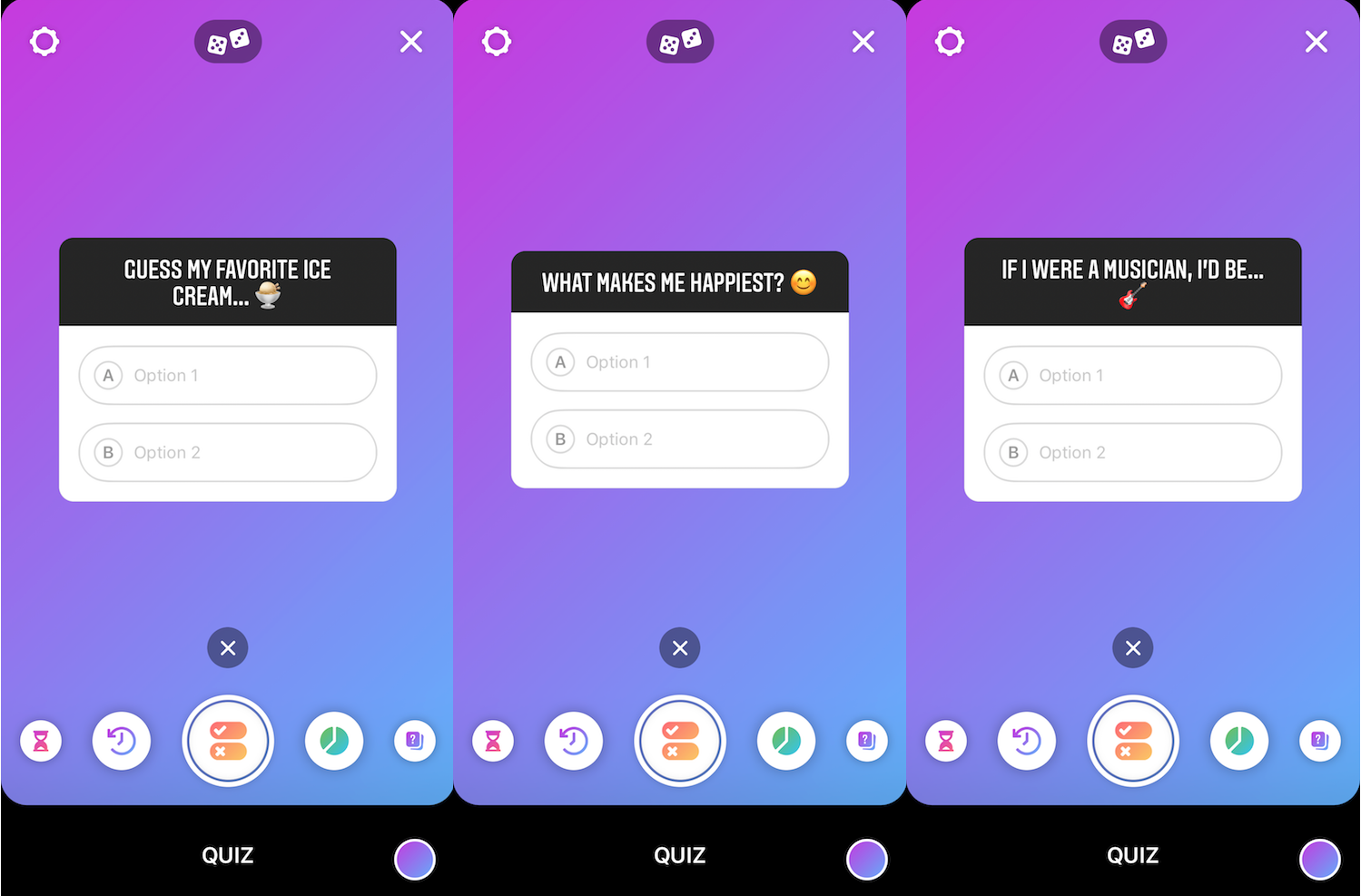
-Quiz with suggestions including “What’s my biggest fear?” and “Only one of these is true” (The Quiz sticker already had suggestions)

Instagram Create Quiz

-Poll with suggestions including “Sweet or savory?” and “Better first date: dinner or movie?”

Instagram Create Poll

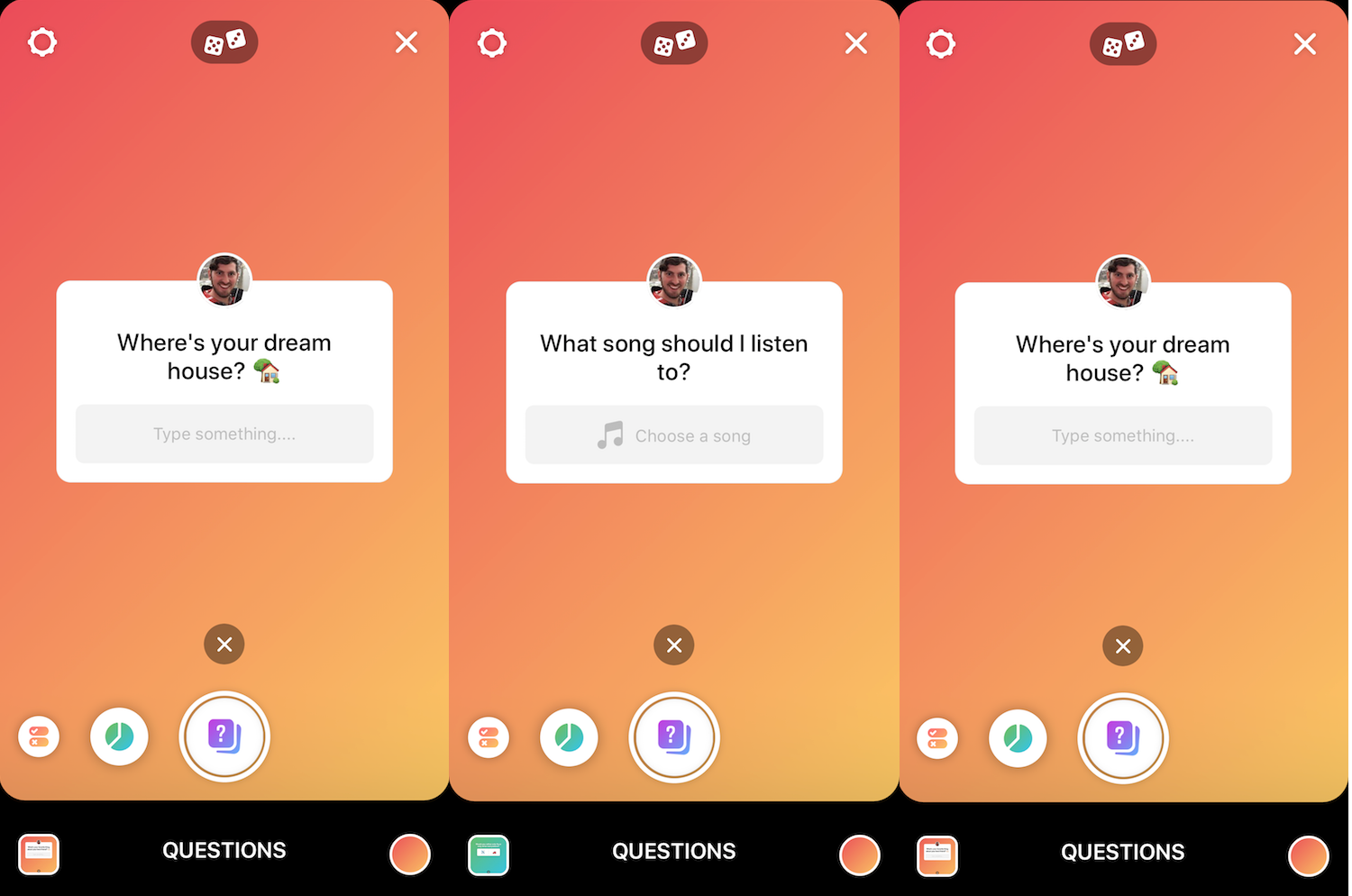
-Question with suggestions including “If you had 3 wishes…” and “Any hidden talents?”

Instagram Create Questions

Instagram is also offering a new version of its Giphy -powered GIFs feature inside Create. It lets you search for a GIF and see it tiled three times vertically as the background of your Create post, rather than laid on top.

Instagram Create GIFs

Through all these features, Create lets people generate new things to share even if they’re laying in bed or stuck somewhere. As Instagram grows internationally to more users with lower quality phones, and replaces Facebook for many people, the ability to share text and other stuff without having to use their camera could increase people’s posting.

As of today, Instagram is about more than photos and videos. It’s stepping up as a multi-faceted social app just as Facebook’s battered brand becomes desperate to turn Instagram into its reputation and business lifeboat.

08 Oct 2019

Boeing backs Virgin Galactic with strategic $20M investment

Virgin Galactic has $20 million more to pursue its goal of space tourism with a new investment from Boeing announced this morning. The two companies are both deeply involved in human spaceflight, but in different ways — and Boeing seems to feel that it’s better to join Virgin than try to beat them at this particular game.

VG is well on its way to its goal of being the first company to offer “routine, consistent and affordable” space tourism, though obviously the last item is relative. Its spacecraft have already been to space with people inside, essentially taking the same trip as what is planned for paying passengers — who, by the way, will embark from the recently unveiled Spaceport America in New Mexico.

The money came through through Boeing’s HorizonX Ventures, which has previously invested in some rather smaller scale aerospace startups, like Accion Systems and Matternet. The team there seems to prefer to give little cash injections here and there rather than back a major player with a sizable series A or the like.

Little context is offered for the investment; Quotes provided in a press release are more empty than usual, speaking only of the bright, vague future of human spaceflight. Why $20 million? Why now?

The investment will be contingent on new shares being issued in the new publicly traded company formed through a recently announced merger with Chamath Palihapitiya’s Social Capital Hedosophia. That’s expected to go forward in Q4 of this year.

Perhaps ahead of that event, and with Virgin founder Sir Richard Branson having walked away from a billion dollars offered by Saudia Arabia (in response to the Khashoggi murder), the company decided it could use a bit more relatively unstructured cash.

No specific partnerships or technologies are mentioned, simply that it is an “important collaboration,” in Branson’s words. CEO George Whitesides said he is “excited to partner with Boeing to build something that can truly change how people move around the planet.” “Something” that moves people around the planet? What else would either company build?

Boeing had probably been knocking on the door for a while, and they needed to get this funding on the books ahead of the merger, with specific collaborations and projects still on the drawing board and therefore with budgets only vaguely formed. “$20 million is probably fine,” I can imagine someone saying in a boardroom somewhere.

There’s no timeline on Virgin Galactic’s first commercial flight, but it’s conceivable it could be before the end of the year — a 2019 launch would be a nice feather to have in their cap, but either way there’s no shortage of customers; Reportedly some $80 million of commitments have already been made towards trips to space.