Category: UNCATEGORIZED

08 Oct 2019

Europe’s recharged antitrust chief makes her five year pitch to be digital EVP

Europe’s competition commissioner Margrethe Vestager, set for a dual role in the next Commission, faced three hours of questions from members of four committees in the European Parliament this afternoon, as MEPs got their chance to interrogate her priorities for a broader legislative role that will shape pan-EU digital strategy for the next five years.

As we reported last month Vestager is headed for an expanded role in the incoming European Commission with president-elect Ursula von der Leyen picking her as an executive VP overseeing a new portfolio called ‘Europe fit for the digital age’.

She is also set to retain her current job as competition commissioner. And a question she faced more than once during today’s hearing in front of MEPs, who have a confirming vote on her appointment, was whether the combined portfolio wasn’t at risk of a conflict of interest?

Or whether she “recognized the tension between objective competition enforcement and industrial policy interests in your portfolio” as one MEP put it, before asking whether she would “build Chinese walls” within it to avoid crossing the streams of enforcement and policymaking.

Vestager responded by saying it was the first question she’d asked herself on being offered the role — before laying out flat reasoning that “the independence in law enforcement is non-negotiable”.

“It has always been true that the commissioner for competition has been part of the College. And every decision we take also in competition is a collegial decision,” she said. “What justifies that is of course that every decision is subject to not one but 2x legal scrutiny if need be. And the latest confirmation of this set up was two judgements in 2011 — where it was looked into whether this set up… is in accordance with our human rights and that has been found to be so. So the set up, as such, is as it should be.”

The commissioner and commissioner-designate responded capably to a wide range of questions reflecting the broad span of her new responsibilities — fielding questions on areas including digital taxation; platform power and regulation; a green new deal; AI and data ethics; digital skills and research; and small business regulation and funding, as well as queries around specific pieces of legislation (such as ePrivacy and Copyright Reform). 

Climate change and digital transformation were singled out in her opening remarks as two of Europe’s biggest challenges — ones she said will require both joint working and a focus on fairness.

Europe is filled with highly skilled people, we have excellent infrastructure, fair and effective laws. Our Single Market gives European businesses the room to grow and innovate, and be the best in the world at what they do,” she said at the top of her pitch to MEPs. “So my pledge is not to make Europe more like China, or America. My pledge is to help make Europe more like herself. To build on our own strengths and values, so our society is both strong and fair. For all Europeans.”

Building trust in digital services

In her opening remarks Vestager said that if confirmed she will work to build trust in digital services — suggesting regulation on how companies collect, use and share data might be necessary to ensure people’s data is used for public good, rather than to concentrate market power.

It’s a suggestion that won’t have gone unnoticed in Silicon Valley.

“I will work on a Digital Services Act that includes upgrading our liability and safety rules for digital platforms, services and products,” she pledged. “We may also need to regulate the way that companies collect and use and share data – so it benefits the whole of our society.”

“As global competition gets tougher we’ll need to work harder to preserve a level playing field,” she also warned.

But asked directly during the hearing whether Europe’s response to platform power might include breaking up overbearing tech giants, Vestager signalled caution — saying such an intrusive intervention should only be used as a last resort, and that she has an obligation to try less drastic measures first. (It’s a position she’s set out before in public.)

“You’re right to say fines are not doing the trick and fines are not enough,” she said in response to one questioner on the topic. Another MEP complained fines on tech giants are essentially just seen as an “operating expense”.

Vestager went on to to cite the Google AdSense antitrust case as an example of enforcement that hasn’t succeeded because it has failed to restore competition. “Some of the things that we will of course look into is do we need even stronger remedies for competition to pick up in these markets,” she said. “They stopped their behavior. That’s now two years ago. The market hasn’t picked up. So what do we do in those kind of cases? We have to consider remedies that are much more far reaching.

“Also before we reach for the very, very far reaching remedy to break up a company — we have that tool in our toolbox but obviously it is very far reaching… My obligation is to ensure that we do the least intrusive thing in order to make competition come back. And in that respect, obviously, I am willing to explore what do we need more, in competition cases, for competition to come back.”

Competition law enforcers in Europe will have to consider how to make sure rules enforce fair competition in what what Vestager described as a “new phenomenon” of “competition for a market, not just in a market” — meaning that whoever wins the competition becomes “the de facto rule setter in this market”.

Regulating platforms on transparency and fairness is something European legislators have already agreed — earlier this year. Though that platform to business regulation has yet to come into force. “But it will also be a question for us as competition law enforcers,” Vestager told MEPs.

Making use of existing antitrust laws but doing so with greater speed and agility, rather than a drastic change of competition approach appeared to be her main message — with the commissioner noting she’d recently dusted off interim measures in an ongoing case against chipmaker Broadcom; the first time such an application has been made for 20 years.

“It’s a good reflection of the fact that we find it a very high priority to speed up what we do,” she said, adding: “There’s a limit as to how fast law enforcement can work, because we will never compromise on due process — on the other hand side we should be able to work as fast as possible.”

Her responses to MEPs on platform power favored greater regulation of digital markets (potentially including data), markets which have become dominated by data-gobbling platforms — rather than an abrupt smashing of the platforms themselves. So not an Elizabeth Warren ‘existential’ threat to big tech, then, but from a platform point of view Vestager’s preferred approach might just sum to death by a thousand legal cuts.

“One of course could consider what kind of tools do we need?” she opined, talking about market reorganization as a means of regulating platform power. “[There are] different ways of trying to re-organize a marketplace if the competition authority finds that the way it’s working is not beneficial for fair competition. And those are tools that can be considered in order to sort of re-organize before harm is done. Then you don’t punish because no infringement is found but you can give very direct almost orders… as to how a market should be organized.”

Artificial intelligence with a purpose

On artificial intelligence — which the current Commission has been working on developing a framework for ethical design and application — Vestager’s opening remarks contained a pledge to publish proposals for this framework — to “make sure artificial intelligence is used ethically, to support human decisions and not undermine them” — and to do so within her first 100 days in office.

That led one MEP to question whether it wasn’t too ambitious and hasty to rush to control a still emerging technology. “It is very ambitious,” she responded. “And one of the things that I think about a lot is of course if we want to build trust then you have to listen.

“You cannot just say I have a brilliant idea, I make it happen all over. You have to listen to people to figure out what would be the right approach here. Also because there is a balance. Because if you’re developing something new then — exactly as you say — you should be very careful not to over-regulate.

“For me, to fulfil these ambitions, obviously we need the feedback from the many, many businesses who have taken upon them to use the assessment list and the principles [recommended by the Commission’s HLEG on AI] of how to create AI you can trust. But I also think, to some degree, we have to listen fast. Because we have to talk with a lot of different people in order to get it right. But it is a reflection of the fact that we are in hurry. We really need to get our AI strategy off the ground and these proposals will be part of that.”

Europe could differentiate itself — and be “a world leader” — by developing “AI with a purpose”, Vestager suggested, pointing to potential applications for the tech such as in healthcare, transportation and combating climate change which she said would also work to further European values.

“I don’t think that we can be world leaders without ethical guidelines,” she said of AI. “I think we will lose it if we just say no let’s do as they do in the rest of the world — let’s pool all the data from everyone, no matter where it comes from, and let’s just invest all our money. I think we will lose out because the AI you create because you want to serve humans. That’s a different sort of AI. This is AI with a purpose.”

On digital taxation — where Vestager will play a strategic role, working with other commissioners — she said her intention is to work towards trying to achieve global agreement on reforming rules to take account of how data and profits flow across borders. But if that’s not possible she said Europe is prepared to act alone — and quickly — by the end of 2020.

“Surprising things can happen,” she said, discussing the challenge of achieving even an EU-wide consensus on tax reform, and noting how many pieces of tax legislation have already been passed in the European Council by unanimity. “So it’s not undoable. The problem is we have a couple of very important pieces of legislation that have not been passed.

“I’m still kind of hopeful in the working way that we can get a global agreement on digital taxation. If that is not the case obviously we will table and push for a European solution. And I admire the Member States who’ve said we want a European or global solution but if that isn’t to be we’re willing to do that by ourselves in order to be able to answer to all the businesses who pay their taxes.”

Vestager also signalled support for exploring the possibility of amending Article 116 of the Treaty on the Functioning of the EU, which relates to competition based distortion of the internal market, in order to enable tax reform to be passed by a qualified majority, instead of unanimously — as a potential strategy for getting past the EU’s own current blocks to tax reform.

“I think definitely we should start exploring what would that entail,” she said in response to a follow up question. “I don’t think it’s a given that it would be successful but it’s important that we take the different tools that the treaty gives us and use these tools if need be.”

During the hearing she also advocated for a more strategic use of public procurement by the EU and Member States — to push for more funding to go into digital research and business innovation that benefits common interests and priorities.

“It means working together with Member States on important projects of common European interest. We will bring together entire value chains, from universities, suppliers, manufacturers all the way to those who recycle the raw material that is used in manufacturing,” she said.

“Public procurement in Europe is… a lot of money,” she added. “And if we also use that to ask for solutions well then we can have also maybe smaller businesses to say I can actually do that. So we can make an artificial intelligence strategy that will push in all different sectors of society.”

She also argued that Europe’s industrial strategy needs to reach beyond its own Single Market — signalling a tougher approach to market access to those outside the bloc.

And implying she might favor less of a free-for-all when it comes to access to publicly funded data — if the value it contains risks further entrenching already data-rich, market-dominating giants at the expense of smaller local players.

“As we get more and more interconnected, we are more dependent and affected by decisions made by others. Europe is the biggest trading partner of some 80 countries, including China and the US. So we are in a strong position to work for a level global playing field. This includes pursuing our proposal to reform the World Trade Organization. It includes giving ourselves the right tools to make sure that foreign state ownership and subsidies do not undermine fair competition in Europe,” she said.

“We have to figure out what constitutes market power,” she went on, discussing how capacity to collect data can influence market position, regardless of whether it’s directly linked to revenue. “We will expand our insights as to how this works. We have learned a lot from some of the merger cases that we have been doing to see how data can work as an asset for innovation but also as a barrier to entry. Because if you don’t have the right data it’s very difficult to produce the services that people are actually asking for. And that becomes increasingly critical when it comes to AI. Because once you have it then you can do even more.

“I think we have to discuss what we do with all the amazing publicly funded data that we make available. It’s not to be overly biblical but we shouldn’t end up in a situation where ‘those who have shall more be given’. If you have a lot already then you also have the capabilities and the technical insight to make very good use of it. And we do have amazing data in Europe. Just think about what can be assessed in our supercomputers… they are world class… And second when it comes to both [EU sat-nav] Galileo and [earth observation program] Copernicus. Also here data is available. Which is an excellent thing for the farmer doing precision farming and saving in pesticides and seeds and all of that. But are really happy that we also make it available for those who could actually pay for it themselves?

“I think that is a discussion that we will have to have — to make sure that not just the big ones keep taking for themselves but the smaller ones having a fair chance.”

Rights and wrongs

During the hearing Vestager was also asked whether she supported the controversial EU copyright reform.

She said she supports the “compromise” achieved — arguing that the legislation is important to ensure artists are rewarded for the work they do — but stressed that it will be important for the incoming Commission to ensure Member States’ implementations are “coherent” and that fragmentation is avoided.

She also warned against the risk of the same “divisive” debates being reopened afresh, via other pieces of legislation.

“I think now that the copyright issue has been settled it shouldn’t be reopened in the area of the Digital Services Act,” she said. “I think it’s important to be very careful not to do that because then we would loose speed again when it comes to actually making sure there is renumeration for those who hold copyright.”

Asked in a follow up question how, as the directive gets implemented by EU Member States, she will ensure freedom of speech is protected from upload filter technologies — which is what critics of the copyright reform argue the law effectively demands that platforms deploy — Vestager hedged, saying: “[It] will take a lot of discussions and back and forth between Member States and Commission, probably. Also this parliament will follow this very closely. To make sure that we get an implementation in Member States that are similar.”

“One has to be very careful,” she added. “Some of the discussions that we had during the adoption of the copyright directive will come back. Because these are crucial debates. Because it’s a debate between the freedom of speech and actually protecting people who have rights. Which is completely justified… Just as we have fundamental values we also have fundamental discussions because it’s always a balancing act how to get this right.”

The commissioner also voiced support for passing the ePrivacy Regulation. “It will be high priority to make sure that we’re able to pass that,” she told MEPs, dubbing the reform an important building block.

“One of the things I hope is that we don’t just always decentralize to the individual citizens,” she added.  “Now you have rights, now you just go and force them. Because I know I have rights but one of my frustrations is how to enforce them? Because I am to read page after page after page and if I’m not tired and just forget about it then I sign up anyway. And that doesn’t really make sense. We still have to do more for people to feel empowered to protect themselves.”

She was also asked for her views on adtech-driven microtargeting — as a conduit for disinformation campaigns and political interference — and more broadly as so-called ‘surveillance capitalism’. “Are you willing to tackle adtech-driven business models as a whole?” she was asked by one MEP. “Are you willing to take certain data exploitation practices like microtargeting completely off the table?”

Hesitating slightly before answering, Vestager said: “One of the things I have learned from surveillance capitalism and these ideas is it’s not you searching Google it is Google searching you. And that gives a very good idea about not only what you want to buy but also what you think. So we have indeed a lot to do. I am in complete agreement with what has been done so far — because we needed to do something fast. So the Code of Practice [on disinformation] is a very good start to make sure that we get things right… So I think we have a lot to build on.

“I don’t know yet what should be the details of the Digital Services Act. And I think it’s very important that we make the most of what we have since we’re in a hurry. Also to take stock of what I would call digital citizens’ rights — the GDPR [General Data Protection Regulation] — that we can have national authorities enforce that in full, and hopefully also to have a market response so that we have privacy by design and being able to choose that. Because I think it’s very important that we also get a market response to say well you can actually do things in a very different way than just to allow yourself to feel forced to sign up to whatever terms and conditions that are put in front of you.

“I myself find it very thought-provoking if you have the time just once in a while to read the T&Cs now when they are obliged, thanks to this parliament, to write in a way that you can actually understand that makes it even more scary. And very often it just makes me think thanks but no thanks. And that of course is the other side of that coin. Yes, regulation. But also us as citizens to be much more aware of what kind of life we want to live and what kind of democracy we want to have. Because it cannot just be digital. Then I think we will lose it.”

In her own plea to MEPs Vestager urged them to pass the budget so that the Commission can get on with all the pressing tasks in front of it. “We have proposed that we increase our investments quite a lot in order to be able to do all this kind of stuff,” she said.

“First things first, I’m sorry to say this, we need the money. We need funding. We need the programs. We need to be able to do something so that people can see that businesses can use funds to invest in innovation, so that researchers can make their networks work all over Europe. That they get the funding actually to get there. And in that respect I hope that you will help push for the multi-annual financial framework to be in place. I don’t think that Europeans have any patience for us when it comes to these different things that we would like to be real. That is now, that is here.”

08 Oct 2019

Twitter admits it used two-factor phone numbers and emails for serving targeted ads

Twitter has said it used phone numbers and email addresses, provided by users to set up two-factor authentication on their accounts, to serve targeted ads.

In a disclosure Tuesday, the social media giant said it did not know how many users were impacted.

The issue stemmed from the company’s tailored audiences program, which allows companies to target advertisements against their own marketing lists, such as phone numbers and email addresses. But Twitter found that when advertisers uploaded their marketing lists, it matched Twitter users to the phone numbers and email addresses users submitted to set up two-factor authentication on their account.

The issue was addressed as of September 17, the disclosure said.

Twitter finds itself in the same boat as Facebook, which last year was caught using users’ phone numbers and email addresses, which they gave Facebook for securing their accounts, for targeted advertising.

For its part, Twitter said its ad targeting was “an error” and apologized.

It’s the latest in a number of security lapses at Twitter in the past year. Last year, the company admitted to storing passwords in plaintext, disclosed a phone number leak bug despite knowing about it for two years, and confirmed a location data leak in May.

In August, Twitter chief executive Jack Dorsey had his own account hacked.

08 Oct 2019

Dig into the key issues in venture today with investor and Techstars co-founder Brad Feld

Few can hold a candle to Brad Feld’s list of accolades in the startup, tech and venture world. As a multi-time founder of both startups and venture firms alike, Feld is widely known for having co-founded the Techstars accelerator — now a Silicon Valley and startup institution — as well as Foundry Group, the early and growth stage venture fund that has raised nearly $2.5 billion over seven funds, in just over a decade.

Feld is equally, if not more, recognized outside of the investing world as a thought leader through both his widely followed blog “Feld Thoughts” and through authoring a number of books and guides to the startup and venture worlds. Feld recently published the fourth edition of his acclaimed and seemingly timeless book “Venture Deals: Be Smarter Than Your Lawyer And Venture Capitalist” (which he co-authored with Foundry Group co-founder Jason Mendelson), which acts as a manual to raising venture capital by walking through tactical advice around negotiating a term sheet, what to consider when selling your business, arguments for and against convertible debt, and much more.

TechCrunch’s Silicon Valley editor Connie Loizos will be sitting down with Brad for an exclusive conversation this Thursday, October 10th at 11:00 am PT on Extra Crunch. Brad, Connie and Extra Crunch members will be digging into the latest edition of “Venture Deals”, Brad’s advice to founders and investors, and his take on hot button issues of the day (including dual-class shares, direct listings, and what happened at WeWork).

Extra Crunch members will also have the opportunity to ask questions! We will pause during the call to take questions from Extra Crunch subscribers. Alternatively, you can email questions to eldon@techcrunch.com.

Tune in to join the conversation and for the opportunity to ask Brad and Connie any and all things venture.

To listen to this and all future conference calls, become a member of Extra Crunch. Learn more and try it for free.

08 Oct 2019

How I Podcast: Broken Record’s Justin Richmond

The beauty of podcasting is that anyone can do it. It’s a rare medium that’s nearly as easy to make as it is to consume. And as such, no two people do it exactly the same way. There are a wealth of hardware and software solutions open to potential podcasters, so setups run the gamut from NPR studios to USB Skype rigs.

We’ve asked some of our favorite podcast hosts and producers to highlight their workflows — the equipment and software they use to get the job done. The list so far includes:

Criminal/This Is Love’s Lauren Spohrer
Jeffrey Cranor of Welcome to Night Vale
Jesse Thorn of Bullseye
Ben Lindbergh of Effectively Wild
My own podcast, RiYL

190712 BrokenRecord Raconteurs 0664 1

This week, we’ve got the producer and “fourth co-host” of Broken Record, Justin Richmond. Richmond actually does much of the talking for the popular music podcast, but you would probably bill yourself as number four if you were sharing mic time with Rick Rubin, Malcolm Gladwell and former New York Times editor Bruce Headlam.

The show aims to serve as aural linear notes in an era when musical context has gone the way of the 8-track and the original Ramones. The show’s guests have been a who’s who of popular musicians, including recent guests Jack White, Tyler the Creator and Ezra Koenig. Season three of the show kicked off recently and is available for listening at Broken Record Podcast. Next week, Richmond will interview rapper, producer, actor and former Fugee, Wyclef Jean.

Most days I work out of the greatest podcast studio there is: Shangri La, perched above one of my favorite Malibu beaches. OK, it might not be a podcast studio. Built by Bob Dylan’s band, The Band, in the mid ’70s, it’s where they recorded their last album as a group. They also taped the interview scenes from “The Last Waltz” there with Martin Scorsese. Bob Dylan’s tour bus was marooned there and has since been turned into a recording space. Black Sabbath recorded their last record there. Neil Young has used it, Run the Jewels, Eric Clapton, Kendrick Lamar … everyone. It’s one of the perks of working on a podcast with Rick Rubin.

There are two studios at Shangri La we typically use. One is in the main studio, with a beautiful API console and U87 microphones. Rick and a guest sit in the control room above the studio’s “live” room and overlook a beautiful green landscape and the ocean. Typically the windows are open so you can often hear helicopters flying by, motorcycles speeding down PCH or birds chirping. But it gives the recordings character. The other place we record is in what we call “The Chapel.” It’s a small charming building that looks like, you guessed it, a chapel. We also use U87’s down there and the console is from the famed Muscle Shoals studio in Alabama. It used to be at Rick’s old Laurel Canyon studio where he recorded the Red Hot Chili Peppers and countless other groups in the ’90s and early 2000s. These bits of history are what make creating a music podcast from there so surreal and fun.

IMG 7596

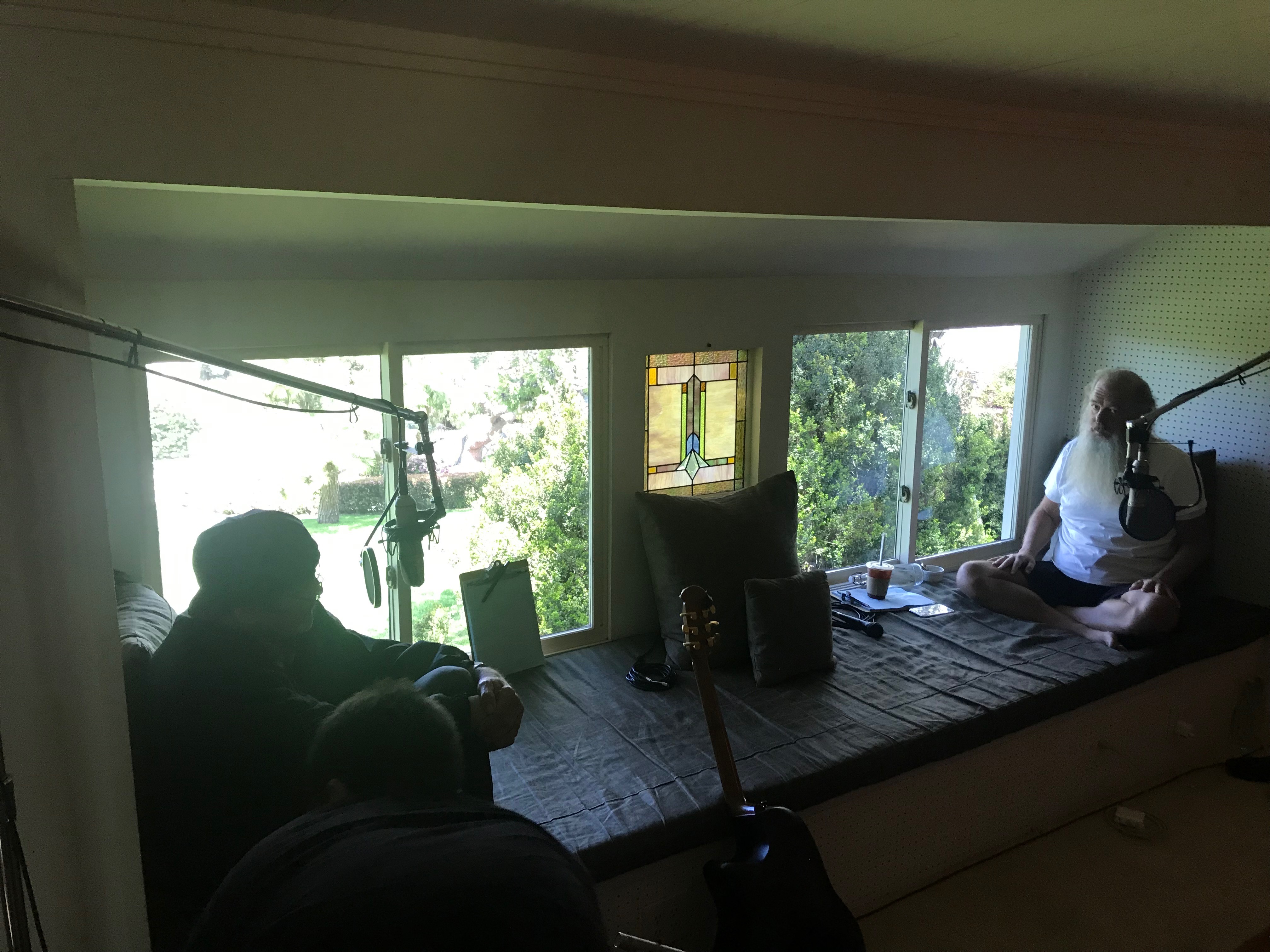
But some days my studio space is challenging (though, honestly, still very fun). Our first episode for Season 3, for example, is Malcolm and Rick talking with the Raconteurs — primarily Brendan Benson and Jack White. We taped the episode in Jack White’s sunroom at a home of his in the Detroit area. As you can tell from the picture, it’s a beautiful space, but there’s a lot going on … and we’re far from our usual Malibu digs. Luckily, Bill Skibbe, who does the mastering for Jack’s Third Man Records stuff, was able to pull up with a wonderful mobile rig.

However, Rick wasn’t in Michigan — he was in Italy. We were initially going to have him FaceTime in and sync himself with an RE-20 on his end, but the internet on both ends was a little shoddy. So we ended up putting my iPhone in the middle of the room with Rick on speaker. It was a nightmare to reduce the bleed of any and every sound coming through the phone on Rick’s end, but we painstakingly got it done. 

Because Rick, Malcolm and Bruce keep very busy schedules we have a bunch of other studios lined up across the country that provide wildly different environments. But somehow we’re managing to unify the Broken Record sound.

08 Oct 2019

Startup says ‘Sober is the new black’

Maveron, Slow Ventures and Female Founders Fund have invested $10 million in a startup that claims it’s carving a new path to sobriety.

Tempest offers a $647 eight-week virtual “sobriety school” to help people, particularly women and “historically oppressed individuals,” get sober. The program is led by the company’s founder and chief executive officer Holly Whitaker, who conducts weekly video lectures and Q+As for participants. Offering their expertise as part of the package is marriage and family therapist Kim Kokoska; Valerie (Vimalasara) Mason-John, the co-founder of Eight Step Recovery; and wellness coach Mary Vance, among others.

Tempest teaches the underlying causes of addiction and the “importance of purpose, meaning and creativity in breaking addiction,” as well as how to manage cravings, how to navigate social situations as a non-drinker, how to develop a mindfulness practice and more. At the end of the program, participants can pay a $127 fee for an annual membership to the Tempest online community, where one can communicate with others who’ve completed the program.

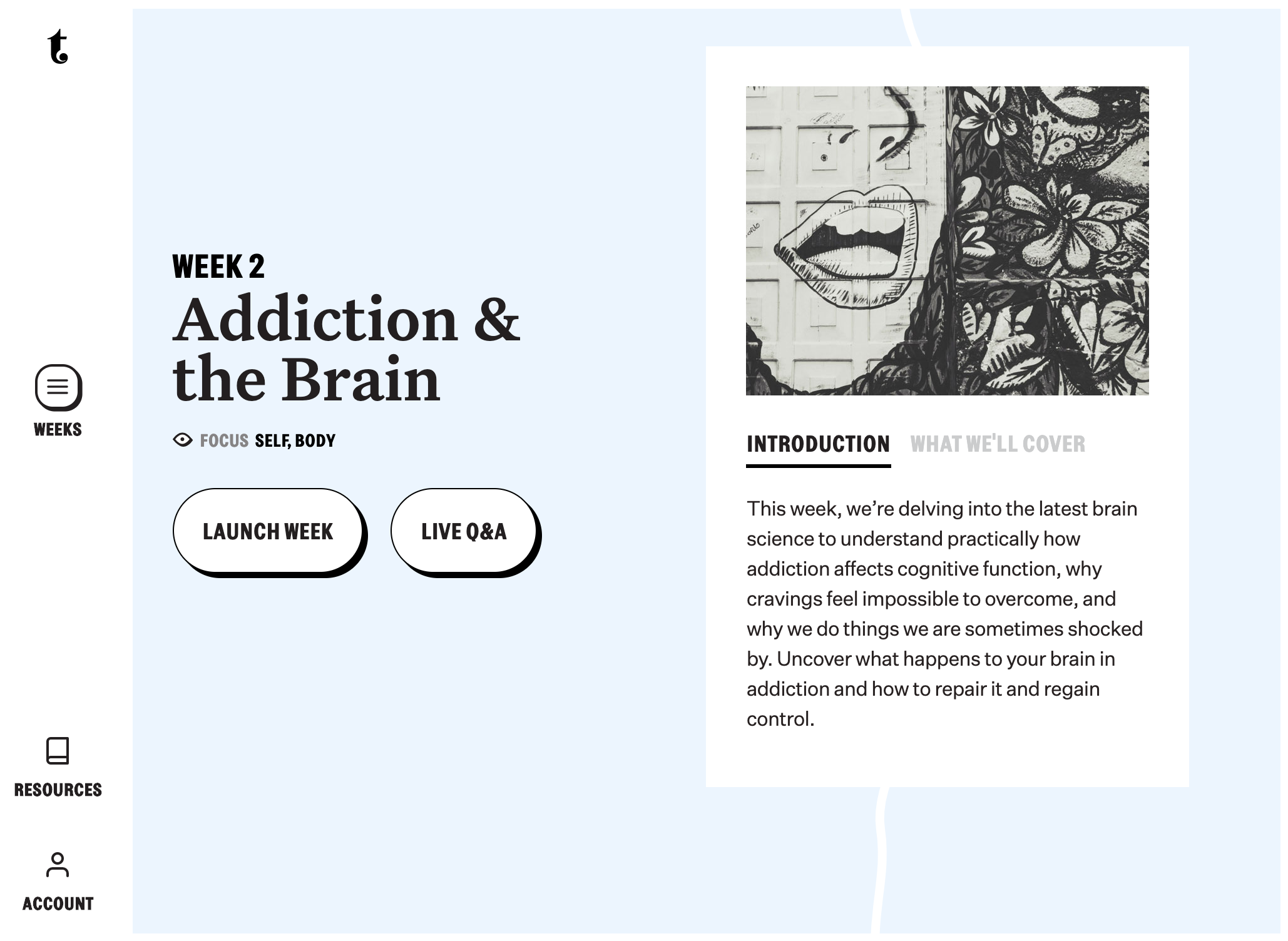
Tempest Syllabus
Week 1: Recovery Maps + Toolkits
Week 2: Addiction & The Brain
Week 3: Habit and Night Ritual
Week 4: Yoga, Meditation and Breath
Week 5: Nutrition & Lifestyle
Week 6: Relationships & Community
Week7: Trauma & Therapy
Week 8: Purpose & Creativity
Week 8+ Wrapping Up + Next Steps

Dashboard Week 2

A snapshot of Tempest’s weekly coursework.

A holistic approach

Founded in 2014, New York-based Tempest has raised about $14.3 million in total VC funding. Whitaker previously spent five years at One Medical, where she was the director of revenue cycle operations. Since founding Tempest, which has enrolled 4,000 participants to date, Whitaker received a two-book deal from Random House to document her methodologies and path to sobriety. Her first book, ‘Quit Like a Woman: The Radical Choice to Not Drink in a Culture Obsessed with Alcohol,’ will be released on December 31.

Today, her business has 28 employees and plans to build out its team, invest in marketing — where it’s historically had very low spend — and explore business opportunities within the enterprise using cash from the $10 million Series A.

“Sobriety, and the refusal to partake in alcogenic culture, is subversive, rebellious, and edgy.” - Tempest

The company is careful to clarify it’s not a detox or 12-step program, like Alcoholics Anonymous, which is structured around the Twelve Steps to recovery. Rather, Tempest can be used in combination with other programs or therapies, or as a first step down the path to recovery. Whitaker explains Tempest isn’t only for the clinically addicted or those who consider themselves addicts or alcoholics. The company welcomes people who have rejected these labels or simply want to cut alcohol out of their life.

“Tempest grew out of my own experience,” Whitaker, who has previously struggled with alcoholism and an eating disorder, tells TechCrunch. “It was a response to the lack of desirable and accessible options to address problematic drinking, the lack of options available for people who don’t identify as alcoholics but struggle with alcohol and the lack of options that have been created for women and other individuals. Everything had been created for men.”

Tempest is tailored to the needs of women and historically oppressed individuals, says Whitaker, though all genders are welcome to complete its course. Taking a holistic approach to recovery, participants are encouraged to address the factors that led them to drink in the first place, including “love lives, poor nutrition, stress, anxiety, crap friendships, consumerism, lack of purpose, unresolved family of origin issues, disenfranchisement, poverty, tight or unmanageable finances, lack of connection, fear, shitty jobs we hate, depression, unprocessed trauma, lack of meaning, unfulfilled dreams, never-ending to-do lists, never-measuring-upness,” the company writes.

TempestWebsite

Tempest’s website

But what about A.A.?

I had the same question.

Alcoholics Anonymous (A.A.), the most popular and accessible approach to recovery, is free and open to anyone willing to acknowledge they have a drinking problem. A nonprofit organization, A.A. has more than 115,000 groups worldwide. The 84-year-old program is built on peer-support groups that gather regularly for discussion meetings. Over time, more seasoned members can become “sponsors,” helping newer entrants work through the Twelve Steps.

Tempest, alternatively, is taking a for-profit approach, charging for its tech-infused method. And where A.A. emphasizes in-person support groups, Tempest relies on video streams. Increasingly, telemedicine startups are enticing customers with convenient options for health and wellness care but whether people will truly pivot to telemedicine, tele-therapy or virtual sobriety schools is still up for debate. As for Tempest’s similarities to A.A., Whitaker says: “The only thing they have in common is that they are working to help people quit alcohol.”

“By just trying on sobriety or questioning our drink-centric culture, you are profoundly ahead of the pack.” - Tempest

In selling its sobriety school, Tempest evokes a sense of coolness, with phrases like “Sober is the new black” and “Your hangover goes away. Your social life doesn’t,” plastered on its website. In providing a priced and more exclusive route to sobriety, one might question Tempest’s ethics and motivations as it builds a business that capitalizes off of substance abuse. Whitaker, in defense, explains a virtual school fit for the historically powerless is a necessary addition to existing options: “Our program is centered on individuals who have been held out of power, who have been told to shut up and listen,” she said. “We aren’t looking at white, upper-class men. We are looking at a queer person from 2019.”

According to survey data published by Recovery.org, 89% of A.A. attendees are white, while 38% are female.

Refusing ‘alcogenic culture’

Tempest’s branding takes a cue from the D2C playbook. The company, led by women, has the opportunity to become the brand that represents sobriety, and it’s taking it. Tempest’s Series A, coupled with the influx of new-age non-alcoholic beverage brands backed by VCs, is representative of the perceived shift away from alcohol among the younger generations.

Millennials are drinking less alcohol and, according to the World Health Organization, there are 5% fewer alcohol drinkers in the world today than in 2000. Tempest’s school seems to cater more to the cohort of people who view ditching alcohol as a lifestyle perk, not those who stop drinking due to addiction.

Holly Whitaker

Tempest founder and CEO Holly Whitaker

Seedlip, a non-alcoholic spirits company, and India’s Coolberg Beverages, which makes non-alcoholic beer, recently raised VC to cater to a similar demographic. Meanwhile, CBD-infused beverage brands like Sweet Reason, Cann and Recess are trendy and raising venture money. None of these, of course, are solutions for someone struggling with alcohol. Capital flowing into these brands merely indicates venture capitalists’ belief that consumers are steering away from traditional liquor and toward new products fit for a generation that is drinking less alcohol.

“By just trying on sobriety or questioning our drink-centric culture, you are profoundly ahead of the pack and among good company,” Tempest writes on its website. “Remember: 70-80% of adults drink depending on where you live; drinking is basic. Sobriety, and the refusal to partake in alcogenic culture, is subversive, rebellious, and edgy.”

Tempest says it has completed an efficacy study performed in consultation with researchers affiliated with the University of Buffalo and Syracuse University. In several years’ time, we’ll know whether the countless think pieces claiming millennials are done with alcohol were indeed true and whether the VC money into these upstarts was wasted or pure genius. As for Tempest, even if just providing a designated place on the internet for discussions around the struggles or benefits of sobriety, it has the potential to make a big impact on those in recovery or those seeking a lifestyle change.

“Alcohol is very similar to cigarettes,” Whitaker said. “We are in a time that we think drinking alcohol is natural, that we are supposed to do it. I thought that would change because to me, alcohol is entirely toxic. We are approaching this tipping point of realizing how toxic and unnecessary it is.”

Tempest is also backed by AlleyCorp, Refactor and Green D Ventures. Maveron’s Anarghya Vardhana has joined the startup’s board of directors as part of the latest deal.

08 Oct 2019

The budding industry of cannabis tech

From food and drink to health and wellness and beyond, there’s one plant we can’t seem to get enough of: cannabis. It seems like every consumer product nowadays is taking part in reefer madness.

Home cooks are taking edibles to new heights. In places like Denver and California, you can take cooking classes specifically centered around food made with Mary Jane. The editors of Vice’s “Munchies” even put out a cookbook last year called Bong Appétit: Mastering the Art of Cooking with Weed. And it’s only one of many.

But marijuana culture today isn’t all based around the stuff you (er, people you know) smoked in college. Cannabis, long known for its medicinal and therapeutic purposes, is a hot commodity in food tech and other consumer products nowadays. Far more than just a way to get high, cannabis in its various forms has been used medically throughout history and in modern times as a treatment for pain and nausea, and has been found anecdotally or in limited studies to treat glaucoma, epilepsy and anxiety, among other conditions and symptoms. Businesses have caught on, and not a moment too soon.

The food products that utilize marijuana are a far cry from the old classic pot brownies (not that there’s anything wrong with those!). Thanks to modern science, producers are able to separate the two main chemical compounds found in marijuana: THC and CBD. THC has therapeutic benefits, but it’s best known as the part of weed that gets you high. This is because it’s a psychoactive compound. CBD, on the other hand, is not psychoactive — it can (supposedly) provide many of the anti-anxiety, analgesic benefits of the plant without producing a high. For obvious reasons, this gives marijuana a new appeal. It’s now possible to reap the benefits of the plant without experiencing intoxication, so you can lessen anxiety or pain while still functioning normally.

It’s worth noting at this point that many of the health benefits of CBD and cannabis in general are not scientifically proven in statistically significant, peer-reviewed studies. This is for a number of reasons, most significantly that marijuana is still a Schedule 1 controlled substance under federal law in the U.S., making legality an issue in its study.

Clearly, the lack of scientific evidence isn’t diminishing anyone’s desire for herbal refreshment.

But what CBD and other cannabis products lack in evidence, they make up for with enthusiasm. Companies and consumers alike are eager to try CBD in various products, from food to oils to skincare, in hopes of treating anxiety, sleeplessness and other woes. If you live in a place where CBD products are legal, you’ve probably seen them everywhere. Newsweek reported that CBD sales are estimated to grow 40-fold in the next four years, reaching a value of $23 billion. The big business of marijuana and CBD — California-based Arena Pharmaceuticals is the biggest publicly traded cannabis company in the world — is only growing.

You can already find CBD candies and oils at major national retail chains like CVS and Walgreens, and in states and municipalities where it’s legal, green connoisseurs can order CBD-infused lattes and cocktails. Even retailers like Sephora, Neiman Marcus and Barneys are selling curated displays of CBD-infused beauty and skincare products. The aforementioned Newsweek article reports that big names like Coca-Cola and Molson Coors Brewing are among the hordes of companies already working on their own CBD products. Clearly, the lack of scientific evidence isn’t diminishing anyone’s desire for herbal refreshment.

Except for the FDA, that is. The legality of marijuana and CBD is a confusing and often contradictory topic, and a hard one to keep track of because it’s changing all the time at the federal, state and municipal levels. But what can be ascertained is that because so much of the CBD industry is operating outside of any kind of government oversight, legally or otherwise, the quality of products can vary widely. This is something about which the FDA and independent doctors and pharmaceutical experts have raised concerns. Apart from companies making unfounded claims about the effects of their products, the actual ingredient makeup may be inconsistent, with some products containing less CBD than their labels claim. Little regulation and nascent standards of quality mean consumers might not always know what they’re getting.

But given the broad interest in CBD, that’s unlikely to remain the case forever. The FDA may have started cracking down on extralegal CBD product sales, but in the grand scheme of things, that only means that the agency recognizes the significance of the compound. CBD probably isn’t going away anytime soon, and among the food, drug, health and cosmetic industries, the race to do it best and biggest has already begun.

08 Oct 2019

With $15M round and 100K tablets sold, reMarkable CEO wants to make tech ‘more human’

The reMarkable tablet is a strange device in this era of ultra-smart gadgets: A black and white screen meant for reading, writing, and sketching — and nothing more. Yet the company has sold 100,000 of the devices and now has attracted $15 million in series A funding from Spark Capital.

It’s an unusual trajectory for a hardware startup exploring a nearly unoccupied market, but CEO Magnus Wanberg is confident that’s because this category of device is destined to grow in response to increasingly invasive tech. Sometimes an anti-technology trend is the tech opportunity of a lifetime.

I reviewed the reMarkable last year and compared it with its only real competition, the Sony Digital Paper Tablet. It was launched not on Kickstarter or Indiegogo but with its own independent crowdfunding campaign — and considering we’ve seen devices like this attempt such a thing and either let down or rip off their backers, that alone was a significant risk.

The device has been a runaway success, though, selling over 100,000 units — and attracting investment in the process. When I talked with Wanberg and co-founder Gerst about their new A round, the conversation was so interesting that I decided to publish it in full (or at least slightly edited).

How did they get here? What would they have done differently? Is the threat of the “smart” world really a thing? Why fight tech with more tech?

Devin: So you guys raised some money, that’s great! But it’s been a while since we talked. I think it’s important to hear about the progress of unique companies that are doing interesting things. So first can you tell me a little about what the company’s been busy with?

Magnus: Well, we’ve created this wonderful product, the reMarkable paper tablet. We’ve been very focused on that effort, based on a love for paper and a love for technology, to see if we can find some ways to join these two together to help people think better. That’s sort of the the whole ethos of the company.

So for the last six years, we’ve just been grinding away… you know, we’re a small player up against the big guys on this. So we’ve been sort of fighting guerrilla warfare trying to trying to establish ourselves.

And we were successful, fortunately, when we did our pre-order campaign, because as we found out, we weren’t the only ones who who love this notion of thinking better with the paper tablet, seeing paper as a powerful tool for thinking and for creating.

08 Oct 2019

Daily Crunch: Apple releases latest MacOS update

The Daily Crunch is TechCrunch’s roundup of our biggest and most important stories. If you’d like to get this delivered to your inbox every day at around 9am Pacific, you can subscribe here.

1. Apple’s MacOS Catalina is now available

Catalina bucks the trend of recent MacOS updates with some pronounced changes — the underlying principles are the same, but the latest version of Apple’s Mac operating system makes some fundamental updates to popular apps, like getting rid of iTunes.

Brian Heater argues that these changes will have an immediate impact on current usage while also laying the groundwork for future evolutions.

2. Sony’s next console is… the PlayStation 5, arriving holidays 2020

The company is saving most of the details for future announcements, but it did reveal a few things about the upcoming game console — like the fact that the controllers will include new haptic feedback.

3. Group Nine acquires PopSugar

Earlier this year, there were reports that Group Nine — which was formed by the merger of Thrillist, NowThis, The Dodo and Seeker — was in talks to acquire a different women’s lifestyle publisher, Refinery29, which was ultimately acquired by Vice Media instead.

4. Chinese firms Tencent, Vivo and CCTV suspend ties with the NBA over Hong Kong tweet

Smartphone maker Vivo, broadcaster CCTV and internet giant Tencent said today they are suspending all cooperation with the National Basketball Association, becoming the latest Chinese firms to cut ties with the league following a tweet from a Houston Rockets executive supporting Hong Kong’s pro-democracy protesters.

5. Opera’s desktop browser gets built-in tracking protection

The marquee feature of Opera’s latest desktop browser is the addition of a blocker that will make it harder for advertisers and others to track you while you browse the web — and which has the additional benefit of speeding up your browsing session. In fact, Opera argues that turning on both the tracking protection and the built-in ad blocker can speed up page loads by up to 23%.

6. Via is launching an on-demand public transit network in the city of Cupertino

The aim is for these on-demand shuttles — starting with six vans branded with the city of Cupertino logo — to provide more efficient connections to CalTrain and increase access to public transit across the city.

7. Laurel Bowden of VC firm 83North on the European deep tech and startup ecosystems

London and Tel Aviv-based VC firm 83North has closed out its fifth fund at $300 million. In a conversation with general partner Laurel Bowden, the veteran investor shared a few thoughts about the tech scene in Europe versus Israel, what the firm looks for in a team and how to scale globally. (Extra Crunch Membership required.)

08 Oct 2019

After several disappointing quarters, Chinese EV maker Nio’s sales surge

Nio delivered 4,799 vehicles in the third quarter, a 35.1% surge in sales and a positive development for the Chinese electric automaker that has been plagued by cost overruns, a voluntary battery recall and macroeconomic conditions such as declining passenger vehicle sales and reduced EV subsidies.

The company said Tuesday it also exceeded the middle point of its guidance range by 499 vehicles, or 11.6%.

The deliveries sent Nio shares up more than 9%. However, Nio shares, which were trading at $1.69 on Tuesday prior to the market close, are still down some 49% from just a month ago.

In the third quarter, Nio delivered 4,196 of its 5-seater ES6 SUV and 603 of the ES8, its more expensive 7-seater premium electric SUV. As of September 30, 2019, aggregate deliveries of the Company’s ES6 and ES8 reached 23,689 vehicles, of which 12,341 vehicles were delivered in 2019.

Nio founder, chairman and CEO William Li credited more “competitive retail prices” on the ES6 for contributing to the jump in deliveries. He added that the company began in October delivering ES6 and ES8 vehicles with an 84-kWh battery pack that extends their range to 316 miles and 276 miles, respectively. Li expects these longer range vehicles to accelerate orders and deliveries in the fourth quarter.

Nio has struggled to hit its own guidance in previous quarters. Nio began deliveries of the ES8 in China in June 2018. And while deliveries initially surpassed expectations, they slowed in 2019. The company reported loss of $390.9 million in the first quarter. The rout continued in the second quarter when Nio reported a loss of $462 million.

Nio delivered 3,553 vehicles in the second quarter, a 7.9% decline from the first period of 2019.

Nio’s response to its dismal numbers has included shifting its vehicle production plans, reducing R&D spending and cutting thousands of jobs. The company plans to cut its workforce from 9,900 people down to 7,800 by the end of the third quarter, Li said in September when reporting its earnings. He also said there will be additional restructuring and some non-core businesses will be spun off by the end of the year.

In June, Nio faced a new problem when it voluntarily recalling nearly 5,000 of its ES8 high-performance electric SUVs after a series of battery fires in China and a subsequent investigation revealed a vulnerability that created a safety risk. The recall affected a quarter of the ES8 vehicles it has sold since they went on sale in June 2018.

Nio was able to complete its recall for the 4,803 ES8s by prioritizing battery manufacturing capacity for this effort. But that significantly affected production and delivery results, Li said at the time. Nio delivered just 837 electric vehicles in July.

But even before the recall, delivery numbers were down. Nio delivered 1,340 vehicles in June, 1,089 in May and 1,124 in April. Those numbers rebounded in September when Nio said it delivered 2,019 vehicles.

It’s unclear if these rosier numbers signal the beginning of a broader turnaround for Nio, which has accumulated about $6 billion in losses since its founding in 2014. Sales of EVs in China continue to slide, a fall blamed on a reduction in subsidies.

08 Oct 2019

Google makes moving music and videos between speakers and screens easier

Google today announced a small but nifty feature for the Google Assistant and its smart home devices that makes it easier for you to take your music and videos with you as you wander about the different rooms in your home.

‘Stream transfer’ as Google prosaically calls it, allows you to simply ask the Assistant to move your music to a different speaker, or — if you have the right speaker group set up — to all speakers and TVs in your home. All you have to say is “Hey Google, move the music to the bedroom speaker,” for example. In addition to your voice, you can also use the Google Home app or the touchscreen on your Google Nest Home Hub.

This will work with any source that can play to your Chromecast-enabled speakers and displays.

It’s all pretty straightforward — to the point where I’m surprised it took so long for Google to enable a feature like this. But maybe it just needed to have enough devices in peoples’ homes to make it worthwhile. “Now that millions of users have multiple TVs, smart speakers and smart displays (some in every room!) we wanted to make it easy for people to control their media as they moved from room to room,” Google itself explains in today’s announcement.