Category: UNCATEGORIZED

08 Oct 2019

Arm brings custom instructions to its embedded CPUs

At its annual TechCon event in San Jose, Arm today announced Custom Instructions, a new feature of its Armv8-M architecture for embedded CPUs that, as the name implies, enables its customers to write their own custom instructions to accelerate their specific use cases for embedded and IoT applications.

“We already have ways to add acceleration, but not as deep and down to the heart of the CPU. What we’re giving [our customers] here is the flexibility to program your own instructions, to define your own instructions — and have them executed by the CPU,” ARM senior director for its automotive and IoT business, Thomas Ensergueix, told me ahead of today’s announcement.

He noted that Arm always had a continuum of options for acceleration, starting with its memory-mapped architecture for connecting GPUs and today’s neural processor units over a bus. This allows the CPU and the accelerator to run in parallel, but with the bus being the bottleneck. Customers can also opt for a co-processor that’s directly connected to the CPU, but today’s news essentially allows Arm customers to create their own accelerated algorithms that then run directly on the CPU. That means the latency is low, but it’s not running in parallel, as with the memory-mapped solution.

arm instructions

As Arm, argues, this setup allows for the lowest-cost (and risk) path for integrating customer workload acceleration, as there are no disruptions to the existing CPU features and still allows its customers to use the existing standard tools they are already familiar with.

custom assemblerFor now, custom instructions will only be available to be implemented in the Arm Cortex-M33 CPUs, starting in the first half of 2020. By default, it’ll also be available for all future Cortex-M processors. There are no additional costs or new licenses to buy for Arm’s customers.

Ensergueix noted that as we’re moving to a world with more and more connected devices, more of Arm’s customers will want to optimize their processors for their often very specific use cases — and often they’ll want to do so because by creating custom instructions, they can get a bit more battery life out of these devices, for example.

Arm has already lined up a number of partners to support Custom Instructions, including IAR Systems, NXP, Silicon Labs and STMicroelectronics .

“Arm’s new Custom Instructions capabilities allow silicon suppliers like NXP to offer their customers a new degree of application-specific instruction optimizations to improve performance, power dissipation and static code size for new and emerging embedded applications,” writes NXP’s Geoff Lees, SVP and GM of Microcontrollers. “Additionally, all these improvements are enabled within the extensive Cortex-M ecosystem, so customers’ existing software investments are maximized.”

In related embedded news, Arm also today announced that it is setting up a governance model for Mbed OS, its open-source operating system for embedded devices that run an Arm Cortex-M chip. Mbed OS has always been open source, but the Mbed OS Partner Governance model will allow Arm’s Mbed silicon partners to have more of a say in how the OS is developed through tools like a monthly Product Working Group meeting. Partners like Analog Devices, Cypress, Nuvoton, NXP, Renesas, Realtek,
Samsung and u-blox are already participating in this group.

08 Oct 2019

Microsoft adds per-app time limits to its parental controls

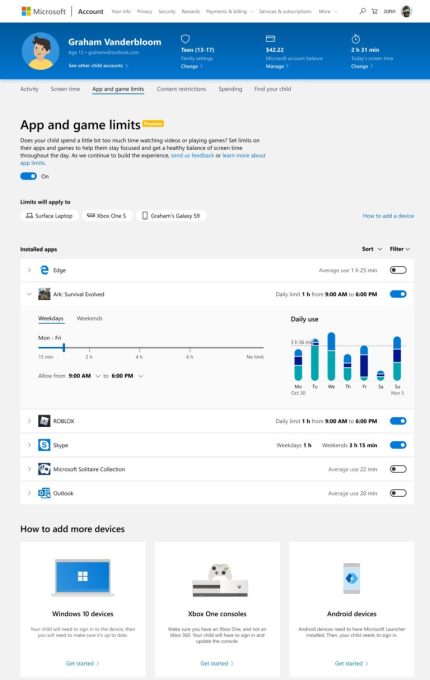
Microsoft is following Apple and Google’s lead with today’s launch of per-app and per-game time limits in its parental control software. Already, the company allows parents to limit screen time across Windows 10, Xbox One, and Android via the Microsoft Launcher. However, it hadn’t yet allowed parents to limit the amount of time a child would spend in a specific app or game, as its competitors do.

Instead, its existing controls allowed parents only to dole out a set amount of hours of screen time. Parents could choose to either leave the time up to the kids to manage, or limit it at the device level — like, only allowing one hour of Xbox time but permitting more screen time on the PC, for example.

However, the current trend in screen time management is not to approach all screen time as unproductive and unhealthy. Instead, it’s about configuring limits on the more addictive apps and games that eat up increasing amounts of children’s time, while permitting educational tools to have fewer limits.

For older kids and teens, social media apps like TikTok or Instagram could be the culprit, while younger kids may just be spending too much time “hanging out” in virtual worlds like Roblox and Fortnite. Problems on this front have gotten pretty bad. Mobile games are under fire for using gambling tactics like loot boxes to engage children. And Fortnite is now the subject of a lawsuit that claims that, in part, that the game’s addictive nature is due to its use slot machine-like mechanics and variable reward systems, which manipulate children’s brains.

Without being able to limit these apps directly, kids may end up using all of their allotted screen time on just the one app or game they’re obsessed with at the moment.

Apple had already allowed per-app time limits with the launch of its screen time controls in iOS 12. And Google more recently updated its own Family Link software, now preinstalled on new Android devices, to include a similar feature.

With today’s update, Microsoft is now on board, too.

microsoft per app time limits

The new app and game limits parents set will apply across Windows 10, Xbox and Android devices running Microsoft Launcher. In other words, kids can’t get more game time just by switching devices.

The controls also allow parents to offer more screen time on certain days — like weekends, for instance — than others.

To use this feature, parents will need to create a family group and make Microsoft accounts for all the kids.

Once enabled, kids will get a warning about their screen time 15 minutes before the limit is reached, and then again at 5 minutes. Since kids will often beg for a few more minutes, Microsoft made it easy for parents to grant or deny more time via email or via a Microsoft Launcher notification on their own Android phone.

The per-app time limits are launching today in preview within Microsoft’s existing family settings.

“Ultimately, our goal is for the app and game limits feature to provide flexible and customizable tools to meet each family’s unique needs,” the company explains in an announcement. “You as parents know what’s best for your children — no technology can ever replace that — but we’re hoping these tools can help you to strike the right balance,” it says.


08 Oct 2019

Startup studio eFounders has a portfolio valuation of $1 billion

European startup studio eFounders has shared some metrics about its portfolio companies. The startup studio has launched 23 companies with a focus on software-as-a-service enterprise products.

While eFounders might not be a familiar name, some of the companies in its portfolio have become promising startups with impressive growth, such as Front, Aircall, Forest, Spendesk, Mailjet and others. Front is also company #85 in Y Combinator’s list of top 101 companies of all time.

And the big new metric is that the total valuation of all 23 companies has now reached $1 billion. Of course, eFounders is just a shareholder in those 23 companies, so eFounders itself isn’t a unicorn. But it’s still an impressive number.

At the end of 2018, eFounders’ portfolio valuation was at $541 million. At the end of 2017, the same metric was at $385 million.

Overall, eFounders companies have raised $254 million from VC funds and business angels, and employ 1,000 people, mostly in Paris, San Francisco and New York. And when you add up the annual recurring revenue of all those startups, they generate $107 million in ARR together.

If you don’t know the eFounders model, it’s quite simple. At first, the core eFounders team comes up with an idea and hires a founding team. In exchange for financial and human resources, the startup studio keeps a significant stake in its startups.

After a year or two, startups should have proven that they can raise a seed round and operate on their own. This way, eFounders can move on to the next project and start new companies. Up next, eFounders is already working on 5 new companies.

08 Oct 2019

Nadella warns government conference not to betray user trust

Microsoft CEO Satya Nadella, delivering the keynote at the Microsoft Government Leaders Summit in Washington, DC today, had a message for attendees to maintain user trust in their tools technologies above all else.

He said it is essential to earn user trust, regardless of your business. “Now, of course, the power law here is all around trust because one of the keys for us, as providers of platforms and tools, trust is everything,” he said today. But he says it doesn’t stop with the platform providers like Microsoft. Institutions using those tools also have to keep trust top of mind or risk alienating their users.

“That means you need to also ensure that there is trust in the technology that you adopt, and the technology that you create, and that’s what’s going to really define the power law on this equation. If you have trust, you will have exponential benefit. If you erode trust it will exponentially decay,” he said.

He says Microsoft sees trust along three dimensions: privacy, security and ethical use of artificial intelligence. All of these come together in his view to build a basis of trust with your customers.

Nadella said he sees privacy as a human right, pure and simple, and it’s up to vendors to ensure that privacy or lose the trust of their customers. “The investments around data governance is what’s going to define whether you’re serious about privacy or not,” he said. For Microsoft, they look at how transparent they are about how they use the data, their terms of service, and how they use technology to ensure that’s being carried out at runtime.

He reiterated the call he made last year for a federal privacy law. With GDPR in Europe and California’s CCPA coming on line in January, he sees a centralized federal law as a way to streamline regulations for business.

As for security, as you might expect, he defined it in terms of how Microsoft was implementing it, but the message was clear that you needed security as part of your approach to trust, regardless of how you implement that. He asked several key questions of attendees.

“Cyber is the second area where we not only have to do our work, but you have to [ask], what’s your operational security posture, how have you thought about having the best security technology deployed across the entire chain, whether it’s on the application side, the infrastructure side or on the endpoint, side, and most importantly, around identity,” Nadella said.

The final piece, one which he said was just coming into play was how you use artificial intelligence ethically, a sensitive topic for a government audience, but one he wasn’t afraid to broach. “One of the things people say is, ‘Oh, this AI thing is so unexplainable, especially deep learning.’ But guess what, you created that deep learning [model]. In fact, the data on top of which you train the model, the parameters and the number of parameters you use — a lot of things are in your control. So we should not abdicate our responsibility when creating AI,” he said.

Whether Microsoft or the US government can adhere to these lofty goals is unclear, but Nadella was careful to outline them both for his company’s benefit and this particular audience. It’s up to both of them to follow through.

08 Oct 2019

Facebook’s Workplace hits 3M paying users, launches Portal app in a wider push for video

The rapid rise of Slack — which has recently broken the 100,000 mark for paying businesses using its service — has ushered in a rush of competition from other companies across the worlds of social media and enterprise software, all aiming to become the go-to conversation layer for businesses. Today, Workplace, Facebook’s effort in that race, announced a milestone in its growth along with a bigger push into video services and other improvements.

The service — priced at $1.50 per month per employee — now has passed 3 million paying users, adding in 1 million workers from mostly enterprise businesses in the last eight months.

And to capitalize on Facebook’s growing focus on video in its consumer service, Workplace is announcing several steps of its own into video: it’s releasing a special app that can be used on the Portal, Facebook’s video screen; and alongside that it’s announcing new video features: captioning at the bottom of videos; auto-translating starting with 17 languages; and a new P2P architecture that will speed up video transmission for those who might be watching videos on Workplace in places where bandwidth is constrained.

The features and milestone number are all being announced today at Flock, the Workplace user conference that Facebook puts on each year. Alongside all these, Facebook also announced several other features for its enterprise app (more on the other new features below).

The push to video comes at an interesting time for Workplace on the competitive front. Karandeep Anand, who came to Facebook from Microsoft and currently heads up Facebook with Julien Codorniou managing business development, has made a point of differentiating Workplace from others in the field of workplace collaboration by emphasizing how it’s used by very large enterprises like Walmart (the world’s largest single employer) to bring together not just white-collar knowledge workers but also frontline workers on to a single communication platform.

The company says that today, its customers include 150 companies with over 10,000 active users apiece, with other names on its books including Starbucks, Spotify, AstraZeneca, Deliveroo and Kering.

The push to video follows that trajectory: it’s a way for Workplace (and Facebook) to differentiate the experience and use cases for the product to businesses, who might already be using Slack but might consider buying this as well, if not migrating away from the other product altogether. (Teams is a different ballgame, of course, since it has a strong video component of its own and also likes to position itself as a product for all kinds of employees, too.)

Workplace’s video efforts here will mark the first time that Facebook is positioning Portal as a product for businesses. This is notable, when you consider that there has been some adoption of Amazon’s Alexa in workplace scenarios, too; and that there has been some pushback from consumers about the prospect of having a Facebook video device sitting in their homes. This gives Facebook’s $179 hardware (which will be sold at the same price to businesses) a new avenue for sales.

Video has been a cornerstone of how Workplace has been developing for a while now, with companies using it as a way for, say, the big boss to send out more personalised communications to workers, and for people in workgroups to create video chats with each other. A dedicated screen for video chats takes this idea to the next level, and plays on the fact that video conferencing services like Zoom have caught on like wildfire in modern offices, where people who work together often work in disparate locations.

There is another way that Portal could find some traction with businesses: videoconferencing solutions tend to be very expensive, in part because of the hefty hardware investments that need to be made. Offering a device at $179 drastically undercuts that investment. Codorniou declined to comment on whether Facebook might make a more concerted effort to push this as a cost-effective videoconferencing alternative down the line, but he did point out that today Facebook and Zoom have a close relationship.

The other video features that Workplace is announcing today will further enhance the experience: Facebook will now give users the option to incluce automatic captions at the bottoms of videos, with the added bonus of translation, initially in 17 languages. And the improved video quality for those with limited bandwidth is significantly not something that Facebook has rolled out in its consumer app: the aim is to improve the quality of broadcasting in scenarios where bandwidth might not be as strong but there are simultaneous people watching the same event: something you could imagine applying, say, at a company all-hands or townhall event with remote participants.

Alongside all of these video features, Workplace is adding in a host of other features to expand the use cases for the product beyond basic chatting:

New learning product. This is not about e-learning per se, but Workplace is now offering a way for HR to add onboarding teaching and videos into Workplace for new employees or new services at the company. No plans right now to expand this to educational content, Codorniou said.

Surveys are also coming to Workplace. These will be set by administrators — not any worker at any time — and it seems that for now there will be no anonymity, so that will mean it’s unlikely that these will cover any sensitive topics, and might in any case see a chilling effect in how people feel they can respond.

Frontline access is getting overhauled in Workplace, where people who do not use company email addresses will now be able to create accounts using generated codes.

Those admins that are trying to track how well Workplace is actually working for them will also be able to track engagement and other metrics on the platform.

In addition to these, Workplace is also adding in some gamification features to the platform, where people can publicly thank people, set and follow workplace goals, and award badges to individuals who have achieved something in areas like sales, anniversaries or other positive milestones.

As with the video features, the idea is to bring services to Workplace that you are not necessarily getting in Slack and other competitive products. That is the maxim also when the features are replicas of features you might have seen elsewhere, but not all in one consolidated place.

Asked what he thought about the claims that Facebook is too much of a “copycat” when it came to building new features, Codorniou was defensive. “I think Workplace itself is getting to a market that has been untouched before. When it comes to badges or goals, for example, yes people have but these before, but the difference is that we are offering them to a wide network of people. If you have to use a separate app, it’s not a great experience.

“Everything that we ship is the result of customer feedback and requests. If they tell us they want these, it means they’re not finding what they needed on the market.”


08 Oct 2019

Google’s Grasshopper coding class for beginners comes to the desktop

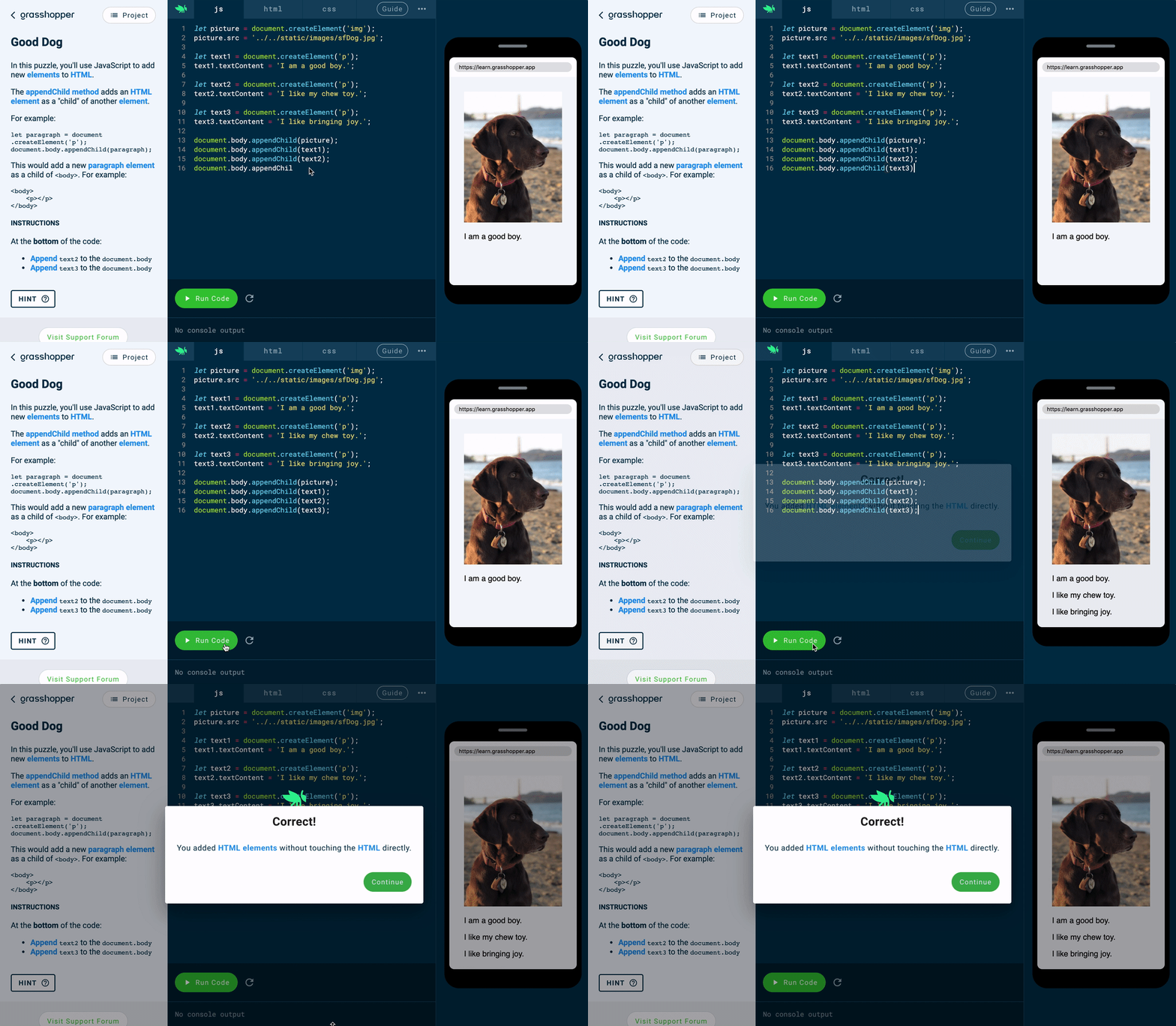
Google today announced that Grasshopper, its tool for teaching novices how to code, is now available on the desktop, too, in the form of a web-based app. Back in 2018, Grasshopper launched out of Area 120 as a mobile app for Android and iOS and since then, Google says, ‘millions’ have downloaded it.

A larger screen and access to a keyboard makes learning to code on the desktop significantly easier than on mobile. In the desktop app, for example, Google is able to put columns for the instructions, the code editor and the results next to each other.

ghop good dog v2

Google also today added two new classes to Grasshopper, in addition to the original ‘fundamentals’ class on basic topics like variables, operators and loops. The new classes are Using a Code Editor and Intro to Webpages, which teaches you more about HTML, CSS and JavaScript.

In case you are wondering why a “Using a Code Editor” class is useful, it’s worth noting that most of the coding experience in the first few courses is more about clicking short code snippets and putting them in the right order than typing out code by hand.

After completing all courses, users will be able to build a simple webpage and ready to take on more complex courses on other platforms like Codecademy, for example.

08 Oct 2019

Over 30 civil rights groups demand an end to Amazon Ring’s police partnerships

Over 30 civil rights organizations have penned an open letter that calls on government officials to investigate Amazon Ring’s business practices and end the company’s numerous police partnerships. The letter follows a report by The Washington Post in August that detailed how over 400 police forces across the U.S. have partnered with Ring to gain access to homeowners’ camera footage.

These partnerships have already raised concerns with privacy advocates and civil liberties organizations, who claim the agreements turn neighbors into informants and subject innocent people to greater risk and surveillance.

Had the government itself installed a video network of this size and scope, it would have drawn greater scrutiny. But by quietly working with Ring behind the scenes, law enforcement gets to tap into a massive surveillance network without being directly involved in its creation.

The new letter from the civil rights groups demand that government officials put an end to these behind-the-scenes deals between Amazon and the police.

“With no oversight and accountability, Amazon’s technology creates a seamless and easily automated experience for police to request and access footage without a warrant, and then store it indefinitely,” the letter reads. “In the absence of clear civil liberties and rights-protective policies to govern the technologies and the use of their data, once collected, stored footage can be used by law enforcement to conduct facial recognition searches, target protesters exercising their First Amendment rights, teenagers for minor drug possession, or shared with other agencies like ICE or the FBI,” it says.

Additionally, the letter points out these police deals involve Amazon coaching cops on how to obtain surveillance footage without a warrant. It also notes that Ring allowed employees to share unencrypted customer videos with each other, including in offices based in Ukraine. And it raises concerns about Amazon’s potential plans to integrate facial recognition features into Ring cameras, based on patents it filed.

The groups also point to the map released by Amazon Ring, which now shows over 500 cities with Amazon-police partnerships across the U.S.

The groups’ letter is not the first to demand action.

Senator Edward J. Markey (D-Mass.) also last month wrote to Amazon to get more information about Ring and its relationships with law enforcement agencies.

But unlike Sen. Markey’s investigative letter to Amazon’s Ring, today’s letter has specific demands for action. The groups are asking mayors and city council members to require their local police departments to cancel their Ring partnerships. The groups also want local government officials to pass new surveillance oversight ordinances that will ensure police departments can’t enter into any such partnerships in the future.

And they want Congress to investigate Ring’s dealings with police more closely.

The letter itself was published online and signed by the following organizations:

Fight for the Future, Media Justice, Color of Change, Secure Justice, Demand Progress, Defending Rights & Dissent, Muslim Justice League, X-Lab, Media Mobilizing Project, Restore The Fourth, Inc., Media Alliance, Youth Art & Self Empowerment Project, Center for Human Rights and Privacy, Oakland Privacy, Justice For Muslims Collective, The Black Alliance for Just Immigration (BAJI), Nation Digital Inclusion Alliance, Project On Government Oversight, OpenMedia, Council on American-Islamic Relations-SFBA, Million Hoodies Movement for Justice, Wellstone Democratic Renewal Club, MPower Change, Mijente, Access Humboldt, RAICES, National Immigration Law Center, The Tor Project, United Church of Christ, Office of Communication Inc., the Constitutional Alliance, RootsAction.org, CREDO Action, Presente.org, American-Arab Anti-Discrimination Committee, and United We Dream.

According to Evan Greer, Deputy Director at Fight for the Future, the letter has not yet been mailed. But the plan, going forward, is to use it in local organizing when groups on the ground make deliveries to local officials in cities where the partnerships are live.

“Amazon has created the perfect end-run around our democratic process by entering into for-profit surveillance partnerships with local police departments. Police departments have easy access to surveillance networks without oversight or accountability,” said Greer. “Amazon Ring’s customers provide the company with the footage needed to build their privately owned, nationwide surveillance dragnet. We’re the ones who pay the cost – as they violate our privacy rights and civil liberties. Our elected officials are supposed to protect us, both from abusive policing practices and corporate overreach. These partnerships are a clear case of both,” Greer added.

08 Oct 2019

Satya Nadella looks to the future with edge computing

Speaking today at the Microsoft Government Leaders Summit in Washington DC, Microsoft CEO Satya Nadella made the case for edge computing, even while pushing the Azure cloud as what he called “the world’s computer.”

While Amazon, Google and other competitors may have something to say about that, marketing hype aside, many companies are still in the midst of transitioning to the cloud. Nadella says the future of computing could actually be at the edge where computing is done locally before data is then transferred to the cloud for AI and machine learning purposes. What goes around, comes around.

But as Nadella sees it, this is not going to be about either edge or cloud. It’s going to be the two technologies working in tandem. “Now, all this is being driven by this new tech paradigm that we describe as the intelligent cloud and the intelligent edge,” he said today.

He said that to truly understand the impact the edge is going to have on computing, you have to look at research, which predicts there will be 50 billion connected devices in the world by 2030, a number even he finds astonishing. “I mean this is pretty stunning. We think about a billion Windows machines or a couple of billion smartphones. This is 50 billion [devices], and that’s the scope,” he said.

The key here is that these 50 billion devices, whether you call them edge devices or the Internet of Things, will be generating tons of data. That means you will have to develop entirely new ways of thinking about how all this flows together. “The capacity at the edge, that ubiquity is going to be transformative in how we think about computation in any business process of ours,” he said. As we generate ever-increasing amounts of data, whether we are talking about public sector kinds of use case, or any business need, it’s going to be the fuel for artificial intelligence, and he sees the sheer amount of that data driving new AI use cases.

“Of course when you have that rich computational fabric, one of the things that you can do is create this new asset, which is data and AI. There is not going to be a single application, a single experience that you are going to build, that is not going to be driven by AI, and that means you have to really have the ability to reason over large amounts of data to create that AI,” he said.

Nadella would be more than happy to have his audience take care of all that using Microsoft products, whether Azure compute, database, AI tools or edge computers like the Data Box Edge it introduced in 2018. While Nadella is probably right about the future of computing, all of this could apply to any cloud, not just Microsoft.

As computing shifts to the edge, it’s going to have a profound impact on the way we think about technology in general, but it’s probably not going to involve being tied to a single vendor, regardless of how comprehensive their offerings may be.

08 Oct 2019

Satya Nadella looks to the future with edge computing

Speaking today at the Microsoft Government Leaders Summit in Washington DC, Microsoft CEO Satya Nadella made the case for edge computing, even while pushing the Azure cloud as what he called “the world’s computer.”

While Amazon, Google and other competitors may have something to say about that, marketing hype aside, many companies are still in the midst of transitioning to the cloud. Nadella says the future of computing could actually be at the edge where computing is done locally before data is then transferred to the cloud for AI and machine learning purposes. What goes around, comes around.

But as Nadella sees it, this is not going to be about either edge or cloud. It’s going to be the two technologies working in tandem. “Now, all this is being driven by this new tech paradigm that we describe as the intelligent cloud and the intelligent edge,” he said today.

He said that to truly understand the impact the edge is going to have on computing, you have to look at research, which predicts there will be 50 billion connected devices in the world by 2030, a number even he finds astonishing. “I mean this is pretty stunning. We think about a billion Windows machines or a couple of billion smartphones. This is 50 billion [devices], and that’s the scope,” he said.

The key here is that these 50 billion devices, whether you call them edge devices or the Internet of Things, will be generating tons of data. That means you will have to develop entirely new ways of thinking about how all this flows together. “The capacity at the edge, that ubiquity is going to be transformative in how we think about computation in any business process of ours,” he said. As we generate ever-increasing amounts of data, whether we are talking about public sector kinds of use case, or any business need, it’s going to be the fuel for artificial intelligence, and he sees the sheer amount of that data driving new AI use cases.

“Of course when you have that rich computational fabric, one of the things that you can do is create this new asset, which is data and AI. There is not going to be a single application, a single experience that you are going to build, that is not going to be driven by AI, and that means you have to really have the ability to reason over large amounts of data to create that AI,” he said.

Nadella would be more than happy to have his audience take care of all that using Microsoft products, whether Azure compute, database, AI tools or edge computers like the Data Box Edge it introduced in 2018. While Nadella is probably right about the future of computing, all of this could apply to any cloud, not just Microsoft.

As computing shifts to the edge, it’s going to have a profound impact on the way we think about technology in general, but it’s probably not going to involve being tied to a single vendor, regardless of how comprehensive their offerings may be.

08 Oct 2019

Lawyers for former Tinder execs file to dismiss defamation lawsuit

Last week, former Tinder CEO Greg Blatt filed a defamation lawsuit against Sean Rad and Rosette Pambakian, who are part of a group of Tinder founders and former executives who accused Blatt (pictured above) of sexual harassment and assault as part of a broader suit.

Now Rad and Pambakian’s attorneys have filed their own motion to dismiss the suit, arguing that it “seeks to chill protected speech through costly litigation” — in other words, that it’s the kind of lawsuit prohibited under California’s anti-SLAPP law.

“This lawsuit is intended to muzzle Rosette and Sean from telling the truth about how [IAC chairman] Barry Diller and Greg Blatt stole from their employees and covered up sexual assault allegations,” said Rad and Pambakian’s attorney Orin Snyder in a statement. “Unfortunately, unlawful retaliatory lawsuits like this one designed to silence victims and violate their First Amendment rights are all too common in the #metoo era.”

In the filing, Rad and Pambakian’s attorneys also argued that Blatt filed the suit “solely to launch a public smear campaign against Pambakian and the person who reported the assault to Match, Sean Rad. At the same time, and now that Blatt’s public court filings have served his media objective, Blatt says that the complaint that he himself chose to file in court should actually be sent to private arbitration.”

In response, Blatt’s attorney Vineet Bhatia sent the following statement:

We fully expected this run-of-the-mill, procedural smoke screen to be made by Rad and Pambakian. These arguments are legally wrong and we expect to prevail in Court. The bottom line is, Rad and Pambakian conspired to defame Mr. Blatt and should be held responsible.

Both Blatt’s suit and the new filing seek to connect the case to the broader #metoo movement (which, as Snyder alluded to, has seen number of high-profile figures accused of sexual assault, and who then fought back through defamation lawsuits).

Blatt’s lawyers argued that “Rad and Pambakian have attempted to weaponize an important social movement, undermining the plight of true victims of sexual abuse by making false accusations in cynical pursuit of a $2 billion windfall.”

In contrast, Rad and Pambakian’s attorneys said the “ensuing crescendo of retaliation — reminiscent of many Hollywood #MeToo cases — included [Tinder’s parent company] Match circling the wagons around Blatt, publicly belittling Pambakian by chalking up the assault to ‘consensual cuddling,’ and firing her months later after she refused to sign an NDA.”

In a lawsuit filed in the summer of 2018, Rad (Tinder’s co-founder and former CEO), Pambakian (who was then the company’s vice president of marketing and communications), Rad’s fellow co-founders Justin Mateen and Jonathan Badeen and others sued Match and its controlling shareholder IAC, accusing them of manipulating financial data and removing Rad as CEO in order to create a “fake lowball valuation” and strip the founders and executives of their stock options.

The suit also accused Blatt — who served as an executive at IAC and as CEO of Match before replacing Rad as CEO of Tinder — of sexually harassing Pambakian at a company holiday party in 2016.

IAC and Match have called this suit meritless. And in Blatt’s defamation lawsuit, his attorneys said the encounter between Blatt and Pambakian at the holiday party was consensual and that Rad and Pambakian subsequently “conspired to make false allegations of sexual harassment and sexual assault against Blatt with the specific intent to damage Blatt’s good name, personal and professional reputation, and credibility.”

In a footnote, Rad and Pambakian’s attorney say that because they’re making a free speech argument, their motion to dismiss Blatt’s suit does not require the court to “delve into the facts.” However, they add:

Blatt’s false narrative — that this was consensual, and that Pambakian and Rad concocted the assault allegations to aid their valuation lawsuit — is patently false and offensive. The evidence shows that Blatt admitted being drunk at the holiday party, making inappropriate comments to Pambakian, and “snuggling and nuzzling” her in a hotel bed. It further shows that Blatt apologized to Pambakian the following week, and later offered to resign over his misconduct. These are not the actions of an innocent man, nor is it the first time Blatt has been accused of mistreating women in the workplace.

To back that up that up, the motion points to a Gawker article describing supposed harassment and verbal abuse by an unnamed “CEO of a major dating site” owned by a corporation “in a glass building on the far side of town” (subsequent coverage has suggested that the piece was about Blatt).

Pambakian subsequently withdrew from the initial suit due to an arbitration agreement, but is now suing Blatt and Match for wrongful termination and sexual assault.

You can read the full motion below.