Category: UNCATEGORIZED

03 Oct 2019

OzoneAI wants companies to pay you for your data, upending the ad model

Imagine this. Instead of giving away your personal data so web giants can show you ads, you cut out the middle person and allow advertisers to pay you directly for your data.

It’s a novel idea for a new startup that bills itself as a “data privacy” company.

OzoneAI says it preserves users’ privacy by allowing them more granular controls over who gets their data. In the startup’s utopian vision, companies can skip over the major advertising giants like Google and Facebook and buy access to anonymized data from the users themselves. That could mean companies buying your Spotify playlists, your Amazon wish list, or your access to your social media. The user is paid for the access, and the company gets to use the data for better targeting their ads.

The company made its public debut at Disrupt SF on the Startup Battlefield stage.

The startup seeks to capitalize on the wave in recent years of mistrust over online ads. As websites have become more aggressive in their advertising by persistently tracking users and collecting personal data, users have fought back with ad-blockers and privacy apps.

OzoneAI thinks there can be a happy medium between selling and protecting your data. With an app, users can grant companies access to their data and get paid for it. In return, companies get anonymized data which they can use for better targeting consumers.

By taking big tech out of the equation, the startup thinks it can make advertising more efficient for everyone.

But not everyone will see it that way. The privacy-minded with their ad blockers aren’t likely to lower their own bar to allow advertisers any more access to their data than is necessary. But for those who want to make a quick buck, will their actions be motivated more by making money and less about privacy?

When asked, the company’s founders Lyndon Oh and Ben Colman, who both previously worked for Google, denied it was encouraging users.

“However much activity you want to sell, that’s completely up to you,” the founders said. “You are anonymized as an identity; however, your data is not. The fact that you watched ‘The Avengers’ five times last week is not anonymized — you are selling that directly.”

Users’ data is fed into the machine learning engine to make recommendations for other companies and services, allowing the process to match activity to another business. OzoneAI makes its money by charging a 30% cut from the businesses who subscribe to a user’s data, which they say still provides better value than the “spray and pay” model that companies who want to advertise on Facebook and Google are subjected to.

The user can use the OzoneAI app to log in to their various social networks, shopping sites, email provider and anything else. That authorizes OzoneAI to vacuum up your data and begin processing it.

Unsurprisingly, many will turn their nose up at the concept of having a startup they’ve never heard of be effectively given unfettered access to all their online accounts so they can sell your data directly to companies hungry to advertise to you. The startup says it, like any company with similar access to the firehose of a person’s online life, has access to that data but immediately writes the data to its servers in an encrypted way. The user retains the private key to their cloud-stored encrypted data, so OzoneAI says it can’t access the user’s data. Through the app, the user can also “detonate” and destroy any of their collected data.

But by giving users control of their data, the user has to trust OzoneAI more than the existing advertising system. Given how broken the existing system is, it likely wouldn’t take much trust at all. But it’s an uphill battle for an emerging startup with not much of a name. And one hiccup could send that trust tanking.

The founders said other tech companies are “doing the same thing,” and that’s reason enough why users should trust OzoneAI.

But “another company does it” doesn’t mean it’s the right thing. OzoneAI was “just putting users directly in front of the business,” the founders said.

The old saying goes, “If you’re not paying, you are the product.” And yet as much as you are paying — with your data — then you inexplicably are still the product.
02 Oct 2019

OmniVis could save lives by detecting cholera-infected water in minutes rather than days

Clean drinking water is one of the most urgent needs in developing countries and disaster-stricken areas, but safety tests can take days — during which tainted water can infect thousands. OmniVis aims to make detection of cholera and other pathogens as quick, simple, and cheap as a pregnancy test. Its smartphone-powered detection platform could save thousands of lives.

OmniVis, which presented on stage at Disrupt SF’s Startup Battlefield today, emerged from research conducted at Purdue University, where CEO and co-founder Katherine Clayton completed her doctorate. She and her advisors were working on the question of using microfluidics, basically very close inspection of the behavior of fluids, to detect cholera bacteria in water.

In case you forgot your Infectious Diseases 101, cholera is a bacterium that thrives in water polluted by fecal matter. When ingested it multiplies and causes severe diarrhea and dehydration — which as you might imagine can become a life-threatening problem if a community is short on clean water.

While normally uncommon, there was a huge cholera outbreak in Haiti in 2010 following a major earthquake there; 665,000 people were infected and more than 8,000 people died. It was this humanitarian disaster that prompted Clayton to look into how such an event might have been prevented. She’s been working on what would become the OmniVis platform since 2013.

“It’s been a long time coming,” she told me.

That’s not uncommon for academic spin-offs with valuable IP but zero product experience. Moving from lab bench to field-ready hardware has taken years of hard work. But the resulting device could upend a costly and slow water testing process that leaves communities at risk in crucial moments.

omnivis lab

Existing water testing is generally done at a central location, a lab run by a university, utility, or the local government. It depends on the region — and of course if there has been a disaster, it may not even be functional. Going from sample collection to results may take several days, and it isn’t cheap, either. Clayton estimated it at $100 per sample.

“But that’s just supplies and labor,” she said. “Not the cost of the lab, the PCR machines — which are tens of thousands of dollars — the pipettes, the dyes, the disposables and consumables, the training… not to mention in a lot of areas you’re not just going to walk by a nice central laboratory. Some countries may only have one or two testing facilities.”

Another option is disposable rapid diagnostic tests, more like pregnancy tests than anything, meant for use with stool samples — but their accuracy is low even then, and with cholera diluted in a water source you may as well be flipping a coin.

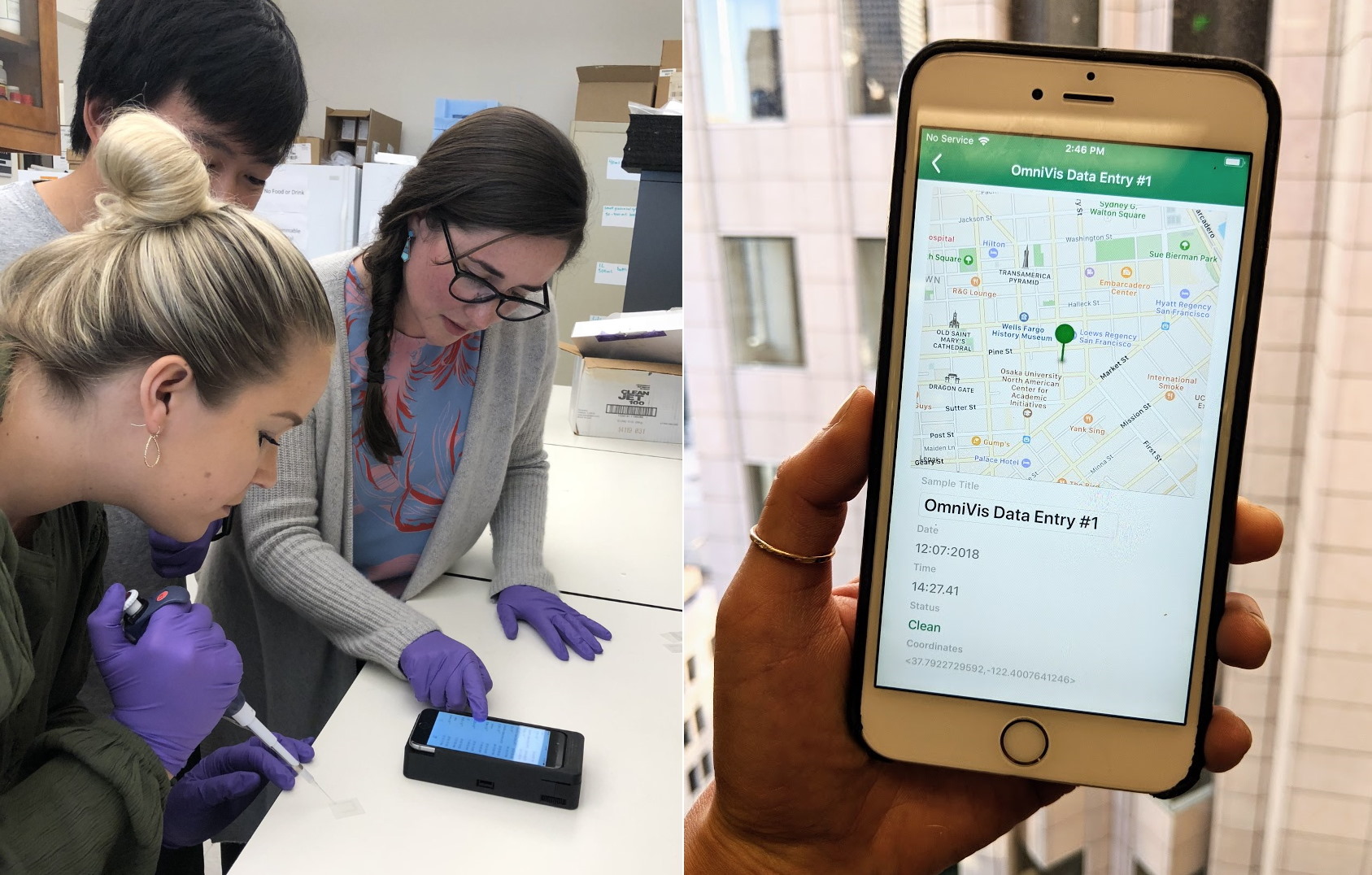
Such was the state of testing when Haiti had its outbreak and Clayton began looking into it. In 2013 they began investigating microfluidics as a method for detection. It works by exposing a set of chemical reagents, or “primers,” to a water sample. These primers are engineered to bind to bits of cholera’s DNA and then when heated, replicate it — a process called DNA amplification.

[gallery ids="1889722,1889720,1889721,1891113,1891110,1891105"]

The more cholera is present, the more DNA will be available to amplify, and it multiplies to the point where it affects the viscosity of the water — a factor that can be tested by the device. Interestingly, the device in no way “analyzes” the DNA or identifies it; all it does is measure how viscous the water is, which is a highly reliable proxy for how much cholera was present in it to begin with.

It turns out this method is both quick and accurate: In 30 minutes it gives as good or better results as central testing.

“The worst thing we could ever do is say there’s no cholera in the water when there is,” Clayton said. So they’re focused on robust test results over all else. But ultimately the device still had to go from the lab to the real world. To that end the team conducted pilot tests in Haiti, where they worked with local NGOs and communities to get some direct feedback.

What they found was promising — but also resulted in major changes to the product. For one thing, they had to switch from iPhone to Android.

“People feel safer with Android than iPhone, which is considered a luxury item,” Clayton said. They also found that men and women operated the system equally well — the team is 84 percent women, she noted, and their design choices may have crept into the product the same as can happen on what is much more common, a male-dominated team. English and Svengali users likewise did fine. Interestingly, locals were baffled by roman numerals. “That was surprising,” she said, but illustrative of how even the smallest assumptions need to be questioned.

“I love user-centered design,” Clayton said. “I think it’s the only way to get engineering to work. UX and graphic design is not my or my colleagues’ specialty, so we had to get some outside contractors for that.”

The production device, which OmniVis hopes to ship in about six months, should cost around a thousand dollars — but at about $10 per test it will pay for itself quickly, especially considering how much easily it can be deployed and used. A half-hour turnaround on a test that can be performed by an aid worker with an hour’s training is an invaluable tool in a disaster-stricken area where infrastructure like mail and roads may be in disorder.

These devices, by the way, are not bought and paid for by the people who drink the water. Like the water-testing labs, they’ll be owned and operated by NGOs, governments and others with budgets for this kind of thing.

Cholera is the first pathogen the company is aiming to detect, but the system can just as easily detect several others simply by using different disposable tests equipped with different primers. E. Coli could be next — with the proper testing, Clayton said. And others would follow. It’s not hard to imagine an OmniVis device being a must-have for any relief work where water needs to be tested.

02 Oct 2019

Samsung pulls the plug on Chinese smartphone production

Samsung this morning confirmed with Reuters that it has shuttered handset production in China. The move comes as the company continues to struggle in the world’s No. 1 smartphone market.

As we noted in a deeper dive into China’s smartphone sales back in August, the Korean hardware giant has struggled to maintain a market share in the low single digits. It’s not alone, of course; Apple, too, has faced an uphill effort to crack the market, which is dominated by homegrown names, including Huawei, Vivo, Oppo and Xiaomi.

Sales have been driven by a combination of pricing and, in the case of embattled Huawei, patriotic purchasing decisions.

Samsung has slowly phased out production in the country over the past year, suspending operations in some plants, before ultimately pulling the plug altogether. The news follows a similar move by Sony. Apple, meanwhile, is maintaining its production in the country for now.

More recently, Samsung has looked to others countries, including India and Vietnam, which have undercut China’s production costs. The company will, however, continue selling phones in China, even as it eyes other cheaper locations for manufacturing.

02 Oct 2019

Chris Dixon from A16Z announces free crypto startup school at TechCrunch Disrupt

Chris Dixon, a general partner at Andreessen Horowitz, announced a new crypto-related startup school at TechCrunch Disrupt today in San Francisco.

Dixon says that the firm is not looking for equity, but really wants to provide a way to teach some best practices in the emerging field of crypto currency. “We are going to run a startup school for crypto-specific startups and what we’ve learned over the last 7 years as best practices in this category,” Dixon told TechCrunch’s Josh Constine on stage today.

The company doesn’t intend to charge any money, nor will it take any equity in the companies that participate. In Dixon’s words, they are doing this to push the category forward and help crypto startups get going. He hopes that based on the good will of offering this education for free, that startups who participate may end up having a conversation with A16Z about possibly getting an investment, but he made clear that this absolutely was not a requirement.

Last year, the firm made its commitment to crypto clear when it established a crypto fund run by Katie Haun. Dixon told TechCrunch at the time of that announcement that his firm had already invested in 20 crypto companies over the previous five years including Ripple and Coinbase way back in 2013, prior to establishing a fund devoted to crypto.

The company will be setting up a page on the company website for companies interested in signing up for the crypto startup schoole.

02 Oct 2019

Will Smith just dropped $10K on a startup that pitched him on Disrupt’s stage

Actor and Hollywood media mogul Will Smith surprised the TechCrunch Disrupt SF 2019 audience this afternoon by announcing he would invest $10K in a startup that pitched to him on stage as part of “elevator pitch” contest, where the winner would get to take a selfie with the star. The company, Socionado.com, helps companies with their social media presence. However, what got Smith’s attention was their well-delivered pitch, he said.

The startups didn’t get much time to prepare, having been plucked from the Startup Alley earlier in the day.

In addition to responding well to the pitch itself, Smith also liked the concept and the business model.

“As I built out my social media team, that was the idea — I wanted to take back my storytelling,” said Smith. “I think that’s hugely important.”

“That was really the best pitch so we’re gonna rock a selfie,” Smith said, jumping up to snap a photo with the founder.

Smith’s investment strategy isn’t usually this off-the-cuff, however.

Speaking on stage at the Disrupt conference, he also offered more details on his plans for Dreamers VC, the investment firm founded with Japanese soccer star, Keisuke Honda, which was announced last year by Honda’s management firm KSK Group.

Smith noted the firm has an interest in “doing good” with its funds — pointing, in particular, to an investment in “Boring tech.” (He actually means The Boring Company, per the Dreamers VC website, where it’s listed alongside a host of others.)

He also offered a little background on how Dreamers VC came to be in the first place.

“Well, you know, I met with [Keisuke Honda]  and we just hit it off immediately. And, you know, we felt like there was a beautiful intersection between being able to create businesses, but also to stay focused on solving problems of the world,” Smith explained. Honda already had banking relationships in Japan that were looking to make their way into the U.S.

“So the relationship worked out well,” he said.

Plus, Smith adds, “I had already been investing and he had already been in investing and our values were were in alignment. We want to solve some of the world’s problems. We want to do well by doing good.”

02 Oct 2019

Render announces object storage service at TechCrunch Disrupt

It was a big day for startup Render, which participated in the TechCrunch Disrupt Startup Battlefield today. While it was at it, it also announced some upgrades to its managed cloud platform.

First of all, it announced the ability to spin up object storage in the cloud, while greatly simplifying the tasks associated with adding storage. CEO and founder Anurag Goel says that the storage option is something customers have been requesting, and as with their other services, they handle a lot of the heavy lifting for them.

“One of the things that our users want us to do next is to build out object storage. Even though they can use things like Amazon S3 and other cloud storage options, they know that Render is going to be easier for them to use. So they really want object storage, and they want everything in one place,” Goel explained.

If you want to do that today without Render, you would have to spin up a virtual machine in the cloud, attach the storage, set up backup schedules and take care of all of these other associated tasks, and what Render is doing with Render Disk, is stripping that all away and managing the process for them.

While the startup was at it, it also developed a concept called infrastructure as code. This allows developers to define their infrastructure requirements in a yaml file. When the developer sends the file to GitHub, Render can build the infrastructure for the customer on the fly based on the contents of this file.

Finally, they are offering a one-click launch to customers. This could come in handy for companies who are offering free trials or open source tools, to enable users to launch their applications with a single click from GitHub and it will load all of the required files.

02 Oct 2019

Brex wants to replace startup bank accounts with Brex Cash

Brex, a Silicon Valley fintech darling, has lofty plans to battle big banks —and Stripe.

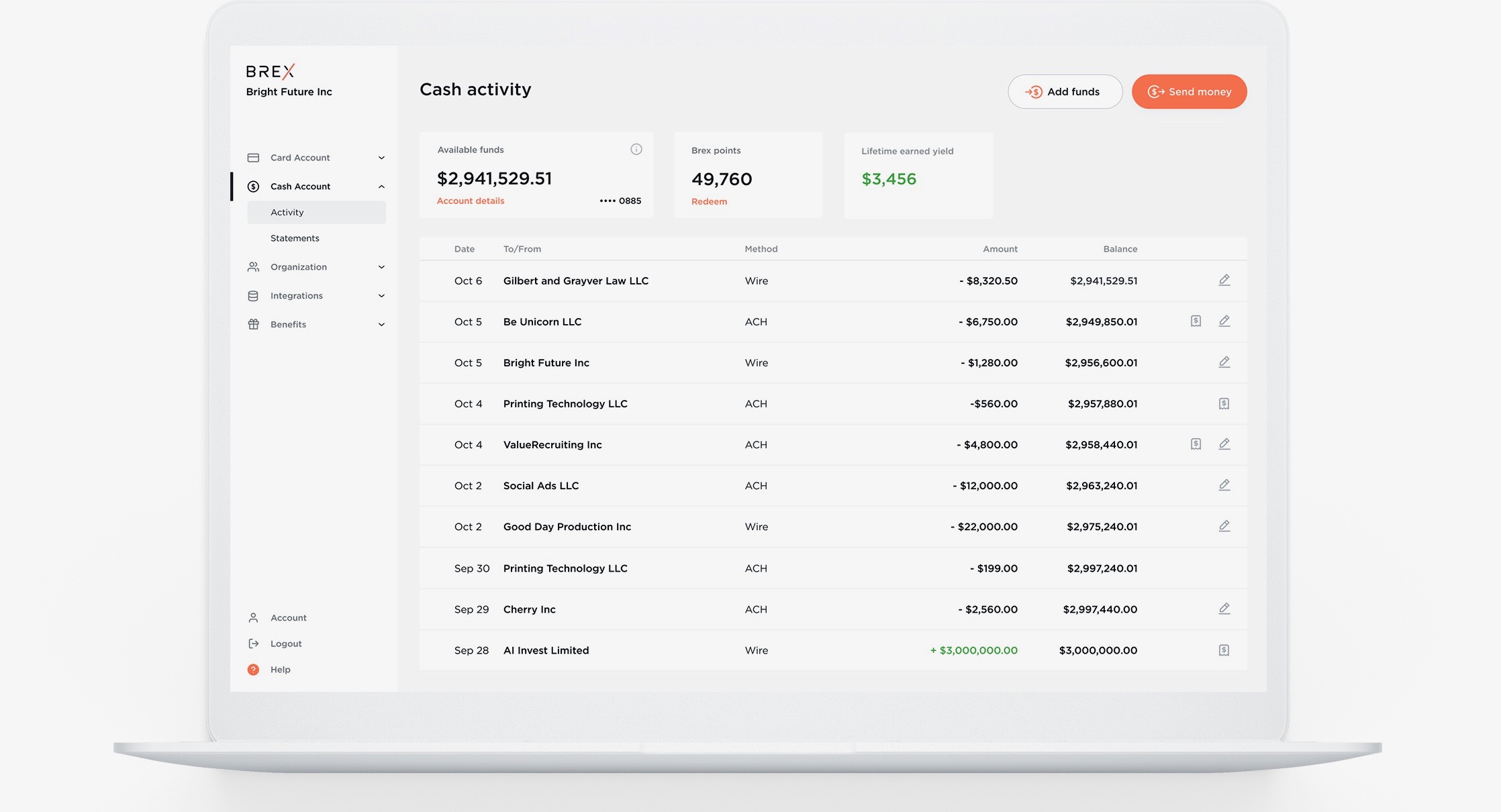
Code-named “Gemini,” Brex today announced a new product designed to replace and improve the functionality of traditional bank accounts. Brex Cash, as it will be known publicly, is a business cash management account integrated with the Brex Card, a corporate card for startups launched in 2018.

Brex tells us they’ve built the core banking infrastructure from scratch, allowing the company to forgo third-party processing fees and provide a much-needed tech infusion to antiquated banking systems. In partnership with Boston’s Radius Bank, Brex Cash will allow customers to send payments quickly and easily with no fees attached. Rather, Brex plans to reward its users for making or receiving payments using Brex Cash with points redeemable for cash back, travel and air miles. Customers will also receive 1.6% interest on deposits.

It’s not a bank, but in practice, it can replace a bank, says Brex co-founder and co-chief executive officer Henrique Dubugras .

“Our idea is that new businesses —the new Y Combinator companies we hope a big percent of them never open a bank account,” Dubugras tells TechCrunch.

Brex now has many similarities to a bank. What differentiates it is its lack of physical branches — it’s exclusively digital — and it’s insurance. Traditional banks are insured by the Federal Deposit Insurance Corporation (FDIC), which protects up to $250,000 per depositor. Brex Cash is backed by the Securities Investor Protection Corporation (SIPC), a nonprofit agency overseen by the U.S. Securities and Exchange Commission that insures up to $500,000 and specializes in protecting customers of brokerage firms from the loss of cash and securities.

We think we’ve won a lot of credibility. Before, who was going to give their money to a random-ass startup called Brex? -Brex co-CEO Henrique Dubugras

Additionally, Brex invests its customers’ money in a money market mutual fund of U.S. treasury bonds. “If Brex goes out of business, customers’ money will be safe,” the company writes in a press statement. “The only scenario where money could be lost is if the U.S. government defaults.”

macbook white final

Brex Cash user interface

“It’s not that we are inventing this — this model exists with Fidelity,” says Dubugras. “Fidelity isn’t necessarily a bank — we are bringing that concept to businesses to give lower fees, better interest rates, better experiences and more security.”

Brex, a graduate of the winter 2017 Y Combinator cohort, has quickly become a Silicon Valley success story for the ages. The rapid adoption of its startup credit card, which doesn’t require a personal guarantee, and its ability to issue cards instantly and provide higher limits than other options on the market has attracted thousands of customers and venture capitalists. The business, led by a pair of young Brazilian repeat entrepreneurs, including Dubugras and co-CEO Pedro Franceschi, has collected more than $300 million in equity funding, including a $100 million C-2 financing that valued the company at $2.6 billion earlier this year.

“There will always be customers that are skeptical, but I think by starting out with a card, we built a lot of trust,” Dubugras said. “It was us giving them money instead of them giving us money. A few years in … We think we’ve won a lot of credibility. Before, who was going to give their money to a random-ass startup called Brex?”

In the weeks ahead of TechCrunch Disrupt San Francisco, where Dubugras announced Brex Cash on Wednesday, the CEO told TechCrunch that Brex had no immediate fundraising plans and that they were “waiting for the right time” to raise again. As for what’s next, he said the company is discussing the launch of a debit card and plans to add another 100 employees in the next year, bringing the Brex headcount to 400.

The Brex news follows the launch of Stripe Capital, a new offering from payments behemoth Stripe that will make instant loan offers to customers on its platform, and the announcement of the Stripe Corporate Card. Akin to Brex, Stripe will issue a no-fee, no interest rate credit card intended for Stripe customers. Brex and Stripe, two Y Combinator grads, will go head-to-head in a battle for customers, particularly YC grads looking for friendly financial tools.

Immediately following Stripe’s announcements, the business announced a $250 million funding at a $35 billion valuation. Brex may be following a similar playbook, announcing a major product on the heels of a large capital infusion.

Brex Cash represents a new era for the company. Though the product may be costly for Brex, it opens the business up to thousands more potential customers. Now, any startup, regardless of funding, can create a Brex account to store cash, explains Dubugras, and all companies using Brex Cash will be immediately issued a Brex corporate credit card.

“If you’re starting out, if you don’t have funding yet, you can still receive your payments using Brex,” Dubugras said. “That’s a super big deal for us.”

Brex Cash was built under product lead Ritik Malhotra, who joined the team as part of an acquisition of his startup, Elph. Brex poached the company, which was focused on blockchain infrastructure, right out of YC for an undisclosed amount. In retrospect, the deal looks much more like an acqui-hire of Malhotra, who had the digital payments infrastructure acumen necessary to complete this project.

“It’s an easy way to move money, which is the lifeblood of a business,” Malhotra tells TechCrunch of the new product.

Brex Cash is itself not a cash cow for Brex; rather, the startup makes money on purchases made on its corporate card, in which it charges the merchant, not the customer. This model is particularly beneficial when its customers are spending a lot of money, growing quickly and raising capital. In a downturn, however, this model isn’t as attractive.

Brex seems unconcerned with the possibility of an impending recession. Brex writes that even in downturns, entrepreneurs will start companies and attempt to raise money. The Brex Cash product, regardless of the economy, will help Brex better underwrite Brex Cards, as it gives them better access to a customer’s financial health.

In a battle against Stripe, Brex is at a disadvantage. At only two years old, the company may have garnered a lot of credibility in a short time but it doesn’t have the decade of experience building fintech products that Stripe has and, more importantly, it doesn’t have 10 years of customer loyalty.

02 Oct 2019

Tesla delivers a record 97,000 electric vehicles in third quarter

Tesla said Wednesday it delivered a record 97,000 electric vehicles in the third quarter, a nearly 2% increase from the previous period, but still short of analysts’ expectations.

Tesla shares fell nearly 6% in after market trading on the news.

The company reported Wednesday that it produced 96,155 vehicles in the third quarter, a 10% increase from the previous period. Tesla has shown steady improvement in its production numbers over the past several quarters. Tesla produced 86,555 vehicles in the fourth quarter of 2018 and then dropped to 77,100 in the first period of the year. Numbers rebounded to 87,048 vehicles in the second quarter of 2019.

Analysts expected Tesla to deliver 99,000 vehicles during the third quarter, according to estimates compiled by FactSet.

Despite hitting record numbers and showing the ability to push production higher, the numbers still weren’t able to meet CEO Elon Musk’s lofty targets. Musk had said in a leaked email that the company could produce 100,000 vehicles in the third quarter.

Tesla said Wednesday it received record net orders in the third quarter and are entering the fourth quarter with an increase in its order backlog. Tesla added that nearly of its Model 3 orders were received from customers who did not hold a reservation.

Here’s a look back at the past several quarters of deliveries.

Tesla delivered 95,200 vehicles in the second quarter, a dramatic pop from the company’s first quarter delivery numbers when it reported deliveries of 63,000 vehicles, nearly a one-third drop from the previous period. The low first-quarter delivery numbers signaled what was to come: wider-than-expected loss of $702 million driven by disappointing delivery numbers, costs and pricing adjustments to its vehicles.

02 Oct 2019

Mutiny creates personalized plans for B2B marketing

Mutiny, a personalized marketing startup for businesses that sell to other businesses, is taking the stage today at TechCrunch’s Startup Battlefield, where it’s announcing new funding and new features.

CEO Jaleh Rezaei told me that she and co-founder Nikhil Mathew created Mutiny to solve a problem they saw as early employees at HR services company Gusto — trying to personalize their messages to different sales prospects.

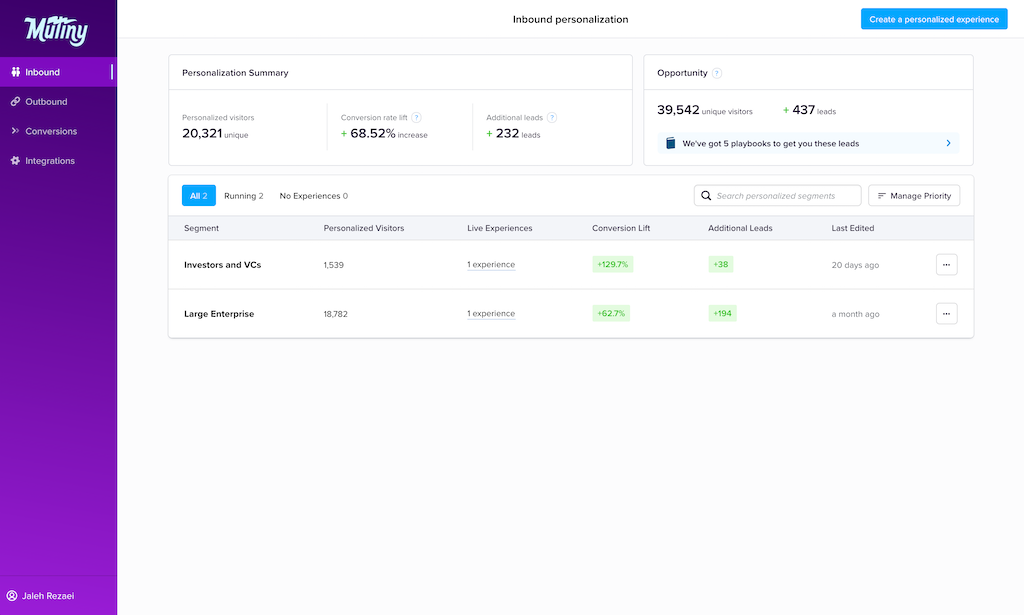
With Mutiny, they’ve built easy-to-use tools allowing marketers to show different landing pages to different customers. To do this, the product draws on pre-built data integrations to identify customer segments, then allows customers to use a visual editor to build different versions of landing pages for those segments.

“When we think about the B2B journey, it has changed quite a bit,” Rezaei said. “Today, 67% of that B2B buyer’s journey is online. Without engineering, it’s really hard to change that journey and have an impact. What’s exciting about Mutiny is we empower these great marketers to improve their customer experience without that constant dependence on technical teams.”

Mutiny was part of the Summer 2018 class at accelerator Y Combinator. Rezaei said that shortly after demo day, the startup raised $3 million in funding from Cowboy Ventures, Uncork Capital and various angel investors.

It’s since added features to support targeted, account-based marketing. Rezaei said Mutiny pulls account data from Salesforce, cleaning it up and surfacing it, so that when a prospective customer responds to your marketing, they could end up on a landing page showing their own name, title and company.

Mutiny dashboard

For example, Brex is creating landing pages for its email marketing campaigns, where each page shows the recipient’s name and company; Gusto is tailoring landing pages based on the AdWords search terms that brought a prospective customer to that page; and Amplitude is customizing landing pages based on company size and other attributes.

As a result, Mutiny says Brex has seen a 200% lift in outbound leads, while Amplitude has increased all inbound leads by more than 40%. (Other customers include Segment, Carta, TripActions and Elastic.) 

Today, Mutiny is also announcing that it will offer personalized recommendations to marketers. So if all these ideas are new to you, the product can recommend specific customer segments that you should consider personalizing for based on things like your traffic data and conversion data.

Mutiny can also create entire “playbooks,” recommending not just the segment to personalize, but what that personalized experience should look like for that segment.

“The goal of Mutiny is always to make personalization really easy and really guided,” Rezaei said.

02 Oct 2019

Render challenges the cloud’s biggest vendors with cheaper, managed infrastructure

Render, a participant in the TechCrunch Disrupt SF Startup Battlefield, has a big idea. It wants to take on the world’s biggest cloud vendors by offering developers a cheaper alternative that also removes a lot of the complexity around managing cloud infrastructure.

Render’s goal is to help developers, especially those in smaller companies, who don’t have large DevOps teams, to still take advantage of modern development approaches in the cloud. “We are focused on being the easiest and most flexible provider for teams to run any application in the cloud,” CEO and founder Anurag Goel explained.

He says that one of the biggest pain points for developers and startups, even fairly large startups, is that they have to build up a lot of DevOps expertise when they run applications in the cloud. “That means they are going to hire extremely expensive DevOps engineers or consultants to build out the infrastructure on AWS,” he said. Even after they set up the cloud infrastructure, and move applications there, he points out that there is ongoing maintenance around patching, security and identity access management. “Render abstracts all of that away, and automates all of it,” Goel said.

It’s not easy competing with the big players on scale, but he says so far they have been doing pretty well, and plan to move much of their operations to bare metal servers, which he believes will help stabilize costs further.

“Longer term, we have a lot of ideas [about how to reduce our costs], and the simplest thing we can do is to switch to bare metal to reduce our costs pretty much instantly.” He says the way they have built Render will make that easier to do. The plan now is to start moving their services to bare metal in the fourth quarter this year.

Even though the company only launched in April, it is already seeing great traction. “The response has been great. We’re now doing over 100 million HTTP requests every week. And we have thousands of developers and startups and everyone from people doing small hobby projects to even a major presidential campaign,” he said.

Although he couldn’t share the candidate’s name, he said they were using Render for everything including their infrastructure for hosting their web site and their back-end administration. “Basically all of their cloud infrastructure is on Render,” he said.

Render has raised a $2.2 million seed round and is continuing to add services to the product, including several new services it will announce this week around storage, infrastructure as code and one-click deployment.