Category: UNCATEGORIZED

02 Oct 2019

Blue Origin’s passengers will pay hundreds of thousands of dollars for a ticket on New Shepard

After committing to having a first crewed launch of its rocket ship in 2019, Blue Origin, the rocket manufacturer and launch services company backed by Jeff Bezos, is likely going to have to push that timeline back to 2020.

Speaking onstage at TechCrunch Disrupt San Francisco, Blue Origin chief executive Bob Smith said that the window for getting the crewed flight done within the 2019 timeframe was narrowing. “We’re not going to be date driven,” Smith said.

But as commercial launches come to market, customers can expect to pay “hundreds of thousands of dollars” for a ticket on the New Shepard suborbital flight.

Blue Origin isn’t the only commercial space company looking to conduct a crewed launch before the end of the year. In June, NASA set a timeline to get crewed launches from Boeing and SpaceX in September and November, respectively.

In an August statement, SpaceX said it was still planning on getting astronauts to the International Space Station later this year.

Blue Origin is still moving ahead with its planned launches and the near-term setback is something that likely won’t make much of a dent in a company backed by the world’s richest man — and one who’s strategy and vision extends on a global timeframe.

For Blue Origin’s chief executive (and its financial backer) the company’s ultimate goal is to ensure that humanity is an extra-planetary species — something that will take decades to achieve.

What Smith and others are sure of is the commercial viability of the space industry.

“Launch volume is going up and has been going up for quite a while,” says Smith.  According to the Blue Origin founder, launch volumes in the space industry have been increasing at 3% per-year and some market analysts have predicted that number could rise to 50% to 80% per-year. 

And those numbers don’t include the mega-constellations that companies like Facebook, Alphabet, and Amazon are all hoping to bring to orbit.

“The launch volume is really looking very attractive over the next ten years,” Smith says. And that’s transforming the space industry, which for decades had been dominated by government customers. “It is fundamentally shifting to a more commercial model,” says Smith. 


02 Oct 2019

YouTube Music is launching three personalized playlists

YouTube Music is preparing to better challenge Spotify and others with the launch of three new personalized playlists, Discover Mix, New Release Mix, and Your Mix, said YouTube Chief Product Officer Neal Mohan, in an on-stage interview this morning at TechCrunch Disrupt SF 2019.

Discover Mix, YouTube Music’s version of Spotify’s Discover Weekly, had already been spotted in the wild back in September. But it wasn’t yet broadly available. The other two hadn’t yet launched.

“Our YouTube Music app has been out now for a couple of years, we’ve launched the YouTube Premium service and the app and now 71 different countries,” noted Mohan. “And as we’ve rolled it out, we’ve gotten lots of feedback from our users about what they’d love to see,” he continued. And one of the things that they tell us repeatedly is, they love the fact that, through a combination of things like machine learning and human beings that are music lovers, we put all this great music in front of our users in the YouTube Music app,” he said.

According to Mohan, the Discover Mix will focus on helping users uncover new artists and music they might like, including tracks from artists you’ve never listened to before as well as lesser-known tracks from artists you already love.

The playlist takes advantage of your historical listening data on YouTube Music and on YouTube, he said.

New Release Mix, meanwhile, is YouTube Music’s version of Spotify’s Your Release Radar, and features the most recent release from your favorite artists.

Finally, Your Mix is a playlist that combines the music you love with songs you haven’t heard yet but will probably like, based on your listening habits.

The mixes will be updated weekly, and will be made available to all users worldwide where they’ll be found on the “Mixed for You” shelf on the home screen, or by searching in the app.

All three will launch sometime later this month, but YouTube doesn’t have an exact date.

The additions arrive at a time when Google is preparing to transition its Google Play Music users over to YouTube Music, which makes it a much bigger threat to existing music streaming services, including Spotify, Apple Music, Amazon Music, Pandora and others.

While YouTube Music hasn’t yet replaced Play Music entirely or shut the older app down, it did just make YouTube Music the default music app that ships with new Android devices just last week, instead of Google Play Music.


02 Oct 2019

Actor-turned-HitRecord founder Joseph Gordon-Levitt says we should all get off YouTube

Actor-turned-entrepreneur Joseph Gordon-Levitt, best known for roles in “3rd Rock from the Sun,” “Inception,” “Snowden” and, “10 Things I Hate About You,” came to TechCrunch Disrupt SF 2019 this morning to talk about his startup, collaborative media platform HitRecord. Specifically, he addressed how HitRecord differs from other platforms for creators. In doing so, he also called out the YouTube business model as problematic and something we should all get away from. 

The comments around YouTube followed a discussion of some of the criticism HitRecord’s platform has faced — namely, that it doesn’t offer high enough payouts or a way for creatives to make a living.

Since 2010, it has only paid out some $3 million dollars to its creators.

Gordon-Levitt said that HitRecord doesn’t emphasize that you’ll gain entry into the creative industry by using its platform, nor does it market itself as something you can turn into a full-time job, like YouTube often promises.

In fact, he found the YouTube model an issue for the industry and society as a whole.

Joseph Gordon-Levitt speaks with Jordan Crook at TechCrunch Disrupt 2019 on October 2, 2019.

Joseph Gordon-Levitt speaks with Jordan Crook at TechCrunch Disrupt 2019 on October 2, 2019.

He said that making art shouldn’t be about the money or external validation — such as likes and subscribers.

“What I have experienced in my life is actually what brings me a lot of joy and happiness about the creative process is not the red carpets. It’s not the box office. It’s not those kinds of external validators. It’s the ‘doing it,’ it’s when I get to actually do the art, and especially do it with other people,” explained Gordon-Levitt.

Of course, he has the comfort of his own Hollywood success to fall back on, when new creators entering the industry don’t.

Asked what he thought of YouTube’s model as well as Instagram’s, Gordon-Levitt had some harsh words.

“Do you think that YouTube and Instagram are a net positive or negative for humans’ creativity?” asked TechCrunch editor Jordan Crook.

He responded quickly that they were a net negative.

Joseph Gordon-Levitt speaks with Jordan Crook at TechCrunch Disrupt 2019 on October 2, 2019.

Joseph Gordon-Levitt speaks with Jordan Crook at TechCrunch Disrupt 2019 on October 2, 2019.

“There’s tons of incredible stuff, beautiful communities form all kinds of creative human expression. It’s not to say that it’s all bad, but I do think that in general the basic business model of: we’re going to offer a quote-unquote ‘free service’ in exchange for the right to conduct mass surveillance, and then apply these incredibly expensive sophisticated machine learning algorithms to this massive data set to optimize for — not the benefit of the users, not what’s going to make the users more creative or more informed or more compassionate or anything — but optimize instead for the agenda of these third-party advertisers; I think that’s a basic business model that we all as the world should get off entirely,” he said.

“We shouldn’t be monetizing software, or businesses that way,” he added.

The audience at TechCrunch Disrupt cheered.

As an alternative to these services, Gordon-Levitt promoted the Netflix model as something that works.

There’s a direct billing relationship with the customer, he said, and the data collected is designed to give you more of want you like to watch.

Similarly, HitRecord aims to use data for better purposes.

“I’m all for using data to accomplish a goal that the user has signed up for,” Gordon-Levitt said. “It’s when the user is being subjected to these algorithms not in their interest, but in the interest of some third-party behind the curtain, that’s I think where you get into danger.”


02 Oct 2019

How Lime, Scoot, JUMP and Spin plan to deploy adaptive scooters

As part of San Francisco’s program to operate shared electric scooters in the city, it’s requiring providers to pilot adaptive scooters to ensure people with disabilities are not left out from this new form of transportation. Companies are expected to deploy these adaptive scooters within the first three months of the permit, which begins this month.

Last week, the San Francisco Municipal Transportation Agency granted electric scooter permits to Uber-owned JUMP, Lime, Bird-owned Scoot and Ford-owned Spin. As part of their applications, each provider outlined its planned approach to developing adaptive scooters. We dig into the key details of their applications below.

02 Oct 2019

Flir purchases IP and assets from defunct drone company, Aria

Back in March, Aria Insights suddenly went dark. The news was a bit of a surprise from a startup that had just announced a name change and pivot in tech focus. Today, thermal imaging company Flir announced that it has acquired the intellectual property and some operating assets from the former company.

Flir, best known for its thermal imaging cameras, has become increasingly invested in the drone category, including some high-profile partnerships with some of the industry’s biggest players like DJI and Parrot.

“Tethered UAS systems are becoming a more valuable tool for force protection, border security, and critical infrastructure protection,” Flir’s David Ray said in a release announcing the news. “Aria’s innovative technology and IP assets will enable us to enhance current capabilities and advance the range of solutions we can deliver to customers in this growing market segment.”

The acquisition follows another high-profile purchase by the company, which picked up iRobot military spin-off Endeavor Robotics, back in March. Aria Insights has strong iRobot connections, as well. The startup was founded in 2008 as CyPhy Works by iRobot co-founder, Helen Greiner. After Greiner left, however, the former drone hardware company pivoted to data collection, a matter of months before shutting down.

“We’re pleased to complete the sale of our assets to Flir Systems,” former Aria Insights CEO Lance VandenBrook said in a release. “We are proud of the technology our team developed through the operations of CyPhy Works and Aria, and we believe Flir offers the best opportunity to see it make a difference and support critical missions in the years ahead.”

02 Oct 2019

Snaplogic raises $72M more for its enterprise data integration platform

Cloud services and the adoption of apps that rely on them are continue to grow in popularity, but a persistent theme in enterprise technology has been that a lot of organizations still continue to use legacy software and architectures, for reasons of cost, migration headaches and simply because sometimes, if it ain’t broke, don’t fix it. That doesn’t mean they couldn’t benefit from a better way of integrating some of those workflows, and better leveraging the data coming out of those different apps, and today a startup that’s built a service to help them do that has raised a growth round of funding.

Snaplogic, which has built an integration platform that lets enterprises bring in and integrate both legacy and cloud apps to better monitor them and let them work together, has closed $72 million in growth financing, money that it will be using to expand its business globally. According to analysis from PitchBook, this latest funding comes at a $260 million pre-money valuation, which would work out to about $372 million post-money. We are checking with Snaplogic to see if it can confirm those numbers directly.

This latest round, which brings the total raised by Snaplogic to $208 million, is being led by growth equity VC Arrowroot Capital, with participation also from Golub Capital and existing investors. Past investors are an illustrious group that has included a mix of financial and strategic backers such as Andreessen Horowitz, Vitruvian (which led its previous round), Capital One, Ignition Parnters, Microsoft, and a number of others.

The company is not disclosing how big its customer base is currently. In its last round in 2016, it had grown to 700 enterprises, adding 300 in just one year, which was an especially big amount of growth. Current customers feature a number of big names like Adobe, Verizon (which owns TechCrunch), AstraZeneca, Bristol-Myers Squibb, Emirates, Schneider Electric, Siemens, Sony, and Wendy’s. It describes the bigger integration market as a $30 billion opportunity.

The defining characteristic in that list is that these are businesses that pre-date the big cloud revolution, and so they are more likely than not grappling with a mix of new and legacy apps that need to be balanced against one another, brought together in some instances to work together, and harnessed in terms of their data to help in a company’s wider efforts around big data for projects in areas like application integration, data integration, API management, B2B integration and data engineering.

“This is an exciting time for SnapLogic,” said Gaurav Dhillon, CEO at SnapLogic, in a statement. “We’re extremely proud to have built a modern and innovative solution that is solving really hard problems for our enterprise customers. This latest investment is a testament to the hard work and ongoing support of our customers, partners, and employees around the world. Together, we’ll continue to chart the way forward, making integration even faster and easier so enterprises can realize their data-driven ambitions.”

There has been an interesting wave of startups that have emerged specifically to tackle the opportunity of providing  tools to businesses that are still using old kit and older software to give them the ability to take advantage of new innovations in computing and how to use their bigger pool of data. Others include Workato (which itself has raised money in the last year), MuleSoft (now a part of Salesforce), and Microsoft itself, and in that context, Snaplogic has been taking a very measured approach in how it raises capital and expands.

“Our approach is to do successive up rounds with straightforward terms rather than chase a big slug with onerous terms,” CEO Guarav Dhillon told TechCrunch once. He’s a repeat entrepreneur and has a track record of conservative but sound growth. “We built Informatica with just $13.5 million, so my approach is to raise funds as needed.”

It’s an approach that is resonating with investors. “SnapLogic is attacking a huge and surging market opportunity with a uniquely modern and powerful platform,” said Matthew Safaii, Founder and Managing Partner at Arrowroot Capital, in a statement. “They’ve built an amazing product, work with an impressive roster of customers, and are led by an experienced executive team. As SnapLogic sets its sights on continued product leadership and global expansion, we look forward to partnering with them to help get their pioneering integration platform into the hands of even more enterprises around the globe.”

“SnapLogic is reinventing application and data integration for the modern era,” said Robert Sverbilov, Director at Golub Capital, added. “We are excited to support SnapLogic’s next generation SaaS application integration platform and to help secure its footing as a leader in the iPaaS (Integration Platform as a Service) vertical.”


 

02 Oct 2019

India’s Udaan raises $585M to expand its B2B e-commerce platform

Udaan, a three-year-old business-to-business e-commerce platform in India, has raised more than half a billion dollars as it looks to bring more kirana stores, chemists, and other small businesses online through its marketplace.

The startup said today it has raised $585 million from Tencent, Altimeter, Footpath Ventures, Hillhouse, GGV Capital and Citi Ventures. Existing investors Lightspeed Venture Partners, which wrote its first check to the startup back in 2016, and DST Global also invested in the round.

The new round valued the startup between $2.3 billion to $2.7 billion, a person familiar with the matter told TechCrunch. Co-founders of Udaan, which reached the unicorn status in the shortest period of time among Indian startups, declined to comment on the valuation.

Udaan operates an eponymous B2B marketplace where it connects buyers and sellers. The platform supports a wide-range of categories from lifestyle, electronics, home and kitchen, staples, toys, to fruits and vegetables.

Udaan also offers a credit line to provide working capital to buyers and sellers on its platform, thereby addressing one of the biggest challenges faced by small and micro businesses and merchants in the nation, said Vaibhav Gupta, a co-founder of Udaan, in an interview with TechCrunch.

The startup has amassed more than 3 million retailers from 900 cities and towns in India. Today, a wide range of merchants, including farmers, shopkeeper owners, restaurants, chemists, and street vendors are connected to Udaan.

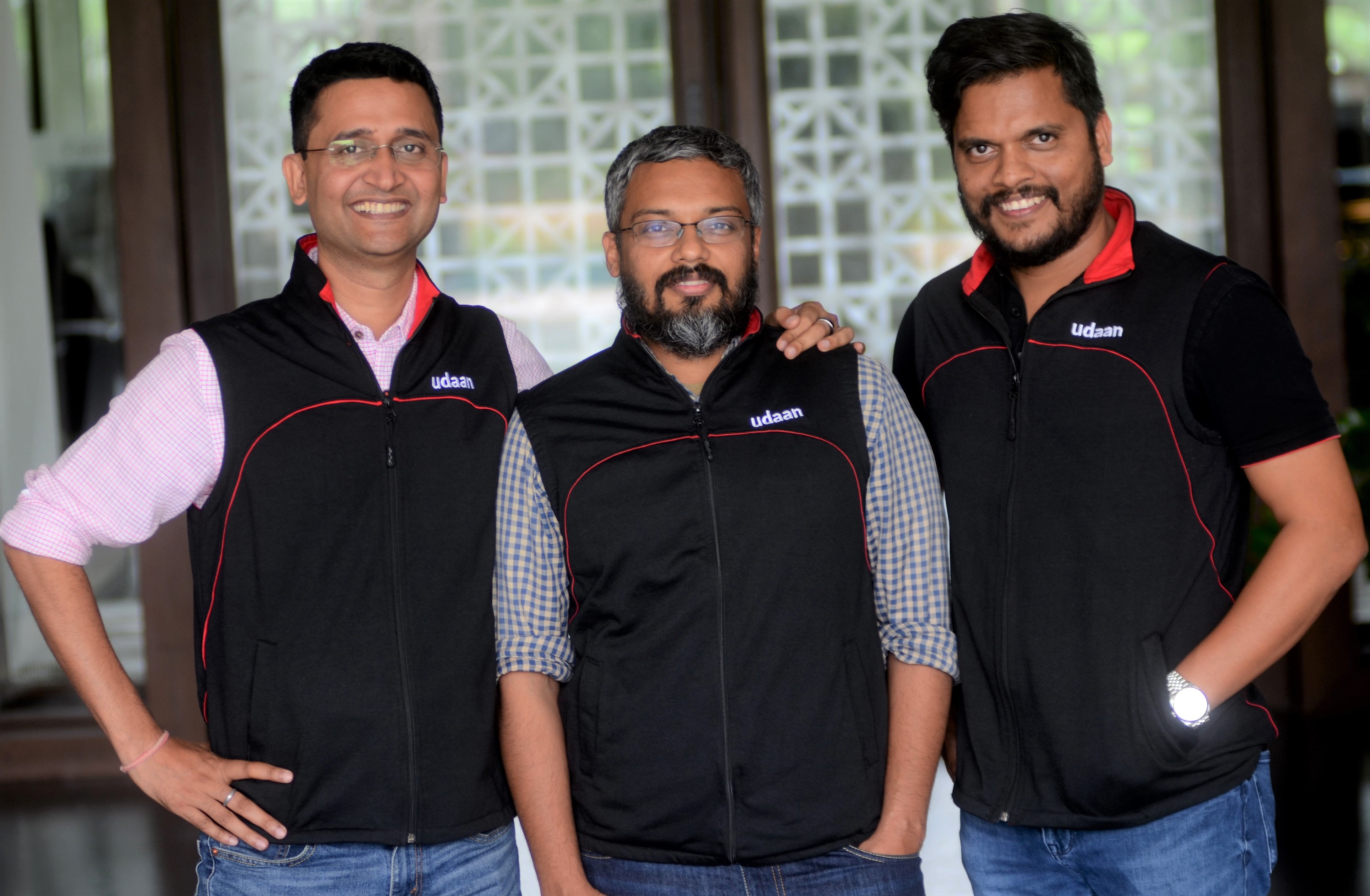
L R Amod Malviya Vaibhav Gupta Sujeet Kumar Co founders Udaan

From left-to-right: Amod-Malviya, Vaibhav Gupta, and Sujeet Kumar, co-founders of Udaan

Sujeet Kumar, another co-founder of Udaan, said the startup will use the fresh capital to expand its footprint in the nation and focus on growing the marketplace in both existing and new categories.

Even as more than half a billion people in India are online today, most businesses in the nation remain offline. But a growing cohort of startups in the nation is beginning to help merchants make use of technology.

Amazon and Walmart have invested billions of dollars to create business-to-commerce marketplaces in India, but e-commerce still accounts for just 3% of the overall retail market in the country.

Their mightiest rivals remain mom and pop stores that dot tens of thousands of villages, cities, towns, and slums of India. In recent years, many Silicon Valley companies have also started to address these businesses. Google has launched tools to help these mom and pop stores set up their online presence, and last month, it launched a business app of Google Pay to help these merchants accept online payments.

That’s the opportunity that drove Vaibhav, Sujeet, and Amod Malviya — the third co-founder — to leave their jobs at e-commerce platform Flipkart and build a platform to serve small businesses in the nation.

“The market opportunity is turning out to be much deeper than we envisioned when Lightspeed led the company’s Series A financing in 2016 and we’re excited to continue supporting the company while welcoming a strong syndicate of new investors,” said Bejul Somaia, a partner at Lightspeed Venture Partners .

In a statement, Martin Lau, President of Tencent, said, “Udaan’s unique approach can enhance the capabilities of millions of retail stores across India. It represents a powerful example of how technology can empower the business of small merchants, improve the efficiency of industries and bring benefits to consumers.”

More to follow…

02 Oct 2019

T2D3 Software Update: Embracing the Founder to CEO (F2C) Journey

It’s been four years since TechCrunch published my blog post The SaaS Adventure, which introduced the concept of a “T2D3” roadmap to help SaaS companies scale — and, as an aside, explored how well my mom understood my job as an “adventure capitalist.” The piece detailed seven distinct stages that enterprise cloud startups must navigate to achieve $100 million in annualized revenue. Specifically, the post encouraged companies to “triple, triple, double, double, double” their revenue as they hit certain milestones.

I was blown away by the response to the piece and gratified that so many founders and investors found the T2D3 framework helpful. Looking back now, I think a lot of the advice has stood the test of time. But plenty has also changed in the broader tech and software markets since 2015, and I wanted to update this advice for founders of hyper-growth companies in light of the market shifts that have occurred.

Perhaps the most notable change in the last four years is that the number of playbooks for companies to follow as they sell software has expanded. Today, more companies are embracing product-led growth and a less-formal, bottoms-up model — employees are swiping credit cards to buy a product, and not necessarily interacting with a human salesperson.

Many of the most high-profile, recent software IPOs structure their go-to-market operations this way. T2D3’s stages, by contrast, focus quite a bit on scaling a company’s internal sales function to grow. Indeed, both a product-led and a sales-led approach are viable in today’s growing B2B-tech market.

What’s more, the revenue needed for a software company to go public has increased dramatically in the last four years. This means that software founders need to focus not only on building a scalable product and finding scalable go-to-market channels, but also building a scalable org chart. These days, what is scarce for software founders isn’t money from investors; it’s great human talent.

So in addition to T2D3, my firm and I are now focusing on another founder journey: F2C, or the transition from founder/CEO to CEO/founder. This journey can take many paths, but ideally it starts with the traditional hustle to find early product/market fit.

02 Oct 2019

Watch Disrupt SF 2019 Day 1 Live right here

It’s that time of year again.

Disrupt has descended upon San Francisco, with thousands of founders, investors and technophiles pouring into the Moscone Center.

We’ll kick off the day with a fireside chat with Blue Origin’s Bob Smith on the Main Stage and a panel on how to build a billion-dollar SaaS company with Neeraj Agrawal (Battery Ventures), Jyoti Bansal (Harness) and Whitney Bouck (HelloSign).

Other speakers from Day 1 include Joseph Gordon-Levitt, Aaron Levie, Jennifer Tejada, YouTube’s Neal Mohan and Will Smith and Ang Lee.

Then, we’ll head into the Disrupt Battlefield, where 20 companies will launch their wares on the Main Stage in front of a panel of expert judges with the hopes of winning the Disrupt Cup, $100,000 and eternal glory.

It’s going to be an amazing day and we’re more than pleased to bring it to you live right here.

View the agenda right here.
Enjoy!

02 Oct 2019

Coinbase users will earn rewards on USDC holdings

Cryptocurrency exchange Coinbase wants to foster USDC adoption by letting you earn rewards when you keep USDC on your Coinbase account. Essentially, if you’re a U.S. customer, your Coinbase account has become an uninsured savings account with a 1.25% APY rewards rate.

If you’re not familiar with USDC, it’s a stablecoin backed by CENTRE, a consortium of companies working in the cryptocurrency space. 1 USDC is worth exactly 1 USD, and CENTRE members save USD in regular bank accounts whenever they issue USDC tokens. CENTRE members currently hold over $1 billion in reserve bank accounts as they have issued over 1 billion USDC.

In addition to price stability, stablecoins work just like any other ERC-20 tokens. You can hold them in a cryptocurrency wallet, you can send and receive them, you can exchange them.

When you want to buy some bitcoins on Coinbase, users usually transfer some money to their accounts and then convert USD into BTC. And yet, transferring money to a Coinbase account can take days, which means you could miss out on some big price changes.

Conversely, if you’re selling some bitcoins on Coinbase, chances are you exchanged those BTC into USD and then transferred your USD balance to your bank account. If you want to buy some bitcoins again in the future, you’ll have to go through the same lengthy process.

Coinbase’s pitch is simple: Whenever you’re converting your crypto assets and you end up with USD, just leave them on the platform as USDC.

You don’t have to do anything to accept USDC rewards as eligible Coinbase users will automatically start earning rewards starting now. If you currently hold USDC, you’ll notice that you have some “rewards pending”.

Coinbase calculates rewards in real time, which means that you’ll earn rewards even if you hold a large sum of USDC for a few hours and then transfer everything. But your Coinbase account is credited with rewards only once a month.

For now, the APY rewards rate is 1.25%, but Coinbase can change that rate in the future. It’s also worth noting that your Coinbase wallet is not insured by the Federal Deposit Insurance Corporation (FDIC) or the Securities Investor Protection Corporation (SIPC).​

Don’t put all your savings on Coinbase, as you could lose everything in case you get phished. Coinbase won’t be responsible.

So who’s eligible exactly? For now, the feature is limited to U.S. customers who don’t live in Hawaii or the State of New York. You have to verify your account (level 2) and you have to hold at least 1 USDC.

If you earn over $600 in USDC rewards in a single year, Coinbase will send you a 1099-MISC form so that you can report your earnings with the IRS.