Category: UNCATEGORIZED

01 Oct 2019

NASA awards $43.2M to Blue Origin, SpaceX and others for tech to take us to the Moon and Mars

NASA has announced the total funding it will distribute to the 14 companies it’s chosen to work with on developing key, innovative technologies that will be instrumental in helping get the agency to the Moon through the Artemis program, and potential to Mars and beyond later on.

The U.S. space agency is awarding $43.2 million to the companies, in varying amounts ranging from $1.3 million to as much as $10 million (going to Blue Origin) for the most lucrative contract.

NASA announced a similar series of partnerships selected to further its Moon shot program back in July, which also included SpaceX and Blue Origin. This new “Tipping Point” partnership program round includes Blue Origin, as mentioned, as well as SpaceX, OxEon Energy, Skyre, SpaceX, Infinity Fuel Cell and Hydrogen, Paragon Space, TallannQuest, Accion Systems, CU Aerospace, ExoTerra, Blue Canyon Technologies, Astrobotic Technology, Intuitive Machines and Luna Innovations.

It includes projects that range from developing autonomous navigation for satellites, better propulsion systems, rover tech, advanced spacecraft avionics, cryogenic propellant and more.

Blue Origin will be using its $10 million to develop a ground-based demonstration of liquefying hydrogen and oxygen, and storing the resulting liquid. This will demonstrate the viability of producing and storing liquid rocket propellant on the Moon, and will be a key stepping down towards the development of a Moon-based propellant production plant.

Meanwhile, SpaceX will be working with NASA Marshall in Huntsville, Alabama to build nozzles that will be used in spacecraft refuelling operations. This tech will be crucial to SpaceX’s Starship, which Elon Musk said on Saturday will need to refuel ship-to-space tanker in orbit in order to load in enough propellant post Earth-based launch to make the rest of the trip to the Moon and Mars. NASA awarded SpaceX $3 million to support this project.

Astrobotic is working with Carnegie Mellon University with a $2 million investment from NASA in order to develop and build small rovers that can carry light payloads and work in tandem with large landers. These would act like advance scouts to work on researching and readying landing and base sites on the Moon. The concept illustration above depicts one of these proposed rover designs.

For the full list of projects, and the amount award to each, check out the official NASA announcement of the ‘Tipping Point’ partnerships.

01 Oct 2019

Where top VCs are investing in edtech

Education is a $4 trillion market globally in urgent need of overall — so where within education are top venture capitalists optimistic about startups building large businesses by providing new solutions?

According to EdSurge, $1.45 billion of venture capital (a mere 1.1% of the $130 billion in US venture funding) was invested in education startups in the US in 2018; there were only 112 education-focused deals. In line with the trend in venture capital overall, this represented an increase in overall capital but a concentration in fewer deals (mainly large late-stage rounds).

Education is regarded as a tough market for achieving VC scale returns. Selling into school districts and universities is difficult and slow, and freemium models that go direct-to-teachers have struggled to monetize.

New software, content, and financing solutions for learning outside the traditional school system are more compelling business opportunities. This is particularly the case in vocational training where the return on investment of an educational program or tool can be quantitatively measured in job offers and salary increases

I asked four leading edtech VCs and six of the top generalist VCs (who have a track record of education investments) to share where they see opportunity in this sector:

  • Jennifer Carolan, Reach Capital
  • Amit Mukherjee, NEA
  • Michael Staton, Learn Capital
  • Annie Kadavy, Redpoint Ventures
  • Aydin Senkut, Felicis Ventures
  • Matt Greenfield, Rethink Education
  • Hemant Taneja, General Catalyst Partners
  • Marlon Nichols, MaC Venture Capital
  • Jan Lynn-Matern, Emerge Education
  • Charles Birnbaum, Bessemer Venture Partner

Here are their answers…

GettyImages 925988314

Image via Getty Images / doyata

Jennifer Carolan, General Partner at Reach Capital (an education-focused VC firm in Palo Alto with investments including Abl, BetterLesson, Epic!, Handshake, Holberton School, Newsela, Outschool, and Tinkergarten):

“Human-centered learning has been traditionally limited to one’s physical geography but technology is unlocking learning opportunities that never before existed.  We’re particularly interested in the marketplaces that are better matching supply and demand across experiential learning, educator coaching, tutoring, and online small groups.

01 Oct 2019

The future of sports tech: Here’s where investors are placing their bets

Sports have always been the ultimate unifier — transcending geographic borders, rising above partisan politics and enabling multiple audiences (and generations) to find alignment — the little-known secret behind this global unifier? Technology.

Technology influences how athletes train and compete, how fans engage and consume content and how world-class venues are constructed. Technology has been quietly transforming the world of sports for years, with investment in areas like esports continuing to rise, surpassing a total of $2.5 billion in VC funding in 2018 — and some estimates predicting the sports tech sector will reach $30 billion by 2024.

With the 2020 Tokyo Olympics less than a year away, a massive amount of investment and innovation are pouring into the sports technology industry ahead of this globally unifying event. But which technologies are making the biggest impact? Where are investors placing their bets? Which sports are at the forefront of the technology revolution and which factors are holding the industry back?

In an attempt to pull the curtain back on the sports tech industry, we conducted a survey, The Current State of Sports Technology, of industry experts, including investors, founders and professionals from teams, leagues and media properties, to answer these very questions. Below you’ll find some key takeaways from our findings, pointing to the areas we believe the industry is headed in the year to come.

Fan engagement technologies, including live streaming and esports, are set to make the largest impact on sports in the next 12 months

When asked about which technologies would make the biggest impact on the sports industry in the next 12 months, an overwhelming 78% selected fan engagement technologies, such as live streaming, esports and content platforms, compared to technologies related to athlete performance (16%) and stadium experience (6%). Respondents also believe that this will hold true for the upcoming 2020 Olympic Games in Tokyo.
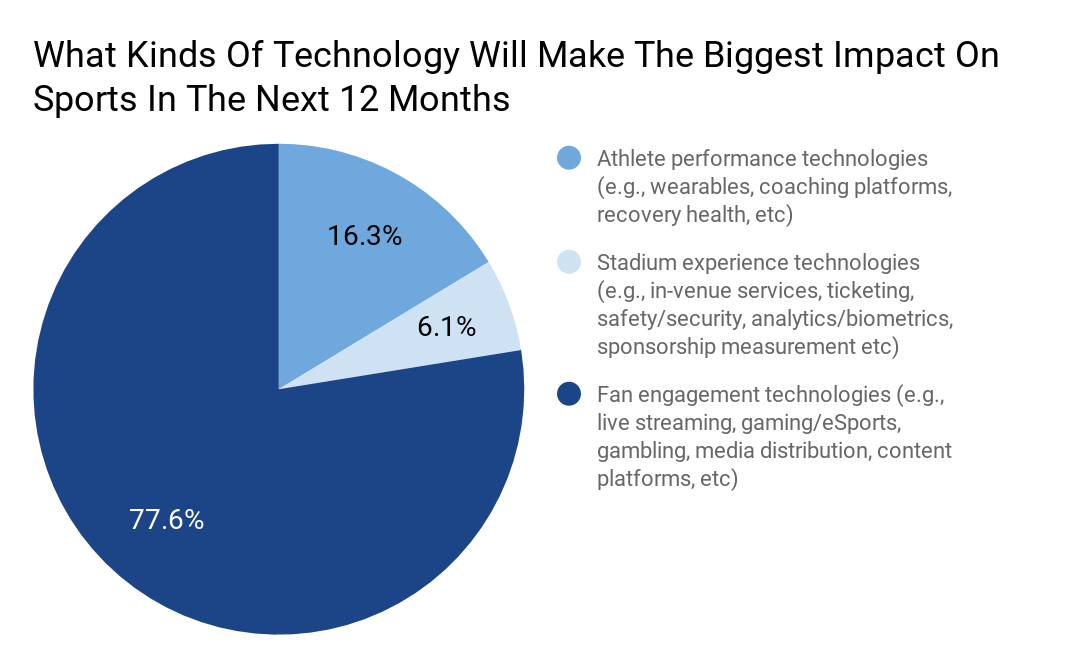
image002

“Anticipating the next fan engagement trend is critical, whether you’re a team, brand or media company,” says Tom Masterman, global head of Publisher Sales at Genius Sports Media, a leading provider of sports data and technology solutions. “Tokyo 2020 will be a make-or-break event for startups as well as incumbent technologies.”

Having worked on two Olympics at previous digital media companies, Masterman is aware of how quickly the Games come and go. “Among the questions that will keep many of us up at night include, ‘Will fans adopt my tech? Is my sponsorship integration a good experience? Did I choose the right channel partners?’ ”

Top three technologies for investment: Media and content-related platforms; measurement platforms for data, analytics and biometrics; and esports
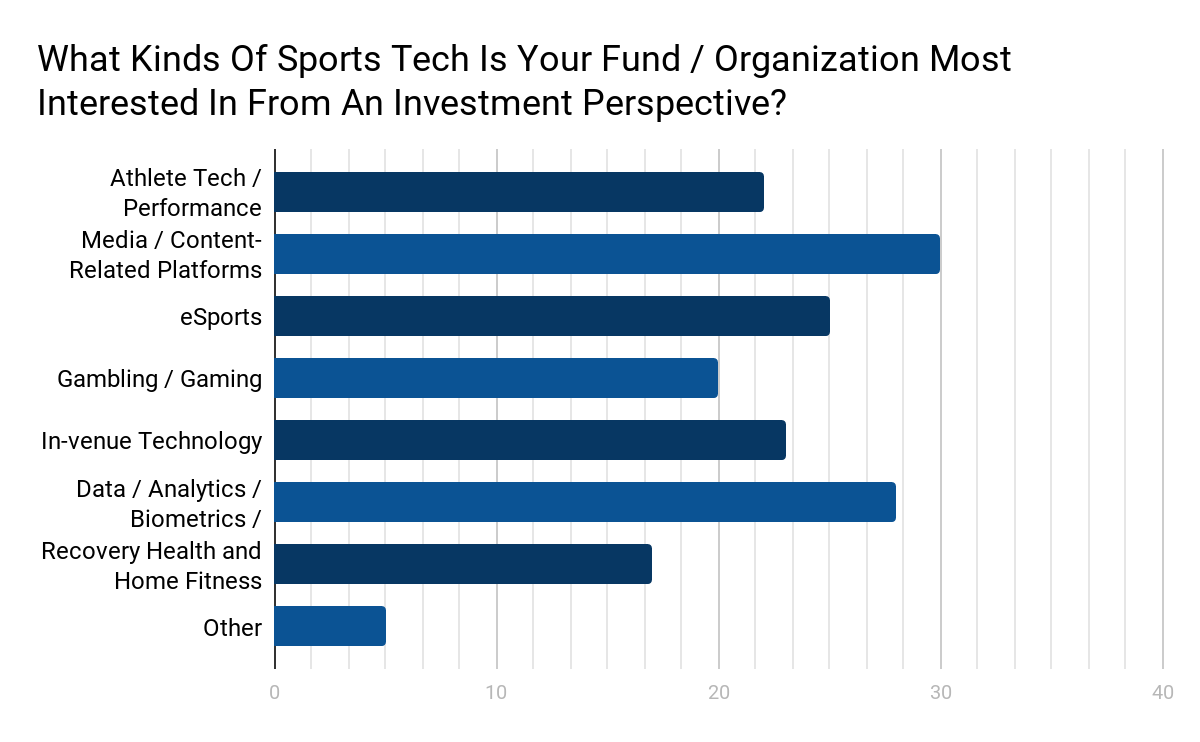
image003

From an investment perspective, media and content-related platforms, esports and measurement platforms for data, analytics and biometrics were among the top three areas of interest. Other notable areas include athlete tech and performance optimization, in-venue technology, gambling and gaming and recovery health and home fitness. This is a powerful indication of where venture capital funding focus is trending, given that more than 50% of respondents, coming from a wide array of areas in the industry, identified themselves as investors.

“As investors, we see cyclicality in every industry except sports, which has the biggest consumer ecosystem. Sports had been a very traditional industry powered by legacy tech, but now with the advent of streaming, sports content media distribution is decentralized via social media platforms,” says Gayatri Sarkar, managing partner at Hype Capital, who offered her take on this investment trend. “The sports market has the opportunity to be a multitrillion-dollar ecosystem with technological advances such as 5G, digital collectible trading and the rise of esports, which will fuel new market and social behavior. As the infusion of deep tech continues in smart venue, gambling, performance biometrics and many more sub verticals where data is the engine, we’ll naturally see more and more deep tech investors entering the sports investment landscape.”

Basketball and esports are at the forefront of technology

While esports is a likely leader in the use of technology, with 79% of respondents placing it in the top three category, basketball remains the top pick, with 87% placing the traditional sport at the forefront of innovation.
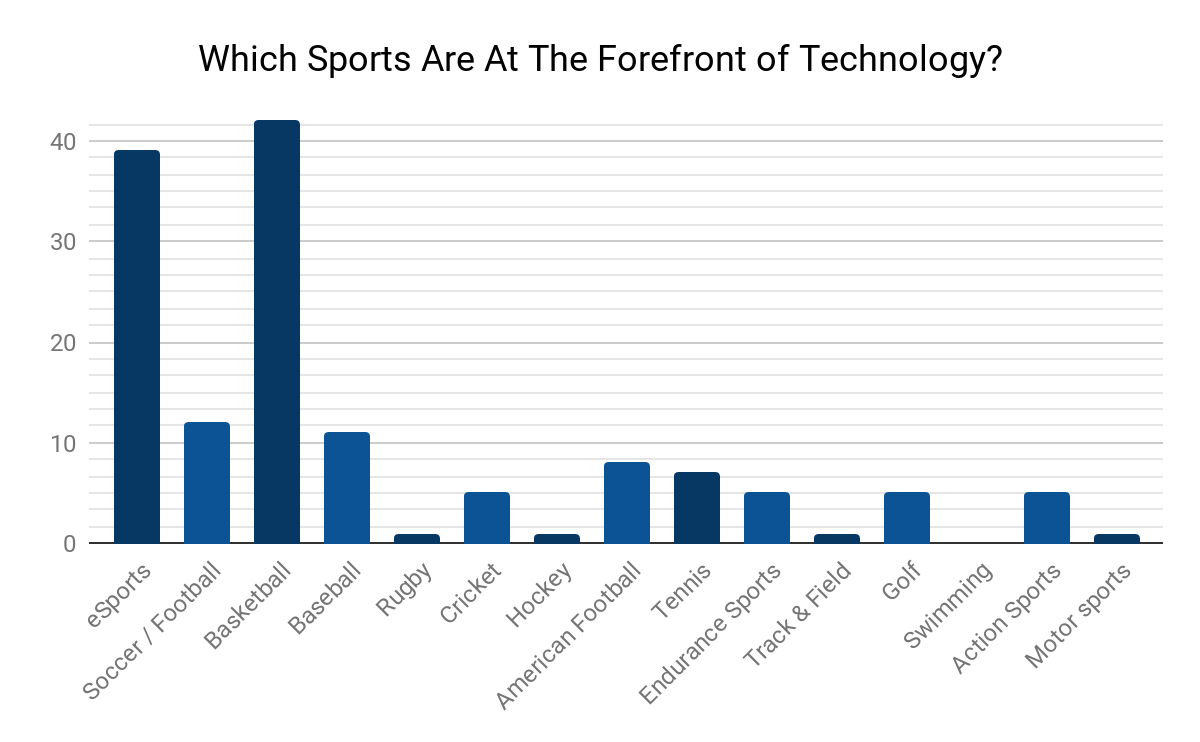
image004

As a former NBA-er*, this comes as no big surprise. The league has always been known as a thought-leader in technology and innovation, and their dominance is what is driving the sport’s tech-savvy DNA on a global level.

When talking to Tom Hunt, EVP, Business Operations at the Sacramento Kings about his take on innovation in the NBA, he placed technology as a top priority. Golden 1 Center is one of the most technologically advanced and connected indoor arenas in the world, and serves as our 21st Century communal fireplace,” said Hunt. “We’ve been at the forefront of leveraging technologies such as AI, AR, blockchain and esports (Kings Guard Gaming/NBA 2K) to deepen connections to our brands while customizing and personalizing frictionless fan experiences remains core to our mission.”

That being said, I’d make a bet that baseball-related technology will catch up very quickly. We’ve seen several startups currently working with baseball clubs — enhancing everything from a player’s cognitive reactions to the ways in which your food is delivered to you at ballparks.

What’s holding back sports tech adoption?
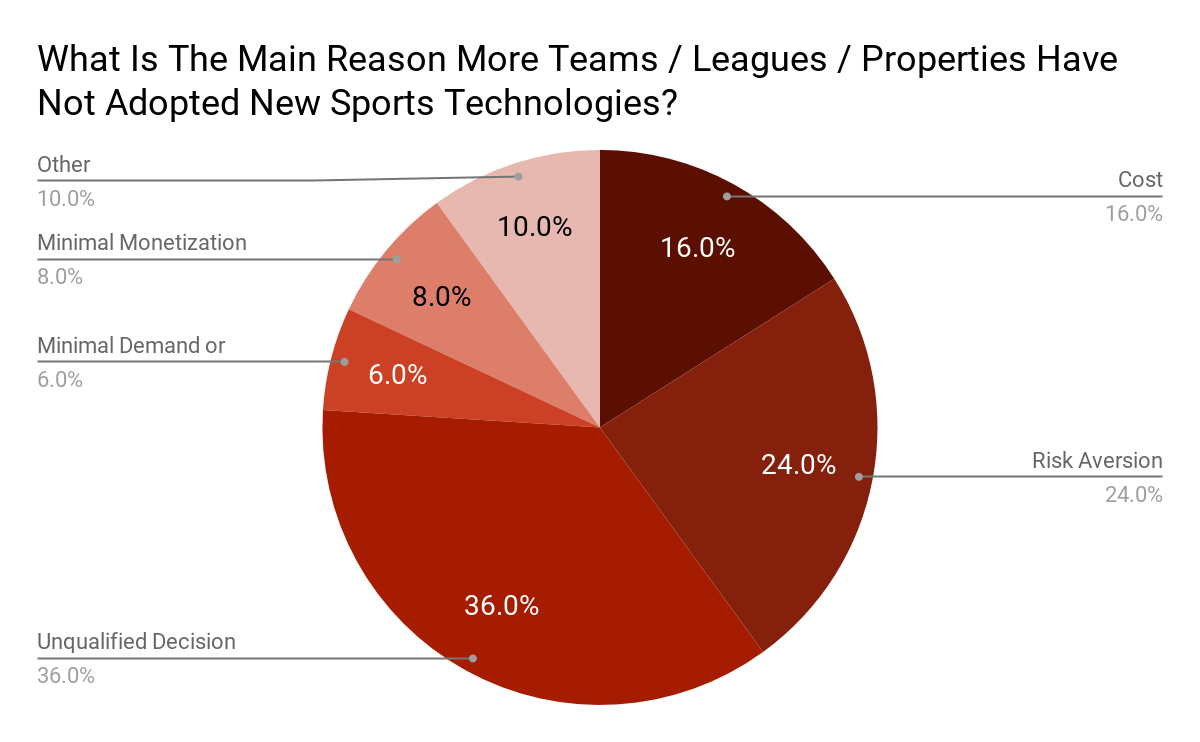
image005

Respondents cited several factors holding back sports technology adoption, with the top three reasons, similar to many non-traditional technology sectors, being unqualified decision makers, risk aversion and cost.

While there’s plenty of blame to go around (and everyone can assume a degree of responsibility), startups in the space need to validate their business model outside of a core sports stakeholder. They need to realize revenue from more than just sports teams, leagues and properties — organizations that have historically reinforced the leading responses to this question. More importantly, relationships with these audiences require long sales cycles and traditionally represent “cents on the dollar” in comparison to partnerships with other industry (e.g. brands) and non-industry (e.g. military, retail, airline, etc.) opportunities.

Parting thoughts

The sports tech industry has and continues to suffer from massive amounts of fragmentation. Whether it be by geography, industry area of focus or funding stage, sports tech startups are missing the community that it has enabled others to realize.

There is a historic opportunity to bring this community together, and when we do, the legacy that we create will be one of continued growth and opportunity — perpetuating the current influx of capital into the space and reinforcing the notion that sports are truly the ultimate unifier.

*I worked for the NBA for more than four years in Global Business Development.

01 Oct 2019

NASA launches a new Earth-like planet hunting telescope using a giant balloon

A new telescope will seek out planets that resemble Earth from a height of around 125,000 feet, suing special optical technology that will filter out light from the stars they orbit to provide a better view. The telescope is the product of UMass Lowell, and took off on Tuesday morning from Fort Sumner, New Mexico aboard a helium balloon roughly the size of an entire football field.

The balloon had to be that big to carry the telescope, which itself weighs around 1,500 lbs, and measures 14 feet long by 3 feet wide. The so-called ‘PICTURE-C’ telescope will operate at the edge of the Earth’s atmosphere for a clear view, and it’s a reusable piece of equipment that will stay aloft for several hours at at time before being decoupled and making its way back via parachute-assisted descent.

NASA is funding the project via a $5.6 million five-year grant for the university, and it’ll return for a follow-up trip next year to capture more images to assist their research team in their search. The project could result in the discovery of other objects in space beyond Earth-like planets, since it’s a novel approach to taking a look at bodies in space that were previously washed out by ambient light from stars.

2d39ecea 6bb4 4beb ab30 8e686a287bb5

Photo credit: NASA

01 Oct 2019

Here’s what Microsoft will probably announce at tomorrow’s Surface event

It’s hardware season, and now it’s Microsoft’s turn to deliver the goods. The company will be holding its big Surface event bright and early tomorrow morning in New York. If past years’ events are any precedent (and they generally are), there’s going to be a lot of stuff shown off in the Big Apple this week.

This time last year, Microsoft introduced a new version of the Surface Pro, Laptop and Studio and adding over-ear headphones to the lineup. This time out, we’ve already seen a number of leaks that point to additional refreshes and a couple of big “surprises” (in as much as rumored products can truly be a surprise).

The Surface Pro and Laptop are both said to be getting refreshes this year. The Surface Pro 7 is getting a smattering of upgrades — likely the most underwhelming of the event, including a new Intel processor and a USB-C port, dragging it kicking and screaming in 2019. The Surface Laptop 3, meanwhile, gets two size options: a 13- and 15-inch inch model, along with, potentially, a new AMD processor.

As for fully new stuff, Microsoft is believed to finally be embracing the ARM for Windows 10 platform with its Surface line. Rumors have it launching an ARM-powered two-in-one at the event. Among the benefits are a smaller footprint and far improved battery life — both marked benefits for any portable.

The biggest reveal of the show, however, is expected to be the long awaited addition of a dual-screen Surface. A decade after abandoning Courier, Microsoft is expected to announced a new form factor for the line. The rumor, which includes a bespoke version of Windows 10 (the somewhat confusingly named Windows 10 X), also point to a potential launch for the device some time later this year.

01 Oct 2019

Elizabeth Warren bites back at Zuckerberg’s leaked threat to K.O. the government

Presidential candidate Senator Elizabeth Warren has responded publicly to a leaked attack on her by Facebook CEO Mark Zuckerberg, saying she won’t be bullied out of taking big tech to task for anticompetitive practices.

Warren’s subtweeting of the Facebook founder follows a leak in which the Verge obtained two hours of audio from an internal Q&A session with Zuckerberg — publishing a series of snippets today.

In one snippet the Facebook leader can be heard opining on how Warren’s plan to break up big tech would “suck”.

“You have someone like Elizabeth Warren who thinks that the right answer is to break up the companies … if she gets elected president, then I would bet that we will have a legal challenge, and I would bet that we will win the legal challenge,” he can be heard saying. “Does that still suck for us? Yeah. I mean, I don’t want to have a major lawsuit against our own government. … But look, at the end of the day, if someone’s going to try to threaten something that existential, you go to the mat and you fight.”

Warren responded soon after publication with a pithy zinger, writing on Twitter: “What would really ‘suck’ is if we don’t fix a corrupt system that lets giant companies like Facebook engage in illegal anticompetitive practices, stomp on consumer privacy rights, and repeatedly fumble their responsibility to protect our democracy.”

In a follow up tweet she added that she would not be afraid to “hold Big Tech companies like Facebook, Google and Amazon accountable”.

The Verge claims it did not obtain the leaked audio from Facebook’s PR machine. But in a public Facebook post following its publication of the audio snippets Zuckerberg links to their article — and doesn’t exactly sound mad to have what he calls his “unfiltered” views put right out there…

Whether the audio was leaked intentionally or not, as many commentators have been quick to point out — Warren principal among them — the fact that a company has gotten so vastly powerful it feels able to threaten to fight and defeat its own government should give pause for civilized thought.

Someone high up in Facebook’s PR department might want to pull Zuckerberg aside and make a major wincing gesture right in his face.

In another of the audio snippets Zuckerberg extends the threat — arguing that breaking up tech giants would threaten the integrity of elections.

“It’s just that breaking up these companies, whether it’s Facebook or Google or Amazon, is not actually going to solve the issues,” he is heard saying. “And, you know, it doesn’t make election interference less likely. It makes it more likely because now the companies can’t coordinate and work together.”

Elections such as the one Warren hopes to be running in as a US presidential candidate… so er… again this argument is a very strange one to be making when the critics you’re railing against are calling you an overbearing, oversized democracy-denting beast.

Zuckerberg’s remarks also contain the implied threat that a failure to properly police elections, by Facebook, could result in someone like Warren not actually getting elected in the first place.

Given, y’know, the vast power Facebook wields with its content-shaping algorithms which amplify narratives and shape public opinion at cheap, factory farm scale.

Reading between the lines, then, presidential hopefuls should be really careful what they say about important technology companies — or, er, else!

How times change.

Just a few short years ago Zuckerberg was the guy telling everyone that election interference via algorithmically amplified social media fakes was “a pretty crazy idea”.

Now he’s saying only tech behemoths like Facebook can save democracy from, uh, tech behemoths like Facebook…

For more on where Zuckerberg’s self-servingly circular logic leads, let’s refer to another of his public talking points: That only Facebook’s continued use of powerful, privacy-hostile AI technologies such as facial recognition can save Western society from a Chinese-style state dystopia in which the presence of your face broadcasts a social credit score for others to determine what you get to access.

This equally uncompelling piece of ‘Zuckerlogic’ sums to: ‘Don’t regulate our privacy hostile shit — or China will get to do worse shit before we can!’

So um… yeah but no.

01 Oct 2019

China’s growing digital influence in Africa

There’s been a heap of China in Africa coverage over the last decade, but very little of it is focused on tech. In part, because the country’s engagement with African startups is light compared to its deal-making on infrastructure and commodities. Now, that all looks to be shifting.

TechCrunch has tracked moves by a number of Chinese actors in Africa’s tech sector over the past year. This could signal the next chapter in China’s influence in Africa — one more digital than bricks and mortar.

Primer on China in Africa

To the former, the government of China has designated Africa a strategic priority in its foreign relations and has pursued policies and programs accordingly.

01 Oct 2019

China’s growing digital influence in Africa

There’s been a heap of China in Africa coverage over the last decade, but very little of it is focused on tech. In part, because the country’s engagement with African startups is light compared to its deal-making on infrastructure and commodities. Now, that all looks to be shifting.

TechCrunch has tracked moves by a number of Chinese actors in Africa’s tech sector over the past year. This could signal the next chapter in China’s influence in Africa — one more digital than bricks and mortar.

Primer on China in Africa

To the former, the government of China has designated Africa a strategic priority in its foreign relations and has pursued policies and programs accordingly.

01 Oct 2019

Salesforce is building an office tower in Sydney, pledging 1000 new jobs in next five years

Salesforce announced this week that it’s building another shiny tower. This one will be in Sydney with views of the harbor and the iconic Sydney Opera House. The company has also committed to adding 1000 new jobs in the next five years and to building the tower in a sustainable fashion.

In fact, Salesforce is pledging the new tower will be one of the greenest buildings in the country when they are finished. “The building has achieved Sydney’s first-ever WELL core and shell Platinum pre-certification, the highest obtainable pre-certification, and will achieve a 6 Star Green Star Design and As-Built rating, representing world excellence in sustainable design,” Salesforce’s Elizabeth Pinkham wrote in a blog post announcing the project.

As is Salesforce’s way, it’s going to be the tallest building in the city when it’s done, and will sit in the Circular Quay, part of the central business district in the city, and will house shops and restaurants on the main floor. As with all of its modern towers, it’s going to dedicate the top floor to allow for flexible use for employees, customers and partners. The building will also boast a variety of spaces including a Salesforce Innovation Center for customers along with social lounges, mindfulness areas and a variety of spaces for employees to collaborate.

Salesforce has had a presence in Sydney for over 15 years, according to the company, and this tower is an attempt to consolidate that presence into a single, modern space with room to expand over the next five years and add hundreds of new employees.

The announcement comes on the heels of the one earlier this year that the company was building a similarly grand project in Dublin to centralize operations in that city where it has had a presence since 2001.

01 Oct 2019

Coding training and outsourcing service Catalyte launches a toolkit for corporate ‘up-skilling’

Catalyte, the Baltimore-based coding training and placement service, has launched a new software service designed to take its machine learning-based skills-assessment and training program to companies around the country.

With revenues already approaching nearly $100 million for its outsourced software development services, Catalyte is hoping to take the lessons and tools it has learned and developed over the course of its 18-year history as a staffing and training company for the tech industry and sell them to companies looking to retrain . or provide additional skills development opportunities for their employees.

“Even if we were the largest employer in the world we still would not be able to move the needle on the labor economy,” says Catalyte’s chief executive, Jacob Hsu. 

He sees the company’s mission as providing a critical step for companies to identify the employees in their workforce with the skills to become coders and an opportunity for those employees to then receive the training they need to move into higher paying roles as software eats into low-skilled, repetitive labor.

“We’re encouraging all of these employers to deploy these up-leveling skills,” Hsu says.

At Catalyte, the company’s success has hinged on practicing what it preaches (and what it’s now selling). Launched in 2000 as a staffing service in Baltimore called Catalyst Devworks by a former White House economist, Michael Rosenbaum, the company expanded to locations in Chicago and Portland and offers training and workforce development through contracted consulting projects with companies.

Photo courtesy of Getty Images

The company’s recruits come from anywhere and everywhere and hiring hinges on a skills test would-be employees have to perform which is monitored by software that tracks how test-takers respond to the company’s questions.

Once an applicant passes the test, they’re brought in for training and given a two-year contract during which time they’re put to work on development projects Catalyte has won from customers like Under Armor, Aetna, AT&T and Microsoft .

Catalyte’s developers are paid roughly $40,000 per-year (less than half of what a developer typically makes) while they’re working under the two-year contract and are then allowed to seek employment outside of the company. Any employee that breaks the mandatory two-year contract is subject to a $25,000 penalty, according to a report in “Fast Company”. As they enter the third year, their contract with Catalyte gets renegotiated and employees who stay with the company can earn at least $75,000.

“We’re taking people from all walks of life,” says Hsu. “The average salary is $25,000 for people who have come in to the program… But within five years from working with the company, the average salary is $98,000.”

It’s this kind of narrative, and the company’s solid revenue that attracted investors like Steve Case, who’s backing Catalyte through his $150 million Rise of the Rest Seed Fund.

In 2018, Catalyte raised roughly $27 million in a round of funding from Palm Drive Capital, Cross Culture ventures, Expon Capital, and the Rise of the Rest Seed Fund.

The relatively novel approach to training and hiring (with some of the company’s recruits even coming in through Craiglist ads that pitch getting paid for learning to code) has netted Catalyte some impressive statistics when it comes to the diversity of its workforce — another important criteria for Case’s Rise of the Rest fund.

“When you use this approach to hiring [in a city]… you end up with a workforce that’s similar to the demographics of a city,” says Hsu.

In Baltimore the company’s workforce is about 29% African American and 30% of the developers are women. The average age of a programmer in the company’s workforce is 33 years-old and education levels range from about one quarter with only a college degree to college-educated candidates. 

Catalyte’s growth over the past three years has been nothing short of explosive. The company went from 50 employees in 2016 to around 800 people on staff now.

That staff is critical not just to the company’s current business model, but also served as a training tool for the machine learning and assessment tools that Catalyte is now trying to sell. “We spent over a decade collecting outcome data from engineering projects,” says Hsu. And that data was what was used to create the company’s metrics for whether or not a candidate for a programming job at the company would be successful.

The company intends to bring its assessment tool to market in the fourth quarter, but on the back of its recent fundraising, Catalyte has been ramping up its research and development activities. It wants to begin putting together a curriculum around cybersecurity and site reliability engineers. The software will cost roughly $1,000 per seat for every employee that receives its training regime.

“One of the fundamental ways our economy is going to both remain competitive on the international level and expand opportunities to more Americans is by changing the way we identify talent,” said Case in a statement discussing Catalyte’s financing last year. “Catalyte proved to us that not only can it bring new and underrepresented groups into the fold, it can do so while helping its own clients grow.”

While the company is growing its product pipeline, it also intends to expand the number of development and training centers it operates. The plan, according to an interview Hsu gave to the local technology news site Technically Baltimore in February, is to have 20 development centers around the country by 2020.