Category: UNCATEGORIZED

17 Sep 2019

Pax Labs’ Bharat Vasan is out as CEO

Bharat Vasan is no longer the Chief Executive Officer at Pax Labs, the consumer tech company that makes cannabis vaporizers. A source familiar with the situation said that the board of directors made the decision to remove Vasan from the CEO role. His last day was Friday.

We’ve reached out to Vasan for comment. Pax is declining to elaborate on what drove its decision.

Certainly, it’s a surprising move, given that Vasan was appointed the CEO of Pax not so long ago —  in February of 2018. Before that, he served as President and COO of August Home, which was acquired by Swedish lock maker Assa Abloy in 2017. Previous to that, Vasan was the cofounder of Basis, a fitness-based wearable company that was acquired by Intel in 2014 for $100 million.

Vasan also led the company in its most recent round this past April, in which it secured $420 million from Tiger Global Management, Tao Capital, and Prescott General Partners, among others. The post-money valuation for the company at the time was $1.7 billion.

Vasan is a veteran of consumer electronics, but Pax may be looking for a CEO that has more operational experience in cannabis.

After all, Pax is at an interesting intersection in its path, navigating an oft-changing regulatory landscape around cannabis. Moreover, the entire cannabis industry — and vaporizer industry —  is under a microscope in the wake of hundreds of reports of vape-related lung illness. The CDC says that there have been 380 cases of lung illness reported across 36 states, with six deaths. Most patients reported a history of using e-cigarette products containing THC.

Pax is currently on the hunt for a new chief executive. In the meantime, its general counsel, Lisa Sergi, who joined the company at the end of July, will be its interim CEO and president.

Sergi had this to say in a prepared statement:

PAX is uniquely positioned as a leader in the burgeoning cannabis industry, with a talented team, an iconic brand, quality products and the balance sheet to achieve our ambitious goals and continued growth trajectory. I am extremely excited and honored to have been entrusted to lead this extraordinary company.

17 Sep 2019

Natural lighting is the key to Apple’s remodeled Fifth Ave. store

When it opened in 2006, Apple’s Fifth Avenue flagship quickly became a top destination for New York City residents and tourists, alike. The big, glass cube was a radical departure from prior electronics stores, serving as the entrance to a 24-hour subterranean retail location. Location didn’t hurt either, with the company planting its flag across from the Plaza Hotel and Central Park and sharing a block with the iconic high-end toy store, FAO Schwarz.

Since early 2017, however, the store has been closed for renovations. Earlier this month, the company took the wraps off the outside of the cube (albeit with some multi-color reflective wrap still occupying the outside of the familiar retail landmark). Last week, the company offered more insight into the plan as retail SVP Deirdre O’Brien took to the stage during the iPhone 11 event to discuss the company’s plans for the reinvented space.

Fifth Ave 1

During a discussion with TechCrunch, Apple shed even more light on the underground store, which will occupy the full area of the Fifth Avenue plaza. As is the case with all of Apple’s flagships, light is the thing here — though that’s easier said than done when dealing with an underground space. Illuminating the store is done through a combination of natural lights and LEDs.

When the store reopens, a series of skylights flush on the ground of the plaza will be doing much of the heavy lifting for the lighting during the day. Each of those round portholes will be frosted to let the light in, while protecting the privacy of people walking above, with supplemental lighting from silver LED rings. That, in turn, is augmented by 18 (nine on each side of the cube) “sky lenses.” Oriented in two 3×3 configurations, the “sculptural furniture” will also provide seating in the outdoor plaza.

Of course, the natural lighting isn’t able to do all of the work for a 24-hour store. That’s complemented by a ceiling system that uses a similar stretched fabric-based lighting system as other Apple Stores. Here, however, the fabric will take on a more cloud-like structure with a more complicated geometrical shape than other Apple stores. The fabric houses tunable LED lights that react to the external environment. If it’s sunny outside, it will be brighter downstairs. When it’s cloudy, the lights will dim.

In all, there are five modes tuned to a 24-hour cycle, including:

  • Sunrise: 3,000K
  • Day: 4,500K-5,250K (depending on how bright it is outside)
  • Sunset: 3,000K
  • Evening: 3,250K
  • Night: 3,500K

Screen Shot 2019 09 17 at 12.21.48 PM

Sunrise and sunset are apparently the best time to check it out, as the lights glow warmly for about an hour or so. There are 80 ring lights in all, and around 500,000 LEDs, with about 2,500 LED spotlights used to illuminate tables and products inside the store. The natural lighting also will be used to keep alive eight trees and a green wall in the underground space. 

The newly remodeled store opens at 8AM on September 20, just in time to line up for the new iPhone.

17 Sep 2019

In a social media world, here’s what you need to know about UGC and privacy

In today’s brand landscape, consumers are rejecting traditional advertising in favor of transparent, personalized and most importantly, authentic communications. In fact, 86% of consumers say that authenticity is important when deciding which brands they support. Driven by this growing emphasis on brand sincerity, marketers are increasingly leveraging user-generated content (UGC) in their marketing and e-commerce strategies.

Correlated with the rise in the use of UGC is an increase in privacy-focused regulation such as the European Union’s industry-defining General Data Protection Regulation (GDPR), the along with others that will go into effect in the coming years, like the California Consumer Protection Act (CCPA), and several other state-specific laws. Quite naturally, brands are asking themselves two questions:

  • Is it worth the effort to incorporate UGC into our marketing strategy?
  • And if so, how do we do it within the rules, and more importantly, in adherence with the expectations of consumers?

Consumers seek to be active participants in their favorite companies’ brand identity journey, rather than passive recipients of brand-created messages. Consumers trust images by other consumers on social media seven times more than advertising.

Additionally, 56% are more likely to buy a product after seeing it featured in a positive or relatable user-generated image. The research and results clearly show that the average consumer perceives content from a peer to be more trustworthy than brand-driven content.

With that in mind, we must help brands leverage UGC with approaches that comply with privacy regulations while also engaging customers in an authentic way.

Influencer vs user: Navigating privacy considerations in an online world

17 Sep 2019

Roboticist and YouTube star Simone Giertz is coming to Disrupt SF (Oct. 2-4)

Here’s a fun thing to look forward to next month. Simone Giertz, she of the shitty robots fame, will be appearing onstage at Disrupt SF (October 2-4) at the Moscone Center in San Francisco.

The U.S.-based Swedish inventor has built a massive online following (currently at 1.92 million YouTube subscribers) with DIY videos that examine technology and art through a whimsical lens.

Giertz is probably best known for her “shitty” robotic creations, including arms that serve soup and breakfast, draw holiday cards and apply lipstick — to hilariously uneven results. More recently, she had a verified viral hit when she busted out some power tools to turn her Tesla into a pickup truck.

She’ll be joining us onstage to walk us through some of her most interesting creations, including The Every Day calendar. The project, which made nearly $600,000 on Kickstarter late last year, is designed to help motivate users into developing good habits, like meditating, flossing or writing. Or, you know, eating churros. 

Disrupt SF runs October 2 to October 4 at the Moscone Center in San Francisco. Giertz joins an outstanding lineup of speakers, including Kitty Hawk’s Sebastian Thrun, Admiral Mike Rodgers, Rachel Haurwitz of Caribou Biosciences, and Marc Benioff, Box’s Aaron Levie and dozens more.

Buy tickets here!

17 Sep 2019

AT&T faked DirecTV Now numbers, lawsuit alleges

AT&T faked the numbers for its DirecTV Now streaming service ahead of the company’s Time Warner merger, according to a lawsuit filed by investors, Bloomberg reported. The suit alleges the media giant pressured employees to boost DirecTV Now’s numbers by secretly adding the product to existing customers’ accounts. It also claims the company touted DirecTV Now’s user growth, when in reality, subscribers were leaving as their promotional periods ended and the service’s price hikes were limiting new sign-ups.

The suit says a variety of tactics were used to promote the idea that DirecTV Now was growing organically. For example, it claims that employees were taught how and encouraged to convert activation fees that customers typically had to pay to upgrade their phones into DirecTV Now subscriptions. This involved the customer being told the fee was being “waived,” when instead the customer was charged anyway and the payment was applied to up to 3 DirecTV Now accounts using fake emails.

One former employee even said that around 40%-50% of customers he dealt with in early 2017 were complaining about being charged for DirecTV Now, which they had never signed up for. This was supported by other employees, the suit cites, and was a directive that came top from upper management to the sales channel.

In addition, the suit speaks to overly aggressive sales quotas, high churn from deeply discounted promotions, technical issues, and unsustainable pricing. It noted how AT&T finally disclosed that by the end of 2018, none of the 500,000 heavily discounted DirecTV Now subscribers remained on the service, and subscriptions had dropped by 267,000 as a result. In April 2019, it reported another 83,000 subscribers had left the service, and in July, 168,000 had abandoned it.

But ahead of the Time Warner merger, AT&T touted the service’s success, the suit said. It didn’t disclose any of the risks associated with DirecTV Now, despite SEC obligations. The plaintiffs believe AT&T should have noted what made its stock risky, including the fact that DirecTV Now was not profitable, its growth had been dependent on aggressive promotions, and it faced severe technical challenges.

“By buying AT&T’s securities at these artificially inflated and artificially maintained prices, the Class members suffered economic losses, which losses were a direct and proximate result of Defendants’ fraudulent conduct,” the suit states.

“We plan to fight these baseless claims in court,” an AT&T spokesperson said in a statement.

DirecTV Now had a rough start to begin with, having suffered heavily from glitches, including freezing, buffering, and more. While that can happen at first with new streaming services, AT&T’s glitches were bad enough that many wanted to cancel.

TechCrunch reported in 2017 how customers complained they weren’t able to get refunds from AT&T, even though they weren’t able to use the service as promised. Some had even filed complaints with the FCC, we found. In January, we also noted how the service’s price hikes and promotional packages ending led to a sizable loss of subscribers and that AT&T was “losing the cord cutters.”

The filing of the lawsuit comes at a time where AT&T has seen much upheaval. This month, activist investor  Elliott Management Corp. disclosed its $3.2 billion stake in AT&T and criticized the company’s acquisition strategy. It also suggested that AT&T should sell some assets that don’t fit its future direction, like the DirecTV satellite service and Mexican wireless business.  AT&T CEO Randall Stephenson defended the company’s $85 billion acquisition of Time Warner today, in response to this criticism.

In addition, AT&T CEO of Communications, John Donovan, recently announced his retirement, with WarnerMedia CEO John Stankey being promoted to president and chief operating officer at AT&T.

The full complaint is below.


17 Sep 2019

The team behind Codementor launches Arc to help companies hire talented developers around the world

Arc, a platform that wants to simplify the process of hiring developers who work remotely, is launching officially today. The new company grew out of Techstars-backed Codementor, an online education platform for software developers. Codementor will continue to operate as a standalone product under Arc.

While there are already many freelancing platforms, Weiting Liu, the founder and CEO of Arc and Codementor, said Arc is more focused on long-term contractor and full-time employee positions instead of short-term gigs. To make the recruitment process easier for tech companies, all developers on its platform are vetted by Arc in a process modeled on the hiring assessments used by tech companies in Silicon Valley. Arc’s clients have already included Spotify, Chegg, Hims, Fivestars and AppLovin.

Codementor launched in 2014 to connect developers with instructors around the world for coding education. Arc has the same mission of helping boost the careers of engineers who live outside of major tech hubs.

“I think Arc is a natural evolution. Codementor had hundreds of thousands of developers in the community already and that created a very strong and inclusive community to help developers worldwide continuously improve their skills,” says Liu. “We definitely see Codementor and its network creating a strong funnel of talented developers who want to work remotely.”

Remote hiring has benefits like increasing the talent pool for tech companies while helping employees maintain work-life balance or avoid moving to high cost-of-living areas. But despite the increase in remote hiring (for example, Stripe recently described its remote engineers as the company’s “fifth engineering hub”), there are still many hurdles to overcome.

The team of Liu’s first startup, Y Combinator alum SocialPicks, were based in different cities. In 2006, that meant everyone had to find a way to work together even though collaboration tools like Slack and Trello didn’t exist yet. But while it has become much more easier to work remotely over the past decade, hiring people who live far away still presents a lot of friction for companies. “From an employers’ perspective, there are a lot of fears and unknowns for hiring strangers online for a permanent, full-time role, but I think things are changing,” says Liu.

He adds that Arc is different from other hiring platforms like AngelList or We Work Remotely because of its vetting process, designed to identify developers who can stay with a company for a long time.

“People can still hire remote developers for short-term contracts, but we want to enable more companies to hire long-term, full-time regular employees who are not based in their ZIP code, but should be treated no differently than their Bay Area counterparts because they are as good, if not better, than Silicon Valley developers,” Liu says.

Arc pre-screens engineers and teams using what it describes as “Silicon Valley-caliber technical and behavioral assessments.” Candidates go through behavioral and technical interviews conducted by senior developers and technical recruiters who have worked for Google, Facebook and other big tech companies. In order to judge how well they will work with a team in another location, Arc also asks developers to prepare programming during the interview process to simulate the process of collaborating remotely.

As Arc grows larger, Liu says it will build tools that will help them gauge developers at scale, as well as features to companies manage remote workers.

California recently passed a significant new bill that, if signed into law, would dramatically change the gig economy by requiring companies to give independent contractors who do the work of employees minimum wage, workers’ compensation and other benefits. Liu hopes this signifies a shift in how remote workers are viewed.

“There are a lot of first-generation online platforms for ‘remote work,’ but most are freelancing work. Platforms like Fiverr and Upwork are pioneers of this space, so they are the first generation of online freelancing platforms,” Liu says. “They came into a world where people felt comfortable working together in very short-term freelancing gigs. I think the second phase means there is increasingly higher trust and better infrastructure to enable long-term, permanent full-time work to be made possible remotely, and we want to be the main facilitator of that.”

17 Sep 2019

Google Fi gets an unlimited plan

For the longest time, Google Fi didn’t play the unlimited calls, text and data game and instead focused on offering pretty affordable and flexible plans with a price cap of $80 (before taxes and government fees). Today, however, Google is introducing Fi Unlimited, which, as you’ve probably figured out from the name, is more akin to a traditional ‘unlimited’ plan from other carriers.

Fi Unlimited plans start at $70 for the first line. For families, you can also opt to pay $60 per line for 2 lines, $50 per line for 3 lines or $45 per line for 4 to 6 lines (excluding taxes and fees). That’s pretty much in line with the unlimited plans from other carriers, though they all come with their own limitations, special services and may feature different (and often more substantial) family discounts.

“Since Fi’s launch in 2015, we’ve had one plan, the Fi Flexible plan, that gives you the flexibility to pay for just the data you use,” writes Fi product manager Dhwani Shah. “As we’ve grown, we’ve heard that many of you want the simplicity and predictability that comes with paying the same price each month. So today, for the first time ever, Fi is adding a second plan: our Google Fi Unlimited plan.”

If you’re also a happy Fi user and like the old plan, don’t panic. A Google spokesperson has told us that Google will continue to offer the existing flexible plan, too.

blog unlimited pricing

Unlimited, of course, is never quite unlimited, so Google will cap your speed after you use 22GB of data in a given month (only 1% of Fi users currently do so, the company says) and it ‘may’ cap video quality at 480p. Like with the company’s other Fi plans, there are no contracts or activation fees.

There are some positives, too, though. You’ll get free international calls from the U.S. to 50 countries and territories and you’ll still get Fi’s unlimited data and text in 200 countries. Every unlimited plan also includes a Google One membership with 100 GB of cloud storage and live support for all Google products, as well as Google’s new phone backup service. There are also no limits on hotspot usage.

As always, you’ll need a compatible phone to make Fi work for you.

The maximum you’ll pay for Fi’s flexible price is $80 per month after you’ve used more than 6 GB of data. So there’s a tradeoff here. You’ll pay a fixed price for every unlimited line, even if you only use 1 GB of data, but you’ll pay a predictable price and you’ll get a discount for activating multiple lines, as well as a few other goodies.

17 Sep 2019

Boston-based DataRobot raises $206M Series E to bring AI to enterprise

Artificial intelligence is playing an increasingly large role in enterprise software, and Boston’s DataRobot has been helping companies build, manage and deploy machine learning models for some time now. Today, the company announced a $206 million Series E investment led by Sapphire Ventures.

Other participants in this round included new investors Tiger Global Management, World Innovation Lab, Alliance Bernstein PCI, and EDBI along with existing investors DFJ Growth, Geodesic Capital, Intel Capital, Sands Capital, NEA and Meritech.

Today’s investment brings the total raised to $431 million, according to the company. It has a pre-money valuation of $1 billion, according to PitchBook. DataRobot would not confirm this number.

The company has been catching the attention of these investors by offering a machine learning platform aimed at analysts, developers and data scientists to help build predictive models much more quickly than it typically takes using traditional methodologies. Once built, the company provides a way to deliver the model in the form of an API, simplifying deployment.

The late-stage startup plans to use the money to continue building out its product line, while looking for acquisition opportunities where it makes sense. The company also announced the availability of a new product today, DataRobot MLOps, a tool to manage, monitor and deploy machine learning models across a large organization.

The company, which was founded in 2012, claims it has had triple-digit recurring revenue growth dating back to 2015, as well as one billion models built on the platform to-date. Customers contributing to that number include a broad range of companies such as Humana, United Airlines, Harvard Business School and Deloitte.

17 Sep 2019

IEX’s Katsuyama is no flash in the pan

When you watch a commercial for one of the major stock exchanges, you are welcomed into a world of fast-moving, slick images full of glistening buildings, lush crops and happy people. They are typically interspersed with shots of intrepid executives veering out over the horizon as if to say, “I’ve got a long-term vision, and the exchange where my stock is listed is a valuable partner in achieving my goals.” It’s all very reassuring and stylish. But there’s another side to the story.

I have been educated about the realities of today’s stock exchange universe through recent visits with Brad Katsuyama, co-founder and CEO of IEX (a.k.a. The Investors Exchange). If Katsuyama’s name rings a bell, and you don’t work on Wall Street, it’s likely because you remember him as the protagonist of Michael Lewis’s 2014 best-seller, Flash Boys: A Wall Street Revolt, which explored high-frequency trading (HFT) and made the case that the stock market was rigged, really badly.

Five years later, some of the worst practices Lewis highlighted are things of the past, and there are several attributes of the American equity markets that are widely admired around the world. In many ways, though, the realities of stock trading have gotten more unseemly, thanks to sophisticated trading technologies (e.g., microwave radio transmissions that can carry information at almost the speed of light), and pitched battles among the exchanges, investors and regulators over issues including the rebates stock exchanges pay to attract investors’ orders and the price of market data charged by the exchanges.

I don’t claim to be an expert on the inner workings of the stock market, but I do know this: Likening the life cycle of a trade to sausage-making is an insult to kielbasa. More than ever, trading is an arcane, highly technical and bewildering part of our broader economic infrastructure, which is just the way many industry participants like it: Nothing to see here, folks.

Meanwhile, Katsuyama, company president Ronan Ryan and the IEX team have turned IEX into the eighth largest stock exchange company, globally, by notional value traded, and have transformed the concept of a “speed bump” into a mainstream exchange feature.
Brad Aug 12

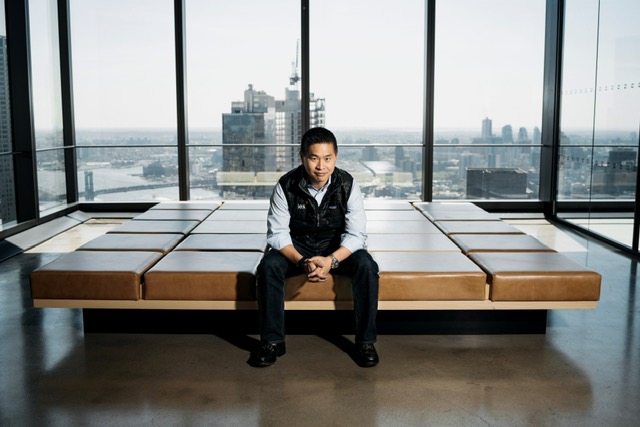
Brad Katsuyama. Image via IEX Trading

Despite these and other accomplishments, IEX finds itself in the middle of a vicious battle with powerful incumbents that seem increasingly emboldened to use their muscle in Washington, D.C. What’s more, new entrants, such as The Long-Term Stock Exchange and Members Exchange, are gearing up to enter the fray in US equities, while global exchanges such as the Hong Kong Stock Exchange seek to bulk up by making audacious moves like attempting to acquire the venerable London Stock Exchange.

But when you sell such distinct advantages to one group that really can only benefit from that, it leads to the question of why anyone would want to trade on that market. It’s like walking into a playing field where you know that the deck is stacked against you.

As my discussion with Katsuyama reveals, IEX may have taken some punches in carving out a position for itself in this high-stakes war characterized by cutting-edge technology and size. However, the IEX team remains girded for battle and confident that it can continue to make headway in offering a fair and transparent option for market participants over the long term.

Gregg Schoenberg: Given Flash Boys and the attention it generated for you on Main Street, I’d like to establish something upfront. Does IEX exist for the asset manager, the individual, or both?

Brad Katsuyama: We exist primarily for the asset manager, and helping them helps the individual. We’re one step removed from the individual, and part of that is due to regulation. Only brokers can connect to exchanges, and the asset manager connects to the broker.

Schoenberg: To put a finer point on it, you believe in fairness and being the good guy. But you are not Robinhood. You are a capitalist.

Katsuyama: Yes, but we want to make money fairly. Actually, we thought initially about starting the business as a nonprofit, But once we laid out all the people we would need to convince to work for us, we realized it would’ve been hard for us to attract the skill sets needed as a nonprofit.

Schoenberg: Do you believe that the US equity market today primarily serves investors or traders?


17 Sep 2019

‘The Big Bang Theory’ goes to AT&T’s HBO Max streaming service for over a billion

‘Friends’ is getting some new neighbors at HBO Max. The streaming service from AT&T’s WarnerMedia has signed a big deal, reportedly worth over $1 billion, for the exclusive streaming and syndication rights for ‘The Big Bang Theory’ over the next five years.

The deal comes as streaming media services look to shore up their original programming offerings with known quantities that have proven to be enduring hits in syndication. It’s the model that originally brought Netflix’s streaming service to near-ubiquity and shows the enduring power of the sitcom format.

In the past year over $2.4 billion has been committed to locking down fan favorite comedies like “Friends”, “The Office”, “Seinfeld” and now the record-setting deal for “The Big Bang Theory”.

Yesterday, The Los Angeles Times broke the news that Netflix had acquired the rights to Seinfeld in a deal worth over $500 million. That deal was struck after Netflix lost two of its tentpole streaming properties — “Friends” to WarnerMedia’s HBO Max and “The Office” to NBCUniversal’s new (terribly, terribly, named) streaming serviceThe Peacock.

All 12 seasons of ‘The Big Bang Theory’ —  starring Jim Parsons, Johnny Galecki, and Kaley Cuoco, will be available to stream in 2020 when HBO Max launches.

“Few shows define a generation and capture mainstream zeitgeist like ‘The Big Bang Theory,’” Robert Greenblatt, chairman of WarnerMedia Entertainment and direct-to-consumer, told The Hollywood Reporter, which broke the news. “We’re thrilled that HBO Max will be the exclusive streaming home for this comedy juggernaut when we launch in the spring of 2020. This show has been a hit virtually around the globe, it’s one of the biggest shows on broadcast television of the last decade, and the fact that we get to bring it to a streaming platform for the first time in the U.S. is a coup for our new offering.”

The competition for talent for new productions and time-tested fan favorites has reached a fever pitch in the entertainment industry as studios, networks, and technology companies including Apple, Amazon, and Netflix shell out big dollars to capture audience in the new media landscape.

“I am forever grateful to have been part of something as extraordinary as ‘The Big Bang Theory,’” Lorre told The Hollywood Reporter. “All of us — Bill Prady, Steven Molaro, Steve Holland, and the amazing writing staff, cast and crew — recognize that 12 seasons of laughter is a gift to be cherished.”

Each of the stars and show creators Lorre and Prady along with executive producers Molaro and Holland stand to become very rich off of the deal. According to The Hollywood Reporter, Lorre alone will pocket somewhere between 30% and 40% of the new syndication deal.