Category: UNCATEGORIZED

16 Sep 2019

Facebook rolls out new video tools, plus Instagram and IGTV scheduling feature

Facebook on Monday announced a number of updates aimed at video creators and publishers, during a session at the International Broadcasting Convention (IBC) taking place in Amsterdam. The updates involve changes to live video broadcasting, Facebook’s Watch Party, and Creator Studio, and they include enhancements to tools, expanded feature sets, and improved analytics, among other things.

The highlights include better ways to prep for and simulcast live broadcasts, ways to take better advantage of Watch Party events, new metrics to track video performance, and a much-anticipated option to schedule Instagram/IGTV content for up to six months’ in advance.

Live Video

facebook live studio

In terms of live video, Facebook says it listened to feedback from those who have been broadcasting live on its platform, and is now rolling out several highly-requested features to Facebook Pages (not Profiles.) The changes are an attempt to better accommodate professional broadcasters who want to use Facebook’s live broadcasting capabilities instead of or in addition to other platforms, like YouTube.

Through the Live API, publishers can now use a “rehearsal” feature to broadcast live only to Page admins and editors in order to test new production setups, interactive features, and show formats before going live to a full audience. QVC has tested this feature, as they broadcast live on Facebook for hundreds of hours per month, and have wanted to try out new workflows and formats.

Publishers will also be able to trim the beginning and end of a live video, and can live broadcast for as long as 8 hours — double the previous limit of 4 hours.

This latter capability has already been used by NASA, who broadcast an 8-hour long spacewalk, for example, and it also leaves room for broadcasting things like live sports, news events, and Twitch-like gaming broadcasts.

Most notably, perhaps, is that the company realizes live broadcasters need to serve their audiences outside of Facebook. Now, publishers will be able to use apps that let them stream to more than one streaming service at once, by simulcasting via the Live API.

Live video recently rolled out to Facebook Lite, as well, the company also noted.
watch party facebook

Watch Party

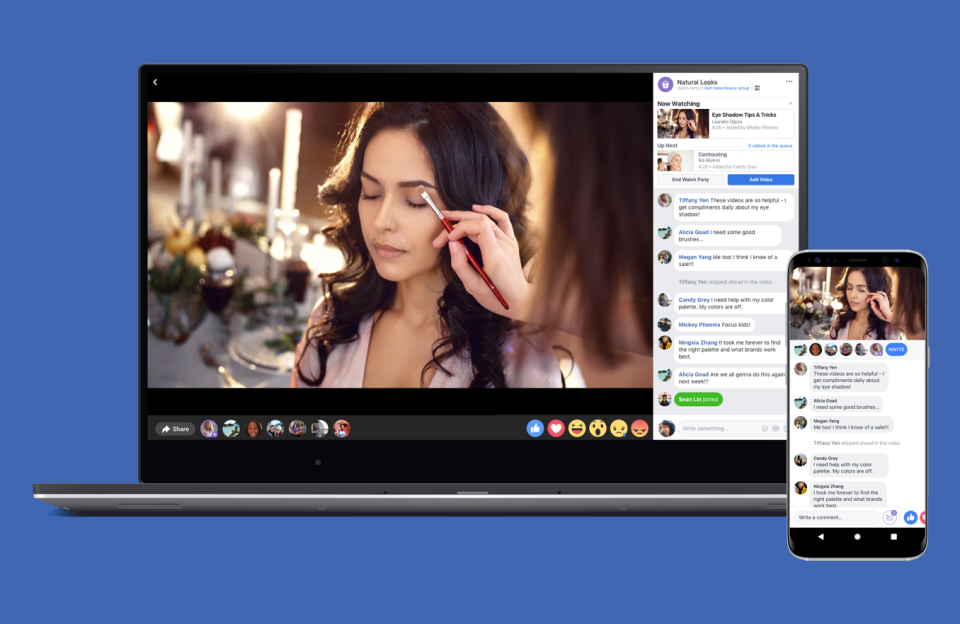
Facebook additionally announced a few new updates for its co-watching feature, Watch Party, which include the ability for Pages to schedule a party in advance to build anticipation, support for “replays” that will let others enjoy the video after airing, the ability to tag business partners in branded content, and new analytics.

As for the latter, two new metrics are being added to Creator Studio: Minutes Viewed and Unique 60s Viewers (total number of unique users that watched at least 60 seconds in a Watch Party.) These complement existing metrics like reach and engagement.

The Live Commenting feature, which allows a host to go live in a Watch Party to share their own commentary, is also now globally available.

Creator Studio

And wrapping all this up is an update to Creator Studio, which is what publishers use to post, manage, monetize and measure their content across both Facebook and Instagram.
Creator Studio Loyalty

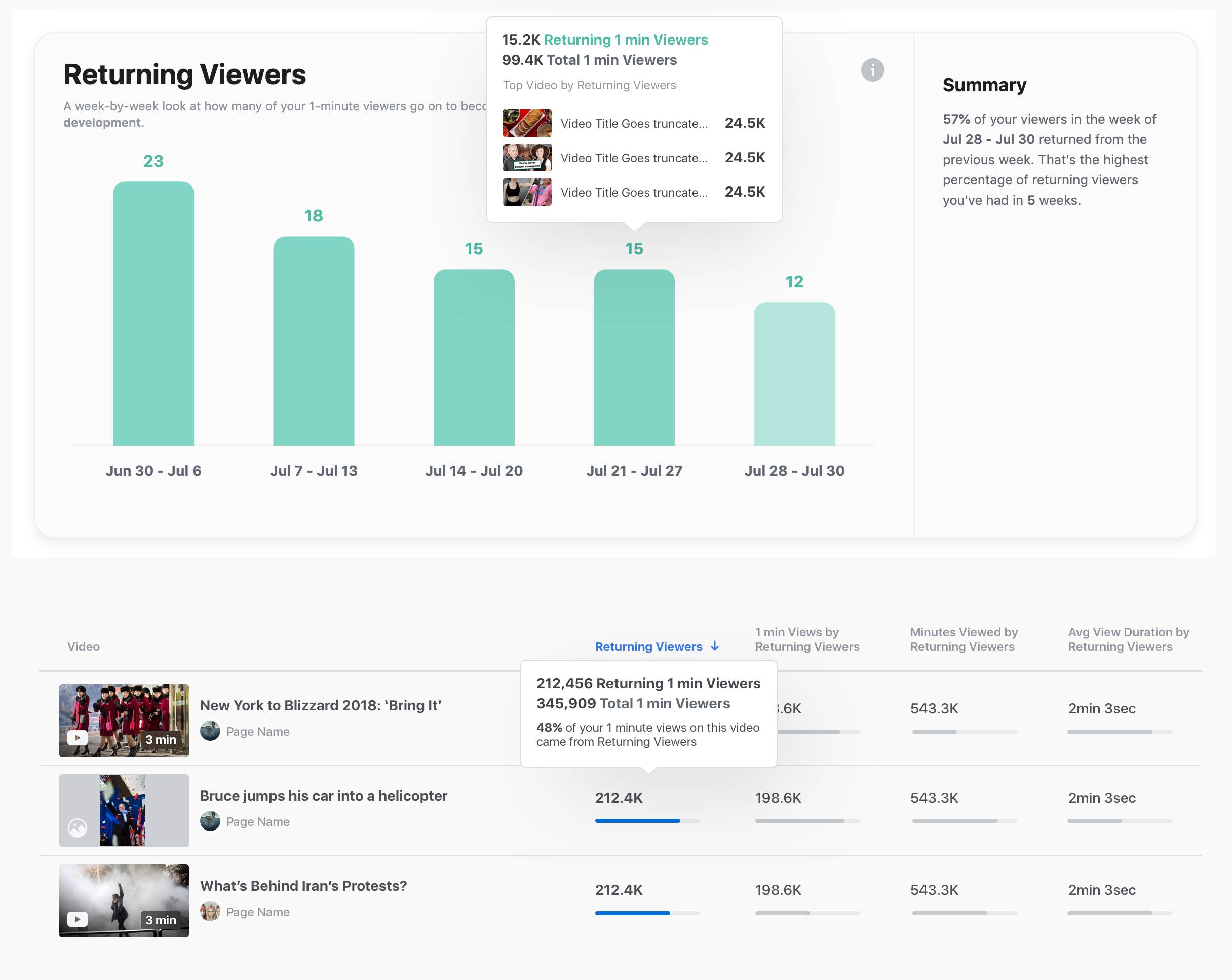
The dashboard will soon add a new visualization layer in Loyalty Insights to help creators see which videos loyal fans want to see, by measuring which videos drive return viewers.

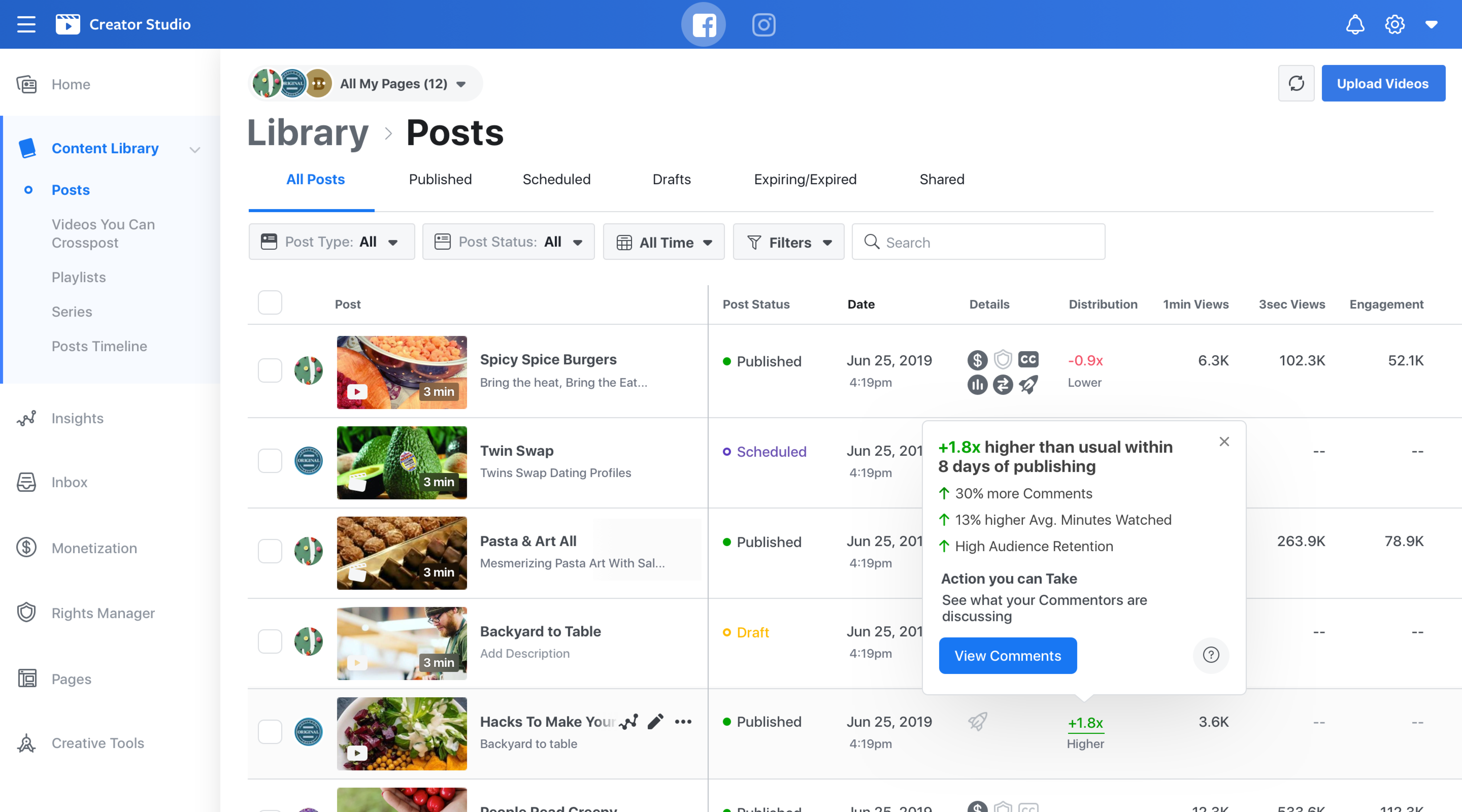
A new Distribution metric will score each video’s performance based on the Page’s historic average on a range of metrics, including: 1 Minute Views, Average Minutes Watched, and Retention. This feature, rolling out in the next few months, will offer an easy-to-read snapshot of a video’s performance.
Creator Studio Distribution

Creator Studio will also now support 13 more languages for auto-captioning: Arabic, Chinese, German, Hindi, Italian, Malay, Russian, Tagalog, Tamil, Thai, Turkish, Urdu, and Vietnamese. These are in addition to those languages already available, which included English, French, Portuguese and Spanish.

Instagram & IGTV Scheduling 

And finally, publishers and creators will be able to publish and schedule their Instagram Feed and IGTV content for up to 6 months. In a few more months, Instagram Feed and IGTV drafting and editing will also become available, the company says.

This feature was already spotted in the wild before today’s announcement, and sent the social media management and influencer community abuzz. It also follows an update to the Instagram API last year to allow scheduling by third-party applications. However, a native feature is not as limited as some of those other options.

The feature is now open to all creators and publishers with Facebook Pages, whereas before some were seeing it labeled only as “coming soon” or were not able to get it working. Story scheduling is not yet included here, but it wouldn’t be surprising to see it added further down the road.




16 Sep 2019

Trigo raises $22M for an automated grocery check out platform, similar to Amazon Go

Automated check-out systems in supermarkets, where cashiers are replaced by barcode-readers and touchscreen interfaces for taking payments, have become a commonplace fixture in many parts of the world. But today, a startup that’s building many believe will be the next generation of such systems — computer-vision-powered platforms that monitor what you take from the shelves and automatically tally it up as you are on the move so that you can leave without checking out — has raised funding to continue developing its product and help it connect with grocery retailers that have seen the advances of Amazon Go and also want to get in on the AI action, without getting involved with Amazon itself.

Trigo, a computer vision startup out of Tel Aviv that is building checkout-free grocery purchasing systems specifically targeted at large supermarkets, has picked up a Series A round of $22 million. The funding is being led by Red Dot Capital, with previous Vertex Ventures Israel and Hetz Ventures also participating. This round brings the total raised by Trigo to $29 million.

The company is not disclosing its valuation but says that it has a number of deals in place already with grocery chains, including an unspecified European chain and Shufersal, the largest grocer in Israel.

Shufersal already has plans to implement Trigo’s solution in 280 stores in the next five years, which speaks to the company’s ambitions and traction to date, even at this early stage in its development: The company says that it’s already piloting its camera and sensor technology in stores that are 5,000 square feet, or twice the size of a typical Amazon Go store. It’s however still fairly small compared to the size of a large supermarket (35,000-45,000 square feet) or even smaller challenger markets like a Trader Joe’s or a Lidl (20,000 square feet).

As with Amazon Go, Trigo works by implementing a series of cameras throughout a store to monitor shoppers and record what they are placing into their baskets. This is not just about being able to identify items: it’s also a triangulation system to ensure that people are not charged twice for items, and that items are removed from the total if they are discarded before a person leaves the store.

And it’s not just to speed things up, either. It’s to make shopping great again.

“I don’t actually think people really want grocery e-commerce,” co-founder and CEO Michael Gabay said. “They do that because the supermarket experience has become worse with the years. We are very much committed to helping brick and mortar stores return to the time of a few decades ago, when it was fun to go to the supermarket. What would happen if a store could have an entirely new OS that is based on computer vision?”

Unlike Amazon Go, Trigo is not tied to any specific company that might potentially compete with the retailers that it is targeting, and the product can be implemented to work with loyalty cards, or without them.

However, given that Amazon has built one of the world’s most valuable companies by being both a simultaneous competitor and partner to businesses, I’m not sure that its competitor status will be a gating factor to the growth of Amazon Go, if it decides to productise it and sell the technology to other retailers… and neither does Michael Bagay, the co-founder and CEO of Trigo, who said he was really happy to see Amazon Go launch.

“The technology behind Amazon Go existed in the industry for about a decade before Amazon Go,” he said (his own company launched in 2018). “But after it launched, it was a moment of realising, ‘Ah, this is really happening!'” Meaning, he knew now would be a fruitful period because other grocery retailers would want to get on board, and even if Amazon did roll Go out as its own service, and a service used by other retailers, there will be others who will never work with it, presenting a market opportunity to his startup.

If the endgame is bringing the time spent in the checkout phase down to zero, there are other startups working on alternative ways to reach that. Just last week, Caper raised a round of funding for a system that is based on “smart” trolleys, with sensors attached to grocery carts to take note of items and add them to your shopping bill. While the shopping cart might have the advantage of being able to more closely monitor an individual’s own shopping cart, store-wide systems like Trigo’s will potentially cost less to operate and the software might even be something that can be used on existing in-store cameras.

Interestingly, at a time when patents form one of the key ways that a company defends its intellectual property, Trigo is taking another approach. “We don’t file patents because we don’t want our technology to be public,” Gabay, who founded the company with his brother Daniel, said. “We have things that we don’t want anyone to see.” It’s an ironic, if perhaps telling, stance for a computer vision company.

In the rush to build tech solutions to all the world’s problems (and if not problems, at least all the world’s processes) there are bound to be others building further technology to bring grocery stores into the twenty-first century. Trigo presents one route to getting there, making it as much coveted company for grocery businesses as it is for the companies that provide other services to them.

“We believe that Trigo’s world-leading computer-vision team will be the first to scale this technology globally and unlock the full potential of a true grocery-wide revolution,” said Barak Salomon, Managing Partner of Red Dot Capital. “The process of manually scanning barcodes for each separate item at checkout is outdated and time consuming. Trigo’s technology is going to save brick and mortar, revitalizing the in-store experience while keeping the best part of shopping alive.”

16 Sep 2019

FOSSA scores $8.5 million Series A to help enterprise manage open source licenses

As more enterprise developers make use of open source, it becomes increasingly important for companies to make sure that they are complying with licensing requirements. They also need to ensure the open sources bits are being updated over time for security purposes. That’s where FOSSA comes in, and today the company announced an $8.5 million Series A.

The round was led by Bain Capital Ventures with help from Costanoa Ventures and Norwest Venture Partners. Today’s round brings the total raised to $11 million, according to the company.

Company founder and CEO Kevin Wang says that over the last 18 months, the startup has concentrated on building tools to help enterprises comply with their growing use of open source in a safe and legal way. He says that overall this increasing use of open source great news for developers, and for these bigger companies in general. While it enables them to take advantage of all the innovation going on in the open source community, they need to make sure they are in compliance.

“The enterprise is really early on this journey, and that’s where we come in. We provide a platform to help the enterprise manage open source usage at scale,” Wang explained. That involves three main pieces. First it tracks all of the open source and third-party code being used inside a company. Next, it enforces licensing and security policy, and finally, it has a reporting component. “We automate the mass reporting and compliance for all of the housekeeping that comes from using open source at scale,” he said.

The enterprise focus is relatively new for the company. It originally launched in 2017 as a tool for developers to track individual use of open source inside their programs. Wang saw a huge opportunity inside the enterprise to apply this same kind of capability inside larger organizations, who were hungry for tools to help them comply with the myriad open source licenses out there.

“We found that there was no tooling out there that can manage the scale and breadth across all the different enterprise use cases and all the really complex mission-critical code bases,” he said. What’s more, he found that where there were existing tools, they were vastly underutilized or didn’t provide broad enough coverage.

The company announced a $2.2 million seed round in 2017, and since then has grown from 10 to 40 employees. With today’s funding, that should increase as the company is expanding quickly. Wang reports that the startup has been tripling its revenue numbers and customer accounts year over year. The new money should help accelerate that growth and expand the product and markets it can sell into.

16 Sep 2019

Samsung’s Galaxy Tab S6 combines creative flexibility with great design

The Android tablet market isn’t exactly a hotbed of excitement and activity, which makes it all the more impressive that Samsung continues to iterate its own tablet lineup in smart, meaningful ways that push the technology forward and deliver a stellar experience. Samsung’s new Galaxy Tab S6 (starting at $649.99) is no exception, and this latest offering expands the definition of what a tablet can be while retaining or refining everything that’s been its predecessors.

Thin, light and luxe design

Samsung has been delivering outstanding body design on its tablet lineup since the introduction of the all metal and glass Tab S4, and the Tab S6 continues this tradition with a full metal back and glass front that’s lighter and thinner than its predecessor. The look and feel is more reminiscent of the Tab S5e, which was released after the S4 earlier this year and which acts as a more economical alternative to Samsung’s flagship lineup. The S6 manages to feel just a touch more premium than the S5e, though both are class-leading in terms of their industrial design.

The brushed finish of the back looks great, and feels nice in the hand, and if you have larger hands you can even one-hand this device when reading for limited periods of time. Samsung has also shrunk the bezels, giving you a more front face-filling screen than on any previous tablet, which does a very good job of putting the gorgeous sAMOLED display in focus. More than ever, this feels like one big sleek, metallic hand-held display – the future, in your hand, reduced to the essentials in an awesome way.

[gallery ids="1881813,1881812,1881811"]

Display and cameras

The display on the Tab S6 isn’t much changed from the one used on the Tab S5e and the Tab S4 – but that’s actually great news, because Samsung has the best tablet display in the business when it comes to watching media. The 10.5-inch 2560 x 1600 pixel Super AMOLED display gives you true blacks that are outstanding, and impossible to replicate on any LED-based display, and Samsung offers a range of color options to choose from, including ‘natural’ settings for photo-accurate editing, and enhanced saturation modes for getting the most out of eye-popping movies and videos.

That display now comes with a neat new trick on the Tab S6: An integrated fingerprint reader. This authentication and unlock method is new for this generation, and replaces iris/face scanning as the only biometric unlock option on the Tab S4. It performs very well in my testing, and has the added cool factor of being just an amazing big of whiz-bang tech magic, especially if this is your first time encountering and in-display fingerprint reader.

tab s6 screen fingerprint unlock

The great display makes a fantastic editing surface for photos and videos, and that’s why it’s super interesting that Samsung went out of their way to upgrade the cameras on the Tab S6 – adding dual camera options, in fact. There’s now a super wide angle lens in addition to the standard one, which gives you a lot of creative options when it comes to both still photography and videos.

While the Tab S6 is great for editing, I still wouldn’t lean too heavily on the built-in cameras for actually capturing content. They’re fine cameras, augmented by Samsung’s built-in software, but the super wide has a fair amount of distortion and not the best resolution, and in general I still think you should avoid shooting too much with tablet cameras in general. Still, it’s nice to have the option in case you’re in a pinch.

[gallery ids="1881836,1881837,1881838,1881839"]

Your pen pal

I mentioned editing above already, but the Samsung Galaxy Tab S6 has an added advantage over other tablets in this area: The S Pen. Samsung’s stylus is updated in this version, with Bluetooth connectivity that gives it additional super powers like the ability to act as a remote for the camera, presentations and other software.

Samsung Galaxy Tab S6 1The S Pen still performs best as an actual stylus, however, and it excels in this capacity. For pressure sensitive applications including sketching and painting, it’s fantastic, but where it really shines in my usage is in editing photos using software like Lightroom from Adobe. Stylus input means you can get super specific and accurate with your edits. This applies to editing video, too, where the stylus works well for making concise trims to video timelines.

You can also easily create handwritten notes with the S Pen, and if you do using Samsung’s built-in Notes application, you get automatic OCR and search indexing. In my testing, I found that this worked really, really well – surprisingly so, considering how bad my handwriting is. For printed characters, the Samsung Notes app had no trouble at all identifying words accurately in my scrawl and retrieving the right results when searching by keyword.

Since this S Pen uses Bluetooth, it now has a built-in rechargeable battery. Like Apple’s Pencil, it charges wirelessly, attaching magnetically to the tablet to power up. Samsung has designed a groove in the back of the tablet to receive the S Pen for charging, and while this isn’t sturdy enough for you to trust it to hold the stylus when you throw them in your bag unprotected, the Tab S6 cover accessory nicely wraps the S Pen with a fold-down flap for easy storage.

Samsung Galaxy Tab S6 6

A true workhorse

Samsung’s official case options include a back panel protector/detachable keyboard combo that are probably the best accessory of this style available on the market for any tablet. The back cover includes a reusable sticky surface to ensure a solid fit which will be more reliably fixed than a magnetic attachment, and it has a multi-angle kickstand that works wonderfully to support the tablet on any table or even on your lap.

As mentioned, there’s a top flap that provides protection and easy access to the S Pen, which is a very clever way to keep that stored without complicating matters. The cover has a finely textured surface that increases grippiness, and it has proven resilient in terms of not picking up dirt or grime so far.

[gallery ids="1881809,1881811,1881808,1881807"]

The keyboard attaches via magnets to one side of the tablet, folding up to protect the display when not in use. It’s slim, but it still had defined keys with actual travel that feel really good to type with, and there’s something you probably weren’t expecting to see on an Android tablet keyboard – a built-in trackpad.

All of this is designed primarily for use with DeX, Samsung’s desktop-like software experience that’s aimed at boosting productivity (though you can use the trackpad in the standard Android interface, too). When it works well, the DeX experience truly makes the Tab S6 feel like a mini desktop, giving you the power to tackle tasks in multiple windows – including in multiple windows for the same apps. It’s great for things like seeing Slack open and working in multiple browser windows, along with your email client, for instance.

That said, there are definite limitations to DeX, including the need to re-open all your windows when switching back from standard Android mode, for instance. Not every app behaves well in this novel mode, either, since third-party ones especially aren’t designed for it, and there are quirks to the windowing (like overflowing and weird-sized windows) that make it occasionally a little strange to work with. Still, all in all it’s great to have the option, and can really increase your ability to do work on the road in the right circumstances.

Bottom line

Samsung Galaxy Tab S6 5

The Samsung Galaxy Tab S6 is, without a doubt, the best Android tablet available. It combines top notch hardware with Samsung’s evolving DeX approach to mobile productivity, and while DeX isn’t perfect in all settings, it’s at the very least not doing any harm and you’re better off having it available vs. not. Meanwhile, the Tab S6 working in standard Android mode is an excellent, super-fast media consumption and photo editing powerhouse. If you’re in the market for a tablet, the Tab S6 is an easy choice.

16 Sep 2019

Salesforce doubles down on verticals, launches Manufacturing and Consumer Goods Clouds

As legacy industries make the migration to cloud-based, digital solutions to run and grow their businesses, Salesforce is hoping that it will get a cut of the action when it comes to their IT investments. The CRM giant has been doubling down on building specialised solutions for individual industry verticals, and today, it is unveiling new business units dedicated to not one but two of them, manufacturing and consumer goods.

The Manufacturing Cloud and Consumer Goods Cloud, as the two new products are called, are the latest in a list of other vertical-specific products that the company has created. Other verticals targeted to date include finance, healthcare, media, non-profits, and retail.

The idea behind Salesforce’s strategy to build industry-specific solutions is that while the CRM and sales processes that go into manufacturing and consumer goods do have some aspects in common with other industries, both also have relatively specific requirements, too, around how sales are agreed and clients are managed.

In the case of manufacturing and consumer goods, both are capital-intensive businesses where those working on the physical products might be very removed from those working on sales (not just in terms of job functions, but in terms of the software that’s used to manage each operation), or those who are in the field who are helping to distribute those goods to the people ultimately selling them.

“In the manufacturing industry, changing customer and market demands can have a devastating effect on the bottom line, so being able to understand what is happening on the ground is imperative for success,” said Cindy Bolt, SVP and GM, Salesforce Manufacturing, in a statement. “Manufacturing Cloud bridges the gap between sales and operations teams while ensuring more predictive and transparent business, so they can build deeper and more trusted relationships with their customers.”

In both the cases of manufacturing and consumer goods, Salesforce is not creating these services out of thin air: the company had already been touting solutions for both sectors as part of its bigger push into specific industries. Past acquisitions of companies like Steelbrick — a specialist in quote-to-cash solutions, a cornerstone of how manufacturing sales are made — are likely to have also played a contributing role in how the new clouds were built.

With the Manufacturing Cloud, Salesforce says that it has included a feature for sales agreements that link up with a company’s ERP and forecasting software to be able to better predict demand from individual customers as well as the wider market. The services are also coming with more analytical insights by way of Einstein Analytics, and more functionality to work with channel partners. Third parties working with Salesforce on joint solutions using Marketing Cloud include Acumen Solutions, Deloitte and Rootstock.

The Consumer Goods Cloud has some parallel with the Manufacturing Cloud, in that both are targeting businesses that are by their nature and by legacy very rooted in physical goods and are therefore not easily “disrupted” by digital innovation. Indeed, despite all that we hear about the might of Amazon and e-commerce, a full 95% of products are still sold in physical stores. That system has a lot of drawbacks, not least of them being challenges with consumer goods brands having accurate control over how products are distributed and ultimately sold.

“Retail execution remains one of the most important pieces of a consumer goods brands strategy, but so much opportunity is wasted if the field rep doesn’t have the data and technology needed to make smart decisions,” said John Strain, GM and SVP, Retail and Consumer Goods at Salesforce, in a statement. “Consumer Goods Cloud provides these field reps with the tools they need to be successful on the ground while helping build both business opportunities and stronger relationships with their retail partners.”

The company, citing research from PwC, claims that of the $200 billion that’s spent in the US by consumer goods companies each year on merchandising, marketing and sales efforts for in-store sales, some $100 billion of that spend is never used in the way it was originally intended. (That’s one reason so many consumer goods companies have jumped into social media: it’s a way of connecting better and more directly at least with the customers.)

That represents a huge area to tackle for a company likes Salesforce, and the Consumer Goods Cloud is the start of that effort. The product covers software that addresses areas optimising visits to stores, improving relationships with retailers, using Einstein insights for analytics, and ordering software. Partners in the effort include Accenture and PwC.

Another important thing to note here is that Salesforce’s move into the area comes as a competitive strike: Not only are there companies out there that have built products specifically for these markets — Sysco for consumer goods, and Atlatl Software for manufacturing, for example — but Salesforce has to contend with general rivals such as Microsoft and SAP also targeting the same potential customers.

As of last quarter, Sales Cloud now accounts for more than one-quarter of Salesforce’s revenues, but today’s news underscores how “sales” is becoming a more complex and nuanced topic for the company as its business continues to grow, and as cloud-based digital processes become ever more ubiquitous across all sectors beyond simply knowledge workers. As salesforce builds out more solutions to meet every kind of enterprise’s needs, it’s likely there will be more vertical-specific tools making their way to the platform.

16 Sep 2019

Plaid announces strategic investment from Mastercard and Visa

When Plaid announced its $250 million Series C investment, last year, it left out a couple of key investors. Today it revealed that Mastercard and Visa had also quietly participated in the round.

For a company like Plaid, which builds APIs to enable customers to access their bank accounts inside applications in a seamless way, having the blessing of two of the major credit companies in the world is a big deal. It could signal that the startup intends to move more broadly into payments, although it didn’t make any specific assertion it was doing that in the announcement.

CEO and co-founder Zach Perret, writing in a blog post this morning, addressed the broad implications of having these companies on board. “We’re particularly excited about what this means for our customers and consumers. As an industry when we come together with a shared vision for an ecosystem that is open, secure and encouraging of innovation the possibilities are limitless,” he wrote.

Screenshot 2019 09 16 07.44.17

Plaid tools

Plaid helps developers connect to financial services in a similar way that Stripe helps them to connect to payments or Trello to communications tools. By having access to a set of tools from Plaid, developers can build access to bank information and other financial data into their applications without having to have knowledge about how to connect to thousands of different banking systems.

Former CTO and co-founder William Hockey explained to TechCrunch what this meant in an announcement earlier this year:

“Everybody in the U.S. can actually use this product now. And some of those [connections] are super quick and instant, and some of those maybe take a day to verify, but what we’re doing is we’re wrapping all of that in the product. And so you as a developer, you don’t have to worry about all of the different authentication methods at some of these banks,” Hockey explained.

Plaid has raised over $310 million since it launched, and that Series C investment last year carried with it a fat $2.65 billion valuation. Strategic investments of this sort show that the industry as a whole is behind a startup, and having Mastercard and Visa on board, gives the company additional credibility in the marketplace.

16 Sep 2019

Get popcorn for iOS 13’s privacy pop-ups of creepy Facebook data grabs

Privacy-minded changes to smartphone operating systems which foreground the background activity of third party apps are helping to spotlight more of the surveillance infrastructure deployed by adtech giants to track and profile human eyeballs for profit.

To wit: iOS 13, which will be generally released later this week, has already been spotted catching Facebook’s app trying to use Bluetooth to track nearby users.

facebook BT

Why might Facebook want to do this? Matching Bluetooth (and wif-fi) IDs that share physical location could allow it to supplement the social graph it gleans by data-mining user-to-user activity on its platform.

Such location tracking provides a physical confirm that individuals were (at very least) in close proximity.

Combined with personal data Facebook also holds on people, and contextual data on the nature of the location itself — a bar, say, or a house — there’s a clear path for the company to make inferences about the nature of the relationship between the people who it’s repurposed short range wireless tech to determine are in close contact.

For a company that makes money by serving targeted ads at humans there are clear commercial reasons for Facebook to seek to intimately understand people’s friend networks.

Facebook piggybacking on people’s use of Bluetooth for benign purposes like pairing devices so that its ad business can ‘pair’ people is the sneaky modus operandi that iOS 13 has caught in the act here.

Ads are Facebook’s business, as CEO Mark Zuckerberg famously told the senate last year. But it’s worth noting the social network giant recently sought to push into the dating space — giving it a fresh, product-based incentive to pry into where and with whom humans are spending their time.

Algorithmic matchmaking based on cold signals like shared interests (in basic Facebook currency this might mean stuff like liking the same pages and events) is of course nothing new.

Yet mix in hot-blooded signals gathered by watching who actually mingles with whom, where and when — by repurposing Bluetooth to harvest interpersonal interactions via tracking people’s physical movements — and Facebook can take its curtain-twitching surveillance of human behavior to the next level.

The path of least resistance to tracking people’s movements is if Facebook app users are opting in to location tracking on their devices. Which means users enabling Location Services — a location tracking feature on smartphones that covers GPS, Bluetooth and crowd-sources wi-fi hotspots and mobile cell towers.

Unsurprisingly, then Facebook Dating requires Location Services to be enabled to function. The company confirmed to us that the Facebook app prompts dating users to enable Location Services if they haven’t already. Facebook also told us it doesn’t use wi-fi or Bluetooth to determine a person’s precise location if a user has Location Services turned off.

It also made a point of emphasizing that users can switch Location Services off at any time. Just not if they wish to use, er, Facebook Dating…

As per usual the company is tangling separate purposes for data processing in a way that denies people a meaningful choice over protecting their privacy. Hence Facebook dating users get to ‘choose’ between being able to use the service; or being able to blanket-deny Facebook the ability to track their physical movements. Like it or lump it.

iOS 13’s new privacy pop-ups to call out background app activity are a clear response to such disingenuous methods by an industry Apple CEO Tim Cook has dubbed the data industrial complex — putting a degree of control back in the hands of the user, who gets a third choice of manually disallowing Bluetooth proximity tracking (in the above example).

Android 10 has also recently expanded the location tracking controls it offers users — with the ability to only share location data with apps while you use them. Though Google’s OS lags far behind what Apple is now offering with these granular pop-ups.

Facebook has responded to awkward (for it) privacy changes incoming at the smartphone OS level by putting out an update on location services last week — where it seeks to get ahead of the deluge of data-grab warnings that iOS users of the Facebook app are likely to experience as they update to iOS 13.

Here it tries to spin Apple’s pro-active foregrounding of apps’ background tracking tactics via push notifications as “reminders” — in just one amusing rebrand.

But in a truly shameless contradiction Facebook also goes on to claim that: “You’re in control of who sees your location on Facebook” (because it says users can make use of the Location Services setting on a phone or tablet to deny tracking) — before admitting that switching off Location Services doesn’t actually mean Facebook will not track your location.

Just because you’re signalling very clearly to Facebook that you don’t want your location to be collected by Facebook doesn’t mean Facebook is going to respect that. Hell no!

“We may still understand your location using things like check-ins, events and information about your internet connection,” it writes. (For a clearer understanding of Facebook’s use of the word “understand” in that sentence we suggest you try substituting the word “steal”.)

In a final shameless kicker — in which Facebook almost appears to be trying to claim credit for smartphone OSes building more privacy features in response to its data grabs — the company seeks to finish on a forward-gazing note, per its preferred crisis PR custom, writing: “We’ll continue to make it easier for you to control how and when you share your location.”

Facebook dishing out misleading qualifications (e.g. “easier”) that whitewash the extent of its rampant data grabs is nothing new. But how much longer it can hope to rely on such flimsy figleaves to cover its privacy sins as the winds of change come rattling through remains to be seen…

16 Sep 2019

Beekeeper raises $45M Series B to become the ‘Slack for non-desk employees’

Beekeeper, the Switzerland and U.S.-based startup that provides a mobile-first communications platform for employers that need to communicate with blue-collar and service-oriented workers, has raised $45 million in Series B funding.

The round was co-led by Thayer Ventures and Swisscanto Invest by Zürcher Kantonalbank, with participation from previous backers including Atomico, Alpana Ventures, Edenred Capital Partners, Fyrfly, Hammer Team, investiere, HighSage Ventures, Keen Venture Partners, Samsung NEXT, Swiss Post, and Swisscom.

Targeting non-desk employees, including those working in hospitality, manufacturing, and retail, Beekeeper’s mobile-first platform is designed to replace more arcane communication methods, such as pen and paper and consumer messaging apps like WhatsApp.

The potential market is said to be big, too, with more than 80% of the world’s workers thought not to be sat at a desk and therefore arguably in need of a “Slack for non-desk employees,” which is how Beekeeper pitches itself. The company reckons 1.7 billion non-desk workers globally are either unconnected or poorly connected by a “patchwork” of consumer and enterprise applications.

Beekeeper’s clients include Hyatt Hotels, Dollar General, Domino’s Pizza. Heathrow Airport and SeaBoard Foods.

Meanwhile, with today’s Series B, Beekeeper’s says it plans to bridge the gap between knowledge workers and their non-desk counterparts, and further expand its offering with new features and integrations. On the product roadmap, for example, is a way for companies to be able to customise the Beekeeper experience via a “marketplace” of additional apps and integrations with systems such as Workday.

16 Sep 2019

Mitto, the payment card and app for ‘Gen Z’ teens, raises €2M seed round

Mitto, a debit card and app designed for “Generation Z” teens, has raised €2 million in seed funding.

Backing the round is Spanish bank Banco Sabadell via its innovation and venture arm InnoCells, along with Athos Capital, and Spanish social media influencers “AuronPlay” and “Wismichu”, amongst others.

Claiming to plug a gap in existing payment solutions for Generation Z (from 14 years old), Mitto offers a digital wallet and/or physical card for spending online or offline. Parents can send instant money to their children by topping up the wallet and get an overview of their “purchasing” profile.

In turn, the idea is that children gain a degree of financial independence by using Mitto and better understand their spending habits. More broadly, Mitto says it want to help develop financial literacy amongst Gen Z kids.

“Despite being born digital, Gen Z today don’t have easy access to a tool to use digital money,” says Mitto co-founder Marcos Cuevas. “Mitto is born to fix this by allowing them to own a digital wallet and virtual and physical cards. At the same time, we allow parents to educate and support financially their children in their first steps using a digital financial product”.

Cuevas says that the longer term mission of Mitto is to deliver the best payment solution experience for Generation Z and to help them understand the impact their spending has on the planet — as lofty as that sounds.

“We are committed to helping this new generation to change their mind about finance, to succeed by giving them the tools to understand their purchasing habits and — in the future — the impact of their decisions in the world, and how they can help to make it more sustainable,” he adds.

To that end, Mitto says the funding will allow it to further invest in its product and partnerships to become “the financial platform of choice” for Generation Z.

The Spanish fintech wants to launch its proposition in other European and Latam countries where it says demand exists. It claims a waiting list of more than 80,000 users in several countries and says it currently has 150.000 registered users.

Meanwhile, directly-comparable competitors include GoHenry and Osper in the U.K., and Current, Step, and Greenlight in the U.S., to name a few.

16 Sep 2019

Leeto helps works councils manage perks

French startup Leeto provides a service for French works councils, better known as comités d’entreprise. The fintech startup lets you hand out perks to employees using a simple web service combined with a payment card.

Leeto recently raised a $2.2 million funding round (€2 million) from Founders Future and various business angels, such as Thomas Rebaud (Meero), Benjamin Netter (October) and Vincent Luciani (Artefact).

If you’re not familiar with French works councils, every French company with more than 50 employees has to elect representatives to defend the interests of employees — starting in 2020, companies with more than 11 employees will have a works council. They act as the interface between members of the board and employees, and they vote on strategic moves.

In addition to that role, companies have to hand out a small budget to the works council every year. Works councils can then reimburse cultural or sports activities, hand out gift cards for Christmas, give movie tickets, etc.

And Leeto wants to manage that budget in particular. Many companies currently have a cumbersome process. You have to send receipts of your yoga lessons, find a store that accepts your gift cards… It’s even worse for representatives as they have to order paper gift cards and make sure everyone picks up their gift cards at their desk.

Leeto is a software-as-a-service the lets you manage all that from a web browser. You can add employees and then grant them perks.

Later this year, every employee will get a prepaid Mastercard that the works council can top up and manage. For instance, representatives can hand out €500 a year for vacation and cultural activities. Employees can then use this card to pay for a Netflix subscription, train tickets, museum tickets and more. It works a bit like Lunchr, but for works councils.

If employees go on vacation and forget their card, they can also upload eligible expenses to get reimbursed even if they paid with a personal card.

On the works council’s side, Leeto wants to make it easier to manage accounting and send notifications to employees. Leeto currently costs €3 per employee per month, but that’s directly taken from the budget of the works council so employees don’t pay that.