Category: UNCATEGORIZED

11 Sep 2019

Theresia Gouw and Ann Miura-Ko are coming to Disrupt

For a very long time, the venture industry was stubbornly resistant to change. The same people sat back in their chairs on Sand Hill Road while nervous founders made the rounds, hoping one of these firms would champion their cause.

No longer. Since roughly the advent of Y Combinator, the landscape has seemed to shift by the year, with more startups raising capital every year, more people becoming VCs, more Medium posts, more newsletters, more events, more great founders, more bad behavior, more congestion, and more money from all over the world finding its way to Silicon Valley and a growing number of smaller but fast-growing hubs.

How to make sense of it all? At Disrupt, we do our best to answer that question by sitting down each year with top venture capitalists who tell us what they are seeing. In 2015, for example, we talked with VCs about why you can start, but not always scale, a company from anywhere. In 2016, the discussion turned to why VCs were gathering up so much capital when the IPO market was (at the time) all but closed to new tech issuers. In 2017, we examined how then-new U.S. President Donald Trump might impact the venture and startup industry. By last year, we were talking about Softbank, mega rounds, and whether Silicon Valley is losing its gravitational pull.

This year, we’re again going to be taking stock of what trends have so far defined 2019, and what may be around the corner, and we’re thrilled to announce the VCs who will help us to answer some of these questions: Ann Miura-Ko, a cofounder of the seed- and early-stage venture firm Floodgate, and Theresia Gouw, a cofounder of the early-stage venture firm Aspect Ventures.

Both of these longtime investors bring a lot of deep insights to any venture discussion. Miura-Ko has been in the industry since before the last major tech boom, starting in the late ’90s. Then a McKinsey analyst who was focused on wireless technologies, she went on to become an analyst at the venture firm CRV before cofounding with partner Mike Maples the venture firm Floodgate in 2008. Since joining forces, Floodgate has backed a long list of powerful companies, including Twitch, Sonos, Chegg, AdRoll, BazaarVoice, and Lyft, where Miura-Ko remains on the board of directors. She has seen plenty of ups and downs, within both Floodgate’s portfolio and the broader startup industry.

Gouw, meanwhile, also has a perspective on the industry that many newer investors don’t enjoy, having worked as a VP at a Bay Area startup during the dot.com run-up, then joining the venture firm Accel in 1999, just a year before the industry imploded. It could have been a short-lived stint. Instead, she helping the firm sift through the wreckage and right itself before leaving in 2014 to start her own firm — Aspect —  with partner and former DFJ partner Jennifer Fonstad. Since then, the firm has backed a wide variety of companies, from The RealReal to Exabeam, HotelTonight to Forescout. Put another way, Gouw also knows what the deal is.

We can’t wait to sit down with both of these top investors to talk about the trends shaping the industry right now, from the growing secondary market to IPO trends, from what excites them the most to what their biggest concerns are for their firms and their portfolio companies as we sail toward 2020.

It’s a conversation you will not want to miss if you want a better understanding of what’s happening on the ground right now. Join us at Disrupt SF, which runs October 2 to 4 at the Moscone Center. Tickets are available here.
11 Sep 2019

AirDrop gets an upgrade in iOS 11

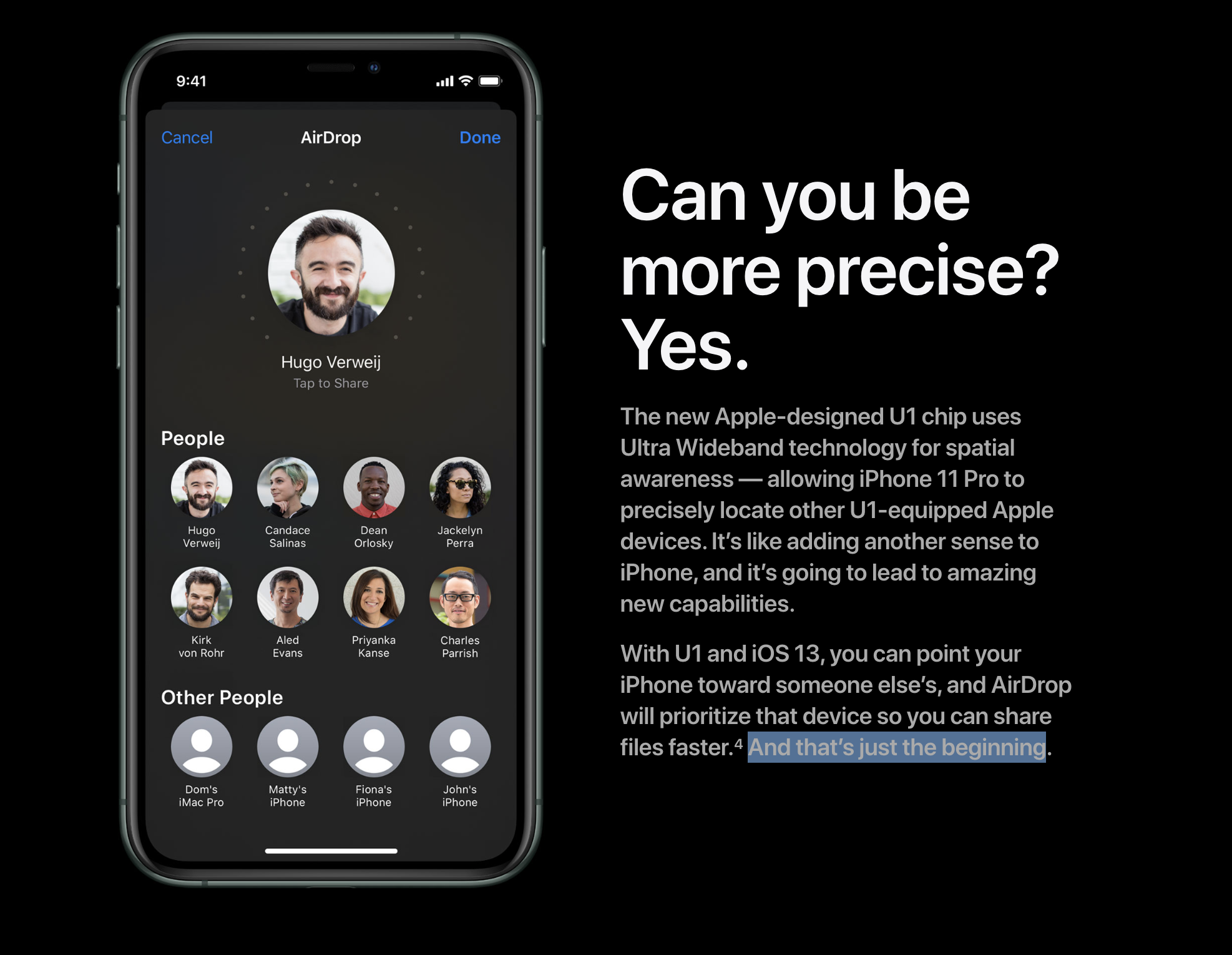
AirDrop, Apple’s proximity-based, built-in file sharing feature and home to teen meme exchanges, is getting an upgrade with the new iPhones. At Apple’s iPhone press event on Tuesday, the company introduced the iPhone 11 line of devices, which include a new Apple -designed U1 chip that uses Ultra Wideband technology for spatial awareness. This will offer a number of improvements to the iPhone’s capability, but Apple is starting with upgraded AirDrop functionality as a more practical use case.

With the U1 chip and iOS 13, you’ll be able to point your iPhone towards someone else’s and AirDrop will prioritize that device in the list of possible AirDrop recipients. This will help to speed up the AirDrop process, which today can still be uncumbersome at times — especially at places where there are a lot of people gathered, like a concert or business convention, for example.

Screen Shot 2019 09 11 at 11.22.22 AM

The additional capability was first spotted by MacRumors in the updates to Apple’s website that rolled out after the iPhone event.

What’s particularly interesting about the U1’s ultra wideband technology is that it’s also what’s rumored to power the forthcoming Apple Tag devices, which were not announced at yesterday’s event.

Apple Tag, it’s been reported, will be a competitor to the lost item tracker Tile which allows you to attach a small tag to items you need to keep up with — like your keys, wallet or bag, for example. Tile leverages Bluetooth and a crowdsourced network of Tile owners running its app on their device to help find missing items. Apple Tag is said to work similarly, via Apple’s Find My app, but will also feature ultra wideband tech.

More recently, references to Apple’s Tile competitor were also spotted in iOS 13 code by MacRumors.

Though Apple didn’t make any announcements about the product, it does seem to hint on the website that AirDrop upgrades are only the first of many enhancements that will come about thanks to the U1 chip, by saying: “And that’s just the beginning.” 

Presumably, whatever that statement is actually referring to will be released further down the road, perhaps as soon as its next big press event.


11 Sep 2019

iFixit gives Fairphone 3 a perfect 10 for repairability

Here’s something the hermetically sealed iPhone can’t do: Score a perfect 10 for repairability.

Smartphone startup and social enterprise Fairphone’s latest repairable-by-design smartphone has done just that, getting 10/10 in an iFixit Teardown vs scores of just 6/10 for recent iPhone models.

The Fairphone 3, which was released in Europe last week with an RRP of €450, gets thumbs up across the board in iFixit’s hardware Teardown. It found all the internal modules to be easily accessible and replaceable — with only basic tools required to get at them (Fairphone includes a teeny screwdriver in the box). iFixit also lauds visual cues that help with disassembly and reassembly, and notes that repair guides and spare parts are available on Fairphone’s website.

iFixit’s sole quibble is that while most of the components inside the Fairphone 3’s modules are individually replaceable “some” are soldered on. A tiny blip that doesn’t detract from the 10/10 repairability score

Safe to say, such a score is the smartphone exception. The industry continues to encourage buyers to replace an entire device, via yearly upgrade, instead of enabling them to carry out minor repairs themselves — so they can extend the lifespan of their device and thereby shrink environmental impact.

Dutch startup Fairphone was set up to respond to the abject lack of sustainability in the electronics industry. The tiny company has been pioneering modularity for repairability for several years now, flying in the face of smartphone giants that are still routinely pumping out sealed tablets of metal and glass which often don’t even let buyers get at the battery to replace it themselves.

To wit: An iFixit Teardown of the Google Pixel rates battery replacement as “difficult” with a full 20 steps and between 1-2 hours required. (Whereas the Fairphone 3 battery can be accessed in seconds, by putting a fingernail under the plastic back plate to pop it off and lifting the battery out.)

The Fairphone 3 goes much further than offering a removable backplate for getting at the battery, though. The entire device has been designed so that its components are accessible and repairable.

So it’s not surprising to see it score a perfect 10 (the startup’s first modular device, Fairphone 2, was also scored 10/10 by iFixit). But it is strong, continued external validation for the Fairphone’s designed-for-repairability claim.

It’s an odd situation in many respects. In years past replacement batteries were the norm for smartphones, before the cult of slimming touchscreen slabs arrived to glue phone innards together. Largely a consequence of hardware business models geared towards profiting from pushing for clockwork yearly upgrades cycle — and slimmer hardware is one way to get buyers coveting your next device.

But it’s getting harder and harder to flog the same old hardware horse because smartphones have got so similarly powerful and capable there’s precious little room for substantial annual enhancements.

Hence iPhone maker Apple’s increasing focus on services. A shift that’s sadly not been accompanied by a rethink of Cupertino’s baked in hostility towards hardware repairability. (It still prefers, for example, to encourage iPhone owners to trade in their device for a full upgrade.)

At Apple’s 2019 new product announcement event yesterday — where the company took the wraps off another clutch of user-sealed smartphones (aka: iPhone 11 and iPhone 11 Pro) — there was even a new financing offer to encourage iPhone users to trade in their old models and grab the new ones. ‘Look, we’re making it more affordable to upgrade!’ was the message.

Meanwhile, the only attention paid to sustainability — during some 1.5 hours of keynotes — was a slide which passed briefly behind marketing chief Phil Schiller towards the end of his turn on stage puffing up the iPhone updates, encouraging him to pause for thought.

Apple 2019 event

“iPhone 11 Pro and iPhone 11 are made to be designed free from these harmful materials and of course to reduce their impact on the environment,” he said in front of a list of some toxic materials that are definitely not in the iPhones.

Stuck at the bottom of this list were a couple of detail-free claims that the iPhones are produced via a “low-carbon process” and are “highly recyclable”. (The latter presumably a reference to how Apple handles full device trade-ins. But as anyone who knows about sustainability will tell you, sustained use is far preferable to premature recycling…)

“This is so important to us. That’s why I bring it up every time. I want to keep pushing the boundaries of this,” Schiller added, before pressing the clicker to move on to the next piece of marketing fodder. Blink and you’d have missed it.

If Apple truly wants to push the boundaries on sustainability — and not just pay glossy lip-service to reducing environmental impact for marketing purposes while simultaneously encouraging annual upgrades — it has a very long way to go indeed.

As for repairability, the latest and greatest iPhones clearly won’t hold a candle to the Fairphone.

11 Sep 2019

Google Express to close in a few weeks, will become part of Google Shopping

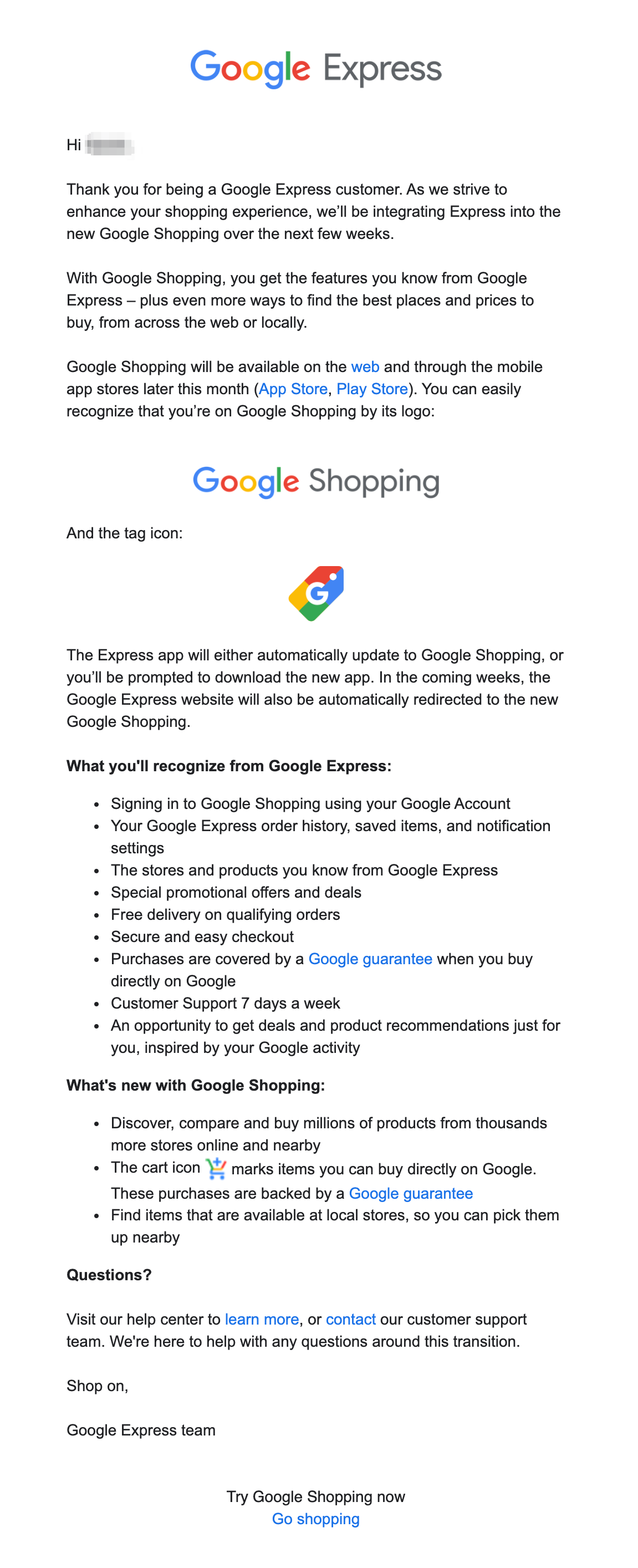
Google’s failed online shopping service Google Express is closing in a few weeks, as its features will be merged into a revamped version of Google Shopping, Google says in an email sent to its customers this week. The company had already announced its plans to shutter the Google Express brand, as part of a wider redesign of how it approached online shopping. This included new advertising options for brands and online sellers, as well as a universal shopping cart across its platform of services, like Search, Shopping, Images, and even YouTube.

While Google is characterizing Google Express’s closure as an “integration,” it’s really more of a sunsetting of a failed product and brand.

Google Express was Google’s high-profile attempt to compete with Amazon for online shopping clicks and ad dollars buy creating a virtual mall on the web filled with top retailers’ products. Because Google is not a retailer itself, it did what it knows best — it organized information. At Google Express, you could find products from thousands of retailers — including big names like Walmart, Target, Walgreens, Best Buy, and others. And you could shop through a dedicated online storefront on the web, a Google Express mobile app, or even Google Assistant.

In the latter case, Google Express partnered with retailers like Walmart and Target for deep integrations for voice-enabled shopping. As direct competitors with Amazon, these retailers didn’t want to offer third-party skills for Echo users or others on Amazon’s Alexa platform. Google represented a safer third-party platform for their experiments with voice commands and personalized shopping.

But even several years after launch, Google Express had failed to offer any real threat to Amazon. Its retail partners, meanwhile, were building out their own fulfillment businesses for their customers’ online orders — like Walmart Grocery’s curbside pickup and delivery, for example, or Target’s Shipt, Drive Up, and Restock.

Not too much later, Target and Walmart were pulling out of Google Express.

Google has tried to downplay the news of Google Express’s demise by including it as just another part to the larger Google Shopping revamp. After all, it’s not a shutdown, the company implied. Its features were simply becoming a part of Google Shopping! Nothing to see here! Just a rebrand!

But clearly, Google Express had been unable to establish itself in consumers’ minds as its own dedicated shopping destination. If customers wanted an online mall, they already had one with either Amazon or Walmart and their vast third-party marketplaces where you could find just about anything you’d need. Nor had Google innovated (or acquired) across key areas like warehousing or logistics, while others like Amazon, Target and Walmart had been spending billions.

With Google Shopping, Google goes back to its search engine roots. It aims to simply capture consumers’ clicks, ad dollars and now conversions no matter where they are on Google’s sites — whether that’s shopping from Merch shelves under YouTube videos, browsing photos in a Pinterest-y manner on Google Images, or through more traditional Google searches for products where ads become shoppable, and shopping carts follow you around Google’s part of the web.

In an email to Google Express shoppers that was sent this week, Google says Google Express will be integrated with Shopping in a few weeks’ time.

The redesigned Google Shopping will then be available across the web and through apps for iOS and Android later this month. At that point, the Google Express apps will automatically update to become Google Shopping, if you already had them installed.

The full email about Google Express’ closure is below:

google express shutdown


11 Sep 2019

Google Express to close in a few weeks, will become part of Google Shopping

Google’s failed online shopping service Google Express is closing in a few weeks, as its features will be merged into a revamped version of Google Shopping, Google says in an email sent to its customers this week. The company had already announced its plans to shutter the Google Express brand, as part of a wider redesign of how it approached online shopping. This included new advertising options for brands and online sellers, as well as a universal shopping cart across its platform of services, like Search, Shopping, Images, and even YouTube.

While Google is characterizing Google Express’s closure as an “integration,” it’s really more of a sunsetting of a failed product and brand.

Google Express was Google’s high-profile attempt to compete with Amazon for online shopping clicks and ad dollars buy creating a virtual mall on the web filled with top retailers’ products. Because Google is not a retailer itself, it did what it knows best — it organized information. At Google Express, you could find products from thousands of retailers — including big names like Walmart, Target, Walgreens, Best Buy, and others. And you could shop through a dedicated online storefront on the web, a Google Express mobile app, or even Google Assistant.

In the latter case, Google Express partnered with retailers like Walmart and Target for deep integrations for voice-enabled shopping. As direct competitors with Amazon, these retailers didn’t want to offer third-party skills for Echo users or others on Amazon’s Alexa platform. Google represented a safer third-party platform for their experiments with voice commands and personalized shopping.

But even several years after launch, Google Express had failed to offer any real threat to Amazon. Its retail partners, meanwhile, were building out their own fulfillment businesses for their customers’ online orders — like Walmart Grocery’s curbside pickup and delivery, for example, or Target’s Shipt, Drive Up, and Restock.

Not too much later, Target and Walmart were pulling out of Google Express.

Google has tried to downplay the news of Google Express’s demise by including it as just another part to the larger Google Shopping revamp. After all, it’s not a shutdown, the company implied. Its features were simply becoming a part of Google Shopping! Nothing to see here! Just a rebrand!

But clearly, Google Express had been unable to establish itself in consumers’ minds as its own dedicated shopping destination. If customers wanted an online mall, they already had one with either Amazon or Walmart and their vast third-party marketplaces where you could find just about anything you’d need. Nor had Google innovated (or acquired) across key areas like warehousing or logistics, while others like Amazon, Target and Walmart had been spending billions.

With Google Shopping, Google goes back to its search engine roots. It aims to simply capture consumers’ clicks, ad dollars and now conversions no matter where they are on Google’s sites — whether that’s shopping from Merch shelves under YouTube videos, browsing photos in a Pinterest-y manner on Google Images, or through more traditional Google searches for products where ads become shoppable, and shopping carts follow you around Google’s part of the web.

In an email to Google Express shoppers that was sent this week, Google says Google Express will be integrated with Shopping in a few weeks’ time.

The redesigned Google Shopping will then be available across the web and through apps for iOS and Android later this month. At that point, the Google Express apps will automatically update to become Google Shopping, if you already had them installed.

The full email about Google Express’ closure is below:

google express shutdown


11 Sep 2019

Kubernetes co-founder Craig McLuckie is as tired of talking about Kubernetes as you are

“I’m so tired of talking about Kubernetes . I want to talk about something else,” joked Kubernetes co-founder and VP of R&D at VMware Craig McLuckie during a keynote interview at this week’s Cloud Foundry Summit in The Hague. “I feel like that 80s band that had like one hit song — Cherry Pie.”

He doesn’t quite mean it that way, of course (though it makes for a good headline, see above), but the underlying theme of the conversation he had with Cloud Foundry executive director Abby Kearns was that infrastructure should be boring and fade into the background, while enabling developers to do their best work. “We still have a lot of work to do as an industry to make the infrastructure technology fade into the background and bring forwards the technologies that developers interface with, that enable them to develop the code that drives the business, etc. […] Let’s make that infrastructure technology really, really boring. ”

IMG 20190911 115940

What McCluckie wants to talk about is developer experience and with VMware’s intend to acquire Pivotal, it’s placing a strong bet on Cloud Foundry as one of the premiere development platforms for cloud native applications. For the longest time, the Cloud Foundry and Kubernetes ecosystem, which both share an organizational parent in the Linux Foundation, have been getting closer, but that move has accelerated in recent months as the Cloud Foundry ecosystem has finished work on some of its Kubernetes integrations.

McLuckie argues that the Cloud Native Computing Foundation, the home of Kubernetes and other cloud-native open-source projects, was always meant to be a kind of open-ended organization that focuses on driving innovation. And that created a large set of technologies that vendors can choose from. “But when you start to assemble that, I tend to think about you building up this cake which is your development stack, you discover that some of those layers of the cake, like Kubernetes, have a really good bake. They are done to perfection,” said McLuckie, who is clearly a fan of the Great British Baking show. “And other layers, you look at it and you think, wow, that could use a little more bake, it’s not quite ready yet. […] And we haven’t done a great job of pulling it all together and providing a recipe that delivers an entirely consumable experience for everyday developers.”

EEK3PG1W4AAaasp

He argues that Cloud Foundry, on the other hand, has always focused on building that highly opinionated, consistent developer experience. “Bringing those two communities together, I think, is going to have incredibly powerful results for both communities as we start to bring these technologies together,” he said.

With the Pivotal acquisition still in the works, McLuckie didn’t really comment on what exactly this means for the path forward for Cloud Foundry and Kubernetes (which he still talked about with a lot of energy, despite being tired of it), but it’s clear that he’s looking to Cloud Foundry to enable that developer experience on top of Kubernetes that abstracts all of the infrastructure away for developers and makes deploying an application a matter of a single CLI command.

Bonus: Cherry Pie.

11 Sep 2019

Explorium reveals $19.1M in total funding for machine learning data discovery platform

Explorium, a data discovery platform for machine learning models, received a couple of unannounced funding rounds over the last year — a $3.6 million seed round last September and a $15.5 million Series A round in March. Today, it made both of these rounds public.

The seed round was led by Emerge with participation of F2 Capital. The Series A was led by Zeev Ventures with participation from the seed investors. The total raised is $19.1 million.

The company founders, who have a data science background, found that it was problematic to find the right data to build a machine learning model. Like most good startup founders confronted with a problem, they decided to solve it themselves by building a data discovery platform for data scientists.

CEO and co-founder, Maor Shlomo says that the company wanted to focus on the quality of the data because not much work has been done there. “A lot of work has been invested on the algorithmic part of machine learning, but the algorithms themselves have very much become commodities. The challenge now is really finding the right data to feed into those algorithms,” Sholmo told TechCrunch.

It’s a hard problem to solve, so they built a kind of search engine that can go out and find the best data wherever it happens to live, whether it’s internally or in an open data set, public data or premium databases. The company has partnered with thousands of data sources, according to Schlomo, to help data scientist customers find the best data for their particular model.

“We developed a new type of search engine that’s capable of looking at the customers data, connecting and enriching it with literally thousands of data sources, while automatically selecting what are the best pieces of data, and what are the best variables or features, which could actually generate the best performing machine learning model,” he explained.

Shlomo sees a big role for partnerships, whether that involves data sources or consulting firms, who can help push Explorium into more companies.

Explorium has 63 employees spread across offices in Tel Aviv, Kiev and San Francisco. It’s still early days, but Sholmo reports “tens of customers.” As more customers try to bring data science to their companies, especially with a shortage of data scientists, having a tool like Explorium could help fill that gap.

11 Sep 2019

Web feature developers told to dial up attention on privacy and security

Web feature developers are being warned to step up attention to privacy and security as they design contributions.

Writing in a blog post about “evolving threats” to Internet users’ privacy and security, the W3C standards body’s technical architecture group (TAG) and Privacy Interest Group (PING) set out a series of revisions to the W3C’s Security and Privacy Questionnaire for web feature developers.

The questionnaire itself is not new. But the latest updates place greater emphasis on the need for contributors to assess and mitigate privacy impacts, with developers warned that “features may not be implemented if risks are found impossible or unsatisfactorily mitigated”.

In the blog post, independent researcher Lukasz Olejnik, currently serving as an invited expert at the W3C TAG; and Apple’s Jason Novak, representing the PING, write that the intent with the update is to make it “clear that feature developers should consider security and privacy early in the feature’s lifecycle” [emphasis theirs].

“The TAG will be carefully considering the security and privacy of a feature in their design reviews,” they further warn, adding: “A security and privacy considerations section of a specification is more than answers to the questionnaire.”

The revisions to the questionnaire include updates to the threat model and specific threats a specification author should consider — including a new high level type of threat dubbed “legitimate misuse“, where the document stipulates that: “When designing a specification with security and privacy in mind, all both use and misuse cases should be in scope.”

“Including this threat into the Security and Privacy Questionnaire is meant to highlight that just because a feature is possible does not mean that the feature should necessarily be developed, particularly if the benefitting audience is outnumbered by the adversely impacted audience, especially in the long term,” they write. “As a result, one mitigation for the privacy impact of a feature is for a user agent to drop the feature (or not implement it).”

Features should be secure and private by default and issues mitigated in their design,” they further emphasize. “User agents should not be afraid of undermining their users’ privacy by implementing new web standards or need to resort to breaking specifications in implementation to preserve user privacy.”

The pair also urge specification authors to avoid blanket treatment of first and third parties, suggesting: “Specification authors may want to consider first and third parties separately in their feature to protect user security and privacy.”

The revisions to the questionnaire come at a time when browser makers are dialling up their response to privacy threats — encouraged by rising public awareness of the risks posed by data leaks, as well as increased regulatory action on data protection.

Last month the open source WebKit browser engine (which underpins Apple’s Safari browser) announced a new tracking prevention policy that takes the strictest line yet on background and cross-site tracking, saying it would treat attempts to circumvent the policy as akin to hacking — essentially putting privacy protection on a par with security.

Earlier this month Mozilla also pushed out an update to its Firefox browser that enables an anti-tracking cookie feature across the board, for existing users too — demoting third party cookies to default junk.

Even Google’s Chrome browser has made some tentative steps towards enhancing privacy — announcing changes to how it handles cookies earlier this year. Though the adtech giant has studiously avoided flipping on privacy by default in Chrome where third party tracking cookies are concerned, leading to accusations that the move is mostly privacy-washing.

More recently Google announced a long term plan to involve its Chromium browser engine in developing a new open standard for privacy — sparking concerns it’s trying to both kick the can on privacy protection and muddy the waters by shaping and pushing self-interested definitions which align with its core data-mining business interests.

There’s more activity to consider too. Earlier this year another data-mining adtech giant, Facebook, made its first major API contribution to Google’s Chrome browser — which it also brought to the W3C Performance Working Group.

Facebook does not have its own browser, of course. Which means that authoring contributions to web technologies offers the company an alternative conduit to try to influence Internet architecture in its favor.

The W3C TAG’s latest move to focus minds on privacy and security by default is timely.

It chimes with a wider industry shift towards pro-actively defending user data, and should rule out any rubberstamping of tech giants contributions to Internet architecture which is obviously a good thing. Scrutiny remains the best defence against self-interest.

11 Sep 2019

Kenshō, ‘the antithesis of Goop,’ launches a research-based guide to natural medicine

Goop is cashing in on pseudoscience and, in the process, giving natural health practices a bad name. Krista Berlincourt, the co-founder and chief executive officer of a new startup, Kenshō Health, hopes she can take back the narrative.

“We’re the antithesis of Goop,” Berlincourt, a fintech veteran who previously led marketing and product at Simple Finance, tells TechCrunch. “What we are creating is less of a consumer magazine. We are a holistic health platform that approaches things as more of a holistic health medical journal — everything is backed by science.”

Kenshō, launching today, is an invite-only subscription-based platform for holistic healthcare providers to list their services and share knowledge. The startup has also collected information to construct a research-backed guide to holistic health, something the team believes has been missing from the natural health sector.

Berlincourt and Kenshō co-founder Danny Steiner, who previously worked at NBC Universal, Conde Nast and Hulu before pivoting to health and wellness, have raised $1.3 million in seed funding from Crosscut, a Los Angeles-based venture capital firm, and Female Founders Fund. The pair, based in the LA area, have both suffered from chronic illnesses that had them in and out of doctor’s offices for years.

“I had two years of working with a team of incredible Western physicians and then I had a crash that landed me in the ER. That’s when I realized, OK, this isn’t working,” Berlincourt said. “When you’re caring for yourself or someone you love, there are standards. I am focused on elevating and creating those standards in a way that can be better advised.”

The global wellness economy represented a $4.2 trillion market in 2017, according to The Global Wellness Institute, as subcategories like personalized medicine, healthy eating and fitness/mind-body accelerate growth.

Kenshō, nestled in the personalized and complementary medicine category, says it ensures all of the care providers featured on its platform are 100% validated. Before being allowed to list their services, providers complete a background check and their provider credentials are verified. Kenshō then affirms the providers use research-backed methods and that they have vetted peer references and clients who can provide positive feedback.

Kenshō’s launch features providers from Stanford University, Harvard University, Columbia University and more.

“When you look at health as a whole today in the U.S., we only treat the physical,” Berlincourt explains. “The reason that is destructive is 70% of death is premature and lifestyle related. We are dying faster and people are dying more quickly, generally speaking, as the world turns.”

Many, of course, are skeptical of natural care practices because they can be untested or dependent on unscientific principles. Additionally, holistic care often forces patients to pay out-of-pocket. Nonetheless, patients across the globe are turning to non-traditional methods.

”There’s been a massive shift in the zeitgeist in the way people look at health,” she adds. “One in three people have paid for supplemental care out of pocket from a holistic health provider.”

11 Sep 2019

ScyllaDB takes on Amazon with new DynamoDB migration tool

There are a lot of open source databases out there, and ScyllaDB, a NoSQL variety, is looking to differentiate itself by attracting none other than Amazon users. Today, it announced a DynamoDB migration tool to help Amazon customers move to its product.

It’s a bold move, but Scylla, which has a free open source product along with paid versions, has always had a penchant for going after bigger players. It has had a tool to help move Cassandra users to ScyllaDB for some time.

CEO Dor Laor says DynamoDB customers can now also migrate existing code with little modification. “If you’re using DynamoDB today, you will still be using the same drivers and the same client code. In fact, you don’t need to modify your client code one bit. You just need to redirect access to a different IP address running Scylla,” Laor told TechCrunch.

He says that the reason customers would want to switch to Scylla is because it offers a faster and cheaper experience by utilizing the hardware more efficiently. That means companies can run the same workloads on fewer machines, and do it faster, which ultimately should translate to lower costs.

The company also announced a $25 million Series C extension led by Eight Roads Ventures. Existing investors Bessemer Venture Partners, Magma Venture Partners, Qualcomm Ventures and TLV Partners also participated. Scylla has raised a total of $60 million, according to the company.

The startup has been around for 6 years and customers include Comcast, GE, IBM and Samsung. Laor says that Comcast went from running Cassandra on 400 machines to running the same workloads with Scylla on just 60.

Laor is playing the long game in the database market, and it’s not about taking on Cassandra, DynamoDB or any other individual product. “Our main goal is to be the default NoSQL database where if someone has big data, real-time workloads, they’ll think about us first, and we will become the default.”