Category: UNCATEGORIZED

11 Sep 2019

Relativity Space signs its the satellite transportation company Momentus as its first customer

Relativity Space, the startup developing manufacturing technologies for entirely 3D printed rockets and space equipment, has signed its latest paying customer, the orbital transportation startup, Momentus.

Relativity’s Terran 1 rocket will carry Momentus’ small and medium-sized satellite payloads on its rocket and Momentus will then move those satellites into geosynchronous orbit using its own in-space shuttle technology.

The deal between Momentus and Relativity covers the first Terran 1 launch scheduled for 2021, with the option for five additional Relativity launches, according to a statement from the company.

Carrying Momentus’ payloads enables the company to include more diverse ranges of orbits for Terran 1’s initial launch, including geostationary transfer orbit, Lunar and deep space orbits, lower inclinations and phasing multiple spacecraft in low Earth orbit, the company said.

The tie-up links two of Y Combinator’s space-focused alumni, with Momentus graduating in 2018 and Relativity launching from the accelerator in 2016.

In July, Momentus closed on a $25 million round of funding to move its business from simply providing a thruster for existing small-sats to becoming a full-service provider of orbital transportation services for payloads. The company’s key innovation was the development of a water-based plasma propulsion system for low-cost transportation in space. That’s what powers the company’s Vigoride orbital shuttle.

Meanwhile, Relativity Space is barreling ahead with its own technology development. 

With the goal of building a rocket that goes from raw materials to launch-ready in less than 60 days with a payload capacity of up to 1250 kilograms, the company is planning its first test launch in 2020 with a commercial payload ready for 2021.

So far the company has performed 200 engine tests to date across 14 different serial numbers and begun conducting turbo pump testing as well. Testing has also begun on the company’s initial avionics hardware, according to company co-founder Tim Ellis.

Relativity has also started printing and stress testing some second stage structures and is beginning to print its larger primary stage structures now.

“With Momentus’ innovations in sustainable in-space ‘last mile’ solutions, we look forward to working together to expand Terran 1’s flexibility and offering beyond LEO, offering small and medium satellite launch opportunities with industry-defining lead time, flexibility, and cost,” Ellis said in a statement. “This partnership will enable us to build the space economy faster, and accelerate the future of humanity in space.”

The company has dramatically expanded its production, testing and launch facilities to include 280,000 square feet of operations on facilities at Cape Canaveral in Florida and the NASA Stennis Space Center in Mississippi.

Relativity also has customer agreements with Telesat, to support their low Earth orbit constellation; the Thai satellite and space technology company, mu Space; and Spaceflight Industries to launch their smallsat ride-shares.


 

11 Sep 2019

Bux launches ‘BUX Zero’ to begin offering fee-free trading in Netherlands

Bux, the Amsterdam-based fintech that wants to make investing more accessible, is launching its fee-free trading app today.

Dubbed “BUX Zero,” the new offering is available first to users in the Netherlands who previously signed up to the wait-list. Further European launches are to follow, with Germany and Austria up next.

The BUX Zero app promises to demystify investing in public markets for people who perhaps haven’t done so before, and also make it cheaper.

“It will offer a unique combination of a simplified investing experience along with a vibrant community where they can follow, learn from fellow investors and explore new investing opportunities,” Nick Bortot, CEO and founder of Bux, told TechCrunch in June.

In addition, the idea is by removing fees it makes investing small sums more viable — a high fee per buy/sell can make it prohibitively expensive to do so.

At launch, both market orders and limit orders are commission-free until the end of this year, after which Bux will charge €1 and €2 per order, respectively.

A “market order” executes as quickly as possible at the market price, and a “limit order” sets the maximum/minimum price you are willing to buy or sell.

Once the special offer ends, BUX Zero will also introduce a third order type called a “basic order”, which will be commission-free “forever” and is executed at a fixed time, once per day.

A subscription plan is also being tested. This will give BUX Zero users the option of paying a fixed monthly fee to get access to unlimited commission-free market, limit and basic orders. “The subscription fee will be lower than the commission of a single transaction at a traditional online broker,” says Bux.

All of this is made possible because, like a number of competitors, such as Freetrade, Bux recently brought its brokering in-house.

Bortot has previously said this gives the company control over “the full value chain,” including a full brokerage license, back-end technology and operation — and, of course, lowers overheads per trade.

It’s a similar argument made by challenger banks that have built out their own banking stack.

11 Sep 2019

Nigerian online-only bank startup Kuda raises $1.6M

Nigerian fintech startup Kuda — a digital-only retail bank — has raised $1.6 million in pre-seed funding.

The Lagos and London-based company recently launched the beta version of its online mobile finance platform. Kuda also received its banking license from the Nigerian Central Bank, giving it a distinction compared to other fintech startups.

“Kuda is the first digital-only bank in Nigeria with a standalone license. We’re not a mobile wallet or simply a mobile app piggybacking on an existing bank,” Kuda bank founder Babs Ogundeyi told TechCrunch.

“We have built our own full-stack banking software from scratch. We can also take deposits and connect directly to the switch,” Ogundeyi added, referring to the Nigeria’s Central Switch — a SWIFT-like system that facilitates bank communication and settlements.

A representative for the Central Bank of Nigeria (speaking on background) confirmed Kuda’s banking license and status, telling TechCrunch, “As far as I’m aware there is no other digital bank [in Nigeria] that has a micro-finance license.”


Kuda Transaction Screen Card

Kuda offers checking accounts with no monthly-fees, a free debit card, and plans to offer consumer savings and P2P payments options on its platform in coming months.

“You can open a bank account within five minutes, do all the KYC in the app, and you get issued a new bank account number,” according to Ogundeyi. Kuda bank Founder CEO Babs OgundeyiOgundeyi — a repeat founder who exited classifieds site Motortradertrader.ng and worked in a finance advisory role to the Nigerian government — co-founded Kuda in 2018 with former Stanbic Bank software developer Musty Mustapha.

The two convinced investor Haresh Aswani to lead the $1.6 million pre-seed funding, along with Ragnar Meitern and other angel investors. Aswani confirmed his investment to TechCrunch and that he will take a position on Kuda’s board.

Kuda plans to use its seed funds to go from beta to live launch in Nigeria by fourth-quarter 2019. The startup will also build out the tech of its banking platform, including support for its developer team located in Lagos and Cape Town, according to Ogundeyi.

Kuda also intends to expand in the near future. “It’s Nigeria for right now, but the plan is build a Pan-African digital-only bank,” he said.

As of 2014, Nigeria has held the dual distinction as Africa’s largest economy and most populous country (with 190 million people).

To scale there, and add some physical infrastructure to its online model, Kuda has correspondent relationships with three of Nigeria’s largest financial institutions: GTBank, Access Bank and Zenith Bank.

He clarified the banks are partners and not investors. Kuda customers can use these banks’ branches and ATMs to put money into bank accounts or withdraw funds without a fee.

“Even though we don’t own a single branch, we actually have the largest branch network in the country,” Ogundeyi claimed.

Kuda’s plans to generate revenues focus largely around leveraging its bank balances. “We plan to match different liability classes to the different asset classes that we create. That’s how we make money, that’s how we get efficiency in terms of income,” Ogundeyi said.

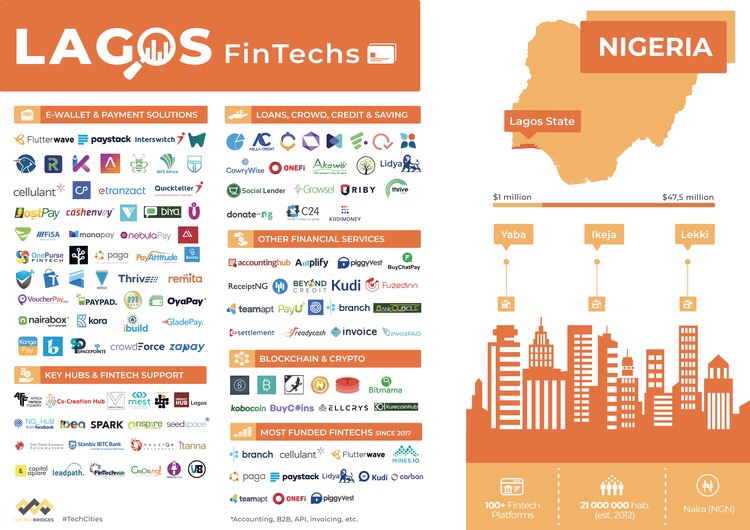
In Nigeria, Kuda enters a potentially revenue-rich market, but its one that already hosts a crowded fintech field — as the country becomes ground zero for payments startups and tech investment in Africa.

Briter Bridges Lagos Nigeria Fintech MapIn both raw and per capita numbers, Nigeria has been slower to convert to digital payments than leading African countries, such as Kenya, according to joint McKinsey Company and Gates Foundation analysis done several years ago. The same study estimated there could be nearly $1.3 billion in revenue up for grabs if Nigeria could reach the same digital-payments penetration as Kenya.
A number of startups — established and new — are going after that prize in the West African country — several with a strategy to scale in Nigeria first before expanding outward on the continent and globally.

San Francisco-based, no-fee payment venture Chipper Cash entered Nigeria this month.

Series B-stage Nigerian payments company Paga raised $10 million in 2018 to further grow its customer base (that now tallies 13 million) and expand to Asia and Latin America.

Kuda CEO Babs Ogundeyi believes the startup can scale and compete in Nigeria on a number of factors, one being financial safety. He names the company’s official bank status and the Nigeria Deposit Insurance Corporation security that brings as something that can attract cash-comfortable bank clients to digital finance.

Ogundeyi also points to offerings and price.”We look to be the next generation bank where you can do everything— savings, payments and transfers — and also the one that’s least expensive,” he said.


11 Sep 2019

Gig worker bill AB-5 passes in California

Assembly Bill 5, the gig worker bill opposed by the likes of Uber, Lyft and DoorDash, has passed in the California State Senate. This comes shortly after California Governor Gavin Newsom officially put his support behind AB 5 in an op-ed.

The bill needed 21 votes to pass in the State Senate. It passed in a 29 to 11 vote this evening.

The next step is for Governor Newsom to sign the bill into law, which he is expected to do. If he signs the bill, it will go into effect at the beginning of 2020.

“AB 5 is only the beginning,” Gig Workers Rising member and driver Edan Alva said in a statement. “I talk daily to other drivers who want a change but they are scared. They don’t want to lose their only source of income. But just because someone really needs to work does not mean that their rights as a worker should be stepped all over. That is why a union is critical. It simply won’t work without it.”

The bill, first introduced in December 2018, aims to codfiy the ruling established in Dynamex Operations West, Inc. v Superior Court of Los Angeles. In that case, the court applied the ABC test and decided Dynamex wrongfully classified its workers as independent contractors based on the presumption that “a worker who performs services for a hirer is an employee for purposes of claims for wages and benefits…”

Those who work as 1099 contractors can set their own schedules, and decide when, where and how much they want to work. For employers, bringing on 1099 contractors means they can avoid paying payroll taxes, overtime pay, benefits and workers’ compensation.

According to the ABC test, in order for a hiring entity to legally classify a worker as an independent contractor, it must prove the worker is free from the control and direction of the hiring entity, performs work outside the scope of the entity’s business and is regularly engaged in an “independently established trade, occupation, or business of the same nature as the work performed.”

In short, AB-5, which has already passed in the California State Assembly, would ensure gig economy workers are entitled to minimum wage, workers’ compensation and other benefits.

Uber and Lyft, two of the main targets of this legislation, are adamantly against it. Last month, Uber, Lyft and DoorDash amped up their efforts to do whatever they can to prevent it from happening. That’s in part due to the fact that the companies cost of operating would increase.

Uber, Lyft and DoorDash each put $30 million toward funding a 2020 ballot initiative that would enable them to keep their drivers as independent contractors.

Assuming Gov. Newsom signs the bill, it will go into effect Jan. 1, 2020.

11 Sep 2019

California passes landmark bill that requires Uber and Lyft to treat their drivers as employees

California legislators have passed a bill that would treat workers at so-called gig economy companies such as Uber and Lyft as employees, giving them access to improved wage and benefit protections.

The 29-11 vote passed on late Tuesday sends the bill back to the State Assembly for final approval. Democratic Governor Gavin Newsom, who has maintained his support for the bill, is expected to approve it.

The proposal, expected to go into effect January 1, had drawn sharp opposition from ridesharing companies and on-demand delivery firms. When Uber, which posted a record $5.2 billion in loss last quarter and laid off hundreds this week, filed to become a public company, it told the SEC that its business would be “adversely affected if drivers were classified as employees instead of independent contractors.”

The bill says that if a contractor’s work is part of a company’s regular business, then they must be designated as employees. And thus, these workers will get access to more protections such as minimum wage, the right to unionize, and overtime.

11 Sep 2019

SpaceX ‘getting ready’ to fly orbital Starship design with new FCC filing

SpaceX is taking the steps necessary to begin test flying the orbital-class version of its Starship spacecraft, with new documents filed by the company (via Teslarati) with the FCC seeking necessary permissions for it to communicate with the prototype while it’s in flight.

The company filed documents with the U.S. regulatory agency this week in advance of the flight, which lists a max altitude of 74,000 feet, which is a far cry from Earth orbit but still a much greater distance vs. the 500 or so feet achieved by the squat ‘Starhopper’ demonstration and test vehicle that SpaceX has been actively operating in preparation for Starship .

SpaceX CEO Elon Musk confirmed that prep was underway via tweet. Musk has previously said that he hoped to follow the Starhopper’s most recent and final successful test quickly with tests of the full-scale vehicle. Like with that low-altitude test, SpaceX will aim to launch and land the Starhopper, with touch down planned just a short distance away.

Assembly and construction of the Starship prototype looks to be well underway, and Musk recently teased a Starship update event for September 28, which is likely when we’ll see this prototype assembled and ready to go ahead of its planned October first test flight window.

Starship is the next generation of SpaceX spacecraft, designed for maximum reusability, and with the aim of creating one vehicle that can serve the needs of current and future customers, eventually replacing both Falcon 9 and Falcon Heavy. Starship is also a key ingredient in Musk’s ambitious plan to reach and establish a continuing human presence on Mars.

11 Sep 2019

Vegetarian frozen food brand Strong Roots looks to expand in the U.S. with $18.3 million funding

The U.K.-based vegetarian frozen food company Strong Roots has picked up $18.3 million in funding from the private equity firm, Goode Partners, as it looks to expand its U.S. presence and build out its technological capabilities.

Advised by global mid-market investment bank, Alantra, Strong Roots has a presence in the U.S. in retailers including Target, Wegmans and Whole Foods, and in the UK at Tesco, Asda, Sainsbury’s and Marks and Spencer.

Neither a direct to consumer company nor a novel technology developer, Strong Roots is hoping to use the new financing to expand its research and development efforts to provide more functional foods and nutrients, according to chief executive officer Samuel Dennigan.

The company is on track to move $50 million worth of frozen vegan food items in the calendar year, and it expects its sales to more than quadruple over the next four years.

The company’s exceptional growth comes at a time when consumers globally are looking for healthy options. Strong Roots offers a range of tasty plant-based food designed for busy lives. Found in your freezer aisle, the award-winning line includes premium root vegetables, veggie burgers and freezer favorites like Cauliflower Hash Browns.

The company has found a strong partner in Goode Partners, whose previous investments include AllSaints and La Colombe.

Dennigan’s career in agribusiness stretches back 15 years, but his family has long been in the food production and distribution business.

“I started working with some international brands in the late nineties and saw how CPG companies were doing things in a poor way,” says Dennigan. At first the company thought it would go after fresh foods, but saw more opportunity in the frozen food aisle.

Strong Roots began selling its frozen foods in 2015 just as the vegan and health food craze began to surge.

While the company has spent the past four years building up a brand as a vegan alternative in frozen foods, Dennigan is now ready to expand into other categories. “The pieces of IP that are going to be developed and placed in market in the next 12 months especially around the fortification of the products,” he says. “What our research is showing us is that there’s a huge opportunity between extruded and food and what we’re doing.”

Dennigan is, of course, referring to companies like Beyond Meat and Impossible Foods which have built protein replacement businesses over the past ten years and have surged into consumer consciousness with big deals at fast food chains (and no small amount of kerfuffles).

The success of those two companies has set up a feeding frenzy among investors who are voraciously scarfing up vegetarian food companies to add to their portfolios.


11 Sep 2019

Vegetarian frozen food brand Strong Roots looks to expand in the U.S. with $18.3 million funding

The U.K.-based vegetarian frozen food company Strong Roots has picked up $18.3 million in funding from the private equity firm, Goode Partners, as it looks to expand its U.S. presence and build out its technological capabilities.

Advised by global mid-market investment bank, Alantra, Strong Roots has a presence in the U.S. in retailers including Target, Wegmans and Whole Foods, and in the UK at Tesco, Asda, Sainsbury’s and Marks and Spencer.

Neither a direct to consumer company nor a novel technology developer, Strong Roots is hoping to use the new financing to expand its research and development efforts to provide more functional foods and nutrients, according to chief executive officer Samuel Dennigan.

The company is on track to move $50 million worth of frozen vegan food items in the calendar year, and it expects its sales to more than quadruple over the next four years.

The company’s exceptional growth comes at a time when consumers globally are looking for healthy options. Strong Roots offers a range of tasty plant-based food designed for busy lives. Found in your freezer aisle, the award-winning line includes premium root vegetables, veggie burgers and freezer favorites like Cauliflower Hash Browns.

The company has found a strong partner in Goode Partners, whose previous investments include AllSaints and La Colombe.

Dennigan’s career in agribusiness stretches back 15 years, but his family has long been in the food production and distribution business.

“I started working with some international brands in the late nineties and saw how CPG companies were doing things in a poor way,” says Dennigan. At first the company thought it would go after fresh foods, but saw more opportunity in the frozen food aisle.

Strong Roots began selling its frozen foods in 2015 just as the vegan and health food craze began to surge.

While the company has spent the past four years building up a brand as a vegan alternative in frozen foods, Dennigan is now ready to expand into other categories. “The pieces of IP that are going to be developed and placed in market in the next 12 months especially around the fortification of the products,” he says. “What our research is showing us is that there’s a huge opportunity between extruded and food and what we’re doing.”

Dennigan is, of course, referring to companies like Beyond Meat and Impossible Foods which have built protein replacement businesses over the past ten years and have surged into consumer consciousness with big deals at fast food chains (and no small amount of kerfuffles).

The success of those two companies has set up a feeding frenzy among investors who are voraciously scarfing up vegetarian food companies to add to their portfolios.


10 Sep 2019

Audi’s off-roading electric concept would be perfect for Tatooine

Concept vehicles are a staple of the auto show circuit. And while most will never end up as a production vehicle, they can provide insight into an automaker and clues to where it’s headed.

Over at Audi, designers and engineers might have had a distant planet in mind. Or at least an expanse of wilderness.

The German automaker unveiled Tuesday at the Frankfurt Motor Show the Audi AI: TRAIL quattro, a concept electric vehicle designed for the “future of off roading.” The “Trail” off roader is one of four concept vehicles that Audi has presented at various auto shows since 2017. Other concepts included a sports car, luxury vehicle and one designed for megacities.

Audi argues that these concepts aren’t efforts of futility. Instead, the company says it these four vehicles show how Audi vehicles in the future will be designed for specific use cases.

“In the future, customers will be able to order any of these specialist Audi models from an Audi on-demand vehicle pool to suit their personal preferences and requirements and to lease them for a limited period,” the company said in its announcement.

Audi takes this idea of the on-demand subscription further by noting that vehicles will be configured to suit individual preferences of customers who use this still non-existent and totally conceptual on-demand product. All the essential customer information would be stored in the myAudi system and accompanying app, the company said.

In the video below, Audi’s head of design Marc Lichte explains the thinking behind these concepts.


In the case of the Audi AI: TRAIL, designers put an emphasis on exploration and seeing the surrounding environment. It even comes with five drones, which aside from replacing the headlights, can provide other tasks such as lighting up your camping area or picnic spot.

The all-electric concept, which has a range of up to 310 miles, is about 13.5 feet long and 7 feet wide and is outfitted with beefy 22-inch wheels. And because it’s a vehicle meant to off road, designers gave it ground clearance of 13.4 inches. This concept, if it really existed beyond the showroom floor, can ford through water more than half a meter deep. The range of the vehicle does drop on rough roads to about 155 miles, which would theoretically (if this vehicle actually existed) make wilderness travel more difficult.

[gallery ids="1880216,1880211,1880220,1880215,1880212,1880213,1880210,1880221,1880214,1880207"]

The battery unit is integrated into the floor providing a spacious interior that sits four people. Glass surrounds the cabin to provide unrivaled views of the environment, whether it’s an earthly vista or the binary sunset over the fictional Tatooine desert.

The remaining exterior body is made of a mixture of high-tech steel, aluminum and carbon fiber, giving it a total weight of 3,858 pounds.

The concept vehicle is equipped with four electric motors, systems for assisted and automated driving and all-wheel drive. What you won’t find are any screens for streaming video. This concept was designed for viewing the outside world.

The interior, which uses recycled materials, is scant. There are pedals, a yoke for a steering wheel, a few buttons, and a smartphone attached to the steering column as a display and control center for vehicle functions and navigation.

The second row features seats that are designed to function like hammocks — and can be removed and used as mobile outdoor chairs.

Drones as headlights!

Perhaps the most interesting feature is the inclusion of five rotorless electrically operated drones, which serve a variety of purposes. The drones, which have matrix LED lighting, can dock on the roof to get more power with the inductive charging elements.

Audi calls these drones Audi Light Pathfinders because of their ability to fly and illuminate the path ahead. These drones, Audi says replace headlights altogether. When the vehicle is parked, the drones can be used ti light up the surrounding area.

Occupants control the drones through their smartphones in this theoretical use case. The on-board cameras can generate a video image that can be transmitted to the display in front of the driver via Wi-Fi, turning the Pathfinders into “eyes in the sky,” Audi says.

10 Sep 2019

Razer made a case for cooling iPhones while gaming

Razer’s efforts to build a game-centric smartphone haven’t exactly caught the world on fire just yet. Still, mobile gaming is a huge business poised to get even bigger, with services from big names like Apple and Google waiting in the wings.

Seeing as how accessories have long been the company’s bread and button, products like Arctech are probably an easier way for the company to ensure it’s got a horse in that race. The product is a phone case specifically designed to help stop phones from overheating during resource-intensive activities like gaming.

Thermaphene

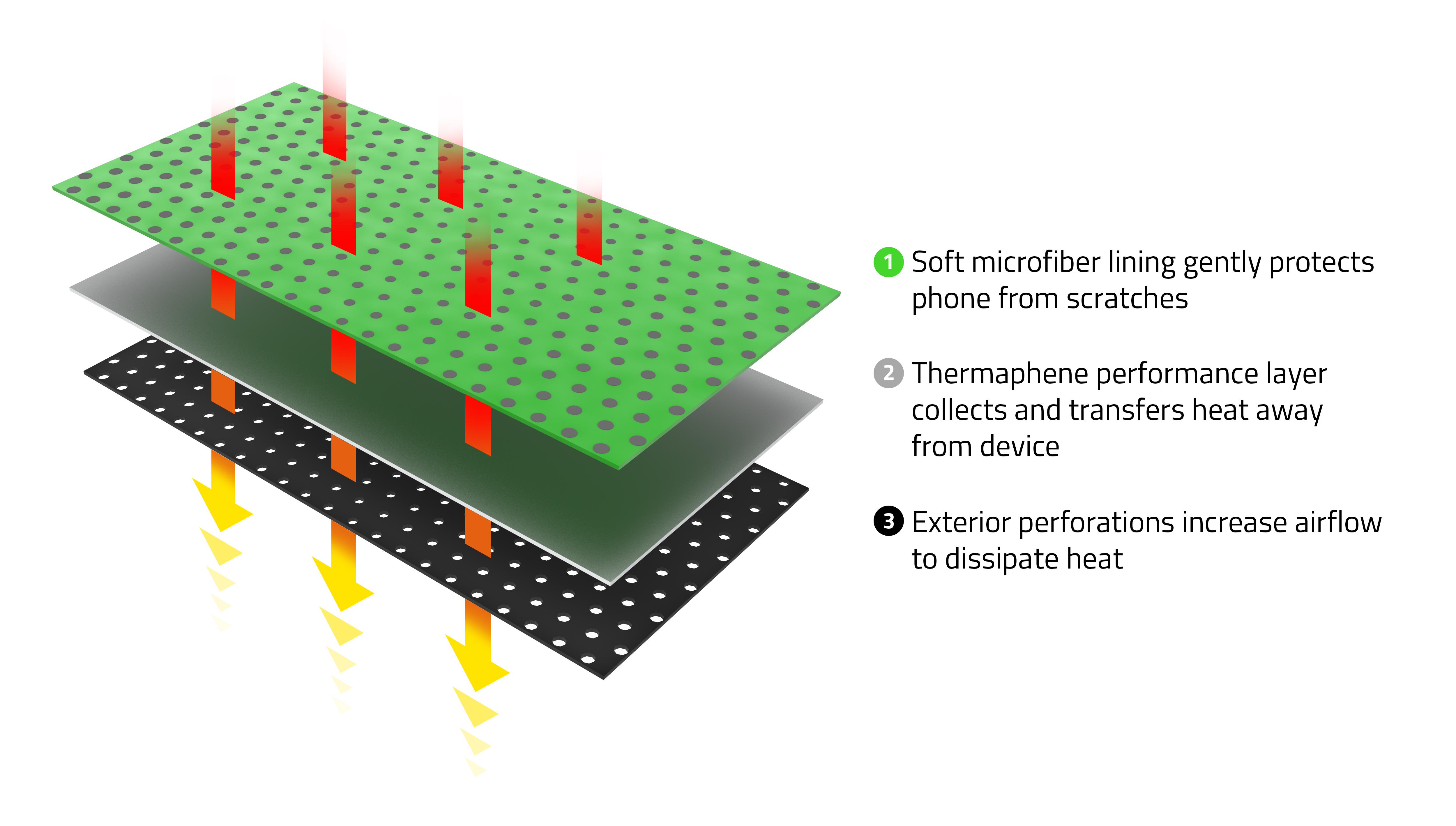
The product uses Razer’s proprietary Thermaphene technology sandwiched between microfiber lining and an outer casing with perforations to help let the heat out. Per Razer,

Thermaphene is a thermally – conductive material that dissipates heat. In independent testing against similar style cases, the Razer Arctech case maintained temperatures up to 6° Celsius (42.8 Fahrenheit) lower than the comparison case.

There are two versions of the case, Slim and Pro, the latter of which offers added protection for up to a 10 foot drop. As for why the company’s launching today, in addition to the Razer Phone 2, the Arctech will be available for all of Apple’s new iPhones. The Slim runs $30 and the Pro is $40. They’re both available starting today.