Category: UNCATEGORIZED

08 Sep 2019

Kite Hill, cofounded by the creator of Impossible Foods, looks to be gaining traction, too

Before he founded the plant-based burger company Impossible Foods, Patrick Brown, who spent 25 years as a biochemistry professor at Stanford, also co-founded a Hayward, Ca.-based food company called Kite Hill that has developed numerous nut milk products that it says are healthier and more sustainable than their dairy counterparts.

Investors seem to agree. According to a new SEC filing, the now nine-year-old company is sealing up $15 million more in funding (and has at least $10 million in fresh capital locked down). The company most recently closed a round if funding last fall, including from backers General Mills, CAVU Venture Partners, and New Crop Capital, and this newest infusion should bring the company’s total funding to around $80 million, according to Crunchbase.

It’s easy to understand their enthusiasm for the space more broadly.  The vegan cheese market has seen double-digit growth over the past few years, according to Nielsen data, which recently found that sales of plant-based cheese grew 41% through August of of 2018, compared with the flat sales of traditional dairy cheese. Sales of almond, soy, oat and other plant-based milks are soaring, too. According to Nielsen data, sales of plant-based milk beverages rose 9% in the year ending in June 2018, up from 3% the previous year. Meanwhile, traditional cow’s milk sales fell 6% during the same period.

Kite Hill makes almond milk yogurts, greek yogurts, cream cheese, ricotta, pastas, dips, and kids tubes that are sold in Safeway, Whole Foods, and Amazon, among other retail outlets. Along with Brown, it was founded by Monte Casino, a former instructor at Le Cordon Bleu in Boston and Tal Ronnen a chef and the founder of the vegan Los Angeles restaurant Crossroads Kitchen.

It’s a crowded space to be operating in. Califia Farms, for example, which makes non-dairy milks and yogurts, among other things, was founded the same year in Bakersfield, Ca., and has raised $115 million so far, including from Stripes Group. Five-year-old Ripple Foods, in Emeryville, Ca., has similarly outpaced Kite Hill on the fundraising front, raising $120 million so far for its non-dairy milk products.

Kite Hill is also competing with big companies that are eager to stay relevant as customer preferences change. Among them, Danone revealed plans to triple the size of its plant-based business — including its non-dairy beverage and yogurt products — by 2025.

Indeed, a strategy for most brands like Kite Hill seems to be to accept funding from the growing number of giant food companies that have established venture arms and hope they’ll help grow their brand, rather than try extinguishing it. Among the behemoths currently funding their smaller rivals is General Mills (its venture arm is 301 INC),  Campbell Soup (Acre Venture Partners), Tyson Foods (Tyson Ventures), and Kelloggs (1894 Capital).

08 Sep 2019

As college football attendance slumps, new ways to ticket may hold an answer

As college football’s second week draws to a close, one storyline has gotten an unusual amount of attention: the game’s slumping attendance numbers.

While opinions on cause of the 22-year-low in ticket sales vary, technology has been cited as a culprit by many pundits; including Northwestern’s head coach Pat Fitzgerald, who recently blamed the youth and their phones.

While there’s no question that highlight-filled phones create stiff competition for ticket sales, college football’s biggest attendance problem may be that it hasn’t adopted enough technology in its effort to fill seats.  At the start of the 2019 season, however, that appears to be changing, with the majority of top 25 teams moving away from their reliance on 3rd-party distribution via the secondary ticket market and inside season-ticket sales.

As a supplement, they’re introducing more products than ever using the kind of brand-centric, direct-to-consumer (DTC) marketing that helped upstarts like Dollar Shave Club, Casper, and Warby Parker take share from some of the most entrenched brands on the planet.

While the ticket category is estimated to be around $20 billion across both the primary and secondary markets, if that number is going to grow over the next decade, direct team and artist brands will likely have to lead the charge by taking a page out of the DTC brands playbook. In addition to leveraging performance-based marketing channels like Facebook, Instagram and Google, schools will also need to move away from a one-size-fits-all message and focus on hyper-targeting consumer with new and more personalized products than ever before.

They’ll also need to make it cheaper.

In a recent poll by Front Office Sports, 58% of respondents cited ticket cost the top reason for not attending a college sporting event. According to TicketIQ, since 2012, the average price of top 25 college football tickets on the secondary market has increased by 24%.

Add to that the cost of parking, gas and food, and the cheapest option to see Saturday football live is a couple hundred dollars…most likely for a game that will be over in the first quarter. For a competitive rivalry, prices can easily be double or triple that. For the Iron Bowl between Alabama and Auburn, the cheapest lower level seat will run $300, while USC’s semi-annual visit to Notre Dame starts at $254.

Image courtesy of Getty Images/Bernard Lang

One play to boost ticket sales is through group ticketing. It’s become a major driver of direct-to-fan marketing for college sports. According to Jake Bye, EVP at IMG Learfield–a leading outsourced ticket sales platform that works with over 40 colleges–group ticket scan rates can be as much as 20% higher than season or single-game tickets.

That may be one of the reasons that IMGL has entered into a national deal with ticket startup Fevo, which launched in 2016 and provides technology to help ticket sellers manage and customize group offers to any affinity group.  Using Fevo, IMGL has rolled out multiple new group products this season with themes including education day, tickets for veterans, youth sports, as well as cheer and dance–all cohorts that can be targeted directly.

Based on a report last year from the Wall Street Journal, ticket products that improve scan rates for purchased tickets may have arrived just in time.

According to the Journal, the difference in announced attendance and scanned tickets was as high as 50% for some major college football programs, and in the range of 10-15% for big-name schools like Alabama and Ohio State. That’s on top of the numbers reported by the NCAA and making headlines, which shows that FBS attendance is down 9% over the last 10 years.

In addition to innovating around products and price, teams looking to evolve their marketplace also must actually have tickets to sell. While that may sound like an obvious statement, it requires a break from the old-school definition of ticket-market success: Selling Out.

2018 was the year the sell-out died for some big name ticket brands like Taylor Swift and the Washington Redskins, and 2019 appears to be the year that college football is following suit. Of the top five teams in the 2019 TicketIQ top 25 only the University of Georgia is completely sold out, meaning that the secondary ticket market is the only place to get tickets.  Even blue chip programs like Notre Dame, Ohio State and the National Champs, Clemson, have unsold single-game tickets available directly through Ticketmaster or Paciolan, their primary ticketing platforms.

Even with single-game tickets to sell, new products in the market, and measurable, ROI-positive marketing channels to tap into, reversing the downward trend for college ticket sales isn’t a sure thing. It will take an entrepreneurial mindset and willingness to test a lot of new strategies, which can be an uphill battle, especially for bureaucratic-heavy state schools.

In a world that values experiences more than things, however, the platform that college sports has to work with is enviable.  Colleges likely have the deepest level of brand identification of any major sports category. Even the most ardent professional sports fans can’t claim to have ever actually been a Yankee or a Laker. For a large percentage of college ticket buyers, however, the opposite is true, and it’s the kind of brand loyalty that can’t be bought. For the 2019 season and beyond, the key to reversing the negative attendance trend will be figuring out how to sell it.

08 Sep 2019

Would we miss the Media Lab if it were gone?

A friend and MIT grad wrote to me yesterday, “I don’t know if the Media Lab is redeemable at all.” This in the wake of the bombshell Ronan Farrow piece in the New Yorker, reporting that the Media Lab under its director Joi Ito had covered up a much closer relationship with Jeffrey Epstein than previously revealed. Ito promptly resigned.

The Media Lab has always occupied a curious place in the tech world. According to itself, it “transcends known boundaries and disciplines by actively promoting a unique, antidisciplinary culture that emboldens unconventional mixing and matching of seemingly disparate research areas … In its earliest years, some saw the Media Lab as a house of misfits. Here, the emphasis was on building; the Lab’s motto was “demo or die.””

It ceased being viewed as a house of misfits a long time ago. Instead it has become perceived as a hyper-prestigious, creme-de-la-creme entity, a weird mixture of counterculture and patrician, seen as home to the best (and coolest) of the best, whose annual budget has tripled from $25 million in 2009 to $75 million in 2019. It seems fair to estimate that roughly a billion inflation-adjusted dollars have been spent on it since its birth in 1986.

While it’s an academic institution it has always been exceptionally business-oriented. “At first glance, much of the Media Lab’s research may seem tangential to current business realities, but for more than 30 years, the Lab has demonstrated that seemingly “far out” research can find its way into the most conventional—and useful—applications … The Media Lab has spawned dozens of new products by our members, and over 150 start-up companies,” to quote, again, them.

And yet. One can’t help but notice. Consider its basic ingredients:

  1. founded in 1986, as Moore’s Law began to hit us all, and tech began the exponential growth that has made it the world’s dominant force
  2. at the most prestigious technical university on the entire planet
  3. in a position to pick and choose from the brightest minds of its generation
  4. allotted $1 billion to spend over those thirty years of hockey-stick growth

Given all that, wouldn’t you have expected … well … a whole lot more than what it has actually accomplished?

Because that list of accomplishments is surprisingly scrawny. Take its spin-off companies. Here’s its list. Trivia question: how many Media Lab spinoffs have gone public, without merging or being acquired, in its 33 years of existence? As far as I can tell, the answer is one, and even that comes with a sizable asterisk: the Art Technology Group, which didn’t start building products until six years after it spun out (it was a consultancy), IPOd during the first dot-boom, and was eventually acquired by Oracle.

There are companies you’ll recognize on that list. Well, there’s one: BuzzFeed. Yes, really. There are a few others of note. Harmonix, makers of Rock Band. Makani Power, acquired by Alphabet six years ago. Elance, which became Upwork and then had its platform phased out. Jana. Formlabs, Otherlab, The Echo Nest, all of which I think are great, but none of which I would have heard of if not for some personal connections. One Laptop Per Child, a bad idea a decade ago and a forgotten one now. And, notably, E Ink, the Media Lab’s one definite, unambiguous big win … back in 1996.

It’s not nothing, but it’s so much less than you’d expect, given its ingredients. It’s certainly no Bell Labs, or Xerox PARC, or even Y Combinator, and I say that as someone who is less of a YC enthusiast than most of the Valley.

OK, I hear you arguing, but they’re a basic research facility! Spinoff companies are not their true measure of success! Sure. Fine. So let’s take a hard look at their own list of their top 30 tech products or platforms (PDF). Aside from E Ink — which, again, was 23 years ago — doesn’t that look a lot like a list of occasionally interesting, but fundamentally limited and/or niche, technologies? Doesn’t it seem rather utterly devoid of any significant impact on the world?

Wouldn’t you have expected so, so much more?

Criticisms that the Lab is more about style and sizzle than serious substance are not exactly new. Nor are they old: here’s a piece condemning its recent “personal food computer” as smoke and mirrors that doesn’t actually work. This “Hunter S. Negroponte” piece dates back to the 1990s. It’s satire, but if you read it, you’ll likely find you can’t help but raise your eyebrows and wonder just how far back the Media Lab’s systemic problems go.

Maybe if it hadn’t been a “plutocratic friendocracy,” to quote former Media Lab faculty, and it had actually systemically favored the best and brightest and most innovative, regardless of background or personal connection — maybe then things would have been very different. Maybe it would actually have been what it pretended to be for all this time.

08 Sep 2019

Week in Review: Facebook’s newest feature might be arriving too late

Hello subscribers. This is Week-in-Review, where I give a heavy amount of analysis and/or rambling thoughts on one story while scouring the rest of the hundreds of stories that emerged on TechCrunch this week to surface my favorites for your reading pleasure.

Last week, I talked about Apple’s Siri apology.


DatingCoverPage 1

The big story

For all that Facebook has been experimenting with and exploring as of late, the launch of Facebook Dating is one feature that feels pretty integral to their DNA. Facebook already piloted relationship statuses and added another step to the dating process, now they’re trying to enable those relationships in the first place.

The biggest threat to Facebook’s dating play (which launched in the United States this week) is that people aren’t using Facebook the same way that they did ten or fifteen years ago. Facebook very well could have missed the boat.

People grumbled when Messenger was spun out of the core Facebook app, but as the app became more about media consumption, actions like visiting friends’ profiles became more about browsing than interacting. Facebook was once the ideal space for an app like this, but it might be a bit less natural of a home compared to apps like Messenger where most communication happens.

Facebook has more than just new user habits to contend with. The company isn’t blazing the trail here, they have a whole mess of contending apps to take on, though interestingly there are only a couple competing conglomerates they need to neutralize given the pretty extreme consolidation in the dating app scene.

Entrepreneurs aligned with Match Group seem to see Facebook trying to ship a one-sized fits all solution for an industry that has proven to need several platforms of varying niches. So, the questions are how broad of an audience Facebook can find and whether they’ll go out of their way to pursue different modes to appeal to what other apps have already gleamed from the market.

Facebook’s clearest advantage is that it already has a directory of most of the people that you know and it can leverage that network for things like its “secret crush” feature that lets you list friends of yours that you’re interested in and can make a connection if one of those Facebook friends feels the same way.

We’ll see soon whether Facebook’s play is coming too late or right on time.

Send me feedback
on Twitter @lucasmtny or email
lucas@techcrunch.com

On to the rest of the week’s news.

DSCF5301 1

Trends of the week

Here are a few big news items from big companies, with green links to all the sweet, sweet added context:

  • Samsung’s Galaxy Fold is aiming for a triumphant relaunch
    Samsung’s biggest fiasco since the Note 7 is ready for another go. The company announced this week that it’s ready to relaunch its $2,000 folding phone in Korea and plans to release the US version in the coming weeks. Read more here.
  • Facebook looks at removing like counts
    User-visible metrics have made the social media world go ’round but there are some questions about how healthy it is to constantly be judging what you share about yourself based on getting likes and shares. Facebook is experimenting a bit with taking like counts off of posts. Read more here.

iPhone rumor OnLeaks Digit

What to expect at the 9/10 iPhone event

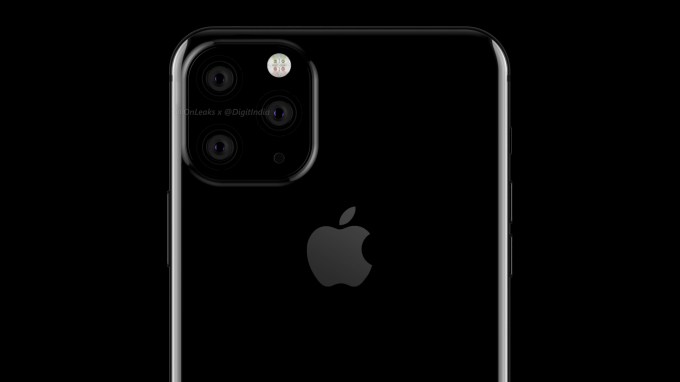
  • Apple is launching its latest iPhone models this week and we have some pretty decent ideas of what we’re going to see. It’s the third-year of the iPhone X cycle so we’re not expecting a full revamp, just some iterative updates, most of which we’re expecting to show up in a redesigned camera. Check out my colleague Brian Heater’s story for all of what he’s expecting at the event.

facebook instagram whatsapp glitch down

GAFA Gaffes

How did the top tech companies screw up this week? This clearly needs its own section, in order of badness:

  1. Hundreds of millions of Facebook user phone numbers scraped:
    [A huge database of Facebook users’ phone numbers found online]
  2. YouTube gets a smaller-than-expected fine:
    [FTC fines YouTube $170M over COPPA violations]
  3. Amazon Ring gets some heat:
    [US Senator demands answers from Amazon Ring over its police partnerships]
  4. More Facebook antitrust news:
    [New York AG will lead antitrust investigation into Facebook]

Extra Crunch

Our premium subscription service had another week of interesting deep dives. We published a roadmap for entrepreneurs trying to make the most of the data that they have.

How early stage startups can use data effectively

“…There are good and bad ways for startups to use data. In my opinion, the bad way unfortunately is often preached on saas blogs, a/b test tool marketing pages, and especially growth hacker conferences: that by simply measuring and looking at data you’ll find simple things to do that will drive explosive growth. Silver bullets, if you will.

The good way is comparable to first principles thinking. Below the surface of your day to day results, your startup can be described by a set of numbers. It takes some work to discover these numbers, but once you have them you can use them to make predictions and spot underlying trends. If everyone in your company knows these numbers by heart, they will inevitably make better decisions…”

(Photo by Steve Jennings/Getty Images for TechCrunch)

Disrupt SF

Our biggest event of the year is right around the corner and we’re bringing in some of the most important figures in the tech industry. Here’s who’s coming to Disrupt SF 2019.

In addition to taking in the great line-up of speakers, you can roam around Startup Alley to catch the more than 1,000 companies showcasing their products and technologies. And of course the Startup Battlefield competition that launched the likes of Dropbox, Cloudflare and Mint will once again be one of the biggest highlights of Disrupt SF.

Sign up for more newsletters in your inbox (including this one) here.

08 Sep 2019

Fairphone 3 is a normal smartphone with ethical shine

How long have you been using your current smartphone? The answer for an increasing number of consumers is years, plural. After all, why upgrade every year when next year’s model is almost exactly the same as the device you’re holding in your hand?

Dutch social enterprise Fairphone sees this as an opportunity to sell sustainability. A chance to turn a conversation about ‘stalled smartphone innovation’ on its head by encouraging consumers to think more critically about the costs involved in pumping out the next shiny thing. And sell them on the savings — individual and collective — of holding their staple gadget steady.

Its latest smartphone, the Fairphone 3 — just released this week in Europe — represents the startup’s best chance yet of shrinking the convenience gap between the next hotly anticipated touchscreen gizmo and a fairer proposition that requires an altogether cooler head to appreciate.

On the surface Fairphone 3 looks like a fairly standard, if slightly thick (1cm), Android smartphone. But that’s essentially the point. This 4G phone could be your smartphone, is the intended message.

Fp3j

Specs wise, you’re getting mostly middling, rather than stand out stuff. There’s a 5.7in full HD display, a Qualcomm Snapdragon 632 chipset, 4GB of RAM and 64GB of storage (expandable via microSD), a 12MP rear lens and 8MP front-facing camera. There’s also NFC on board, a fingerprint reader, dual nano-SIM slots and a 3,000mAh battery that can be removed for easy replacement when it wears out.

There’s also a 3.5mm headphone jack: The handy port that’s being erased at the premium smartphone tier,  killing off a bunch of wired accessories with it. So ‘slow replacement’ smartphone hardware demonstrably encourages less waste across the gadget ecosystem too.

But the real difference lies under the surface. Fairer here means supply chain innovation to source conflict-free minerals that go into making the devices; social incentive programs that top up the minimum wages of assembly workers who put the phones together; and repairable, modular handset design that’s intended to reduce environmental impact by supporting a longer lifespan. Repair, don’t replace is the mantra.

All the extra effort that goes into making a smartphone less ethically challenging to own is of course invisible to the naked eye. So the Fairphone 3 buyer largely has to take the company’s word on trust.

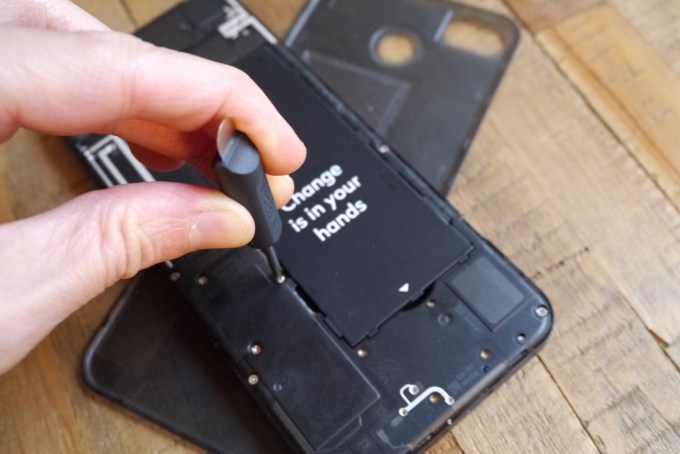
The only visual evidence is repairability. Flip the phone over and a semi-opaque plastic backing gives a glimpse of modular guts. A tiny screwdriver included in the box allows you take the phone to pieces so you can swap out individual modules (such as the display) in case they break or fail. Fairphone sells replacements via a spare parts section of its website.
Fp3sc

Despite this radically modular and novel design vs today’s hermetically sealed premium mobiles the Fairphone 3 feels extremely solid to hold.

It’s not designed to pop apart easily. Indeed, there’s a full thirteen screws holding the display module in place. Deconstruction takes work (and care not to lose any of the teeny screws). So this is modularity purely as occasional utility, not flashy party trick — as with Google’s doomed Ara Project.

For some that might be disappointing. Exactly because this modular phone feels so, well, boringly normal.

Visually the most stand out feature at a glance is the Fairphone logo picked out in metallic white lettering on the back. Those taking a second look will also spot a moralizing memo printed on the battery so it’s legible through the matte plastic — which reads: “Change is in your hands”. It may be a bit cringeworthy but if you’ve paid for an ethical premium you might as well flaunt it.

It’s fair to say design fans won’t be going wild over the Fairphone 3. But it feels almost intentionally dull. As if — in addition to shrinking manufacturing costs — the point is to impress on buyers that ethical internals are more than enough of a hipster fashion statement.

It’s also true that most smartphones are now much the same, hardware, features and performance wise. So — at this higher mid-tier price-point (€450/~$500) — why not flip the consumer smartphone sales pitch on its head to make it about shrinking rather than maximizing impact, via a dull but worthy standard?

That then pushes people to ask how sustainable is an expensive but valueless — and so, philosophically speaking, pointless — premium? That’s the question Fairphone 3 seems designed to pose.

Or, to put it another way, if normal can be ethical then shouldn’t ethical electronics be the norm?

Normal is what you get elsewhere with Fairphone 3. Purely judged as a smartphone its performance isn’t anything to write home about. It checks all the usual boxes of messaging, photos, apps and Internet browsing. You can say it gets the job done.

Sure, it’s not buttery smooth at every screen and app transition. And it can feel a little slow on the uptake at times. Notably the camera, while fairly responsive, isn’t lightning quick. Photo quality is not terrible — but not amazing either.

Testing the camera I found images prone to high acutance and over saturated colors. The software also struggles to handle mixed light and shade — meaning you may get a darker and less balanced shot that you hoped for. Low light performance isn’t great either.

That said, in good light the Fairphone 3 can take a perfectly acceptable selfie. Which is what most people will expect to be able to use the phone for.

Fairphone has said it’s done a lot of work to improve the camera vs the predecessor model. And it has succeeded in bringing photo performance up to workable standard — which is a great achievement at what’s also a slightly reduced handset price-point. Though, naturally, there’s still a big gap in photo quality vs the premium end of the smartphone market.

On the OS front, the phone runs a vanilla implementation of Android 9 out of the box — preloaded with the usual bundle of Google services and no added clutter so Android fans should feel right at home. (For those who want a Google-free alternative Fairphone says a future update will allow users to do a wipe and clean install of Android Open Source Project.)

Fp3f

In short, purely as a smartphone, the Fairphone 3 offers very little to shout about — so no screaming lack either. Again, if the point is to shrink the size of the compromise Fairphone is asking consumers to make in order to buy an ethically superior brand of electronics they are slowly succeeding in closing the gap.

It’s a project that’s clearly benefiting from the maturity of the smartphone market. While, on the cellular front, the transformative claims being made for 5G are clearly many years out — so there’s no issue with asking buyers to stick with a 4G phone for years to come.

Given where the market has now marched to, a ‘fairer’ smartphone that offers benchmark basics at a perfectly acceptable median but with the promise of reduced costs over the longer term — individual, societal and environmental — does seem like a proposition that could expand from what has so far been an exceptional niche into something rather larger and more mainstream.

Zooming out for a second, the Fairphone certainly makes an interesting contrast with some of the expensive chimeras struggling to be unfolded at the top end of the smartphone market right now.

Foldables like the Samsung Galaxy Fold — which clocks in at around 4x the price of a Fairphone and offers ~2x the screen real estate (when unfolded), plus a power bump. Whether the Fold’s lux package translates into mobile utility squared is a whole other question, though.

And where foldables will need to demonstrate a compelling use-case that goes above and beyond the Swiss Army utility of a normal smartphone to justify such a whopping price bump, Fairphone need only prick the consumer conscience — as it asks you pay a bit more and settle for a little less.

Neither of these sales pitches is challenge free, of course. And, for now, both foldables and fairer electronics remain curious niches.

But with the Fairphone 3 demonstrating that ethical can feel so normal it doesn’t seem beyond the pale to imagine demand for electronics that are average in performance yet pack an ethical punch scaling up to challenge the mainstream parade of copycat gadgets.

[gallery ids="1878512,1878515,1878516,1878514,1878517,1878513"]

07 Sep 2019

Joi Ito resigns as MIT Media Lab head in wake of Jeffrey Epstein reporting

Joichi Ito, the embattled director of the M.I.T. Media Lab, has stepped down according to a statement by MIT’s president, L. Rafael Reif. The news was first reported by The New York Times, which had received a copy of an email sent by Ito to university provost Martin A. Schmidt.

“After giving the matter a great deal of thought over the past several days and weeks,” the now-former director writes, “I think that it is best that I resign as director of the media lab and as a professor and employee of the Institute, effective immediately.”

In addition to resigning as director, Reif’s statement also confirmed that Ito resigned as a professor of the university.

The ‘matter’ to which the letter refers to is Ito’s reported connections to Jeffrey Epstein. The financier died in prison by hanging on August 10, following an arrest a month prior on federal charges of sex tracking minors.

Ito was among several high profile and powerful people whose alleged ties to the disgraced billionaire came into sharp focus following his arrest. In the immediate aftermath of that arrest, it came to light that the MIT Media Lab and Ito personally received funds from Epstein, to which Ito apologized in an August 15th letter.

The allegations against Ito intensified overnight following a report by Ronan Farrow in The New Yorker that Ito’s engagement of Epstein were far deeper than had been previously been acknowledged. According to emails and documents discovered by Farrow, Ito and MIT Media Lab’s head of development, Peter Cohen, worked in tandem to conceal Epstein’s contributions from MIT’s central fundraising office, such as by marking donations anonymous and keeping his name out of disclosure statements.

Ito has long stood firm that the facts of his relationship with Epstein have been misreported. In an email to the Times, Ito said that the New Yorker piece was “full of factual errors.”

In response to Farrow’s piece, M.I.T, president L. Rafael Reif in today’s statement said:

Because the accusations in the story are extremely serious, they demand an immediate, thorough and independent investigation. This morning, I asked MIT’s General Counsel to engage a prominent law firm to design and conduct this process. I expect the firm to conduct this review as swiftly as possible, and to report back to me and to the Executive Committee of the MIT Corporation, MIT’s governing board.

The MIT Media Lab is a storied research center with a long legacy of contributions to science, technology, and innovation. There are no indications yet on who might replace Ito.

In addition to the MIT Media Lab, Ito sits as a board director for The New York Times Company, where he sits on the company’s audit committee.

07 Sep 2019

After Epstein, it’s time for the Valley to find a moral view on capital

Is capital moral or amoral?

In the predominant view held in Silicon Valley today, capital is amoral — cash is cash, and regardless of where it comes from, once it leaves the hand of its investor or donor, it no longer has that individual’s taint. That money might have previously been spent on acquiring access to underage girls, or murder, or espionage, but now it is being spent on something productive, something useful. Isn’t that ultimately a net win for society?

That culture of fundraising is under an exacting microscope this week after the MIT Technology Review reported that Nicholas Negroponte, the founder of the famed MIT Media Lab, would have continued to take convicted sex offender Jeffrey Epstein’s donations to the research center.

[… He] said he had recommended that [Joichi Ito, the lab’s current director] take Epstein’s money. “If you wind back the clock,” he added, “I would still say, ‘Take it.’” And he repeated, more emphatically, “‘Take it.’”

The comments, made during a meeting of the lab’s staff, shocked many of the participants, with some angrily replying in the heat of the moment. As the Review noted, “Kate Darling, a research scientist at the MIT Media Lab, shouted, ‘Nicholas, shut up!’ Negroponte responded that he would not shut up and that he had founded the Lab, to which Darling said, ‘We’ve been cleaning up your messes for the past eight years.’”

Epstein funded projects widely in the tech world through the Edge Foundation and other initiatives, and his acquaintances read like a who’s-who of tech luminaries.

Yet, this week’s controversy over fundraising is hardly novel. Just last year, SoftBank’s Vision Fund was dealing with the fallout in its own fundraising after Saudi Arabia — the fund’s largest limited partner with a $45 billion commitment to the $93 billion fund — murdered journalist Jamal Khashoggi in its consulate in Istanbul.

These two singular cases also connect to the larger story about the U.S. government’s active shutdown of Chinese venture capital dollars flowing into the Valley for fear of foreign intelligence espionage. Through the modernization of legal tools like CFIUS, to the Pentagon’s creation of a Trusted Capital Marketplace, to reversals of acquisitions like the unwinding of Chinese company Kunlun’s purchase of gay dating app Grindr, the government has repeatedly been telling entrepreneurs: it matters where your capital comes from.

Indeed, that’s the very quandary that Silicon Valley is facing these days. Its amoral view of capital is increasingly clashing with the reality that it matters a whole heck of a lot where that capital comes from. And it is about time that founders and investors take responsibility for cleaning up a capital base that has become more and more squalid over time.

Why can’t capital just be immoral? Well, Epstein’s web of donations provided him with a philanthropic sheen that eased access to the highest echelons of society while he committed his crimes. Saudi Arabia is the largest investor in Silicon Valley not only because it drives a return and diversifies its oil-dependent economy, but also because it can Valley-wash the horrific rights abuses and atrocities it commits against all of its citizens, including women, LGBT people, and immigrants.

(But hey, women can drive now, just in time for autonomous vehicles.)

This amoral versus moral view of capital is just the classic debate in philosophy between utilitarianism versus deontological duties, but Silicon Valley has almost exclusively chosen the former rather than the latter. My bank asks me more questions about my $50 deposits than many founders ask about where that $500 million check comes from.

That’s perhaps understandable in context. Founders — as with non-profit leaders — fundraise around-the-clock. When a check finally arrives, they don’t bother to ask a bunch of due diligence questions. They just want that money to hit the bank and get back to building what they were intending to the entire time.

It’s a mode of operating that continues to the present day. I was chatting with a founder this week, and during demo day last week, he got an emailed check for $50,000 from an investor in the audience. It was amazing, he said with exclamation points to me, and it sounded like he just added the check to the pile he had accumulated. Who is this person? Do we know where his capital comes from? Is there going to be some scandal that shocks the startup in a couple of years? Yet the excitement was palpable — the round was closed, and it was the easiest $50,000 ever fundraised.

Those diligence questions probably didn’t need to be asked a decade or two in the Valley, back when a few dozen firms mostly raised from blue-chip university and non-profit endowments as well as state pension funds.

Today though, there are all kinds of sources of capital, with little clarity about where the capital is coming from. Take, for instance, Carlos Ghosn, who once headed Nissan Motors and is currently on trial in Japan for a variety of financial crimes. He has been accused of embezzling millions of dollars for a VC fund run by his son by running a kickback scheme through a Nissan distributor in Lebanon. As the Wall Street Journal reported a little more than a week ago:

In March 2015, the Ghosns set up in Delaware an investment vehicle called Shogun Investments, which Mr. Ghosn described as a fund that would invest in Silicon Valley startups. Mr. Ghosn was majority owner while his son, Anthony, held a stake, according to people familiar with the matter. The younger Mr. Ghosn, who was about to graduate from Stanford University, was working at the time as chief of staff for Silicon Valley venture capitalist Joe Lonsdale, providing the elder Mr. Ghosn a close-up view of the tech investment world. The lofty returns had stunned him, according to one of the people.

That fund would go on to fund some of the most well-known unicorns in the world:

“Following our phone conversation, I ordered a transfer of $3 million,” Carlos Ghosn wrote in a December 2017 email to his son, who was 22 years old at the time.

Of that amount, $2 million was for an investment in Grab, a Southeast Asian competitor to Uber Technologies Inc., Mr. Ghosn wrote, adding that he was sending “$1 million for the company of your friend that you think will do very well.” It wasn’t clear which company Mr. Ghosn was referring to.

I would love a world in which founders asked all the right due diligence questions. I would love for them to inquire about limited partners, about how wealth was created, and how it has been invested. But I am also aware that in what can be a desperate search for funds, those questions may well never get asked in the first place.

If you want to stop the capital laundering taking place every day in the Valley, you have to create active, real-time antidotes. That means stopping it at every point of contact, every single opportunity where it can infect the ecosystem.

And so, we need better systems as a community and as an ecosystem to cleanse ourselves of this dirty money. We need “know-your-capital” processes that are standardized, robust, and accurate so that every check can be verified before it hits the bank. We need tools to verify that a startup or non-profit has actually followed those KYC processes, so that employees don’t suddenly show up at work and realize they are making money for a bunch of murderers. It’s “trust but verify.”

Systematization and process are key to execution, but that doesn’t disclaim the responsibility for the Valley’s leaders to take a moral stance here. Utilitarianism only takes you so far — it does matter that you take capital from a bad actor. Negroponte is wrong to say that he would still take Epstein’s money, regardless of what that capital might have funded at the MIT Media Lab.

Taking responsibility for your capital is part of being a leader of an organization today. Hopefully, the next generation of founders will take a look at Epstein, and Khashoggi, and China, and Ghosn, and the Sacklers, and a whole host of other case studies and learn from them and change their fundraising practices. A moral view on capital isn’t a cost of doing business — it’s simply the right thing to do.

07 Sep 2019

Original Content podcast: Amazon’s ‘Carnival Row’ mixes fairies, politics and murder

“Carnival Row” offers an unlikely mix of genres, laying out a murder mystery in a world of fairies and other mythical creatures, while also delivering a healthy dose of allegorical politics.

And as we explain in the latest episode of the Original Content podcast, the show (recently released on Amazon Prime Video) does take some getting used to. There’s a certain clumsiness in the way the opening episode insists on its grittiness and adult themes — and most viewers will probably need some time before they stop gawking at the fairy sex and focus instead on the story and characters.

Once they do, though, “Carnival Row” offers plenty of rewards. Orlando Bloom and Cara Delevingne star as Philo and Vignette — a police investigator and a “fae” refugee, respectively, who have a complicated romantic past together. Bloom and Delevingne may not be entirely up to the task of creating complex and memorable characters, but the world that creators Travis Beacham and René Echavarria have built around them is rich, detailed and strange.

The pair is also surrounded by a strong supporting cast that includes Jared Harris (“The Crown”) and Indira Varma (“Game of Thrones”) — and ultimately, the fantasy, the politics and the mystery do come together in satisfying ways.

In addition to reviewing “Carnival Row,” we also discuss YouTube’s settlement with the FTC and listener response to last week’s review of “The Dark Crystal: Age of Resistance.”

You can listen in the player below, subscribe using Apple Podcasts or find us in your podcast player of choice. If you like the show, please let us know by leaving a review on Apple. You can also send us feedback directly. (Or suggest shows and movies for us to review!)

And if you want to skip ahead, here’s how the episode breaks down:
0:00 Introduction
2:11 “Dark Crystal: Age of Resistance” listener response
15:03 “Carnival Row” review (minor spoilers for the first episode)
33:47 “Carnival Row” spoiler discussion

07 Sep 2019

Wikipedia blames malicious DDOS attack after site goes down across Europe, Middle East

Wikipedia was forced offline in several countries Friday after a cyber attack hit the global encyclopedia.

Users across Europe and parts of the Middle East experienced outages shortly before 7pm, BST, according to downdetector.com.

Wikimedia’s German Twitter account posted: “The Wikimedia server…is currently being paralysed by a massive and very broad DDOS [distributed denial of service] attack.”

The site issued the following statement:

Today, Wikipedia was hit with a malicious attack that has taken it offline in several countries for intermittent periods. The attack is ongoing and our Site Reliability Engineering team is working hard to stop it and restore access to the site.

As one of the world’s most popular sites, Wikipedia sometimes attracts “bad faith” actors. Along with the rest of the web, we operate in an increasingly sophisticated and complex environment where threats are continuously evolving. Because of this, the Wikimedia communities and Wikimedia Foundation have created dedicated systems and staff to regularly monitor and address risks. If a problem occurs, we learn, we improve, and we prepare to be better for next time.

We condemn these sorts of attacks. They’re not just about taking Wikipedia offline. Takedown attacks threaten everyone’s fundamental rights to freely access and share information. We in the Wikimedia movement and Foundation are committed to protecting these rights for everyone.

Right now, we’re continuing to work to restore access wherever you might be reading Wikipedia in the world. We’ll keep you posted.”

The site was reported to be down in large parts of the UK as well as Poland, France, Germany and Italy.

07 Sep 2019

What top enterprise VCs are thinking, using data effectively, ethics, Light, and Flipkart

Top VCs on the changing landscape for enterprise startups

TechCrunch had our debut confab for enterprise types this week at Yerba Buena Center in SF, where we heard from Aaron Levie, CEO of Box, Apple VP Susan Prescott of Apple, and Microsoft Azure CTO Mark Russinovich. We were sold out, which perhaps isn’t all that surprising given the amount of interest in enterprise these days. Expect more events to come.

Our Silicon Valley editor Connie Loizos hosted a panel with leading enterprise VCs, and she selected the most interesting points from that conversation and from her calls with them for Extra Crunch members. Hear a bit from Jason Green of Emergence Capital, Rebecca Lynn of Canvas Ventures and Maha Ibrahim of Canaan Partners and what they are investing in these days.

And if you want to hear even more from Jason Green and yours truly, head over to TechCrunch’s VC podcast Equity, where we shot live from Yerba Buena along with host Kate Clark with a special focus on enterprise startups.

Maha Ibrahim: I feel like people are focusing too much on metrics and not as much on [the total addressable market]. We make money [when a startup strikes on a] huge, huge market.

But there’s [also] so much correlation between consumer and enterprise startups in that we want customers that love the product. We want customers that come back and come back and come back to us, without us having to pay for them to come back. So the equivalent in a consumer company would be me having to spend advertising dollars to acquire that customer again, as opposed to that customer just coming back because he or she loves what I’m doing. The same goes for the enterprise.

How early-stage startups can use data effectively

Silicon Valley may be obsessed with using data to improve startup outcomes, but the reality is quite a bit more nuanced. Koen Bok, co-founder of interactive design tool Framer, has put together an extensive guide here on how to to use data — and when not to.