Category: UNCATEGORIZED

28 Aug 2019

Eero updates subscription plans

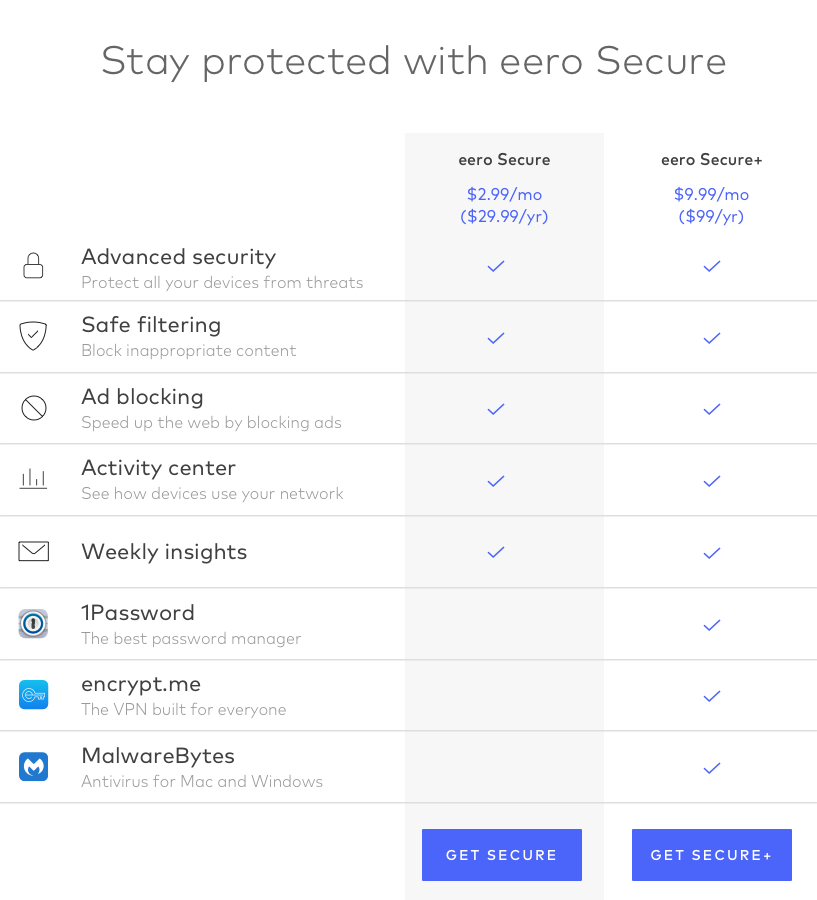
Router maker Eero is expanding its focus on subscriptions with a new two-tier system. Eero already had a $10 per month subscription called Eero Plus. It is now called Eero Secure+. The company is adding a cheaper plan with less features for $3 per month.

It seems a bit counterintuitive that Eero is selling software subscriptions. The company is mostly known for its tiny mesh routers that you can put in every room of your house.

Eero originally introduced a subscription back in 2017. It was designed as a sort of Amazon Prime of internet services focused on security. It included family plans to password manager 1Password, VPN service Encrypt.me and antivirus MalwareBytes.

Eero Secure+ is more or less a new name for Eero Plus. It costs $9.99 per month or $99 per year and includes the same services, as well as a few software additions, such as parental controls, filtering of dangerous websites at the network level as well as ad blocking.

Essentially, Eero intercepts DNS queries and blocks the ones to suspicious content — it could be a phishing site, an adult site or an ad network. The company replaces your default DNS with ZScaler’s DNS for that feature.

If you don’t want 1Password, Encrypt.me or MalwareBytes, you can now subscripte to Eero Secure to get those DNS-powered features. It costs $2.99 per month of $29.99 per year.

eeroSecure plans

As a reminder, Amazon acquired Eero in February 2019. Eero promised that its privacy policy wouldn’t change after the acquisition.

Still, paying a subscription for DNS filtering is a bit odd. Some public DNS services, such as Quad9, block access to malicious websites.

And if you’re looking for a fun weekend project, you can buy a cheap Raspberry Pi and play with Pi-Hole, an open source project that basically does everything Eero Secure does. You can also build your own VPN service as you should never trust VPN services. They don’t make you more secure and they can basically see all your network traffic.

28 Aug 2019

Sony’s new a6600 flagship APS-C camera adds stabilization and over 2x better battery life

Sony announced two new APS-C mirrorless interchangeable lens cameras at a special event in New York today, and the announcements are big news for anyone who’s looking for a small, capable camera that can handle everything from sport shooting to vlogging. The new a6600 flagship takes everything that is great about the a6400 it introduced earlier this year, and adds a big battery boost, in-body stabilization, a headphone jack and real-time eye autofocus for video.

The a6600 otherwise looks nearly identical to the a6400 on paper – it has the same 24.2 megapixel APS-C sensor, ISO sensitivity that expands all the way up to 102400, burst shooting at up to 11 fps, 3k 40p internal HDR recording and the same quality viewfinder. None of that is in any way a criticism, however – these were all excellent specs when they debuted on the a6400 earlier this year, and they’ll serve a6600 owners just as well.

What’s been added should be plenty exciting, however, since it brings the in-body image stabilization (IBIS) that was present on the a6500 but did not make it into the a6400, which was more capable in many other ways. This is a clutch feature for video creators, and that’s a key market for the a6XXX line for Sony, especially with its class-leading reputation for autofocus and high-quality 4K video capture. Ditto the addition of continuous real-time eye AF during movie recording.

Finally, that bigger Z battery (which debuted on the company’s full-frame mirrorless camera line and brought big battery life gains there) will be a boon to video and still shooters alike. The existing battery that powers the a6400, along with the rest of the line, is rated at 360 shots, but that’s very low compared to the a7 III’s 610 shots, and Sony is saying you’ll get over 2x the shooting time with the Z battery in the a6600 compared to its predecessor.

The a6600 retails for $1,400 U.S. for the body alone, and is available in a kit with the 18-135 lens from Sony for $1,800. It’ll be on sale in November.

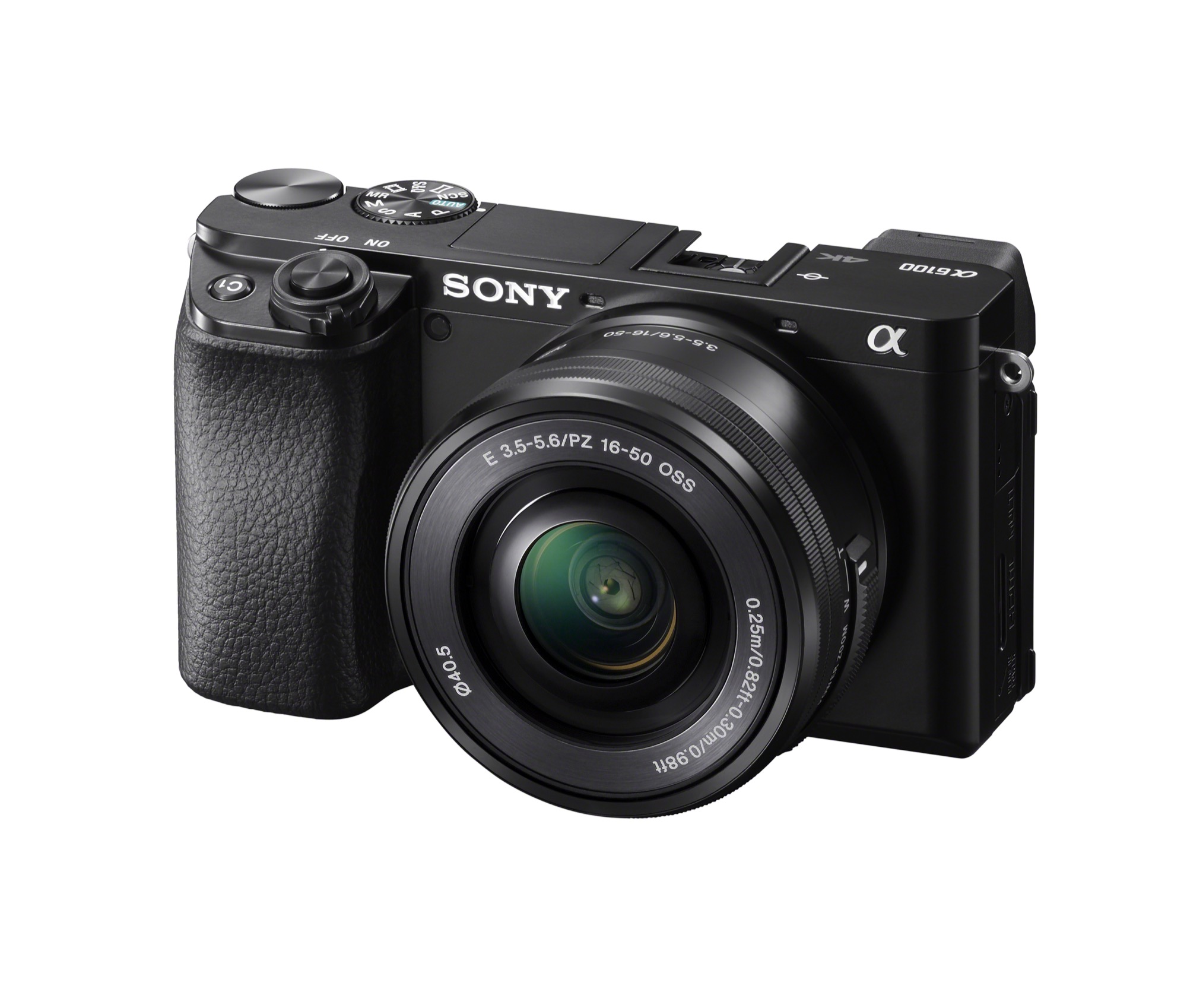
Alpha Universe alpha 6100 ilce6100 selp1650 right black

Sony also unveiled a new entry-level option in its a6XXX line, the a6100. You get a lot of the benefits of the more expensive cameras here, including the same AF system (albeit without real-time Eye AF for movies, which is only on the a6600), and 4K 30p internal recording. You don’t get S-Log or HLG recording options, or HDR, however, and there’s no in-body stabilization. You’re also stuck with the older battery, lower maximum ISO sensitive (51200 in expanded mode) and a lower resolution electronic viewfinder. Still, all told it’s a good bargain – especially since you get Sony’s outstanding real-time object tracking autofocus feature.

The a6100 retails for $750 U.S. for the body alone, and is available in a kit with the 16-50 lens from Sony for $850, or with both the 16-50 and the 55-210 for $1,100. It’ll be on sale in October.

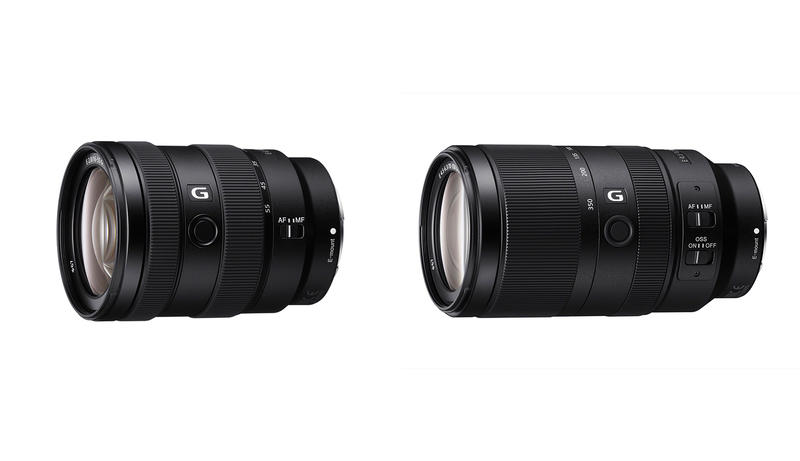
Alpha Universse 16 55mm G 70 350mm G.91159cb549bb213dddcb831882634037.ryg3hbESB

Finally, there are two new lenses which will be hugely beneficial to Sony APS-C camera shooters looking for pro-level options. The E-mount 16-55 F2.8 G gives you a focal range on par with the best glass available on other camera systems, and the E 70-350mm f4.5-6.3 G OSS gives you a really long reach zoom (105-535mm equivalent on a 35mm) with built-in stabilization in a relatively small package. The new 18-55mm lens sells for $1,400 and will be sold in October, and the 70-350mm goes on sale in November for $1,000.


28 Aug 2019

Facebook will require political advertisers provide further credentials, or have their ads paused

Ahead of the 2020 elections, Facebook today announced it’s tightening requirements for groups buying political ads on the social network. The company last year began requiring advertisers get authorized to run ads about social issues, elections, or politics, which involves advertisers providing identification to confirm who they are and where they’re located — including a U.S. street address, phone number, business email and website matching the email. Starting in mid-September, Facebook says advertisers will now need to submit more information about their organization in order to run political ads.

Failure to submit this information will see their ads paused, the company says.

There are five options for submitting more information, three of which will confirm the advertiser is registered in some way with the U.S. government. This includes submitting a tax-registered organization identification number (EIN); a government website matching an email ending in .gov or .mil; or a Federal Election Commission (FEC) identification number.

By submitting this information, Facebook will label the advertiser a “Confirmed Organization” in its ad archive. The advertiser will also be allowed to use their registered organization name in the ad disclaimers and the “i” icon that appears on the upper-right hand corner of the ad will read “Confirmed Organization.”

For smaller businesses or local politicians who want to run ads about social issues, elections, or politics, they can choose to submit one of two other options instead: an organization name with a verifiable phone number, business email, mail-deliverable address and business website with a domain matching the email; or they can provide no organizational information and use the Page Admin’s legal name on their personal information document.

In either of these two cases, the “i” icon on the ad will read “About this ad” instead of “Confirmed Organization.”

Facebook says this “i” icon is how people will be able to see who is trying to influence them through the ad.

Facebook Ads Info

Posted by Facebook on Tuesday, August 27, 2019

“Now, with one tap, people will not only see information about the ad, but they’ll be able to see the information Facebook confirmed, such as whether an advertiser used an EIN or FEC identification number. This will allow people to confidently gauge the legitimacy of an organization and quickly raise questions or concerns if they find anything out of the ordinary,” the company explained in a blog post announcing the changes.

Despite Facebook’s rule around political ads, the company admitted that there have been several cases where advertisers attempted to put out misleading “Paid for by” disclaimers on their ads.

VICE, for example, demonstrated how easy it was to manipulate the system by placing ads on behalf of VP Mike Pence, DNC Chairman Tom Perez, and the Islamic State, which Facebook approved. Business Insider also ran fake ads pretending to be Cambridge Analytica, which Facebook also approved.

More recently, Facebook banned conservative news outlet The Epoch Times from running ads on its platform because of ad policy violations. The organization had hidden under page names like “Honest Paper” and “Pure American Journalism,” to bypass Facebook’s ad transparency system in order to run some $2 million worth of ads promoting the president and spreading conspiracy theories about his opponents.

In addition to the changes around the advertiser requirements, Facebook is updating its social issues list in the U.S. to include 10 categories, instead of 20 distinct subjects. This doesn’t represent a narrowing focus, but rather makes the categories themselves broader to encompass more topics. For example, the “Civil and Social Rights” category would include sub-topics like freedom of religion, LGBTQ rights, and women’s rights.

The new categories were based on the issue lists in countries who recently held elections, Facebook says.

Facebook also will no longer require some environmentally-focused ads to submit these additional requirements, based on user feedback. This includes ads that “discuss, debate or advocate for environmental issues,” those that encourage recycling, or those highlighting sustainable products.

In the months ahead, Facebook says it will be updating its Ad Library to make it easier to track and compare U.S. presidential candidate spending, and it will expand its policy to prohibit ads that discourage people from voting.

It will turn its attention to Pages, too, by requiring national candidates or elected officials to go through Page Publishing Authorization, to verify their Pages are using real accounts and are based the U.S. Facebook will then begin exposing more information about the Page, including the business or organization behind it.

“We know we can’t tackle these challenges alone. That’s why we’re calling for sensible regulation and working directly with governments, watchdogs and regulators,” the company wrote in the blog post, referring to Mark Zuckerberg’s pro-regulation op-ed, which called for rules on Facebook’s terms. “While our efforts to protect elections are ongoing and won’t be perfect, they will make it harder for advertisers to obscure who is behind ads and will provide greater transparency for people.”


28 Aug 2019

Hackers to stress-test Facebook Portal at hacking contest

Hackers will soon be able to stress-test the Facebook Portal at the annual Pwn2Own hacking contest, following the introduction of the social media giant’s debut hardware device last year.

Pwn2Own is one of the largest hacking contests in the world, where security researchers descend to find and demonstrate their exploits for vulnerabilities in a range of consumer electronics and technologies, including appliances and automobiles.

It’s not unusual for companies to allow hackers put their products through their paces. Tesla earlier this year entered its new Model 3 sedan into the contest. A pair of researchers later scooped up $375,000 — and the car they hacked — for finding a severe memory randomization bug in the web browser of the car’s infotainment system.

Hackers able to remotely inject and run code on the Facebook Portal can receive up to $60,000, while a non-invasive physical attack or a privilege escalation bug can net $40,000.

Introducing the Facebook Portal is part of a push by Trend Micro’s Zero Day Initiative, which runs the contest, to expand the range of home automation devices available to researchers in attendance. Pwn2Own said researchers will also get a chance to try to hack an Amazon Echo Show 5, a Google Nest Hub Max, an Amazon Cloud Cam, and a Nest Cam IQ Indoor.

Facebook said it would also allow hackers to find flaws in the Oculus Quest virtual reality kit.

Pwn2Own Tokyo, set to be held on November 6-7, is expected to dish out more than $750,000 in cash and prizes.

28 Aug 2019

Insta360’s tiny new GO stabilized camera could be game-changer for social video

Insta360 has quickly established itself as the leader in 360-degree video capture, at least for the consumer market, and its new GO stabilized camera builds on that legacy and extends some of the tech it’s built into the category of more traditional, non-360-degree footage.

The $199.99 GO is truly tiny – it weighs under an ounce, and measures less than two inches tall, by under an inch wide. It’s tiny, and that’s ideal for the use case that Insta360 has in mind for this device – wearing it or mounting it virtually anywhere for capturing quick clips. The GO’s all about quick action grabs, with a 30-second cap on clip recording, which you trigger by pressing the lone control button on the device (a second press stops the clip, unless you let it run the entire 30 seconds).

Sport Running Easy Clip

GO’s design is clearly meant for social sharing, but its secret weapon vs. just using your smartphone or making use of other devices is that it packs Insta360’s FlowState stabilization on board. This is the company’s digital video stabilization feature, which works to great effect in its Insta360 One X 360-degree camera for smoothing out footage so that even in intense action sequences it’s not nausea-inducing.

GO also features a magnetic body, which is designed to work in tandem with a variety of accessories, including backs for securing them unobtrusively to clothing, an underwater housing (the camera itself is IPX4 rated, which means essentially it’s protected from splashes but not meant to be submerged), and mounts for sticking to things like surf boards or vehicles. It can capture clips at resolution of up to 2720×2720, but it crops the image to 1080p (at 25 fps) for export as a result of the stabilization tech.

Shooting modes include a standard 25fps as mentioned, as well as a 30fps time-lapse which can record up to 8 hours (which will output a 9 second video) and a hyper laps mode that can shoot for up to 30 minutes to generate a 5 minute video. It can capture photos, too, exporting square images at 2560 x 2560 resolution, or a number of landscape options reading down from there.

In addition to simplifying capture, the Insta360 GO also hopes to make editing and sharing much easier, too, with its FlashCut auto editing feature. This software tool uses “AI” according to the company, in order to find the best clips (you can even sort by category, ie. ‘food’) you capture throughout the day and then stitch them together in a final edit. You can also fully tweak the edits it provides if you’d rather be a more involved creator.

The biggest limitation, based on just reading the specs and not having had a chance to test this out yet, is that the battery life is rated at around 200 clips per day, based on an average of 20 seconds per clip. But that’s including recharging the camera when not in use using the included Charge Case, which has 2.5 extra charges using its built-in battery. That and the recording limitation could prove challenging to anyone looking to create a lot of content with this camera, but on the other hand, it’s very easy to ensure you have it with you at all times – even when your smartphone isn’t nearby.

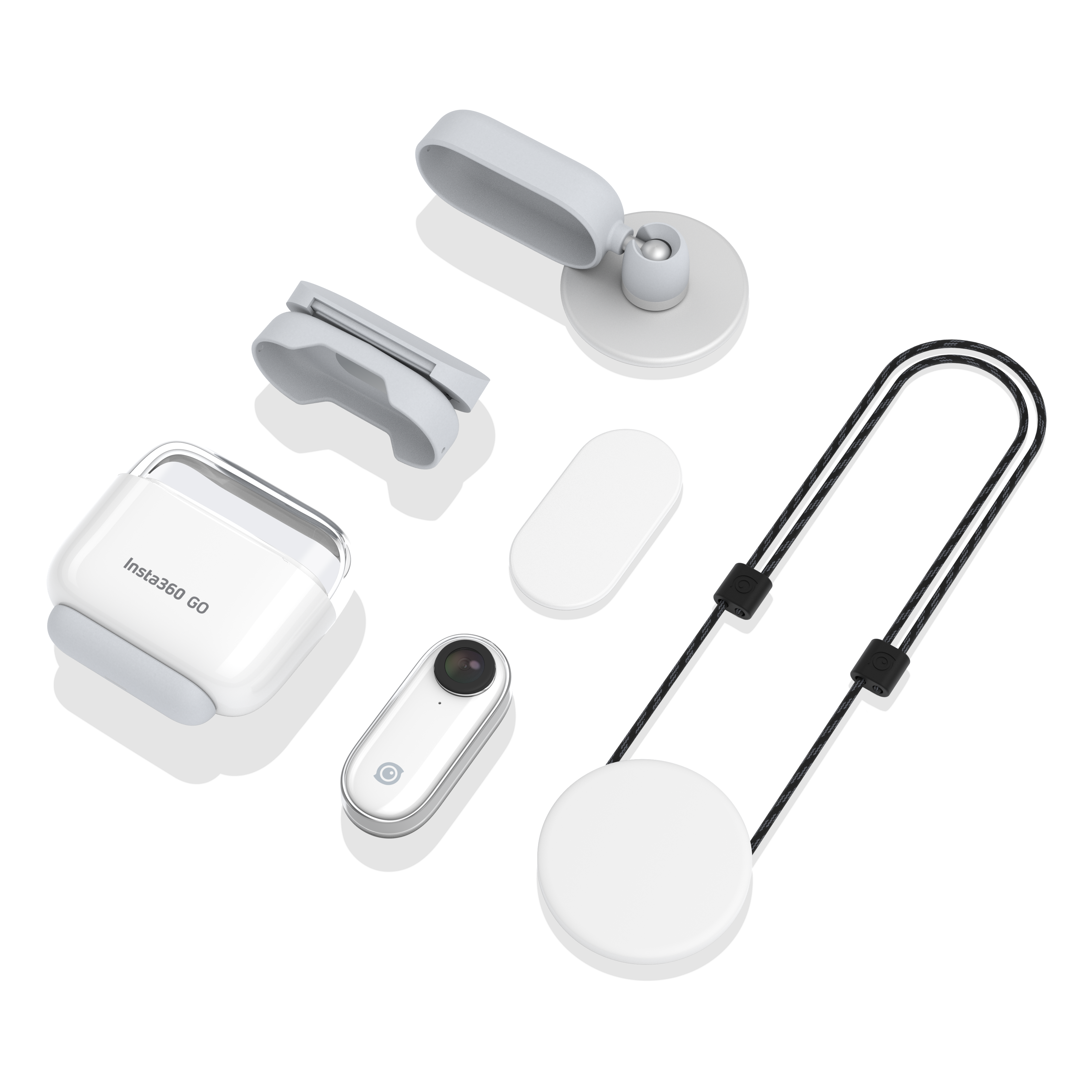
Collection

At $199.99, the Insta360 GO isn’t exactly cheap – but it does include the Charge Case, a pendant with a magnet you can use to wear it around you neck, a stand, a clip for clothing and a sticky mount for putting it on most smooth surfaces. You can also laser-engrave it if you purchase it directly via Insta360’s website. But after some missed starts for this category like the Google Clips camera, and earlier entrants like the Memoto and Narrative Clip lifelogging cameras, I’ll be curious to see if Insta360’s additional features help this gadget define a category.

28 Aug 2019

Lego is piloting audio and braille building instructions

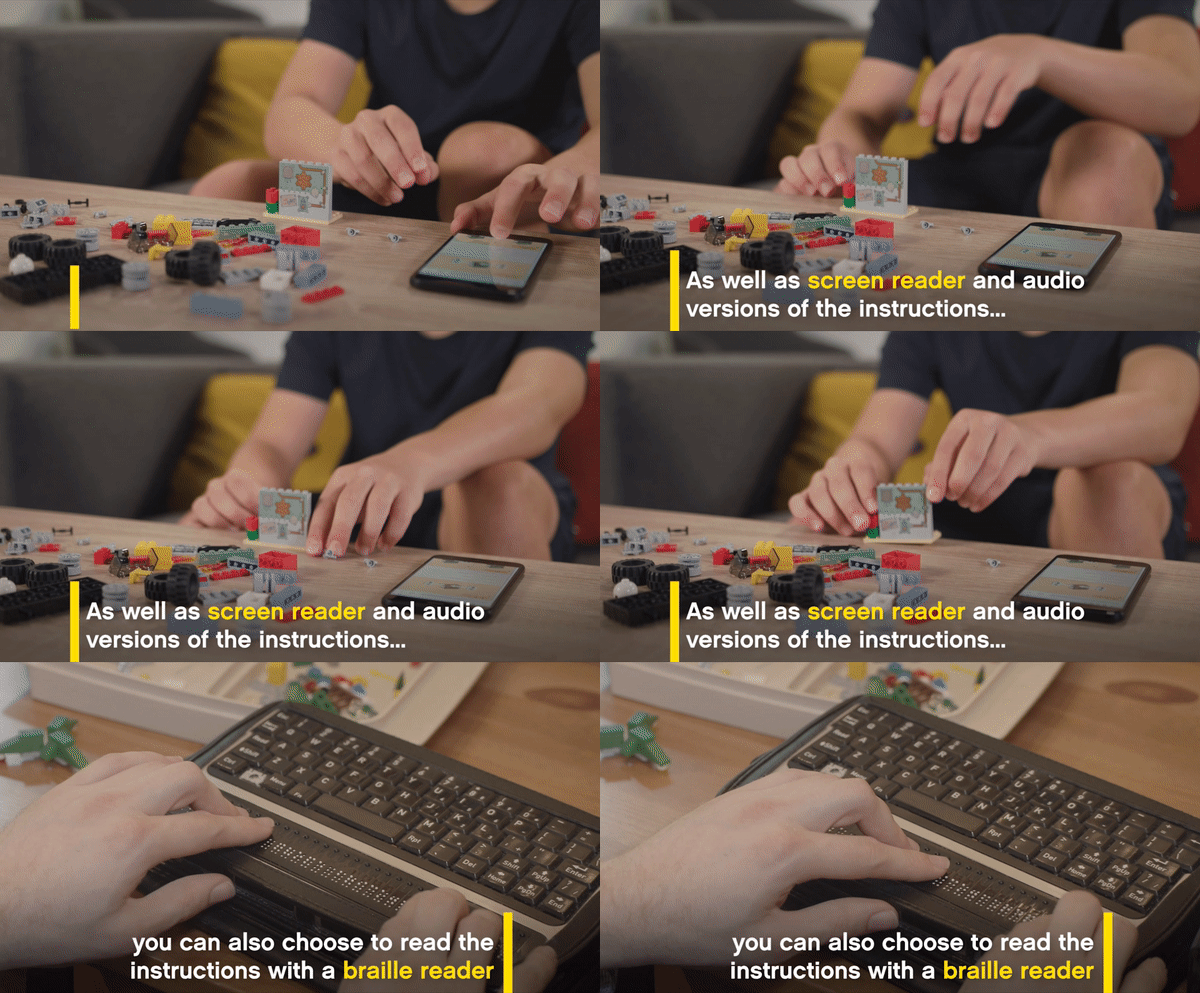
Here’s a nice thing from some companies this morning — and it’s got a compelling back story, to boot. Lego this morning announced a new accessibility initiate that will make building instructions for select kits available as braille or text for voice readers, in order to reach builders with blindness and vision impairment.

The service is currently available for free through the Lego Audio Instructions site. It’s still in pilot mode, which mostly means it’s currently limited to four kits, with one each from Classic Lego, Lego City, Lego Friends and Lego Movie 2. The company is currently collecting feedback from the experiences with plans to build out its offerings at some point in the first half of next year.

ezgif 5 89f5aac6f44e

The idea comes from Matthew Shifrin, a 22-year-old blind Lego enthusiast. He approached the company with the idea after he and a friend worked together to create instructions for kits that he could read.

“I had a friend, Lilya, who would write down all the building steps for me so that I could upload them into a system that allowed me to read the building steps on a Braille reader through my fingers,” he says in a release. “She learned Braille to engage with me and support my LEGO passion, and then spent countless hours translating LEGO instructions into Braille.”

[gallery ids="1874890,1874889,1874888,1874887,1874886,1874885"]

MIT’s Media Lab helped create a software that uses AI to translate visual LXFML data (LEGO Exchange Format Mel Script) instructions into text. The result of those instructions are currently being hosted on the Lego site.

28 Aug 2019

Duolingo is now offering a beta version of Latin courses

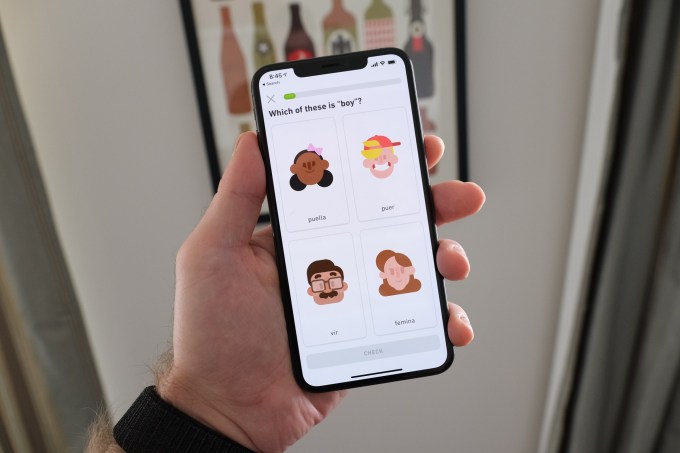
Duolingo is one of the most popular apps on the market for folks who want to learn languages. And now, the service is giving users a way to truly ‘carpe diem’ by offering a course in Latin.

If you’re wondering why Duolingo is offering lessons for a language that hasn’t been commonly used since the 8th Century, that’s totally fair. Here’s the scoop: Latin is the backbone for a variety of romance languages, as well as the language of origin for plenty of words across a number of languages, including English.

Studying Latin gives folks a way to study the infrastructure of a handful of other languages.

Moreover, there are plenty of historians, linguists, and professors who wish to read works like The Aeneid by Virgil or Metamorphoses by Ovid or Meditations by Marcus Aurelius in their original Latin form.

Duolingo 2

Duolingo uses mini-games to help users learn languages. Mini-courses reward users for finishing a course and take away ‘a life’ (like a videogame) when users make a mistake. The company hopes that the end result of a user finishing a course is that they’re able to read, write, speak and comprehend that language.

Moreover, Duolingo has troves of data around how people actually learn languages, and uses machine learning to tweak and improve its service based on that data.

Duolingo has raised more than $100 million across five rounds of funding since it launched in 2011, according to Crunchbase.

28 Aug 2019

Fitbit’s CEO discusses the company’s subscription future

At a small event in Manhattan this week, Fitbit laid out its future for the press. Tellingly, the event was far more focus on the company’s software play, with the big hardware announcement feeling almost rushed at the end.

Along with an increased focus on health care providers and enterprise, much of its revenue strategy will be tied up in Fitbit Premium, a $10 a month subscription service. The offering marks a major shift for a company whose identity has been so closely tied to hardware for its first decade of existence.

The announcement comes a year and a half after the release of Versa. The smartwatch has helped the company begin to right the ship after several quarters’ worth of financial struggle. And while last quarter found Fitbit’s valuation stumbling a bit on the heels of a disappointing performance by the Versa Lite, the company says it continues to be committed to its core hardware offering.

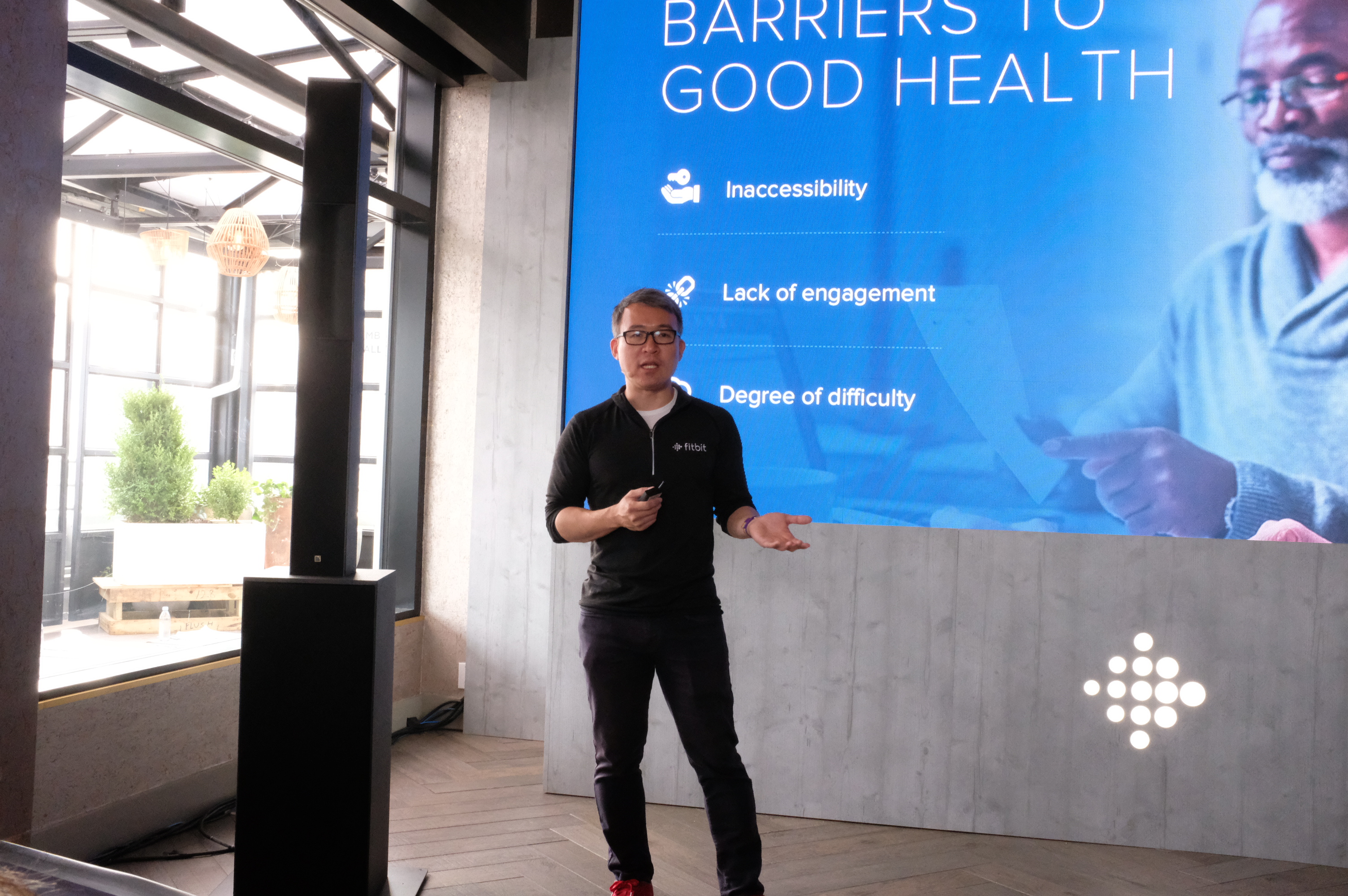
Following the announcement of Fitbit Premium and the Versa 2 smartwatch, we sat down with CEO and co-founder James Park to discuss the company’s path and what the future holds for Fitbit.

The state of Fitbit

Brian Heater: The flow of today’s briefing was different. In previous years, the company’s always led with hardware.

James Park: You noticed that it was pretty conscious, and I think it’s just to reinforce the fact that what we’re working on is not just about hardware anymore. But it’s equally important that the services component is an important part of our strategy, and also an important part of an overall solution, again, people healthier.

28 Aug 2019

Coursera makes its first acquisition, Rhyme Softworks, to power new Coursera Labs offering

Coursera, the online education platform now valued at over $1 billion, has made its name through its popular e-learning programs, working with some 190 universities and big names like Google to bring some 3,600 courses and 14 degrees online, attracting 43 million learners to date. Now, it’s taking a significant step in its development.

First, Coursera has made its first-ever acquisition, of a startup called Rhyme Softworks, which has built a platform that lets developers build hands-on, virtual e-learning projects that can be executed from a user’s internet browser. And along with that, Coursera is launching a new offering called Coursera Labs, which will let educational institutions and industry partners (and eventually enterprises) build their own hands-on learning projects, powered in part by the Rhyme technology.

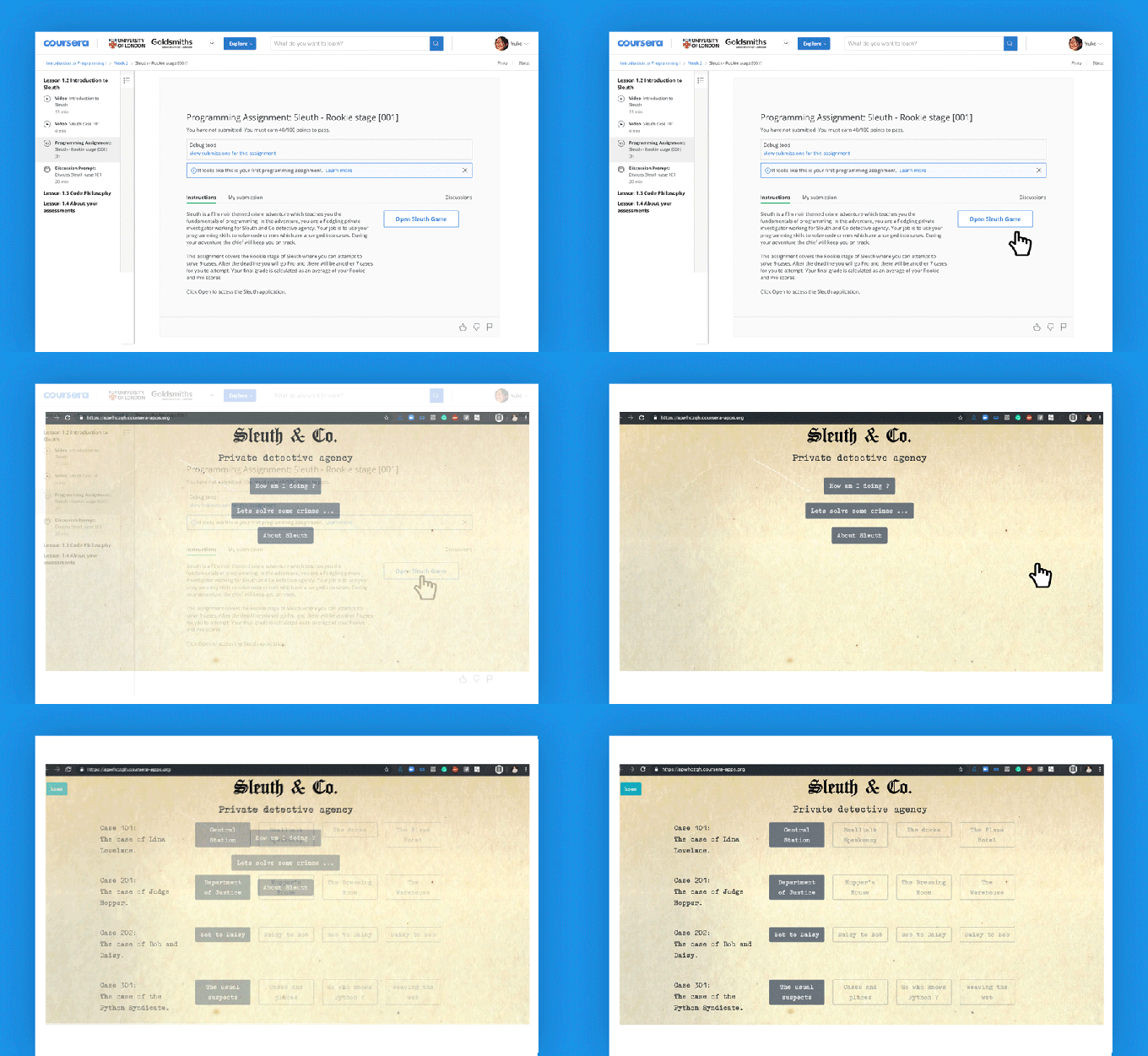
The deal and the Labs product have been in the works for a while before today, and so some partners have already started to build projects around the offering, like this project from the University of London called Sleuth, to help teach programming skills:

Coursera Labs Learner Experience UofL Sleuth

The terms of the deal to acquire Rhyme are not being disclosed — and it’s not clear who its investors were, as Crunchbase lists only a pre-seed round for the startup. But Jeff Maggioncalda, the CEO of Coursera, said that it includes not just Rhyme’s IP and related assets, but its team of six, who will now form the basis of a new R&D office for the company out of Sofia, Bulgaria led by Rhyme’s co-founder and CEO, Namit Yadav. Coursera will also be investing millions in the company’s technology as part of its Coursera Labs initiative.

The idea behind developing Coursera Labs is to bring more flexibility as well as customization into the Coursera platform. Aimed at courses that have strong project and development components to them such as programming, math, or perhaps marketing projects — but not, for example, necessarily a course on 20th century history or Japanese literature — the idea is to bring in more of the tools that have become standard in those disciplines as they are taught elsewhere, and as they are used elsewhere (such as in job applications). Tools that are supported to Labs projects include Jupyter Notebook, RStudio, VS Code, cloud software consoles, and native desktop applications, the company said. Educators building courses can use templates from these or create custom courses for their needs.

The new initiative to offer Labs signals an interesting shift for Coursera in another regard: it will be the first time that the company will have a significant amount of content that will require a person to be “online” in order to use it, a change from previously, when leaners could take work offline to do it. Maggioncalda said however that bandwidth is not an issue — very little of it is required — which will be key considering the growth that Coursera has seen in many emerging markets outside of its home base of the US.

What the change could mean is interesting: Coursera will be able to offer more analytics now to course creators  (and to learners) about how long projects take to complete, what questions give people more pause, and more. It will also give those building online courses a new window into making content specifically for the Coursera platform, rather than work that was originally built for consumption in the class being translated into the Coursera (or indeed more generally e-learning) environment. Important to note, though, that Coursera Labs will be one part of a wider toolkit: there will still be a lot of Coursera courses that do not use it, and do not really need to.

Maggioncalda hinted that there will be another chapter coming in how Labs and Coursera will be developing later in the year that could see the initiative scaling up even more. That could in part be down to extending Labs to Coursera Enterprise users, which is a newer area for the company that provides training for knowledge workers and now has 2,000 customers, Maggioncalda said.


28 Aug 2019

Fitbit’s Versa 2 smartwatch features Alexa and a better battery

The first Versa was a revelation for Fitbit. After falling flat with the Ionic, the company’s second true smartwatch finally delivered on the promise of high-profile acquisitions, including Pebble and Vector, with a smartwatch the could truly compete with Apple’s. In fact, the product helped jump-start Fitbit’s sputtering stock and appeared to be the first step on its road to recovery.

Announced earlier this year, the Versa Lite was widely regarded as a misfire — something CEO James Park admitted in a recent earnings call. Although it was right to have price point at front of mind, it wasn’t enough to justify the loss of several key features. And honestly, the original Versa’s $200 MSRP seems to be right in the sweet spot for those looking for a lower-cost Apple Watch competitor (that also happens to work with Android).
DSCF7768

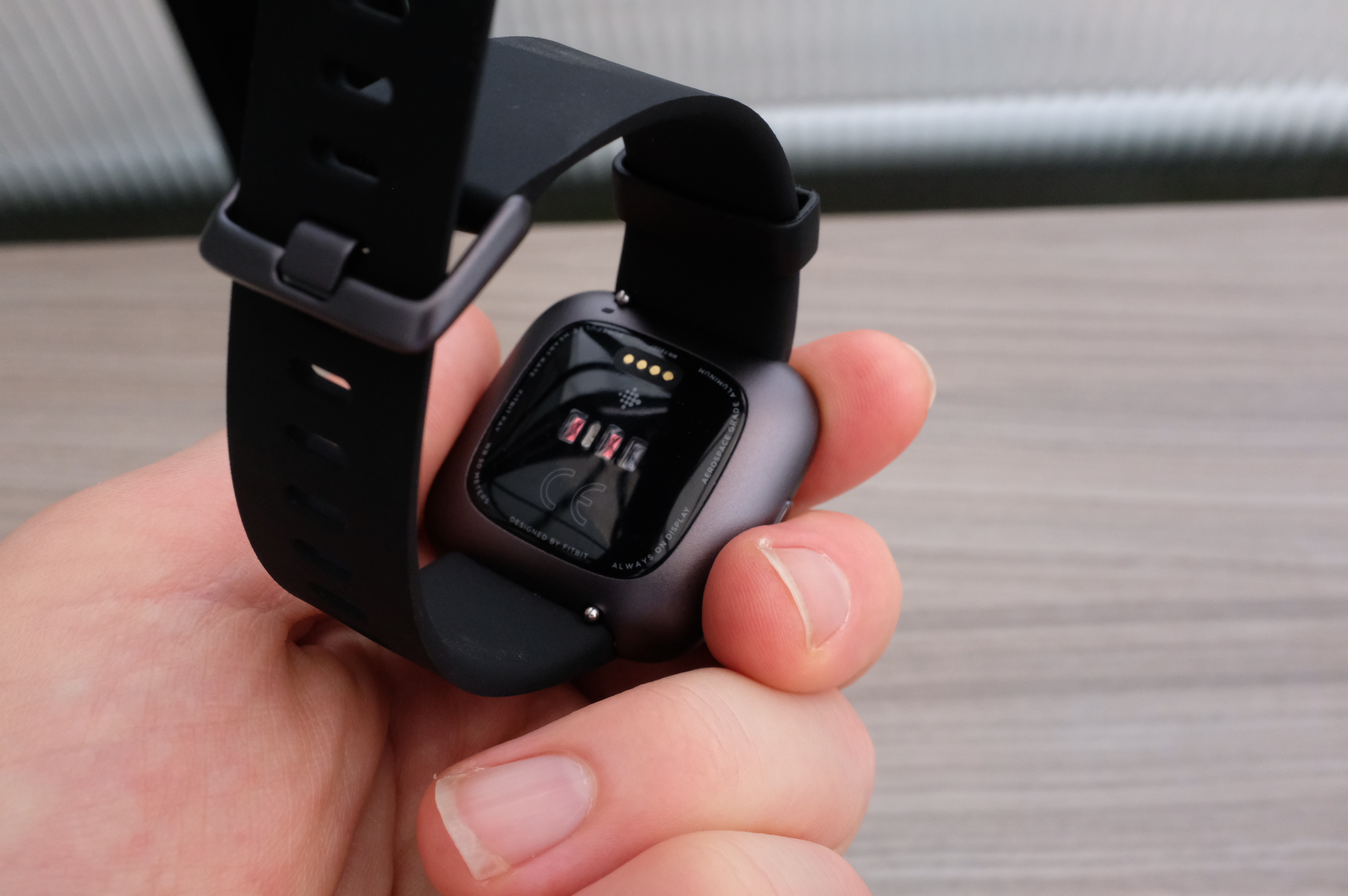
A year and a half after the first Versa, Fitbit finally returns with the follow-up, the apply named Versa 2. The new version of the device isn’t a radical departure, but looks to be a pretty solid upgrade. I don’t anticipate too many Versa 1 owners making the upgrade here, but there’s a lot to like in the new version.

Confirming earlier leaks, Alexa is a key part of the update. Without its own voice assistant, Fitbit turned to the most logical place, partnering with Amazon. Seems like a mutually beneficial team up for both parties — Amazon finally breaks into the wearables space in a meaningful way and Fitbit gets access to an already immensely popular smart assistant.

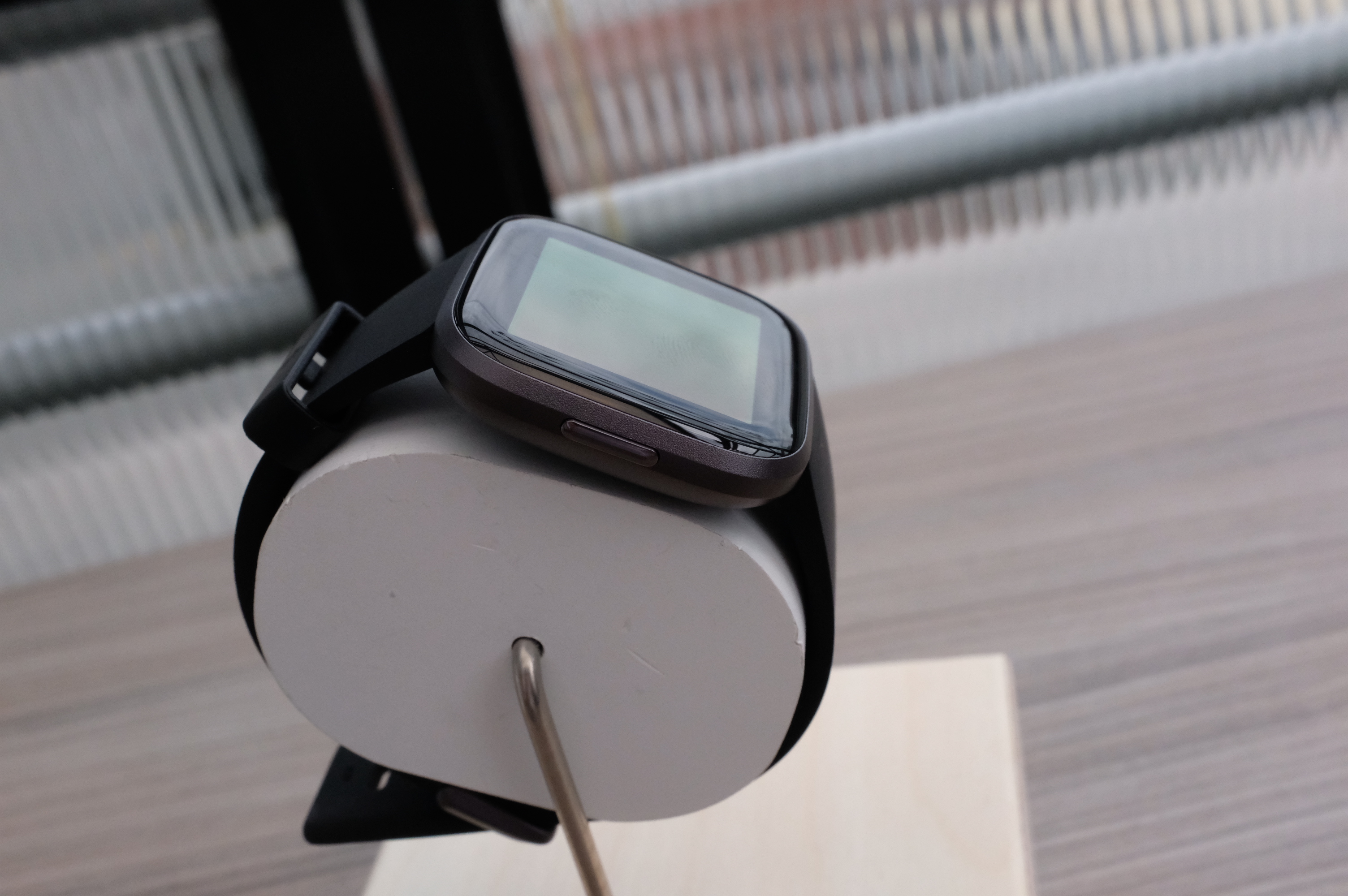
Interestingly, the Versa 2 marks the first time Fitbit has built a microphone directly into a device. The hardware was added specifically for the purposes of bringing Alexa to the product. The assistant is accessed with the press of a button for a wide variety of features, from weather to smart home control. Answers arrive on-display in text form.

DSCF7774

“We actually had to work closely with Amazon because Alexa wouldn’t work out of the box on these devices,” CEO James Park tells TechCrunch. “One, we’re still trying to maintain a low power profile. Two, we’re trying to make our devices still affordable. So we didn’t integrate a speaker. So we had to work with Amazon closely to make Alexa work without voice output. So that actually took a lot of collaborations between the two companies.”

Among the more practical additions is improved battery life. Fitbit says the Versa 2 can get “5+ days” on a charge. The watch should still be able to get several days, even with the new always-on watch face display enabled.

Sleep features get a bit of an overhaul, as well. Sleep Score is pretty much what it sounds like, attaching a number to the quality of one’s sleep. That factors in things like heart rate, restlessness, time awake and sleep stages. The company is promising a higher-quality breakdown of that information via its new Premium subscription offering. Smart Wake is a welcome addition, as well. The feature will be rolling out to all Fitbit smartwatches, waking up users within a 30-minute window, based on sleep cycle.

DSCF7759 1

Design-wise, well, this thing looks even more like the Apple Watch than its predecessor. Here’s what Park told me on that front:

With phones, it’s like every phone starts to look the same. But for us, we try to blend around design and the square design into what we call the squircle design that tries to capture both one that looks more like a traditional watch piece but still has a squareish form factor to display information. So we think we’ve struck the right balance. And I think whether it looks like an Apple Watch or not is kind of irrelevant. We’re trying to look at the customer experience and try to see what’s best for the user.

What a lot of it comes down to is kind of getting out of its own way. Gone are the days when the devices were flashy status symbols. These sorts of wearables have become far more utilitarian, and, as such, are designed to occupy a similar space as a good, old-fashioned dumb watch.

All models of the watch also feature Fitbit Pay built-in, which includes access to a number of different global transit systems, including New York, Vancouver, London and Taiwan.

The Versa is priced at $200, the same as its predecessor. There’s a premium model at $230, which includes a special strap and a 90-day pass to Fitbit Premium.