Category: UNCATEGORIZED

20 Aug 2019

Starship Technologies raises $40M, crosses 100K deliveries and plans to expand to 100 new universities

Starship Technologies invented the category of rolling autonomous sidewalk delivery robots, and to date, the company has made over 100,000 commercial deliveries on behalf of customers. The milestone comes as Starship adds $40 million in Series A funding, bringing its total funding to $85 million. When it announced an additional $25 million in June 2018, Starship was also piloting its first university deployment – and now the company has a plan to expand to 100 university campuses over the next two years based on the strength of that pilot.

“When I came on board, I was testing a whole bunch of different go-to-market strategies,” explained Starship Technologies CEO Lex Bayer. “We were testing grocery delivery, university campuses, corporate campuses, industrial campuses, and we’ve actually seen tremendous traction on most of these environments. Our grocery business north of London, in Milton Keynes is going exceptionally […] But one of the experiments was to try university campuses. And I think, you know, as a company that’s a startup still, we have to always focus and have sequencing in terms of how we grow. And the university campus has just been pulling our business forward – not only our students pulling it, meaning there are more orders than the restaurant from the robots can keep up with that, sorry, we had to add restaurants and add hours. And so we’ve seen signal from the students, but we’ve also seen signal from universities reaching out to us, and from the food service providers.”

This vertical focus on post-secondary schools will see Starship robots deployed at the University of Pittsburgh today, and Purdue University in Indiana on September 9, with many more to follow. Starship’s ambitious goal is to deploy at 100 schools within the next two years, as mentioned, and it’s going to be using this funding in pursuit of that expansion. The market appetite is strong, as Bayer notes, and it’s a way to show that the robots can operate in all kinds of environments, in and among campuses that blend seamlessly with public city streets and sidewalks. Plus, the student population has proven the ideal initial customer base.

“I think, you know, starting with the younger generation is always great for that,” Bayer said. “Because so much of the way they see the world is the way the world can be; they’re not encumbered by all of the past and the way things were done before. And so when you present them with a better solution, they just use it and they say, ‘Oh, this is how things should be normally. This is the way things should be moving forward.'”

Pitt Student with StarshipAnd that perceived normalcy leads to high utilization: One of the robots serving one of the universities where Starship operates manages to drive the equivalent of the distance between San Francisco and New York City, which is quite an accomplishment when you consider that they only travel at a top speed of four miles per hour. Starship’s all-electric delivery robots have, in total racked up 350,000 miles across its delivery trips, and delivered 9,000 such rolls and 15,000 bananas, among various other grocery and food items.
“The first few years were really proving that this could be done, and that this technology is even possible,” Bayer explained. “And so it took us four years to get to the first 10,000 deliveries. And then it took us eight months ago from 10,000 deliveries to 50,000 deliveries, and now it’s taken us less than four months to get to 100,000. So that is a major milestone, and we’re the first autonomous vehicle company to do that. It’s something we’re obviously very proud of. But it really shows the sort of inflection that our company’s going through and how we’re really scaling up.”

Starship’s funding this round was led by Morpheus Ventures, and included existing investors Shasta Ventures, Matrix Partners, MetaPlanet Holdings and more, along with new investors TDK Ventures, Qu Ventures and others.

20 Aug 2019

IFTTT warns against migrating Nest devices to Google accounts

Google says it’s moving Nest devices over to a unified Google ecosystem for the sake of simplicity. But simple can be complicated, as is certainly the case here. In May, after user pushback, the company announced that it would maintain Works with Nest connections for some third-party integration.

IFTTT’s popular applets for the company’s camera, smoke detector and thermostat are among those exceptions. That certainly bodes well for those user who took the time to ingrate IFTTT functionality.

However, users who opt to migrate a Nest account to a Google one will apparently break their connections in the process. The organize issued a dual warning late last night, following a migration blog post encouraging users to migrate.

Per IFTTT,

  • Do not migrate your Nest account to a Google account. Migrating your Nest account will cause IFTTT and other Works with Nest integrations to be disconnected. This process is not reversible.
  • Do not disconnect Nest from IFTTT after August 31st as you will not be able to reconnect it. This affects users that do not migrate their Nest accounts to a Google one.

For its part, Google says it’s looking to bring similar automation functionality to Nest that presently requires third-party integration from services like IFTTTT.

20 Aug 2019

Yubico launches its dual USB-C and Lightning two-factor security key

Almost two months after it was first announced, Yubico has launched the YubiKey 5Ci, a security key with dual support for both iPhones, Macs and other USB-C compatible devices.

Yubico’s latest Yubikey is the latest iteration of its security key built to support a newer range of devices, including Apple’s iPhone, iPad, and MacBooks in a single device. Announced in June, the company said the security keys would cater for cross-platform users — particularly Apple device owners.

These security keys may be small enough to sit on a keyring, but they contain the keys to your online line. Your Gmail, Twitter, and Facebook account all support these plug-in devices as a second-factor of authentication after your username and password — a far stronger mechanism than the simple code sent to your phone.

Security keys offer almost unbeatable security and can protect against a variety of threats, including nation-state attackers.

Jerrod Chong, Yubico’s chief solutions officer, said the new key would fill a “critical gap in the mobile authentication ecosystem,” particularly given how users are increasingly spending their time across a multitude of mobile devices.

The new key works with a range of apps, including password managers like 1Password and LastPass, and web browsers like Brave, which support security key authentication.

20 Aug 2019

Reputation.com nabs $30M more to help enterprises manage their profiles online

In these days where endorsements from influential personalities online can make or break a product, a startup that’s built a business to help companies harness all the long-tail firepower they can muster to get their name out there in a good way has raised some funding to expand deeper into feedback and other experience territory. Reputation.com, which works with big enterprises in areas like automotive and healthcare to help improve their visibility online and provide more accurate reports to the businesses about how their brands are perceived by customers and others, has raised $30 million in equity financing, money that CEO Joe Fuca said the company will use to continue to expand its tech platform to source more feedback and to future-proof it for further global expansion.

The funding — led by Ascension Ventures, with participation also from new backers Akkadian Ventures, Industry Ventures and River City Ventures and returning investors Kleiner Perkins, August Capital, Bessemer Venture Partners, Heritage Group and Icon Ventures — is the second round Reputation.com has raised since its pivot away from services aimed at individuals. Fuca said the company’s valuation is tripling with this round, and while he wouldn’t go into the details from what I understand from sources (which is supported by data in PitchBook), it had been around $120-130 million in its last round, making it now valued at between $360-390 million now.

Part of the reason that the company’s valuation has tripled is because of its growth. The company doesn’t disclose many customer names (for possibly obvious reasons) but said that three of the top five automotive OEMs and as well as over 10,000 auto dealerships in the U.S. use it, with those numbers now also growing in Europe. Among healthcare providers, it now has 250 customers — including three of the top five — and in the world of property management, more than 100 companies are using Reputation.com. Other verticals that use the company include financial services, hospitality and retail services.

The company competes with other firms that provide services like SEO and other online profile profile management and sees the big challenge as trying to convince businesses that there is more to having a strong profile than just an NPS score (providers of which are also competitors). So, in addition to the metrics that are usually used to compile this figure (based on customer feedback surveys typically), Reputation.com uses unstructured data as well (for example sentiment analysis from social media) and applies algorithms to this to calculate a Reputation Score.

Reputation.com has been around actually since 2006, with its original concept being managing individuals’ online reputations — not exactly in the Klout or PR-management sense, but with a (now very prescient-sounding) intention of providing a way for people to better control their personal information online. Its original name was ReputationDefender and founded by Michael Fertik, it was a pioneer in what came to be called personal information management.

The company proposed an idea of a “vault” for your information, which could still be used and appropriated by so-called data brokers (which help feed the wider ad-tech and marketing tech machines that underpin a large part of the internet economy), but would be done with user consent and compensation.

The idea was hard to scale, however. “I think it was an addressable market issue,” said Fuca, who took over as CEO last year the company was reorienting itself to enterprise services (it sold off the consumer/individual business at the same time to a PE firm), with Fertik taking the role of executive chairman, among other projects. “Individuals seeking reputation defending is only certain market size.”

Not so in the world of enterprise, the area the startup (and I think you can call Reputation.com a startup, given its pivot and restructure and venture backing) has been focusing on exclusively for the better part of a year.

The company today integrates closely with Google — which is not only a major platform for disseminating information in the form of SEO management, but a data source as a repository of user reviews — but despite the fact that Google holds so many cards in the stack, Fuca (who had previously been an exec at DocuSign before coming to Reputation.com) said he doesn’t see it as a potential threat or competitor.

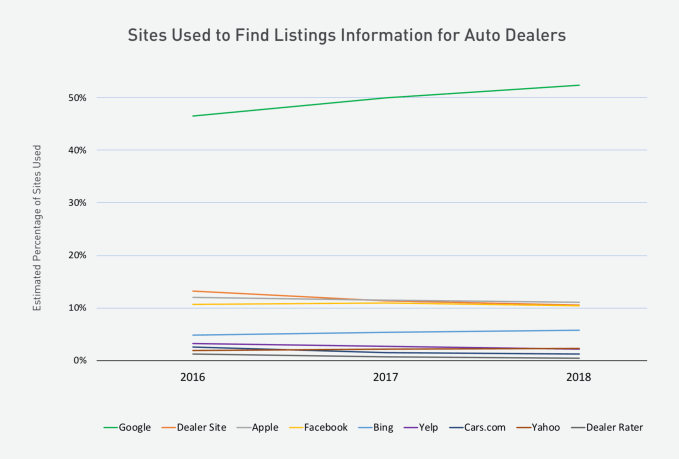
A recent survey from the company about reputation management for the automotive sector underscores just how big of a role Google does play:

Screenshot 2019 08 20 at 11.48.57“We don’t worry about google as competitor,” Fuca said. “It is super attracted to working with partners like us because we drive domain activity, and they love it when people like us explain to customers how to optimise on Google. For Google, it’s almsot like we are an optimization partner and so it helps their entire ecosystem, and so I don’t see them being a competitor or wanting to be.”


Nevertheless, the fact that the bulk of Reputation.com’s data sources are essentially secondary — that is publically available information that is already online and collected by others — will be driving some of the company’s next stage of development. The plan is to start to add in more of its own primary-source data gathering in the form of customer surveys and feedback forms. That will open the door too to more questions of how the company will handle privacy and personal data longer term.

“Ascension Ventures is excited to deepen its partnership with Reputation.com as it enters its next critical stage of growth,” said John Kuelper, Managing Director at Ascension Ventures, in a statement. “We’ve watched Reputation.com’s industry leading reputation management offering grow into an even more expansive CX platform. We’re seeing some of the world’s largest brands and service providers achieve terrific results by partnering with Reputation.com to analyze and take action on customer feedback — wherever it originates — at scale and in real-time. We’re excited to make this additional investment in Reputation.com as it continues to grow and expand its market leadership.”

20 Aug 2019

Summer flash sale: Score 2-for-1 passes to Disrupt Berlin 2019

The dog days of summer are upon us, and even busy startuppers across Europe are enjoying a well-deserved vacation. Down time’s important and so is saving money, so all this week we’re holding a 2-for-1 summer flash sale on passes to Disrupt Berlin 2019.

Disrupt Berlin takes place on 11-12 December and, depending on the type of pass you buy, our super early-bird pricing can save you up to €600. But now you can double your savings simply by purchasing an Innovator, Founder or Investor pass before our 2-for-1 flash sale ends on August 23 at 11:59 p.m. (CEST). Buy your 2-for-1 passes right here.

Experience all the early-stage startup excitement and opportunity that Disrupt Berlin offers and do it at a huge discount. Join your community — roughly 3,000 attendees from more than 50 countries, including European Union members, Israel, Turkey, Russia, Egypt, India, China and South Korea. Explore hundreds of early-stage startups exhibiting in Startup Alley. Listen to and learn from our roster of speakers — leading founders, technologists, investors and tech icons along with up-and-coming founders.

Be sure to watch — or even better apply to compete in — the Startup Battlefield pitch competition. TechCrunch editors will select some of the best early-stage startups to go head-to-head on the Disrupt Main Stage. Who knows, you might take home the $50,000 top prize or find your next investment opportunity.

More opportunity awaits in the form of TC Top Picks. Apply here to be one of a select few startups to represent these tech categories: AI/Machine Learning, Biotech/Healthtech, Blockchain, Fintech, Mobility, Privacy/Security, Retail/E-commerce, Robotics/IoT/Hardware, CRM/Enterprise and Education. If you’re chosen, you’ll receive a free Startup Alley Exhibitor Package, a VIP experience and a ton of media and investor exposure. What’s more, a TechCrunch editor will interview every TC Top Pick on the Showcase Stage. We’ll record that interview and promote the video across our social media platforms. That video will drive traffic to your site and come in mighty handy as a future talking point with investors.

Disrupt Berlin 2019 takes place on 11-12 December. Don’t let sleepy summer days distract you from serious summer savings. You have the rest of this week to double your savings on Innovator, Founder or Investor passes. Buy your 2-for-1 passes before our flash sale ends on August 23 at 11:59 p.m. (CEST). We’ll see you in December!

Is your company interested in sponsoring or exhibiting at Disrupt Berlin 2019? Contact our sponsorship sales team by filling out this form.

20 Aug 2019

SpotQA picks up $3.25M seed funding for its automated software testing

SpotQA, a new automated software testing platform that claims to be significantly faster than either manual testing or existing automated QA solutions, has raised $3.25 million in seed funding.

Leading the round is Crane Venture Partners, the newly-outed London venture capital firm focusing on “intelligent” enterprise startups. Also participating is Forward Ventures, Downing Ventures and Acequia Capital.

Founded in 2016 by CEO Adil Mohammed, who sold his previous company to apparel platform Teespring, SpotQA’s flagship product is dubbed Virtuoso. Described as an “Intelligent Quality Assistance Platform” that uses machine learning and robotic process automation, it claims to speed up the testing of web and mobile apps by up to 25x and make QA accessible across an entire company, not just software or QA engineers.

“Over the years working closely with engineering teams, I learned how the QA and testing process, when done inefficiently, can be a big barrier for company growth and productivity,” Mohammed tells me. “The way testing is done today is not fit for purpose. Even automated testing methods are not keeping pace with agile development practices”.

This results in software testing creating a bottleneck that prevents companies deploying as fast as they’d like to, says the SpotQA CEO, which is pain point for all involved, from developers to testers, all the way through to DevOps and production. “It has a real impact on the company’s bottom line,” adds Mohammed.

The incumbent options are either manual testing or traditional automation. Mohammed says manual testing is slow and makes continuous development difficult as there is a constant “disconnect” between QA and other teams. In turn, traditional automation is not very smart and hasn’t seen much innovation in the last decade. “It’s still very code based, relies on expensive automation engineers and it is difficult to setup and maintain,” he argues.

Explorations pages

In contrast, SpotQA claims to have designed Virtuoso so that software quality can be ensured across the entire software development lifecycle, something the company has branded “Quality Assistance”.

“By using machine learning and robotic process automation, Virtuoso is by far the most efficient and effective way to ensure bugs, inconsistencies and errors can be identified and fixed in a fraction of the time taken using manual and traditional automated testing,” says Mohammed.

Meanwhile, the London-based company will use the new injection of capital to scale engineering, sales and marketing, and to expand internationally. Existing Virtuoso customers include Experian, Chemistry, Optionis and DXC Technologies.

20 Aug 2019

State attorneys general to launch antitrust investigation into big tech companies, reports say

The state attorneys in more than a dozen states are preparing to begin an antitrust investigation of the tech giants, the Wall Street Journal and the New York Times reported Monday, putting the spotlight on an industry that is already facing federal scrutiny.

The bipartisan group of attorneys from as many as 20 states is expected to formally launch a probe as soon as next month to assess whether tech companies are using their dominant market position to hurt competition, WSJ reported.

If true, the move follows the Department of Justice, which last month announced its own antitrust review of how online platforms scaled to their gigantic sizes and whether they are using their power to curb competition and stifle innovation. Earlier this year, the Federal Trade Commission formed a task force to monitor competition among tech platforms.

It won’t be unprecedented for a group of states to look at a technology giant. In 1998, 20 states joined the Justice Department in suing Microsoft . The states could play a key role in building evidence and garnering public support for major investigations.

Because the tentacles of Google, Facebook, Amazon, and Apple reach so many industries, any investigation into them could last for years.

Apple and Google pointed the Times to their previous official statements on the matter, in which they have argued that they have been vastly innovative and created an environment that has benefited the consumers. Amazon and Facebook did not comment.

Also on Monday, Joseph Simons, the chairman of FTC, warned that Facebook’s planned effort to integrate Instagram and WhatsApp could stymie any attempt by the agency to break up the social media giant.

“If they’re maintaining separate business structures and infrastructure, it’s much easier to have a divestiture in that circumstance than in where they’re completely enmeshed and all the eggs are scrambled,” Simons told the Financial Times.

20 Aug 2019

All 84 startups from Y Combinator’s S19 Demo Day 1

It’s that time of year, Silicon Valley’s investor technocrati and advice-giving Twitter celebrities descended upon Pier 48 in San Francisco to judge the latest summer batch of Y Combinator startups. TechCrunch was there, as well, and we were tapping away feverishly as co-founders pitched to woo investors.

There are 197 companies in total in the summer YC batch, we heard from 84 of them today — in addition to a few off-the-record pitches which we agreed to hold off publicizing as they remain in stealth. We’ll hear from another chunk of them tomorrow, so check back tomorrow for even more startup blurbs.

Demo Day used to be the debut for many of these companies, but as Y Combinator’s prestige has grown so has the likelihood that the batch’s best will be closing rounds at outsized valuations before the first pitches have been made.

We’ll undoubtedly be reporting on some of these rounds moving forward, but for now here are the 84 companies whose founders pitched onstage today at Y Combinator Demo Days – Day 1.


ECWZ6h1U4AArURK

  • Mighty: Mixpanel’s founder is at Y Combinator with his new startup, Mighty, a $20 per month cloud computer streaming service that’s just for Google Chrome (at the moment). Why pay for a free piece of software? The startup says that by streaming the experience from a beefed-up PC your most-used app will be considerably faster and only use 5% of your CPU. It’s a premium product with a tight niche, but the company has ambitions to support other software types as it builds out the tech.
  • Hype and Vice: This startup combines the latest trends with college brands to make fashion-focused college apparel for women. Working with 11 universities to date, the founders say the company has grown 4x YoY, with margins of 84%; meanwhile, they have 50 additional college licenses in the pipeline.

  • Lumineye: Lumineye wants to help first responders identify people through walls. In domestic violence disputes, hostage rescue or human trafficking situations, first responders often need help determining where humans are behind closed doors or other barriers. Lumineye’s team of four built a portable 3D-printed radar device that uses signal analysis software to differentiate moving and breathing humans from other objects through barriers like drywall, concrete, rubble and brick. For Lumineye, four pilot programs represent $90K in ARR. They’ve also just signed a $50K pilot with the U.S. Air Force. They’re also signed on to start testing with the FBI this fall.
  • Flo Recruit: This is an applicant-tracking platform for in-person recruiting events. The startup helps companies scale their college recruiting efforts, saving time and money. The company says they have $8,500 in monthly recruiting revenue, counting Y Combinator itself as one of its customers.
  • Gaiascope: Electricity trading is a $15 billion annual market, but it’s hard. Electricity is consumed instantly, which means the supply must always match the demand. That, however, leads to extreme price volatility. Traditional quant models don’t work, so this is where Gaiascope’s algorithms come in. Through its quant fund, Gaiascope enables electricity trading at more predictable prices. 
  • Revel: Many of the venture-backed communities online seem to be geared toward 20-something dudes, but Revel is aiming to create an online-to-offline community group for women over the age of 50. The site is a $15 per month membership that gives you access to the community-hosted groups. Revel went live in the Bay Area last month.

demoday node

  • Node: Node wants to use an Ikea-like assembly process to build sustainable backyard cottages — a market the founders say is worth $100 billion and growing quickly. In the past year 25 cities have passed legislation to allow these buildings. Node ships a flat pack of materials that it says only take a few days to assemble into a turnkey backyard cottage or sustainable vacation home. They’ve sold 11 homes in the past two weeks, and the founders are optimistic that they could reach 50% margins with their tech. Early target markets include Seattle, Portland and Vancouver. 
  • Prolific: A marketplace for finding survey participants on demand. Submit your survey, tell them a bit about your target audience, and they’ll find survey participants accordingly. They saw $185K net revenue in July, with 2.5x yearly growth through word of mouth.
  • Juno College of Technology: JCT is creating the technical university of the future. The startup operates a coding bootcamp, expected to do $3 million in revenue by the end of 2019. Similar to Lamda School, they offer income-share agreements, but “the similarities stops there,” explained the founder. Juno says it places 87% of founders who complete their nine-week long program. 
  • LAIKA: In Latin America, it’s hard to buy pet supplies in person due to a reliance on bus transportation. LAIKA, an online pet supplies service for Latin America, aims to make it easier. The startup has $200,000 in monthly revenues and is growing 30% month over month. 
  • ScholarMeThe startup is building what it calls the “Common App for college financing,” a single form that helps students pay for college. The company prevents prospective students from filling out endless forms to find scholarships, FAFSAs, income-share agreements and loans. 
  • Sable: Getting set up with a bank is a slow process for people new to the U.S. It can take months for foreign-born people to get set up with a credit card and a checking account. Sable launched a mobile bank for international people in the U.S. that wants to expedite that process. The team has collectively worked on distributed teams that launched 14 banking products in the past. The company is currently managing credit cards and live checking accounts. With Sable, users can get set up with a credit card and checking account online in five minutes. In five days of launch, the company has 135 customers and is managing $200,000. Sable is targeting 4.5 million creditworthy internationals, and what it says is a $3.3 billion market in the U.S. alone. The team wants to eventually launch a suite of banking products like mortgages and student loans while they’re at the beginning of their financial independence in the U.S. 

demoday metacode

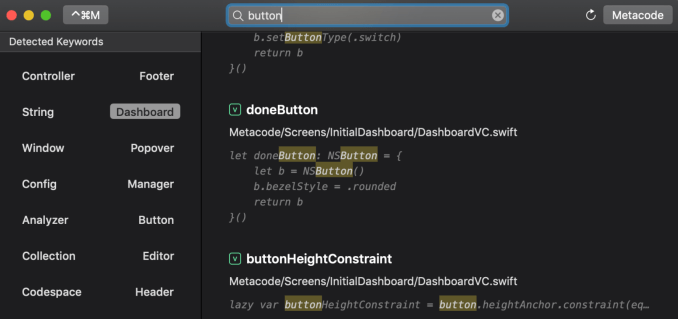
  • Metacode: “Better code search,” currently for Swift, TypeScript and Javascript. Whereas many code environments only do plaintext search, Metacode sorts results by relevance, displays code in the context of code around it and allows you to filter results by keyword. The company says more than 700 engineers from companies like Pinterest and VueJS are currently using it. The cost is $25 per month per engineer.
  • Fad Mania: This is an app that provides users with an endless stream of games with ambitions of being the next major social network. One of the first games was called Trump Punch, which got more than 100,000 organic users. The team realized most games don’t retain users and decided to create Fad Mania, which develops social-first games. Fad Mania has 1,000 weekly users.
  • Breadfast: This startup delivers fresh bread, milk and eggs to customers in Egypt. Because Breadfast makes its own bread and works with farmers, its business has 35% gross margins with $180,000 in monthly revenue. For customers, Breadfast costs $18 per month per household.
  • Ever Loved: If you thought people using GoFundMe’s to pay for their surgeries were dark, Ever Loved is helping people pay for funeral expenses with a dedicated platform. The crowdfunding site can help families and friends amass cash and the startup will let people pay for services directly from the site, letting them take a slice on both sides of the transaction.
  • Localyze: Localyze provides international employee relocation as a service. Employee relocation is an expensive cost for businesses, yet every year, two million people are moving to the U.S. and Europe for work. Localyze wants to streamline that process with a software that automates some tasks related to immigration, moving and housing processes 50% faster. The platform also connects international employees to services like banking, insurance and transportation. Localyze is currently working with 27 B2B customers and says it produced $16,000 in revenue last month.
  • Safely Deposit: This startup provides on-demand safe deposit boxes specifically for physical papers like estate documents and wills. You mail your documents in via FedEx, they store the physical copy in a safe deposit box while providing you access to digital copies. The cost is $120 per year.

demoday elpha

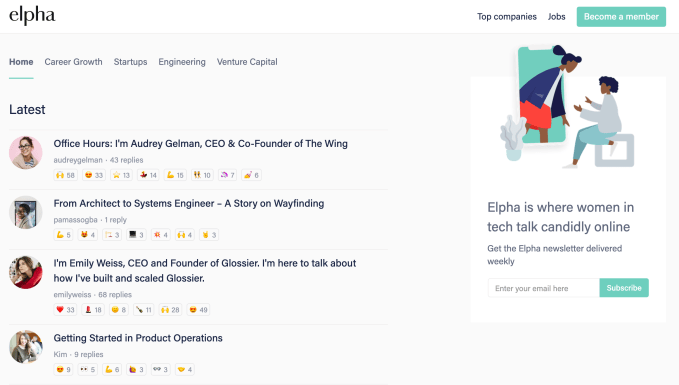
  • Elpha: (IMAGE) This is a networking and communication platform for women in tech to talk candidly online. Elpha today counts 15,000 members and 6,000 members visiting the site each work. They have 23 paying companies who pay $12,000 per year for access to the platform. Elpha strives to be the first professional network built for and by women.
  • Basis: This is a construction startup that automates workflows and manages bids from subcontractors. To date, Basis has four signed contracts within three weeks of operating. The big vision is to become a full-fledged platform for the construction industry.
  • Hatchways: Learning to code online has kind of been a trope for people that are tired of their careers and are ready to do something new. The issue is that even if they get their skills to a great position that’s really only part of the equation. Hatchways is building a platform to help people who have learned to code online find internships and team projects. The startup is aiming to collect fees on both sides, from candidates looking to find opportunities and companies looking for new talent. They’re starting with software engineers but are also looking to help people get into finance, as well.
  • Puzzl: Puzzl is a campaign tracking platform for brands; it focuses on the in-person parts of campaigns. The platform lets businesses manage their ambassador programs and track metrics without being physically present at targeted locations. Puzzl’s software lets companies track impressions, engagement and conversions for the in-person parts of marketing campaigns. They managed a campaign for Juli Learning code school, another YC company. They’ve made $11,000 in revenue with 33% margins since launching 20 campaigns. Puzzl is currently enabling brands to manage 100 brand ambassadors in what it says is an $8 billion market.

demoday marble

  • Marble Technologies: This startup provides cashier-free checkout kiosks for restaurants, running on iPads. Marble’s founders say their solution increases customer spending by 16%. They have three national restaurant chain contracts in the works, and have processed $3 million in sales to date. They charge $12,000 per location, per year. 
  • Apero Health: Led by a pair of serial entrepreneurs, including the former chief technology officer of Doctor on Demand, Apero Health provides automated claim submission, integrated online patient building and modern APIs to doctor’s offices. 

demoday shortstory

  • Short Story: You could think of Short Story as a Stitch Fix for petite women. Petite women can have a hard time finding clothes that fit them. First, petite women complete a style quiz to notify the company of their preferences. Then, Short Story sends them their first monthly box of clothes. Short Story says the petite women’s clothing market is worth $35 billion. To date, Short Story has seen 74% monthly revenue growth.
  • EncepHeal Therapeutics: Non-addictive prescription substitutes have been a very popular solution for people addicted to drugs like tobacco and opioids. EncepHeal Therapeutics is creating medications to help the 2.5 million cocaine and methamphetamine addicts have a similar option. The company’s medication has shown promising early testing on lab rats.
  • PopSQL: PopSQL provides collaborative SQL query editing. You can store SQL queries you run regularly, grouping them into folders that can be kept private or shared amongst your team. Version history tracks changes so it can be reverted if/when something breaks. It currently has more than 100 paying companies, and is making $13K per month. It plans to build a marketplace for apps that run on top of your company’s database.
  • Kuarti: Kuarti is building the OYO of Latin America. The founder equates the current hotel booking process in Latin America to what it looked like decades ago in the U.S. Kuarti identified a trend of increasing demand to travel within Mexico’s growing middle class. However, there are currently no standardized hotel options in the country. Kuarti wants to provide another hotel booking option for standardized hotel chains that can be reserved online. The company wants to partner with independent hotels, to make small renovations and offer rooms for $35 per night. They’ve partnered with four hotels, have 20 rooms in their inventory and say that users have already booked 275 nights collectively. The founder identifies this as a $2.5 billion market in Mexico alone, and an $11 billion market across all of Latin America, where it hopes to expand. Kuarti is a Mexican company that is part of the business accelerator with which Airbnb started.
  • UpEquity: The startup lets future homeowners put down all-cash offers in what they claim is a $20 billion market opportunity. The founders, Harvard Business School dropouts, have a history in the private equity industry. The startup claims to have more than $30,000 in revenue for the month of August. The tech-enabled mortgage solution says it provides customers better bargaining power than traditional solutions, at competitive rates.
  • Blair: Blair finances college education through income-share agreements. Through ISAs, which require students to pay back Blair a percentage of their future income, Blair finances everything from tuition to cost of living. Since launching a few weeks ago, Blair has already put $250,000 toward the education of 20 students. Blair will deploy its second fund this week.

  • Intersect Labs: Intersect Labs is building CoreML for enterprise, letting its customers easily build machine learning models to help make sense of their historical data and deliver insights without having to hire data scientists. The monthly subscription is aiming to deliver a product that doesn’t require much technical knowledge. “If you can use a spreadsheet, you can use Intersect Labs.”
  • Traces: As privacy-conscious consumers speak up against the proliferation of facial recognition tech, there’s still a clear need for a product that enables smart camera tracking for customers. Traces is building computer vision tracking tech that relies on cues other than facial structure like clothing and size to help customers integrate less invasive tracking tech. It was built by former Ring engineers.

demoday Epic Aerospace

  • Epic Aerospace: Epic is manufacturing inexpensive space tugs to deliver satellites into geostationary orbit. The 21-year-old founder has been building rockets since he was 16, and is now managing a team of seven aerospace engineers with Epic Aerospace. The founder describes propulsion as one of the biggest problems for satellite companies, in that it can take up to two years to qualify new satellite systems and can cost up to $30 million. The problem they’re solving is moving satellites from low Earth orbit directly into geostationary orbit. Epic’s tug is half the cost of the competition and is reusable. They’re currently working with Satellogic, and chasing what the founder says is a $3.1 billion geostationary insertion market. 
  • Soteris: Soteris is a startup building machine learning software for insurance pricing. Within six months of their pilot, they already have two insurers under contract, giving them $500K in guaranteed annual revenue. 
  • Gold Fig Labs: The startup is building a tool for version control on settings pages. The founders come from Firebase, where they were both early employees. The company has signed up 60 companies in the last five weeks, including “multi-billion-dollar tech companies.”
  • Mela: Mela, which refers to itself as the Pinduoduo for India, is an e-commerce platform that enables customers to participate in group shopping and buying via WhatsApp and Facebook. The number of orders on Mela are increasing by 59% per day. 

demoday Million Marker

  • Million Marker: The world is full of nasty chemicals that can mess up your body. Million Marker is building testing kits to help people measure their exposure to certain chemicals. The startup is starting with a urine testing kit that analyzes for BPA and Phthalates, plastics chemicals that can disrupt hormones and lead to fertility issues. 
  • Well Principled: This is an AI-driven management consultant that says it wants to “replace MBAs with software.” Companies spend $200 billion on management consultants every year. Well Principled wants to replace that expensive and cumbersome system with its tech that has culled growth and revenue learnings from academic research and turned it into enterprise software. The company wants to eliminate the need for outside consultants by integrating its software into the daily operations of businesses as they launch new products. Well Principled is advised and invested in by early Palantir leaders, and claims $840,000 ARR from its first Fortune 200 customer. 
  • Dashblock: Dashbloack creates APIs from any web page using machine learning. Drop in a URL, select the data you want from a page, and it will figure out how to automatically extract it and provide it via API. It has have more than 1,500 users since launching two weeks ago.
  • Valiu: This startup provides remittances, or international money transfers, focused on the Latin American market. The company is beginning with a focus on Venezuela, where there are limited options for transferring money globally. The company estimates a $15 million market and is currently growing 35% month over month.
  • Vorticity: Vorticity builds custom chips to make computers 10,000x faster for fluid dynamics modeling. Vorticity’s chips and processes can be applied to industries like aerospace, life sciences and nuclear energy. Boom Supersonics, which spends millions of dollars every year on fluid dynamics work, is Vorticity’s first customer. 
  • PredictLeads: PredictLeads is aiming to help data-driven investors identify companies that are picking up traction. The startup says its data can tell you when the startups that you passed on are starting to gain traction, informing you when they’ve launched new products or are starting to advertise new partnerships.
  • GreenTiger: Billing itself as the Robinhood for India, this startup is allowing users to trade U.S. stocks from India for ₹0 commission. As it is now, Indians don’t have Social Security numbers, preventing them to trade U.S. stocks. GreenTiger provides commission-free trades on NASDAQ and NYSE, and allows users to start trading in two minutes. GreenTiger provides transactional shares, allowing Indian traders to start trading with as little as ₹100. These ex-Microsoft founders describe the opportunity as worth $7.2 billion. 
  • Compound: Compound provides wealth management for startup employees, helping them figure out what their stock options actually mean, forecast their value over time and optimize against things like potential taxes. Launched two weeks ago, they currently have 200 startup employees as customers.
  • Prenda: A startup that provides in-home “microschools” for K through 8th graders. Prenda provides everything a teacher needs to run a microschool, from glue sticks to curriculum. The startup claims microschools are the future of education.

demoday Curri

  • Curri: An Uber for construction supplies, Curri delivers construction-related materials, parts and tools on-demand. From refrigerators to small pipe fittings, Curri’s network of drivers can deliver it to your warehouse, job site or anywhere else you may need it for an average delivery of fee of $77. For three months in a row, Curri has grown 112% month over month. 
  • Nomad RidesNomad rides wants to compete with the big rideshare companies, but they also want to kill them. The commission-free rideshare program changes up the business equation by having drivers pay a monthly subscription to Nomad while collecting all of the ride profits. They are targeting college campuses first. In a two-month illegal trial period, the company facilitated 5,700 rides at Indiana University before the startup had to shut down, but they say they’re legal now and ready to try new markets.
  • EARTH AI: This full stack AI-powered mining exploration company built a technology to predict the location of un-mined rare metals. EARTH AI’s mission is to improve the efficiency of mineral exploration to provide enough metals and minerals for current and future generations. The company predicts where metals may exist, actually mines the ore and then sells it. The team credits themselves with discovering the world’s first AI-predicted mineral deposit, and says it has also secured the rights to $18 billion worth of ore.
  • Binks: Binks provides tailor-made clothing for women in India. The company says that the traditional method requires four-plus visits to a tailor; Binks, meanwhile, uses photos and computer vision to calculate fit and make clothing within three days.
  • Lang API: A language translation platform that helps businesses translate the language on their website or app into any language in minutes, Lang says they are building the “AWS for translations” in what is a $20 billion market.
  • Rent the Backyard: Imagine building and then renting out a studio apartment in your own backyard. Well, that’s what Rent the Backyard is all about. Rent the Backyard handles everything from the construction of the studio to selecting the tenant to occupy it. In exchange, the startup takes a 50% cut of the rent. So far, Rent the Backyard has 10 signed letters of intent from homeowners, with more than 1,200 people on its waitlist.

demoday LEGACY

  • Legacy: Legacy is a male fertility startup building a mail-in sperm testing product that helps people test their reproductive health without leaving their home. The company sells a kit that users can use and send back to them, at which point Legacy is able to analyze the sperm and let users know whether everything is in good working order.
  • Lezzoo: Lezzoo wants to build the “super-app of the Middle East,” starting with an on-demand delivery service in Iraq. The company currently delivers food, beverages, groceries and pharmaceuticals to users in Iraq. The founder says they are seeing positive unit economics, including a net profit of 63 cents per delivery. The market is huge — 40 million people live in Iraq, but there is no digital infrastructure in place to serve the needs of an increasingly mobile population. The founder claims there’s a demand for mobile services like Lezzoo, citing that current users are placing two orders per month. Due to the lack of digital infrastructure in the country, Lezzoo is tasked with solving the problems of payments and mapping in addition to scaling its delivery network.
  • Kern Systems: This startup wants to store information in DNA. “Google stores about 10,000 petabytes of data. You could store that in just the DNA in your thumb,” says company co-founder Henry Lee. The company says their first DNA storage synthesizer should be finished in nine months.

demoday courier

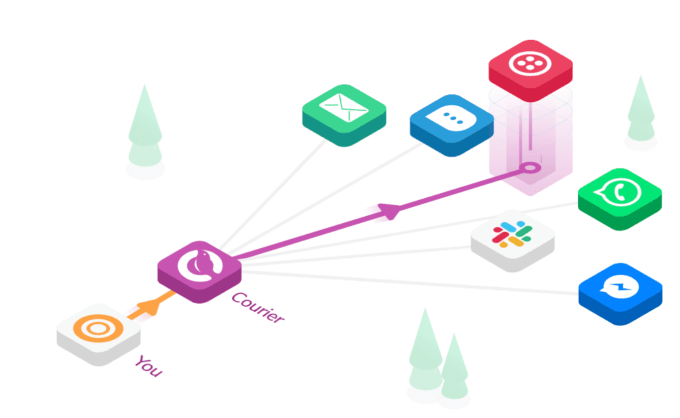
  • Courier: After adding one line of code with Courier, developers can, first, send messages through every communication channel to users. Courier then measures users’ response rates on each channel (Slack, WhatsApp, Facebook Messenger etc.) and determines where notifications should be directed.  
  • Lokal: Lokal provides local news, information and classifieds for India. Since launching the app 10 months ago, Lokal has grown to 260,000 daily active users and is growing at 27% month over month. “The existing apps only focus on national and state level news,” the founder said. Otherwise, in order to get local news, they need to read a physical newspaper. 
  • taxProper: The company says that 60% of homeowners overpay on property taxes, so taxProper is building software that quickly allows customers to easily appeal their property taxes, helping them enter data about their home and determine if they are overpaying. The startup is charging $79 per appeal.
  • InEvent: This is CRM for corporate events. It’s hard for businesses to create personalized, automated event experiences. This platform lets corporate event planners integrate registration, vendor and travel and expense management. InEvent is seeing $1.15 million ARR in Brazil, and broke into the U.S. corporate event market in May — which it describes as a $7.5 billion opportunity. They’re seeing $13,000 MRR in the U.S.

demoday quirk

  • Quirk: Quirk is a “thought diary” that helps to stop panic attacks by using the concepts of cognitive behavioral therapy. You identify negative thoughts you’re having, and then examine those thoughts to determine which parts are negatively impacting you. It costs $5.99 per month; the company says one month after launch, they have 1,000 paying customers.
  • Zippi: Zippi provides loans specifically designed for gig workers in Brazil, a booming population underserved by traditional banks. The gig workers repay their loans with a percent of their income each week. Zippi is live and fully compliant. To date, they’ve done $160,000 in loans and plan to build and end-to-end neo bank for gig workers in Latin America. 
  • Simmer: Simmer provides reviews for individual dishes, not just for restaurants. Simmer tells you the best reviewed dishes across all delivery apps and services to help you better decide which food to order on-demand. In a one-month pilot there were 1,300 weekly active users on Simmer. This fall, Simmer will launch in three cities. 
  • Actiondesk: Updating spreadsheets is about as unsexy as enterprise workflows get, but Actiondesk is focusing wholly on revamping the data tables with “superpowers.” The company’s solution allows customers to dynamically connect data sources and their spreadsheets so that edits made in the spreadsheet will be replicated in the data source. Users are also able to schedule actions related to the data in their sheets.
  • GradJoy: GradJoy is a fintech platform that wants to help recent grads better-strategize their student loan payments. The company bills itself as “a student loan co-pilot,” and a “robo-advisor for student debt,” offering services meant to help users save money. GradJoy connects loans and financial information to create personalized repayment plans for new borrowers. They’ve completed eight refinances in two weeks, and have amassed more than 1,000 customers within a few weeks of being operative. GradJoy doesn’t want to stop at student debt, but scale out to provide services for other types of debt repayment in the future. 
  • Taskade: This is a collaboration tool for remote teams. You can create lists, outlines and mindmaps, then collaborate and chat about them in real-time. It currently has more than 700 active teams, and over 10,000 active users.
  • Alana: Alana helps large businesses headquartered in Latin America hire and retain blue-collar workers. Their hope is to become the LinkedIn of the blue-collar industry with a better matching process for potential employees and by automating much of the process. The company claims to have experienced very fast growth, working with companies like Hilton, Starbucks and Rappi. They charge a monthly subscription per store or $400 in MRR per location.

demoday Obie

  • Obie: This is a free analytics platform for commercial real estate owners to manage their assets. From there, Obie uses that data to sell insurance to those commercial real estate owners. In the last year, Obie has done $1.4 million in gross premiums.
  • Together SoftwareTogether is building souped-up employee mentorship software that helps new employees get connected with veterans inside their company. The onboarding buddy program handles pairing of employees and can help the duos schedule meetings and work their way through development plans.
  • Holy Grail: Holy Grail says it has built a cheaper and faster way to manufacture batteries. The company is using AI to find the next generation of batteries at what it claims is 1,000x faster and hundreds of million dollars cheaper than traditional R&D processes. Holy Grail’s software designs batteries and predicts their performance — then manufactures them using a robot it built. Traditional R&D relies on trial and error and spreadsheets, and this company thinks it can harness AI to “do something good for the world while also making money.” 
  • Tranqui Finanzas: This startup provides consumer debt consolidation for Latin America, where 45 million employees have existing high interest loans. Payments are made through salary deductions. After launching seven weeks ago, they’re making $6K monthly net revenue.
  • Sorting Robotics: It began its life building a robot sorting Magic: The Gathering cards. Now it’s pivoting to sorting weed. They buy cannabis trim for $120 per lb; their robot separates the sticks/leaves from the flower, which can be resold for upwards of $180 per lb. Four weeks after rolling out their first robot, it’s making roughly $1,000 per day.
  • Pengram: Augmented reality is making itself useful through Pengram’s indoor navigation system. Pengram enables anyone to create indoor pathways using any iOS device and then easily share those pathways with others. Already, Pengram has a $10,000 pilot with building maintenance company Johnson Controls, which uses the tool to quickly located sprinklers, smoke detectors, fire extinguishers and other systems they need to find and ensure are properly up to date and working.

demoday Yummy

  • Yummy Future: Yummy Future is basically a robotic Starbucks. The company wants to take baristas out of the coffee-making process, using a box of robots to make complex espresso drinks. It’s not the only one in this space, but the startup is hoping that partnerships with existing marketplace retailers will be the key to its success.
  • Athlane: Athlane is building what it calls “the NCAA for esports,” a new esports league powered by its software. The founders believe they have what it takes to help college esports eclipse traditional sports, citing that the League of Legends finals saw 5X the viewership of the NBA finals in 2019. Athlane hopes college esports teams will compete on their platform because they’ll actually be able to pay their players. Athlane will enable teams to monetize through its AI-powered sponsorship platform, and has secured two contracts with G Fuel and DraftKings. 
  • TRM Labs: Banks are required to trace the source of their customers’ money. TRM helps banks identify and trace cryptocurrency fraud. They charge $20K per user seat. Though they couldn’t say the name, TRM says they recently signed a top-five global bank as a customer.
  • Mars Auto: The startup is developing autonomous trucks for the $50 billion Korean trucking market. The goal is to fully automate warehouse to warehouse truck operations to save the trucking market billions. The company has two LOIs with two of the largest logistic businesses in Korea.
  • Wasmer: Wasmer is an application container that works in edge computing. Powered by WebAssembly, Wasmer is building the next generation of containers that enables developers to run any code on any client.
  • Matagora: Matagora is delivering pop-up physical storefronts for online brands. The startup is partnering with local businesses to fill areas of their store with online-only gear that brands are looking to get in front of people’s eyeballs. Matagora takes a whopping 40% of each sale.

demoday Nonu

  • Nonu: Nonu calls itself the “Hims for India.” The company created a subscription hair loss prevention kit that includes medicines, vitamins and herbal shampoo. The founder says that 80% of Indian men don’t know that prescription medicine can stop hair loss in India, and therefore are getting scammed into spending over a billion dollars on fake hair loss products while continuing to lose hair. With Nonu, all you have to do is take a photo of your balding head, and you’ll receive a monthly subscription of medicine that will show up at your door. Nonu says that within this $7.2 billion market, there are 60 million hair loss patients who can afford this $120 a year subscription in India. Nonu has already amassed 500 subscribers, and plans to expand into tackling sexual wellness. 
  • Dex: Dex is a personal CRM. You sync up your contacts/calendars, and it finds the people you haven’t kept in touch with and reminds you to reach out. You can add notes about a contact — like what you last spoke about, or what’s going on in their life — to help with the conversation next time you see them.
  • Outtalent: This startup helps engineers living in emerging markets get jobs abroad. The company was launched by a pair of brothers from Kyrgyzstan, one of which landed a life-changing job at Google years ago and wants to make the entire process easier for other foreigners.
  • SannTek Labs: SannTek created a breathalyzer that detects cannabis consumption, as well as alcohol consumption. The founders say there’s currently no breathalyzer for cannabis because it’s a technically challenging task. SannTek has developed sensors that can detect whether you’ve consumed cannabis in the last three hours. Once it launches, it will charge police officers $20 per test.
  • BuildStream: The startup is a platform for companies to manage and optimize rented equipment fleets. The team is focusing specifically on the construction industry, trying to minimize idle equipment. Users start by installing off-the-shelf IoT sensors on gear to track the fleet of equipment and pinpoint areas for optimization.
  • Sling Health: Sling Health wants to build more cost-effective virtual care teams. The ex-Forward founders say they want to turn any doctors office into a One Medical model. Next-gen tools can’t scale their engineering teams. Sling’s platform automates back offices with remote medical teams and 24/7 chat support. Sling Health says it has already transformed 12 doctor’s offices and is producing over $17,000 in monthly recurring revenue. The founders say they can save doctors 67% on labor costs while also drastically improving patient experiences with a personalized care team. The tech can apparently manage scheduling, create personalized follow-ups and manage prescriptions.

demoday mofe

  • MoFE: The “Museum of Future Experiences” turns physical spaces into trippy, walk-around virtual reality experiences. They launched in New York three weeks ago, and have sold every ticket available so far to bring in $60K in revenue since launch.


That’s all for Day 1, we’ll be posting our favorites from today’s batch soon and we’ll be back tomorrow with the rest of the batch.

19 Aug 2019

This hand-tracking algorithm could lead to sign language recognition

Millions of people communicate using sign language, but so far projects to capture its complex gestures and translate them to verbal speech have had limited success. A new advance in real-time hand tracking from Google’s AI labs, however, could be the breakthrough some have been waiting for.

The new technique uses a few clever shortcuts and of course the increasing general efficiency of machine learning systems to produce, in real time, a highly accurate map of the hand and all its fingers, using nothing but a smartphone and its camera.

“Whereas current state-of-the-art approaches rely primarily on powerful desktop environments for inference, our method achieves real-time performance on a mobile phone, and even scales to multiple hands,” write Google researchers Valentin Bazarevsky and Fan Zhang in a blog post. “Robust real-time hand perception is a decidedly challenging computer vision task, as hands often occlude themselves or each other (e.g. finger/palm occlusions and hand shakes) and lack high contrast patterns.”

Not only that, but hand movements are often quick, subtle, or both — not necessarily the kind of thing that computers are good at catching in real time. Basically it’s just super hard to do right, and doing it right is hard to do fast. Even with multi-camera, depth-sensing rigs like those used by SignAll have trouble tracking every movement. (But that isn’t stopping them.)

The researchers’ aim in this case, at least partly, was to cut down on the amount of data that the algorithms needed to sift through. Less data means quicker turnaround.

handgesturesFor one thing, they abandoned the idea of having a system detect the position and size of the whole hand. Instead, they only have the system find the palm, which is not only the most distinctive and reliably shaped part of the hand, but is square to boot, meaning they didn’t have to worry about the system being able to handle tall rectangular images, short ones, and so on.

Once the palm is recognized, of course, the fingers sprout out of one end of it and can be analyzed separately. A separate algorithm looks at the image and assigns 21 coordinates, roughly coordinating to knuckles and fingertips, to it, including how far away they likely are (it can guess based on the size and angle of the palm, among other things).

To do this finger recognition part, they first had to manually add those 21 points to some 30,000 images of hands in various poses and lighting situations, for the machine learning system to ingest and learn from. As usual, artificial intelligence relies on hard human work to get going.

Once the pose of the hand is determined, that pose is compared to a bunch of known gestures, from sign language symbols for letters and numbers to things like “peace” and “metal.”

The result is a hand-tracking algorithm that’s both fast and accurate, and runs on a normal smartphone rather than a tricked-out desktop or the cloud (i.e. someone else’s tricked-out desktop). It all runs within the MediaPipe framework, which multimedia tech people may already know something about.

With luck other researchers will be able to take this and run with it, perhaps improving existing systems that needed beefier hardware to do the kind of hand recognition they needed to recognize gestures. It’s a long way from here to really understanding sign language, though, which uses both hands, facial expressions, and other cues to produce a rich mode of communication unlike any other.

This isn’t being used in any Google products yet, so the researchers were free to give their work away for free. The source code is here for anyone to take and build on.

“We hope that providing this hand perception functionality to the wider research and development community will result in an emergence of creative use cases, stimulating new applications and new research avenues,” they write.

19 Aug 2019

Who are the major revenue-based investing VCs?

This guest post was written by David Teten, Venture Partner, HOF Capital. You can follow him at teten.com and @dteten. This is part of an ongoing series on Revenue-Based Investing VC that will hit on:

So you’re interested in raising capital from a Revenue-Based Investor VC. Which VCs are comfortable using this approach?

A new wave of Revenue-Based Investors (“RBI”) are emerging. This structure offers some of the benefits of traditional equity VC, without some of the negatives of equity VC.

I’ve been a traditional equity VC for 8 years, and I’m now researching new business models in venture capital.

(For more background, see the accompanying article “Revenue-based investing: A new option for founders who care about control” published on Extra Crunch.

RBI normally requires founders to pay back their investors with a fixed percentage of revenue until they have finished providing the investor with a fixed return on capital, which they agree upon in advance.

I’ve listed below all of the major RBI venture capitalists I’ve identified. In addition, I’ve noted a few multi-product lending firms, e.g., Kapitus and United Capital Source, which provide RBI as one of many structural options to companies seeking capital.


The guide to major RBI VCs

Alternative Capital: “You qualify if you have $5k+ MRR. We have a special program if you are pre-seed and need product development. Since 2017 we’ve managed $3 million in revenue-based financing, which helps cash-strapped technology companies grow. In 2019 we partnered with several revenue-based lending providers, effectively creating a marketplace.”

Bigfoot Capital: According to Brian Parks, “Bigfoot provides RBI, term loans, and lines of credit to SaaS businesses with $500k+ ARR. Our wheelhouse is bootstrapped (or lightly capitalized) SMB SaaS. We make fast, data-driven credit decisions for these types of businesses and show Founders how the math/ROI works. We’re currently evaluating about 20 companies a month and issuing term sheets to 25% of them; those that fit our investment criteria. We’re also regularly following-on for existing portfolio companies.”

Investment Criteria:

  • B2B SaaS or tech-enabled services with proven, recurring contracts
  • ARR of $500K+
  • At least 12 months of customer history, generally 20+ enterprise customers or 200+ SMB customers
  • Rational burn profile, up to 50% of revenue at close, scaling down
  • Capital need of up to $1.5M over next 12 months

Benefits:

  • Non-dilutive, flexible credit offerings that fit SMB or enterprise SaaS
  • Facility sizes of 2-5x MRR
  • Repaid 12-36 months with ability to prepay at reduced cost
  • For RBI, return caps of 1.2x-1.8x and cash share rates of 3-10%
  • Multiple draws available once history established
  • Ability to scale payments to provide initial cash flow relief
  • No board seats or personal guarantees
  • Success fee on M&A can be traded for lower payments

Corl: “No need to wait 3-9 months for approval. Find out in 10 minutes. Corl can fund up to 10x your monthly revenue to a maximum of $1,000,000. Payments are equal to 2-10% of your monthly revenue, and stop when the business buys out the contract at 1-2x the investment amount.”

  • Investment amount of up to 10x monthly revenue, to a maximum of $1,000,000.
  • Payment is 2-10% of monthly revenue, until a Contract Buyout.
  • The Contract Buyout Rate is 1-2x the Investment Amount, depending on the risk of the business.
  • To be eligible, a business must have at least $10,000 in monthly revenue, at least 30% gross margins, and post-revenue for at least 6 months.

According to Derek Manuge, Corl CEO, “Funds are closed significantly quicker than the industry average at under 24 hours. The majority of businesses that apply for funding with Corl are E-commerce, SaaS, and other digital businesses.”

Manuge continues, “Corl connects to a business’ bank accounts, accounting software, payment processors, and other digital services to collect 10,000+ historical data points that are analyzed in real-time. We collect more data on an individual business than, to our knowledge, any other RBI investor, through our application process, data partners, and various public sources online. We have reviewed the application process of other RBI lenders and have not found one that has more API connections that ours. We have developed a proprietary machine learning algorithm that assesses the risk and return profile of the business and determines whether to invest in the business. Funding decisions can take as little as 10 minutes depending on the amount of data provided by a business.”

In the past 12 months, 500+ companies have applied for funding with Corl. The following information is based on companies funded by us and/or our capital partners:

  • The average most recent monthly revenue is $331,229
  • The average most recent annual revenue is $1,226,589
  • The average most recent annual profit is $237,479
  • The average gross profit margin is 55%.
  • The average monthly operating expenses is $70,335
  • The average cash balance is $191,164
  • The mode purpose for funding is (in order of frequency) Sales, Marketing, Market Expansion, Product Development, and Hiring Employees.
  • 30% have been operated by females, 70% have been operated by males.
  • 40% have been operated by “visible minorities”, 60% have been operated by “non-visible minorities”.

Decathlon Capital: According to John Borchers, Co-founder, Decathlon is the largest revenue-based financing investor in the US. His description: “We announced a new $500 million fund in Q1 of 2019, in our 10th year. Unlike many RBI investors, a full 50% of our investment activity is in non-tech businesses. Like other RBI firms, Decathlon does not require warrants, governance involvement, or the types of financial covenants that are often associated with other venture debt type solutions. Decathlon typically targets monthly payment percentages in the 1% to 4% range, with total targeted multiples of 1.5x to 3.0x.”

Earnest Capital: Earnest is not technically RBI. Tyler Tringas, General Partner, observes, “Almost all of these new [RBI] forms of financing really only work for more mature companies (say $25-50k MRR and up) and there are still very few new options at the stage where we are investing.” From their website: “We invest via a Shared Earnings Agreement, a new investment model developed transparently with the community, and designed to align us with founders who want to run a profitable business and never be forced to raise follow-on financing or sell their business.” Key elements:

  • “We agree on a Return Cap which is a multiple of the initial investment (typically 3-5x)
  • “We don’t have any equity or control over the business…”
  • “As your business grows we calculate what we call “Founder Earnings” and Earnest is paid a percentage. Essentially we get paid when you and your co-founder get paid.”
  • “Founder Earnings = Net Income + any amount of founders’ salaries over a certain threshold. If you want to eat ramen, pay yourselves a small salary, and reinvest every dollar into growth, we don’t get a penny and that’s okay. We get earnings when you do.”
  • “Unlike traditional equity, our share of earnings is not perpetual. Once we hit the Return Cap, payments to Earnest end.”
  • “In most cases, we’ll agree on a long-term residual stake for Earnest if you ever sell the company or raise more financing. We want to be on your team for the long-term, but don’t want to provide any pressure to “exit.”
  • “If you decide you want to raise VC or other forms of financing, or you get an amazing offer to sell the company, that’s totally fine. The SEA includes provisions for our investment to convert to equity alongside the new investors or acquirers.”

Feenix Venture Partners: Feenix Venture Partners has a unique investment model that couples investment capital with payment processing services. Each of Feenix’s portfolio companies receives an investment in debt or equity and utilizes a subsidiary of Feenix as its credit card payment processor (“Feenix Payment Systems”). The combination of investment capital and credit card processing (CCP) fees creates a “win-win” partnership for investors and portfolio companies. The credit card processing data provides the investor with real-time sales transparency and the CCP fee margin provides the investor high current income, with equity-like upside and significant recovery for downside protection. Additionally, portfolio companies are able to access competitive and often non-dilutive financing by monetizing an unavoidable expense that is being paid to its current processors, thus yielding a mutual benefit for both parties.

Feenix focuses on companies in the consumer space across a number of industry verticals including: multi-unit Food & Beverage operators, hospitality, managed workspace (office or food halls), location-based entertainment venues, and various direct to consumer online companies. Their average check size is between $1-3 million, with multi-year term and competitive interest rates for debt. Additionally, Feenix typically needs fewer financial covenants and can provide quicker turnaround for due diligence with the benefit of transparency they receive by tracking credit card sales activity. 10% of Feenix’s portfolio companies have received VC equity prior to their financing.

Founders First Capital Partners: “Founders First Capital Partners, LLC is building a comprehensive ecosystem to empower underrepresented founders to become leading premium wage job creators within their communities. We provide revenue-based funding and business acceleration support to service-based small businesses located outside of major capital markets such as Silicon Valley and New York City.”

“We focus our support on businesses led by women, ethnic minorities, LGBTQ, and military veterans, especially teams and businesses located in low to moderate income areas. Our proprietary business accelerator programs, learning platform, and growth methodologies transition these underserved service-based businesses into companies with $5 million to $50 million in recurring revenue. They are tech-enabled companies that provide high-yield investments for fund limited partners (LPs) that perform like bonds but generate returns on par with equity investments. Founders First Capital Partners defines these high performing organizations as Zebra Companies .”

“Each year, Founders First Capital Partners works with hundreds of entrepreneurs. Three tracks of pre-funding accelerator programs determine the appropriate level of funding and advisory support needed for each founder to achieve their desired expansion: 1) Fastpath for larger companies with $2 million to $5 million in annual revenue, 2) Founders Growth Bootcamp program for companies with $250,000 to $2 million in annual revenue, and 3) Elevate My Business Challenge for companies with $50,000 to $250,000 in annual revenue.”

“Founders First Capital Partners (FFCP) runs a 5-step process:

  1. Attend the Appropriate Pre-Funding Accelerator Program. Programs are offered in both online, in-person, and hybrid format with cohorts of leadership teams for an average of 10 companies. Most programs culminate with a Pitch Day and Investor Networking Event where the companies present their newly defined and expanded growth playbook.
  2. Apply for funding. After completion of the relevant pre-funding program, FFCP will review company funding applications and conduct due diligence.
  3. Get Funding. FFCP-approved companies receive revenue-based loans of up to $1 million to support the implementation of a customized 5-year growth playbook for their businesses.
  4. Growth support. FFCP uses its proprietary performance technology platform, structured growth program curriculum, and executive-level coaching operations to assist funded companies with the development, implementation, and iteration of their custom 5-year growth playbook.
  5. Graduate. Companies repay loans with growth revenue generated over a 5-year term, capped at 2x the amount financed. Companies gain predictable revenue streams with significant and measurable increases in revenue and profits to graduate to either traditional debt or equity sources of growth capital.”

According to Kim Folson, Co-Founder, “Founders First Capital Partner (F1stcp) has just secured a $100M credit facility commitment from a major institutional impact investor. This positions F1stcp to be the largest revenue-based investor platform addressing the funding gap for service-based, small businesses led by underserved and underrepresented founders.”

GSD Capital: “ GSD Capital partners with early-stage SaaS founders to fund growth initiatives. We work with founding teams in the Mountain West (Arizona, Colorado, Idaho, Montana, Nevada, New Mexico, Utah and Wyoming) who have demonstrated an ability to get sh*t done… We empower founders with a 30-day fundraising process instead of multiple months running a gauntlet. ”

“To best explain the process of RBF funding, let’s use an example. Pied Piper Inc needs funding to accelerate customer acquisition for its SaaS solution. GSD Capital loans $250,000 to Pied Piper taking no ownership or control of the business. The funding agreement outlines the details of how the loan will be repaid, and sets a “cap”, or a point at which the loan has been repaid. On a 3-year term, the cap amounts typically range from 0.4-0.6x the loan amount. Each month Pied Piper reviews its cash receipts and sends the agreed upon percentage to GSD. If the company experiences a rough patch, GSD shares in the downside. Monthly payments stop once the cap is reached and the loan is repaid. In a situation where Pied Piper’s revenue growth exceeds expectations, prepayment discounts are built into the structure, lowering the cost of capital.”

“Requirements for funding consideration:

  • Companies with a minimum of $50k in MRR
  • We can fund to 4x MRR (Monthly Recurring Revenue)
  • Companies seeking funding of $200k to $1mm
  • Limited amount of existing debt and a clean cap table”

Indie.VC: Part of the investment firm O’Reilly AlphaTech Ventures. See Indie VC’s Version 3.0 . “On the surface, our v3 terms are a fairly vanilla version of a convertible note with a few key variables to be negotiated between the investor and the founder: investment amount, equity option, and repurchase start date and percentage.”

  • Investment amount “is what it is”.
  • Equity option is, ” a simple fixed percentage which converts into that % of shares at the time of a sale OR into that % shares prior to a qualified financing.”
  • Repurchase start date and percentage is, “We chose 24 months from the time of our investment (but can be whatever date the founders and investors agree upon) and a % of gross revenue shared to repurchase the shares. With each revenue share payment, our equity option decreases and the founder’s equity increases. With v3, a team can repurchase up to 90% of the original equity option back at any point prior to a qualified financing through monthly revenue share payments, a lump or some combination of both until they reach a 3x cap. “

Kapitus: Offers RBI among many other options. “Because this [RBI] is not a loan, there is no APR or compounded interest associated with this product. Instead, borrowers agree to pay a fixed percentage in addition to the amount provided.”

Lighter Capital: “Since 2012, we’ve provided over $100 million in growth capital to over 250 companies.” Revenue-based financing which “helps tech entrepreneurs get to the next level without giving up equity, board seats, or personal guarantees… At Lighter Capital, we don’t take equity or ask you to make personal guarantees. And we don’t take a seat on your board or make you write a big check if you’re having a down month.”

  • “Up to 1/3 of your annualized revenue run rate”
  • “Up to $3M in growth capital for your tech startup”
  • “Repaid over 3–5 years”
  • “You pay between 2–8% of monthly revenue”
  • “Repayment caps usually range from 1.35x to 2.0x”

Novel Growth Partners: ” We invest using Revenue-Based Investing (RBI), also known as Royalty-Based Investing… We provide up to $1 million in growth capital, and the company pays that capital back as a small percentage (between 4% and 8%) of its monthly revenue up to a predetermined return cap of 1.5-2.2x over up to 5 years. We can usually provide capital in an amount up to 30% of your ARR. Our approach allows us to invest without taking equity, without taking board seats, and without requiring personal guarantees. We also provide tailored, tactical sales and marketing assistance to help the companies in our portfolio accelerate their growth.” Keith Harrington, Co-Founder & Managing Director at Novel Growth Partners, observes that he sees two categories of RBI:

  • Variable repayment debt: money gets paid back month over month, e.g., Novel Growth Partners
  • Share buyback structure, e.g., Indie.vc. Investors using this model typically can ask for a higher multiple because they wait longer for cash to be paid back.

He said, “We chose the structure we did because we think it’s easier to understand, for both LPs and entrepreneurs.”

Podfund: Focused on podcast creators. “We agree to provide funding and services to you in exchange for a percentage of total gross revenue (including ads/sponsorship, listener support, and ancillary revenue such as touring, merchandise, or licensing) per quarter. PodREV terms are 7-15% of revenue for 3-5 years, depending on current traction, revenue, and projected growth. At any time you may also opt to pay down the revenue share obligation in full, as follows:

  • 1.5x the initial funding in year 1
  • 2x the initial funding in year 2
  • 3x the initial funding in year 3
  • 4x the initial funding in year 4 “

RevUp: “Companies receive $100K-250K in non-dilutive cash… [paid back in a] 36-month return period with revenue royalty ranging from 4-8%, no equity .”

Riverside Acceleration Capital: Closed Fund I for $50m in 2016. Fund II has raised over $100m as of mid-2019.

Investment size : $1 – 5+ million, significant capacity for additional investment.
Return method: Small percentage of monthly revenue. Keeps capital lightweight and aligned to companies’ growth.
Capped return: 1.5 – 2x the investment amount. Company maximizes equity upside from growth.
Investment structure: 5-year horizon. Long-term nature maximizes flexibility of capital.”

Jim Toth writes, “One thing that makes us different is that we live inside of an $8Bn private equity firm. This means that we have a tremendous amount of resources that we can leverage for our companies, and our companies see us as being quite strategic. We also have the ability to continue investing behind our companies across all stages of growth.”

ScaleWorks: “We developed Scaleworks venture finance loans to fill a need we saw for our own B2B SaaS companies. No personal guarantees, board seats, or equity sweeteners. No prepayment penalties. Monthly repayments as a percentage of revenue.”

United Capital Source: Provides a wide structure of loans, including but not limited to RBI. The firm has provided more than $875 million in small business loans in its history, and is currently extending about $10m/month in RBI loans. Jared Weitz, Founder & CEO, said, “[Our] typical RBF client is $120K-$20M in annual revenue, with 4-200 employees. We only look at financials for deals over a certain size.

For smaller deals, we’ll look at bank statements and get a pretty good picture of revenues, expenses and cash flow. After all, since this is a revenue-based business loan, we want to make sure revenues and cash flow are consistent enough for repayment without hurting the business’s daily operations. When we do look at financials to approve those larger deals we are generally seeing a 5 to 30% EBITDA margin on these businesses.” United Capital Source was selected in the 2015 & 2017 Inc. 5000 Fastest Growing Companies List.

Note that none of the lawyers quoted or I are rendering legal advice in this article, and you should not rely on our counsel herein for your own decisions. I am not a lawyer. Thanks to the experts quoted for their thoughtful feedback. Thanks to Jonathan Birnbaum for help in researching this topic.