Category: UNCATEGORIZED

19 Aug 2019

TikTok’s new ‘Hashtag Challenge Plus’ lets video viewers shop for products in the app

TikTok, the short-form video platform favored by young adults and teens, has launched a new feature that allows users to shop for products associated with a sponsored Hashtag Challenge, without leaving its app. These sponsored challenges are Gen Z-friendly marketing campaigns where users are prompted to post videos of them using a product — like showing off favorite outfits from Uniqlo or Guess, for example. Or they might participate in some sort of manufactured viral trend, like singing favorite Disney songs ahead of a Disney-themed episode of American Idol.

The new e-commerce feature, called Hashtag Challenge Plus, adds a shoppable component to the hashtag.

In addition to creating and viewing videos featuring the brand’s sponsored hashtag, a separate tab features an in-app experience where products from the campaign can be purchased within TikTok itself.

Last week, Kroger was the first brand to try out the new feature, according to a report from AdWeek.

Image from iOS 2

While not exactly a company that exudes youth appeal, Kroger found a way to reach TikTok’s young adult audience through their hashtag campaign.

In partnership with four TikTok influencers — Joey Klaasen, Cosette Rinab, Mia Finney and Victoria Bachlet — Kroger prompted TikTok viewers to post videos of their dorm makeovers using the hashtag #TransformUrDorm. Digital agency i360 was involved in the videos’ creation.

What made Kroger’s challenge unique was that it also introduced a dedicated brand page where viewers could actually shop for products, too.

Image from iOS 1 1

Kroger paid for its sponsored hashtag to be given placement on TikTok’s Discover page for a week’s time. The tag can still be found via search, even though the campaign has wrapped.

Of course, many of its intended viewers found it by way of their favorite TikTok influencer’s profile, much like how Instagram ad campaigns work.

Since launch, the hashtag has since grown to around 477 million views across hundreds of videos — some labeled “Official,” if from the influencers. The rest is user-generated content from other TikTok users hoping to capitalize on the trend to gain a little TikTok fame for themselves.

On the hashtag’s landing page, there’s a separate tab also labeled “Discover,” but not to be confused with TikTok’s main Discover section. This directs viewers to the new shopping experience.

Here, Kroger shows off a scrollable row of featured products including things like a popcorn maker, a box of snack bars, a toaster, and other items.

Tapping the “Shop Now” link then opens up Kroger’s website where users can add items to their cart and check out online.
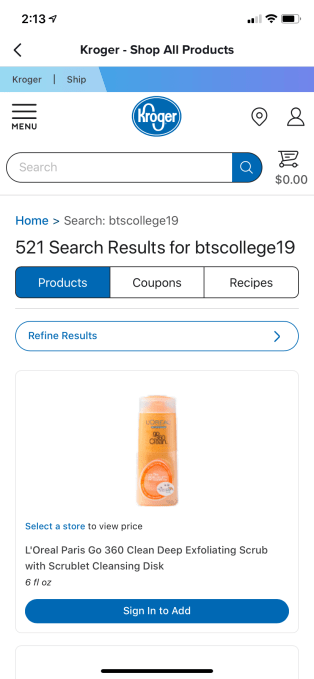
Image from iOS 3

This shoppable experience is really just a mobile-optimized Kroger website pointing to a special search term (btscollege19). It isn’t a TikTok creation, nor built with TikTok’s help. On the mobile site, you can scroll down through a random list of items — from shampoos to coffee filters to toothpaste to hangers and more — or you can filter by category or enter a search term.

It’s unclear if such an offering will actually significantly impact e-commerce sales.

If anything, a hashtag campaign like this is better utilized to remind viewers that Kroger’s grocery store is also a place to shop for back-to-school needs, as an alternative to big-box stores like Target or Walmart or online retailers like Amazon.

TikTok confirmed to TechCrunch that Kroger was the first to put it into action last week. A spokesperson declined to say if other campaigns using the new product were in the works, adding that the company couldn’t talk about any plans ahead of their launch.

Sponsored Hashtag Challenges are only one way TikTok is experimenting with generating revenue from its some 500 million monthly users, the majority who are under 30. The company has also tried out full-screen ads at launch, in-feed ads, 3D/AR lenses, stickers and more.



19 Aug 2019

Join The New Stack for Pancake & Podcast with Q&A at TC Sessions: Enterprise

Popular enterprise news and research site, The New Stack, is coming to TechCrunch Sessions: Enterprise on September 5 for a special Pancake & Podcast session with live Q&A  featuring, you guessed it, delicious pancakes and awesome panelists!

Here’s the “short stack” of what’s going to happen:

  • Pancake buffet opens at 7:45 am on Thursday, Sept. 5 at TC Sessions: Enterprise
  • At 8:15 am the panel discussion/podcast kicks off, the topic, “The People and Technology You Need to Build a Modern Enterprise
  • After the discussion, the moderators will host a live audience Q&A session with the panelists
  • Once the Q&A is done, attendees will get the chance to win some amazing raffle prizes

You can only take part in this fun pancake-breakfast podcast if you register for a ticket to  TC Sessions: Enterprise. Use the code TNS30 to get 30% off the conference registration price!

Here’s the longer-versions of what’s going to happen:

At 8:15 a.m., The New Stack founder and Publisher Alex Williams takes the stage as the moderator and host of the panel discussion. Our topic for TC Sessions: Enterprise is The People and Technology You Need to Build a Modern Enterprise. We’ll start with intros of our panelists and then dive into the topic with Sid Sijbrandij, founder and CEO at GitLab, and Frederic Lardinois, enterprise reporter and editor at TechCrunch, as our initial panelists. More panelists to come!

Then it’s time for questions. Questions we could see getting asked (hint, hint): Who’s on your team? What makes a great technical team for the enterprise startup? What are the observations a journalist has about how the enterprise is changing? What about when the time comes for AI? Who will I need on my team?

And just before 9 a.m., we’ll pick a ticket out of the hat and announce our raffle winner. It’s the perfect way to start the day.

On a side note, the pancake breakfast discussion will be published as a podcast on The New Stack Analysts

But there’s only one way to get a prize and network with fellow attendees, and that’s by registering for TC Sessions: Enterprise and joining us for a short stack with The New Stack. Tickets are now $349, but you can save 30% with code TNS30.

19 Aug 2019

WP Standard’s Weekender leather duffle is built for life

Have you heard? It’s Bag Week! It’s the most wonderful week of the year at TechCrunch. Just in time for back to school, we’re bringing you reviews of bags of all varieties: from backpacks, to rollers to messengers to fanny packs.

WP Standard makes exceptional leather goods and the company’s new leather duffle is no different. It’s fantastic and my go-to travel bag. There are downsides — it’s heavy and the shoulder strap slips on my boney shoulders — but the good outweighs the bad.

I travel a lot. Airplanes, bikes, cars, and pretty much everything but trains — because I live in the midwest and not because I don’t like trains. A few years back I got a lovely, low-cost leather duffle from Amazon and started using it instead of a roller bag. It’s fun and forces me to pack smarter. Besides, the duffle always fits in overhead spaces, in taxi cabs and is easier to handle on a busy subway.

But you don’t care about my life. You’re here for this bag.

WP Standard built the Weekender duffle for people like me. It’s a great size and I have no issue packing away a bunch shirts, a few pairs of pants and an extra pair of shoes. This isn’t a bag built to hold suits, but rather a weekend’s worth of clothes — hence the name.

The full grain leather is thick and tough and has so far held up nicely to the riggers of travel. There are scratches and scuffs but those are souvenirs and badges of honor. It’s ridden in the back of my pickup in downpours and down dusty lanes. It’s survived several transatlantic flights and still looks like it has decades of life to give.

In the end this isn’t a Patagonia or The North Face duffle constructed out of space-age fabric designed to survive the tallest peaks or the deepest valleys. WP Standard doesn’t play that game. This company makes goods out of full grain leather that are naturally tough and will age gracefully.

The bag is constructed in a way to give the leather the best chance at survival. The hand straps wrap the bag to give it extra strength. The bottom is constructed out of two layers of stiff leather. The zipper is beefy. The shoulder strap is tough and hasn’t shown any sign of stretching.

A few years ago I reviewed WP Standard’s messenger bag. The Weekender duffle is just as lovely but these two bags share the same downside: The shoulder straps pad is too slippery. It doesn’t matter if I’m wearing a t-shirt, jacket or parka, the shoulder strap doesn’t stay in place. To compensate, I often forgo using the pad and use the strap itself, which is thinner and can be uncomfortable after several minutes. To me, this isn’t a deal killer, but you, dear reader, should know about this downside.

The WP Standard Weekender costs $375. It’s a great price considering the thickness of the leather and quality of construction. Similar bags can be had from Wills, Shinola or Saddleback but for nearly twice the price. Pad and Quill makes quality leather goods and sells a leather duffle that’s similar to the Weekend for $545; it’s also worth a consideration.

19 Aug 2019

Twitter blocks state-controlled media outlets from advertising on its social network

Twitter is now blocking state-run media outlets from advertising on its platform.

The new policy was announced just hours after the company identified an information operation involving hundreds of accounts linked to China as part of an effort to “sow political discord” around events in Hong Kong after weeks of protests in the region. Over the weekend over 1 million Hong Kong residents took to the streets to protest what they see as an encroachment by the mainland Chinese government over their rights.

State-funded media enterprises that do not rely on taxpayer dollars for their financing and don’t operate independently of the governments that finance them will no longer be allowed to advertise on the platform, Twitter said in a statement. That leaves a big exception for outlets like the Associated Press, the British Broadcasting Corp., Public Broadcasting Service, and National Public Radio, according to reporting from BBC reporter, Dave Lee.


The affected accounts will be able to use Twitter, but can’t access the company’s advertising products, Twitter said in a statement.

“We believe that there is a difference between engaging in conversation with accounts you choose to follow and the content you see from advertisers in your Twitter experience which may be from accounts you’re not currently following. We have policies for both but we have higher standards for our advertisers,” Twitter said in its statement.

The policy applies to news media outlets that are financially or editorially controlled by the state, Twitter said. The company said it will make its policy determinations on the basis of media freedom and independence including editorial control over articles and video, the financial ownership of the publication, the influence or interference governments may exert over editors, broadcasters and journalists, and political pressure or control over the production and distribution process.

Twitter said the advertising rules wouldn’t apply to entities that are focused on entertainment, sports, or travel, but if there’s news in the mix, the company will block advertising access.

Affected outlets have 30 days before they’re removed from Twitter and the company is halting all existing campaigns.

State media has long been a source of disinformation and was cited as part of the Russian campaign to influence the 2016 election. Indeed, Twitter has booted state-financed news organizations before. In October 2017, the company banned Russia Today and Sputnik from advertising on its platform (although a representative from RT claimed that Twitter encouraged it to advertise ahead of the election).


19 Aug 2019

A newly funded startup, Internal, says it wants to help companies better manage their internal consoles

Uber and Facebook and countless other companies that know an awful lot about their customers have found themselves in hot water for providing broad internal access to sensitive customer information.

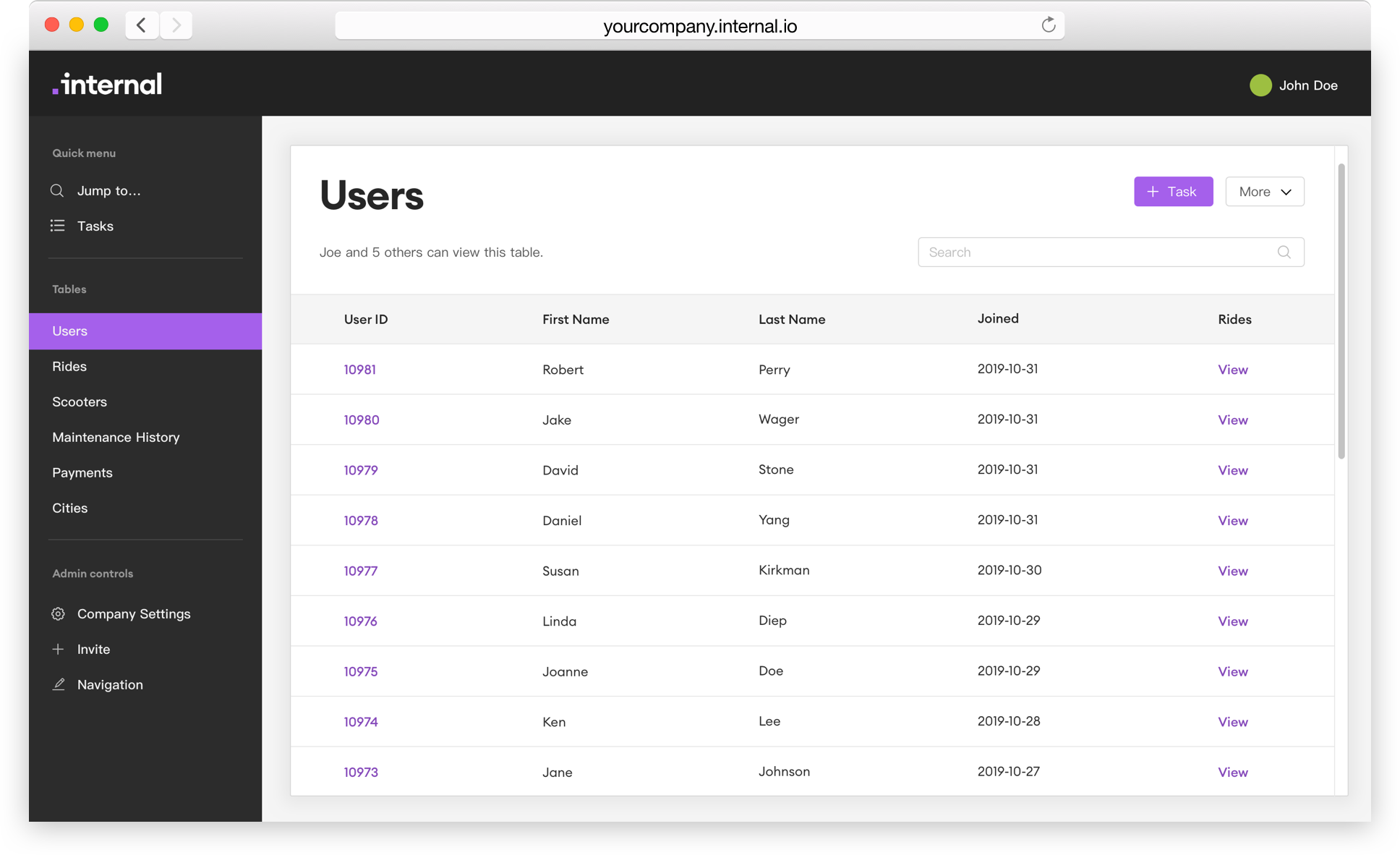
Now, a startup says its “out-of-the-box tools” can help protect customers’ privacy while also saving companies from themselves. How? With a software-as-a-service product that promises to help employees access the app data they need — and only the app data they need. Among the features the company, Internal, is offering, are search and filtering, auto-generated tasks and team queues, granular permissioning on every field, audit logs on every record, and redacted fields for sensitive information.

Whether the startup can win the trust of enterprises is the biggest question for the company, which was created by Arisa Amano and Bob Remeika, founders who last year launched the blockchain technology company Harbor. The two also worked together previously at two other companies: Zenefits and Yammer.

All of these endeavors have another person in common, and that’s David Sacks, whose venture firm, Craft Ventures, has just led a $5 million round in Internal. Sacks also invested last year in Harbor; he was an early investor in Zenefits and took over during troubled times as its CEO for less than a year; he also founded Yammer, which sold to Microsoft for $1.2 billion in cash in 2012.

All of the aforementioned have been focused, too, on making it easier for companies to get their work done, and Amano and Remeika have built the internal console at all three companies, which is how they arrived at their “aha” moment last year, says Amano. “So many companies build their consoles [which allow users advanced use of the computer system they’re attached to] in a half-hearted way; we realized there was an opportunity to build this as a service.” Adds Remeika, “Companies never dedicate enough engineers to [their internal consoles], so they’re often half broken and hard to use and they do a terrible job of limiting access to sensitive customer data. We eliminate the need to build these tools altogether, and takes just minutes to get set up.”

Internal Screens 1

Starting today, companies can decide for themselves whether they think Internal can help their employees interact with their customer app data in a more secure and compliant way. The eight-person company has just made the product available for a free trial.

Naturally, Amano and Remeika are full of assurances why companies can trust them. “We don’t store data,” says Amano. “That resides on the [customer’s] servers. It stays in their database.” Internal’s technology instead “understands the structure of the data and will read that structure,” offers Remeika, who says not to mistake Internal for an analytics tool. “Analytics tools commonly provide a high-level overview; Internal is giving users granular access to customer data and letting you debug problems.”

As for competitors, the duo say their most formidable opponent right now is developers who throw up a data model viewer that has complete access to everything in a database, which may be sloppy but happens routinely.

Internal isn’t disclosing its pricing publicly just yet, but it says its initial target is non-technical users, on operations and customer support teams, for example.

As for Harbor (we couldn’t help but wonder why they’re already starting a new company), they say it’s in good hands with CEO Josh Stein, who was previously general counsel and chief compliance officer at Zenefits (he was its first lawyer) and who joined Harbor in February of last year as its president. Stein was later named CEO.

In addition to Craft Ventures, Internal’s new seed round comes from Pathfinder, which is Founders Fund’s early-stage investment vehicle, and other, unnamed angel investors.

19 Aug 2019

Without evidence, Trump accuses Google of manipulating millions of votes

The President this morning lashed out at Google on Twitter, accusing the company of manipulating millions of votes in the 2016 election to sway it towards Hillary Clinton. The authority on which he bases this serious accusation, however, is little more than supposition in an old paper reheated by months-old congressional testimony.

Trump’s tweet this morning cited no paper at all, in fact, though he did tag conservative watchdog group Judicial Watch, perhaps asking them to investigate. It’s also unclear who he thinks should sue the company.

Coincidentally, Fox News had just mentioned the existence of such a report about five minutes earlier. Trump has also recently criticized Google and CEO Sundar Pichai over a variety of perceived slights.

In fact the report was not “just issued,” and does not say what the President suggests it did. What both Fox and Trump appear to be referring to is a paper published in 2017 that described what the authors say was a bias in Google and other search engines during the run-up to the 2016 election.

If you’re wondering why you haven’t heard about this particular study, I can tell you why — it’s a very bad study. The authors looked at search results for 95 people over the 25 days preceding the election and evaluated the first page for bias.

They claim to have found that based on “crowdsourced” determinations of bias, the process for which is not described, that most search results, especially on Google, tended to be biased in favor of Clinton. No data on these searches, such as a sample search and results and how they were determined to be biased, is provided. There’s no discussion of the fact, for example, that Google tailors search results based on a person’s previous searches, stated preferences, location, and so on.

In fact, the paper lacks all the qualifications of any ordinary research paper. There is no abstract or introduction, no methods section to show the statistics work and definitions of terms, no discussion, no references. Without this basic information the document is not only incapable of being reviewed by peers or experts, but is indistinguishable from completely invented suppositions. Nothing in this paper can be in any way verified.

Epstein freely references himself, however: a single 2015 paper in PNAS on how search results could be deliberately manipulated to affect a voter looking for information on candidates, and  the many, many opinion pieces he has written on the subject, frequently on far-right outlets the Epoch Times and Daily Caller, but also non-partisan ones like USA Today and Bloomberg Businessweek.

The numbers advanced in the study are completely without merit. Citing math he does not describe, Epstein says that “a pro-Clinton bias in Google’s search results would over time, shift at least 2.6 million votes to Clinton.” No mechanism or justification for this assertion is provided, except a highly theoretical one based on ideas and assumptions from his 2015 study, which had little in common with this one. The numbers are, essentially, made up.

In other words, this so-called report is nothing of the kind — a nonfactual document written with no scientific justification of its claims written by someone who publishes anti-Google editorials almost monthly. It was not published in a journal of any kind, simply put online at a private nonprofit research agency called the American Institute for Behavioral Research and Technology, where Epstein is on staff and which appears to exist almost solely to promote his work. (I’ve asked AIBRT for more information on its funding.)

If that were all, it would be more than enough. But Trump’s citation of this fraudulent paper doesn’t even get the facts right. His assertion was that “Google manipulated from 2.6 million to 16 million votes for Hillary Clinton in 2016 Election,” and the report doesn’t even state that.

The source for this false claim appears to be Epstein’s recent appearance in front of the Senate Judiciary Committee in July. Here he received star treatment from Sen. Ted Cruz (R-TX), who asked him to share his expert opinion on the possibility of tech manipulation of voting. Cruz’s previous expert for this purpose was conservative radio talk show host Dennis Prager.

Again citing no data, studies, or mechanisms whatsoever, Epstein described 2.6 million as a “rock bottom minimum” of votes that Google, Facebook, Twitter and others could have affected (he does not say did affected, or attempted to affect). He also says that in subsequent elections, specifically in 2020, “if all these companies are supporting the same candidate, there are 15 million votes on the line that can be shifted without people’s knowledge and without leaving a paper trail for authorities to trace.”

“the methods they are using are invisible, they’re subliminal, they’re more powerful than most any effects I’ve seen in the behavioral sciences,” Epstein said, but did not actually describe what the techniques are. Though he did suggest that Mark Zuckerberg could send out a “get out the vote” notification only to Democrats and no one would ever know — absurd.

In other words, the numbers are not only invented, but unrelated to the 2016 election, and inclusive of all tech companies, not just Google. Even if Epstein’s claims were anywhere near justifiable, Trump’s tweet mischaracterizes them and gets everything wrong. Nothing about any of this is anywhere close to correct.

Google issued a statement addressing the President’s accusation, saying “This researcher’s inaccurate claim has been debunked since it was made in 2016. As we stated then, we have never re-ranked or altered search results to manipulate political sentiment.”

You can read the full “report” below:

EPSTEIN & ROBERTSON 2017-A Method for Detecting Bias in Search Rankings-AIBRT by TechCrunch on Scribd

19 Aug 2019

Mammoth Media introduces Choose Your Own Adventure-style storytelling to its chat fiction app Yarn

The chat fiction stories offered in Mammoth Media‘s mobile app Yarn are about to get more interactive.

The branching narrative mechanic should be familiar to anyone who read Choose Your Own Adventure books when they were kids — you read a story, and at certain key moments, you choose from different options that determine where the plot will go next.

More recently, the “Being Beyonce’s assistant for a day” thread on Twitter reminded everyone how fun and stressful this kind of storytelling can be. In fact, Mammoth says it’s hired the thread’s author Landon Rivera as one of the writers for this new initiative.

One thing you probably won’t recognize from your childhood reading is the fact that some of these choices aren’t free — to select them, you’ll need to spend money in the form of Yarn’s new virtual currency, gems.

Mammoth founder and CEO Benoit Vatere explained that in those cases, there might be two choices that you can select for free, plus a third that you need to pay for. Usually, it will be something that accelerates the story or sends it off in a new direction — in a horror story, you could get the option to stab someone, or in a romance story, your character could get the option to go home with someone.

Vatere added, “It’s not only being able to have a different branch in the story, but being able to play as a different character lead … Instead of being the male character, would they like to be the female character and really see a different perspective?”

He acknowledged that some of Yarn’s paying subscribers might be cranky about being asked to pay more, but he said the goal is that those subscribers can have “a full experience” without having to buy additional gems.

Yarn is launching interactive stories with titles including “Blue Ivy’s Nanny,” where it’s your first day on the job as Beyoncé’s nanny (I’m going to go ahead and guess that Rivera worked on this one); a romance story called “Playing the Field”; a horror story called “Haunted Camper” and a drama called “Trapped.” Vatere also said there are plans for branched narratives tying into existing Yarn franchises, and set in the world of Archie Comics.

Overall, Vatere said he’s hoping that this will lead to more engagement from Yarn readers, while also opening up new opportunities for monetization.

“Subscription is a great model, but subscription has a cap,” he said. That’s why Mammoth is experimenting with virtual currency, and why it plans to make these stories available to non-subscribers.

19 Aug 2019

These are the games coming to Google Stadia

Google’s game streaming service isn’t set to launch until November, but the company kept the hype train going through the mid-August doldrums with a Gamescom Stadia Connect livestream. As promised, the online press conference was “all about the games,” featuring what looks to be a nearly complete list of launch (and some post-launch) titles.

The games include some top names like Cyberpunk 2077, Final Fantasy XV, Assassin’s Creed Odyssey and Mortal Kombat 11. It also enlists a number of top publishers, including Bethesda, Square and Ubisoft. A number of key publishing partners have opted to keep their lists under wraps until closer to (or at) launch, however, including EA, Capcom and Rockstar.

As previously noted, the service will run $10 a month, including access to games and discounts on purchases. A base version of the service will also be available at some point next year. When it launches in November, the service will be available in 14 countries, including US, Canada, UK, Ireland, France, Germany, Italy, Spain, Netherlands and Finland. More will be added in 2020.

Google is currently offering up a “Founder’s Edition” pre-order for $130. That includes a controller, Chromecast Ultra and three months of the service for you and a friend.

Here’s the list of titles so far,

  • Bandai Namco – Dragon Ball Xenoverse 2
  • Bethesda – DOOM Eternal, DOOM 2016, Rage 2, The Elder Scrolls Online, Wolfenstein: Youngblood
  • Bungie – Destiny 2, Destiny 2: Shadowkeep Expansion
  • CD PROJEKT RED – Cyberpunk 2077
  • Chump Squad – KINE
  • Coatsink – Get Packed
  • Codemasters – GRID
  • Dotemu – Windjammers 2
  • Deep Silver – Metro Exodus
  • Drool – Thumper
  • Giants Software -Farming Simulator 19
  • Larian Studios – Baldur’s Gate 3
  • nWay Games – Power Rangers: Battle for the Grid
  • Omega Force – Attack on Titan 2: Final Battle
  • Pandemic Studios – Destroy All Humans!
  • Robot Entertainment – Orcs Must Die 3
  • Sega – Football Manager
  • SNK – Samurai Shodown
  • Square Enix – Final Fantasy XV – Tomb Raider Definitive Edition, Rise of the Tomb Raider, Shadow of the Tomb Raider, Marvel’s Avengers
  • SUPERHOT – SUPERHOT
  • 2K – NBA 2K, Borderlands 3
  • Tequila Works – Gylt
  • Warner Bros – Mortal Kombat 11
  • THQ – Darksiders Genesis
  • Ubisoft – Assassin’s Creed Odyssey, Just Dance , Tom Clancy’s Ghost Recon Breakpoint , Tom Clancy’s The Division 2 , Trials Rising, The Crew 2, Watch Dogs: Legion
19 Aug 2019

Twitter says accounts linked to China tried to ‘sow political discord’ in Hong Kong

Twitter says a significant state-backed information operation involving hundreds of accounts linked to China were part of an effort to deliberately “sow political discord” in Hong Kong after weeks of protests in the region.

In a blog post, the social networking site said the 936 accounts it found tried to undermine “the legitimacy and political positions of the protest movement on the ground.”

More than a million protesters took to the streets this weekend to demonstrate peacefully against the Chinese government, which took over rule from the British government in 1997. Protests erupted months ago following a bid by Hong Kong leader Carrie Lam to push through a highly controversial bill that would allow criminal suspects to be extradited to mainland China for trial. The bill was suspended, effectively killing it from reaching the law books, but protests have continued, pushing back at claims that China is trying to meddle in Hong Kong’s affairs.

Although Twitter is banned in China, the social media giant says the latest onslaught of fake accounts is likely “a coordinated state-backed operation.

“Specifically, we identified large clusters of accounts behaving in a coordinated manner to amplify messages related to the Hong Kong protests,” the statement said.

china tweets

Two of the tweets supplied by Twitter.

Twitter said many of the accounts are using virtual private networks — or VPNs — which can be used to tunnel through China’s vast domestic censorship system, known as the Great Firewall. The company added that the accounts its sharing represent the “most active” portions of a wider spam campaign of about 200,00 accounts.

“Covert, manipulative behaviors have no place on our service — they violate the fundamental principles on which our company is built,” said Twitter.

Facebook said in its own post it also took down five Facebook accounts, seven pages and three groups on its site “based on a tip shared by Twitter.” The accounts frequently posted about local political news and issues including topics like the ongoing protests in Hong Kong, said Nathaniel Gleicher, Facebook’s head of cybersecurity policy.

“Although the people behind this activity attempted to conceal their identities, our investigation found links to individuals associated with the Chinese government,” said Gleicher.

Some of the posts, Facebook said, referred Hong Kong residents are “cockroaches.”

Twitter said it’s adding the complete set the accounts’ tweets to its archive of information operations.

19 Aug 2019

After data incidents, Instagram expands its bug bounty

Facebook is expanding its data abuse bug bounty to Instagram.

The social media giant, which owns Instagram, first rolled out its data abuse bounty in the wake of the Cambridge Analytica scandal, which saw tens of millions of Facebook profiles scraped to help swing undecided voters in favor of the Trump campaign during the U.S. presidential election in 2016.

The idea was that security researchers and platform users alike could report instances of third-party apps or companies that were scraping, collecting and selling Facebook data for other purposes, such as to create voter profiles or build vast marketing lists.

Even following he high profile public relations disaster of Cambridge Analytica, Facebook still still had apps illicitly collecting data on its users.

Instagram wasn’t immune either. Just this month Instagram booted a “trusted” marketing partner off its platform after it was caught scraping millions of users’ stories, locations and other data points on millions of users, forcing Instagram to make product changes to prevent future scraping efforts. That came after two other incidents earlier this year where a security researcher found 14 million scraped Instagram profiles sitting on an exposed database — without a password — for anyone to access. Another incident saw another company platform scrape the profile data — including email addresses and phone numbers — of Instagram influencers.

Last year Instagram also choked developers’ access as the company tried to rebuild its privacy image in the aftermath of the Cambridge Analytica scandal.

Dan Gurfinkel, security engineering manager at Instagram, said its new and expanded data abuse bug bounty aims to “encourage” security researchers to report potential abuse.

Instagram said it’s also inviting a select group of trusted security researchers to find flaws in its Checkout service ahead of its international rollout, who will also be eligible for bounty payouts.

Read more: