Category: UNCATEGORIZED

12 Aug 2019

Nike launches a subscription service for kids’ shoes, Nike Adventure Club

Just in time for back-to-school shopping, Nike today officially announced its entry into the subscription service market with the launch of a “sneaker club” for kids called Nike Adventure Club. The new program is specifically designed to make shopping easier for parents who struggle to keep up with their quickly growing children’s shoe needs. Instead of taking kids to the store and trying on pair after pair to try to find something the child likes, the new Nike Adventure Club will instead ship anywhere from four pairs to a dozen pairs of shoes per year, depending on which subscription tier parents choose.

The club serves kids from sizes 4C to 7Y — or roughly ages 2 to 10.

Club pricing begins at $20 per month which will ship out new shoes every 90 days. For $30 per month, kids get 6 pairs per year. And for $50 per month, kids will get new shoes every month — a choice that may be excessive except for the most active kids who were their sneakers every day, play sports, or have a tendency to wreck their shoes in short order.

However, even the minimum of four pairs per year may be too frequent for some parents of older kids.

According to the American Orthopaedic Foot & Ankle Society, toddlers under 16 months grow more than one-half a foot size every two months. From 16 to 24 months, they grow an average of one-half a foot size every three months. From 24 to 36 months, it’s one-half a foot size every four months. Then things slow down.

Children over three years old grow one-half a foot size every 4 to 6 months. That means some older kids only need to replace their shoes twice per year, outside of excessive wear and tear.

That said, Nike allows parents to upgrade or downgrade their subscription at any time, or even put it on pause.

NikeNews NikeAdventureClub ActivityGuide 1 native 1600

Once signed up, parents will receive an email with a selection of over 100 styles of Nike and Converse shoes to choose from, which they can review with their kids. They then pick which shoes they want to receive, and these are shipped to the home in a box with the child’s name on it. This box also includes an “adventure kit” filled with activities and games for parents to do with their kids, stickers, plus a small gift. The kit is created in partnership with the nonprofit KaBoom, which is focused on encouraging kids to lead healthy lifestyles.

If the shoes are the wrong size, exchanges are free within a week of delivery.

Perhaps the best part of the program is the recycling component.

Twice a year, Nike will ship out a prepaid bag where parents can send back their kids’ worn shoes, which will either be donated to families in need if in good condition or recycled through Nike Grind, a program that separates out the rubber, foam, leather, and textile blends, grinds them into granules, and incorporates those into new products including footwear, apparel, and play surfaces.

“We see Nike Adventure Club sits as having a unique place within Nike, and not just for it being the first sneaker club for kids,” says Dave Cobban, VP of Nike Adventure Club, in a statement about the launch. “It provides a wide range of options for kids, while at the same time, it removes a friction point for parents who are shopping on their behalf.”

Nike has been testing the program since 2017, when it was known as Easy Kicks. The test reached 10,000 members, the company said.

Nike isn’t the first to launch a subscription focused on kids — and big retailers have taken note. This year, Foot Locker took a minority stake in kids’ clothing subscription Rockets of Awesome and Walmart partnered with children’s clothing startup Kidbox.

Stitch Fix also offers a kids’ styling service. And Amazon offers a try-before-you-buy shopping service without a subscription, Prime Wardrobe. Amazon’s variation offers both girls and boys options where parents can fill a box with apparel, shoes, and accessories for home try-on and easy returns.

Nike’s Adventure Club is launching today but is easing in new customers via a waitlist option.
12 Aug 2019

Lucidworks raises $100M to expand in AI-powered search-as-a-service for organizations

If the sheer amount of information that we can tap into using the internet has made the world our oyster, then the huge success of Google is a testament to how lucrative search can be in helping to light the way through that data maze.

Now, in a sign of the times, a startup called Lucidworks, which has built an AI-based engine to help individual organizations provide personalised search services for their own users, has raised $100 million in funding. Lucidworks believes its approach can produce better and more relevant results than other search services in the market, and it plans to use the funding for its next stage of growth to become, in the words of CEO Will Hayes, “the world’s next important platform.”

The funding is coming from PE firm Francisco Partners​ and ​TPG Sixth Street Partners​. Existing investors in the company include Top Tier Capital Partners, Shasta Ventures, Granite Ventures and Allegis Cyber.

Lucidworks has raised around $200 million in funding to date, and while it is not disclosing the valuation, the company says it been doubling revenues each year for the last three and counts companies like Reddit, Red Hat, REI, the US Census among some 400 others among its customers using its flagship product, Fusion. PitchBook notes that its last round in 2018 was at a modest $135 million, and my guess is that is up by quite some way.

The idea of building a business on search, of course, is not at all new, and Lucidworks works in a very crowded field. The likes of Amazon, Google and Microsoft have built entire empires on search — in Google’s and Microsoft’s case, by selling ads against those search results; in Amazon’s case, by generating sales of items in the search results — and they have subsequently productised that technology, selling it as a service to others.

Alongside that are companies that have been building search-as-a-service from the ground up — like Elastic, Sumo Logic and Splunk (whose founding team, coincidentally, went on to found Lucidworks…) — both for back-office processes as well as for services that are customer-facing.

In an interview, Hayes said that what sets Lucidworks apart is how it uses machine learning and other AI processes to personalise those results after “sorting through mountains of data”, to provide enterprise information to knowledge workers, shopping results on an e-commerce site to consumers, data to wealth managers, or whatever it is that is being sought.

Take the case of a shopping experience, he said by way of explanation. “If I’m on REI to buy hiking shoes, I don’t just want to see the highest-rated hiking shoes, or the most expensive,” he said.

The idea is that Lucidworks builds algorithms that bring in other data sources — your past shopping patterns, your location, what kind of walking you might be doing, what other people like you have purchased — to produce a more focused list of products that you are more likely to buy.

“Amazon has no taste,” he concluded, a little playfully.

Today, around half of Lucidworks’ business comes from digital commerce and digital content — searches of the kind described above for products, or monitoring customer search queries sites like RedHat or Reddit — and half comes from knowledge worker applications inside organizations.

The plan will be to continue that proportion, while also adding in other kinds of features — more natural language processing and more semantic search features — to expand the kinds of queries that can be made, and also cues that Fusion can use to produce results.

Interestingly, Hayes said that while it’s come up a number of times, Lucidworks doesn’t see itself ever going head-to-head with a company like Google or Amazon in providing a first-party search platform of its own. Indeed, that may be an area that has, for the time being at least, already been played out. Or it may be that we have turned to a time when walled gardens — or at least more targeted and curated experiences — are coming into their own.

“We still see a lot of runway in this market,” said Jonathan Murphy of Francisco Partners. “We were very attracted to the idea of next-generation search, on one hand serving internet users facing the pain of the broader internet, and on the other enterprises as an enterprise software product.” 

Lucidworks, it seems, has also entertained acquisition approaches, although Hayes declined to get specific about that. The longer-term goal, he said, “is to build something special that will stay here for a long time. The likelihood of needing that to be a public company is very high, but we will do what we think is best for the company and investors in the long run. But our focus and intention is to continue growing.”

12 Aug 2019

TechCrunch’s Enterprise event early bird deadline extended: buy now & save $100

Even the most enterprising startup founders can suffer a bout of procrastination or last-minute decision making. We get it. That’s why we’re extending the early-bird deadline for  TC Sessions: Enterprise 2019 in San Francisco on September 5.

You now have until August 16 at 11:59 p.m. (PT) to save $100 on this day-long conference focused on the richest, most competitive tech behemoth, enterprise software. Buy your early bird ticket now and save.

More than 1,000 attendees will join us, including some of the industry’s biggest names, best technologies, disruptive founders and intrepid VCs — the people making it happen in enterprise today. Not to drop names, but here are a few of the people who will be on stage with TechCrunch’s editors:

  • Andrew Ng, Landing AI founder
  • Jim Clarke, Intel director of Quantum Hardware
  • Susan Larson-Green, Qualtrics chief experience officer
  • Scott Farquhar, Atlassian co-founder and co-CEO
  • Shruti Tournatory, Sapphire Ventures partner
  • Jason Greene, Emergence Capital Partners founder and partner
  • Aaron Levie, Box co-founder and CEO
  • Aparna Sinha, Google director of product, Kubernetes and Anthos
  • Max Wessel, SAP Chief Innovation Officer
  • Bindu Reddy, RealityEngine’s co-founder and CEO

When you have a minute or two, peruse the conference agenda to see all the main-stage interviews and panel discussions, plus break-out sessions and speaker Q&As. In the meantime, here are two quick examples of the programming at this day-long conference.

The Quantum Enterprise
Jim Clarke (Intel), Jay Gambetta (IBM
and Krysta Svore (Microsoft)
4:20 PM – 4:45 PM

While we’re still a few years away from having quantum computers that will fulfill the full promise of this technology, many companies are already starting to experiment with what’s available today. We’ll talk about what startups and enterprises should know about quantum computing today to prepare for tomorrow.

How Kubernetes Changed Everything
Brendan Burns (Microsoft), Tim Hockin (Google Cloud),Craig McLuckie (VMware
and Aparna Sinha (Google)
1:45 PM – 2:15 PM

You can’t go to an enterprise conference and not talk about Kubernetes, the incredibly popular open-source container orchestration project that was incubated at Google. For this panel, we brought together three of the founding members of the Kubernetes team and the current director of product management for the project at Google to talk about the past, present and future of the project and how it has changed how enterprises think about moving to the cloud and developing software.

Pro Tip: Buy four or more tickets at once and save 20%. Plus, every ticket you buy to TC Sessions: Enterprise includes a free Expo Only pass to TechCrunch Disrupt SF on October 2-4.

The deadline to save $100 on your ticket to TC Sessions: Enterprise 2019 expires on August 16 at 11:59 p.m. (PT). Procrastinations is so yesterday. Buy your early bird pass now.

Is your company interested in sponsoring or exhibiting at TC Sessions: Enterprise? Contact our sponsorship sales team by filling out this form.

12 Aug 2019

Twitter’s latest test lets users subscribe to a tweet’s replies

Twitter in more recent months has been focused on making conversations on its platform easier to follow, participate in, and in some cases, block. The company’s latest test, announced via a tweet ahead of the weekend, will allow users to subscribe to replies to a particularly interesting tweet they want to follow, too, in order to see how the conversation progresses. The feature is designed to complement the existing notifications feature you may have turned on for your “must-follow” accounts.

Many people already have Twitter alert them via a push notification when an account they want to track sends out a new tweet. Now you’ll be able to visit that tweet directly and turn on the option to receive reply notifications, if you’re opted in to this new test.

If you have the new feature, you’ll see a notification bell icon in the top-right corner of the screen when you’re viewing the tweet in Twitter’s mobile app.

When you click the bell icon, you’ll be presented with three options: one to subscribe to the “top” replies, another to subscribe to all replies, and a third to turn reply notifications off.

Twitter says top replies will include those from the author, anyone they mentioned, and people you follow.

This is the same set of “interesting” replies that Twitter has previously experimented with highlighting in other ways — including through the use of labels like “Original Tweeter” or “Author,” and as of last month, with icons instead of text-based labels. For example, one test displayed a microphone icon next to a tweet from the original poster in order to make their replies easier to spot.

The larger goal of those tests and this new one is to personalize the experience of participating in Twitter conversations by showcasing what the people you follow are saying, while also making a conversation easier to follow by seeing when the original poster and those they mentioned have chimed in.

This latest test takes things a step further by actually subscribing you to those sorts of replies — or even all the replies to a tweet, if you choose.

The new experiment comes at a time when Twitter is attempting to solve the overwhelming problem of conversation health in other ways, too. Beyond attempting to write and enforce tougher rules regarding online abuse and harassment, it also last month officially launched a “Hide Replies” feature in Canada that would allow the original poster to put replies they didn’t feel were valuable behind an icon so they weren’t prominently displayed within the conversation. It’s unclear how “Hide Replies” would work with this new reply notifications option, however — presumably, you’d still get alerts when someone you follow responded, even if the original poster hid their reply from view.

Twitter says the new test is available on iOS or Android.

12 Aug 2019

Bosch is working on glasses-free 3D displays for in-car use

German auto industry giant Bosch is developing new technology that will add glasses-free 3D imaging to future versions of its in-car digital display technology. These 3D displays use passive 3D tech, which mans you won’t need to wear glasses to see the effect, and it also skips eye tracking, which is a key ingredient for most high-quality glasses-free 3D displays today.

Going glasses-free, and not requiring that a viewer look from a very specific position are both key ingredients for successfully bring 3D display tech to cars – for obvious reasons. A driver needs to be focused on the road, and the fundamental guiding principle for all Curren in-car display tech is that they provide easy-to-grasp information at a glance, so that a driver’s focus stays exactly where it should.

But why would a driver even want 3D visual effects in their instrument panel or infotainment display? Well, Bosch says that there are multiple compelling reasons, including making sure that crucial alerts really pop-out when they need to in an attention-catching way. Plus, parking cameras can present even more accurate 3D views to the driver so they really get a sense of the space they’re working with. And during navigation, guidance can offer 3D representations of where and when to turn, which can eliminate questions around whether that next corner really is the right corner you’re looking for.

[gallery ids="1867401,1867400,1867399,1867398,1867397,1867396"]

That’s all stuff that could be beneficial now, but it’s also a bet on a future where vehicles are autonomous at least part of the time, and in-car immersive displays could be even more of an opportunity to entertain and inform passengers while they’re ferried to their destinations.

Bosch says that part of the reason they can do this now, compared to in the past, is that more powerful mobile computing has changed the game for what they can build. Instead of having essentially a myriad of tiny, cheap underpowered controllers scattered throughout a car’s tech stack, automakers are generally moving towards having one centralized computer that’s plenty more powerful, and that can be updated easily and quickly over-the-air.

The company doesn’t say when we’ll see these systems actually in use through their automaker customers in shipping cars, but especially in the high end where premium distinguishing features can make all the difference, it shouldn’t be long before some carmaker takes the plunge.

12 Aug 2019

Deliveroo is exiting the German market

UK on-demand food delivery startup Deliveroo is pulling the plug on its service in Germany.

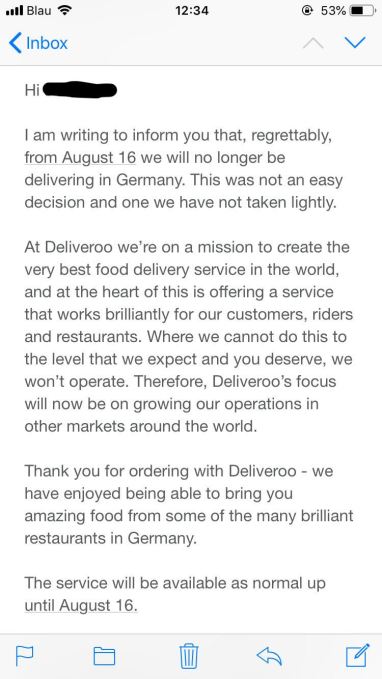
The startup expanded into the market more than four years ago. But in an email sent to users it writes that — “regrettably” — it will be exiting Germany on August 16.

“This was not an easy decision and one we have not taken lightly,” it adds, saying its focus will be on “growing our operations in other markets around the world”.

deliveroo german goodbye email

The company had already dialled back service in the market, shuttering services in a number of smaller German cities a year ago. At the time it said it would focus on Berlin, Munich, Cologne, Hamburg and Frankfurt.

A spokesperson for Deliveroo confirmed it’s complete exit from Germany, emailing TechCrunch the following statement:

We want to thank all of the riders and restaurants who worked with Deliveroo in Germany, as well our wonderful customers. It has been an honour to serve so many people amazing food from Germany’s many great restaurants and to work with so many brilliant, hard-working riders. We are grateful to our extremely talented employees for their commitment to bringing fantastic foods to people’s homes, and they will be supported in this period. Deliveroo will continue to grow and invest in markets across the world, seeking to become the world’s definitive food company.

The spokesperson added that Deliveroo intends to refocus resources and investment to accelerate growth and expansion in other markets across Europe and APAC — without specifying exactly where it plans to focus.

Support for riders and affected employees will include unknown levels of compensation and goodwill packages, according to information provided by Deliveroo.

It also said it does not ruling out returning to Germany in future, albeit it expressed a similar sentiment when it downsized its service footprint in the market last year.

At the time of its launch into Germany, back in April 2015, we wrote that Deliveroo would face “stiff competition”, noting for example that Berlin was already host to a range of local food delivery startups.

Competition in the on-demand food delivery space in Europe has raged fiercely for years — with very little to distinguish one delivery app from another, aside from price. Switching service is always just an app tap away.  But with consolidation now starting to eat into the market the temperature is rising.

At the end of last year another Deliveroo rival, Delivery Hero, ceded its entire business in Germany to Netherlands-based Takeaway.com — selling the unit for €930M.

While, late last month, UK-based Just Eat and Takeaway.com announced they were in advanced talks to combine their businesses. Their boards reached agreement on terms last week — with the deal set to be put to their respective shareholders before the end of the year.

Most likely that mega-merger is concentrating minds at Deliveroo. Competing for customers with a platform giant valued at $10BN+ certainly does not sound like a cake walk.

TechCrunch’s Steve O’Hear contributed to this report 

12 Aug 2019

India’s Reliance Jio inks deal with Microsoft to expand Office 365, Azure to more businesses; unveils broadband, blockchain, and IoT platforms

India’s Reliance Jio, which has disrupted the telecom and features phone businesses in India in less than three years of existence, is now ready to aggressively foray into many more businesses with the help of global giants including Microsoft.

The subsidiary of India’s largest industrial house Reliance Industries today announced that it will commercially launch its optical fiber broadband business next month, an IoT platform on January 1, 2020, and “one of the world’s biggest blockchain networks” in the next 12 months.

The broadband service, called Jio Giga Fiber, is aimed at individual customers, small and medium sized businesses, as well as enterprises, Mukhesh Ambani, Chairman and Managing Director of Reliance Industries, said at a shareholders meeting Monday. The service, which will be available to consumers starting September 5, will offer free voice calls, high-speed internet and start at Rs 700 per month.

The company also announced a 10-year partnership with Microsoft to leverage the Redmond giant’s Azure, Microsoft 365, and Microsoft AI platforms to launch new cloud datacenters in India to ensure “more of Jio’s customers can access the tools and platforms they need to build their own digital capability,” said Microsoft CEO Satya Nadella in a video appearance Monday.

“At Microsoft, our mission is to empower every person and every organization on the planet to achieve more. Core to this mission is deep partnerships, like the one we are announcing today with Reliance Jio. Our ambition is to help millions of organizations across India thrive and grow in the era of rapid technological change… Together, we will offer a comprehensive technology solution, from compute to storage, to connectivity and productivity for small and medium-sized businesses everywhere in the country,” he added.

As part of the partnership, Nadella said, Jio and Microsoft will jointly offer Office 365 to more organizations in India, and also bring Azure Cognitive Services to more devices and in many Indian languages to businesses in the country. The solutions will be “accessible” to reach as many people and organizations in India as possible, he added.

Ambani also said Jio is working on a “digital stack” to create a new commerce partnership platform in India to reach tens of millions of merchants, consumers, and producers.

More to follow…

12 Aug 2019

India’s Meesho raises $125M to expand its social commerce business

Meesho, a Bangalore-based social commerce startup, has raised $125 million in a new financing round to expand its business in the country and change the way millions shop online.

The Series D round was led by Naspers, and existing investors SAIF, Sequoia, Shunwei Capital, RPS and Venture Highway participating as well. Facebook also participated in the round, so did Arun Sarin, former CEO of Vodafone Group. The startup has raised $190 million to date.

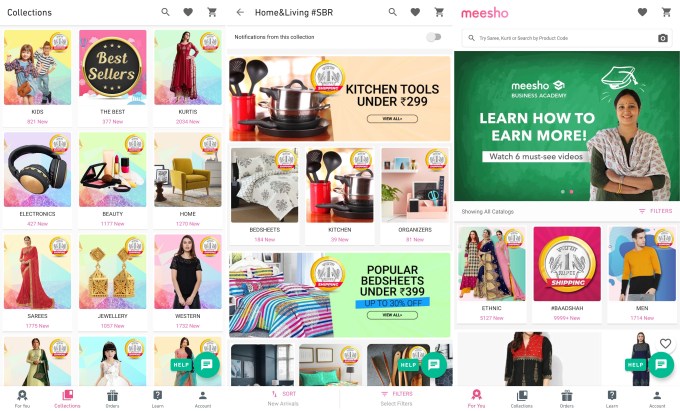
Meesho is an online marketplace that connects sellers with customers on social media platforms such as WhatsApp, Facebook, and Instagram. The four-year-old startup claims to have a network of more than 2 million resellers from 700 towns who largely deal with apparel, home appliances and electronics items.

These resellers are mostly homemakers, most of whom have purchased a smartphone for the first time in recent years. Eighty percent of Meesho’s user base is female.

meesho android

Meesho said the startup will use the fresh capital to expand its reach in the nation and add as many as 18 million new sellers by end of next year. “The latest investment will also strengthen Meesho’s aim to grow its community of women entrepreneurs who have dreamt of running their own businesses but lacked the funds and expertise to do so,” the company said.

More than 90% of businesses in India are still offline and unorganized. Meesho is trying to get these businesses, most of whom don’t have working capital to enable their own online presence, sell online, Vidit Aatrey, Meesho co-founder and CEO, told TechCrunch in an interview.

“I am particularly proud that Meesho has cut across gender, education levels, risk appetites and vocations to create livelihoods for people with no investment of their own. Our social sellers are small retailers, women, students and retired citizens, with 70% being homemakers who have found financial freedom and a business identity without having to step outside their homes,” said Aatrey.

Meesho also plans to use the new funds to further bulk up its technology platform to accommodate new product lines, and to evolve its analytics and machine learning platforms to handle national scale.

“The phenomenal growth they are already experiencing shows that Meesho has hit a sweet spot in the market and is well-poised to serve the next 500 million online shoppers in the country,” said Ashutosh Sharma, Head of India Investments, Naspers Ventures, in a statement.

12 Aug 2019

ByteDance launches a new search portal that returns a mix of results from the Web and its own platforms

ByteDance has taken another step into search with the launch of a new search portal today. Called Toutiao Search, the portal is part of the website for Toutiao, the news aggregator owned by ByteDance, and currently optimized only for mobile.

Though it is part of Toutiao’s website, the portal is separate from the Toutiao’s own search function, which lets users look for news articles and topics within the app. Toutiao Search brings up results from the Web, but like other search engines in China, the results are censored. For example, a search for “Hong Kong,” where large pro-democracy demonstrations are currently taking place, show only results from state-approved media outlets or ByteDance’s own services, like Xigua Video, Douyin (its domestic version of TikTok) or Toutiao.

[gallery ids="1867330,1867331,1867332"]

Searches for less contentious topics like “restaurant” also return a similar mix of web results and media from ByteDance apps. This means the company’s entrance into the search business not only sets it up as a new competitor to Baidu, which currently holds 76% of the search engine market, Sogou, Bing and 360, but will also help ByteDance drive traffic to all of its platforms. Google’s efforts to re-enter the Chinese market stalled when employees protested against the development of a censored search engine last year.

TechCrunch’s Rita Liao reported earlier this month that ByteDance, currently the most highly-valued tech startup in the world, has already hired people from other search companies, including Google, Baidu, Bing and 360. A recruiting post published earlier this month on ByteDance’s WeChat account was the company’s first public announcement that it is building a “universal search engine.”

TechCrunch has contacted ByteDance for more information about the new search portal.

11 Aug 2019

Competition among alternative protein players gets hot as companies beef up with new deals

The competition for control of the burgeoning market for burger replacements (and other alternatives to animal proteins) continues to heat up.

Beyond Meat and Impossible Foods the two leading contenders for top purveyor of plant-based patties (and other formulations) have spent most of the typically sleepy summer months jockeying for the position as top supplier to a food industry suddenly ravenous for alternatives to traditional meat product.s

As soon as the first Impossible Whoppers came off the flame broilers at Burger King, Beyond Meat was announcing a new fast food chain supply deal of its own with Subway.

Through that agreement the publicly traded provider of plant-based products will be grinding up meatless meatballs for Subway’s new vegetarian option to the classic meatball sub.

Subway will roll out meatless meatballs in 685 of its franchise locations in the U.S. and Canada starting in September.

Not to be outdone, Impossible Foods came swinging back with some a new partnership with the institutional food prep giant Sodexo. At roughly 1,500 Sodexo locations food slingers at healthcare facilities and corporate and university cafeterias will unveil new options like Impossible Foods-based sausage muffin sandwiches, sausage gravy and biscuits, steakhouse burgers and creole burgers.

Screen Shot 2019 08 11 at 4.36.46 PM

Image courtesy of Sodexo

“Sodexo is committed to providing customers with more plant-forward and sustainable options as part of their diet,” said Rob Morasco, senior director culinary development, Sodexo, in a statement. “We are excited to expand our menu to include the Impossible Burger’s flavorful blend, which will be featured in several new products this fall.”

Set against this meatless horserace for national food service dominance, other plant-based providers have launched to take the startup direct-to-consumer approach to satisfy vegetarian cravings for other types of food substitutes.

It was partially in response to this furor over the vegetarian market that the world was introduced to Nuggs. Ben Pasternak, the company’s young founder, first came to fame as the teenage entrepreneur behind the social media app Monkey.

When Monkey was sold to a Chinese company in 2017, Pasternak turned his attention to food. He’s been cooking up the idea for Nuggs since that time. In 2018 the core team assembled with Pasternak bringing on Liam Mullen, a former pastry chef and self-trained molecular gastronomist who was working for the high-end New York restaurant Daniel at the age of 16.

Screen Shot 2019 08 11 at 4.38.18 PM

Image courtesy of Nuggs

Unlike Impossible Foods, which has faced supply chain woes thanks to its initial strategy of building its own manufacturing facilities, Nuggs is manufactured by McCain Foods, a food prep giant that also led the company’s $7 million round. Other investors include Rainfall Ventures; Greylock Discovery Fund; Maven Ventures; NOMO Ventures; M Ventures; ACME Capital; Founder of MTV and CEO of iHeartMedia, Bob Pittman; Casper Founder & COO, Neil Parikh; and Former President of Tumblr, John Maloney.

While Beyond Meat and Impossible Foods have grabbed most of the headlines as the first generation of protein substitutes to really make a dent with consumers, Just (the company formerly known as Hampton Creek) has also nabbed some major deals with big fast food chains for its big product — egg replacements.

Launched in 2018, the egg replacement from Just inked a major deal in late July with Tim Hortons, the Canadian coffee, donut, and sandwich chain. Much as Beyond Meat has found a home for its meatless sausages at Dunkin Donuts in the U.S., Just has seen Tim Hortons take its eggless egg replacement to a Canadian consumers (Hortons also has a sandwich using Beyond Meat).

Some companies are going beyond plant-based protein replacements to lab-grown versions of the real thing. That’s been the story behind Perfect Day, which sold out of their $20-per-pint ice cream in a matter of hours. Like Impossible Foods and Beyond Meat, the company intends to sell through ice cream manufacturers rather than going direct to consumers with its own product, according to a CNBC report.

The three protein replacement companies have grabbed investor attention and heralded a surge of venture capital investment into plant based protein products. In all, Beyond Meat, Impossible Foods, and Just have snagged over $1 billion in funding.

For investors in Beyond Meat, the $122 million in capital will yield billions in returns. The company’s market capitalization is up to a meaty $13.4 billion from $1.5 billion when its stock first began public trading. Analysts at Barclays predict the market for alternative proteins could hit $140 billion by 2029.