Category: UNCATEGORIZED

06 Aug 2019

India’s Awfis raises $30M to grow its co-working spaces business

Speaking of businesses that operate co-working spaces in India, New Delhi-based startup Awfis announced today that it has raised $30 million in a new financing round to expand its footprint in the country.

The Series D round for the four-year-old startup was led by ChrysCapital. Existing investors Sequoia Capital India and The Three Sisters Institutional Office also participated in the round, the startup said. Awfis has raised $81 million to date.

Awfis operates in nine cities in India and has 63 centers. It currently has the capacity to accommodate 30,000 people across its centers. In an interview with TechCrunch, Amit Ramani, founder and CEO of Awfis, said the startup will use the capital to add about 340 centers to accommodate 170,000 more people in the next one year and a half.

The startup currently operates two models: It works with landowners to use their workspaces and splits profits with them, and second, it serves as a management operator where it takes a cut of the revenue as its fee. Ramani did not disclose the financial performance of Awfis, but said the startup is aiming to go public in 2022.

Most of its customers today are either small businesses or corporate clients. Some of its customers include Vodafone, Reliance, Hitachi, Zomato, and Practo . It also offers a mobility solution for individuals who want to work from Awfis’ workspaces.

Kshitij Sheth, VP of ChrysCapital, told TechCrunch in an interview that India is finally beginning to see a major boom in the co-working spaces culture. He said his team was impressed by Awfis’ quality services, business model, and ratings from customers.

India’s co-working space, still a relatively new business category in the nation, is worth $390 million — a fraction of the $30 billion office and commercial real estate business. Awfis today competes with a number of startups including GoWork, which announced $53 million in a debt financing round earlier today, 91Springboard, GoHive, and the global giant WeWork.

Fast-growing hotel lodging startup Oyo also recently entered the co-working spaces business with the launch of Oyo Workspaces. For the expansion, it acquired local player Innov8 for a sum of about $30 million to immediately establish presence in 10 cities in India with more than 20 centers.

But the competition does not necessarily worry Ramani, who said the market today remains largely untapped. “Competition is great. It helps educate the market. People have more choices.” Ramani is happy to compete with others on quality and service front, he said.


06 Aug 2019

Slack makes some key security enhancements

As Slack makes its way deeper into the enterprise, it needs to layer on more sophisticated security measures like the encryption key management feature it released last year. Today, the company published a blog post outlining its latest security strategy, and while it still doesn’t include end-to-end encryption of Slack messaging, it is a big step forward.

For many companies, there is a minimum level of security they will require before they use a tool like Slack company-wide, and this is particularly true for regulated industries. Slack is trying to answer some of these concerns with today’s post.

As for end-to-end (E2E) encryption, Slack believes it would adversely affect the user experience and says there hasn’t been a lot of customer demand for it so far. “If we were to add E2E encryption, it would result in limited functionality in Slack. With EKM (encryption key management), you gain cryptographic controls, providing visibility and opportunity for key revocation with granularity, control, and no sacrifice to user experience,” a Slack spokesperson told TechCrunch.

Today, the company provides the ability for admins to require Touch ID or Face ID or to enter a passcode on a mobile device. In addition, if a user reports a device stolen, admins can wipe Slack conversations remotely, although this is currently only available through an API.

What they have coming soon is a new administrative dashboard, where admins can manage all of this kind of security in a single place. They will even be able to detect if a person is using a jail-broken phone and shut down access to the phone. In addition, they will be able to force upgrades to the latest version of Slack by not allowing access until the person downloads the latest version.

Later this year, admins will be able to block files downloaded from Slack desktop that come from outside of a set of pre-approved IP addresses. And on the mobile side, they will be able to force file links to open in an approved browser.

All of these features are designed to make administrators feel more comfortable using Slack in a secure and reliable way. One of Slack’s big strengths is its ability to integrate with other pieces of the enterprise software ecosystem, but companies still want control over what files are shared and how they open across devices. These new tools go a long way toward easing those types of concerns.

06 Aug 2019

Dogdrop is launching a doggy daycare to take on Wag Hotels

When you think of dog daycare, Wag Hotels and Rover likely come to mind. Now, there’s a new entrant in the space. Dogdrop, launching this September in Los Angeles, aims to be a daycare service for dog parents who need more flexible care and pricing.

Through a monthly membership, dog parents can drop off their dogs and pick them up whenever they want. And if they don’t need all-day daycare, hourly options are available. But, you’ll still need to pay a monthly subscription.

The monthly plans range from $20 per month for three hours worth of daycare plus 10% off workshops to $800 per month for unlimited dog daycare, which comes out to less than $2 per hour, as well as 20% off workshops.

Wag Hotels, on the other hand, is geared toward people who need to board their dogs all day. The prices range from $46 per day (7am – 7pm) with to $625 for monthly pack.

“Dogdrop is for the modern dog parent who has high expectations of quality care and whose lifestyle demands convenience,” Dogdrop co-founder Shaina Denny said in a statement. “We are centered around community, and our thoughtfully designed spaces are streamlining the dog service experience. We want dogs to be happy and healthy and for our human members to better incorporate their dog into their everyday life.”

Dogdrop is not disclosing how much funding it has, but was incubated by Science, which previously backed DogVacay. The plan is to open its first location in Los Angeles this September, and plans to add additional locations next year.

“An uptick in pet ownership along with generational shifts and changes in the modern workplace mean there is a need for more flexible, accessible care for pets,” said Michael Jones, co-founder and CEO of Science Inc. “Dogdrop’s plans to scale will make it a trusted, reliable service that dog owners can turn to in an otherwise highly fragmented industry. We’re impressed with Dogdrop’s commitment to delivering quality dog care services and easing the pain points of cost and rigid schedules in traditional dog care. We look forward to seeing this company scale and transform pet ownership.”

06 Aug 2019

Amazon Scout autonomuous delivery robots begin deliveries in California

Amazon’s Scout six-wheeled, sidewalk driving delivery robots have begun doing deliveries in Southern California, to customers in the Irvine area. Amazon announced this first California deployment of Scout bots in a blog post, noting that in its experience to date, the company has had plenty of opportunity to experience a range of weather conditions in its first deployments in the Pacific Northwest in Seattle – so weather-wise at least, the little blue bot should have a smoother time in sunny CA.

There are only a “small number” of the robots currently deployed, so even if you’re an Irvine resident, don’t necessarily expect to get a glimpse of one just yet. But they will be making their way to customer homes “during daylight hours,” Monday to Friday, per Amazon. They’ll be sent out at random for orders placed by customers through Amazon as usual, regardless of what delivery option you select.

While the robots can drive themselves around, which is the whole point of the project to begin with, for the time being they’ll be accompanied by an ‘Amazon Scout Ambassador .’ These Amazon staff are part diplomat, part research associate for the project, answering questions from people in the neighborhood and also taking note of their reactions. Robots aren’t yet actually interacting with people too much on a daily basis, especially out in the world, so a key part of rolling them out commercially is studying how people interact with them, and think about how those interactions might be altered or improved.

A lot of thought went into the initial Scout design, both in terms of making sure it’s able to survive the many miles it traverses during a day, and in coming up with a design that looks and feels at once approachable but also somewhat bland, so as to quickly evolve from novelty to standard neighborhood background scenery.

06 Aug 2019

Trump attacks Google and Sundar Pichai in morning tweets

The President of the United States of America kicked off the morning with a series of tweets criticizing one of the country’s largest corporations for alleged ties to election tampering and China’s military. In a thread that would have been regarded as a remarkable occurrence under any other administration, Donald J. Trump called out Google by name, tagging CEO Sundar Pichai for good measure.

“[Pichai] of Google was in the Oval Office working very hard to explain how much he liked me, what a great job the Administration is doing, that Google was not involved with China’s military, that they didn’t help Crooked Hillary over me in the 2016 Election,” the President tweeted, “and that they […] are NOT planning to illegally subvert the 2020 Election despite all that has been said to the contrary.”

Trump cited a Lou Dobbs Fox Business Network interview with Peter Schweizer, Breitbart editor and the president of conservative think tank, the Government Accountability Institute. “[Schweizer] stated with certainty that they suppressed negative stories on Hillary Clinton, and boosted negative stories on Donald Ttump [sic],” Trump tweeted. “All very illegal. We are watching Google very closely!”

The tweets are the latest in an on-going series of public criticisms of Google and other U.S.-based social platforms like Facebook and Twitter . Trump and fellow republicans have long accused the services of a liberal bias, suggesting that they have “shadow banned” and otherwise repressed conservative voices.

The President’s latest salvo can be linked to comments from Kevin Cernekee a fired Google engineer who has been making the conservative news rounds this week. “They really want Trump to lose in 2020,” he recently told Fox News’ Tucker Carlson. “That’s their agenda.”

Google vehemently denied Cernekee’s claims in a statement offered to TechCrunch this morning.

“The statements made by this disgruntled former employee are absolutely false,” a spokesperson told TechCrunch. “We go to great lengths to build our products and enforce our policies in ways that don’t take political leanings into account. Distorting results for political purposes would harm our business and go against our mission of providing helpful content to all of our users.”

Conservative Google employees have claimed that Cernekee led conversations within the company tied to alt-right beliefs — claims he has since denied. “These are false and baseless smears from a jealous and vindictive ex-colleague,” the former Google engineer said in a statement. “I have always supported free speech and opposed white nationalism.”

Cernekee says he was fired from the company for his conservative views. Google maintains he was let go for violating multiple company policies, including downloading internal Google documents on a personal device.

06 Aug 2019

AT&T rolls out (limited) 5G in (parts of) New York City

Both Verizon and Sprint have been promising 5G coverage in the nation’s largest city for some time now. AT&T this morning, however, said it’s starting to do just that. The U.S.’s largest carrier by subscribers announced limited availability of 5G coverage in New York City.

The typical not-so-fine print applies to the news this morning. The service will be limited to business users at launch — and only available in a select number of areas. In other words, don’t go running out and buying a 5G phone just yet, if you’re an AT&T customer in the five boroughs.

On the plus side, 5G+ is the real deal, unlike the deceptively named 5GE that came before it. And AT&T’s being reasonably transparent about the limited nature of the roll out.

“As a densely-populated, global business and entertainment hub, New York City stands to benefit greatly from having access to 5G, and we’ve been eager to introduce the service here,” AT&T’s New York President Amy Kramer said in a release. “While our initial availability in NYC is a limited introduction at launch, we’re committed to working closely with the City to extend coverage to more neighborhoods throughout the five boroughs.”

Per CNET, the rollout is limited to a small section of Manhattan for the time being, including, “near and around East Village, Greenwich Village and Gramercy Park.” Business users can access the service using Samsung’s Galaxy S10 5G on the carrier’s Business Unlimited Preferred plan.

06 Aug 2019

Apple subsidiary FileMaker Inc. changes its name (back) to Claris

Remember Claris, the 1987 Apple spin-off that made applications like MacWrite, MacPaint and FileMaker? In 1998, Apple brought all of those products in-house again, with the exception of the low-code application platform FileMaker . With that move, Claris changed its name to FileMaker Inc. Today, however, the Claris name rises from the dead, as FileMaker Inc. is changing its name to Claris International. The name of the FileMaker product itself, though, remains the same.

As FileMaker Claris CEO Brad Freitag, who recently took over this role from Dominique Goupil, told me, the reason for this move is because the company is starting to look beyond its core FileMaker product. “We’re accelerating our vision and our strategy,” he said. “We’ve described our vision for a long time as making powerful technology accessible to everyone. And with the leadership change, we are really asserting a more aggressive posture in bringing that product roadmap to life.”

Brad

Claris CEO Brad Freitag

To put a point on this and clarify its strategy, Claris is also using today’s announcement to launch Claris Connect, a tool for integrating various cloud services and automating workflows between them. With this, Claris also confirmed the previously reported acquisition of Stamplay, a small Italian startup that makes tools for connecting the APIs of various enterprise tools. Claris Connect is going to be the second product in Claris’ lineup, with FileMaker remaining its flagship product.

FileMaker, the product, currently serves more than a million end users who work at about 50,000 different companies. The company has great brand recognition and has been profitable for more than 80 consecutive quarters, Freitag said, but with its foray into workflow and business process automation, it was time to look for a different brand name.

Although low-code/no-code has been a growing buzzword in the industry for a few years now, FileMaker didn’t really make any waves. That, too, is going to change a bit, it seems, as Freitag actually hopes to expand the business significantly. “As we look out five years, we see multiplying the user community by at least 3x and there’s a pretty clear path to getting there,” he said. “If you look at our business, we’re over 50% outside of the U.S. The market opportunities for us exist in the Americas, as well as Europe and Asia.”

Claris logo rgb blk

Freitag admits that FileMaker was “relatively modest” in its go-to-market posture, so it will expand its brand and category awareness efforts. Chances are then, you’ll hear the Claris and FileMaker names a bit more often going forward (and Freitag stressed that the company remains “100% committed to the FileMaker platform”).

Claris also expects to expand its product offerings going forward — and that may include additional acquisitions. “We are investing heavily in organic innovation as we expand the product lines — and we are open to additional acquisitions,” he said.

FileMaker Inc./Claris is making this move while the overall market for products like FileMaker continues to grow. That’s something Freitag hopes to capitalize on as the company looks ahead. What exactly that will look like remains to be seen, but Freitag noted that the kind of next-generation platform will go beyond the kind of database-driven applications FileMaker itself is known for today and focus on services that support workflow applications. He also believes there is an opportunity for IoT solutions under the Claris brand and maybe, in the long run, augmented reality applications.

06 Aug 2019

Democratic senate campaign group exposed 6.2 million Americans’ emails

A political campaign group working to elect Democratic senators left a spreadsheet containing the email addresses of 6.2 million Americans’ on an exposed server.

Data breach researchers at security firm UpGuard found the data in late July, and traced the storage bucket back to a former staffer at the Democratic Senatorial Campaign Committee, an organization that seeks grassroots donations and contributions to help elect Democratic candidates to the U.S. Senate.

Following the discovery, UpGuard researchers reached out to the DSCC and the storage bucket was secured within a few hours. The researchers published shared their findings exclusively with TechCrunch and published their findings.

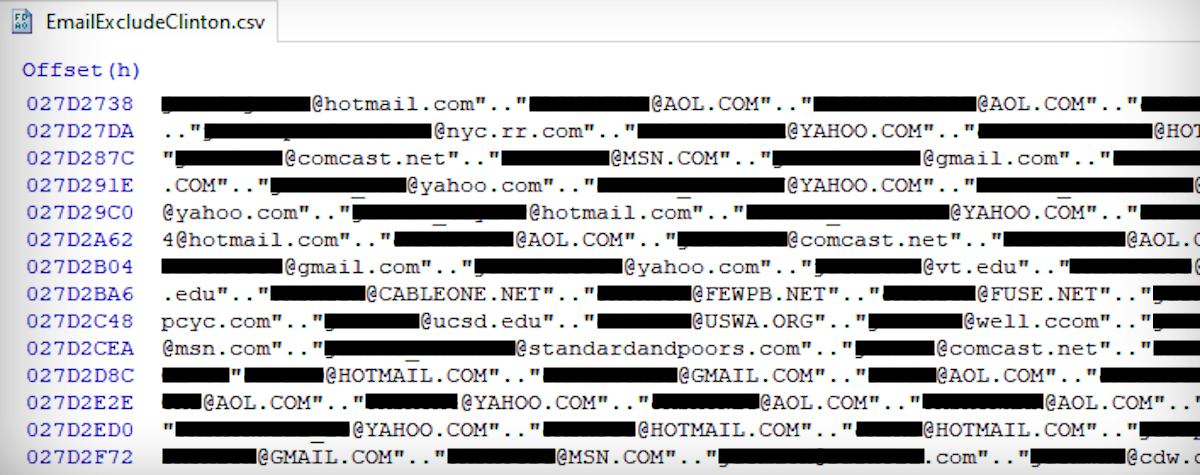
The spreadsheet was titled “EmailExcludeClinton.csv” and was found in a similarly named unprotected Amazon S3 bucket without a password. The file was uploaded in 2010 — a year after former Democratic senator and presidential candidate Hillary Clinton, whom the data is believed to be named after, became secretary of state.

UpGuard said the data may be people “who had opted out or should otherwise be excluded” from the committee’s marketing.

screenshot

A redacted portion of the email spreadsheet. (Image: UpGuard/supplied)

Stewart Boss, a spokesperson for the DSCC, denied the data came from the Sen. Hillary Clinton’s campaign and claimed the data had been created using the committee’s own information.

“A spreadsheet from nearly a decade ago that was created for fundraising purposes was removed in compliance with the stringent protocols we now have in place,” he told TechCrunch in an email.

Despite several follow-ups, the spokesperson declined to say say how the email addresses were collected, where the information came from, what the email addresses were used for, how long the bucket was exposed, or if the committee knew if anyone else accessed or obtained the data.

We also contacted the former DSCC staffer who owned the storage bucket and allegedly created the database, but did not hear back.

Most of the email addresses were from consumer providers, like AOL, Yahoo, Hotmail and Gmail, but the researchers found over 7,700 U.S. government email addresses and 3,400 U.S. military email addresses, said the UpGuard researchers.

The DSCC security lapse is the latest in a string of data exposures in recent years — some of which were also discovered by UpGuard. Two incidents in 2015 and 2017 exposed 191 million and 198 million Americans’ voter data respectively, including voter profiles and political persuasions. Last year, 14 million voter records on Texas residents were also found on an exposed server.

Although the DSCC’s data exposure contains less damaging information than similar exposed sets of voter data, it represents another embarrassing lapse around political campaign data security.

“This list contained only email addresses, but other political data sets contain far more information on individuals, down to psychographic information such as their habits, behaviors, and likely beliefs,” said UpGuard. “The same things that make this data valuable to political campaigns makes it valuable to malicious actors — intel on individuals that can be used to contact and influence them.”

“If political data can be exposed for ten years, the risk created by that data has an unknown half-life,” the researchers said.

06 Aug 2019

Klarna raises $460 million, looks to expand its payments presence in the U.S.

Swedish payments provider Klarna has announced a new round of equity funding, adding $60 million at a post-money valuation of $5.5 billion, which makes it one of the most highly-valued private fintech companies in the world. The new funding will be used to help Klarna continue to grow its presence in the U.S. payments market, the company said in a press release.

Klarna’s European presence is strong, based on the back of its credit card-alternative payment method which allows customers to pay over time, with the purchase price broken up over four equal instalments, but directly from their bank accounts and without incurring any interest. The company also offers pay now options to provide both retailers and their customers so people can pay more traditionally, too.

In Europe, the mode has been a tremendous success because it’s more in line with how customers in many European markets prefer to pay anyway – avoiding credit and opting for cash and debit. Klarna is also riding the rise of pay later options that are increasingly popular in U.S. commerce, including offerings like purchase financing from Affirm.

Once reserved for big ticket items, interest-free, instalment based payment programs are increasingly common, and popular, for lower-cost purchase. Affirm, for instance saw total loan volume cross $2 billion in 2018. Klarna, meanwhile, is currently growing in the U.S. at a rate of around 6 million new customers annually, and it counts over 3,000 U.S. merchants as customers. Per order value is also growing among customers using Klarna’s 4-payment instalment option, the company says: Average order value is 68% higher when using this option, with a 44% higher conversion rate (ie. customers actually following through with the purchase) vs. traditional credit card payments.

The new funding for Klarna is led by Dragoneer Investment Group, and includes participation by Commonwealth Bank of Australia, HMI Capital LLC, Merian Chrysalis Investment Company Limited, and more.

06 Aug 2019

OnePlus’ first 5G handset is headed for Sprint

Sprint href="https://newsroom.sprint.com/sprint-to-launch-5g-smartphone-from-oneplus.htm"> this morning announced that it will be the first network to get its hands on OnePlus’s long-promised 5G handset [not pictured]. The Shenzhen-based manufacturer announced late last year that it was targeting 2019 for the device, bucking the trend of being slightly behind the curve on the latest smartphone technologies.

Sprint’s not offering much in the way of actual information here — no pricing or availability. Not even specs or a device name were made available via the press release. Rather, the carrier notes that this is its first 5G smartphone, joining three other non-phone 5G devices for the nascent network.

Last year OnePlus made a device available for the first time through a U.S. carrier, partnering with T-Mobile for the 6T. It’s made the jump to Sprint this time out, though given merger plans, that distinction may soon be moot regardless.