
Category: UNCATEGORIZED

06 Aug 2019

Facebook still full of groups trading fake reviews, says consumer group

Facebook has failed to clean up the brisk trade in fake product reviews taking place on its platform, an investigation by the consumer association Which? has found.

In June both Facebook and eBay were warned by the UK’s Competition and Markets Authority (CMA) they needed to do more to tackle the sale of fake product reviews. On eBay sellers were offering batches of five-star product reviews in exchange for cash, while Facebook’s platform was found hosting multiple groups were members solicited writers of fake reviews in exchange for free products or cash (or both).

A follow-up look at the two platforms by Which? has found a “significant improvement” in the number of eBay listings selling five-star reviews — with the group saying it found just one listing selling five-star reviews after the CMA’s intervention.

But little appears to have been done to prevent Facebook groups trading in fake reviews — with Which? finding dozens of Facebook groups that it said “continue to encourage incentivised reviews on a huge scale”.

Here’s a sample ad we found doing a ten-second search of Facebook groups… (one of a few we saw that specify they’re after US reviewers)

Screenshot 2019 08 06 at 09.53.19

Which? says it found more than 55,000 new posts across just nine Facebook groups trading fake reviews in July, which it said were generating hundreds “or even thousands” of posts per day.

It points out the true figure is likely to be higher because Facebook caps the number of posts it quantifies at 10,000 (and three of the ten groups had hit that ceiling).

Which? also found Facebook groups trading fake reviews that had sharply increased their membership over a 30-day period, adding that it was “disconcertingly easy to find dozens of suspicious-looking groups in minutes”.

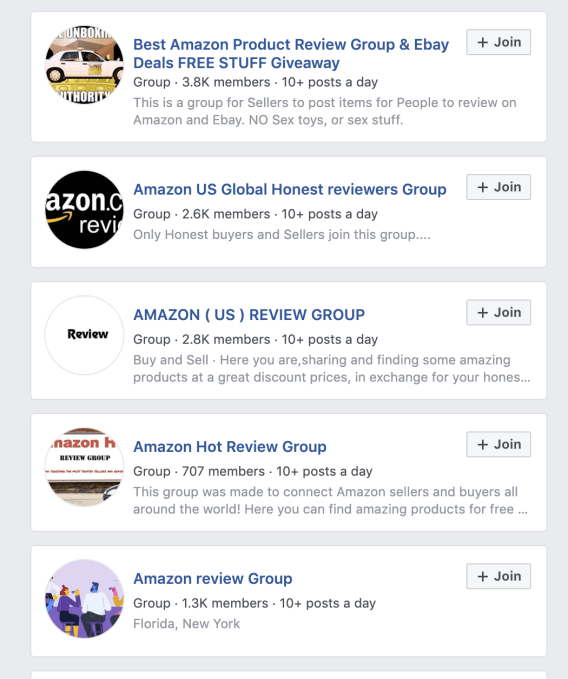
We also found a quick search of Facebook’s platform instantly serves a selection of groups soliciting product reviews…
Screenshot 2019 08 06 at 09.51.09

Which? says looked in detail at ten groups (it doesn’t name the groups), all of which contained the word ‘Amazon’ in their group name, finding that all of them had seen their membership rise over a 30-day period — with some seeing big spikes in members.

“One Facebook group tripled its membership over a 30-day period, while another (which was first started in April 2018) saw member numbers double to more than 5,000,” it writes. “One group had more than 10,000 members after 4,300 people joined it in a month — a 75% increase, despite the group existing since April 2017.”

Which? speculates that the surge in Facebook group members could be a direct result of eBay cracking down on fake reviews sellers on its own platform.

“In total, the 10 [Facebook] groups had a staggering 105,669 members on 1 August, compared with a membership of 85,647 just 30 days prior to that — representing an increase of nearly 19%,” it adds.

Across the ten groups it says there were more than 3,500 new posts promoting inventivised reviews in a single day. Which? also notes that Facebook’s algorithm regularly recommended similar groups to those that appeared to be trading in fake reviews — on the ‘suggested for you’ page.

It also says it found admins of groups it joined listing alternative groups to join in case the original is shut down.

Commenting in a statement, Natalie Hitchins, Which?’s head of products and services, said: ‘Our latest findings demonstrate that Facebook has systematically failed to take action while its platform continues to be plagued with fake review groups generating thousands of posts a day.

“It is deeply concerning that the company continues to leave customers exposed to poor-quality or unsafe products boosted by misleading and disingenuous reviews. Facebook must immediately take steps to not only address the groups that are reported to it, but also proactively identify and shut down other groups, and put measures in place to prevent more from appearing in the future.”

“The CMA must now consider enforcement action to ensure that more is being done to protect people from being misled online. Which? will be monitoring the situation closely and piling on the pressure to banish these fake review groups,” she added.

Responding to Which?‘s findings in a statement, CMA senior director George Lusty said: “It is unacceptable that Facebook groups promoting fake reviews seem to be reappearing. Facebook must take effective steps to deal with this problem by quickly removing the material and stop it from resurfacing.”

“This is just the start – we’ll be doing more to tackle fake and misleading online reviews,” he added. “Lots of us rely on reviews when shopping online to decide what to buy. It is important that people are able to trust they are genuine, rather than something someone has been paid to write.”

In a statement Facebook claimed it has removed 9 out of ten of the groups Which? reported to it and claimed to be “investigating the remaining group”.

“We don’t allow people to use Facebook to facilitate or encourage false reviews,” it added. “We continue to improve our tools to proactively prevent this kind of abuse, including investing in technology and increasing the size of our safety and security team to 30,000.”
06 Aug 2019

Apply to be a TC Top Pick at Disrupt Berlin 2019

It’s official — applications are now open for TC Top Picks at Disrupt Berlin 2019, which takes place on 11-12 December. This pre-conference competition is your chance to experience Disrupt Berlin VIP-style and exhibit your early-stage startup to some of the world’s most influential tech leaders, investors and media outlets across Europe, Asia and beyond — for free. Das ist gut, ja?

Apply here to be a TC Top Pick.

Here’s how it all works. TechCrunch editors — a picky bunch with an eye for exceptional startups — will closely review every qualified application. Then they’ll select up to five startups in each of these categories: AI/Machine Learning, Biotech/Healthtech, Blockchain, Fintech, Mobility, Privacy/Security, Retail/E-commerce, Robotics/IoT/Hardware, CRM/Enterprise and Education.

What sort of startups catch our eye? Great question. Take a look at the TC Top Picks Disrupt Berlin 2018.

If you’re one of the chosen few, you’ll win a free Startup Alley Exhibitor Package. In addition to one exhibit day, the package includes three Founder passes, access to the full conference and all programming across four stages, including Startup Battlefield, our epic pitch competition with a $50,000 prize. You’ll also receive invitations to VIP events, like the investor reception. We’re talking top-tier investors and global press.

Top Picks enjoy a prime location in Startup Alley, and you’ll be well-positioned for the thousands of attendees looking for investments, collaborators, providers or the next big thing. Plus, each Top Pick founder will be interviewed by a TechCrunch editor on the Showcase Stage, and we’ll edit and promote that video interview across our social media platforms. That’s a marketing gift that keeps on giving.

Here’s yet another perk. All companies exhibiting in Startup Alley — including Top Picks — become eligible for a Wild Card spot in the Startup Battlefield. Who knows, it might be you.

Disrupt Berlin 2019 takes place on 11-12 December, and it draws participants from more than 50 countries. There’s no better place to introduce your pre-Series A startup to the international startup community. And there’s no easier, or more affordable, way to do it than as a TC Top Pick. Apply today. Das ist gut, ja?

Is your company interested in sponsoring or exhibiting at Disrupt Berlin 2019? Contact our sponsorship sales team by filling out this form.

06 Aug 2019

Spaceflow, the ‘tenant experience platform’, scores $1.8M investment

Spaceflow, a startup founded out of Prague that offers a “tenant experience platform” to help landlords provide a better service, has raised $1.8 million in funding.

Leading the round is Credo Ventures, with participation from Day One Capital, and UP21. The company, which also has an office in Sillicon Valley, says it will use the new capital to hire additional members of its product development team, and to meet its U.S. and U.K. growth goals.

Describing itself as a “plug & play” tenant experience and community engagement platform sold to landlords and operators of co-living spaces, the Spaceflow mobile app connects space users to amenities, services, and “community life”.

The claimed upside is that by enabling landlords and building operators to offer a “space-as-a-service” to tenants and guests, the startup helps improve tenant satisfaction and, in turn, attract and retain good tenants in order to increase profits.

“Once you download the Spaceflow app as an occupant, you can locate your building via QR code/GPS (in most cases the profile is not public so there is also an access code),” explains Spaceflow co-founder and CEO Lukas Balik. “Once you reach the building profile, most of the content is tailored specifically to the building”.

Balik says the Spaceflow app is akin to a “remote control” for your building so that you have access to bookings and reservations for common spaces, bikes, and parking etc. There’s also a “digital concierge” aspect for things like dry cleaning, room cleaning, food delivery, or local yoga classes.

In addition, the news feed provides the latest updates from the property owner. The app houses a reporting tool for maintenance and other issues too, and an online community for the building.

“Every landlord gets an access to the admin console where they can set up their whole portfolio,” adds Balik. “Also every client gets an on-boarding session with one of our community managers and our subscription plans offer three different plans based on the level of ongoing support”.

Since being founded in 2016, Spaceflow says it currently operates in 9 country markets, with a footprint on both sides of the pond.

06 Aug 2019

Penta, the German business banking startup, raises €8M additional funding

Penta, the business banking provider for small and medium sized enterprises (SMEs) that was recently acquired by fintech company builder Finleap, has raised “over” €8 million in new funding.

The round is led by HV Holtzbrinck Ventures. Also participating is Finleap, alongside Fabrick, the Italian platform for open banking and fintech services, which is another of Penta’s existing shareholders. The startup raised a €7 million Series A round in late 2018, and is thought to have had over €18 million investment since being founded in 2016.

Meanwhile, today’s new injection of capital comes shortly after Penta was acquired by Finleap, the German company builder that co-founded and also owns a stake in banking platform solarisBank, of which Penta is a customer. Shortly after the deal went through, it was confirmed that Marko Wenthin, who previously co-founded solarisBank, had become Penta’s new CEO, replacing outgoing CEO and Penta co-founder Lav Odorović.

With a team of over 50, Penta now operates from three offices located in Berlin, Belgrade, and Milan. The latter follows a recent merger with Beesy, the Italian micro-business banking startup. Penta CEO Wenthin says internationalisation will be one of the focuses following HV Holtzbrinck Ventures’ backing.

“Penta has shown an incredible amount of passion for the market, the customers, and the product: it is amazing to see what the team has built since their inception,” he says in a statement. “This funding will allow us to further invest into our product and partnerships to become the financial platform of choice for small and medium sized companies. Additionally, we will push the internationalisation of Penta, starting with Italy this year”.

06 Aug 2019

The Federal Reserve announces plans for a real-time payments system that will be available to all banks

The Federal Reserve Bank announced today that it is developing a new service called FedNow that will allow all banks in the United States to offer 24/7 real-time payment services every day of the week. FedNow is expected to be available by 2023 or 2024 and will initially support transfers of up to $25,000.

FedNow will make managing budgets easier for many people and small businesses, but it also puts the Fed at loggerheads with big banks since a federal real-time payments system would compete with the one being developed by the Clearing House, which is owned by some of the world’s largest banks, including Capital One, Citibank, Wells Fargo, Bank of America, JP Morgan Chase and Deutsche Bank.

The Federal Reserve’s board of governors voted 4-1 to approve the proposal for FedNow on August 2, with its of vice chair for supervision, Randal Quarles, casting the dissenting vote.

While Venmo, Zelle and other apps already allow users to transfer money instantly to one another, the Federal Reserve Bank described services like those as a “closed loop” because both parties need to be on the same platform in order to transfer money and they can only be linked to accounts from certain banks. On the other hand, FedNow will be a universal infrastructure, enabling all banks, including smaller ones, to provide real-time payments.

Furthermore, the traditional retail payment methods used for transferring funds not only creates frustrating delays, but can “result in a build-up of financial obligations between banks which, as faster payment usage grows, could present risks to the financial system, especially in times of stress,” the Federal Reserve Board said.

In a FAQ, the Federal Reserve Board explained that “there is a broad consensus within the U.S. payment community and among other stakeholders” that real-time payment services can have a “significant and positive impact on individuals and businesses throughout the country and on the broader U.S. economy.”

For example, real-time payments mean people living on tight budgets will have to rely less on costly check-cashing services and high-interest loans and will incur less overdraft and late fees. Small businesses will also benefit because they can avoid short-term loans with high-interest rates.

The proposal has gained the support of Democratic lawmakers including U.S. Senators Elizabeth Warren and Chris Van Hollen and Representatives Ayanna Pressley and Jesús García.

In a statement, Warren, who is campaigning for the Democratic presidential nomination, said “I’m glad the Fed has finally taken action to ensure that people living paycheck-to-paycheck don’t have to wait up to five days for a check to clear so that they can pay their rent, cover child care, or pick up groceries.  Today’s Fed action will also help small businesses by making payments from customers available more quickly. I look forward to working with the Fed to ensure a swift and smooth implementation of this system.”

Comments about FedNow will be accepted for 90 days after the proposal is published in the Federal Register.

06 Aug 2019

Cybereason raises $200 million for its enterprise security platform

Cybereason, which uses machine learning to increase the number of endpoints a single analyst can manage across a network of distributed resources, has raised $200 million in new financing from SoftBank Group and its affiliates. 

It’s a sign of the belief that SoftBank has in the technology, since the Japanese investment firm is basically doubling down on commitments it made to the Boston-based company four years ago.

The company first came to our attention five years ago when it raised a $25 million financing from investors including CRV, Spark Capital and Lockheed Martin.

Cybereason’s technology processes and analyzes data in real-time across an organization’s daily operations and relationships. It looks for anomalies in behavior across nodes on networks and uses those anomalies to flag suspicious activity.

The company also provides reporting tools to inform customers of the root cause, the timeline, the person involved in the breach or breaches, what tools they use and what information was being disseminated within and outside of the organization.

For founder Lior Div, Cybereason’s work is the continuation of the six years of training and service he spent working with the Israeli army’s 8200 Unit, the military incubator for half of the security startups pitching their wares today. After his time in the military, Div worked for the Israei government as a private contractor reverse engineering hacking operations.

Over the last two years, Cybereason has expanded the scope of its service to a network that spans 6 million endpoints tracked by 500 employees with offices in Boston, Tel Aviv, Tokyo and London.

“Cybereason’s big data analytics approach to mitigating cyber risk has fueled explosive expansion at the leading edge of the EDR domain, disrupting the EPP market. We are leading the wave, becoming the world’s most reliable and effective endpoint prevention and detection solution because of our technology, our people and our partners,” said Div, in a statement. “We help all security teams prevent more attacks, sooner, in ways that enable understanding and taking decisive action faster.”

The company said it will use the new funding to accelerate its sales and marketing efforts across all geographies and push further ahead with research and development to make more of its security operations autonomous.

“Today, there is a shortage of more than three million level 1-3 analysts,” said Yonatan Striem-Amit, chief technology officer and Co-founder, Cybereason, in a statement. “The new autonomous SOC enables SOC teams of the future to harness technology where manual work is being relied on today and it will elevate  L1 analysts to spend time on higher value tasks and accelerate the advanced analysis L3 analysts do.”

Most recently the company was behind the discovery of Operation SoftCell, the largest nation-state cyber espionage attack on telecommunications companies. 

That attack, which was either conducted by Chinese-backed actors or made to look like it was conducted by Chinese-backed actors, according to Cybereason targeted a select group of users in an effort to acquire cell phone records.

As we wrote at the time:

… hackers have systematically broken in to more than 10 cell networks around the world to date over the past seven years to obtain massive amounts of call records — including times and dates of calls, and their cell-based locations — on at least 20 individuals.

Researchers at Boston-based Cybereason, who discovered the operationand shared their findings with TechCrunch, said the hackers could track the physical location of any customer of the hacked telcos — including spies and politicians — using the call records.

Lior Div, Cybereason’s co-founder and chief executive, told TechCrunch it’s “massive-scale” espionage.

Call detail records — or CDRs — are the crown jewels of any intelligence agency’s collection efforts. These call records are highly detailed metadata logs generated by a phone provider to connect calls and messages from one person to another. Although they don’t include the recordings of calls or the contents of messages, they can offer detailed insight into a person’s life. The National Security Agency  has for years controversially collected the call records of Americans from cell providers like AT&T and Verizon (which owns TechCrunch), despite the questionable legality.

It’s not the first time that Cybereason has uncovered major security threats.

Back when it had just raised capital from CRV and Spark, Cybereason’s chief executive was touting its work with a defense contractor who’d been hacked. Again, the suspected culprit was the Chinese government.

As we reported, during one of the early product demos for a private defense contractor, Cybereason identified a full-blown attack by the Chinese — ten thousand usernames and passwords were leaked, and the attackers had access to nearly half of the organization on a daily basis.

The security breach was too sensitive to be shared with the press, but Div says that the FBI was involved and that the company had no indication that they were being hacked until Cybereason detected it.

06 Aug 2019

Financial services marketplace CompareAsiaGroup raises $20 million in new funding led by Experian

Experian, one of the largest credit reporting bureaus in the United States, announced today that it has invested in CompareAsiaGroup, the financial services marketplace. Experian led the initial closing of a $20 million B1 round.

In addition to new funding, the investment also gives Hong Kong-based CompareAsiaGroup access to Experian’s technology, including Experian One, a cloud-based credit scoring and risk assessment platform. CompareAsiaGroup recently opened a research and development center in Singapore to develop more tech tools and its partnership with Experian will enable it to launch new open banking services in Hong Kong that can also be adapted for other markets.

The platform currently claims 60 million users in Asian countries including Hong Kong, Singapore, Taiwan and Thailand who use it to comparison shop for bank accounts, personal loans, insurance, credit cards and other financial products.

This is the latest investment Experian has made in Asian fintech startups (the others include Jirnexu in Malaysia, C88 Financial Technologies Group, and India’s BankBazaar). It is also participated in Grab’s Series H, announced earlier this summer.

Ben Elliot, the CEO of Experian in Asia Pacific, tells TechCrunch that Experian focuses on investments that gives more people access to financial services. “Obviously we benefit from that, but I think this really shows our commitment to Southeast Asia in particular, and also in this case Hong Kong and Taiwan,” he said about the new funding in CompareAsiaGroup. “My view is that overtime we’ll see our capabilities and CompareAsiaGroup really improving the experience of customers while they are borrowing.”

CompareAsiaGroup has now raised more than $90 million to date since it was founded in 2014. Its other investors include World Bank Group member IFC, Goldman Sachs Investment Partners, ACE and Company, Jardines, Alibaba Entrepreneurs Fund, SBI Group and H&Q Utrust.

06 Aug 2019

India’s GoWork raises $53M in debt financing to expand its co-working spaces business

GoWork, a Gurgaon-based startup that runs a co-working spaces business in India, said on Tuesday it has raised $53 million in a debt round to scale its business in the country as competition in the market, including from recent entrant Oyo Rooms, intensifies.

The debt round for the two-year-old startup — not to be confused with an Indonesian startup with the same name that operates in the same space — was financed by a private fund managed by BlackRock’s Private Credit team and CLSA Capital Partners’ Special Situations Group, the startup said. Prior to today’s announcement, GoWork had raised an undisclosed amount from Nimitaya fund, a spokesperson told TechCrunch.

Sudeep Singh, CEO of GoWork, said the startup will use the fresh capital, which will flow for the next two years, to expand its footprints in the country. GoWork plans to establish 50 centers across several major Indian cities by 2025, up from two it runs currently in Gurgaon.

In the immediate quarters, it plans to expand its accommodation capacity to 25,000 people, up from 12,000 currently. GoWork counts corporates such as Paytm Mall, CoverFox, and Impactify Consulting among its clients.

In addition to fast Wi-Fi, shuttle service, parking facility, cafe, and food court services it currently offers, the startup plans to include additional add-ons such as pet care facility and brewery in the coming months.

In a statement, Neeraj Seth, BlackRock’s Head of Asian Credit, said, “GoWork is taking the brick and mortar aspect of the co-working concept further, as well as consistent measures to enable young businesses to reach their highest potential. We look forward to GoWork offering optimal operational efficiency for all start-ups as well as corporates.”

India’s co-working space, still a relatively new business category locally, is worth $390 million — a fraction of the $30 billion office and commercial real estate business.

GoWork competes with a number of firms including hotel lodging startup Oyo, which last month entered the co-working spaces business with the launch of Oyo Workspaces. For the expansion, it acquired local player Innov8 for a sum of about $30 million to immediately establish presence in 10 cities in India with more than 20 centers. 91Springboard, Awfis, GoHive, and the global giant WeWork are also competing for a slice of the $390 million market.

06 Aug 2019

Automotive marketplace Carro acquires Indonesia’s Jualo, extends Series B to $90M

Carro, an automotive marketplace and car financing startup based in Singapore, said it has raised $30 million to extend and close its $90 million Series B financing round and acquired Indonesia-based marketplace Jualo as it looks to further scale its business in Southeast Asia.

The Series B round, for which Carro raised $60 million last year, was funded by SoftBank Ventures Asia, government-linked global investor EDBI, Dietrich Foundation, and NCORE Ventures.

Hanwha Asset Management as well as existing investors including Insignia Ventures, Facebook co-founder Eduardo Saverin’s B Capital Group, Singtel Innov8, Golden Gate Ventures, and Alpha JWC also participated in the round. The three-year-old startup has raised over US$100 million from investors.

“There was an overflow of interest in our Series B round, which we initially closed towards the end of last year. We had a lot of quality strategic investors coming to the and therefore decided to extend the round. The round is now officially closed,” Aaron Tan, founder and CEO of Carro, told TechCrunch.

As part of the announcement, Carro said it had acquired Jualo.com, one of Indonesia’s fastest-growing marketplaces where sellers trade new and used goods in over 300 categories including cars, motorcycles, property, fashion, electronics. Jualo has amassed 4 million monthly active users and facilitated transactions worth $1 billion last year.

Carro, which operates in Singapore, Thailand and Indonesia, said more than $500 million worth of vehicles were sold last year on its platform, up from $250 million in 2017 and $120 million the year before.

Carro has already expanded in terms of services. Initially a vehicle marketplace, it launched Genie Finance and has also forayed into insurance brokerage and road-side assistance. It recently introduced a service that completes vehicle sales in 60 minutes — Carro Express — which it said is now available in 30 locations across Southeast Asia.

In March this year, Carro launched its first subscription-based car service in Singapore to offer consumers flexibility of selecting a plan to pay for a car.

Tan said that Jualo, which operates in several more categories than Carro, will continue to operate under its original branding.  “Our aim with Jualo.com is to double down and grow the Jualo.com business; with a strong focus and emphasis on the automotive sector,” he said.

Carro is rivaled by a number of startups, including BeliMobilGue in Indonesia, Carsome, iCar Asia and Rocket Internet’s Carmudi, although with its new raise in the bank Carro is the best-funded by some margin.

iCar Asia, which is managed by Malaysian venture builder Catcha, raised $19 million in late 2017. Last year, Carsome — which covers Malaysia, Singapore, Indonesia and Thailand — raised a $19 million Series B, BeliMobilGue — Indonesia-only — raised $3.7 million and Carmudi landed $10 million.

In the case of Carmudi, the business has retrenched itself. At its peak it covered over 20 markets worldwide across Asia, the Middle East, Africa and Latin America, but today its focus is on Indonesia, the Philippines and Sri Lanka.

Carro’s monster raise follows another notable deal in Southeast Asia today which saw Carousell close a Series C round worth $85 million. The firm added backing from new investors DBS, Southeast Asia’s largest bank, and EDBI, the corporate investment arm of Singapore’s Economic Development Board.

06 Aug 2019

Scale AI and its 22-year-old CEO lock down $100 million to label Silicon Valley’s data

Big artificial intelligence companies are promising an automated future but many of their products rely on the labeled training data coming from Scale AI, a startup that highlights machine learning’s intimate bond between human contractors and algorithms.

The three-year-old startup announced Monday that it had closed a $100 million Series C round of financing led by Founders Fund with participation from Accel, Coatue Management, Index Ventures, Spark Capital, Thrive Capital, Instagram founders Kevin Systrom and Mike Krieger and Quora CEO Adam d’Angelo. A report in Bloomberg details that this funding will bring Scale’s valuation past $1 billion.

“In general, AI and machine learning is just growing so quickly as a field, that it’s appropriate to raise this amount that will allow us to capitalize on our ambitions,” the company’s 22-year-old executive Alexandr Wang told TechCrunch in an interview. “We don’t want to be in the business of constantly needing to raise capital, so ideally this is the last fundraise for us.”

Scale has around 100 employees, according to Wang, but its limited full-time staff is a small fraction of the human-power behind the services Scale offers. The startup has nearly 30,000 contractors aiding in the labeling process. “The humans are pretty critical to what we’re doing because they’re there to make sure that all the data we provide is really high quality,” Wang says.

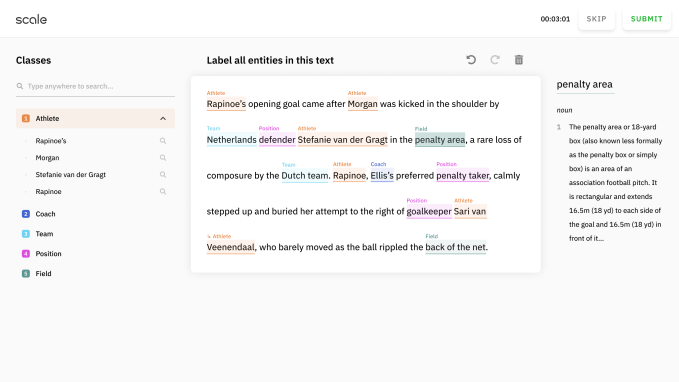
Companies provide Scale with data via their API and the startup puts its resources to work labeling the text, audio, pictures and video so that its customers’ machine learning models can be trained.

The startup’s customers include Waymo, OpenAI, Airbnb and Lyft.

For a customer working with autonomous driving data, Scale’s services may mean taking collected video frames and manually segmenting out individual cars, humans or other obstacles. For another customer, it can mean making common sense language connections to ensure natural language processing models can understand language in context.

scale nlp entityrecognition

The “human insight” can help minimize labeling bias and give customers data that is more precise and more accurate though, as with just about all AI startups, the hope is that these insights will gradually usher in a future where reliance on these humans-in-the-loop will be lessened. In the meantime, Scale sits atop an army of contractors that might hold the key to bulking up Silicon Valley’s machine learning intelligence.

“AI companies will come and go as they compete to find the most effective applications of machine learning. Scale AI will last over time because it provides core infrastructure to the most important players in the space,” Founders Fund partner and former Trump advisor Peter Thiel said in a statement.