Category: UNCATEGORIZED

31 Jul 2019

Daily Crunch: Facebook wants to build brain-controlled wearables

Facebook reveals its research into brain-controlled wearable devices (yes, really), iPhone sales dip and Samsung announces a new Galaxy Tab. Here’s your Daily Crunch for July 31, 2019.

1. Facebook is exploring brain control for AR wearables

Facebook revealed that it’s working with UCSF to research a brain-computer interface as a way to control future augmented reality interfaces. The company says the approach would involve “a non-invasive wearable device that lets people type just by imagining what they want to say.”

The company acknowledged that there are some thorny privacy issues here: “Neuroethical design is one of our program’s key pillars — we want to be transparent about what we’re working on so that people can tell us their concerns about this technology.”

2. Apple’s revenue growth slows as iPhone sales dip 12% year-over-year

Across categories, iPhone revenue had the biggest year-over-year dip, going from $29.5 billion in last year’s Q3 to just $26 billion this most recent quarter.

3. Samsung targets iPad Pro with the Galaxy Tab S6

Samsung’s latest tablet is going after the same slice of creatives targeted by the iPad Pro and various Surface devices. Its most appealing feature may be the addition of the latest Qualcomm Snapdragon processor.

NEW YORK, NY – APRIL 03: The Spotify banner hangs from the New York Stock Exchange (NYSE) on the morning that the music streaming service begins trading shares at the NYSE on April 3, 2018 in New York City. (Photo by Spencer Platt/Getty Images)

4. Spotify hits 108M paying users and 232M overall, but its average revenue per user declines

“We missed on subs… That’s on us,” the company said.

5. The maker of popular selfie app Facetune just landed $135 million at a unicorn valuation

Facetune, a photo-editing app that empowers users to cover their gray hairs, refine their jaw lines and reshape their noses, was first introduced around six years ago. Its parent company Lightricks is based in Jerusalem and has 260 employees supporting six products across three divisions.

6. How the new ‘Lion King’ came to life

Even though the film looks like a live-action remake of “The Lion King,” every shot (except for the first) was created on a computer.

7. The dreaded 10x, or, how to handle exceptional employees

The very concept of a 10x engineer seems so… five years ago. (Extra Crunch membership required.)

8. Bindu Reddy, co-founder and CEO at RealityEngines, is coming to TechCrunch Sessions: Enterprise

RealityEngines is creating research-driven cloud services that can reduce some of the inherent complexity of working with AI tools.

31 Jul 2019

Aspire raises $32.5M to help SMEs secure fast finance in Southeast Asia

Aspire, a Singapore-based startup that helps SMEs secure working capital, has raised $32.5 million in a new financing round to expand its presence in several Southeast Asian markets.

The Series A round for the one-and-a-half-year old startup was funded by MassMutual Ventures South Asia. Arc Labs and existing investors Y Combinator — Aspire graduated from YC last year — Hummingbird, and Picus Capital also participated in the round. Aspire has raised about $41.5 million to date.

Aspire operates a neo-banking-like platform to help small and medium-sized enterprises (SMEs) quickly and easily secure working capital of up to about $70,000.

AspireAccount, the startup’s flagship product, provides merchants and startups with instant credit limit for daily business expenses, as well as a business-to-business acceptance and other tools to help them manage their cash flow.

“I saw the problem while trying to rally small businesses trying to grow in the digital economy,” Andrea Baronchelli, founder and CEO of Aspire told TechCrunch last year. “The problem is really about providing working capital to small business owners,” said Baronchelli, who served as a CMO for Alibaba’s Lazada platform for four years.

Aspire currently operates in Thailand, Indonesia, Singapore, and Vietnam. The startup said it will use the fresh capital to scale its footprints in those markets. Additionally, Aspire is building a scalable marketplace banking infrastructure that will use third-party financial service providers to “create a unique digital banking experience for its SME customers.”

The startup is also working on a business credit card that will be linked to each business account by as early as this year, it said.

Baronchelli did not reveal how many business customers Aspire has, but said the startup has seen “30% month-on-month growth” since beginning operations in January 2018. Additionally, Aspire expects to amass more than 100,000 business accounts by next year.

Southeast Asia’s digital economy is slated to grow more than six-fold to reach more than $200 billion per year, according to a report co-authored by Google. But for many emerging startups and businesses, getting financial services from a bank and securing working capital have become major pain points.

A growing number of startups are beginning to address these SMEs’ needs. In India, for instance, NiYo Bank and Open have amassed millions of businesses through their neo-banking platforms. Both of these startups have raised tens of millions of dollars in recent months. Drip Capital, which helps businesses in developing markets secure working capital, raised $25 million last week.

31 Jul 2019

As tech changes homelessness, libraries roll with the punches

The warmth and quiet of the library have ever been a draw for those suffering from homelessness, but the past decade has piled more responsibilities on the shoulders of these institutions. The digital resources they provide are more important than ever for the homeless, but libraries have warily embraced their new role.

It is needless to recount here what most city-dwellers already know, that the homeless situation is critical in many cities, and that it is a hugely complex problem in both causes and potential solutions.

But it’s worth noting that the closure of mental institutions in the ’80s created an enduring and poorly addressed population of deeply ill homeless, compounded by veterans of conflicts in the ’90s — compounded again by rapid gentrification and the rising cost of living in most metropolitan areas.

And as the backdrop for all this, the rise of the information age — the future, as in William Gibson’s most continuously relevant epigram, but unequally distributed. As industries were reinvented, homeless people were systematically excluded from systems that barely tolerated them in the first place.

But it has not all been bad news. The introduction of smartphones and widespread wi-fi allowed — as the future made its way downward through the social strata — for communication, information, and entertainment. I used to do a double take when I saw a homeless person typing away at their phone, but the idea that phones are “luxuries” and that these people might be feigning destitution gave way quickly to the understanding that these devices are as necessary for someone in dire straits as they are for anyone else.

Even government services and associated aid organizations have evolved, putting crucial information like shelter updates, phone numbers, job-hunting resources, and important paperwork online and even in a mobile-friendly format. Programs like the U.S. Digital Service have been working on that lately but the infrastructure they are revamping is often decades old. It’s a work in progress.

Libraries have changed as well — obviously the book-centric model that predominated the 20th century has moved on to a hybrid one where digital resources are as important as physical ones. And although the homeless have always found their way into libraries for one reason or another, be it help putting together a resume or just to get out of the cold, they are coming in record numbers and to share resources that are being spread increasingly thin.

Consider something as simple as computer and internet access. Personal computers long ago graduated from something you’d sit and do work at for half an hour, yet that is the model around which most library access is organized. It’s also a source of judgment for homeless people using public computers: How can someone monopolize such a resource just to browse reddit or watch YouTube? Shouldn’t they be looking for a job and then leaving after their allotted 45 minutes?

Libraries were always sources of education, but that has become more pronounced recently as they’ve shifted from being the ones who store information to those who provide free and open access to it. With the combination of how that information is used and who needs these services, this involves a transformation not just of purpose but of architecture: Becoming a place where people come and stay rather than a place people visit.

That transformation doesn’t come equally easily to all libraries or branches. It may be that a small, underfunded library happens to be near a shelter or bus station and attracts more of the homeless than it can serve, and indeed more than intend to use the library for its “intended” purpose. Though these facilities were designed to provide short-term refuge for any and all, they’re generally not equipped or staffed to handle the volume or types of people who find their way in and stay sometimes from open to close.

But some libraries are being proactive about both the way they provide access and in contacting at-risk populations where they are instead of waiting for them to come to a crowded central branch in desperation.

“Having internet access and wi-fi access is critically important for homeless populations,” said SPL communications director Andra Addison. “Many cannot afford a computer or cannot afford the cost of data for their phones or electronic devices. This is important when looking for work or completing school assignments. Our librarians visit homeless encampments where they bring wi-fi hotspots and other resources.”

The library has nearly a thousand portable wi-fi devices, which have been checked out some 27,000 times since the program started in 2015. That may be the difference between being able to answer a job-related email in time or not, or being in touch with family during a crucial moment.

SPL and the San Francisco Public Library have initiated other social programs as well. As the homeless crisis has worsened, so too has the strain on libraries, and the latter have taken steps to address the problem rather than the symptoms.

That means social workers at library branches frequented by homeless people who are schooled not just in how to interact with what can sometimes be an intimidating population, but how to offer them lasting help. The library is a conduit to information, right? That already includes helping people with job searches and schoolwork — why shouldn’t it also be a way for the homeless and mentally ill to get directed to the help they need?

To this end libraries have had to specialize in populations — the recently released from prison, veterans, teens, those suffering from addiction, and so on.

“Libraries welcome and serve everyone, no matter their age, background or income level. Libraries are also particularly committed to helping the underserved, particularly the insecurely housed,” Addison said. If that’s the mission, then that’s the mission — if fulfilling that mission looks different today than it did ten, twenty, or fifty years ago, that just means we’ve successfully evolved the model.

Computers, smartphones, and the internet are at the core of this change not just because it is the way things get done these days, but because they have the possibility to systematically improve access for the unfortunate as well as the fortunate. But that transition too is a painful one — when the eye of the technotopians is forever pointed upwards and outwards, to look backwards and downwards at the people it has left behind.

Libraries are not the only ones that must adapt if we are to build a truly inclusive environment in tech. Startups, funding, even hardware makers should be looking at making it their responsibility not just to reach higher heights but to lift up the lowest among us.

sfhomelss

This post was written as part of the SF Homelessness Project, a yearly event in which news organizations highlight the causes of and solutions to homelessness throughout the nation.

31 Jul 2019

Impossible Foods goes to the grocery store

After receiving approval from the Food and Drug Administration, Impossible Foods has cleared the last regulatory hurdle it faced to rolling out in grocery stores.

The company is targeting a September release of Impossible products on grocery store shelves, joining its competitor Beyond Meat on grocery store shelves.

The news comes as the company said it inked a major supply agreement with the OSI Group, a food processing company to increase the availability of its Impossible Burger.

Impossible Foods has been facing shortages of its product, which it can’t make fast enough to meet growing customer demand.

The supply constraints have been especially acute as the company inks more deals with fast food vendors like Burger King, White Castle, and Qdoba to supply its Impossible protein patty and ground meal to a growing number of outlets.

Impossible Foods products are now served in over 10,000 locations around the world.

Earlier this year, the company hired Dennis Woodside and Sheetal Shah to scale up its manufacturing operations and help manage its growth into international markets. The company began selling its product in Singapore earlier this summer.

May not only saw new executives joining the Impossible team, but a new capital infusion as well. Impossible Foods picked up $300 million in financing from investors including Khosla Ventures, Bill Gates, Google Ventures, Horizons Ventures, UBS, Viking Global Investors, Temasek, Sailing Capital, and Open Philanthropy Project.

With the new FDA approval, Impossible Foods will now be able to go head to head with its chief rival, Beyond Meat. The regulatory approval will also help to dispel questions that have swirled around the safety of its innovative soy leghemoglobin that have persisted since the company began its expansion across the U.S.

Last July, the company received a no-questions letter from the FDA, which confirmed that the company’s heme was safe to eat, according to a panel of food-safety experts.

The remaining obstacle for the company, was whether or not the company’s “heme” could be considered a color additive. That approval — the use of heme as a color additive — is what the FDA announced today.

“We’ve been engaging with the FDA for half a decade to ensure that we are completely compliant with all food-safety regulations—for the Impossible Burger and for future products and sales channels,” said Impossible Foods Chief Legal Officer Dana Wagner. “We have deep respect for the FDA as champion of US food safety, and we’ve always gone above and beyond to comply with every food-safety regulation and to provide maximum transparency about our ingredients so that our customers can have 100% confidence in our product.”

31 Jul 2019

Prodly announces $3.5M seed to automate low code cloud deployments

Low code programming is supposed to make things easier on companies, right? Low code means you can count on trained administrators instead of more expensive software engineers to handle most tasks, but like any issue solved by technology, there are always unintended consequences. While running his former company, Steelbrick, which he sold to Salesforce in 2015 for $360 million, Max Rudman identified a persistent problem with low-code deployments. He decided to fix it with automation and testing, and the idea for his latest venture, Prodly, was born.

The company announced a $3.5 million seed round today, but more important than the money is the customer momentum. In spite of being a very early-stage startup, the company already has 100 customers using the product, a testament to the fact that other people were probably experiencing that same pain point Rudman was feeling, and there is a clear market for his idea.

As Rudman learned with his former company, going live with the data on a platform like Salesforce is just part of the journey. If you are updating configuration and pricing information on a regular basis, that means updating all the tables associated with that information. Sure, it’s been designed to be point and click, but if you have changes across 48 tables, it becomes a very tedious task, indeed.

The idea behind Prodly is to automate much of the configuration, provide a testing environment to be sure all of the information is correct, and finally automate deployment. For now, the company is just concentrating on configuration, but with the funding it plans to expand the product to solve the other problems as well.

Rudman is careful to point out that his company’s solution is not built strictly for the Salesforce platform. The startup is taking aim at Salesforce admins for its first go-round, but he sees the same problem with other cloud services that make heavy use of trained administrators to make changes.

“The plan is to start with Salesforce, but this problem actually exists on most cloud platforms — ServiceNow, Workday — none of them have the tools we have focused on for admins, and making the admins more productive and building the tooling that they need to efficiently manage a complex application,” Rudman told TechCrunch.

Customers include Nutanix, Johnson & Johnson, Splunk, Tableau and Verizon (which owns this publication). The $3.5 million round was led by Shasta Ventures with participation from Norwest Venture Partners.

31 Jul 2019

Google’s Titan security keys come to Japan, Canada, France and the UK

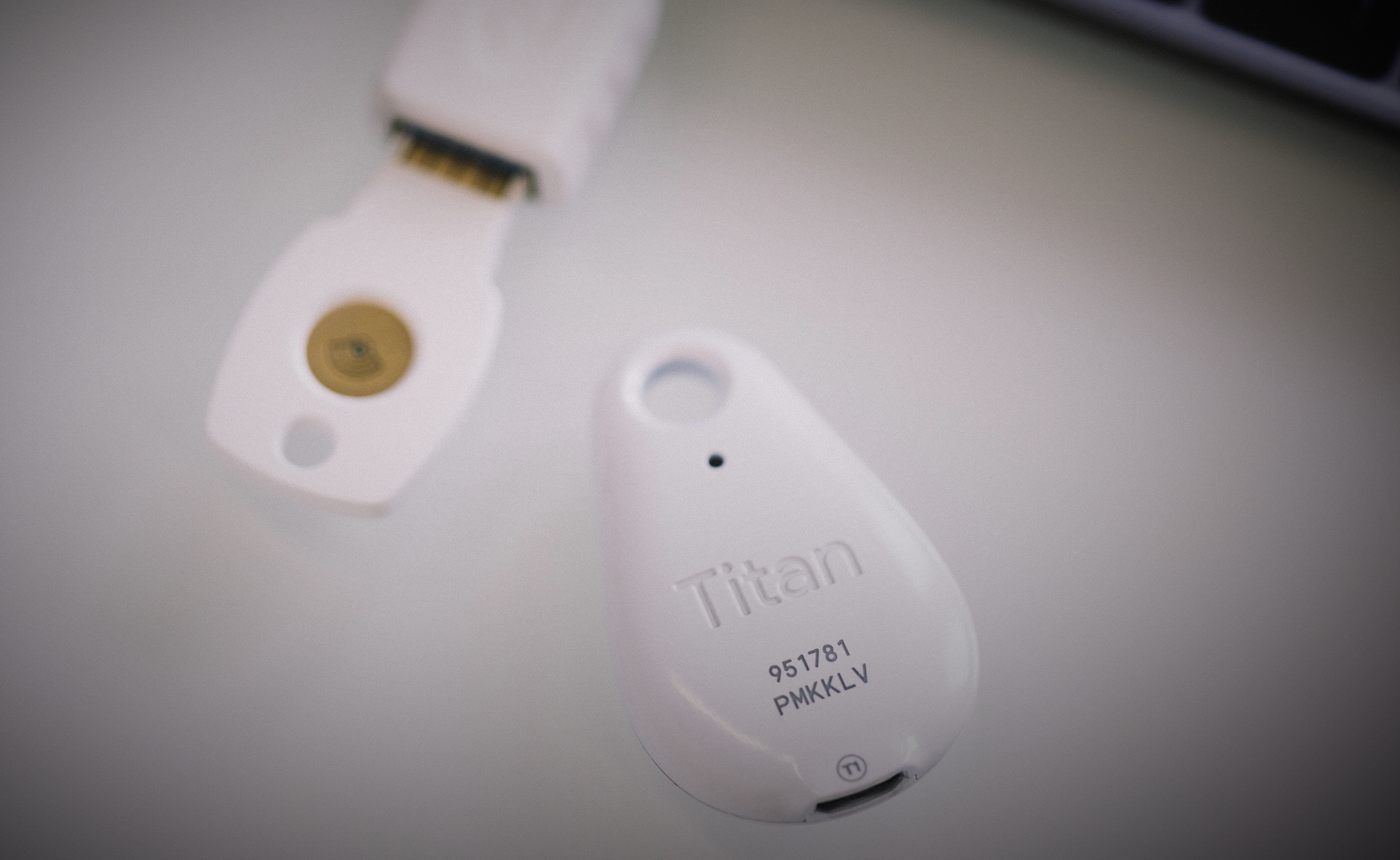
Google today announced that its Titan Security Key kits are now available in Canada, France, Japan and the UK. Until now, these keys, which come in a kit with a Bluetooth key and a standard USB-A dongle, were only available in the U.S.

The keys provide an extra layer of security on top of your regular login credentials. They provide a second authentication factor to keep your account safe and replace more low-tech two-factor authentication systems like authentication apps or SMS messages. When you use those methods, you still have to type the code into a form, after all. That’s all good and well until you end up on a well-designed phishing page. Then, somebody could easily intercept your code and quickly reuse it to breach your account — and getting a second factor over SMS isn’t exactly a great idea to begin with, but that’s a different story.

Authentication keys use a number of cryptographic techniques to ensure that you are on a legitimate site and aren’t being phished. All of this, of course, only works on sites that support hardware security keys, though that number continues to grow.

The launch of Google’s Titan keys came as a bit of a surprise, given that Google had long had a good relationship with Yubico and previously provided all of its employees with that company’s keys. The original batch of keys also featured a security bug in the Bluetooth key. That bug was hard to exploit, but nonetheless, Google offered free replacements to all Titan Key owners.

In the U.S., the Titan Key kit sells for $50. In Canada, it’ll go for $65 CAD. In France, it’ll be €55, while in the UK it’ll retail for £50 and in Japan for ¥6,000. Free delivery is included.


31 Jul 2019

DeepMind touts predictive healthcare AI ‘breakthrough’ trained on heavily skewed data

DeepMind, the Google-owned UK AI research firm, has published a research letter in the journal Nature in which it discusses the performance of a deep learning model for continuously predicting the future likelihood of a patient developing a life-threatening condition called acute kidney injury (AKI). 

The company says its model is able to accurately predict that a patient will develop AKI “within a clinically actionable window” up to 48 hours in advance. 

In a blog post trumpeting the research, DeepMind couches it as a breakthrough — saying the paper demonstrates artificial intelligence can predict “one of the leading causes of avoidable patient harm” up to two days before it happens.

“This is our team’s biggest healthcare research breakthrough to date,” it adds, “demonstrating the ability to not only spot deterioration more effectively, but actually predict it before it happens.”

Even a surface read of the paper raises some major caveats, though.

Not least that the data used to train the model skews overwhelmingly male: 93.6%. This is because DeepMind’s AI was trained using patient data provided by the US Department of Veteran Affairs (VA).

The research paper states that females comprised just 6.38% of patients in the training dataset. “Model performance was lower for this demographic,” it notes, without saying how much lower.  

A summary of dataset statistics also included in the paper indicates that 18.9% of patients were black, although there is no breakout for the proportion of black women in the training dataset. (Logic suggests it’s likely to be less than 6.38%.) No other ethnicities are broken out.

Asked about the model’s performance capabilities across genders and different ethnicities, a DeepMind spokeswoman told us: “In women, it predicted 44.8% of all AKI early, in men 56%, for those patients where gender was known. The model performance was higher on African American patients — 60.4% of AKIs detected early compared to 54.1% for all other ethnicities in aggregate.”

“This research is just the first step,” she confirmed. “For the model to be applicable to a general population, future research is needed, using a more representative sample of the general population in the data that the model is derived from.

“The data set is representative of the VA population, and we acknowledge that this sample is not representative of the US population.  As with all deep learning models it would need further, representative data from other sources before being used more widely.

“Our next step would be to work closely with [the VA] to safely validate the model through retrospective and prospective observational studies, before hopefully exploring how we might conduct a prospective interventional study to understand how the prediction might impact care outcomes in a clinical setting.”

“To do this kind of work, we need the right kind of data,” she added. “The VA uses the same EHR [electronic health records] system (widely recognized as one of the most comprehensive EHRs) in all its hospitals and sites, which means the dataset is also very comprehensive, clean, and well-structured.”

So what DeepMind’s ‘breakthrough’ research paper neatly underlines is the reflective relationship between AI outputs and training inputs.

In a healthcare setting, where instructive outputs could be the difference between life and death, it’s not the technology that’s king; it’s access to representative datasets that’s key — that’s where the real value lies.

This suggests there’s huge opportunity for countries with taxpayer-funded public healthcare systems to structure and unlock the value contained in medical data they hold on their populations to develop their own publicly owned healthcare AIs.

Indeed, that was one of the recommendations of a 2017 industrial strategy review of the UK’s life sciences sector.

Oxford University’s Sir John Bell, who led the review, summed it up in comments to the Guardian newspaper, when he said: “Most of the value is the data. The worst thing we could do is give it away for free.”

Streams app evaluation

DeepMind has also been working with healthcare data in the UK.

Reducing the time it takes for clinicians to identify when a patient develops AKI has been the focus of an app development project it’s been involved with since 2015 — co-developing an alert and clinical task management app with doctors working for the country’s National Health Service (NHS).

That app, called Streams, which makes use of an NHS algorithm for detecting AKI, has been deployed in several NHS hospitals. And, also today, DeepMind and its app development partner NHS trust are releasing an evaluation of Streams’ performance, led by University College London.

The results of the evaluation have been published in two papers, in the Nature Digital Medicine and the Journal of Medical Internet Research.

In its blog DeepMind claims the evaluations show the​ ​app​ “​improved​ ​the​ ​quality​ ​of​ ​care​ ​for​ ​ patients​ ​by​ ​speeding​ ​up​ ​detection​ ​and​ ​preventing​ ​missed​ ​cases”, further claiming ​clinicians​ ​”were​ ​able​ ​to​ ​respond​ ​to​ ​urgent​ ​AKI​ ​cases​ ​in​ ​14​ ​minutes​ ​or​ ​less” — and suggesting that ​using​ ​existing​ ​systems​ “​might​ ​otherwise​ ​have​ ​taken​ ​many​ ​hours”.​ ​

It also claims a reduction in the cost of care to the NHS — ​from​ ​£11,772​ ​to​ ​£9,761​ ​for​ ​a hospital​ ​admission​ ​for​ ​a​ ​patient​ ​with​ ​AKI.​ ​

Though it’s worth emphasizing that under its current contracts with NHS trusts DeepMind provides the Streams service for free. So any cost reduction claims also come with some major caveats.

Simply put: We don’t know the future costs of data-driven, digitally delivered healthcare services — because the business models haven’t been defined yet. (Although DeepMind has previously suggested pricing could be based on clinical outcomes.)

“A​ccording​ ​to​ ​the​ ​evaluation,​ ​the​ ​app​ ​has​ ​improved​ ​the​ ​experience​ ​of​ ​clinicians​ ​responsible​ ​for​ ​ treating​ ​AKI,​ ​saving​ ​them​ ​time​ ​which​ ​would​ ​previously​ ​have​ ​been​ ​spent​ ​​trawling​ ​through​ ​paper,​ ​ pager​ ​alerts​ ​and​ ​multiple​ ​desktop​ ​systems,” DeepMind also writes now of Streams.

However, again, the discussion contained in the evaluation papers contains rather more caveats than DeepMind’s PR does — flagging a large list of counter considerations, such as training costs and the risks of information overload (and over-alerting) making it more difficult to triage and manage care needs, as well as concluding that more studies are needed to determine wider clinical impacts of the app’s use.

Here’s the conclusion to one of the papers, entitled A Qualitative Evaluation of User Experiences of a Digitally Enabled Care Pathway in Secondary Care:

Digital technologies allow early detection of adverse events and of patients at risk of deterioration, with the potential to improve outcomes. They may also increase the efficiency of health care professionals’ working practices. However, when planning and implementing digital information innovations in health care, the following factors should also be considered: the provision of clinical training to effectively manage early detection, resources to cope with additional workload, support to manage perceived information overload, and the optimization of algorithms to minimize unnecessary alerts.

A second paper, looking at Streams’ impact on clinical outcomes and associated healthcare costs, concludes that “digitally enabled clinical intervention to detect and treat AKI in hospitalized patients reduced health care costs and possibly reduced cardiac arrest rates”.

“Its impact on other clinical outcomes and identification of the active components of the pathway requires clarification through evaluation across multiple sites,” it adds.

To be clear, the current Streams app for managing AKI alerts does not include AI as a predictive tool. The evaluations being published today are of clinicians using the app as a vehicle for task management and push notification-style alerts powered by an NHS algorithm.

But the Streams app is a vehicle that DeepMind and its parent company Google want to use to drive AI-powered diagnosis and prediction onto hospital wards.

Hence DeepMind also working with US datasets to try to develop a predictive AI model for AKI. (It backed away from an early attempt to use Streams patient data to train AI, after realizing it would need to gain additional clearances from UK regulators.)

Every doctor now carries a smartphone. So an app is clearly the path of least resistance for transforming a service that’s been run on paper on pagers for longer than Google’s existed.

The wider intent behind DeepMind’s app collaboration with London’s Royal Free NHS Trust was stated early on — to build “powerful general-purpose learning algorithms”, an ambition expressed in a Memorandum of Understanding between the pair that has since been cancelled following a major data governance scandal.

The background to the scandal — which we covered extensively in 2016 and 2017 — is that the medical records of around 1.6 million Royal Free NHS Trust patients were quietly passed to DeepMind during the development phase of Streams. Without, as it subsequently turned out, a valid legal basis for the data-sharing.

Patients had not been asked for their consent to their sensitive medical data being shared with the Google-owned company. The regulator concluded they would not have had a reasonable expectation of their medical data ending up there.

The trust was ordered to audit the project — though not the original data-sharing arrangement that had caused the controversy in the first place. It was not ordered to remove DeepMind’s access to the data.

Nor were NHS patients whose data passed through Streams during the app evaluation phase asked for their consent to participate in the UCL/DeepMind/Royal Free study; a note on ‘ethical approval’ in the evaluation papers says UCL judged it fell under the remit of a service evaluation (rather than research) — hence “no participant consent was required”.

It’s an unfortunate echo of the foundational consent failure attached to Streams, to say the very least.

Despite all this, the Royal Free and DeepMind have continue to press on with their data-sharing app collaboration. Indeed, DeepMind is pressing on the accelerator — with its push to go beyond the NHS’ AKI algorithm.

Commenting in a statement included in DeepMind’s PR, Dr​ ​Chris​ ​Streather,​ ​Royal​ ​Free​ ​London​’s ​chief​ ​medical​ ​officer​ ​and​ ​deputy​ ​chief​ ​executive,​ ​enthuses: “The​ ​ findings​ ​of​ ​the​ ​Streams​ ​evaluation​ ​are​ ​incredibly​ ​encouraging​ ​and​ ​we​ ​are​ ​delighted​ ​that​ ​our​ ​partnership​ ​with​ ​DeepMind​ ​Health​ ​has​ ​improved​ ​the​ ​outcomes​ ​for​ ​patients.​ ​

“Digital​ ​technology​ ​is​ ​the​ ​way​ ​forward​ ​for​ ​the​ ​NHS.​ ​In​ ​the​ ​same​ ​way​ ​as​ ​we​ ​can​ ​receive​ ​transport​ ​ and​ ​weather​ ​alerts​ ​on​ ​our​ ​mobile​ ​devices,​ ​doctors​ ​and​ ​nurses​ ​should​ ​benefit​ ​from​ ​tools​ ​which​ ​put​ ​ potentially​ ​life-saving​ ​information​ ​directly​ ​into​ ​their​ ​hands.​

“In​ ​the​ ​coming​ ​months,​ ​we​ ​will​ ​be​ ​introducing​ ​the​ ​app​ ​to​ ​clinicians​ ​at​ ​Barnet​ ​Hospital​ ​as​ ​well​ ​as​ ​ exploring​ ​the​ ​potential​ ​to​ ​develop​ ​solutions​ ​for​ ​other​ ​life-threatening​ ​conditions​ ​like​ ​sepsis.”​

Scramble for NHS data

The next phase of Google-DeepMind’s plan for Streams may hit more of a blocker, though.

Last year DeepMind announced the app would be handed off to its parent — to form part of Google’s own digital health push. Thereby contradicting DeepMind’s own claims, during the unfolding scandal when it had said Google would not have access to people’s medical records.

More like: ‘No access until Google owns all the data and IP’, then…

As we said at the time, it was quite the trust shock.

Since then the Streams app hand-off from DeepMind to Google appears to have been on pause.

Last year the Royal Free Trust said it could not happen without its approval.

Asked now whether it will be signing new contracts for Streams with Google a spokesperson told us: “At present, the Royal Free London’s contract with DeepMind remains unchanged. As with all contractual agreements with suppliers, any changes or future contracts will follow information governance and data protection regulations. The trust will continue to be the data controller at all times, which means it is responsible for all patient information.”

The trust declined to answer additional questions — including whether it intends to deploy a version of Streams that includes predictive AI model at NHS hospitals; and whether or not patients will be given an opt out for their data being shared with Google.

It’s not clear what its plans are. Although DeepMind’s and Google’s is clearly for Streams to be the conduit for predictive AIs to be pushed onto NHS wards. Its blog aggressively pushes the case for adding AI to Streams.

To the point of talking down the latter in order to hype the former. The DeepMind Health sales pitch is evolving from ‘you need this app’ to ‘you need this AI’… With the follow on push to ‘give us your data’.

“Critically, these early findings from the Royal Free suggest that, in order to improve patient outcomes even further, clinicians need to be able to intervene before AKI can be detected by the current NHS algorithm — which is why our research on AKI is so promising,” it writes. “These results comprise the building blocks for our long-term vision of preventative healthcare, helping doctors to intervene in a proactive, rather than reactive, manner.

“Streams doesn’t use artificial intelligence at the moment, but the team now intends to find ways to safely integrate predictive AI models into Streams in order to provide clinicians with intelligent insights into patient deterioration.”

In its blog DeepMind also makes a point of reiterating that Streams will be folded into Google — writing: “As we announced in November 2018, the Streams team, and colleagues working on translational research in healthcare, will be joining Google in order to make a positive impact on a global scale.”

“The combined experience, infrastructure and expertise of DeepMind Health teams alongside Google’s will help us continue to develop mobile tools that can support more clinicians, address critical patient safety issues and could, we hope, save thousands of lives globally,” it adds, ending with its customary ‘hope’ that its technology will save lives — yet still without any hard data to prove all the big claims it makes for AI-powered predictive healthcare’s potential. 

As we’ve said before, for its predictive AI to deliver anything of value Google really needs access to data the NHS holds. Hence the big PR push. And the consent-overriding scramble for NHS data.

Responding to DeepMind’s news, Sam Smith, coordinator at health data privacy advocacy group  medConfidential told us: “The history of opportunists using doctors to take advantage of patients to further their own interests is as long as it is sordid. Some sagas drag on for years. Google has used their international reach to use data on the US military what they said they’d do in the UK, before it became clear they misled UK regulators and broken UK law.”

In a blog post the group added: “In recent weeks, Google & YouTube, Facebook & Instagram, and other tech companies have come under increasing pressure to accept they have a duty of care to their users. Can Google DeepMind say how its project with the Royal Free respects the Duty of Confidence that every NHS body has to its patients? How does the VA patient data they did use correspond to the characteristics of patients the RFH sees?

“Google DeepMind received the RFH data -– up to 10 years’ of hospital treatments -– of 1.6 million patients. We expect its press release to confirm how many of those 1.6 million people actually had their data displayed in the app, and whether they were used for testing alongside the US military data.”


31 Jul 2019

Direct-to-consumer lingerie brand Lively acquired for $85M

Lively, a lingerie business founded and led by former Victoria’s Secret executive Michelle Cordeiro Grant, has sold to intimate apparel brand Wacoal for $85 million.

The deal includes up to an additional $55 million in performance-based payouts.

Lively, headquartered in New York, had raised $15 million in venture capital funding, including a $6.5 million Series A investment from GGV Capital, NF Ventures and former Nautica CEO Harvey Sanders announced late last year. The Series valued the startup at $101 million, according to PitchBook.

The deal brings Wacoal’s parent company, Wacoal International Corporation, a team of highly-skilled e-commerce marketers, who’ve successfully managed to tap into the millennial customer sect.

Lively, founded in 2016, sells bras and intimates online and in two brick-and-mortar locations in Chicago and New York. It competes with a number of other direct-to-consumer lingerie and activewear upstarts, including ThirdLove, AdoreMe, TomboyX and Outdoor Voices .

“We built Lively to inspire women to live life passionately, purposefully, and confidently,” Grant wrote in a statement. “We invest in our community and customers to empower them to celebrate their individuality and enable them with products to look and feel their best. Wacoal’s core values have a beautiful synergy with Lively’s, enabling us to come together, not just to take market share, but to also create market share.”

31 Jul 2019

Consumer internet companies are easy to understand, but hard to create

Atari founder Nolan Bushnell once said that the best video games are easy to learn and nearly impossible to master.

I believe that a related concept holds for building foundational consumer internet companies. Two characteristics that I always look for in startups are the founder’s ability to describe what they do in less than five seconds, and a product or service that’s exceptionally hard to build well. Those two characteristics may sound as though they’re in opposition, but it turns out that the best companies can be simultaneously very easy to understand and very hard to do.

A successful consumer internet company must be easy to understand

“In a world of abundance, the only scarcity is human attention.” —Kevin Kelly, The Inevitable

Humans have short attention spans, and the competition for mindshare has never been greater. Today, the most successful products in consumer internet tend to be those that achieve high degrees of virality. Word of mouth, in particular, is an especially important driver of distribution for world-class products. Only products that are extremely simple to understand—such as DoorDashNiantic, or Coinbase—can thrive in the telephone-chain word-of-mouth distribution channel.

Here’s an example: imagine talking with a friend about something like Doppler Labs’ Here One earbuds. Though this hardware product had standout features and was unlike other earbuds on the market, it was difficult to explain what made them special. A conversation might sound something like, “They’re kind of like headphones, but really, they’re augmented reality for audio. You can phase in and out background noise. No, it’s not the same as adjusting volume or noise-canceling… but yes, you can use them to listen to music.” It’s not hard to predict that a message like this might not easily catch on.

Compare this to a product like Robinhood. You might say something such as, “It’s an app to buy and sell stocks on your phone without paying commission.” The succinct description instantly showcases the company’s value for consumers, and it’s memorable. Most people can understand how the product works, which makes it clear why Robinhood’s message sticks and can generate strong word-of-mouth distribution.

The less obvious insight is that this phenomenon can also work in startups’ benefit to attract capital. Founders who can quickly articulate their product and business model have the advantage of appealing to a large amount of investors.

Even more, a product or startup must be hard to do

Being able to concisely describe what a company does is just one part of the blueprint for success. While having a message and value proposition that are easy to understand and talk about are critical to growth, to become extremely valuable a startup must also build a product that’s hard to do.

Some verticals, like direct-to-consumer brands, can have a large number of companies that offer a similar product even after some have reached a moderate scale. While it’s never been easier to get to market with a new product in this vertical (good), it’s also a lot less likely for a single, super valuable company to capture the entire market (bad, at least from the perspective of a venture capitalist).

In contrast, when a business builds something that is hard to do well, they effectively construct a moat, or a sustainable competitive advantage. Nearly all startup pitches include a conversation around moats and the barrier to entry, and rightfully so. Building a moat allows a company to become a compounding franchise and accrue outsized profits over the long run.

The blueprint for consumer success

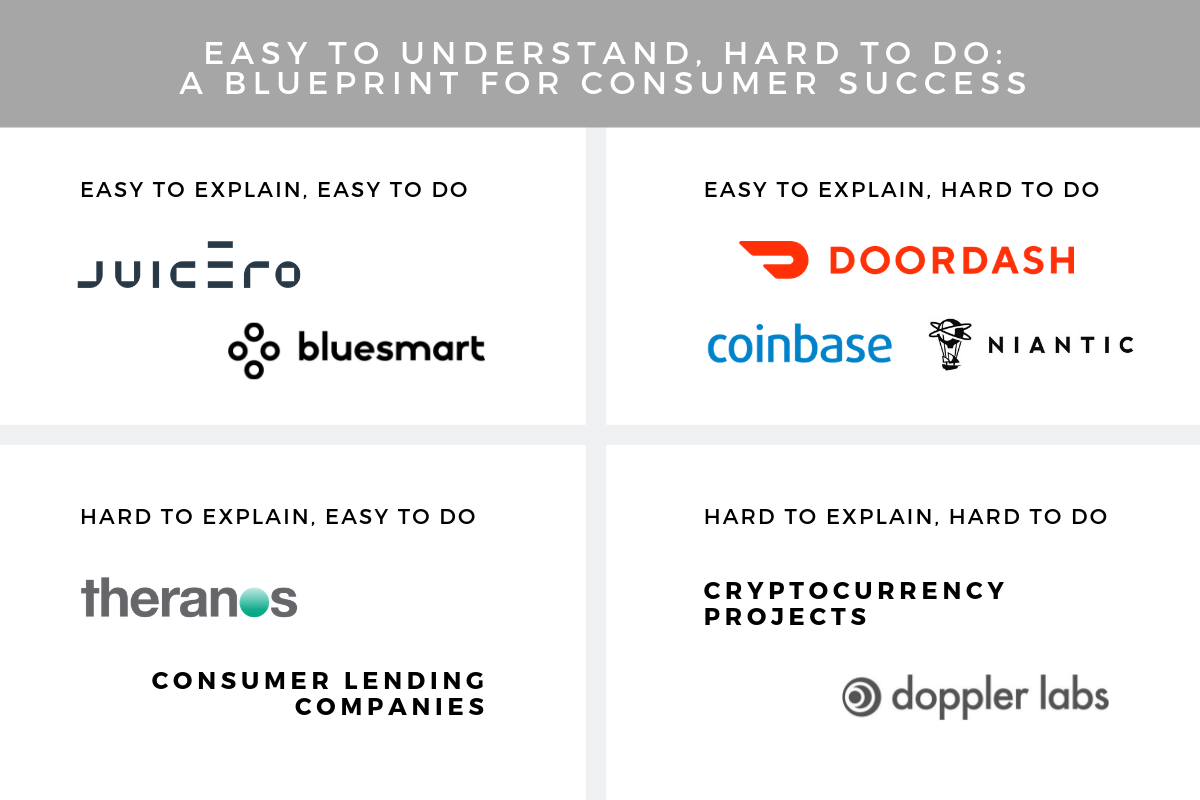
Using this framework, companies can be classified into one of four quadrants when we evaluate whether or not they follow the blueprint for consumer success.

Matt H 2

Easy to understand, hard to do

As described, this is the magic quadrant for consumer internet companies. Companies in this quadrant have a simple message that can be explained in five seconds or less, along with a component that’s hard to do. This may be an engineering build, regulatory approvals, cracking a network effect at scale, or building a brand that resonates.

  • Coinbase: Crypto is a notoriously complex vertical to understand, but the magic of Coinbase is that it doesn’t require a person to have any specific knowledge to use the product. By abstracting away the complexities of safely buying and storing crypto, Coinbase brought crypto to the mass market. Despite the simplicity of Coinbase’s product, the infrastructure that makes it possible is one of the most sophisticated engineering builds I’ve ever seen. For instance, keeping 98%+ of crypto deposits in cold storage while enabling instantaneous transaction ability is not a straightforward feat or something that people think about, but it’s critical to the ultimate product experience. Even more, the security infrastructure is a moving target that requires Coinbase to constantly innovate. Coinbase also remains one of the few scaled crypto exchanges/brokerages that have never been hacked .
  • Niantic: Niantic is a mobile game producer and the maker of Pokemon GO and Harry Potter: Wizards Unite. Niantic lands in the ‘easy to understand, hard to do’ category because the best games need little explanation; players simply open the app and start playing. Yet, there are few other companies that could successfully replicate the infrastructure that supports 100 million simultaneous instances in a single shared world geospatial game.
  • DoorDash: While DoorDash offers a drop-dead simple value proposition of better food delivery, the company has actually built a highly sophisticated software and operations stack that is really a next-generation last-mile logistics backbone. Much like Fedex or UPS, which were really software companies with trucks and drivers on the front end, DoorDash software controls every step of the process, from order batching, timing of food preparation, traffic analysis, and driver availability. DoorDash has largely out-executed competition because they recognized that better software and operations unlock a better product and a better business. For example, they solved reserved parking for dashers, and partnered with national chains to expand to non-urban markets. DoorDash also had to crack sufficient density in a geo-specific three-sided marketplace (restaurants, dashers, consumers), which is no small task.

Easy to understand, easy to do

Companies that are easy to understand may be able to get widespread, frictionless distribution, but those that are easy to do fall usually short when it comes to building a moat, or genuine competitive advantage. Brilliant marketing is not enough to prevent duplication, and business models that can be copied with something as simple as contract manufacturing may soon find themselves sidelined by competitors.

  • Juicero: No example comes to mind more quickly than Juicero. The Juicero Press was an expensive Wi-Fi connected device that utilized single-serving, pre-juiced fruit and vegetable packets sold via an exclusive subscription model. Juicero was easy to explain, but its technology wasn’t truly hard to do. Customers caught on to the fact that they didn’t actually need their device or Wi-Fi to make juice with the packets—they could do it with their hands by squeezing the packs. And there were significant alternatives in the market. The company shut down after 16 months in business.
  • BlueSmart: BlueSmart, a smart luggage company, serves as another good example of a company that was easy to understand and had a clear use case. Unfortunately, there was little about the product that was hard to do—it faced stiff competition from other smart suitcase companies as well as incumbents. Away, for example, came to market at a similar time and was able to out-execute on brand. The final blow came when airlines began banning lithium batteries, which the company decided they wouldn’t be able to sufficiently differentiate without.

Hard to understand, hard to do

Companies that are hard to do—perhaps they offer multiple products or elaborate models—can be difficult to articulate, which often causes the message to become distorted. As a result, these companies often have low virality. They can experience the same fate when it comes to attracting capital, as only a narrow set of investors will feel comfortable understanding the scope of what they do.

  • Doppler Labs: As mentioned, Doppler Labs headphones were hard to explain. They were different than any other headphones on the market and needed to be distinguished as such, but people failed to understand what set them apart and why they were valuable. While the technology to build the product may have been hard to do, that alone was insufficient to create a valuable company.
  • Cryptocurrency projects: “Crypto projects” are those where the core of the product (and often the investment security) requires at least some understanding of the cryptographic math and token economics to grasp what’s special about what they’re doing. Crypto projects are naturally harder to do because the nuts and bolts of crypto are complicated. That said, some of the most articulate founders in crypto can communicate their projects as easily as one can communicate a consumer marketplace.

Hard to understand, easy to do

Companies that are hard to understand and easy to do are the least appealing to investors, as they have a message that’s hard for consumers to grasp and low virality. They will struggle to build a moat. Put simply, they lack a real competitive advantage and are difficult to grow.

  • Consumer lending companies: Undifferentiated consumer lending companies often have models, investment criteria, or loan requirements that are hard for investors to understand. Though there may be moving parts, many lending companies rely on a simple funding and underwriting model that does the same thing: Checks a borrower’s credit score and/or bank account, connects to sources of capital, and then originates the loan. Without anything special to differentiate it, a lending company may be easily forgotten in a crowded space.
  • Theranos: Theranos marketed itself as a new kind of healthcare company that could run lab tests with smaller amounts of blood in a shorter period of time; a paradigm shift healthcare diagnostics. The various testing devices and panels made it difficult to understand exactly what the company did—and it turned out that they were doing something that was actually quite easy. Despite claims that it had created disruptive technology, the company was running standard blood tests (and doing so poorly) that lacked innovation. While it may have been fraud that brought down the company, the reality is that even if Theranos had told the truth about what they were actually doing, it’s unlikely they would have attracted significant capital to begin with.

Consumer internet companies can set themselves up for success early on by ensuring they can clearly speak to what they do, making it easy for people to understand and share the product and its value. A thoughtful approach to building something that’s difficult to do will go a long way when establishing a competitive advantage. This will also set a startup apart, attract investors and customers, and help the company thrive in a crowded space for the long run.

Special thanks to Steve Mullaney, the CEO of our portfolio company Aviatrix, for sparking this topic. He recently brought up this great concept (easy to understand, hard to do) when we talked about enterprise, and it inspired me to explore how the idea applies to consumer internet.

31 Jul 2019

Clearbanc co-founder and president Michele Romanow is coming to Disrupt SF

Raising venture capital isn’t easy; for some, it’s impossible.

Clearbanc offers startups a fundraising alternative and in just a few short years, it’s become a household name in Silicon Valley circles. The company disrupts the startup funding process by providing companies cash to buy ads in exchange for a revenue share so those companies aren’t forced to give up equity to venture capitalists. 

2019 has been Clearbanc’s year. It was only natural to invite Romanow to join us on stage at Disrupt SF. Romanow will discuss the funding landscape for startups, Clearbanc’s plans to deploy billions of dollars, as well as a breakdown of when to raise equity cash vs. non-dilutive capital. Alongside Brex CEO Henrique Dubugras, Romanow will also talk through serving startups as customers.

This year alone, the company, under Romanow’s lead, launched a campaign to back 2,000 businesses with $1 billion in non-dilutive capital by the end of 2019, raised $120 million across three different equity rounds and just this week, announced a $250 million fund to continue backing startups through its rev-share model.

Romanow’s career took off as an angel investor on the Canadian version of Shark Tank, Dragons’ Den. Together with co-founder Andrew D’Souza, she started Clearbanc in 2015 with a goal of helping more founders maintain control of their company through larger equity stakes. In conversation with TechCrunch earlier this year, she and D’Souza explained that some 40% of VC dollars end up going to Facebook and Google for digital ad campaigns. That capital, they said, should be put into hiring and other scaling efforts. 

“We are essentially a non-dilutive co-investor,” Romanow said. “VC takes time; it’s a lot of nos and you’re really giving up equity that you can never get back.”

“A lot of founders in the early days don’t calculate what their equity could be worth,” she added. “Like the first $250,000 in Uber is worth $1 billion now.”

Clearbanc, founded less than four years ago, has already put hundreds of millions of dollars in its pockets and like Brex, it has ambitions to support each and every startup out there. Brex and Clearbanc’s leaders will undoubtedly provide a conversation on the state of startups & fintech that can’t be missed.

Disrupt SF runs October 2 – October 4 at the Moscone Center in San Francisco. Tickets are available here.