Category: UNCATEGORIZED

31 Jul 2019

Investors bet another $50M on Clearbanc’s revenue share model

That company disrupting venture capital just raised more venture capital.

Clearbanc has attracted $300 million, including a $50 million equity investment led by Highland Capital with participation from Arcadia, iNovia and Emergence Capital, and another $250 million from limited partners for its third fund. Clearbanc declined to disclose its valuation, but noted the company was not “forced to raise” and therefore “raised on terms that [they] liked.”

The Canadian business, headquartered in Toronto, offers startups an alternative to VC in the form of non-dilutive revenue-share agreements. Coupling data and machine learning technology, Clearbanc is quick to make decisions about potential investments, driven by a lofty goal of backing 2,000 companies by 2020.

Through its latest campaign, the “20-Min Term Sheet,” Clearbanc invests between $10,000 to $10 million in e-commerce upstarts with positive ad spend and positive unit economics. Charging 6% on its capital, Clearbanc collects a portion of a company’s revenue until they’ve paid back 106% of the original investment.

Clearbanc has invested in 791 online brands so far this year, including Le Tote, UNTUCKit, Leesa Sleep and Public Goods. The company says its investments have generated an average of $121 million in monthly revenue.

“The 20-minute term sheet was our take on showing the market how fast we could get startups access to capital,” Clearbanc co-founder and president Michele Romanow tells TechCrunch. Their method, she explained, saves both VCs and founders a lot of time.

“[Founders] don’t need to go and pitch their life story,” Clearbanc co-founder and chief executive officer Andrew D’Souza tells TechCrunch. “They don’t need to spend hours and hours on due diligence and they don’t need to get on a flight and meet VCs in person, we’ve automated all of that.”

The $50 million investment will be used to expand into new verticals beyond e-commerce and to launch a venture partner program, which will give its portfolio of founders access to experienced investors and operators, a resource a traditional venture capital fund typically provides its entrepreneurs.

Clearbanc has signed up Jack Abraham, the founder and managing partner of Atomic, Hubble co-founder Jesse Horwitz, Product Hunt founder Ryan Hoover and more to support the new venture partner network.

D’Souza and Romanow say Clearbanc’s revenue-share model could become a larger asset class than equity in the long term. Bullish about their prospects, D’Souza compares Clearbanc to SoftBank, the Japanese telecom giant behind The Vision Fund.

“I have no doubt we will raise billions and billions for funds in the coming years and I think we can be bigger than SoftBank,” he said. “If we aren’t aiming to do that, then we aren’t aiming to solve the problems that exist for entrepreneurs globally.”

Clearbanc’s third fund, a $250 million effort, is five times larger than its second fund. The company wouldn’t disclose the size of its debut fund.

Clearbanc has raised $120 million in equity funding to date.
31 Jul 2019

Luna Labs creates playable ads, directly from Unity

It seems obvious that the best way to advertise a game is to let people play the game itself — and we’ve covered other startups tackling this problem, such as AppOnboard and mNectar.

But Luna Labs co-founder and CEO Steven Chard said that for most developers, the creation of these ads involves outsourcing: “It might take weeks to make an ad, and the quality of the content at the end could be limited.”

The problem, Chard said, is that most games are built on the Unity engine, while the ads need to be in HTML5, which means that developers often have to build playable ads from scratch — hence the outsourcing.

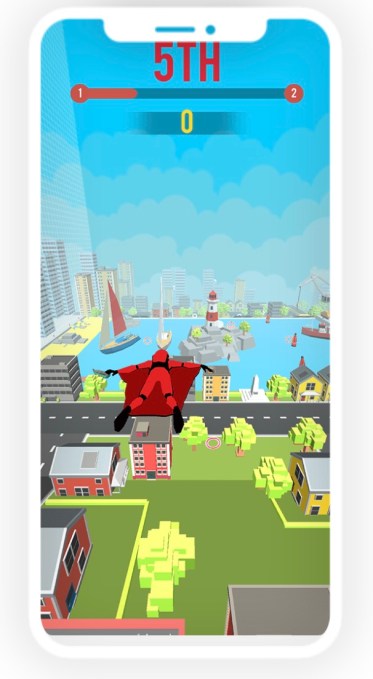
“There’s this huge demand for playables, but the tech hasn’t caught up with it,” he said. “Our view — and I think why it’s really resonating with developers — we’re saying to developers: Use that same [Unity] editor to create a playable ad. You’re going to give the user a playable ad which genuinely feels like the game.”

In fact, while Luna is officially launching its service to developers this week, it’s already been working with a few partners like Kwalee and Voodoo. Luna says that in Kwalee’s case, the results were good enough that the company spent 60% more than they did on other playable ads, and the Luna playables drove more than 250,000 installs per day.

“Luna is solving a real pain point for our studio, and the initial results have been tremendous,” said Kwalee CRO Jason Falcus in a statement. “Integrating the Luna service has allowed us to significantly scale our campaigns by a comfortable margin, to the best results so far.”

Luna Labs screenshot

Luna’s investors include Ben Holmes (formerly of Index Ventures, backer of King and Playfish) and Chris Lee (who also invested in Space Ape and Hello Games).

Chard said the startup is currently focused on providing tools to developers, rather than getting involved in the ad-buying process. More generally, he said the company has been focused on the technology rather than the business model.

“We’re an early company with a very, very complex piece of technology — it’s taken a lot of time to get where we are,” he said. “We’re not doing it for free, but the focus isn’t on short-term profitability. It is, in the longer term, on creating a scalable product which can be used by developers.”

Chard added that eventually, he’s hoping Luna can become more involved in “at the content creation level.” For example, he suggested that developers could use the technology to test out playable concepts and see what resonates, before building a full game.

You can test it out for yourself on the Luna Labs website.

31 Jul 2019

Why AWS is building tiny AI race cars to teach machine learning

The AWS DeepRacer is an almost toylike 1/18th scale race car. It comes with all of the sensors and software tools to help developers build machine learning models to drive the car around a course — or really do anything else they want it to do. The $399 DeepRacer launched at AWS’s massive re:Invent show in late 2018.

At the time, it seemed like a bit of a gimmick, but AWS has put a lot of its weight behind it and is currently running a DeepRacer league at its various events around the world. At these events, developers can pit their models against each other and learn more about building a specific kind of machine learning model in the process.

Why bother, though? It’s not like DeepRacer cars are likely to add to AWS’s bottom line anytime soon. DeepRacer, however, is part of a line of hardware products from AWS that started with DeepLens, a smart camera for developers.

“It really comes from the same place,” AWS general manager for Artificial Intelligence and Machine Learning marketing Ryan Gavin told me. “When you think about the stimulus for something like DeepLens, it was really about how do we put machine learning into the hands of every developer and data scientist. That’s our mission and we’re very consistent about that.”

31 Jul 2019

Verizon adds Washington DC, Atlanta, Detroit and Indianapolis to list of 5G cities

This morning Verizon (TechCrunch’s parent company) flipped the 5G switch on four additional cities. Washington DC, Atlanta, Detroit and Indianapolis join Chicago, Denver, Minneapolis/St. Paul and Providence in getting coverage for the carrier’s growing next-generation network.

All of the usual caveats apply here. While the list of cities continues to grow, coverage varies from city to city to such a point where Verizon currently includes specific neighborhoods in these announcements. Here’s the break down,

In Washington DC, consumers, businesses and government agencies can initially access Verizon’s 5G Ultra Wideband service in areas of Foggy Bottom, Dupont Circle, Cardozo / U Street, Adams Morgan, Columbia Heights, Le Droit Park, Georgetown Waterfront, Judiciary Square, Shaw, Eckington, NOMA, National Mall and the Smithsonian, Gallery Place / Chinatown, Mt. Vernon Square, Downtown, Penn Quarter, Brentwood, Southwest Waterfront, Navy Yard, and nearby Crystal City, VA, as well as around landmarks such as the Ronald Reagan National Airport, United States Botanical Gardens, Hart Senate Building, National Gallery of Art, Lafayette Square, The White House, Freedom Plaza, Farragut Square, George Washington University, Capital One Arena, Union Station, Howard University Hospital, George Washington University Hospital, and Georgetown Waterfront Park.

In Atlanta, 5G Ultra Wideband service will initially be concentrated in parts of the following neighborhoods: Downtown, Midtown, Tech Square, and around such landmarks as The Fox Theater, Emory University Hospital Midtown, Mercedes Benz Stadium, Home Depot Backyard, Centennial Olympic Park, Georgia Aquarium, World of Coca Cola, and parts of Renaissance Park.

In Detroit, 5G Ultra Wideband service will initially be concentrated in parts of the following areas: Dearborn, Livonia, and Troy, including areas around the Oakland-Troy Airport.

In Indianapolis, 5G Ultra Wideband service is initially available in parts of the following neighborhoods, Arsenal Heights, Bates Hendricks, Castleton, Crown Hill, Fountain Square, Grace Tuxedo Park, Hawthorne, Historic Meridian Park, Lockerbie Square, Ransom Place, Renaissance Place, St. Joseph Historic Neighborhood, Upper Canal and Woodruff Place and around such landmarks and public spaces as Garfield Park, and Indiana University School of Medicine.

The carrier adds that service will be expanded within the above cities “in the months to come.” But hey, the White House is covered, which means even more rapid tweet storms. Verizon is adding a bunch more cities by the end of the year, including Boston, Charlotte, Cincinnati, Cleveland, Columbus, Dallas, Des Moines, Houston, Kansas City, Little Rock, Memphis, Phoenix, San Diego and Salt Lake City.

That will bring the total up to 30 for 2019.

The device selection is still limited, too for the moment. Verizon currently offers the LG V50 ThinQ 5G, Samsung Galaxy S10 5G and the Moto Z, which has an option 5G mod. There’s a 5G MiFi from Inseego available, as well.

31 Jul 2019

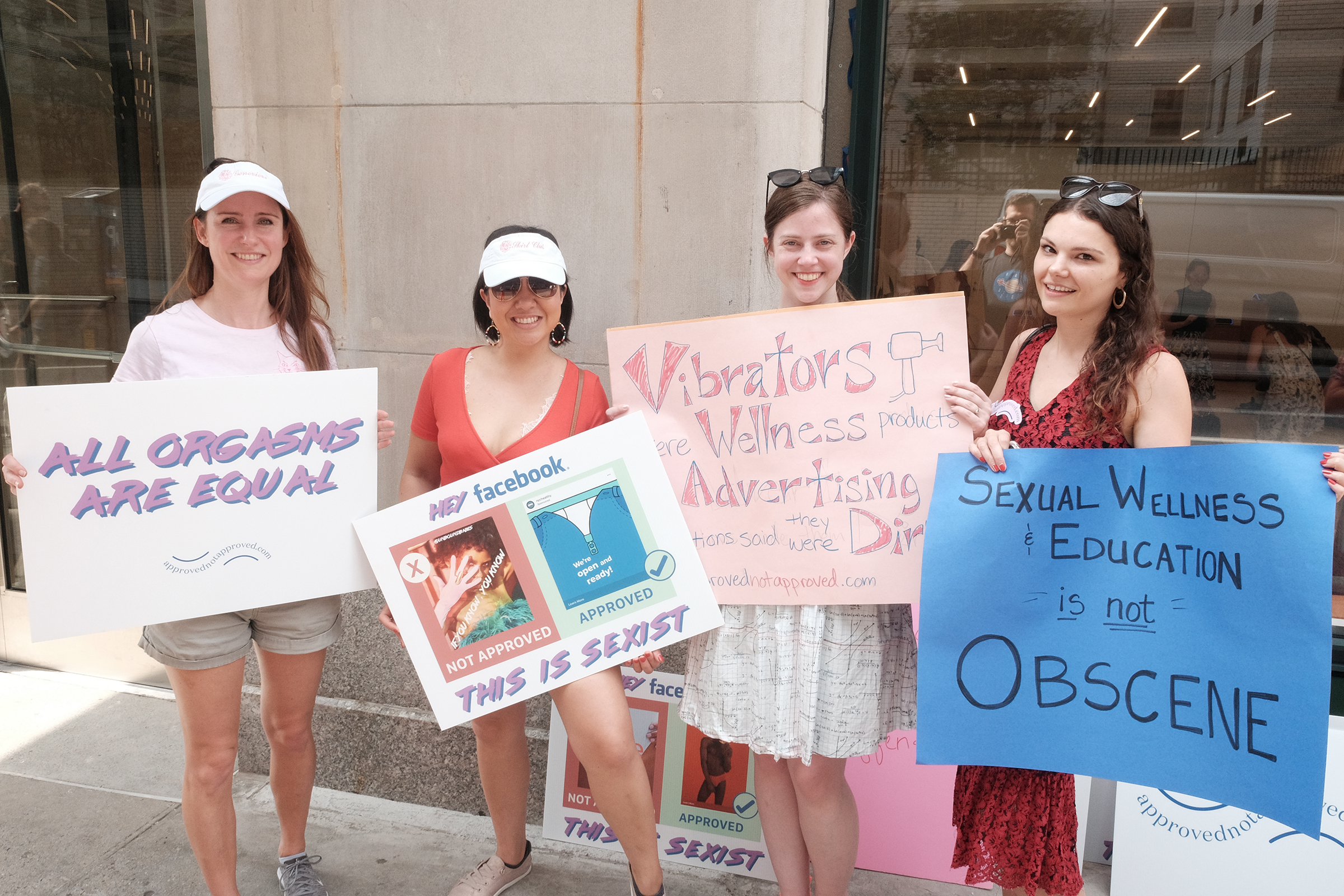
Sex tech companies and advocates protest unfair ad standards outside Facebook’s NY HQ

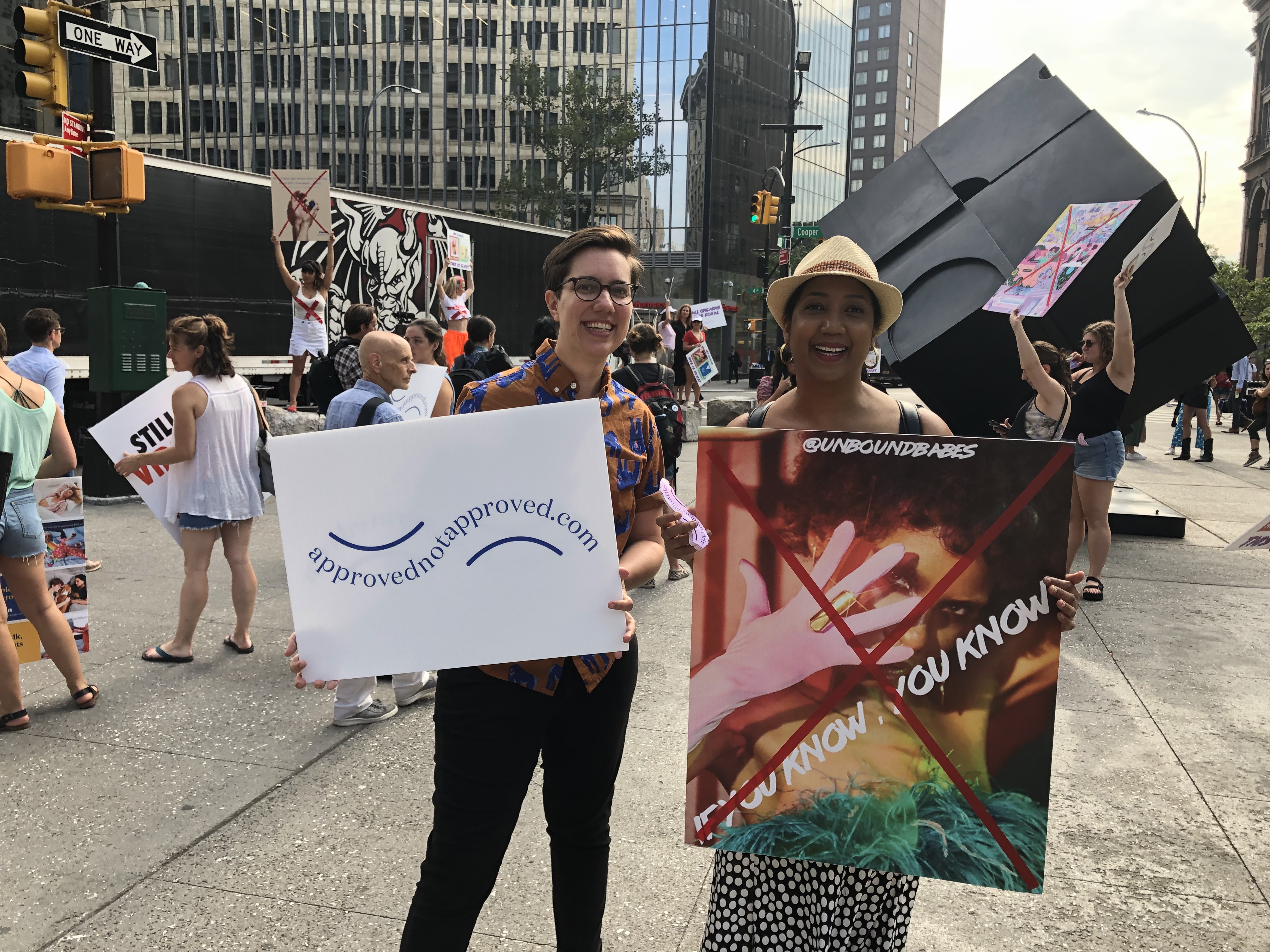
A group of sex tech startup founders, employees and supporters gathered outside of Facebook’s NY office in Manhattan to protest its advertising policies with respect to what it classifies as sexual content. The protest, and a companion website detailing their position we reported on Tuesday, are the work of ‘Approved, Not Approved,’ a coalition of sex health companies co-founded by Dame Products and Unbound Babes.

These policies are applied have fallen out of step with “the average person’s views of what should or shouldn’t be approved of ads,” according to Janet Lieberman, co-founder and CTO of Dame Products.

“If you look at the history of the sex toy industry, for example, vibrators were sexual health products, until advertising restrictions were put on them in the 1920s and 1930s – and then they became dirty, and that’s how the industry got shady, and that’s why we have negative thoughts towards them,” she told me in an interview at the protest. “They’re moving back towards wellness in people’s minds, but not in advertising policies. There’s a double standard for what is seen as obscene, talking about men’s sexual health versus women’s sexual health and talking about products that aren’t sexual, and using sex to sell them, versus taking sexual products and having completely non-sexual ads for them.”

facebook ad protest nyc

Credit: TechCrunch

It’s a problem that extends beyond just Facebook and Instagram, Lieberman says. In fact, her company is also suing NYC’s MTA for discrimination for its own ad standards after it refused to run ads for women’s sex toys in their out-of-home advertising inventory. But it also has ramifications beyond just advertising, since in many ways what we see in ads helps define what we see as acceptable in terms of our everyday lives and conversations.

“Some of this stems from society’s inability to separate sexual products from feeling sexual, and that’s a real problem that we see that hurts women more than men, but hurts both genders, in not knowing how to help our sexual health,” Lieberman said. “We can’t talk about it without being sexual, and that we can’t bring things up, without it seeming like we’re bringing up something that is dirty.”

IMG 9739

Credit: Unbound / Dame Products

“A lot of the people you see here today have Instagrams that have been shut down, or ads that have been not approved on Facebook,” said Bryony Cole, CEO at Future of Sex in an interview. “Myself, I run Future of Sex, which is a sex tech hackathon, and a podcast focused on sex tech, and my Instagram’s been shut down twice with no warning. It’s often for things that Facebook will say they consider phallic imagery, but they’re not […] and yet if you look at images for something like HIMS [an erectile dysfunction medication startup, examples of their ads here], you’ll see those phallic practice images. So there’s this gross discrepancy, and it’s very frustrating, especially for these companies where a lot of the revenue in their business is around community that are online which is true for sex toys.”

Online ads aren’t just a luxury for many of these startup brands and companies – they’re a necessary ingredient to continued success. Google and Facebook together account for the majority of digital advertising spend in the U.S., according to eMarketer, and it’s hard to grow a business that caters to primarily online customers without fair access to their platforms, Cole argues.

“You see a lot of sex tech or sexual wellness brands having to move off Instagram and find other ways to reach their communities,” she said. “But the majority of people, that’s where they are. And if they’re buying these products, they’re still overcoming a stigma about buying the product, so it’s great to be able to purchase these online. A lot of these companies started either crowdfunding, like Dame Products, or just through ecommerce sites. So the majority of their business is online. It’s not in a store.”

IMG 9753

Credit: Unbound / Dame Products

Earlier this year, sex tech company Lora DiCarlo netted a win in getting the Consumer Technology Association to restore its CES award after community outcry. Double standards in advertising is a far more systemic and distributed problem, but these protests will hopefully help open up the conversation and prompt more change.

31 Jul 2019

Netflix’s ‘The Irishman’ gets its first trailer starring a digitally de-aged De Niro

There’s plenty of reason to be excited for The Irishman. The Netflix-backed film teams Martin Scorsese with Robert De Niro, Al Pacino and Joe Pesci for a biopic based on the lives of organized crime-linked union figures Frank Sheeran and Jimmy Hoffa. But it’s the effects that have everyone talking.

Granted, that’s not the kind of phrase you generally hear in the lead up to a Scorsese film (particularly one that unites him with both De Niro and Pacino for the first time), but the involvement of Industrial Light & Magic has piqued the internet’s interest.

Lucasfilm’s special effects wing was tasked with de-aging the leads — in particular De Niro — as the septuagenarian actors play their characters at a range of different ages. The first trailer for the film, which hit this morning, features a notably younger De Niro in the role of Sheeran, the film’s titular Irishman.

The two minute trailer looks to be classic Scorsese: a stylized period piece with high tension and plenty of organized violence. There’s no release date yet for the film, which also stars  Harvey Keitel, Bobby Cannavale, Anna Paquin and Ray Romano, but it’s expected to appear in select theaters along with the streaming service — similar to Netflix’s award-focused approach with last year’s Oscar-winning Roma.

31 Jul 2019

Hello Heart raises $12 million for at-home monitoring and behavioral treatment for hypertension

Leveraging new remote sensing and monitoring technologies and the willingness of corporate insurance programs to provide more preventative treatment to reduce longterm costs, Hello Heart has raised $12 million in new financing to further develop its business.

The money came from Khosla Ventures and previous backer Blue Run Ventures. The company said it will use the financing to expand its business.

Hello Heart tackles high blood pressure and heart disease with early monitoring coming from an at-home sensing system to track blood pressure and an integrated smart phone application providing prompts on behaviors to reduce high blood pressure.

According to a retrospective study paid for by Hello Heart and conducted by researchers at UCLA and Harvard Medical School, 70% of Hello Heart users managed to reduce their blood pressure an average of 22mmHg.

“Delivering clinical outcomes at the scale of population health requires strong patient engagement across a variety of patient types.  Hello Heart’s ability to drive engagement is what led to these unprecedented results,” said Dr. Eyal Zimlichman a Harvard medical school faculty researcher, and the chief medical and innovation officer of Sheba medical center.

The company collects all the data on its patients in a randomized and anonymized fashion in order to provide information on population health, according to a statement. In an interview, Maayan Cohen, the chief executive officer of the company said that Hello Heart did not sell any data to third parties.

“Our mission is to empower patients to understand and improve their health, and we’re very proud to be able to help them do it so effectively in heart health — [the number one] cause of death in the world.”

31 Jul 2019

Snapchat launches ‘instant’ tool for creating vertical ads

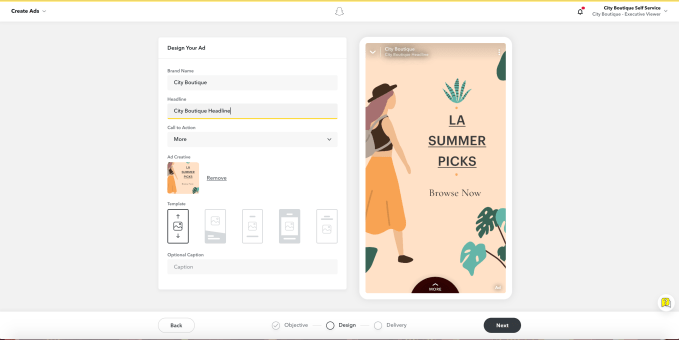
Snapchat is hoping to attract new advertisers (and make advertising easier for the ones already on the platform) with the launch of a new tool called Instant Create.

Some of these potential advertisers may not be used to creating ads in the smartphone-friendly vertical format that Snapchat has popularized, so Instant Create is to designed to make the process as simple as possible.

Executives at parent organization Snap discussed the tool during last week’s earnings call (in which the company reported that its daily active users increased to 203 million).

“Just this month we started testing our new Instant Create on-boarding flow, which generates ads for businesses in three simple steps from their existing assets, be it their app or their ecommerce storefront,” said CEO Evan Spiegel.

Now the product is moving from testing to availability for all advertisers using Snapchat’s self-serve Ads Manager.

Snapchat Instant Create

Those three steps that Spiegel mentioned involve identifying the objective of a campaign (website visits, app installs or app visits), entering you website address and finalizing you audience targeting.

You can upload your creative assets if you want, but that’s not required since Instant Create will also import images from your website. And Snap notes that you won’t need to do any real design work, because there’s “a streamlined ad creation flow that leverages our most popular templates and simplified ad detail options, enabling you to publish engaging creative without additional design resources.”

The goal is to make Snapchat advertisers accessible to smaller advertisers who may not have the time or resources to try to understand new ad formats. After all, on that same earnings call, Chief Business Officer Jeremi Gorman said, “We believe the single biggest driver for our revenue in the short to medium term will be increasing the number of active advertisers using Snapchat.”

Instant Create is currently focused Snapchat’s main ad format, Snap Ads. You can read more in the company’s blog post.

31 Jul 2019

DJI aims for the best first-person drone experience with new googles, controller and more

New gear from DJI will equip you with everything you need to become the best first-person drone racer that’s ever graced the Earth – you’ll be the Anakin Skywalker of FPV drone races. The company is launching a new suite of products specifically to make the most of Digital First Person Viewing (FPV) when operating drones, with a wide range of compatibility.

The DJI Digital FPV Ecosystem includes a set of FPV goggles, a transmission unit that you attach to your drone of choice, a camera that also attaches to the transmitter unit and the drone body, and an FPV controller. Together, they provide the “first low latency HD video transmission signal” according to DJI, with total end-to-end latency of just 28 milliseconds per the specs, and the ability to transmit 720p footage at 120fps with that low lag transmission.

There are a few key ingredients here that are tuned specifically to the needs of drone racers here: low-latency is important because you want the video feed to be as real-time as possible when you’re racing high-speed drones around courses with tight turns and a field of airborne competitors you can potentially run into. And high-quality speed, with a high refresh rate for the video, is important for similar reasons – you need to ‘see’ accurately from the perspective of the drone in order to race it effectively.

The system can also transmit at a distance of up to 2.5 miles, and there are eight channels of 5.8GHz wireless frequency supported by the Air Unit so that you can fly as many as eight drones at the same time connected to a single system. Users can even change feeds on the fly when multiple units are in use, letting them take a look at the competition or just watch the race rom an FPV perspective if they don’t actually have a drone in the running.

As for the camera, it offers a 150-degree field of view, and while the feed is optimized for action at 720p 120fps as mentioned, you can export video at either 1080p 60 or 720p 120 depending on your editing needs. The live video transmission also optimizes by first pixellating around the edges and keeping the center clear when it needs to increase broadcast efficiency under heavy load and in sub-optimal connection conditions, so that the important part of the action remains in focus for racers.

DJI will be selling these in two packages, including a ‘Fly More Combo’ that retails for $929 and an ‘Experience Combo’ that will be $819, with the main difference being that you get the Remote controller in the mix with the ‘Fly More’ version.

31 Jul 2019

Samsung targets iPad Pro with the Galaxy Tab S6

Once again, the rumors proved to be true, with Samsung going straight from the S4 to S6 for its premium tier. Vaguely confusing naming conventions aside (there’s also the lower cost S5E), the company’s got another solid entry on its hands, going after the same slice of creatives targeted by the iPad Pro and various Surface devices.

The company buried the lede a bit here. The top level feature is almost certainly the addition of the latest Qualcomm Snapdragon processor. The 855 marks a nice bump the S4’s 835 (and even more so the S5E’s 670) — good news as the company is no doubt hoping the product will do double duty, inhabiting that increasingly blurry space between tablet and laptop. The 7,040mAh battery, meanwhile, promises up to 15 hours of life on a charge.

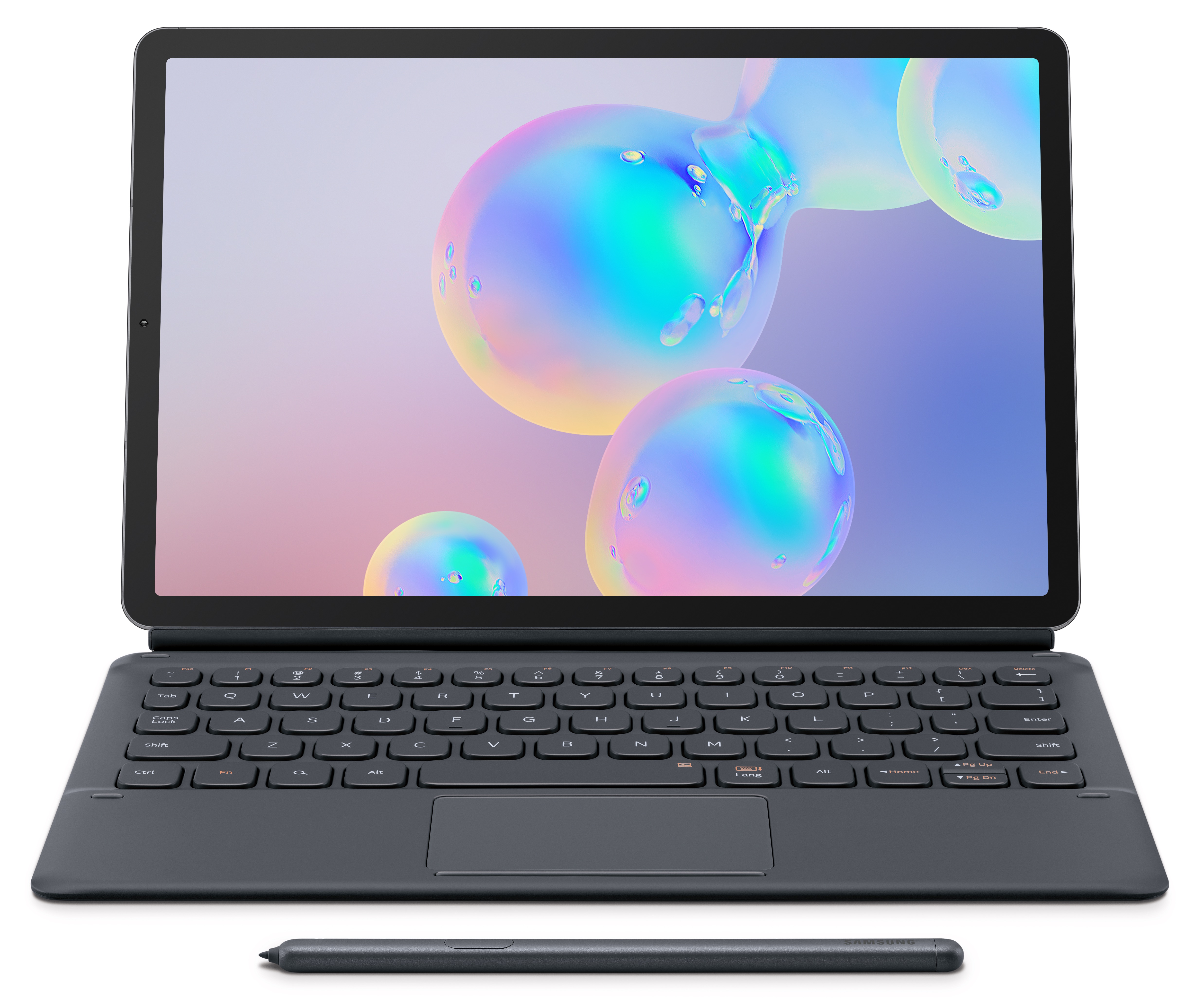
wifi sm t860 tab s 6 bk keyboard open s pen rgb

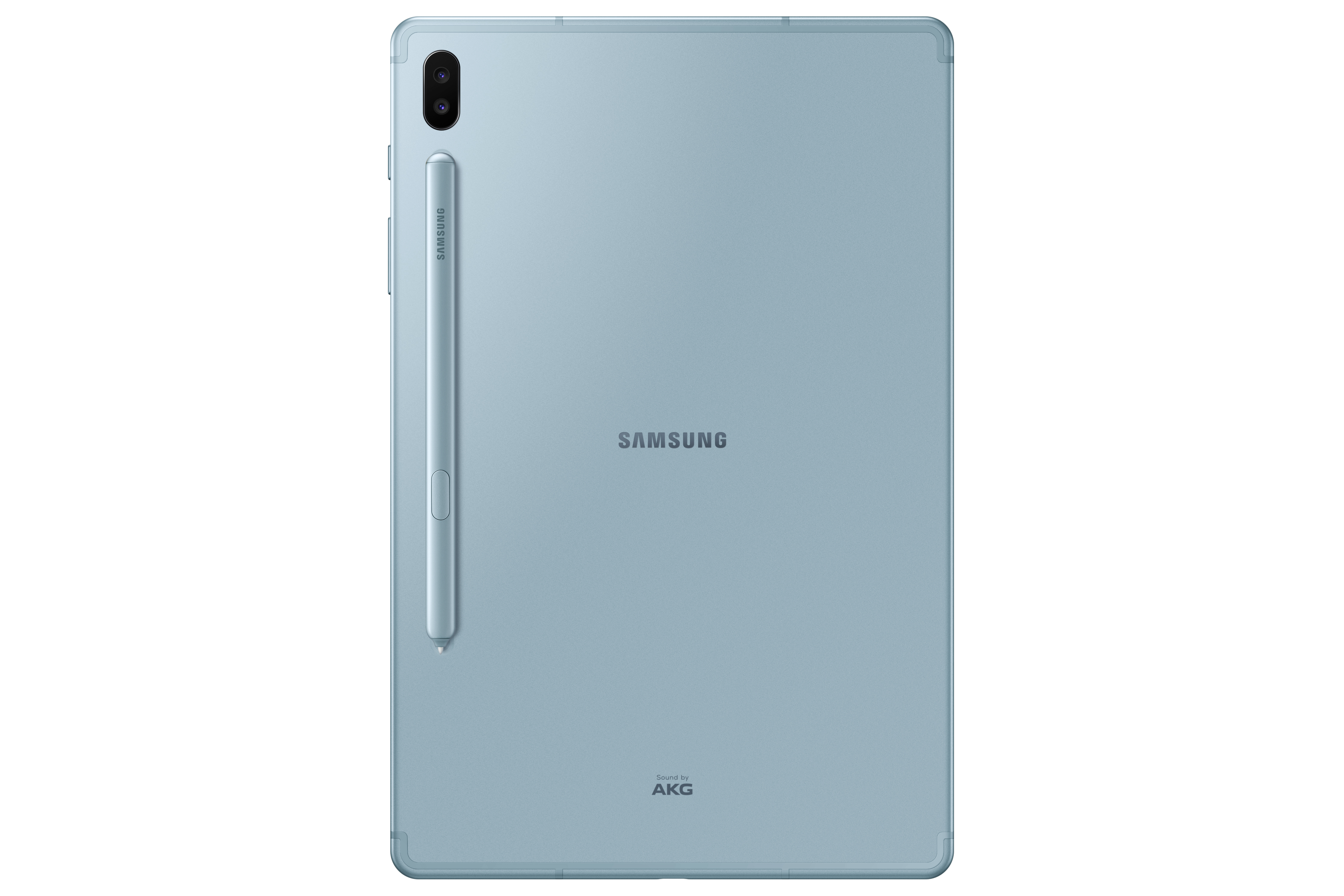
The S Pen comes standard — a nice touch, especially for the $649 price point. Mind you, that’s already a few hundred bucks cheaper than the entry level iPad Pro. The stylus charges wireless, attaching magnetically to the rear of the device, so you’re less likely to misplace it. And, more importantly, won’t accidentally break the whole thing by sticking it in backwards — truly the most humiliating of defeats.

The magnetic connection is pretty weak, compared to the iPad Pro’s sides. Though the new case has a clever concave slot for the S Pen, helping it stay in place while on. I also didn’t love the feel of the S4’s keyboard, so I’m happy to see what’s new there.

The S Pen does your standard array of stylus things, and as with the Note line, Samsung is working to make it more of a kitchen sink productivity accessory. That includes the ability to use it as a kind of bluetooth remote for advancing slide presentations and snapping videos and taking selfies. According to Samsung, people taking photos with tablets is very much a thing, and you might as well get used to it.

In fact, the rear camera actually gets an overhaul here. Samsung’s gone dual camera with a wide lens — noting that the S6 is its first tablet to offer that functionality. The wide angle lens offers a 123 degree angle — roughly the equivalent of what the human eye offers. As with other mobile devices from the company, AI is doing a lot of the heavy lifting to ensure you get better shots, offering scene optimization with the built-in Neural Processing Unit.

One thing the S6 offers that the iPad Pro (and for that matter, the iPhone) doesn’t is an on-screen fingerprint reader. It’s an optical scanner, however, instead of the ultrasonic offered on the Galaxy S10 (and, one assumes, the forthcoming Note 10). Samsung says the less advanced scanner was a matter of space issues — an odd concern, given the much larger real estate we’re dealing with here.

Product Image Galaxy Tab S6 4

Speaking of real estate, that’s a 10.5 inch Super AMOLED display and a fairly slim 5.7 millimeter body — thinner and lighter than the S4. The multimedia offering is filled out with a quartet of Dolby Atmos speakers tuned by Samsung’s own AKG.

Samsung continues to push DeX as a key part of its workflow. In fact, there’s now a DeX function key right on the case’s keyboard. DeX offers a more desktop like software experience on the table for improved multitasking. Now you can do stuff like opening multiple windows from the same app — bringing it more inline with what Apple is trying to do with iPadOS.

The company’s also partnered with Discord for an exclusive desktop Game Launcher — not doubt in a bid to offer something inline with Apple’s forthcoming Arcade. The Discord dealie is coming to Samsung tablets next month.

Preorders on the WiFi unit start August 23, starting at $649 for a unit with 6GB of RAM and 128GB of storage. Another $80 will get you a version with 8GB of RAM and double the storage. Early preorders will get the keyboard cover for half off when bundled with the tablet. There’s also an LTE model coming later this year.